Licensed under Creative Common Page 1
http://ijecm.co.uk/
ISSN 2348 0386
HOW BUSINESS ANALYTICS IS ADDING VALUE TO
BREAKTHROUGHS – A PAKISTANI PERSPECTIVE
Rana, Imran Ahmad
Quality Mgt Head, Treet Corporation Ltd., Pakistan [email protected]
Rehman, Sumaira
Business School, Superior University, Lahore, Pakistan
Rehman, Ch. Abdul
Superior University, Lahore, Pakistan
Abstract
The survival of organizations in the present time depends upon the frequency, height and
effectiveness of business breakthroughs and management of Innovation. Innovation can’t be
successfully introduced and never be sustained without managing & filtering the Information
flow on daily basis. Poor information flow/data management systems consume extensive
resources and waste energies of the management on tasks not required. Now business
analytics tools have been observed delivering right decision support to the right people at right
time for right markets. Managers in South Asia seems loosing the opportunity where by virtue of
their experience and new essential skills they can make significant contributions on uplifting
organizations from mediocre to high performing. Integrating Analytics across the organization
can flourish innovativeness because it has become unnecessary to just keep on knowing what
has happened and why it was so. Business leaders are in acute need of updating themselves
on what is happening at the moment, what’s likely to happen next and what actions should our
businesses take to get the optimal results. A qualitative study was conducted in Pakistan which
highlights that organizations are lagging behind and are hardly able to add value to their
products and services only due to miss management of information flow. The paper promotes
the integration of innovativeness with analytics for a prosperous corporate Pakistan.
Keywords: Business Analytics, Innovation, High performance, Daily analysis, Breakthrough
Licensed under Creative Common Page 2
INTRODUCTION
In the present time, organizations in South Asian region need to make radical change, or changes that can at least ensure their survival in this competitive, rapidly changing world. It was known, business leaders of the region are facing a core challenge i.e. where will be there organizations in the next two, three and five years from now and how they will reach there? Previously in the Asian region countries like Thailand, Korea, Taiwan and Malaysia had improved their organizations’ management system through implementation of ISO 9001 quality
system standards (Thomas, Shoji and Robert 1999). The standards were helpful enough to standardize the daily practices and systems in these countries. May studies has been conducted to find out the relationship between successful implementation of ISO standards, information analysis, firms’ performance, initial phase problems and maturity period benefits in
varied dimensions (Ali 2002, Rana 2009). Furthermore, it has also been argued by researchers that the key to survival in any sector is the fundamental change in an organization’s direction –
as a response to some abrupt and radical change in its market environment (Andrew 2010). This highlights the needs that organizations have to focus on market intelligence, it was observed that information is already available with the businesses but they lack the analytic maturity to explore the patterns hidden therein (Brodbeck et.al 2009).
In the present era, we are engulfed with tsunami of data and we keep on collecting it as long as we get the meaningful information. Every day we create, collect, store and retrieve massive data sets from emails, product /service records, performance specifications, competition and above all the customer feedback (Thomas 2010). One can define data as the qualitative or quantitative characteristic of an item or service delivered. This data is processed to get information which becomes knowledge. The past data when retrieved and processed to get insight for a competitive scenario, knowledge enhancement objective and to spur innovation using IT, mathematical modeling and statistical tools is known as “Business Analytics” (Efraim,
Jay, et. al 2002).
Thomas Davenport, Jean G. Harris has defined Business Analytics (BA) as using data, statistical, qualitative, quantitative analysis, predictive models and factual approach to decision making. The factual approach drives better planning and action (2010). This is not new to businesses but the real difference lies how, where and when to use what model. Business
analytics (BA) has been defined by Matthew & Thomas (2008) as Data access, reporting and
Licensed under Creative Common Page 3 widespread application of statistics and information technology to draw conclusion. In engineering or operations management we are using this to verify or disprove existing models or theories (Ohri Ajay2010).
Today’s business scenario in developing countries is very unpredictable, more complex
and uncertain than any time in recent years. Under the situation businesses in these countries are charged with responsibility to explore better ways to realize favorable outcomes, increase revenue while lowering costs and effectively manage the risks. During the recent past business intelligence earned a high value for making businesses successful but today’s competitive
environment has pushed these to a mandatory level for sustainability (Udo G et al. 2008). This has also been discussed by IBM Institute as the “New Normal” (IBM 2012). The study states;
due to the frequent, high paced, disruptive change and louder customer voices have changed the very basic and old established buyer and seller relationships. Now, apart from customers’
organizations must comply requirements of other stakeholders like regulators, registrar and governments where transparent transactions are included as mode of survival. These requirements often seem supporting each other and sometime conflicting. The phenomena demands a complete new set of business measurement and analysis where managers can get auto-feedback on the process performance as well as alerts on regulatory requirements’
deadlines or standards. Without that new systems business seems caught in unnecessary activities instead of utilizing time for more profitable avenues (Zairi 2009)
As far as the selection of this study is concerned, three major factors provide motivation to conduct research on the topic. Firstly, to-date there is no existing theoretical model or explanation on how business analytics is directly associated with innovation and competitive edge. Development of some theoretical model /framework will be quite helpful for business professionals, academicians and researchers who are engaged with BA. Secondly, researches conducted so far on the subject are of quantitative nature utilizing RBV (Pavlou and El Sawy 2006). In contrast, author has proposed a qualitative research that give emphasis to the challenges and action based views of corporate managers (Sambamurthy et al. 2003; Shanks and Sharma 2011). This will describe why actions were required, how these actions guide on changes for innovation in operational capabilities of an organization. Thirdly, technology is changing very fast and businesses are deploying the same to get early benefits but in many cases the relation of adopted technology is not known to a specific business domain (Satya 2012). Use of Analytics is growing very fast in industry a model will be developed that will help organizations to draw relationship between various BA tools, Innovation and firm performance.
Licensed under Creative Common Page 4 add to strategic management and decision making literature with an evolutionary perspective toward transformation of operational capabilities. Due to several underlying reasons it will be worthwhile knowing how BA systems lead to organizational innovation (Zairi 2013). Firstly, many firms are investing on BA systems to see breakthrough improvements in performance. Secondly, as per Gartner’s 2008 study conducted in Asia Pacific, business intelligence applications’ are among the key priority items & a high usage of information and analytics (8th
important business priority for Chief Information Officers). Thirdly, even a lot is known about how companywide information systems bring value to organizations (Gattiker and Goodhue 2005; Seddon et al. 2010) but this is not true for BA systems because value provided by companywide information systems is just at company level using manual approaches depending upon process standardization and optimization tools. Contrary to this, the value from BA systems is accessible companywide which is evolutionary in nature but improvement depends on timely access and business analytics application capability (Sarita 2013).
Purpose of the Study
To date no qualitative or even quantitative study has been conducted in Pakistan that can narrate direct opinions of professionals as well as find if there is any linkage among business analytics and business breakthrough innovation.
Presently, objective of top and middle management in high performing organizations is on whether organization is getting full use of data being collected from all operations from supplier capability analysis to customer satisfaction and competition. Senior leader most importantly seeks information on competition. That covers how they are accessing the insights on changing customer and market behaviors, how they are reaching on cutting edge insights? (Grove 2010) What’s their focus on the expenses while providing quality products. How new
technology introduction will be taken by their customers and technology will reshape the relations. It has become unnecessary to just keep on knowing what has happened and why it was so. Business leaders are in acute need of updating themselves on what is happening at the moment, what’s likely to happen next and what actions should businesses take to get the
Licensed under Creative Common Page 5
Research Questions & Research Gap
1- How firms Exploit Data and information through analytics supported by new technology to improve quality, introduce new products and customer value?
2- How Information Analysis, Decision Support and Breakthrough Management are linked together and may help propose a model or structure for integrating information analysis into decision making to nurture breakthrough innovation?
3- How information analytics is Reshaping the Way business organizations operate?
4- How (externally) Customers are more Integrated into value creation and needs determination through proactive means?
5- How value chain analysis is viewed by staff to deliver high performance in speed, quality, reliability etc by way of information analytics.
Study has been conducted through observing organizations cases, managers’ opinion, daily
experiences with reference to business analysis and their link with research questions. This has helped identify following major gaps which provide enough satisfaction and encourage researcher to work on the proposal.
To bring breakthrough innovations, a company’s members must learn to continually
upgrade their ways of leading the business, routine working and thinking through measurement and analysis. They must learn to regularly tap the vast creative potential of everyone in their group (Zeisler 2003).
The above task can’t be accomplished in the absence of a good daily information
Licensed under Creative Common Page 6 Customer requirements and expectations, market conditions and information communication channels are getting new shapes. So, currently there is dearth of serious knowledge which connects together the daily and breakthrough management to seek answers to these challenges. The task of investigating and codifying methods of management in the context of new common elements of business will be an important realm of future study (Shoji Shiba, David Walden 2007).
Beside that Six Sigma is also being considered as a mechanism to introduce breakthrough improvements and add to performance results of companies. Researchers agrees that six sigma although being a tool for breakthrough will be less effective , waste resources of an organization and even riskier one in the absence of good information management systems. One of these systems, which is known as daily management, is needed to support the daily work by identifying, prioritizing, and assigning resources to continuously improve the process within a team-based framework (Steven, Michael 2002).
Therefore, researchers today are of the view we should focus researches in areas where big management disciplines like business excellence, six sigma and breakthrough management rely on managing the information in a daily fashion. Moreover, how unique their business information and intelligent systems are (Provost 2013). Therefore, it is important to explore the significant similarities between these disciplines w.r.t. Daily business analytics through a unique model to improve management systems, make businesses and employee prosperous. It has also provide insight that previously the relation of business analytics tools and performance management exist but while reviewing the literature no evidence was found on the relations of analytics tools and organizational breakthrough innovation.
LITERATURE REVIEW
In this study to distinguish between various trends in Business Analytics and Breakthrough Innovation related literature from the last 15 years (1998–2013) was collected from various
digital sources, reputed journals, magazines, white papers and valid industry report.
In order to ensure consistency in data and to maintain relevance throughout the collection process , I have searched only the publications that contained the keywords analytics,
business analytics, innovation, performance within their title, abstract, or indexing. The choice of
Licensed under Creative Common Page 7 Studies confirm the strong relationship between the innovations and firms’ operating profit
margin. Geroski et al. (1993). Study further explored that innovative firms are more profitable than non-innovative firms. In 1998 a study conducted by Han et al. (1998) empirically tested relationship among market orientation, innovation and firms’ performance in US finance
industry. This study describes that administrative and technical innovativeness of a company had positive impact on its performance. This has also been verified through product innovativeness effects on its profit sustainability of firms in U.S. pharmaceutical sector (Roberts 1999). Furthermore, expected relationship of services or product innovation tendency and high profitability was also supported through the study. A framework was developed by the Calantone et al. (2002) to explore relationship between innovativeness and firms performance in the U.S. manufacturing & service entities. Like above mentioned studies, this one also highlights that firm innovativeness is strongly correlated with firm performance. The relation between organizational innovation, quality, growth, profitability and market value was also examined by Cho and Pucik (2005) by use of structural equation at U.S. finance industry. This study shows that innovativeness mediates the relationship between quality and growth, quality mediates the relationship between innovativeness and profitability.
Han, Kim and Srivastava has described a positive link innovation and a firm’s performance (1998). Outcomes of their work highlights that innovation is positively related to performance outcomes. Furthermore, it also highlights the strong positive relation of innovation with efficiency related gains in a firm but it also shows a weak relationship with financial performance.
As the core purpose of Business Analytics tools and techniques is to promote the need for companywide communication on key deliverables which are being used by other units. Communication through BA tools facilitates the dissemination of timely and needed information across the company. This in turn promotes increased information exchange and diversity of ideas created within an organization (Ahuja 2000).
Licensed under Creative Common Page 8 sound theoretical basis for understanding of how this value linked to innovation which ensures future growth.
Carla O Dell in 2012 described the knowledge creation and link of business analytics. She informed that currently Social media and mobile devices are redefining the way work was being done in past. Performance measurement and reporting has become more sophisticated. ICT to capture Knowledge will develop interest and new type of conversations with business leaders. Use of communication technologies where providing insight for quick decision making will also be helpful in knowing how knowledge management by way of analytics is making a great difference to solve problems and innovate systems (Sergey 2011, Harindranath 2008).
Therefore, above studies have been helpful to let us know the relationship of Innovation to High performance and in turn know high performance relationship with business Analytics tools. Thus it can be easily drawn from above review that business Analytics indirectly helping spur breakthrough innovation in organizations of all size and type. Whether BA directly link with innovativeness is a case yet to be established through this study.
THEORETICAL FRAMEWORK
Given above relation of Business Analytics with organizations’ performance and innovation
require a theoretical framework which can help explore business analytics in an entire new dimension i.e. innovation (Han JK, Kim N. et. al 1998). As discussed relation of business analytics with improved or high firm performance has been validated by above studies likewise it has also been confirmed through literature review that improved firm performance has strong positive relation with innovativeness of the company. The direct relation of business analytics with breakthrough innovation has not been studied yet (Pankaj 2011, Watson J2007). The research study require to develop a theoretical framework that may add to the exiting body of knowledge as well as strengthen the existing business analytics , performance management and breakthrough theories (Ali Sajid 2011, Zairi 2009).
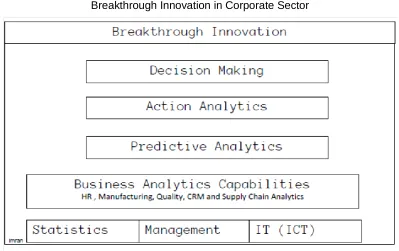
The following theoretical framework has been proposed. The purpose is how we can position analytics, firms’ performance and breakthrough in corporate/industrial sector
(Davenport and Harris 2007). It will support professionals, researchers and academicians with their varied performance analysis requirements at required organizational levels. In corporate sector professionals come across with different sets of analytics to perform several tasks.
Licensed under Creative Common Page 9 Figure 1 Theoretical Framework Business Analytics for
Breakthrough Innovation in Corporate Sector
a. Analytics: This has been defined by Watson (2007) as a concept that is encompassing
data-driven decision making. This description of the analytics remains same whether one is working in industrial, banking, healthcare, education or general customer services. In this study it will be explored what tools can be effectively used to drive high performance as well as Innovation.
b. Business Analytics: Business analytics allows floor, divisional management and senior executives to set and access the performance indicators through purpose built information dashboards—of how the business in totality and its various units (HR,
Quality, Manufacturing, Sales, Marketing etc.) are performing (IBM 2012). In the study the coordinated work arranged by management on Statistics and IT will be assessed which enable professionals as well as experts to develop customized BA application or select readymade solutions from a broader list. Previous studies as discussed above has proved the benefits that professionals can get from BA. The benefits include value, skill, behavioral and perceptual indicators (Wheeler 2002). Typical BA measures include increased revenue, decreased operational costs, increased customer loyalty and satisfaction, more efficient processes and reduced inventory (Carte et al. 2005; Davenport and Harris 2007; Piccoli and Watson 2008). Increased competitive
Licensed under Creative Common Page 10 industry sector, is a possible benefit (Davenport and Harris 2007). Finally on innovation, revenues from new and modified products and services are other possible benefit firms can witness from (Aral and Weill 2007). Specific measures will depend on the nature of the business analytics-driven initiatives undertaken within the organization.
c. Predictive Analytics: This performs the role of connector between data, intelligent action which is guided by analysis of same data and these lead to informed decision making (Gaurav2013). The Predictive analytics process serves all the operations of a business. There is dire need that manufacturing and quality now must move from the traditional reporting system to take insight (Michael Hopkins 2010). The focus of the study will be to know how and when to use predictive analytics.
Action analytics provide opportunities to businesses on aligning their corporate strategic goals with daily performance measures for better decision making. This can be deployed in targeted areas and can be expanded across emerging needs of a business (Donald Norris, Linda Baer et.all 2008).
d. Organizational Culture: Impact of organizational culture will also be studied in the research. As in organizations which are using any kind of BA tool , executives are charged with the responsibility to make fact based decisions. These professional will be helpful in creating such culture which can facilitate performance measurement through identification of key deliverables at all levels and functions.
RESEARCH METHODOLOGY
Purposive sampling method was utilized for informant selection. The technique is being widely used in research to facilitate deliberate selection of participants in a qualitative study (Bernard 2010). As the research objectives were already known, so, this tool helped selecting the informants who can share their knowledge and specific business analysis experience and firms’
innovativeness. In qualitative research there are no fix and defined rules for sample size (Baum 2002, Patton2002), in most of the cases it is connected with how much detail and depth is required by study objectives (Miles & Huberman 1994; Patton 2002). So, sample was taken on the basis of continuous data comparison and richness around specific phenomenon instead of random sampling (Ezzy 2002).
Licensed under Creative Common Page 11 and opinions through valid documents like independent reports on firm performance, newsletter, industry analysis and reviews by top management (Riessman, C. K. 2002). Interviewees were selected from ERP user firms’ professionals. It was ensured that the respondent must have at
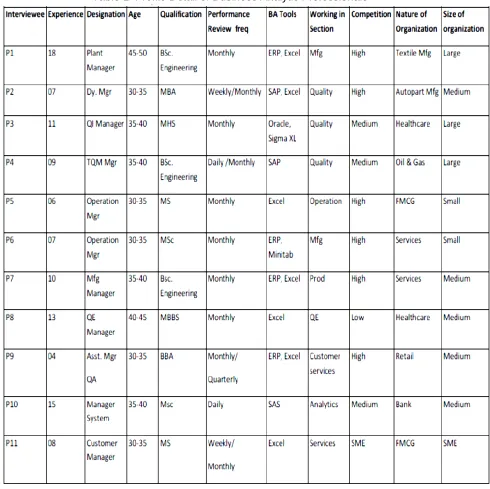
least 4-5 years experience in the field of business analytics or simply the business analysis. Table-1 highlights the characteristics of the participants. Each interview lasted between 35 – 50
minutes. These were then transcribed, coded and analyzed to derive key phenomenological themes. The themes were then incorporated into findings and results. Special care was taken that interviewees and their organizations would not be identifiable at any stage of the research.
Moreover, data triangulation was used to overcome the validity issues and draw logical themes from data (Creswell 2007). Therefore, three sources of qualitative data collection were employed i.e., interviews, observation and document review (Merriam 2009). As the interviews were performed during normal work settings so, the whole process was also observed in terms of behavior, artifacts, gestures on the certain questions in the work setting chosen for study. The interviews were being recorded in parallel through video recording equipment with advance permission of interviewee (Creswell 2002).
The rationale behind selecting the semi structured interviewee method was to know at length about business analytics and its relationship with high performance and innovation in major areas of a business entity. Interview method was used effectively in conjunction with observation and document review to explore the hidden, unknown patterns about the field (Flick, U., Von Kardorff, et.all 2004).
In this paper phenomenological approach was used in conjunction with thematic analysis. This bilateral approach has served the study purpose to analyze themes that are based on specific experiences and feelings of selected individuals. Why phenomenology approach was mixed with thematic analysis in study; reason being that employees working in automated analytic environments have different experiences, perceptions than people working in organizations relying on manual analysis and reports. Moreover the ERP tools, implementation and professionals’ experiences also vary from company to company (Li Fang &
Sylvia Patricia 2005). A manager who started his job in a company which has implemented its business analytics application several years ago will have different feeling than those who moved from manual analysis to automated one.
This phenomenon based work can’t be only served through thematic approach alone.
Licensed under Creative Common Page 12 themes from large sets of transcriptions. This approach offered to highlight similar and varied themes across same question (see table 02). Researcher has extended the sample until nothing new was heard from participants (Patton 2002; Ezzy 2002; Higginbotham et al. 2001).
The emerging themes were carefully combined and categorized into related patterns to give meaning to fragmented ideas, views, and experiences of professionals (Leininger, 1985, p. 60). This piecing together has facilitated the study to portray comprehensive picture of collective experiences (Leininger, 1985). The emerging link of Business Analytics with Business breakthroughs was highly visible. Then transcribe conversations and these collected themes were sent to informants for their feedback and verification.
FINDINGS
11 professionals were interviewed to know the first hand information on the usage, benefits, barriers and learning took place in organizations since implementation of some analytics application. Semi structured interview guide, document review, observation methods and experience of researcher ensured the data saturation as per research objectives (Russell Bernard and Gery W. Ryan 2010). Professionals were also asked to briefly elaborate on their previous/existing manual business analysis experience as compared with automated information available since its implementation. Professionals from organizations who are not using any sort of analytics application were also interviewed to know their work experience, pace of development and satisfaction with existing system (Thomas McCarty, Praveen 2004).
An interviewee (P2-table01) working in the manufacturing section said that application is in process for the last 4-5 years. He talking on the benefits of business analytics informed;
“We have recently developed performance metrics to accurately gauge
effectiveness of analytics tools. Starting from Cycle time to information (CTI)
metric which measures the time taken from occurrence of technical problem to
identification of its root causes and recommendation provided by the system for
appropriate action. Then Cycle time to action (CTA) metric is a metric which help
us measure the time passed between information available to a manager and
action taken. These metrics have really helped us to know efficiency and
comparison of the managers on critical problems and their solution. ”
Licensed under Creative Common Page 13 innovation introduced by staff based on this data to facilitate the shoppers (Davenport2010). The manager informed us;
“Business Performance is dependent upon the ever better and timely decisions.
Some time back, we has not even imagining this data can be analyzed for our
good. We have used the simple analysis of shoppers’ behaviors on particular
days in a week. We are stacking the products and filling our racks as per the
information gained from analytics tools. What items should be kept parallel to
each other. On the basis of this identified requirement our staff was able to
design a unique rack style for attractiveness. This has been copied with our
permission by a nearby store. ”
The study was also expanded to know the benefits of business analytics in healthcare. In healthcare field the application of automated system to improve information flow and serve patients is known as “ Healthcare Informatics” (Carte, T., Schwarzkopf 2005). Interview with an
experienced healthcare executive (P3) from a reputed health entity of the country was arranged. He informed us;
“The organization is employing the use of informatics in almost every related field
from patient registration to discharge from hospital and routine visits. Informatics
has not only provided us with paperless medical records but also facilitated
across expedited diagnosis, course of treatment and dietary plans all are
integrated in the application. We are using this in professional competence
evaluation as well. What we are taking from the system have much worth than
our investment”.
He further narrated that;
“There is wide gap in Pakistan in this field as compare with neighboring
countries. We can use technology to deal with local health problems and achieve
better health outcomes. Bangladesh has deployed the technology to
electronically register births and issue e-identification cards which facilitate in
immunization and school admissions. India is ahead in this field where many
private hospitals are making use of innovative technology to improve healthcare
system”.
Licensed under Creative Common Page 14 services industry (P6) informed creation of advance knowledge about the customer processes was observed after implementation of analytic application which proved helpful in opening up the gateway to innovation (Sergey 2011):
“Although we were having some information through old way but how to convert
the information into knowledge and how to access this in the event of problem
was not known. In services area, it is very crucial and you are forced to solve
issues in a limited time. Knowledge about the previous transactions and
recommending the newly developed services is the key to success of our
business. So, developed knowledge is being used in many different and creative
ways in right direction. It has helped us how on ...how to open up possibilities,
how to open up other alternatives?”
One participant (P7) working in a services sector while discussing; how analytics is introducing breakthrough innovations in our organization informed;
“The analytics applications need to be deployed by organizations. This facilitate
on unleashing the performance and potential of each and every staff member. In
this way, we had obtained competitive advantage by being more aware of and
timely responding to the market changes with our customized services. Our
employees are the major ingredient to inculcate an innovative culture. HR
analytics by …. vendor has really provided us value able insights on the
employee performance, their suggestions, innovation and improvements brought
in by each one.”
Collective opinions of participants for a few categories viz. a. viz challenges they had and are facing are given in table 02.
Current State of Business Analytics in Pakistan Pacific
BA tools and their positive impact on organizational performance has been realized by large companies, but in mid and small sized firms it’s still in infancy. The decision makers and
Licensed under Creative Common Page 15
- This has introduced companywide improvements in quality, productivity and in turn our
profit raised (P10)
- Now our data is more visible than before on key business dimensions (P1)
- This has enhanced analysis capabilities of our team (P11) with abilities in measuring,
monitoring, analyzing process performance and predicting outcomes.
- Facilitate decision makers across operations in fields to explore available data from
different wells in various angles(P4)
As discussed above the major force hindering organization in adopting business analytics tools is a faulty perception as applications are very expensive for small to mid size firms. Actually, professionals are unable to put in their effort to convenience top management that BA gains much higher than firms’ investments (Imran 2009).
Customer Services Manager of another SME manufacturing company (P5) discussed this as;
“BA is a good method to drive high performance, as I observed in other small
organizations. But for me this involves extra costs to make it work adequately,
and it’s not what we can achieve easily. I fear my current staff will not be able to deal with it as required so, I have never think having that”.
Executive Director of a public sector healthcare organization in Pakistan (P8) stressed on the need, analytics tools and techniques should be deployed by government’s healthcare
institutions. He was of the view;
“In a previous organization, I have witnessed application on not only decreasing
cycle time to treat patients but also reduced the cost which here in current
organization being incurred in collecting information again and again for the
same patient due to manual file handling. There we were very conveniently
getting and retrieving the case specific information and course of treatment but I
have found the gap in my current role and my department has to rely on lot of
manual work , this time can be saved to focus on other value added activities”.
While talking to a senior banker of renowned private sector’s medium size bank (P10) it was
known;
“Bank was managing its risk somewhat separately from its business line from
years. Upon integrating analytics tool into SOPs to better manage enterprise risk
Licensed under Creative Common Page 16
reduce financial costs and innovative offering to customers. The approach
facilitated bank on winning ‘Bank of the Year …… Pakistan’ by the International Publication ‘The Banker’ in …….”
Current state of Analytics in HR functions
While talking on knowledge management, It was known HR professionals of surveyed organizations were in a fix on whether they are looking onto the whole scenarios of competence, trainings, compensation or just a part of each (Center AHR Studies at Cornell University 2010). Interviewees further elaborated (P2, P3, P4, P6,P9,P10); they thoroughly discussed how they were using their data to look deeper inside an issue and its communication to concerned rather preparing and sending the traditional reports that were seldom read. Organizations found solving their HRD issues through HR Analytics under ERP umbrella. It was informed that there is a dearth of qualified Business Analytics trainers and implementers in country. This is a major reason in failure or delayed or minimal outcomes from BA projects in the region. The trainers and consultants who are engaged to implement a certain system have direct relation with its successful, failure and employee’s motivation on the same (Li Fang2005,
Ali Sajid 2002, Seddon P.2010). This paper make researcher aware of analytics worth at HR to understand some hard concepts and their practical links, such as relationships between HR drivers and key outcomes, as well as how employee skills, capabilities, satisfaction and motivations’ are linked with business outcomes that are hard to quantify otherwise.
The Future of Business Analytics
Licensed under Creative Common Page 17 Table 1 Profile Detail of Business Analytic Professionals
Licensed under Creative Common Page 18 Table 2 Collective Themes Carefully Categorized by Researcher
with their Linkage to Research Questions
CONCLUSION
The study has helped on adding to existing theory of business analytics and its relation with high performance which in some extent was already there. The important theoretical contribution was to know how business analytics and innovation are interwoven. Moreover, research has also explored how knowledge can be automatically created, stored, retrieved in event of possible use. This characteristic found useful by professionals. Professionals in BA environments are easily distinguishing among the required and redundant knowledge.
Licensed under Creative Common Page 19 gauge the relationship (if any) exists between them. Moreover, as discussed it will help professionals in timely finding solution to operational problems. With application of analytics tools Professionals will be able to measure performance for required period. The application is also adding to improvement suggestions from employee and it was known this has enhanced suggestions per employee per year.
LIMITATIONS & SCOPE FOR FURTHER RESEARCH
The study has a few limitations which can be overcome in future studies. Firstly, the data was of one region which may not be able to prove the findings in some other phenomena. So it is suggested future studies be conducted with more data in other regions of Asia or world. Secondly, the study was conducted in three major cities of Pakistan (Lahore, Karachi, and Islamabad) using purposive sampling approach from almost all major areas of business i.e. manufacturing, banking, healthcare and retailing. So, we may not have been reached to a few more professionals who are working in the field since long or doing this in some better way. So, studies should be conducted to test this in a single business arena (e.g. healthcare, retail etc.) or other countries of the region.
REFERENCES
Ahuja G. 2000. Collaboration Networks, Structural Holes, and Innovation: A Longitudinal Study. Administrative Science Quarterly 45(September): 425-455
Ali, Sajid Dr. “Customer Focus and our organizations” 12th
International Convention on Quality Improvement (ICQI 2011) – PIQC Institute of Quality, Lahore-Pakistan
Ali, Sajid Dr. Competitiveness and Innovation – Ignored Issues in Pakistani Industry. 7th International Convention on Quality Improvement (ICQI 2002) – PIQC Institute of Quality
Ando, Yokihiro and Pankaj Kumar , “Daily Management – the TQM way at Tata” Productivity and Quality Publishing, 2010 , India.
Andrew S. Grove, Only the Paranoid Survive: How to Exploit the Crisis Points That Challenge Every Company, Crown Publishing Group, 2010.
Brodbeck, Angela Freitag; Rigoni, Eduardo Henrique; Hoppen, Norberto “Strategic Alignment Maturity between Business and Information Technology in Southern Brazil”.Journal of Global Information Technology Management . 2009, Vol. 12 Issue 2, p5-32. 28p.
Carla O Dell (2012) 'Knowledge Analytics – A Fresh Way of Thinking about Old Problems', APQC Annual Conference 2012.
Carte, T., Schwarzkopf, A., Shaft, T. and Zmud, R. 2005. “Advanced Business Intelligence at Cardinal Health,” MIS Quarterly Executive (4:4), pp 13-424.
Chen, H. 2011a. “Design Science, Grand Challenges, and Societal Impacts,” ACM Transactions on Management Information Systems (2:1), pp. 1:1-1:10.
Creswell, JW. (1998). Qualitative Inquiry and Research Design Choosing Among Five Traditions. Thousand Oaks, CA: Sage Publications.
Licensed under Creative Common Page 20 Donald Norris, Linda Baer et. all 2008 “Action Analytics” , EDUCAUSE Review Jan-Feb 2008 , pp. 43-67. Efraim Turban, Jay E. Aronson, Ting-Peng Liang, Ramesh Sharda (2006) “Decision Support and Business Intelligence Systems” Prentice Hall; 8th
Ed. 2006.
Ellis, K. 2009. Business Analysis Benchmark 2009: The Pass to Success. IAG Consulting. Ezzy D (2002) Qualitative Analysis: Practice and Innovation. Crows Nest, NSW:Allen & Unwin.
Flick, U., Von Kardorff, E., and Steinke, I. (2004) 'A companion to qualitative research', Sage Publications Ltd.
Foster Provost, Tom Fawcett “Data Science for Business: What you need to know about data mining and data-analytic thinking” O'Reilly Media 2013.
Gartner 2008. “Australian and New Zealand CIOs Expect Lower Than Average IT Budget Growth in 2008,” Retrieved 15 January, 2009, from http://www.gartner.com/it/page.jsp?id=606007.
Gattiker, T. and Goodhue, D. 2005. “What Happens After ERP Implementation: How Interdependence and Differentiation Affect Plant Level Outcomes,” MIS Quarterly (29:3), pp 561-587.
Glaser B (1999) The future of grounded theory. Qualitative Health Research. 9,6,836-845. Retrieved November 11, 2002, from ProQuest database.
Greg H Watson “Understanding Hoshin Kanri – an Introduction” JSQC Journal Vol XV Issue 03, 2002.
H. Russell Bernard and Gery W. Ryan (2010). Analyzing Qualitative Data: Systematic Approaches. Newbury Park, CA: Sage Publications.
Hamm, S. 2009. IBM Roars into Business Consulting. Business Week Online.
Han JK, Kim N, Srivastava RJ. 1998. Market Orientation and Organization Performance: Is Innovation a Missing Link? Journal of Marketing 62(4): 30-45.
Harindranath, G. “ICT in a Transition economy: The case of Hungary” Journal of Global Information Technology Management, Vol. 11, No. 4, 2008, p. 33-55.
Higginbotham N et al. (2001) Health Social Science: A Transdisciplinary andComplexity Perspective. Oxford: Oxford University Press.
Kohavi, R., Rothleder, N., and Simoudis, E. 2002. “Emerging Trends in Business Analytics,” Communications of the ACM (45:8), pp 45-48.
Leininger, M. M. (1985). Ethnography and ethnonursing: Models and modes of qualitative data analysis. In M. M. Leininger (Ed.), Qualitative research methods in nursing (pp. 33-72). Orlando, FL: Grune & Stratton.
Li Fang & Sylvia Patrecia 2005 “Critical Success Factors in ERP implementation “ Jonkoping International Business School, Jonkoping University.
Matthew J. Liberatore & Thomas Coghlanto “ Introduction to Business Analytics” (2008), Chapter 3.
Merriam, Sharan B. (2009). Qualitative Research: A Guide to Design and Implementation
Mid-Market Cloud Computing and Business Analytics Survey: Adoption among content users of Inc. and The Build Network, prepared by Inc. Research exclusively for IBM, October 2012
Miles M, Huberman A (1994) An Expanded Source Book: Qualitative DataAnalysis. (2nd ed.). London: Sage.
Mohamed Zairi “Distinctive Capability (Excellence Tetralogy)” European Centre for Best Practice Management 2009
Ohri A. (2013) “Analytics with R” Analytics India – Bhas Gupta Publication 2013
Patton M (2002) Qualitative Evaluation and Research Methods. London: Sage.
Licensed under Creative Common Page 21 Rana, Imran Ahmad. Breakthrough Management in Pakistan, ANQ 8th International Conference on Quality for Inclusive growth of Asia, (ANQ 2010) New Delhi-India
Rana, Imran Ahmad. Daily Management to Breakthrough Management – a Competitive Panacea, 2nd ANQ Regional Conference , 12th ICQI - PIQC Institute for Quality, (ANQ 2011) Lahore, Pakistan
Rana Imran Ahmad, Ch. Abdul Rehman (2014). “Past Present and Future of Business Analytics – A review” International Journal of Management Sciences and Business Research Vol III, Issue 8
Reconceptualising the Role of Information Technology in Contemporary Firms,” MIS Quarterly (27:2), pp 237-263.
Riessman, C. K. (2002). Analysis of Personal Narratives. In J. F. Gubrium &J. A. Holstein (Eds.), Handbook of Interview Research (pp. 695–710). ThousandOaks, CA: Sage
Robin Mann, “Business Excellence Model and their performance in selected Asian countries” APO Research 2010, Tokyo.
Sambamurthy, V., Bharadwaj, A., and Grover, V. 2003. “Shaping Agility through Digital Options:San Francisco, Calif.: Jossey-Bass Publishers.
Satya Prakash Saraswat, “A Phenomenological Investigation of Information and Communications Technology at a Multinational Enterprise From India” Journal of Global Information Technology Management, Vol. 15, No. 4, 2012.
Seddon, P., Calvert, C. and Yang, S. 2010. “A Multi-Project Model of Key Factors Affecting Organizational Benefits from Enterprise Systems,” MIS Quarterly (32: 2), pp 305-328
Sergey Samoilenko, Ojelanki Ngwenyama “Understanding the Human Capital dimension of ICT and Economic Growth in Transition Economies” Journal of Global Information Technology Management 01/2011; 14(1):59-69.
Shanks, Graeme; Bekmamedov, Nargiza; and Sharma, Rajeev, "Creating Value from Business Analytics Systems: A Process-oriented Theoretical Framework and Case Study" (2011). ACIS 2011 Proceedings. Paper 67. http://aisel.aisnet.org/acis2011/67
Shiba, Shoji and David Walden. Breakthrough Management. Confederation of Indian Industry (CII) 2007.
Steven M. Ouellette, Michael V. Petrovich 2002 “Key to Success to a Changing Environment” JPM 2002 pp. 121- 129)
Subramanian, Ramesh“India and Information Technology: A Historical & Critical Perspective” Journal of Global Information Technology Management . 2006, Vol. 9 Issue 4, p28-46. 19p.
Thomas H. Davenport, Jeane G. Harris and Robert Morrison “ Analytics at Work – Smarter Solutions Better Results” (Boston: Harvard Business School Press 2010), 1-17.
Thomas H. Lee, Shoji Shiba, Robert Chapman Wood “Integrated Management Systems: A Practical Approach to Transforming Organizations” Wiley 1999.
Tushman, Michael L., and Charles A. O’Reilly III.Winning through Innovation. Boston: Harvard Business School Press, 2002
Udo,G., Bagchi, K. and Kirs, P. (2008), "Diffusion of ICT in Developing Countries: A Qualitative Differential Analysis of Four Nations," Journal of Global Information Technology Management, Vol. 11, No. 1, pp. 6 – 27.
Williams, S. and Williams, N. 2006. The Profit Impact of Business Intelligence. Morgan Kaufmann.