R E S E A R C H
Open Access
Why do they die? Comparison of selected aspects
of organ injury and dysfunction in mice surviving
and dying in acute abdominal sepsis
Susanne Drechsler
1†, Katrin M Weixelbaumer
1,4†, Adelheid Weidinger
1, Pierre Raeven
1,2, Anna Khadem
1,
Heinz Redl
1, Martijn van Griensven
1,5, Soheyl Bahrami
1, Daniel Remick
3, Andrey Kozlov
1and Marcin F Osuchowski
1** Correspondence:
[email protected] †Equal contributors
1
Ludwig Boltzmann Institute for Experimental and Clinical Traumatology, Trauma Research Center of AUVA,
Donaueschingenstrasse 13, Vienna, 1200, Austria
Full list of author information is available at the end of the article
Abstract
Background:The mechanisms of sepsis mortality remain undefined. While there is some evidence of organ damage, it is not clear whether this damage alone is sufficient to cause death. Therefore, we aimed to examine contribution of organ injury/dysfunction to early deaths in the mouse abdominal sepsis.
Methods:Female OF-1 mice underwent either medium-severity cecal ligation and puncture (CLP-Only) or non-lethal CLP-ODam (CLP with cisplatin/carbontetrachloride to induce survivable hepatotoxicity and nephrotoxicity). In the first experiment, blood was collected daily from survivors (SUR; CLP-Only and CLP-ODam groups) or until early death (DIED; CLP-Only). In the second experiment (CLP-Only), early outcome was prospectively predicted based on body temperature (BT) and pairs of mice predicted to survive (P-SUR) and die (P-DIE) were sacrificed post-CLP. The overall magnitude of organ injury/dysfunction was compared in retrospectively and prospectively stratified mice.
Results:At day 7 post-CLP, survival in CLP-Only was 48%, while CLP-ODam was non-lethal. In CLP-Only mice within 24 h of death, urea increased to 78 (versus 40 mg/dl in SUR), ALT to 166 (vs. 108 U/l), LDH to 739 (vs. 438 U/l) and glucose declined to 43 (vs. 62 mg/dl). In CLP-ODam, hypoglycemia was exacerbated (by 1.5-fold) and ALT and LDH were 20- and 8-fold higher versus DIED (CLP-Only) mice. In CLP-Only, predicted deaths (P-DIE) were preceded by a significant rise only in cystatin C (268 vs. 170 ng/ml in P-SUR) but not in creatinine and troponin I. Respiratory function of mitochondria in the liver and kidney of P-SUR and P-DIE CLP-Only mice was not impaired (vs. controls) and ATP level in organs remained similar among all groups. Histologic injury scores in the liver, kidney, heart and lung showed no major disparities among dying, surviving and control mice.
Conclusions:In CLP-Only mice, although the deregulation of parameters indicative of organ injury/dysfunction was greater in dying versus surviving mice, it never exceeded the changes in surviving CLP-ODam animals, and it was not followed by histopathological damage and/or mitochondrial dysfunction. This shows that interpretation of the contribution of the organ injury/dysfunction to early deaths in the CLP model is not straightforward and depends on the pathophysiological origin of the profiled disturbances.
Keywords:Inflammation; Survival; Outcome prediction; Body temperature; Organ failure
Background
Sepsis syndromes belong to the most challenging conditions in contemporary critical care. In young immuno-competent subjects, sepsis onset is typically associated with hyperinflammation reflected by a strong and simultaneous release of pro- and anti-inflammatory mediators in the blood [1]. In contrast, in immune-compromised pa-tients, e.g., older, with comorbidities and/or after major trauma, the ‘cytokine storm’ is frequently replaced by a severe immunosuppression from the very onset of the dis-ease [1]. Each of the above reactions, however, can disrupt the functional homeosta-sis of vital organs including the lungs, heart, liver and kidney [2]. As sephomeosta-sis evolves, these initial perturbations may, especially in the case of an over-excessive cytokine burst, quickly evolve into the multiple organ dysfunction syndrome (MODS, also re-ferred to as multiple organ failure or MOF). In the ICU patients with sepsis, MODS frequently develops as a secondary complication with fatal outcome [3]: e.g., in the PROWESS trial, MODS was one of the three most common causes for sepsis-related death [4,5].
However, despite its lethality, the exact pathogenesis of MODS remains unclear [6]. While an early-onset (days 0 to 3) MODS secondary to acute insults such as sepsis and trauma has been observed in patients, MODS typically develops in a more protracted fashion and over the course of several days [7-11]. The exact sequence of the early events that lead to organ failure and its contribution to acute deaths await in-depth characterization [2]. For example, it was demonstrated that non-infected traumatized patients without signs of MODS and patients with early-onset MODS demonstrated the same risk of lethal outcome [2,9]. In septic patients, the most recent in-depth ana-lysis demonstrated that MODS is often a key contributor to mortality but not through a rapid and overt failure but rather through a protracted process of the gradual decline in the organ function [5]. Similarly, in septic children, early-onset MODS is associated with much milder morbidity and mortality compared to secondary MODS [12]. This evidence invites a speculation that in young and uncomplicated septic subjects, the life-threatening impairment of multiple organs (i.e. an overt MOF stage) will not be reached immediately but at later time points. Relatively minimal histopathological changes (and/or lack thereof ) in organs of acutely dying septic patients indirectly sup-port such a notion: in the recent studies by the Hotchkiss group, autopsies performed on patients who died in the intensive care unit (ICU) detected only trivial signs of apoptosis/necrosis in the heart, kidney, liver and lung [13,14]. Notably, findings from few existing (clinically relevant) mouse models of trauma and sepsis parallel, at least partly, the aforementioned clinical findings. For example, trauma/hemorrhage followed by cecal ligation and puncture (CLP)-sepsis in the mouse did not induce marked changes in the lung and kidney morphology for up to 96 h post-CLP [15] and pulmon-ary injury did not contribute to death in another acute CLP study [16].
Methods
Animals
Female, 3- to 4-week-old, outbred OF-1 mice (Himberg, Austria) were used for all ex-periments (the exactn/group distributions are specified in legends to the figures). After arrival, all animals were allowed to acclimatize to their new environment for at least 1 week. Mice were kept together in groups of five per type III cage, housed on a 12 h light-dark diurnal cycle with controlled temperature (21°C to 23°C) and pro-vided with standard rodent diet and water ad libitum throughout all experiments. Cages were enriched with houses, wood wool for nesting as well as wooden boards, tunnels and small blocks for gnawing (Abbedd Lab & Vet Service, Vienna, Austria) to facilitate natural behavior prior to and throughout the experimentation.
Ethics statement
All animal procedures were approved by the Viennese (Austria) legislative committee (Animal Use Proposal Permission no 007602/2007/10) and conducted according to the National Institutes of Health guidelines.
Given the severity of our study, we employed a maximally diligent observation of all mice to minimize suffering within the frames of the experimental design. All mice en-rolled in the study were kept in the institute's small in-house animal facility to enable optimal and frequent monitoring: the overall health status was checked by trained pro-fessionals (i.e. DVMs and/or MDs) at least three times per day and more (typically every 2 to 3 h) whenever an animal's condition deteriorated (defined by, among other parameters, decreased activity, progressing hypothermia, rapid weight gain) [17,18].
Given that the objective of our study was to compare the magnitude and dynamics of organ injury/dysfunction in early murine sepsis between acutely dying and long-term surviving mice, the time of septic death was a critical endpoint. In survival studies, as recommended by Nemzek et al.[18], we followed a precise, empirically established set of guidelines that offers a feasible window of opportunity (due to the frequent monitor-ing) for euthanasia in moribund mice at the earliest possible time simultaneously retaining the 100% certainty of their impending demise (to eliminate the type I error). Specifically, mice were killed only upon signs of imminent death (i.e. inability to main-tain upright position/ataxia/tremor and prolonged/deep hypothermia and/or agonal breathing) by using deep inhalation anesthesia (isoflurane) followed by an overdose of barbiturate (thiopental, Thiopental Sandoz®; Sandoz International GmbH, Holzkirchen, Germany).
Sepsis model
between the development of organ injury/dysfunction in the consistently robust hyperin-flammatory environment [23] and (2) to avoid strong confounding factors such as age [24] and comorbidities [25].
Two CLP protocols were used in the study: (1) medium-severity (18G needle; hence-forth referred to as CLP-Only mice,n= 83) to reach an approximate 30% to 50% mor-tality and (2) low-severity (23G needle; used only in the CLP-ODam subgroup of mice; the ODam component explained below) protocol with mortality typically not exceeding 10% by day 5 post-CLP. In brief, after opening the abdominal cavity via midline laparot-omy, the cecum was exposed, ligated and punctured twice. After repositioning of the cecum, the abdomen was then closed with two single button sutures and Histoacryl® skin adhesive (B. Braun, Aesculap, Tuttlingen, Germany). Starting 2 h post-CLP, all mice received subcutaneous wide-range antibiotic therapy (25 mg/kg imipenem, Zienam®; MSD, Lucerne, Switzerland) and fluid resuscitation (1 ml Ringer's solution) with analgesia (0.05 mg/kg buprenorphine, Buprenovet®; Bayer, Maharashtra, India) twice daily (in approximately 12 h intervals) for five consecutive days post-CLP.
Non-lethal model of CLP and CCl4/cisplatin
To induce an acute but survivable hepatocyte injury and kidney dysfunction in CLP mice (with low mortality; see the next section), a single dose of carbon tetrachloride (CCl4;
0.3μl/g of body weight) and cisplatin (1μg/g of body weight) was administered into the open abdominal cavity at the time of CLP surgery; we will henceforth designate this group as CLP-ODam. The subjective ODam acronym signifies the presence of tissue injury caused to the liver and kidney by exposure to CCl4/cisplatin, although this is
simultan-eously accompanied by functional deterioration of those organs [26-28]. Of note, the in-jury and dysfunction recorded in the CLP-ODam mice (although exacerbated compared to CLP-Only) are not equivalent to an overt organ failure post-CLP.
Three CLP-ODam mice were sampled at 24, 48 and 72 h post-CLP and were followed for 7 days after CLP (and euthanized on day 8 post-CLP) to ensure the CLP-ODam setup was not lethal in the acute phase of sepsis. CCl4is a potent hepatotoxin
commonly used to induce cirrhosis in mouse models of liver disease [29,30], while cis-platin is a chemotherapeutic agent with strong nephrotoxic side effects [31] utilized in mouse models of acute kidney injury (AKI) [26,32]. Furthermore, both agents trigger a strong release of inflammatory cytokines (e.g. TNFα, IL-1β, IL-6) [27,28]. We chose the liver and kidney as the target organs given that their injury/dysfunction is commonly investigated in septic patients and CLP mice [6,33,34]. Of note, after selection of the non-lethal CCl4/cisplatin dose, the number of mice enrolled to the surviving
CLP-ODam group was kept to minimum (i.e. three, but sampled sequentially over 3 days) given the severe burden of the combined CLP/CCl4/cisplatin challenge.
A complete illustration of severe CCl4/cisplatin-induced damage to the liver and
organ injury was performed (based on the prospective outcome stratification; see below).
Experimental setup and outcome stratification protocols
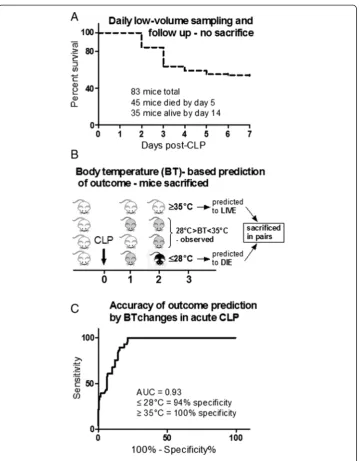
Depending on the needle gauge, each CLP mouse was assigned to either (1) CLP-Only or (2) CLP-ODam. In the CLP-Only group, two outcome stratification approaches were applied. In the first experiment, mice were monitored for 14 days for outcome and retrospectively stratified into those that died (henceforth referred to as DIED) and those that survived (henceforth referred to as SUR) within the first 5 days after CLP (Figure 1A). In this (non-sacrificed) group, 20 μl of blood were collected daily for the first 5 days post-CLP to measure selected metabolic and organ injury/dysfunction pa-rameters (i.e. urea, lactate dehydrogenase, alanine transaminase and glucose). Of note, creatinine and cystatin C were not measured in those mice given the severe restriction in the sampled blood volume.
In the CLP-ODam group, mice underwent CLP combined with application of CCl4
and cisplatin (see above). Of note, the combination of CCl4/cisplatin and CLP was
chosen given that it created an environment in which development of organ-injury was additionally promoted via the sepsis-triggered inflammation. Sham surgeries were not performed to reduce the total number of animals.
In the second experiment, early outcome was prospectively predicted via repeated rectal body temperature (BT) measurements using the Fluke 52 Series II thermometer (Fluke, Everett, WA, USA). For example, whenever BT of a given mouse decreased below 28°C (recorded at least at two sequential measurements), the animal was assigned to predicted to die (within the next 24 h) group (henceforth referred to as P-DIE). In the prospective stratification approach, mice were sacrificed in pairs. Specific-ally, each P-DIE mouse was then sacrificed together with one CLP mouse predicted to survive (henceforth referred to as P-SUR) that was defined by BT≥35°C (Figure 1B). A separate group of healthy control mice (no CLP) was also sacrificed as reference. Blood and organs (kidney, liver, heart and lung) were collected for further analysis.
Blood sampling
In the first experiment, irrespective of the group, 20 μl of blood were drawn daily for 5 days or until death, including one extra sample at 6 h post-CLP. Blood was collected by puncturing the facial vein (vena submandibularis) with a 23-gauge needle as previously described [36]. All samples were collected with a pipette rinsed with ethylenediaminetetra-acetic acid (EDTA) (diluted 1:50) and immediately diluted 1:10 in PBS. After centrifuga-tion (1,000×g, 5 min, 22°C), 180 μl of plasma was removed and stored at −80°C until further analysis.
In the second experiment, the whole blood was collected at sacrifice from the inferior vena cava with addition of sodium citrate (9:1 ratio vol/vol, blood:citrate). After centri-fugation (2,500×g, 5 min, 22°C), undiluted plasma was removed and stored at−80°C for further analysis.
Metabolic and organ injury/function parameters
with Cobas c111 analyzer (Roche, Basel, Switzerland). The lower detection limit for urea was 3 mg/dl, for glucose 1.98 mg/dl, for LDH 10U/l, and for ALT was 2U/l. In the second experiment (BT-based outcome stratification), cystatin C (Biovendor, Karasek, Czech Republic) and troponin I (Life Diagnostics, West Chester, PA, USA) were ana-lyzed in plasma (obtained from undiluted whole blood samples) using ELISA kits ac-cording to manufacturer's recommendations. Creatinine was analyzed with Cobas c111 analyzer using the same plasma samples. The lower detection limit for cystatin C was 0.04 ng/ml, for troponin 0.156 ng/ml. In the context of the liver, it must be noted that ALT and LDH are indicators of hepatocyte and general (LDH) tissue injury, thus, they do notper sedefine the level of liver dysfunction (although the latter effect typically de-velops once a pronounced injury occurs - as in CLP-ODam mice). Given that the pa-rameters we recorded in this study are indicative of either organ injury or (dys) function, we refer to those data by the‘organ injury/dysfunction’acronym.
ATP measurement
In the second experiment (BT-based outcome stratification), the lateral liver lobe, the en-tire heart and the left kidney were immediately snap-frozen in liquid nitrogen after dissec-tion. Eighty milligrams of each dissected organ was homogenized (RW 1 basic homogenizer, IKA, Wilmington, NC, USA) with three volumes (1:4 wt/vol) of Tris-HCl buffer (20 mM Tris, 135 mM KCl, pH 7.4). Nine hundred microliters of boiling 100 mM Tris/4 mM EDTA buffer (pH 7.75) were added to 100μl homogenate (liver, kidney, heart). Homogenates (performed as duplicates) were incubated for 2 min at 100°C and then cen-trifuged (1,000×g) for 1 min. The supernatants were transferred to a fresh tube and stored on ice until measurement. ATP content from the supernatant was detected according to the manufacturer's manual (ATP Bioluminescence Assay Kit CLS II, Roche, Switzerland).
Mitochondrial respiration
In the second experiment (BT-based outcome stratification), respiratory parameters of mitochondria were monitored using a high-resolution respirometer (Oxygraph-2k, Oroboros Instruments, Innsbruck, Austria). Liver/kidney homogenate was incubated in buffer containing 105 mM KCl, 5 mM KH2PO4, 20 mM Tris-HCl, 0.5 mM EDTA and 5 mg/ml fatty
acid-free bovine serum albumin (pH 7.2, 25°C). State 2 respiration was stimulated by addition of 5 mM glutamate/5 mM malate or 10 mM succinate and 1 ng/ml rotenone. Transition to state 3 respiration was induced by addition of adenosine diphosphate (ADP, 1 mM). Respiratory control (RC), characterizing coupling between oxidation and phos-phorylation, was determined as the ratio of respiration rates of state 3 to state 2. Mito-chondrial respiration in the uncoupled state (total capacity of the respiratory chain) was measured by titration of CCCP in steps of 0.5 μM. Effect of exogenous cytochrome c (2.5μM) on the respiration rate was used to estimate the permeability of the outer mito-chondrial membrane. All reagents were obtained from Sigma-Aldrich (Vienna, Austria).
Histology and histology scores
Statistical analysis
The 28-day survival curve was plotted using the Kaplan-Meier method. Accuracy of outcome prediction via BT was analyzed using the receiver operating characteristic (ROC) defined by the area under the curve (AUC) (Figure 1C). The accuracy of the ROC-AUC test is defined as excellent from 0.9 to 1, good from 0.8 to 0.9, fair from 0.7 to 0.8, poor from 0.6 to 0.7, and <0.6, not useful. To ensure maximal data Figure 1Survival curve and outcome prediction based on body temperature. (A)Seven-day mortality in 4-week-old OF-1 mice subjected to CLP-Only and daily low-volume blood sampling for days 1 to 5 post-CLP.
reproducibility, all experiments were conducted in small animal groups (typically 10 to 20 per cycle). All data are presented on the original scale and the level of significance was set atp< 0.05.
In the first experiment (Figures 2 and 3), a high number (n= 83) of enrolled mice (in the CLP-Only group) was required to enable reliable DIE vs. SUR comparison over the 5-day post-CLP period (the DIE subgroup at 72 and 96 h time points was the main lim-iting factor). Initially,n= 10/DIE group at each time point was set to detect a minimal inter-group SUR/DIE difference of approximately 20% to 30% (at α= 0.05,β= 0.8). The interim data analysis after five CLP runs showed futility of the n = 10 goal for DIE mice at the 96 h time point (due to low late mortality) as well as acceptable data distribution and variability for the pre-96 h time points. Consequently, the study was stopped after reaching n DIE = 7 (at 72 h) and n DIE = 3 (at 96 h) and n DIE = 9 at 72 h in the inverted comparison approach (Figure 3).
In the second experiment, n≥10 in the P-DIE and P-SUR groups (i.e. at least ten pairs) was set for comparison of the organ dysfunction score (Table 1) and n≥5/group for comparison of other parameters (Figures 4, 5, 6). The ninconsistency among indi-vidual tables and figures is due to the fact that not all shown parameters could have been measured in each sacrificed mouse and/or due to infrequent errors at sample col-lection and analysis.
All organ parameter values were tested for normality before further analysis. Detailed n distribution per group is defined in the legend to each figure/table. Subgroup com-parisons with at least three groups were made using either one-way ANOVA and Bonferroni for selected pairs aspost hoc test (parametric data) and Kruskal-Wallis and
Dunn's post hoc test for selected pairs (non-parametric data). Differences between DIED and SUR at a specific time point were analyzed using unpaired Student's t-test (with Welch correction for unequal variances whenever necessary) or Mann-Whitney Utest for those parameters with non-Gaussian distribution. All statistical analyses and graphics were made with GraphPad (San Diego, CA, USA).
Results
Retrospective and prospective comparison of outcome-dependent responses in acute
CLP sepsis
The study was divided into two experimental parts. In the first (retrospective) experi-ment, female OF-1 mice were subjected to CLP, sampled for blood (without sacrifice, see‘Blood sampling’section) and observed for 28 days for outcome. Forty-eight percent of those animals were alive at the end of the observation period (Figure 1A) and all
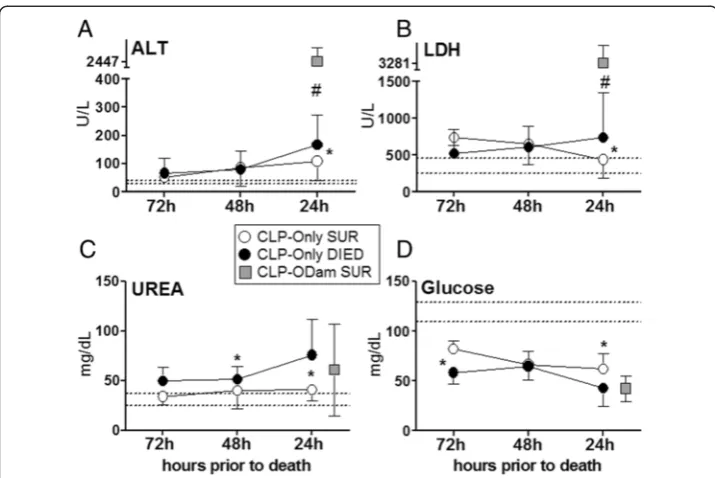
Figure 3Retrospective comparison of organ function between dying and surviving septic mice using death as reference point. Plasma levels of(A)ALT,(B)LDH,(C)urea and(D) glucose in mice subjected to CLP were compared between those that either died (CLP-Only DIED) or survived (CLP-Only SUR) and additionally to surviving CLP-ODam mice (CLP-ODam SUR). For (A) to (D) in the CLP-Only group: at 72 h, DIEDn= 9 and SURn= 35; at 48 h, DIEDn= 33 and SURn≥30; at 24 h, DIEDn= 42 and SUR
n= 40. In the CLP-ODam SUR group, an average value of all combines measurements (i.e. taken at 24, 48 and 72 h post-CLP;n= 9) is shown at the 24 h prior death time point; *p< 0.05 between CLP-Only DIED and SUR #p< 0.05 between CLP-Only DIED and CLP-ODam SUR. Dotted lines indicate normal range. Data points shown as mean ± SD.
Table 1 Pathology score in organs
Group Heart Kidney Lung Liver
CLP-DIED 0 0.5 0.5 0.8
CLP-SUR 0 0.3 0.1 0.1
CONTROL 0 1.0 0 0.8
data obtained between days 1 and 5 post-CLP were retrospectively compared based on the actual outcome.
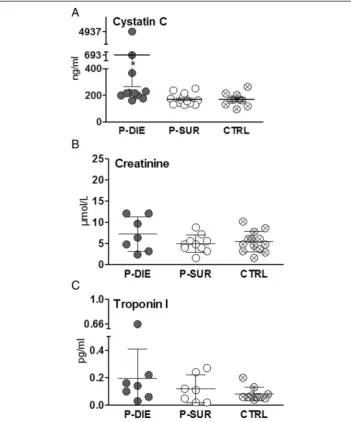
In the second (prospective) experiment, we intended to prospectively predict the out-come of CLP-induced sepsis based on specific BT cutoff values given that in septic mice, a strong decrease of BT is among the distinct signs of upcoming death. There-fore, a group of female OF-1 mice was subjected to CLP, monitored BT for first 5 days (post-CLP) and divided into sub-groups with predicted outcome; the prospective identi-fication approach is presented in Figure 1B schematic. We had established an excellent accuracy of BT to predict outcome (AUC = 0.93) by ROC analysis using our previously compiled internal BT measurement database: identification of P-DIE mice (BT≤28°C) Figure 4Comparison of organ function between dying and surviving septic mice using prospective stratification of outcome.Mice were subjected to CLP, monitored for BT and stratified into either predicted to die (P-DIE) or predicted to survive (P-SUR). Upon identification, P-DIE and P-SUR mice were always sacrificed in pairs additionally compared to the healthy animals (CTRL).(A)Cystatin C: P-DIEn= 11, P-SURn= 14 and CTRL
n= 14.(B)Creatinine: P-DIEn= 7, P-SURn= 10 and CTRLn= 13.C. Troponin I: P-DIEn= 7, P-SURn= 7 and CTRL
had 94% specificity, while identification of P-SUR mice (BT≥35°C; at least for the next 24 h) displayed 100% specificity (Figure 1C).
In this study, an average of 23% of mice per day did not meet the low/high temperature cutoffs for the outcome prediction. The exact percentages of animals >28°C and <35°C for each sampling time point post-CLP were: 50% at 6 h, 27% at 24 h, 12% at 48 h, 18% at 72 h and 8% at 96 h.
CLP as reference point: temporal profiles of organ injury/dysfunction in dying and surviving septic mice
As polymicrobial sepsis unfolds, homeostasis of vital organs becomes deregulated. By using our serial low-volume sampling approach (first experiment) with CLP as the ref-erence point, we followed temporal fluctuations of circulating organ function/injury pa-rameters in DIED and SUR septic (CLP-Only) mice juxtaposing them with the readouts from non-lethal CLP-ODam mice.
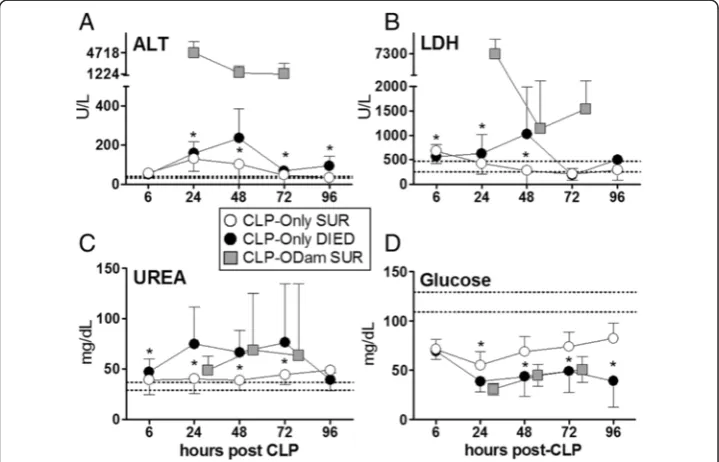
In the CLP-Only group, a consistent deterioration in all parameters was recorded in DIED versus SUR mice. At 48 h post-CLP (the most pronounced DIED/SUR
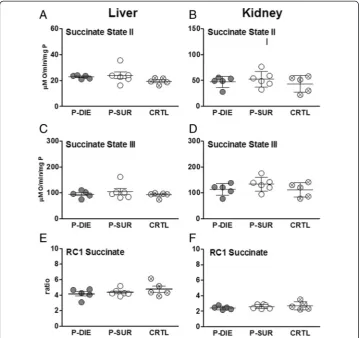
Figure 5Comparison of mitochondrial function between dying and surviving septic mice using prospective stratification of outcome. Mice were subjected to CLP, monitored for BT and stratified into either predicted to die (P-DIE) or predicted to survive (P-SUR). Upon identification, P-DIE and P-SUR mice were always sacrificed in pairs and additionally compared to the healthy animals (CTRL).(A,B) Succinate state II.(C,D)
separation), circulating ALT in DIED was 2.3-fold higher (vs. SUR) (235 vs. 102 U/l), LDH was 3.7-fold higher (1,028 vs. 276 U/l) and urea was 1.7-fold higher (67 vs. 39 mg/dl), while blood glucose decreased by approximately 30% (44 vs. 69 mg/dl) (Figure 2).
We wanted to gain more insight into the biological relevance of the recorded differ-ences upon acute septic outcomes, therefore, we compared temporally measured values (at 24, 48 and 72 h post-CLP) obtained from CLP-ODam survivors to the corresponding
measurements obtained in DIED and SUR mice from the CLP-Only cohort. The deterior-ation of readouts in surviving CLP-ODam mice was always greater than in SUR and either equaled or further exceeded changes recorded in DIED CLP-Only. In CLP-ODam mice, ALT was 5- to 30-fold higher (up to 4,717 U/l), LDH 8- to 11-fold higher (up to 7,300 U/l) while urea and glucose were approximately equal to the values measured at 24 to 72 h time points in DIED mice of the CLP-Only group (Figure 2A-D).
Death as reference point: pre-lethal evolution of organ injury/dysfunction in acute CLP Given that organ dysfunction/injury in DIED mice was more pronounced at many but not all time points compared to SUR, we next aimed to characterize the dynamics of progressive pre-lethal organ impairment in acute CLP. Therefore, we used the time of impending death as the reference point to inversely plot changes in the recorded pa-rameters between dying and surviving CLP-Only mice (and also to compare them to CLP-ODam survivors).
Within 48 h of death, apart from an approximately 30% increase in urea (51 vs. 40 mg/dl), none of the parameters recorded in the DIED group was higher than in cor-responding SUR CLP-Only mice. However, a significantly higher deterioration of all pa-rameters was recorded within 24 h of death: ALT increased by 54% (167 vs. 107 U/l), LDH by 68% (739 vs. 439 U/l), urea by 86% (76 vs. 40 U/l), while glucose decreased by 30% (62 vs. 43 mg/dl). Next, the last pre-lethal (i.e. at 24 h time point) measurements in DIED CLP-Only were compared to the averaged value (i.e. using the combined 24, 48 and 72 h post-CLP measurements) of each respective parameter measured in CLP-ODam survivors. The comparison demonstrated that in CLP-ODam survivors, ALT was 15-fold higher (167 vs. 2,447 U/l), LDH was 5-fold higher (739 vs. 3,281 U/l) while urea and glu-cose were approximately similar to CLP-Only mice that died (Figure 3A-D).
By using the ROC analysis, we also estimated the capacity of the last pre-death mea-surements (i.e. within 24 h of death) to predict early CLP outcome (Table 2). Only the urea (and blood urea nitrogen (BUN); Additional file 1: Figure S1) demonstrated a good (AUC = 0.85) separation between DIED and SUR datasets: 40% of CLP mice would have been identified as predicted to die without inclusion of false positive SUR mice.
Outcome-dependent profiling of kidney and cardiac muscle tissue injury in acute CLP based on the BT prediction
In the next step, we aimed to characterize the magnitude of kidney dysfunction and cardiac muscle tissue injury in fully symptomatic mice dying of sepsis. We assessed cre-atinine and cystatin C as markers for renal glomerular filtration rate and troponin I as
Table 2 Capacity to predict outcome in acute CLP sepsis
Parameter AUC Cutoff Specificity (%) Sensitivity (%)
Urea 0.85 77 mg/dl 100 40
Glucose 0.78 30 U/l 100 25
LDH 0.68 1,320 U/l 100 17
ALT 0.68 365 U/l 100 7
CLP-Only mice were never sacrificed but sampled daily for blood between days 1 to 5 post-CLP and followed for 28 days. For ROC analysis, parameter values recorded within 24 h of death (occurring anytime between days 1 and 5 post-CLP) and from mice that lived until day 28 post-CLP were used. Specificity was set to 100% to identify only mice predicted to die without committing the type I error (i.e. an erroneous inclusion of P-SUR animals). ROC calculation was based on:
marker for cardiac muscle tissue injury. In CLP-Only mice predicted to die, circulating cystatin C rose by approximately 1.6-fold (692 vs. 170 ng/dl) (p< 0.05) while creatinine was not higher than SUR (and control) animals (Figure 4A,B). Troponin I levels did not differ among P-DIE, P-SUR (CLP-Only) and healthy control groups (Figure 4C). To comply with the three Rs principle, a comparison to CLP-ODam survivors was not per-formed (explained in the‘CCl4/cisplatin model’section).
Outcome-dependent profiling of renal and hepatic mitochondrial respiratory activity in acute CLP based on the BT prediction
Pronounced organ failure is typically preceded by more subtle metabolic changes at the cellular level. To investigate the cellular energy homeostasis in CLP-induced sepsis, we compared the outcome-dependent activity of the mitochondrial respiratory electron transport chain in septic mice. Specifically, we assessed state 2/state 3 respirations and RC in the presence of succinate as well as ATP level in organs collected from P-DIE and P-SUR CLP-Only mice (and healthy control).
In the liver and kidney, succinate state 2 and 3 did not differentiate between P-DIE, P-SUR and control mice (Figure 5A,B). Similarly, RC was virtually identical among groups, irrespective of the outcome and organ (Figure 5C).
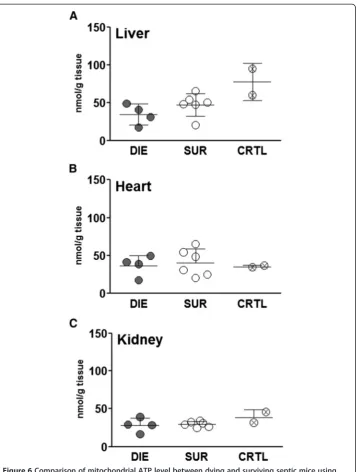
Next, a direct measurement of ATP was performed in the liver, heart and kidney of CLP-Only mice predicted to either die or survive (and healthy control). ATP concentration was virtually identical among all three groups in each examined organ (Figure 6A-C).
Acute CLP did not induce prominent pathomorphologic changes in organs
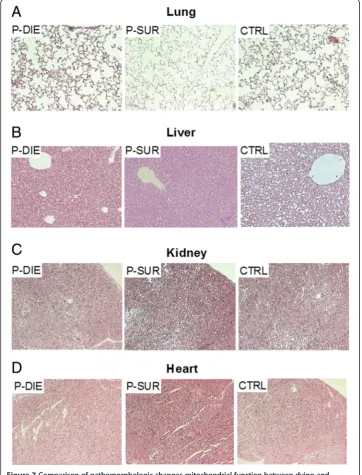
In the final investigative step, organ samples collected from CLP-Only mice were sub-jected to histologic evaluation for detection of pathomorphologic signs of organ dam-age. Based on the comparison of combined pathology scores, there were no distinct signs of organ injury in neither of the examined groups (Table 1). Representative micro-graphs of the examined organs are shown in Figure 7. Similarly, the TUNEL assay re-vealed only trivial changes: only isolated apoptotic cells in the lungs and liver of septic mice were observed (Additional file 2: Figure S2).
Discussion
Overall, given the absence of cellular respiratory/energy disturbances and histopatho-logical damage as well as the relatively mild exacerbation of organ injury/dysfunction (as measured by selected circulating parameters), this study strongly cautions against reflexive interpretation of organ deregulation as the main culprit of early deaths in the young outbred CLP female mice. The factual contribution of the recorded organ in-jury/dysfunction to early CLP mortality strongly depends on the pathophysiological and immuno-inflammatory context in which those detrimental changes occurred.
excessive severity may strongly skew the model towards the more pronounced organ damage and artificially pre-program the outcome [1]. Furthermore, we used two strati-fication approaches: an outcome-dependent retrospective [24,25] and BT-based pro-spective one [38] - both allow a comparison between confirmed dying and surviving
Figure 7Comparison of pathomorphologic changes mitochondrial function between dying and surviving septic mice using prospective stratification of outcome.Mice were subjected to CLP, monitored for BT and stratified into either predicted to die (P-DIE) or predicted to survive (P-SUR). Upon identification, P-DIE and P-SUR mice were always sacrificed in pairs (days 1 to 3 post-CLP) and additionally compared to the healthy animals (CTRL). HE-staining of (A)lung,(B)liver,(C)kidney and
CLP mice (see the stratification section in ‘Methods’) instead of the typical approach that compares septic and control (healthy) mice.
In the retrospective stratification approach, we first compared 5-day profiles using CLP as the reference point. While a statistically significant separation of four circulating pa-rameters was recorded between DIED and SUR mice, this difference was not consistent at all time points. For example, ALT and LDH separation was greatest at 48 h post-CLP, while urea increase and glucose decrease began early and remained constantly separated. The delay observed in ALT and LDH dynamics is consistent with our recent post-traumatic sepsis study, which demonstrated the greatest difference in a combined organ score between DIE and SUR mice at 48 h post-CLP [24]. In two rodent studies, liver dys-function in abdominal sepsis was described as an early event and signs of acute hepatic failure coincided with early deaths [34,39]. Specifically, Recknagel et al. using a rat model of fecal peritonitis demonstrated that sepsis-related hepatic malfunction (already present at 6 h post-challenge) was more severe in animals predicted to die [39]. Thanks to the low-volume sampling technique [36], we also analyzed data by using the day of death as the reference point. This approach enabled us to profile dynamic parameter changes to-wards the approaching death - similar to deteriorating ICU septic patients in whom the onset of sepsis is typically unknown. It was striking to observe that the separation of DIED vs. SUR mice became clear only within the last 24 h (prior to death); no signs of differen-tial organ deterioration were apparent at earlier time points.
Yet, the above findings did not resolve the main question: i.e. to what extent the re-corded level of exacerbation of organ injury/dysfunction was responsible for the acute mortality. We attempted to address it, at least partly, by comparing CLP-Only to mild CLP with administered CCl4and cisplatin to provoke an added exacerbation of organ
To gain a deeper insight into the severity of organ dysfunction/injury in our medium-severity CLP sepsis model, we next employed a prospective BT-based stratification that allowed autopsy and examination of tissue histology and mitochondrial energy metabol-ism in organs. In acute sepsis, factors like pulmonary damage, reduction of cardiac output and impaired myocardial contractibility may lead to shortage of oxygen and consequently to a failure of mitochondrial respiration and/or tissue energy status (tissue ATP level) in major organs [42,43]. Yet, the role of mitochondrial dysfunction in the septic organ failure and subsequent death is unclear [43,44]. In our study, we did not observe any disturbances in mitochondrial respiration and energy status in the examined organs (i.e. liver, heart, kidney); the sick mice, regardless whether P-DIE or P-SUR, were undistinguishable from the healthy subjects. The unaltered ATP level in the hearts of septic mice is in line with their stable level of circulating troponin I - an established marker of myocardial tissue in-jury and prognosticator of mortality in severe sepsis patients [45,46]. The histological as-sessment of the organs demonstrated only random alterations (accompanied by only sporadic apoptosis) further reinforcing the perception that the recorded exacerbation in circulating markers in P-DIE (vs. P-SUR), although statistically significant, was not imme-diately indicative of a lethal organ failure in the young OF-1 mice. Of note, the autopsied organs were harvested from fully symptomatic animals within the hours of their demise (i.e. by prospective BT-based stratification), thus, maximizing the probability of detect-ing signs of structural damage in the examined tissues.
not develop significant lung injury [16], while others produced ALI in inbred BALB/c and C57/BL/6 strains [58,60].
The most important shortcoming of our study is that we did not assess all building blocks of clinically defined MODS (e.g. acute respiratory distress, hypotension, dimin-ished cardiac output). Due to obvious technical limitations, we were able to focus only on selected aspects of organ injury/dysfunction and supplementary studies are neces-sary to expand onto those omitted elements. In consequence, our preclinical study is not definite and, furthermore, it is not our intention to imply that organ dysfunction developing in septic patients should be discounted as the main contributor to their mortality. The main strength of this study lies elsewhere: it strongly cautions that find-ings from numerous preclinical experiments, due to their varying design, are prone to severe misinterpretations [61]. In other words, we believe that preclinical studies con-ducted in young and healthy mice tend to over interpret statistically significant, but relatively mild and not instantly life-threatening changes in organ function/injury as: (1) the leading cause of septic death, and/or (2) the key life-saving mechanism of action behind beneficial effects of tested therapeutics.
Conclusions
It is clear that the dynamics of organ dysfunction/injury and its response to treatments profoundly differ between young mice without underlying comorbidities and their aged and disease-burdened counterparts as well as between the inbred and outbred lineages. The past year has brought about a heated discussion regarding the true utility of mouse critical care disease models [62,63]. Among other things, this discussion has stressed that the mistrust of data from sub-optimally matched/designed experiments can also easily en-compass relevant preclinical studies given that recognition of the various design flaws is not easy and immediate [61,64,65]. Therefore, we believe that the degree of the interpret-ational skepticism applied to the mouse organ dysfunction-related experiments should be proportional to the distance separating their study design quality from the clinical reality.
Additional files
Additional file 1: Figure S1.Comparison of BUN elevation between dying and surviving CLP mice.(A)Plotted dots represent blood urea nitrogen (BUN) values taken from mice within 24 h of death (occurring anytime between days 1 and 4 post-CLP; right scatter) and from mice that lived until day 28 post-CLP (left scatter). Surviving
n= 40; dyingn= 42.(B)Predictive capacity of BUN for outcome by ROC curve assessed by measurements taken within 24 h of death in the acute phase of CLP sepsis (days 1 to 4 post-CLP). Each dot represents a single mouse. Survivingn= 40; dyingn= 42. Solid horizontal lines represent mean ± SD. The two dotted horizontal lines represent 95% CI. *p< 0.05.
Additional file 2: Figure S2.Comparison of apoptosis in different organs between dying and surviving septic mice using prospective stratification of outcome. Mice were subjected to CLP, monitored for BT and stratified into either predicted to die (P-DIE) or predicted to survive (P-SUR). Upon identification, P-DIE and P-SUR mice were always sacrificed in pairs (days 1 to 3 post-CLP) and additionally compared to the healthy animals (CTRL). TUNEL-staining of(A)lung,(B)liver,(C)kidney and(D)heart was performed. P-DIE and P-SURn= 11 and CTRLn= 7. Representative photographs are shown (original magnification ×10). Arrow in (A) indicates an infrequent apoptotic cell.
Competing interests
The authors declare that they have no competing interests.
Authors’contributions
Author details
1
Ludwig Boltzmann Institute for Experimental and Clinical Traumatology, Trauma Research Center of AUVA, Donaueschingenstrasse 13, Vienna, 1200, Austria.2Department of Anaesthesia, University Hospital Regensburg, Franz-Josef-Strauß-Allee 11, Regensburg, 93053, Germany.3Department of Pathology and Laboratory Medicine, Boston University School of Medicine, Boston, MA 02118, USA.4Current address: ViruSure GmbH, University of Veterinary Medicine Vienna, Veterinärplatz 1, Vienna, 1210, Austria.5Current address: Experimental Trauma Surgery, Clinic for Trauma Surgery, Klinikum Rechts der Isar, Technical University Munich, Ismaninger Straße 22, Munich 81675, Germany.
Received: 2 September 2014 Accepted: 19 February 2015
References
1. Iskander KN, Osuchowski MF, Stearns-Kurosawa DJ, Kurosawa S, Stepien D, Valentine C, Remick DG (2013) Sepsis: multiple abnormalities, heterogeneous responses, and evolving understanding. Physiol Rev 93:1247–1288 2. O'Brien JM Jr, Ali NA, Abraham E (2008) Year in review 2007: critical care - multiple organ failure and sepsis. Crit
Care 12:228
3. Vincent JL, Sakr Y, Sprung CL, Ranieri VM, Reinhart K, Gerlach H, Moreno R, Carlet J, Le G Jr, Payen D (2006) Sepsis in European intensive care units: results of the SOAP study. Crit Care Med 34:344–353
4. Bernard GR, Vincent JL, Laterre PF, LaRosa SP, Dhainaut JF, Lopez-Rodriguez A, Steingrub JS, Garber GE, Helterbrand JD, Ely EW, Fisher CJ Jr (2001) Efficacy and safety of recombinant human activated protein C for severe sepsis. N Engl J Med 344:699–709
5. Vincent JL, Nelson DR, Williams MD (2011) Is worsening multiple organ failure the cause of death in patients with severe sepsis? Crit Care Med 39:1050–1055
6. de Montmollin E, Annane D (2011) Year in review 2010: critical care - multiple organ dysfunction and sepsis. Crit Care 15:236
7. Waydhas C, Nast-Kolb D, Jochum M, Trupka A, Lenk S, Fritz H, Duswald KH, Schweiberer L (1992) Inflammatory mediators, infection, sepsis, and multiple organ failure after severe trauma. Arch Surg 127:460–467
8. Regel G, Sturm JA, Pape HC, Gratz KF, Tscherne H (1991) Multiple organ failure. Reflection of generalized cell damage of all organs following severe trauma. Unfallchirurg 94:487–497
9. Maier B, Lefering R, Lehnert M, Laurer HL, Steudel WI, Neugebauer EA, Marzi I (2007) Early versus late onset of multiple organ failure is associated with differing patterns of plasma cytokine biomarker expression and outcome after severe trauma. Shock 28:668–674
10. Regel G, Grotz M, Weltner T, Sturm JA, Tscherne H (1996) Pattern of organ failure following severe trauma. World J Surg 20:422–429
11. Osterbur K, Mann FA, Kuroki K, DeClue A (2014) Multiple organ dysfunction syndrome in humans and animals. J Vet Intern Med 28:1141–1151
12. Proulx F, Fayon M, Farrell CA, Lacroix J, Gauthier M (1996) Epidemiology of sepsis and multiple organ dysfunction syndrome in children. Chest 109:1033–1037
13. Hotchkiss RS, Karl IE (2003) The pathophysiology and treatment of sepsis. N Engl J Med 348:138–150 14. Boomer JS, To K, Chang KC, Takasu O, Osborne DF, Walton AH, Bricker TL, Jarman SD, Kreisel D, Krupnick AS,
Srivastava A, Swanson PE, Green JM, Hotchkiss RS (2011) Immunosuppression in patients who die of sepsis and multiple organ failure. JAMA 306:2594–2605
15. van Griensven M, Kuzu M, Breddin M, Bottcher F, Krettek C, Pape HC, Tschernig T (2002) Polymicrobial sepsis induces organ changes due to granulocyte adhesion in a murine two hit model of trauma. Exp Toxicol Pathol 54:203–209
16. Iskander KN, Craciun FL, Stepien DM, Duffy ER, Kim J, Moitra R, Vaickus LJ, Osuchowski MF, Remick DG (2013) Cecal ligation and puncture-induced murine sepsis does not cause lung injury. Crit Care Med 41:159–170 17. Nemzek JA, Hugunin KM, Opp MR (2008) Modeling sepsis in the laboratory: merging sound science with animal
well-being. Comp Med 58:120–128
18. Nemzek JA, Xiao HY, Minard AE, Bolgos GL, Remick DG (2004) Humane endpoints in shock research. Shock 21:17–25 19. Wichterman KA, Baue AE, Chaudry IH (1980) Sepsis and septic shock - a review of laboratory models and a
proposal. J Surg Res 29:189–201
20. Raeven P, Feichtinger GA, Weixelbaumer KM, Atzenhofer S, Redl H, Van GM, Bahrami S, Osuchowski MF (2012) Compartment-specific expression of plasminogen activator inhibitor-1 correlates with severity/outcome of murine polymicrobial sepsis. Thromb Res 129:e238–e245
21. Dejager L, Pinheiro I, Dejonckheere E, Libert C (2011) Cecal ligation and puncture: the gold standard model for polymicrobial sepsis? Trends Microbiol 19:198–208
22. Torgersen C, Moser P, Luckner G, Mayr V, Jochberger S, Hasibeder WR, Dunser MW (2009) Macroscopic postmortem findings in 235 surgical intensive care patients with sepsis. Anesth Analg 108:1841–1847 23. Osuchowski MF, Craciun F, Weixelbaumer KM, Duffy ER, Remick DG (2012) Sepsis chronically in MARS: systemic
cytokine responses are always mixed regardless of the outcome, magnitude, or phase of sepsis. J Immunol 189:4648–4656
24. Drechsler S, Weixelbaumer K, Raeven P, Jafarmadar M, Khadem A, Van GM, Bahrami S, Osuchowski MF (2012) Relationship between age/gender-induced survival changes and the magnitude of inflammatory activation and organ dysfunction in post-traumatic sepsis. PLoS One 7:e51457
25. Osuchowski MF, Craciun FL, Schuller E, Sima C, Gyurko R, Remick DG (2010) Untreated type 1 diabetes increases sepsis-induced mortality without inducing a prelethal cytokine response. Shock 34:369–376
26. Singh AP, Junemann A, Muthuraman A, Jaggi AS, Singh N, Grover K, Dhawan R (2012) Animal models of acute renal failure. Pharmacol Rep 64:31–44
28. Miller RP, Tadagavadi RK, Ramesh G, Reeves WB (2010) Mechanisms of cisplatin nephrotoxicity. Toxins (Basel) 2:2490–2518
29. Marques TG, Chaib E, da Fonseca JH, Lourenco AC, Silva FD, Ribeiro MA Jr, Galvao FH, D'Albuquerque LA (2012) Review of experimental models for inducing hepatic cirrhosis by bile duct ligation and carbon tetrachloride injection. Acta Cir Bras 27:589–594
30. Ma JQ, Ding J, Zhang L, Liu CM (2014) Ursolic acid protects mouse liver against CCl4-induced oxidative stress and inflammation by the MAPK/NF-kappaB pathway. Environ Toxicol Pharmacol 37:975–983
31. Daugaard G (1990) Cisplatin nephrotoxicity: experimental and clinical studies. Dan Med Bull 37:1–12
32. Oh GS, Kim HJ, Choi JH, Shen A, Choe SK, Karna A, Lee SH, Jo HJ, Yang SH, Kwak TH, Lee CH, Park R, So HS (2014) Pharmacological activation of NQO1 increases NAD+levels and attenuates cisplatin-mediated acute kidney injury in mice. Kidney Int 85:547–560
33. Yan J, Li S, Li S (2014) The role of the liver in sepsis. Int Rev Immunol 33:498-510
34. Zhang L, Wan J, Jiang R, Wang W, Deng H, Shen Y, Zheng W, Wang Y (2009) Protective effects of trichostatin A on liver injury in septic mice. Hepatol Res 39:931–938
35. Kilkenny C, Browne WJ, Cuthill IC, Emerson M, Altman DG (2010) Improving bioscience research reporting: the ARRIVE guidelines for reporting animal research. PLoS Biol 8:e1000412
36. Weixelbaumer KM, Raeven P, Redl H, Van GM, Bahrami S, Osuchowski MF (2010) Repetitive low-volume blood sampling method as a feasible monitoring tool in a mouse model of sepsis. Shock 34:420–426
37. Volakli E, Spies C, Michalopoulos A, Groeneveld AB, Sakr Y, Vincent JL (2010) Infections of respiratory or abdominal origin in ICU patients: what are the differences? Crit Care 14:R32
38. Raeven P, Salibasic A, Drechsler S, Weixelbaumer KM, Jafarmadar M, Van GM, Bahrami S, Osuchowski MF (2013) A non-lethal traumatic/hemorrhagic insult strongly modulates the compartment-specific PAI-1 response in the subsequent polymicrobial sepsis. PLoS One 8:e55467
39. Recknagel P, Gonnert FA, Westermann M, Lambeck S, Lupp A, Rudiger A, Dyson A, Carre JE, Kortgen A, Krafft C, Popp J, Sponholz C, Fuhrmann V, Hilger I, Claus RA, Riedemann NC, Wetzker R, Singer M, Trauner M, Bauer M (2012) Liver dysfunction and phosphatidylinositol-3-kinase signalling in early sepsis: experimental studies in rodent models of peritonitis. PLoS Med 9:e1001338
40. Peng ZY, Wang HZ, Srisawat N, Wen X, Rimmele T, Bishop J, Singbartl K, Murugan R, Kellum JA (2012) Bactericidal antibiotics temporarily increase inflammation and worsen acute kidney injury in experimental sepsis. Crit Care Med 40:538–543
41. Moreno R, Sprung CL, Annane D, Chevret S, Briegel J, Keh D, Singer M, Weiss YG, Payen D, Cuthbertson BH, Vincent JL (2011) Time course of organ failure in patients with septic shock treated with hydrocortisone: results of the Corticus study. Intensive Care Med 37:1765–1772
42. Garrabou G, Moren C, Lopez S, Tobias E, Cardellach F, Miro O, Casademont J (2012) The effects of sepsis on mitochondria. J Infect Dis 205:392–400
43. Galley HF (2011) Oxidative stress and mitochondrial dysfunction in sepsis. Br J Anaesth 107:57–64
44. Ruggieri AJ, Levy RJ, Deutschman CS (2010) Mitochondrial dysfunction and resuscitation in sepsis. Crit Care Clin 26:567–5xi
45. John J, Woodward DB, Wang Y, Yan SB, Fisher D, Kinasewitz GT, Heiselman D (2010) Troponin-I as a prognosticator of mortality in severe sepsis patients. J Crit Care 25:270–275
46. Mehta NJ, Khan IA, Gupta V, Jani K, Gowda RM, Smith PR (2004) Cardiac troponin I predicts myocardial dysfunction and adverse outcome in septic shock. Int J Cardiol 95:13–17
47. Dirkes S (2013) Sepsis and inflammation: impact on acute kidney injury. Nephrol Nurs J 40:125–132 48. Levy EM, Viscoli CM, Horwitz RI (1996) The effect of acute renal failure on mortality. A cohort analysis. JAMA
275:1489–1494
49. Wang Z, Holthoff JH, Seely KA, Pathak E, Spencer HJ III, Gokden N, Mayeux PR (2012) Development of oxidative stress in the peritubular capillary microenvironment mediates sepsis-induced renal microcirculatory failure and acute kidney injury. Am J Pathol 180:505–516
50. Seely KA, Holthoff JH, Burns ST, Wang Z, Thakali KM, Gokden N, Rhee SW, Mayeux PR (2011) Hemodynamic changes in the kidney in a pediatric rat model of sepsis-induced acute kidney injury. Am J Physiol Renal Physiol 301:F209–F217 51. Liu L, Li Y, Hu Z, Su J, Huo Y, Tan B, Wang X, Liu Y (2012) Small interfering RNA targeting Toll-like receptor 9 protects
mice against polymicrobial septic acute kidney injury. Nephron Exp Nephrol 122:51–61
52. Liu J, bdel-Razek O, Liu Z, Hu F, Zhou Q, Cooney RN, Wang G (2014) Role of surfactant proteins A and D in sepsis-induced acute kidney injury. Shock 43:31-38
53. Holthoff JH, Wang Z, Patil NK, Gokden N, Mayeux PR (2013) Rolipram improves renal perfusion and function during sepsis in the mouse. J Pharmacol Exp Ther 347:357–364
54. Craciun FL, Iskander KN, Chiswick EL, Stepien DM, Henderson JM, Remick DG (2014) Early murine polymicrobial sepsis predominantly causes renal injury. Shock 41:97–103
55. Murray PT, Mehta RL, Shaw A, Ronco C, Endre Z, Kellum JA, Chawla LS, Cruz D, Ince C, Okusa MD (2014) Potential use of biomarkers in acute kidney injury: report and summary of recommendations from the 10th Acute Dialysis Quality Initiative consensus conference. Kidney Int 85:513–521
56. Chawla LS, Kellum JA (2012) Acute kidney injury in 2011: biomarkers are transforming our understanding of AKI. Nat Rev Nephrol 8:68–70
57. Leelahavanichkul A, Souza AC, Street JM, Hsu V, Tsuji T, Doi K, Li L, Hu X, Zhou H, Kumar P, Schnermann J, Star RA, Yuen PS (2014) Comparison of serum creatinine and serum cystatin C as biomarkers to detect sepsis-induced acute kidney injury and to predict mortality in CD-1 mice. Am J Physiol Renal Physiol 307:F939–F948
59. Lygizos MI, Yang Y, Altmann CJ, Okamura K, Hernando AA, Perez MJ, Smith LP, Koyanagi DE, Gandjeva A, Bhargava R, Tuder RM, Faubel S, Schmidt EP (2013) Heparanase mediates renal dysfunction during early sepsis in mice. Physiol Rep 1:e00153
60. Chao MC, Garcia CS, de Oliveira MB, Santos RS, Lucas IH, Silva PL, Vieira-Abreu A, de Castro-Faria-Neto HC, Parra-Cuentas ER, Capelozzi VL, Pelosi P, Rocco PR (2010) Degree of endothelium injury promotes fibroelastogenesis in experimental acute lung injury. Respir Physiol Neurobiol 173:179–188
61. Osuchowski MF, Remick DG, Lederer JA, Lang CH, Aasen AO, Aibiki M, Azevedo LC, Bahrami S, Boros M, Cooney R, Cuzzocrea S, Jiang Y, Junger WG, Hirasawa H, Hotchkiss RS, Li XA, Radermacher P, Redl H, Salomao R, Soebandrio A, Thiemermann C, Vincent JL, Ward P, Yao YM, Yu HP, Zingarelli B, Chaudry IH (2014) Abandon the mouse research ship? Not just yet! Shock 41:463–475
62. Seok J, Warren HS, Cuenca AG, Mindrinos MN, Baker HV, Xu W, Richards DR, Donald-Smith GP, Gao H, Hennessy L, Finnerty CC, Lopez CM, Honari S, Moore EE, Minei JP, Cuschieri J, Bankey PE, Johnson JL, Sperry J, Nathens AB, Billiar TR, West MA, Jeschke MG, Klein MB, Gamelli RL, Gibran NS, Brownstein BH, Miller-Graziano C, Calvano SE, Mason PH, Cobb JP, Rahme LG, Lowry SF, Maier RV, Moldawer LL, Herndon DN, Davis RW, Xiao W, Tompkins RG (2013) Genomic responses in mouse models poorly mimic human inflammatory diseases. Proc Natl Acad Sci U S A 110:3507–3512
63. Takao K and Miyakawa T (2014) Genomic responses in mouse models greatly mimic human inflammatory diseases. Proc Natl Acad Sci U S A 112:1167-1172.
64. Fink MP (2014) Animal models of sepsis. Virulence 5:143–153
65. Gentile LF, Nacionales DC, Lopez MC, Vanzant E, Cuenca A, Cuenca AG, Ungaro R, Baslanti TO, McKinley BA, Bihorac A, Cuschieri J, Maier RV, Moore FA, Leeuwenburgh C, Baker HV, Moldawer LL, Efron PA (2014) A better understanding of why murine models of trauma do not recapitulate the human syndrome. Crit Care Med 42:1406–1413
Submit your manuscript to a
journal and benefi t from:
7Convenient online submission
7Rigorous peer review
7Immediate publication on acceptance
7Open access: articles freely available online
7High visibility within the fi eld
7Retaining the copyright to your article