Observational Sequence Learning
Christa Lorraine Foster University College London
Thesis submitted for
the degree of Doctor of Philosophy
ProQuest Number: U642995
All rights reserved
INFORMATION TO ALL USERS
The quality of this reproduction is dependent upon the quality of the copy submitted.
In the unlikely event that the author did not send a complete manuscript and there are missing pages, these will be noted. Also, if material had to be removed,
a note will indicate the deletion.
uest.
ProQuest U642995
Published by ProQuest LLC(2015). Copyright of the Dissertation is held by the Author.
All rights reserved.
This work is protected against unauthorized copying under Title 17, United States Code. Microform Edition © ProQuest LLC.
ProQuest LLC
789 East Eisenhower Parkway P.O. Box 1346
Abstract
The objective of this thesis was to assess whether human and nonhuman animals can learn about serial order by observation of a conspecific performing a task designed to assess sequence knowledge. With regard to human sequence learning, two questions were asked. The first, whether procedural knowledge of sequences, typically acquired following direct practice, can be gained following observation, the second, how such knowledge is represented and by which mechanisms. Using an adaptation of a serial reaction time task (Nissen & Bullemer 1987) and a free generation task the implicit versus explicit knowledge distinction was examined. Evidence reported in this thesis suggests that humans are capable of observational sequence learning on an implicit task and sequence knowledge is stored in terms of a motor code. However, experiments suggest that observational sequence learning may be limited to situations where the sequences are unique in structure and where there are 16 exposures of the sequence per block of trials. There was no evidence for a dissociation in observer performance between measures designed to assess procedural and declarative knowledge and it was concluded that this was not an appropriate distinction to make when characterising observer performance on the SRT task.
Contents
List of Tables..7.
List of Figures...8
Acknowledgements. .,10
Preface...^1
CHAPTER 1
Human Sequence Learning. ..13
1.1 HUMAN SEQUENCE LEARNING THROUGH PRACTICE...13 1.1.1 What is learned via direct practice... 13
1.1.2 Procedural versus Declarative Memory...16
1.2 HUMAN SEQUENCE LEARNING AND OBSERVATION...21 1.2.1 What is learned via observation...21
1.2.2 Perceptual versus Response learning...25 1.3 MODELS OF MEMORY FOR SERIAL ORDER...30
1.3.1 How associations are formed...32 1.3.2 Chaining models...33
1.3.3 Inhibition models...34 1.4 SUMMARY...35
CHAPTER 2
Animal Sequence Learning...37
2.1 STIMULUS AND RESPONSE LEARNING BY OBSERVATION...38 2.1.1 What can animals learn via observation alone...39
2.1.2 Is there any evidence for sequence learning by observation...42 2.2 THEORIES OF ANIMAL SEQUENCE LEARNING...47
2.2.1 A Rule Encoding account...47 2.2.2 An Associative Memory View...54
CHAPTER 3
Testing For Observational Implicit Learning of a Second Order Conditional
Sequence...65
3.1 A Comparison of Practice, Observation and Non-Practice...65 Method...65
Results...69 Discussion...72
3.2 Testing for a dissociation: comparing Practice, Observation and Non practice a SRT task and on a free-generation task...75
Method...75 Results...79 Discussion...84
CHAPTER 4
Observational Learning of a Unique Sequence...QQ
4.1 Varying the amount of sequence exposure : 16 vs 8 exposures per block of trials, A pilot study...88
Method...88 Results...90 Discussion...94
4.2 Testing for a dissociation using a six item unique sequence...96 Method...96
Results...97 Discussion...101
4.3 Removing the Refresher Blocks... 102 Method...102
Results...104 Discussion...106
4.4 Comparing knowledge of sequences on the SRT task and the free generation task using a between subjects procedure... 107
Results...108 Discussion...111
GENERAL DISCUSSION...112
CHAPTER 5
Investigating Perceptual and Motor Contributions to Observational Sequence
Learning..A16
5.1 Learning about stimuli or responses on the SRT task for observer participants...117
Method...117
Results & Discussion...119
5.2 Transfer task; Are Practice and Observation subjects storing information they acquire during employment on the SRT task in terms of a motor or perceptual code... 123
Method...125
Results (SRT task)...127 Results (Transfer task)... 129 Results (Free generation)... 132 GENERAL DISCUSSION...133
CHAPTER 6
Can Rats Learn Sequences of Lever Presses by Observation of a Conspecific...^36
6.1 An investigation into whether rats can learn a sequence of lever presses which combine location and directional information following pretraining under observational conditions...137
Method...137 Results...141 Discussion...144 6.2 Without pretraining... 146
Results & Discussion...147
6.3 Can rats learn a sequence of lever presses utilising location information in a fixed trial procedure...151
Method...151 Results...156
GENERAL DISCUSSION...159
CHAPTER 7
Summary & Conclusions..A63
7.1 Human sequence learning and observation... 163 7.2 Rat sequence learning and observation... 172 7.3 Conclusions...176
List of Tables
Table 6.3: Diagram of demonstrator and observer operant chambers in the fixed trial procedure Experiment 6.3...153
List of Figures
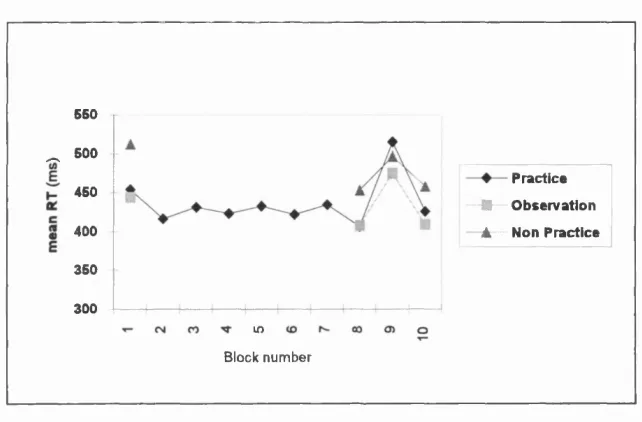
3.1 : Mean RT's for all groups on the SRT task from Experiment 3.1 ...70
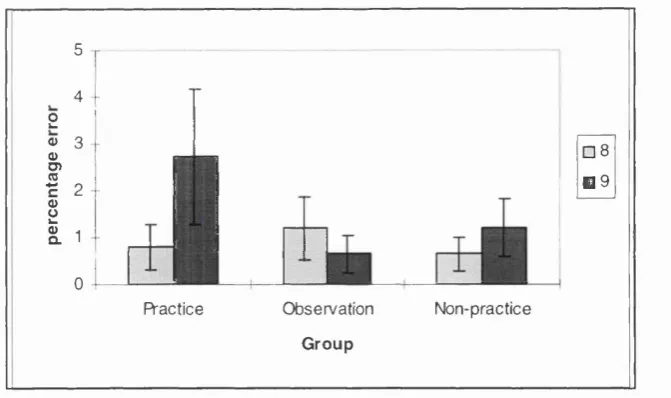
3.1a: Error data (block 8 & 9) for all groups on the SRT task from Experiment 3.1...71
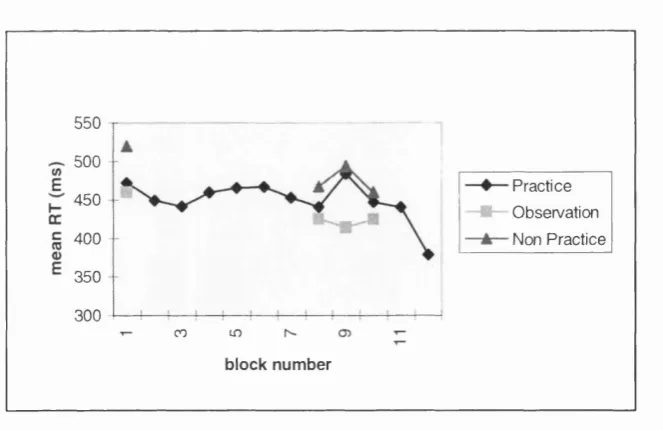
3.2a: Mean RT's for all groups on the SRT task, counterbalancing condition 1, from Experiment 3.2...79
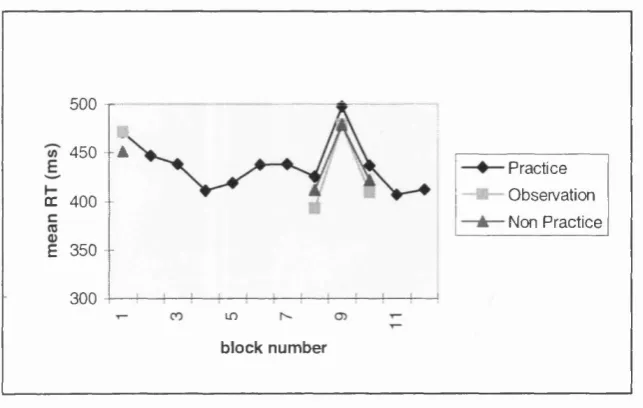
3.2b: Mean RT's for all groups on the SRT task, counterbalancing condition 2, from Experiment 3.2...81
3.2c: Error data (block 8 & 9) for all groups on the SRT task from Experiment 3.2...82
3.2d: Free generation task results for all groups from Experiment 3.2...83
4.1 : Mean RT's for all groups on the SRT task from Experiment 4.1 ...90 4.1a: Interaction of block by exposure condition from Experiment 4.1 ...92 4.1 b: Free generation task results for all groups from Experiment 4.1 ...93
4.2: Mean RT's for all groups on the SRT task from Experiment 4.2...97
4.2a: Error data (block 8 & 9) for all groups on the SRT task from Experiment 4.2...99
4.2b: Free generation task results for all groups from Experiment 4.2...100
4.3: Mean RT's for all groups on the SRT task from Experiment 4.3... 104 4.3a: Free generation task results for all groups from Experiment 4.3... 105
4.4: Mean RT's for all groups on the SRT task from Experiment 4.4...109 4.4a: Free generation task results for all groups from Experiment 4.4...110
5.1...120
5.1b; Free generation task results for all groups from Experiment 5.1...121
5.2: Mean RT's for all groups on the SRT task, stimulus and response transfer tasks from Experiment 5.2... 128
5.2a: Free generation task results for all groups from Experiment 5.2...132
6.1 : Mean sequence discrimination ratios for all groups from Experiment 6.1 ...142 6.1a: Mean discrimination ratios (individual responses) for all groups from
Experiment 6.1...144
6.2: Mean sequence discrimination ratios for all groups from Experiment 6.2... 148 6.2a: Mean discrimination ratios (individual responses) for all groups from
Experiment 6.2...149
6.3a: Mean discrimination ratios (perseverating responses) for all groups from Experiment 6.3...157
Acknowledgements
It goes without saying that firstly I would like to thank my Mum and Dad who have always been willing to listen to my worries and upsets and have encouraged me at all times no matter what. I wish to extend a special thanks to my sister, Joanna who has managed to take my mind off my work, has made me laugh at myself on many occasions, and has wholeheartedly accompanied me on many a night out in and around Macclesfield when I needed a break. What breaks we have had, disco diva!!
My thanks also goes to Celia Heyes, my supervisor, whose professionalism has extracted the best work from me and has subtly kept me in line. Her job has been tough. Also, thank you to David Shanks and Phil Reed who have been a calming influence over the last few years.
To all my friends who have helped me get through the last four years, I say thank you! Nicky Acuna Ocana, Ruth Butler, Caroline Edmonds, Mark Gardner, Clare Simmons, Natalie Owen, Liz Ray. I couldn't have done this without you all and I will miss you terribly. Also thanks to Alphonse Reid, Roger Bunce, Brian Bye and Alan Stewart who have helped me with all matters technical.
Thank you to my office buddy, Fiona Campbell, who has been a great inspiration. Her hard work and diligence have rubbed off. We have laughed together, cried together, moaned together, sighed together and I wish her all the luck in the future.
Last, but by no means least, I want to thank Stephen Rockall, for his love and support over the last two years. He has proved to be a motivating force in my life when times have been tough. He has kept me sane.
Preface
The ability to learn about and remember for later use sequences of actions or events forms an integral part of everyday human life. Consider a child's first attempt to tie a shoe lace or button up a jumper. Both of these complex actions, which we as adults take for granted and which become habitual, consist of a number of smaller manipulations. Only if these manipulations are executed in the correct order and with a certain level of dexterity will it result in the child achieving their goal. The problem that faces a child in its early years is in acquiring the knowledge that will allow him/her to attempt such a feat of manual dexterity and acquire the ability to remember how to do the task so that he/she gets it right each time.
Chapter 1
Human Sequence Learning
This chapter consists of an overview of experiments designed to assess the ability of humans to learn about sequences, and a review of experiments designed to investigate whether sequences can be learned following observation of another agent involved in a task. Section 1.1 reviews the extent to which humans learn about sequences following direct practice alone and makes the distinction between various types of sequences that exist, namely unique sequences, hybrid sequences and ambiguous sequences. Section 1.1.2 makes the distinction between procedural and declarative knowledge and introduces the possibility of a dissociation in performance between measures designed to assess sequence knowledge following observation and practice. Section 1.2 focuses on the evidence for and against observational sequence learning, and includes a review of experiments designed to evaluate the relative contributions of stimulus and response inputs and the extent to which these inputs might be integral for sequence learning. Section 1.2.2 asks how these inputs might be coded and stored. Finally, section 1.3 reviews the current theoretical approaches to sequence learning in humans, with a view to evaluating the extent to which each approach can explain the current evidence for observational sequence learning in humans.
1.1 Human sequence learning through practice
1.1.1 What is iearned via direct practice
m V r r ^ yC /:? r f
Cohen, Ivry & Keele (1990) used a 'tapping task' devised by Nissen and Bullemer (1987). In the tapping task subjects were required to track a sequence of dot movements on a computer screen by pressing appropriate keys on a computer keyboard which matched the location of a dot on the screen. Sequence learning was measured by reaction time, so that if subjects learnt about the sequence of dot movements then one would expect reaction times to dot presentations to decrease over trials. As an additional measure, following a number of predetermined acquisition trials, a single block of trials was introduced in which dot locations were presented in random order. It was expected that if subjects had gained knowledge of serial order then the introduction of a random block of dot presentations would result in a concomitant increase in reaction time.
Cohen et al (1990) compared three types of sequence structure; unique, hybrid and ambiguous. Unique sequences are those for which each element within the sequence provides a unique marker for the next element in the sequence. 13425 is an example of a unique sequence. Here a 1 is always followed by a 3, a 3 always followed by a 4 and so on, each element signalling the next. Ambiguous sequences e.g. 132312 on the other hand, are sequences where there are no unique associations between the elements. A 1 could signal a 3 or a 2, a 3 could signal a 2 or a 1. Finally, hybrid sequences form a mixture of unique and ambiguous pairwise associations. For example consider the hybrid sequence 123243. Here a 1 on all occasions signals a 2, however a 2 could require a subject to press the key associated with 3 or a 4.
to the original sequence which indicated that less learning had occurred.
These results implied that knowledge of a sequence which consists entirely of unique or partly unique pain/vise associations, i.e. hybrid sequences, is more readily disrupted by the introduction of a sequence which is determined randomly in comparison with a sequence which includes no unique pairings. This is probably due to the fact that all or some elements in the sequence provide unique signals for the following item. Ambiguous sequences which do not contain an inherent structure are more akin to a random presentation of dot locations and thus harder to learn. Unique or hybrid sequences also lend themselves to mnemonic strategies such as chunking. These sequences are more readily broken down into smaller sections, thus reducing memory load. This suggestion is consistent with performance under dual task conditions where the subject is required to count tones in addition to tracking the location of a dot on a screen. Under these conditions, performance on structured sequence^ i.e. those with unique or hybrid components, is not disrupted, while performance is impaired on ambiguous sequences. This finding, however, may depend upon the nature of the secondary task. Schmidtke & Heuer (1996) used an auditory go/no-go task which required subjects to respond to high pitched tones by pressing a foot pedal at the same time as they responded to sequence information. They found that knowledge for ambiguous sequences w a ^ s affected as knowledge for unique sequences under these conditions contrary to findings where subjects had to merely count tones.
position of the next dot location was similar to ratings made by subjects that had been exposed to a random array of dots. This implied little or nOyawareness of sequence structure. In contrast learning of the sequence was apparent on the implicit reaction time measure for both unique and hybrid sequences, highlighting a dissociation in performance between the two tasks. In simpler terms it appeared possible to learn implicitly about the inherent structure of the sequence of dot locations reflected by the interference caused to reaction time when novel information is introduced, however, this knowledge did not carry over when subjects were asked to explicitly judge the location of the next dot. The distinction between implicit and explicit knowledge of the structure of the sequence has been referred to as procedural knowledge and declarative knowledge respectively.
Further support for the idea of separable memory systems was found in studies carried out on Korsakoff patientSy^ho typically show impaired declarative memory and so exhibit a lack awareness of structured sequences. Nissen and Bullemer (1987) employed Korsakoff patients on the 'tapping task' and found that these individuals were able to learn the structured sequence under these conditions,
exhibiting interference from the introduction; of a npvel block of trials at a similar , level to 'normal' subjects. Similarly^when scopolamine^was administered to healthy/"^ j
patients^performance was reduced on a measure of awareness but not on the sequence learning task (Nissen, Knopman & Schacter 1987).
1.1.2 Procedural versus Declarative Memory
^ cÎA
measure of awareness. This was interpreted as indicating that sujDjects can learn a sequence without sequence knowledge becoming explicit,i.^. available to conscious awareness.
The hypothesis that there are two separable memory systems, one responsible for sequence or rule based knowledge gained without conscious recollection of prior experience, and the other being responsible for sequence knowledge which is available for verbal recall and so accessible at a conscious level, has attracted considerable research interest. In addition to the tapping task, the hypothesis has been investigated using artificial grammars of the kind first used by Reber (1967). Reber's studies further highlighted the distinction between knowledge that is acquired implicitly and knowledge that is available to conscious recall.
In his early experiments, Reber presented subjects with examples of letter strings e.g. TSSXS or PXVPS and asked them to memorise as many as they could. Subjects were divided into two groups. The first group were provided with a list of letter strings that conformed to a rule based finite-state grammai) e.g. TSSXS, whereas the second group were presented with a list of letter strings which did not conform to any rule at all , their stimuli was generated randomly by computer e.g. PXVPS. The finite-state grammar was generated according to a set of rules producing 43 letter strings of specified lengths. The letter strings used in Reber's study were selected so that examples of all structural regularities of the grammar were present; for all lengths, permissable initial letters, permissable terminal letters, loops or recursions. Subjects at this stage of the study were not informed about the existence of the grammar.
did not. They were then asked to classify the strings into two groups, those which conformed to the grammar and those which did not. The results showed that subjects given grammatical strings to memorize in phase 1 showed superior recall^ in comparison with those given random letter strings, and were better able to classify the strings. However, when asked if they could verbalise the rules of the grammar all subjects failed to do so.
This basic finding was replicated in several subsequent experiments carried out by Reber 1976, Reber & Lewis 1977, Reber & Allen 1978. More recently, Reber, Knowlton & Squire (1996) suggested that knowledge acquired procedurally differs substantially in the way it can be accessed and utilised in comparison with knowledge that is acquired declaratively. In a study which compared amnesiacs, known to have impaired declarative memory, with normal controls,^amnesiacs were found to perform similarly to control subjects on a measure which reflected procedural knowledge . However, when tested on a measure designed to assess the flexibility of task knowledge where the nature of the questions asked differed from those experienced during training, amnesiacs failed to perform well. These findings suggested that declarative memory may have different operating characteristics than memory for procedural knowledge.
However, there are opponents to this argument. Jacoby (1991) has challenged the view that there are distinct procedural and declarative memory systems, arguing th a tj
'...results taken as evidence of unconscious influences (and the like) may have arisen due to the conscious use of memory undetected by the experimenter. One cannot be sure that subjects were unaware of supposedly subliminal stimuli.' (pp.515).
processing may contaminate tasks devised to measure unconscious processes and vice versa.
Perruchet and Amorim (1992) also argued against assuming two separable memory systems and criticised the adequacy of the measures employed in previous studies for evaluating procedural and declarative memory. A major difference between the Perruchet and Amorim study and previous experiments using the tapping task was that they included the free generation task in place of the generate task as a measure of explicit knowledge. In line with Jacoby (1991) they argued that the 'generate' task, which required subjects to indicate the position of the next dot location given the previous two locations, was subject to contamination and could not be described as factor-pure. Generate task results could be said to be a result of 'in task learning' as the task would not allow subjects to move onto the next dot location judgment until they had made a correct response on their current judgement. Sequence learning could have occurred through trial-by-trial correction. Perruchet and Amorim employed the free-generation task as an alternative measure of explicit or declarative knowledge arguing that it provided a more accurate measure of explicit knowledge of the sequence. In the free generation task, subjects were presented with the four possible dot locations on the computer screen and required to attempt a replication of the sequence they had practised during the learning phase of the reaction time task using the appropriate keys on the computer keyboard. This procedure excludes the possibility of in task learning.
original sequence when compared to the random group. Most strikingly a large proportion of subjects trained under structured sequence conditions managed to reproduce the entire sequence whereas under random conditions none of the subjects produced the entire sequence.
1.2 Human sequence learning and observation
The following section aims to provide a review of observation learning literature to date, paying specific attention to whether it is possible to learn sequences of actions or events via observation alone, without practice. More specifically, does exposure to another person executing a sequence of actions result in sequence knowledge of the same kind as follows direct practice and via the same processes as exposure to a sequence of events in the absence of action observation? Does observation alone give rise to a different kind of knowledge?
1.2.1 What is learned via observation
In a study by Funke & Muller (1988), observers and practice subjects were compared on a system known as SINUS and found that observation facilitated learning to a much lesser extent than practice when observers were subsequently required to try to control the system themselves during testing. In the first phase of this study, subjects either watched another individual controlling the task or were required to control the task themselves. During the test phase, all subjects were assessed on their ability to control the task and achieve task goals. Results showed that observers were significantly worse at controlling the task than subjects who had been involved in direct practice with SINUS. However, observers showed superior performance when asked to construct a causal model of the task, showing expert knowledge of the causal relations between task variables and routes to correct performance.
control SINUS themselves during the learning phase, subsequent testing of their knowledge of the rules of the task may have reflected knowledge gained implicitly. This finding is similar to those subjects in the Cohen et al study who showed a large amount of interference caused to RT's due to the introduction of novel sequence information following the memory phase of the 'tapping task. In Funke & Muller's study this might explain why practice subjects, having gained procedural knowledge of the task , were unable to state explicitly the rules when asked to do so. In contrast, observer subject performance in the Funke & Muller study could be argued to reflect explicit knowledge of the rules of the task. Subjects watched another individual engaged in the task of controlling SINUS and so were forced to search explicitly for the rules which, in turn, may have accounted for their superior performance when asked to state what the rules were. Here, their expert knowledge of the causal relations between task variables could be argued to be analogous to free generation task results in previous studies.
Berry (1991) also compared the task-control performance of subjects that had practised controlling a task with those who had observed someone else controlling the task. She used a computerised task, which has subsequently become known as the sugar production task, in which subjects are required to maintain a specified level of production by manipulating a variety of work force variables e.g. worker input. Level of production was related to the work force variables by the rule, P = (2 X W - P I) + R, where P = current sugar output, PI = preceding trial sugar output,
W = size of the workforce, R = +1000, 0 or -1000 tons, at random.
knowledge, although findings from a later study suggested that the nature of the rule underlying the task may account for observer performance on the sugar production task.
In a second study; Berry (1991) compared a group of subjects who observed a person generated by the computer interacting with the sugar production task in which the underlying rule was changed so as to be considered salient. A second group of subjects observed the computer interaction with the task under a non salient rule. In order to make the original algorithm, described above, salient or non salient, Berry included the conditions p=S-2 and p=S1-2 respectively. This meant that for the salient condition controller's behaviour was directly related to the computers immediately preceding response, whereas for the non-salient condition, controller's behaviour was related to, not the immediately preceding response, but the one prior to that. Comparison of the two groups suggested that learning by observation may be limited to situations where the underlying rule is salient and not non-salient as suggested by Berry's first study. This finding was further supported by data emanating from post-task questionnaires of awareness which showed that observers who had seen the salient rule showed significantly greater knowledge of the task than observers that had seen a non-salient rule.
These two studies suggest that observers are unable to control output on the sugar production task when the rule is non-salient or the task is one which gives rise to implicit knowledge. Whilst on a salient task where the rules of the task are more apparent or could be considered to be more obvious, learning can occur. In addition, a measure of awareness implied that observers in the salient condition were more able to state the rules of the task.
However due to problems surrounding what is truly meant by the term salience, coupled with the possibility that by making the rule more obvious to observers this resulted in task demands becoming more explicit, it is impossible to state that Berry's findings suggest a dissociation^does not exist. In a third experiment, which investigated directly whether action was integral to learning to control the sugar production system. Berry found that observers who instructed another person to type in the decisions they made during the learning phase of the task performed badly when later controlling the task themselves compared with a second group who observed the task during the learning phase but were able to type in their own decisions. For this second group, participants were able to control the task at a significantly higher level implying that having direct interaction with the task is integral to control performance and that observation alone is not sufficient to assure success.
Kelly & Burton (in press) found no evidence of observational sequence learning in an experiment which utilised the serial reaction time task. In Experiment 1 (Kelly & Burton, in press) the response group was trained on sequence 42313214321^
neither responds or observes during the training phase. Kelly & Burton did not
trvon
include such a group. Although observers were found to respond 75ms faster that the response group during their first block responding to the training sequence which suggests that some observational learning had occurred these data do not provide a clear indication of whether observation is sufficient for sequence learning.
On the basis of the evidence outlined above, it is not clear whether observational sequence learning is possible when the sequence to be learned is not a salient one, and the measure on which learning is assessed is indirect. However, given the appropriate contrpls^i.e. non-exposure, this may provide a clearer indication of any differential learning that may occur following observation.
1.2.2 Perceptual versus Response learning
Funke & Muller's (1988) study, and Berry's (1991) study raised some important questions regarding the ability of individuals to learn by observation alone. In the Funke & Muller study, observers showed poor performance on a task which aimed to assess implicit or procedural knowledge of the rules of the task, but performed well on a task which aimed to assess explicit or declarative knowledge. In Berry's (1991) study, observers were able to control the task on a measure of procedural knowledge but only when the rules were made more salient. If the rule was non salient observation did not facilitate learning. More importantly follow-up studies implied that action / actually participating in the task via key pressing/ may be integral to good performance on the task.
One of the most fundamental questions to arise from this debate relates to whether motor responses are integral to serial learning (response learning) or whether stimulus information is sufficient to allow sequence learning (stimulus learning). It is possible that observers may learn about responses and stimuli under observational conditions but how this information is coded and stored is of particular importance. Learning about stimulus inputs may be stored in terms of a
motor and/or a perceptual code and learning about responses may be stored perceptually and/or motorically. On the whole evidence for the predominance of perceptual over motor processing or vice versa following stimulus or response learning is mixed. Some studies have suggested that perceptual and motor knowledge of serial order develops independently (Howard 1992, Fendrich et al 1991, Stadler 1989), whilst others propose that both processes are inextricably linked (Willingham et al 1989).
responded to using the right middle and right index fingers respectively. If responding with your fingers is integral to learning the rule underlying the task and that is accompanied by storing response information on the basis of a motor code then any change to the fingers used to carry out the task should result in disruption to reaction times.
Stadler (1989) found that reaction time to the target was severely disrupted when the position of the target within the quadrant was altered between the training phase and testing, and that changes to the way in which subjects responded via the keyboard had a minimal effect on RT. This result implied that although subjects gained some information via keypressing (response learning), knowledge of the rules of the task were predominantly stored via perceptual processes.
In a similar vein, Howard et al (1992) obtained similar results using the tapping task (Nissen & Bullemer 1987). The task consisted of subjects pressing one of four keys to the location of an asterisk which appeared on a computer screen. The position of the asterisk was governed by a sequence BCACDCDBADADACAD which was repeated over 7 blocks (1-4 & 6-8, 10 times within each). The sequence in block 5, however, was entirely random. As is usual for this task, it was anticipated that if anything was being learned about the sequence during blocks 1 to 4, the introduction of a random block would result in an increase in RT. Subjects were required either to practice the sequence via keypressing or merely watch where the asterisk was located without making contact with the keyboard. For practice and observation groups, RT increased significantly during block 5. This result implied that both observing and participating in the task can produce equivalent knowledge about the sequence involved in addition to being consistent with the idea that perceptual processes can develop independently.
responses thus setting up a motor program. Subjects were required to search for the target letters which were embedded in a matrix of non target letters. Although the order of presentation of target letters was entirely random, the location of the target letter within the matrix was systematically predetermined by the location of the previous target letter. Therefore, subjects learned a sequence of responses which corresponded to the location of the target letter on the computer screen. Two measures of sequence knowledge were taken; the first introduced a random block of target locations in order to assess the extent to which subjects were able to anticipate the location of the next response, the second measure made changes to the location of the target letters in an attempt to disrupt any motor program which had been established during training. RTs were found to increase significantly following the introduction of a random block of trials implying that subjects had learned about the relationship between the responses made to the target letters and their particular location. In addition, when the location of target letters was altered in an attempt to disrupt any motor program that had emerged during training, RT's increased to a level well above baseline. This result implied that disrupting a well established motor program had a severe effect on subjects ability to perform well on this task providing evidence that subjects learned about responses, that the response information was stored motorically and may be integral to implicit serial learning.
possible perceptual learning of the sequence of stimulus locations. Motor condition subjects would have the opportunity to learn a motor program and the control condition subjects would learn neither about motor responses or about perceptual information. After a number of training traite subjects took part in a transfer task where they had to respond to the location of the stimuli and not the colour.
Willingham et al (1989) found that subjects in the perceptual condition/showed no learning of stimulus location; their RTs were equivalent across all stages of training. Subjects in the motor condition however, showed a significant decrease in RTs over trials, implying knowledge of the sequential presentation of colours. Willingham et al concluded from these data that learning had taken place through the motor response rather than stimulus learning. Turning to the transfer data, Willingham et al found that neither group showed any effect of transfer. Willingham et al had proposed that if motor processes were entirely responsible for learning then subjects in the motor condition group would show good transfer because the same motor sequence was employed, although location rather than colour was important. Why was this not the case? They argued that the transfer data implied that both perceptual and motor processes are utilised simultaneously. During initial training, motor responses were matched with colour stimuli and so provided a colour context for responding. During transfer, however, colour became irrelevant and location important, thus providing a new context for responding. Willingham et al argued that once 'production rules' are formed they do not readily transfer to other tasks.
et al study could be said to conform to an ambiguous sequence structure and so it is possible that subjects in the perceptual condition failed to show learning of the location of the stimuli in phase 1 of the study on that basis. Similarly, the Willingham
I
5study presented subjects with two stimulus condition^ colour and location, thus giving rise to the possibility that attentional resources may have been divided between them. Due to this, it is possible that the specific attentional demands of the task resulted in no evidence in favour of independent processing.
More recently, Mayr (1996) suggested that the nature of the stimuli employed in the Willingham et al (1989) study was inappropriate to maximise conditions under which independent perceptual learning might occur. He argued that it is necessary to ensure that target stimuli are sufficiently distinct in terms of their spatial location to ensure extensive orienting. In Willingham's study, stimuli were located in close proximity and of such a distinctive colour that extensive orienting was not achieved. In response to these criticisms, Mayr (1996) altered Willingham et al's (1989) stimuli so that valid spatial expectations could be made and replaced the colour stimuli used in the original study with an object discrimination task. Following transfer, data revealed evidence of pure spatial learning independency from any motor output.
1.3 Models of memory for serial order
is represented in memory. What follows will be an overview of the various models of memory for serial order.
Prior to assessing the relative merits of the various models of sequence learning it would be useful to provide a summary of the necessary prerequisites of memory for serial order. Consider the sequence A B 0 D. In order to learn about this particular sequence, it is first necessary that some kind of representation of each separate item in the list is formed and encoded accurately. In the case of Nissen & Bullemer's (1987) tapping task, where subjects are required to track the location of a dot which could appear in one of four possible locations, position A in the sequence may be encoded as 'far left', position B as 'middle left', position 0 as 'middle right' and so on. Second, once individual representations of each item are formed there should be in place some kind of process which encodes the relative position of each item within the sequence. The ability to order items correctly is an integral part of ensuring quality of performance upon retrieval.
All of the models of memory for serial order are based on these basic assumptions they differ only in the way in which they define the actual units of storage. The way in which these assumptions are represented between the differing architectures is not an issue here. This section will concern itself with the way in which the various models represent sequence information in memory and more importantly how each model suggests that the relations between items in a sequence are formed.
1.3.1 How associations are formed
The most successful models of sequence learning, those which claim to be able to account for the majority of the data on sequence learning, assume that memory for serial order is acquired via a mechanism which enables the formation of associations between representations of items in a list. These models are deemed associative in nature.
1.3.2 Chaining models
Chaining models assume that associations are formed between pairs of items in a list in such a way that they form a chain of links between them. For example, the sequence A B 0 D, would be represented as A-B-G-D. The first element of the sequence, 'A', would be represented as the start of the list so when triggered would lead to the activation of the connection A-B. As soon as B' is activated this would trigger the link A-B to B-0 which in turn would trigger the connection between B and 0. This would carry on until the entire sequence had been recalled.
One obvious problem with this approach is that when an item is incorrectly recalled it becomes impossible to recall the rest of the sequence. Basic chaining models do not provide any mechanism for correction. A possible solution to this problem has been suggested by Lewandowsky & Murdock (1989). If the model allowed approximations of an item to be utilised as a cue for the next item then if a representation of B were lost or incorrectly encoded the approximation of B could lead to the next item 0 even if B were never recalled. More complex chaining models have included what is known as backpropogation learning to overcome such difficulties. Backpropogation is useful in that it allows backward links to be formed between input and output units. These links allow the network to update regularly so that information stored in the input units regarding the relationship between one unit and other units in the network is further strengthened. Consequently if an error occurs during recall, backpropogation allows the network to "backtrack" and correct itself.
than those that are considered to have an ambiguous structure (Cohen et al 1990). According to a chaining model all sequence structures should be encoded on an equal basis. A further problem for chaining models is that they predict that similar items in a list are likely to be incorrectly recalled due to the fact that their retrieval cues may be similar if not identical. This does , however, lend support to findings which show differences in the ability to process unique vs ambiguous sequences in the sequence learning literature. Ambiguous sequences typically contain no unique markers to aid learning. An example of an ambiguous sequence is 132312. The retrieval cue for 1-3 would possibly be similar to the retrieval cue for 1-2 and so, according to the chaining approach, would lead to mistakes upon recall.
1.3.3 Inhibition models
A second category of model used to explain sequence learning is that which incorporates context or alternatively some kind of inhibitory mechanism. Inhibitory mechanisms have recently been viewed as integral to any explanation of memory for serial order and so will be mentioned in greater detail here. The basic premise is that inhibitory mechanisms allow us to pinpoint the exact location of an item within a sequence, know the position of that item within any given list and then reconstruct items in the correct order.
associations between them. This aside, the competitive queuing model poses difficulties for stimuli which contain repeated items. Consider the sequence A(i) A(ii) B C D , here the first item A(i) would have the highest level of activation and so would be the first to be sent to the output units for recall. Problems arise, however, when attempting to recall the second item A(ii). Due to the fact that both the first and second items are identical it is possible that any inhibition which has occurred following recall of the first item A(i) may in turn inhibit recall of the second item A(ii), especially if recovery from inhibition is slow. Difficulties in recalling identical items is well reported in the literature on characteristic errors in spelling (Brown 1997). This problem does not, however, account for free generation data where subjects are required to replicate a sequence many times to complete the task. There is no evidence that as the number of replications increases so the number of correctly generated triplets subsequently decreases. This criticism of the model could be overcome if recovery from inhibition was speedy and quick.
Data which support an inhibition model of serial memory and accommodate the problem of repeated items is that which refers to poor learning of ambiguous sequences. Ambiguous sequences tend , by nature, to have many repeated items and so, according to this approach, mistakes may tend to occur around these items leading to poor learning (Cohen et al 1990).
1.4 Summary
was argued to have been as a result of the type of RT task employed between studies and in their use of control groups. In contrast Kelly & Burton (in press) employed a task similar to the one employed Howard et al. (1992) and therefore differences in the results between these two studies are of greater interest. One possible reason for the lack of an observation effect in the Kelly & Burton (in press) study, different from the presence of observational learning in the Howard et al. (1992) study, was that their sequences were balanced as much as possible for transition and location frequency and so any interference caused to RT on test could not have been due to a greater familiarity for some sequence items as might have been the case in the Howard et al. (1992) study. More importantly, evidence of observational learning might have been more apparent if Kelly & Burton (in press) had employed a non exposed control group who had no opportunity to perform or observe the sequence to be learned during training.
Chsptsr 2
Animal sequence learning
The following sections will provide a critical review of studies which look at the ability of animals to learn sequences of actions or events. Chapter 1 asked, can humans learn about serial order following observation of another agent in the same manner as occurs following direct practice and how this learning takes place i.e. via the process of motor or perceptual learning. Here, chapter 2 asks a more general question; are animals capable of performing a sequence of actions or events and can this learning extend to learning by observation. There is ample evidence that a number of species are capable of learning sequences of events or behaviour asocially e.g. lever presses, the order of food reward in a maze indexed by speed of running. However, there is little evidence that this kind of information can be learned under observational conditions in a purely social setting. Observational learning is typically viewed as unique to humans and although there have been many attempts to investigate this type of learning in animals, studies have produced equivocal results.
2.1 Stimulus and Response Learning by observation.
Within the field of animal social learning, researchers have looked for evidence of an animals' ability to learn about the environment directly from interaction with a member of its own species or a conspecific. For humans the ability to gain useful information about objects, goals, actions by observation of another person is assumed. The ability to utilise social and observational cues to their advantage enables humans to acquire new skills. Whether animals can utilise this kind of information to direct their own behaviour is a question still under debate.
Research on social learning in animals has identified two categories of learning which can occur following observation of a conspecific involved in a task; stimulus learning and response learning. Stimulus learning refers to the benefit gained following observation of a conspecific which serves to make objects or stimuli within the environment more salient thus encouraging or discouraging subsequent observer interaction with those stimuli or serves to establish a connection between a stimulus and reinforcement for example. An example of stimulus learning is stimulus enhancement which refers to "a change in stimulus conditions, the enhancement of the particular limited aspect of the total stimulus situation to which the response is made" (Spence 1937, p 821) which occurs via observation of a conspecific coming into contact with that stimulus. Response learning, on the other hand, is more commonly associated with learning by imitation (Heyes 1993), and refers to the ability of an animal to learn about actions, responses and patterns of actions and responses as a direct result of conspecific observation. Evidence of response learning as opposed to stimulus learning is defined in terms of the extent to which observer action is found to match conspecific action. If an observer responds in a manner identical, and topographically similar, to the method of responding employed by a demonstrator animal then this would be deemed to be evidence of response learning.
different types of social learning that exist. However, it would be useful to provide a brief overview of the extent to which animals can learn when using observation as a cue for learning. In this thesis I am partly interested in the type of learning which results, whether that be stimulus or response learning, however the emphasis will be on whether animals are able to learn about the relationships between stimuli, particularly sequential stimuli, through observation alone.
2.1.1 What can animals learn via observation alone?
McQuoid and Galef (1992) trained demonstrator birds to eat out of one of four bowls placed in an enclosure. Once they were confident that demonstrator animals would consistently eat from a particular bowl they allowed a second group of naïve birds to watch demonstrator feeding from outside the enclosure. To examine whether demonstrator preference for a particular food bowl would influence the feeding behaviour of observers, observer birds were then allowed to explore the enclosure for themselves. Observer birds showed a definite preference for the bowl from which the demonstrator birds had eaten. McQuoid and Galef suggested that by watching the demonstrator interact within the environment of the enclosure observers learned something about the place from which it was best to eat and had gained information about the most appropriate object to eat from i.e. the food bowl.
for learning under these conditions.
Turner (1964) investigated social feeding in birds by constructing a mechanical hen which would peck at different coloured seeds on the ground. This artificial method was preferred because when live hens had been used demonstrator behaviour was so variable that Turner found it impossible to ensure accuracy of seed pecking. The mechanical hen was hand operated and made to look as near as possible like a real hen. Two groups of chicks were used. The first group were housed together and formed the 'social ' group and a second group of chicks were kept in social isolation and had no experience of other birds or indeed pecking behaviour. Turner argued that if social cues were an important factor controlling the feeding of birds then birds in the social group would be more likely to feed on items selected by another hen compared with a chick which had no experience of social relations. The chick and mechanical hen were separated by a wire mesh partition and the hen was placed close to the mesh so that the chick could approach within a few centimetres of the apparatus. Chicks were offered a choice of orange and green seeds to peck arranged alternately in a row along the edge of the partition. The chick was allowed to observe the mechanical hen pecking at either a green coloured seed or an orange coloured seed. For half of the test trails the mechanical hen pecked at seeds of one colour type and then switched to the other colour type for the remainder of the test trails. Results showed that chicks that had been housed in social groups were more likely to peck items in general within the testing enclosure than those chicks which had been reared in isolation. In addition the social group chicks were also found to approach the food source in a faster time , were more likely to peck at those seeds which were coloured orange or green compared with non coloured seeds and most importantly showed a preference for pecking the same colour type of seed as the mechanical hen.
it is necessary to approach these results with caution. This kind of study cannot state conclusively that findings are as a direct result of social factors as artificial methods were used to elicit such behaviour and there is no suggestion that findings might be replicated with a live hen as a demonstrator. In addition it may be that chicks reared in social groups had acquired pecking behaviour from their companions which was not possible for those chicks reared in isolation. It can be argued , however, that learning by observation had occurred at some level as the 'socially housed' chicks showed a preference for pecking seeds of the same colour type as the mechanical hen. However, it is not possible to state whether observers learned about demonstrator responding in particular or whether they learned specifically about the stimuli involved in the task. This kind of experiment stresses the importance of including demonstrator groups designed to assess whether learning can occur regardless of demonstrator behaviour and the necessity of including the means by which to distinguish between response and stimulus learning.
2.1.2 Is there any evidence for sequence learning by observation?
It appears that it is possible for an animal to learn about stimuli or responses by observation as evidenced by the studies cited above. This thesis, however, is primarily concerned with the question; Can animals learn about the sequential ordering of stimuli by observation? Evidence of sequence learning by observation in animals is typically found amongst studies which aim to investigate imitation in animals.
of this procedure do not exist between individual gorillas, some gorillas may have a preference for one hand over the other (Byrne & Byrne 1991) for example. The most important aspect of this approach is that it is essential that the manipulations are carried out in the correct order.
The problems associated with observations made in a natural setting as outlined by Byrne and Russon (1996) pose difficulties when making definite claims as to the type of learning which is responsible for the acquisition of this particular feeding behaviour as it is possible that the observed regional differences in food preparation could be attributed entirely to individual learning brought about by differing ecologies. Behaviour which Byrne and Russon argue to be imitative (response learning) can be equally explained in terms of other forms of social learning, such as emulation learning (Tomasello 1990). Emulation refers to an animal learning about the causal structure of a task by acquiring facts about entities and events within the environment, which lead to transformations and changes to the animals own behaviour directly as a result of the behaviour of another animal. An individual learns about the "affordances" of the environment which hitherto it would have been unlikely to have learned itself. It is entirely plausible that in the case of Byrne's gorillas, animals learned, via emulation, about the causal structure of the feeding process and not about the particular actions required to carry it out successfully. Using this knowledge of causal structure, individual success at eating the plant is more likely to be as a result of stimulus learning of sequence structure and a by product of trail and error. To overcome the problems associated with distinguishing between the various forms of social learning, experiments which aim to investigate sequence learning by observation in the laboratory utilise a method named the two action task which goes some way towards solving the problems associated with observations made in a natural setting.
gained. On the side of the puzzle box was a steel rod manipulandum which could be moved in three ways in order to gain access to food e.g. push, pull and/or rotate. On the front panel of the box was also a large protruding pipe from which food could be dispensed if the correct manipulation to the puzzle box was made. Following a brief period in which the orangutan was allowed to familiarise itself with the apparatus a human demonstrator manipulated the steel rod according to a combination of simple actions. One group of apes was shown a demonstration of 'push then rotate' and a second group was shown the reverse order i.e. 'rotate then push'. In addition, each group of animals was also exposed to the puzzle box for a set of 'control' trials where no demonstrator was present. This was to ensure that the existence of any subsequent matching behaviour was as a direct result of demonstrator behaviour. Each ape saw thirty demonstrations of the sequence of manipulations in which the human demonstrator was seen to receive food reward which was then consumed. Following each demonstration the orangutan was then allowed to manipulate the puzzle box for a period of time during which any manipulations made to the manipulandum were recorded.
Results showed no evidence of sequence learning following demonstration of a combination of complex actions, in fact neither group of orangutans showed any tendency to match demonstrator behaviour and performed at a level similar to chance. In addition, findings suggested that the presence of a demonstrator had no facilitative effect upon orangutans' ability to reproduce a sequence of actions in order to gain food reward. Follow-up studies, which aimed to overcome criticism that a human demonstrator may be inappropriate as a model for behaviour, found that even when using an orangutan demonstrator i.e. a conspecific, no evidence of sequence learning by observation was forthcoming.
Terrace (1991) in an experiment with pigeons found evidence that in order for a sequence of manipulations to be executed the various component items of a sequence have to be present within the animal's repertoire for reproduction of a combination of those items to occur. This was already the case in Call and Tomasello's study. It is possible that observers may not have been allowed sufficient exposure to demonstrations of the different action sequences which may account for a failure to find sequence learning. Terrace (1993) found that to master lists of between four and seven items asocially chimpanzees typically took in excess of thirty trials to attain maximum learning so it is possible that under observational conditions many more trials are required before learning is achieved.
The animals employed in the Call & Tomasello (1995) study displayed many idiosyncrasies in their manipulations of the puzzle box. A criticism of many studies of this nature revolve around the notion that too much emphasis is placed upon correct replication of the actions required from the observer animal following demonstration. Byrne and Russon (1996), advocate evaluating the correct ordering of actions rather than concentrating upon the actions themselves. In line with this suggestion, Call and Tomasello scored observer actions in terms of categories of behaviours i.e. pull, push and rotate responses, regardless of the actions employed in addition to scoring observer actions in relation to how well they matched demonstrator action.
error.
Whiten (1998) utilised a variation of the two-action method by constructing an 'artificial fruit'. The 'fruit' was analogous to the puzzle box in the Call and Tomasello study (1995) but differed in that food reward was placed inside the box and could be accessed upon opening. Whiten used arbitrary sequences of actions and manipulations in contrast to the type of sequences employed in the puzzle box study, which were necessary to gaining food reward. This approach was designed to eliminate individual trial and error learning and problem solving.
Manipulations made to the fruit differed along two dimensions; order of manipulation of the various manipulanda on the 'fruit' and secondly the actions required at each stage of the process. The two sequences were [far-bolt/inner- bolt/pin/handle] and [pin/handle/far-bolt/inner-bolt] respectively and were demonstrated to observer subjects using differing arbitrary actions e.g. twist then spin then turn or turn then spin then twist. In total subjects were allowed 5 demonstrations of each method before testing began. Observer responses were coded in terms of how well they conformed to the sequence of manipulations they had been shown and whether they reproduced the specific actions they had seen demonstrated. Findings indicated that chimpanzees showed a tendency to replicate the sequence they had seen during observation but showed no tendency to reproduce the demonstrated actions. In simpler terms, if the observer had seen [pin/handle/far-bolt/inner-bolt] it was more likely to approach the pin prior to the handle followed by the far and inner bolt in that order. The tendency for chimpanzees to replicate the correct order of demonstrated manipulations can be explained as these apes being able to learn a stimulus sequence by observation. However, the finding that the chimpanzees did not reproduce any of the observed actions suggests no evidence of response learning or learning by imitation.
TuAr-maee CxtmAWZEg, 8cnrKfc>
ALTEA\lArhfCfWenfcDO ■ca^
two items, as the bolts and the bars may have been encoded as pairs of manipulanda) by observation. It seems likely that the chimpanzees learned primarily about stimuli, that the bars and bolts moved according to a particular order, rather than learning to make certain body movements in a particular order in order to gain access to the contents of the box (response learning). However, there is little indication from the results of this experiment how the chimpanzees learned the sequence by observation i.e. what cognitive mechanisms are involved.
2. 2 Theories of animal sequence learning
Studies which investigate animal sequence learning generally might provide some insight into the mechanisms responsible for sequence learning which occurs following observation. In addition they may provide some clue as to how the chimpanzees in Whiten's 1998 study learned to manipulate the artificial fruit in the correct order, and extend some explanation as to why these apes fail to replicate the correct action components of the task. Sections 2.2.1 and 2.2.2 provide examples of studies showing that nonhuman animals are able to learn about sequences through direct exposure to serially ordered events, and examines a theoretical account of the mechanisms mediating this learning.
2.2.1 A Rule Encoding account
three pellet reward(3) and so on until the sequence [0-1-3-7-14] was complete. Group 2 rats were exposed to food quantities that decreased monotonically from the largest to the smallest according to the rule E(i)>E(i+1). Here rats would encounter a fourteen pellet reward (14) in the first maze arm, followed by a seven pellet reward (7) in the second and so on until the sequence [14-7-3-1-0] was complete. Group 3 rats were presented with food quantities which were arranged in a random order throughout the maze and two further groups were included, one where the terminal element was always zero and the second where the terminal element was always fourteen.
Results indicated that running speed increased or decreased monotonically dependant upon the nature of the pattern of reinforcement. Group 1 rats, for whom reinforcement increased at each stage of the maze, were found to run progressively faster at each increase of food compared with group 2 rats who ran faster towards the first element of the sequence, in their case the fourteen pellet reward, and then slowed progressively as food reward decreased in quantity. This result implied that rats are able to learn the order in which food would appear and are sensitive to the relationship between each successive element . This suggestion was further supported following comparison with group 3 who had been exposed to a random food presentation. This group ran with equal speed between each element implying no knowledge of sequence order. The biggest change overall in running speed was noted for the zero pellet reward which appeared to be the most salient element.
hungry rat to run quickly regardless of the magnitude of the next food reward. A second explanation of results, temporal anticipation, suggests that rats respond to the terminal element alone and so run faster if included in the monotonically ascending group (Group 1) and slower if included in the monotonically descending group (Group 2). Results bear out this explanation and it is not possible to disregard this explanation completely. However, if temporal anticipation of the terminal element is crucial then one could expect to see equivalent running speeds towards the first four sequence elements for a group exposed to a random sequence (Group 3), followed by a decrease or increase in running speed towards the terminal element dependant upon its magnitude, either zero or fourteen pellets. Running speed was found to decrease following a random presentation of food reward which ended in zero but did not increase following a sequence which ended in a fourteen pellet reward. The particular saliency of the zero pellet reward in the third random control group and the slowing of running for group 2 (monotonically descending) can also rule out explanations such a counting, frustration and other emotional or motivational factors.
pellet reward and decrease in anticipation of the zero pellet reward. Results showed sensitivity to the zero pellet reward but not to the fourteen pellet reward when one would expect faster running speed if S-R links have been formed.
A chaining explanation of a rats memory for serial order is possibly too simple an explanation to account for the findings in Hulse's original study. An alternative theory which has been proposed suggests that ratsf may be encoding the structural features of the sequence rather than relying on simple pairwise associations. Here some feature of the structure of the sequence is encoded although the theory is unclear as to what these features are. It is possible that by features this could refer to the complexity or simplicity of the sequence, the internal structure i.e. whether food reward is ascending or descending, the saliency of particular sequence items i.e. a zero food reward may result in greater disappointment leading to slower running to that event, or some other identifying markers. In the same way that humans form some kind of representation of the structure of a sequence by identifying markers or cues within the pattern which in turn can be used as mnenomic triggers for recall so it is postulated that rats learn some feature of the sequence itself which in turn can be used as a trigger for recall.