Combining Case-Based Reasoning with
Neural Networks in Diagnostic Systems
Eliseo Berni Reategui
A dissertation submitted in partial fulfilment
of the requirement for the degree of
Doctor of Philosophy
of the
University of London
Department of Computer Science
University College London
ProQuest Number: 10106655
All rights reserved
INFORMATION TO ALL USERS
The quality of this reproduction is dependent upon the quality of the copy submitted.
In the unlikely event that the author did not send a complete manuscript and there are missing pages, these will be noted. Also, if material had to be removed,
a note will indicate the deletion.
uest.
ProQuest 10106655
Published by ProQuest LLC(2016). Copyright of the Dissertation is held by the Author.
All rights reserved.
This work is protected against unauthorized copying under Title 17, United States Code. Microform Edition © ProQuest LLC.
ProQuest LLC
789 East Eisenhower Parkway P.O. Box 1346
Abstract
This thesis presents a new approach for integrating Case-Based Reasoning (GBR) with a
Neural Network (NN) in diagnostic systems. In the hybrid NN-CBR approach, the neural
network makes hypotheses and provides remindings that are used in guiding the search for
similar experiences in a library of previous cases. GBR is responsible for the selection of a
most similar match for a given problem, as to support a particular hypothesis made by the
neural network, or to decide among hypotheses. Items called diagnosis descriptors have been created in order to represent in an intelligible way the knowledge stored in the neural network.
These descriptors are used for consultation purposes, for confirming or refuting a final result,
and for building explanations.
The NN-GBR architecture has been used in the development of a system for the diagnosis
of Congenital Heart Diseases (GHD). The system has been evaluated using two cardiological
databases with a total of 214 GHD cases. The cases of the first database were collected with
the supervision of an expert in GHD, while the cases of the second database were collected
without expert supervision. The hybrid system has shown a good performance when
diagnosing cases of the first database. Additionally, its diagnosis descriptors created to interpret the knowledge of the neural network have been found to be similar to the knowledge
elicited from experts for the same diagnostic problems. A drop in performance could be
observed when the system was trained to diagnose cases of the second database, whose cases
were collected without the supervision of an expert. Three other well-known databases have
been used to evaluate the NN-GBR approach further. The hybrid system manages to solve
problems that cannot be solved by the neural network on its own. Additionally, its indexing
mechanism based on remindings provided by the neural network introduces a significant
reduction in the number of case comparisons, if contrasted with a standard nearest-neighbour
procedure.
By using these alternative knowledge representation and reasoning schemes, the hybrid
NN-GBR approach suggests some solutions for common GBR problems (e.g. indexing and
retrieval), as well as for neural network problems (e.g. the interpretation of the knowledge
Acknowledgment
Thanks to Prof. John A. Campbell for his invaluable support and advice. His outstanding
ability to always come up with a story related to the topics we had to discuss has been
essential in guiding me throuout the three years of research I carried out at UCL. It has been a
priviledge to work with such a remarkable man.
Thanks to Dr. Beatriz Leao for her help in providing the cases which were used in the
validation phase of the work reported in this thesis, and for the comments on the results
achieved.
Thanks to Dr. Eneida Mendonca for her additional collaboration in the collection of cases of
Congenital Heart Disease.
Thanks to Jonathan Poole for his initial support in the beginning of my work at UCL.
Thanks to Mara Abel for her attention and concern, for the helpful comments and
bibliographic references.
Thanks to Rafael Bordini for the friendship, the technical support and hospitality when
hosting me indefinite times in London.
Thanks to my dear Gisella for being such a good friend, in occasions where I most needed
one.
Thanks to my mother, my aunts, my brothers, and all the rest of my family, for always
supporting me regardless of distance which separated us.
Thanks to Jean-Francois for motivating me, for giving me support in difficult moments, for his
Contents
1 Introduction 11
2 Combining CBR with other Reasoning Approaches 16
2.1 Intro ductio n ... 16
2.2 Indexing in CBR S y ste m s ... 16
2.3 Combining CBR with other A p proaches...20
2.3.1 Combining CBR with other Symbolic Reasoning M echanism s...27
2.3.2 Combining CBR with Neural N etw o rk s... 33
2.4 Difficulties and Inconveniences with Hybrid CBR A p proaches... 39
3 Related Research: Integrating Symbolic and Connectionist Processing 41 3.1 Introduction...41
3.2 Integrating Neural Networks with Symbolic S y ste m s... 49
3.3 Difficulties with Hybrid Symbolic/Connectionist A pp ro aches...54
4 Knowledge Graphs, CNM, HYCONES and other Experiments 57 4.1 In tro d u c tio n ...57
4.2 Knowledge G ra p h s ... 59
4.3 The Combinatorial Neural M o d e l... 61
4.4 The System N E X T O O L ... 65
4.5 The System H Y C O N E S ... 67
4.6 Other Prior E xperim ents... 71
4.6.1 Classifying Credit Card T ransactions... 72
5 The Hybrid NN-CBR Model 81
5.1 In tro d u c tio n ... 81
5.2 The NN-CBR M odel...82
5.3 Representing the Domain Knowledge... 84
5.4 Representing C ases...86
5.5 The Combinatorial Neural M odel... 88
5.5.1 The Neural Network Learning M echanism...90
5.5.2 Training the CNM for a Simple Diagnostic Problem ...91
5.6 The Diagnosis D escriptors... 95
5.7 The Learning Process... 100
5.8 The Reasoning Process...105
5.9 Reinforcing a Final R esult... 114
5.10 Final Rem arks... 117
6 Validation Results 119 6.1 Diagnosing Three Frequent CHD Problem s...119
6.2 CHD - Diagnosis of Four other Problem s...124
6.3 The Soybean and the Mushroom D atabase...136
6.4 The MONK’S Problem s...138
6.5 Further Comm ents... 141
7 Discussion 143 7.1 The NN-CBR Architecture and other Related W o rk ...143
7.2 Limitations and Apphcability of the Hybrid A pproach...152
7.2.1 Modifications and Possibilities... 157
7.2.2 Creating the Neural network... 158
7.2.3 Building the Diagnosis Descriptors...159
A The Knowledge Acquisition Methodology for the
Elicitation of Knowledge Graphs 166
A. 1 Phase 0 - Problem D efinition... 166
A. 2 Phase 1 - Knowledge A cquisition...166
B The Learning Algorithms of the Combinatorial Neural Model 168
B. 1 Neural Network Punishment and Reward Algorithm (Scratch V ersion)...168
B.2 Neural Network Punishment and Reward Algorithm (Refinement V ersion). . . . 169
B.3 Pruning and Normalisation A lgorithm ... 170
List of Figures
2.1 The four integration levels for hybrid CBR system s... 23
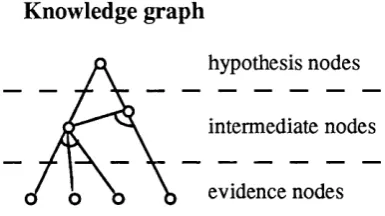
4.1 The basic structure of the knowledge g raph... 59
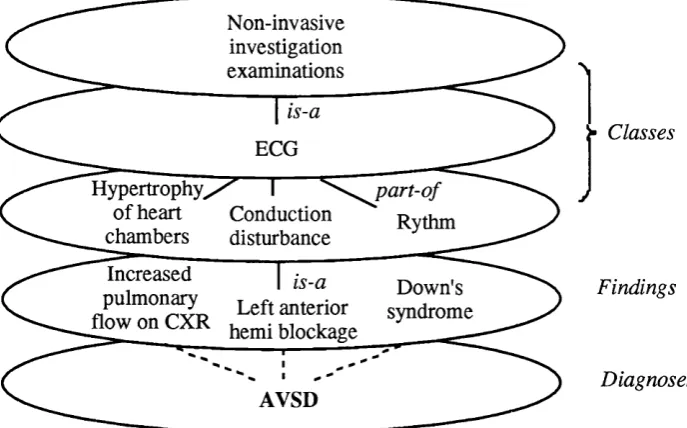
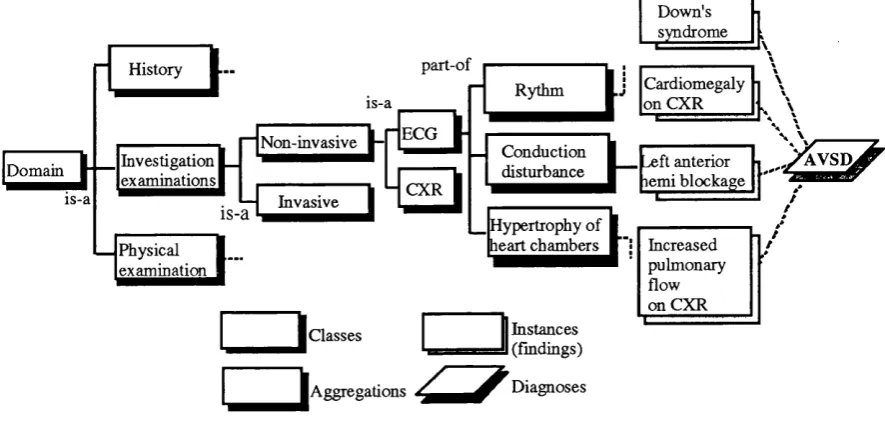
4.2 Knowledge graph for the diagnosis of A V S D ...60
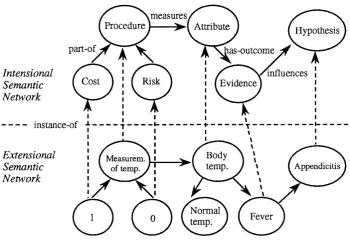
4.3 NEXTOOL'S semantic network divided into Intensional and Extensional levels... 66
4.4 The architecture of HYCONES... 68
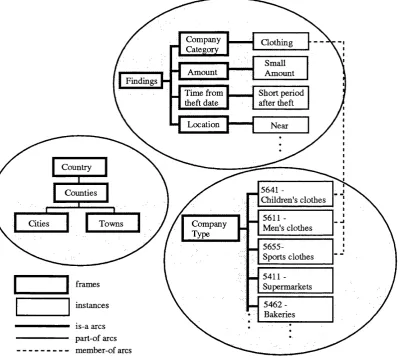
4.5 Representation of the domain knowledge in HYCO N ES...69
4.6 A typical record for a credit card transaction...73
4.7 Examples of the use of the abstraction concepts in the frame hierarchy... 74
4.8 Example of fuzzy overlapping intervals... 76
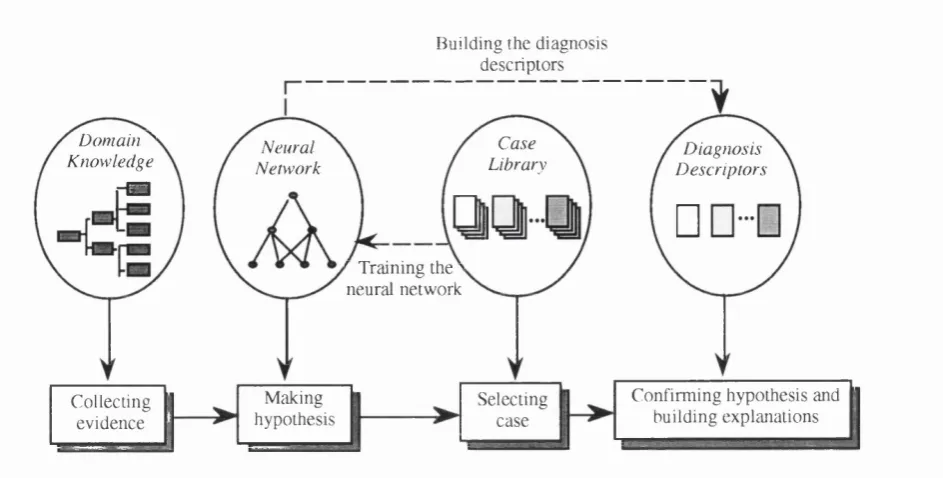
5.1 The main components of the hybrid NN-CBR architecture and their interaction... 83
5.2 The representation of the domain know ledge... 85
5.3 The structured representation of cases...87
5.4 Basic structure of the C N M ...88
5.5 The fuzzy-AND function...89
5.6 The fuzzy-OR function... 89
5.7 The initial neural network created for the e x a m p le ... 93
5.8 Training the neural network to solve a simple diagnostic problem ...94
5.9 The main structure of the diagnosis descriptor... 96
5.10 The mapping of a KG into a diagnosis descriptor and a neural netw ork...97
5.12 The construction of the diagnosis descriptor of A V S D ... 104
5.13 The strongest outputs of the neural network when presented with
case A SD 32... 109
5.14 A set of cases similar to ASD32 retrieved by the case-matching
procedure... 110
5.15 The strongest outputs of the neural network when presented
with case AVSD 1 7 ... 112
5.16 A set of cases similar to AVSD17 retrieved by the case-matching
procedure... 113
6.1 A set of symbolic rules and a diagnosis descriptor representing
the AVSD problem ... 122
6.2 Comparing expert and non-expert KGs with the diagnosis descriptors
of A S D ... 127
6.3 Comparing expert and non-expert KGs with the diagnosis descriptors
of A V S D ... 128
6.4 Comparing expert and non-expert KGs with the diagnosis descriptors
of V S D ...128
6.5 Comparing expert and non-expert KGs with the diagnosis descriptors
of A S T ... 129
6.6 Comparing expert and non-expert KGs with the diagnosis descriptors
of A C O A ... 129
6.7 Comparing expert and non-expert KGs with the diagnosis descriptors
o fT F L T ... 130
6.8 Comparing expert and non-expert KGs with the diagnosis descriptors
List of Tables
2.1 Comparison of CBR system s... 26
2.2 Main features of systems combining CBR with neural netw orks...38
3.1 Classifying some hybrid connectionist/symbolic systems... 48
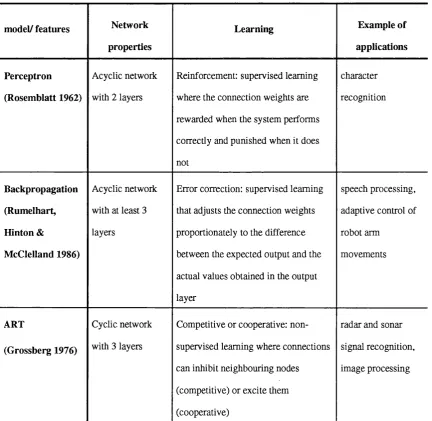
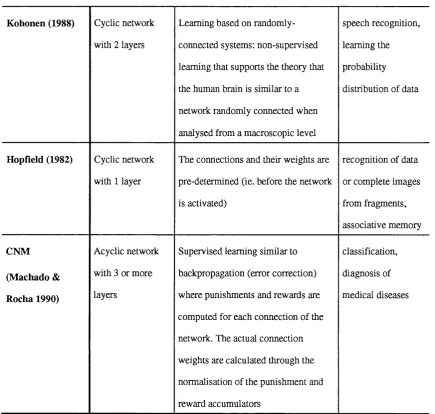
4.1 Comparison of neural network m odels... 61
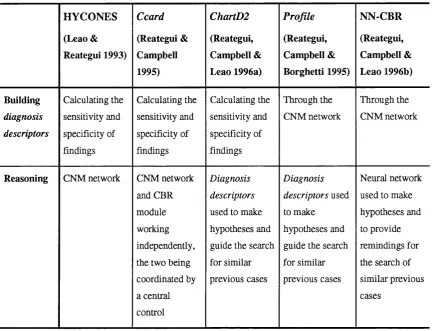
4.2 Comparing the experiments that led to the NN-CBR architecture...79
5.1 The cases used to train the CNM netw ork...92
5.2 The punishments and rewards for the AVSD and the ASD netw orks... 102
6.1 CHD, training-set A, testing-set A ...120
6.2 Systems trained to diagnose ASD, VSD and AVSD, diagnosing four other diseases: AST, ACOA, PDA and T F L T ...123
6.3 The performance of the systems when diagnosing the seven CHD diseases... 125
6.4 The performance of NN-CBR for each of the seven types of CHD diagnoses... 126
6.5 The performance of NN-CBR’s reasoning procedures for the Chd3 and the Chd7 databases... 134
6.6 The performance of the CNM network and NN-CBR in the diagnosis of soybean diseases and in the classification of mushroom s... 136
6.7 The performance of each procedure in the reasoning process for the soybean and the mushroom databases... 137
10
6.9 The reduction in the number of case comparisons between the
NN-CBR approach and the nearest neighbour algorithm ...141
Chapter 1
Introduction
This thesis presents a new approach fo r integrating Case-Based Reasoning (CBR) with a Neural Network (NN) in diagnostic systems. In addition to being able to solve problems that cannot be solved by the neural network on its own, this hybrid approach proposes some useful solutions fo r common CBR problems, such as indexing and retrieval, as well as fo r neural network problems, such as the interpretation o f the knowledge stored in a neural network and the explanation o f reasoning. A hybrid NN-CBR model is introduced here, as well as its use in the development o f a system fo r the diagnosis o f Congenital Heart Diseases (CHD).
Case-Based Reasoning (CBR) is the field of Artificial Intelligence (AT) that investigates how
previous experiences can be remembered and used in solving new problems, in an attempt to reproduce a reasoning process commonly observed in people.
Earlier work in Expert Systems (ES) (Hayes-Roth 1983) was different in that it focused
on reproducing expertise by eliciting knowledge from a person, representing and using it in problem-solving. The usual attempt was to try to embody the knowledge of an expert in a set
of rules, and apply these rules in a systematic form to solve new problems. Besides having
some cognitive support, this idea was also commercially appealing, as machines could
increase their expertise simply by augmenting their number of rules.
However, knowledge elicitation has proved to be a very difficult and time-consuming task
(Hayes-Roth 1983). Furthermore, it has been noticeable that most experts do not rely only on a
plain set of rules to solve new problems. Experts are often found to use cases to evaluate
situations, suggest solutions and validate them (Klein & Calderwood 1988).
1. Introduction 12
and a more plausible model of human reasoning. Instead of relying solely on general
knowledge of a problem domain, CBR was based on the use of specific knowledge of
previously experienced, concrete problem situations (cases). The first memory model based on
these principles proposed that a memory would be organised as memory organization packets
(MOPs) whose functions were to store general knowledge as well as specific experiences of
that general knowledge (Riesbeck & Schank 1989). This model was based on the Theory of
Dynamic Memory (Schank 1982) which says that experiencing, understanding, remembering
and learning cannot be separated from each other. When we are faced with a new experience,
we try to understand it by remembering old experiences and comparing them with the new
one. During this process the new experience is incorporated in our memory and associated
with other experiences which we have had previously (learning).
EPF (Lebowitz 1983) and CYRUS (Kolodner 1983a; Kolodner 1983b) were the first
systems to use MOPs as a cognitive model of a memory. IPP could read stories about
terrorism, ‘understand’ them and build a memory of those stories. CYRUS had a similar use:
to store and retrieve events in the life of Cyrus Vance, who was the Secretary of State of the
USA. The system could understand stories collected from newspapers and answer questions
about Vance’s diplomatic meetings based on those stories. Following it, many other systems
were developed using the same memory organization principles, such as CHEF (Hammond
1986), CASEY (Koton 1988), MEDIATOR (Kolodner & Simpson 1989) and PERSUADER
(Sycara 1988). However, independently of the memory scheme used, the operation and the
main principles behind CBR have remained the same: four 'REs' steps are generally followed by the case-based systems, namely REtrieve, REuse, REvise and REtain (Aamodt & Plaza 1994; Watson & Marir 1994a). When a new problem is posed, the first step in the CBR cycle
is the retrieval of similar cases. By comparing the new case with previous experiences, the case-based system must find which past experiences most resemble the new case. The solution
suggested by the retrieved case(s) can then be reused for the new case. The assumption is that if a solution was applied successfully previously, there is a high probability that it can be used
again in a similar situation. However, the old solution would usually have to be adapted to fit
the requirements and constraints of the new problem. In the revise step, the solution composed for the new situation is tested for success. This is done by applying the solution to the real
world, or by having it evaluated and repaired by a teacher when failures are detected. The last
step in the CBR cycle is the storage of the new case, where its description and solution are
1. Introduction 13
Many advantages have been introduced by case-based systems (Kolodner 1993). Firstly,
CBR may be able to ease the task of knowledge acquisition (ie. eliciting knowledge from an
expert and translating it into one of the knowledge representation formalisms) as most of the
knowledge needed for solving new problems is contained in cases that have already been
solved. Secondly, case-based systems can learn incrementally simply by appending new cases
to their library of previous cases and indexing these cases for future use. CBR also seems to be
a natural problem-solving method, which enables case-based systems to explain their
reasoning relatively easily. Furthermore, CBR makes possible the composition of new
solutions based on previous solutions used in old cases, which is generally much less
complicated than building new solutions from scratch according to the requirements and
constraints of the new case.
However, despite the relative success with which CBR techniques have been employed,
they have also brought with them some disadvantages. For instance, in CBR systems reasoning
is based on a set of cases that does not necessarily cover all the problem’s solution space.
Because of this, it is not guaranteed that an optimal solution for a given problem can be found.
Although this last statement is true for every heuristic method, this is still a problem CBR
researchers have to deal with. Other difficulties faced by case-based systems include the
following:
• a case-based system might allow previous cases to bias it too much in solving a new
problem;
• the most relevant experiences are often not considered when a new problem is being
solved;
• non-case information (eg. rules), which may also be available, is ignored in a pure CBR
system;
• for large systems, it might be a difficult task to manage an extensive case library, which
does not happen with other generalization-based approaches.
Additionally, the idea that people use cases in problem-solving goes somehow against the
observation that experts in typical application areas treated by AI methods reason by using
generalised rules. AI practitioners have remarked that it is intuitive for experts to express their
knowledge in the form of rules, and that this is not a new idea. In fact, some papyri have been
1. Introduction 14
then fashion (Crevier 1993). The counter-argument to this conviction is that representing
knowledge with rules is different from actually using rules to reason. When using rules in
problem-solving, it is often the case that rules have exceptions, and that some rules are also
contradictory. When this happens, people usually start referring to previous experiences to try
to explain these exceptions and contradictions.
The debate on which reasoning method is the most plausible, appropriate and/or efficient
is a very long one. What is certain is that CBR and more traditional A1 approaches to
reasoning have their own advantages and drawbacks. In order to incorporate in one single
architecture the benefits of both approaches and to minimise their drawbacks, CBR has been
combined with complementary forms of reasoning, such as rule-based, model-based or neural
networks. Our goal here has been to investigate what type of gain could be obtained from
integrating CBR with neural networks to solve classification problems. The main reason for
this choice was that by combining CBR with neural networks, we could benefit both from the
logical and cognitive nature of symbolic systems and from the numeric, associative and self-
adapting nature of the neural networks. Additionally, we wanted to continue our previous
work in which neural networks were combined with symbolic systems (Reategui & Leao
1993; Leao & Reategui 1993; Leao, Reategui & Guazzelli 1995), as well as with CBR systems
(Reategui & Campbell 1995; Reategui, Campbell & Borghetti 1995).
We present here a new approach for integrating Case-Based Reasoning (CBR) with a
Neural Network (NN) in diagnostic systems. When solving a new problem, the neural network
is used to make hypotheses and to guide the CBR module in the search for a similar previous
case that supports one of the hypotheses. The knowledge acquired by the network is
interpreted and mapped into symbolic diagnosis descriptors, which are kept and used by the system to determine whether a final answer is credible, and to build explanations for the
reasoning carried out. The NN-CBR model has been used in the development of a system for
the diagnosis of Congenital Heart Diseases (CHD). The system has been evaluated using two
cardiological databases with a total of 214 CHD cases. Three other well-known databases have
been used to evaluate the NN-CBR approach further. The hybrid system manages to solve
problems that cannot be solved by the neural network with a good level of accuracy.
Additionally, the hybrid system suggests some solutions for common CBR problems, such as
indexing and retrieval, as well as for neural network problems, such as the interpretation of the
knowledge stored in a neural network and the explanation of reasoning.
1. Introduction 15
main reason for dividing the topic into two chapters has been that two types of hybrid
architectures were related to our work:
• the ones combining CBR with other reasoning techniques;
• the ones combining neural networks with symbolic approaches.
While chapter 2 is devoted to the combination of CBR with other reasoning techniques,
chapter 3 is devoted to the integration of neural network with symbolic approaches. Chapter 4
analyses with a greater level of detail some particular research which served as a basis for the
development of the work reported in the present thesis. Chapter 5 introduces the new case-
based architecture where CBR was combined with the CNM. A system addressed to
Congenital Heart Disease (CHD) diagnosis is also presented in this chapter. This sytem was
built with the collaboration of the Institute of Cardiology in Porto Alegre, RS, Brazil, which
provided the cases to develop the case library of the system and test it. Chapter 6 presents
validation results. Chapter 7 compares our NN-CBR approach with other related work.
Chapter 2
Combining CBR with other Reasoning
Approaches
This chapter advances some criteria fo r analysing hybrid systems that integrate CBR with neural networks, rule-based or model-based approaches. Several systems are described and their features highlighted according to the
criteria established.
2.1 Introduction
This premise that people rely on concrete previous experiences when solving new problem has
been confirmed either by simple observation or (on some other occasions) by psychological
experimentation. For instance, it has been observed that engineers rely on cases when trying to
identify problems that occur in telephone switching networks (Kopeikina, Brandau &
Lemmon 1988), that novices use previous examples to learn a new cognitive task (Ross 1989),
or simply that people feel comfortable in using cases to make decisions (Klein & Calderwood
1988). However, determining how people remember pertinent cases at the right times has not
been a trivial task. Moreover, how could computer programs simulate this behaviour? This has
been one of the central problems in CBR, and has come to be known as the indexing problem.
2.2 Indexing in CBR Systems
Indexing a new case consists of creating appropriate pointers which designate under what
circumstances the case may have a lesson to teach and, therefore, when it is likely to be
2. Combining CBR with other reasoning approaches 17
Both manual and automated methods have been used in CBR index selection. Choosing
indexes manually involves deciding under what circumstances a case will be useful, and
identifying striking features which should make the case memorable. Although manual
indexing is a difficult and time-consuming task, it may represent a good choice in some
circumstances, especially when cases are complex and the knowledge needed for accurate
case indexing is not concretely available, or it is too elaborate to be inserted in an indexing
algorithm.
Choosing indexes with automated methods consists of building algorithms that can
identify the circumstances in which a case can be useful. The main advantage of automated
indexing over manual index selection is that it eases the knowledge acquisition process in
which experts have to identify the features they use to recall past experiences, which is
usually a non-trivial task. The methods for automated index selection most commonly used in
pure CBR systems are:
• Checklist-based indexing: In this method the domain is analysed and the dimensions
that tend to be important are computed. These are put in a checklist and all cases are
indexed by their values along these dimensions. The system CHEF (Hammond 1986),
a case-based planner whose specialty is to create new recipes, indexes known recipes
through the following dimensions: texture and taste o f food, preparation method, and ingredients. For example, a B eef and brocoli recipe could be indexed by CHEF the following way:
B eef and brocoli:
preparation: stir-fry
ingredient: brocoli ingredient: beef
texture: crunchy vegetable taste: savoury
Although this method of automated index selection can be easy to implement, the
method is only as good as the checklist used by the system builder. An incomplete
checklist will result in insufficient indexing, while a checklist that does not
2. Combining CBR with other reasoning approaches 18
overindexing and retrieval of too many cases.
Difference-based indexing: How can a system determine that some indexed feature is
not predictive? Or how can it appreciate that it is predictive? The answer relies on the
identification of the similarities and differences among cases indexed in an equivalent
fashion. The system CYRUS (Kolodner 1983a), whose main goal was to build a
memory of events that happened in the life of Cyrus Vance, the US Secretary of the
State at the time, found out that it could make no special predictions about meetings in
which the main participant was a foreign minister because, by keeping track of
similarities among several meetings with foreign ministers, it realised that they had
nothing in common except the things common to all meetings. Difference-based indexing tries to solve this problem by finding out features that can differentiate cases from one another so that at retrieval time best-matching cases can be selected from the
library. But it is certain that not all features that are different across similar cases make
useful indexes, and this is a problem difference-based indexing methods have to confront. For instance, it would not make much sense for CYRUS to index the
meetings of the American Secretary of State by room size, as this would probably not allow any inferences to be made.
Explanation-based indexing: Difference-based and checklist-based indexing provide a simple way for determining potentially predictive features to be used as indexes. But
they have a major problem: they choose indexes based on a model of the kinds of
features that are usually predictive but do not analyse cases individually for their
predictive features. This causes two problems: extra features are often chosen for
indexing that are not predictive in a particular case, and some features that are
predictive in that case, but not in general, are not indexed. Because these methods do
not always discriminate cases well enough from each other, retrieval based on indexes
chosen by these methods results in many superfluous cases being retrieved. A separate
ranking process must sort the cases that are recalled to determine which are the most
appropriate. Explanation-based indexing methods are aimed at choosing indexes appropriately for individual cases. The reasoner attempts to explain why a given
2. Combining CBR with other reasoning approaches 19
1) Successful solutions (credit assignment): To create this type of explanation, a
reasoner must keep track of the features found to be useful in achieving a goal.
An example of this type of explanation-based indexing occurs in the system JULIA (Hinrichs 1988; Hinrichs 1989), which works in the domain of meal
planning. When elaborating a meal for several guests, JULIA decides to make a
tomato tart as the main dish. It chose this type of tart because it was summer and
tomatoes were in season, and because a vegetarian friend was coming for dinner.
‘Summer’, ‘tomatoes in season’ and ‘vegetarian guest’ were the reasons for
JULIA to select the tomato tart, therefore these are the elements used to index the
case.
2) Unsuccessful solutions (assignment of blame): After the reasoner discovers it has
made a mistake, it attempts to explain it. Then, the reasoner extracts from the
explanation the concrete recognisable features of the situation that were
responsible for the problem. In the next step, the reasoner generalises those
features to the point where they still make sense in the explanation derived. An
example of this type of explanation-based indexing can be given again from the behaviour of the system CHEF. When making the recipe of a strawberry soufflé,
the results are not satisfying as the strawberries produced more liquid than the
leavening could handle. The cause of the failure is attributed to ‘too much liquid
in strawberries', which can be generalised to ‘too much liquid in fruit'. The unsuccessful case is then indexed by ‘type of food = soufflé’ and ‘dish includes
fruit'.
Despite the fact that explanation-based indexing relies on the analysis of the success or the failure of each particular case, there is still no guarantee that the indexes provided by the
explanation-based methods will discriminate a case from similar ones. A combination of different indexing approaches can be used to provide a solution to this problem. For instance,
an explanation-based method can be used to generate a set of useful indexes, while difference-based methods can be used to discard those features that do not discriminate.
2. Combining CBR with other reasoning approaches 20
only be as good as the domain model from which explanations are drawn. Moreover, if the
existing domain model is not complete enough, in certain situations the system would not be
able to build any explanation for the faults identified, which would inhibit it from indexing the
cases at hand.
Another problem with explanation-based indexing is that it indexes cases specifically for situations in which it is known that they are used. However, it is possible that a case can be
useful in unanticipated ways, and indexing according to explanations alone may keep it from
being remembered in these situations.
The indexing problems reported, as well as the wish to improve upon CBR systems, have
led researchers to propose alternative architectures where case-based techniques have been
combined with other reasoning mechanisms. The next sections present a general framework
for describing hybrid CBR architectures, and describe several systems combining CBR with
some other reasoning and/or learning technique.
2.3 Combining CBR with other Approaches
Although indexing has been one of the central problems in CBR, it has not been the only
reason to incite researchers to combine CBR with complementary forms of reasoning, such as
rule-based, model-based or neural networks. Other facts that have also influenced the
construction of such hybrid architectures are:
• in order to represent human expertise more accurately, the specific knowledge stored in
cases should be complemented by some form of generalised knowledge (Strube et al.
1995). For instance, students in US business schools learn from specific cases, as well
as from general principles applicable to these cases. Therefore, cases and general
knowledge should not be kept apart. An example of the practical use of such a
combination of general and specific knowledge can be given by the congenital heart
disease diagnostician ChartD2 (Reategui, Campbell & Leao 1996a). The system, when solving a new case, uses its general knowledge to draw hypotheses and to guide the
search for the most similar cases it has already ‘seen’. The retrieved cases,
representing specific knowledge, are then used to support one of the hypotheses and to
2. Combining CBR with other reasoning approaches 2.1
• managing large case libraries and getting the most out of cases may be a difficult task
in CBR systems. Organising cases according to some generalisation principle has the
possibility of giving the user a clearer view of what types of cases exist in the library,
and reducing the number of case comparisons when a best-match is looked for. The
case-based tool REMIND, for instance, organises the case library by employing user-
defined attributes to create an initial prototype hierarchy, which is then partitioned
further by an inductive method. The final hierarchical structure is efficient for case-
browsing and reduces the number of case comparisons during case-matching.
• previous cases may influence a CBR system in different directions without giving it
many hints on which cases to consider as more important. This problem can be
partially solved by good indexing schemes which enforce the retrieval of relevant cases
only. However, in large case libraries, even efficient indexing mechanisms may have
problems in indicating exclusively pertinent cases. In such circumstances, it may be
advisable to have only a reduced set with selected cases for consideration in the case-
matching process. For instance. Surma & Vanhoof (1995) use an algorithm to partition
the cases of the library into standard and exception cases. The standard cases are used
to generate rules, while only the exception cases are used in the case-matching process.
Several other techniques have been used to combine CBR with other reasoning
approaches. In the project INRECA (Manago et al. 1993; Auriol et al. 1994) a general
framework for combining induction with CBR in classification tasks has been proposed and
implemented in the generic tool that combines the systems PATDEX (CBR) and KATE
(induction). This integration has been based on the understanding of the advantages and
weaknesses of each approach. Four levels of integration between induction and CBR were
identified in the project, each level providing certain advantages that could be suitable for one
type of application or another. The integration levels defined in INRECA were modified and
further specified here in order to describe other mixed paradigms combining CBR with
different reasoning mechanisms h
2. Combining CBR with other reasoning approaches 22
(la) independent approach: the two reasoning mechanisms work side by side in an independent fashion. They are activated to solve the same problem, but they may
reach equivalent or different answers. When reaching different answers, an external
mediator, or the user himself, decides which answer to take. For instance, a rule-
based and a CBR system can be used independently to identify malfunctions in an
engine. When different answers are provided by each system, the user himself or an
external mechanism decides which answer to take. This may be useful for the
comparison of two different techniques in solving a particular problem, with the
advantage that two existing systems can be employed.
(lb) back-up approach: one of the mechanisms starts the reasoning and transfers it to the other mechanism when it cannot complete the process. The main reason justifying
this approach is that alternative results can be presented to the user when the
reasoning mechanism commonly used to solve the problem cannot reach a plausible
answer. For example, the system CASEY (Koton 1988), a cardiac disease
diagnostician, starts its reasoning process by first activating a CBR module. If no
answer is provided by this module, the system attempts to solve the same problem
by activating the Heart Failure Program, an earlier model-based expert system.
(Ic) interactive approach: one of the mechanisms starts the reasoning process and transfers some intermediate results to the other mechanism, which proceeds with the
reasoning from that point to the end. This approach is frequently used in the design
of alternative indexing methods. For instance, in a system for fault diagnosis,
model-based reasoning may be used to estimate the probable location of a faulty
component. The hypotheses generated can be then used by a CBR module to
retrieve similar previous cases (Feret & Glasgow 1993). Another alternative to this
approach is that a higher level of interaction can be established between the two
reasoning mechanisms, where the responsibility for the reasoning is transferred
See Riesbeck & Schank (1989) for a more detailed explanation of MOPs and a description of several systems implemented using these memory structures.
2. Combining CBR with other reasoning approaches 23
several times until the system reaches a final conclusion.
(Id) unified approach: the two reasoning mechanisms are completely integrated by having certain features of each of them combined in a single system. This approach
is most commonly used in the combination of CBR with neural networks, with the
main goal of creating efficient indexing and retrieval mechanisms. For instance, the
system INSIDE (which was developed for the use of Singapore Airlines), keeps
cases as intermediate nodes of a neural network. Case indexing and retrieval in this
hybrid architecture are a consequence of the learning and activation functions of the
neural network, respectively.
The four levels of integration described above are illustrated in figure 2.1.
(la) Independent
Other CBR mechanism(lb) Back-up
Other mechanism CBRreasoning
(Ic) Interactive
Other mechanism CBRreasoning
(Id) Unified
(
CBR + O th e r \ mechanism 'Jreasoning
Figure 2.1: The four integration levels for hybrid CBR systems
For each of these levels, other criteria can also be employed to detail further the type of
integration used: The levels of integration (la), (lb) and (Ic) can employ one of two types of
general knowledge:
(2a) compiled knowledge: general knowledge is the result of the pre-processing of existing cases (e.g. decision-trees or rules inductively generated from cases, neural
networks);
(2b) elicited knowledge: general knowledge can represent the knowledge of an expert, knowledge found in books or simply commonsense knowledge (e.g. rules or graphs
learned through a knowledge acquisition process).
2, Combining CBR with other reasoning approaches 2,4
the same cases of the library pre-processed to originate general knowledge. However, it is also
possible that a system would, for instance, use cases as the consequents of expert rules
{elicited knowledge), and have them selected as near matches when the rules are fired.
Different levels of priority can be assigned to the reasoning mechanisms. This feature
applies mostly for architectures where the two mechanisms are separate, working in a
somewhat competitive way, as in (la) and (lb). For architectures where the co-operation
between the components is higher, it becomes difficult to establish the level of priority
between them.
(3a) giving priority to CBR: the other reasoning mechanism serves as an alternative device when no final answer can be provided by the CBR system;
(3b) giving priority to the other reasoning mechanism: the CBR system is used to produce a final answer when the other reasoning mechanism fails to solve the
problem addressed.
Giving priority to CBR can be a good alternative for applications in domains with a weak model (or a limited body of rules), where cases are usually of primary importance in the
reasoning process. In contrast, giving priority to the other reasoning mechanism can be more suitable for applications where there is a strong domain model with well-established rules, or
where cases are sparse or difficult to collect.
For level of integration (Ic) and (Id), the co-operation between CBR and the other
reasoning mechanism can have different purposes:
(4a) general knowledge supporting CBR: general knowledge can be used to assist in a CBR task. For example, rules extracted from cases can be used to index and retrieve
cases in the library (Zeleznikow, Hunter & Vossos 1993);
(4b) cases complementing general knowledge: cases can support the reasoning performed by the mechanism based on general knowledge. For example, cases can be used to
deal with missing information in a consultation of a decision-tree (Auriol et al.
1994);
2. Combining GBR with other reasoning approaches 25
reasoning process. For instance, a rule may support the selection of a particular case
as the most similar, and an existing case can support the firing of a rule (Rissland &
Skalak 1989).
Because of the smaller amount of interaction existing in architectures of the type (la) and
(lb), it is difficult to determine the level of co-operation between the two mechanisms.
For levels of integration (la), (lb) and (Ic), the knowledge embedded in cases and in the
generalisations can be:
(5a) equivalent and address the same problems;
(5b) complementary and address different problems.
To illustrate item (5a), a system that diagnoses car malfunctions could store previous
cases of car problems, as well as rules specifying the problems related to certain collections of
symptoms (this is the approach generally used to combine GBR with Model-Based Reasoning
(MBR), which refers to the use of general causal knowledge, usually to describe well-
understood causal devices). To exemplify item (5b), a similar system diagnosing car
malfunctions could have a set of rules that, instead of identifying the car problems themselves,
would be used to determine other associated symptoms that could help the system to retrieve
the most similar previous case from the library.
For unified architectures, it is usual that both cases and general knowledge would be equivalent, as they address the same problem. The reason for this is linked to the fact that the usual choice of unified approach employs compiled knowledge, ie. the cases pre-processed to originate general knowledge are the same as those used in the reasoning process.
These characteristics provide a framework for the analysis of hybrid GBR systems that
combine GBR with other reasoning approaches. Table 2.1 lists several such systems and their
2. Combining GBR with other reasoning approaches 26
Systems / features
Level of integration Type of general knowledge Priority in the reasoning process
Form of support Knowledge embedded in cases and in generalisations CABARET interactive elicited * mutual equivalent GREBE interactive elicited * mutual complementary IKBALS interactive compiled * general knowledge
supports case retrieval
equivalent
INRECA various compiled various various equivalent REMIND unified * * general knowledge
used to structure the case library and to support ease retrieval
*
BUBE/CcC+ interactive compiled * general knowledge supports case retrieval
equivalent
Surma & Vanhoof(1995)
back-up compiled mles * equivalent
CASEY back-up and interactive
elicited CBR general knowledge supports case retrieval
equivalent
CABATA interactive elicited * general knowledge supports case retrieval
complementary
ARAMBHS back-up elicited rules, then CBR, then MBR
* equivalent
Feret & Glasgow (1993)
interactive elicited * general knowledge supports case retrieval
equivalent
Table 2.1: Comparison of CBR systems
2. Combining CBR with other reasoning approaches 27
2.3.1 Combining CBR with other Symbolic Reasoning Mechanisms
An approach that has become rather popular within the CBR community is the use of
rules in cooperation with CBR. Many of the systems of this type are legal applications, where
the partitioning of the knowledge into rules and cases was a natural alternative, as in
CABARET2 (Rissland & Skalak 1989; Skalak 1989), GREBE (Branting 1989) and IKBALS
(Zeleznikow, Hunter & Vossos 1993). These three systems combine CBR and rules in an
interactive approach, as in fact most hybrid CBR architectures do.
CABARET (Skalak 1989) has been conceived as a domain-independent shell, and
applied in statutory interpretation, ie. in the determination of the meaning of a legal rule by
analysing its terms and then applying it to a particular set of facts. CABARET integrated a
CBR and a rule-based module using a central control scheme, as defined in Skalak (1989)^.
The system worked with 30 types of expert heuristics to control and interleave reasoning with
rules and reasoning with cases. The system’s architecture was characterised by the following:
• there are two co-reasoners (case-based and rule-based);
• each co-reasoner has an independent mechanism to report the results achieved, or some
intermediate state of the reasoning;
• there is a controlling process that uses the set of heuristics and the reports provided by
each reasoner to decide how the system as a whole is to proceed.
^Although CABARET has been conceived as a domain-independent shell, its first application was in the domain of law.
2. Combining CBR with other reasoning approaches 28
Legal rules and cases addressed the same types of problem. However, although being
combined in an interactive approach, rules and cases might contradict each other. For instance, a rule may say that an attitude should lead to punishment, and the case library might
contain cases contradicting it (or supporting it). This feature enables CABARET to reason
from different points of view (e.g. the prosecuted or the prosecutor). Thus, even with the same
set of rules and cases the system can reach different conclusions. The main contributions of
the accompanying research have been the establishment of a framework for the development
of systems integrating CBR and rules, as well as the definition of the set of heuristics for a
central control module to co-ordinate the reasoning process.
The system GREBE (Branting 1989) has also been designed for the domain of law. It too
integrates CBR and RBR in an interactive approach, as in CABARET. GREBE uses both legal and commonsense rules, in addition to category exemplars (previous cases) to determine
the classification of new cases. While exemplar-based explanations are used to bridge the gap
between new case descriptions and generalisations, domain theory in the form of general rules
is used to explain the equivalence of new cases and category exemplars. Generalisation-based
reasoning and CBR are considered complementary approaches in GREBE, where each of
which is necessary for the success of the other. It has been demonstrated that some
explanations that GREBE produces could not be produced by other methods limited
exclusively to generalisation or case-based reasoning.
The system IKBALS (Zeleznikow, Hunter & Vossos 1993) has as a main goal to
investigate ways of reducing the problems associated with modelling law using only a rule-
based approach. Among the main problems identified in the use of rules in legal expert
systems are the difficulties in representing open-textured legal predicates using rules, as well
as the deficiencies found in the explanations produced by traditional expert systems developed
in this domain. Differently from CABARET and GREBE, IKBALS uses an inductive
algorithm (Induce!) to produce a decision-tree from the available cases. This tree is later
converted into production rules that are then used by the system to locate relevant similar
cases. Another difference between IKBALS and CABARET is that the latter uses a central
control to perform the integration between the rule-based and the CBR modules, while
2. Combining CBR with other reasoning approaches 29
Another important approach to combining inductive learning methods with CBR has been
delineated in the INRECA project (Manago et al. 1993, Auriol et al. 1994), which we have
already mentioned in the introduction of this chapter. In the project, advantages and
weaknesses of CBR and induction were analysed and distinct levels of integration were
proposed in order to minimise drawbacks and use the best features of each approach. In each
level of integration, different alternatives are possible for combining CBR and induction. For
example, cases can be used to minimise the problem of handling missing values during
consultation in a decision-tree {CBR com plem enting gen eral knowledge)', and decision-trees
can be used to perform consistency checks in the case library {general knowledge supporting
CBR). Many applications in different domains have been tested in the INRECA project,
including the maintenance of aircraft engines, the estimation of risk factors for car insurance
companies and the selection of hotels according to travellers’ preferences. A recent extension
to the project has been the incorporation of the INRECA tree (Auriol et al. 1995) into the
system. This tree is based on both decision-trees (Quinlan 1986) and k-d trees (Friedman,
Bentley & Finkel 1977). The main advantage of the new INRECA tree is that it can be used
either as a k-d tree in the case-based reasoning process (e.g. in case indexing and retrieval) or
as a decision-tree in the induction process (e.g. for case generalisation).
Similarly to the PATDEX/KATE tool developed in the INRECA project, the system
REMIND (Barietta 1994) is a generic tool for developing systems that combine CBR and
inductive processes. However, REMIND is based on a unified approach where the cases are
part of an indexing/retrieval scheme divided into three levels: a prototype hierarchy, an
inductive indexing structure and the weighted nearest-neighbour algorithm. At the top of the
indexing structure is the prototype hierarchy. This hierarchy is built according to attributes
selected by the system developer that serve as an initial support for partitioning the available
cases (for indexing and retrieval purposes). The inductive method is then used to partition the
prototypes of the lower branches of the hierarchy further. When a new case is presented to the
system, it compares the new case with the prototype structure and then retrieves cases under
the most specific prototype that matches the new case. Once the best prototype is matched, the
system follows the inductive indexing structure created for that prototype. The cases collected
2. Combining CBR with other reasoning approaches 30
ranking procedure. REMIND has already been used in the development of systems in different
application areas, such as in legal decision-making, in medical outcome analysis, and in help
desks.
In Bamberger & Goos (1993) another different integration method is presented where a
case-based and an inductive learning system (CcC-k and BUBE, respectively) are combined in
an interactive architecture. BUBE is used to learn rules that are later employed to reduce the
number of cases that are analysed by CcC-H when a problem is being solved (general
knowledge supporting case retrieval). The learned rules generate a set of possible solutions,
and provide the cases corresponding to these solutions to the CcC+ system for a more detailed
similarity computation. One of the main advantages of BUBE/CcC-f- is that the response time
of the inference process is minimised by the integration of CBR and rules, while the
performance and the quality of the explanations provided are kept at a good level.
Surma & Vanhoof (1995) also use induction to learn rules from cases. However, their
approach to reasoning is different in that their architecture has a back-up level of integration
which gives p rio rity to the gen eralised knowledge expressed in the rules. This reasoning
scheme is based on the following assumption (from Riesbeck & Schank (1989)): “ When an
activity has been repeated often enough, it becomes rule-like in nature. We do not reason from
prior cases when well-established rules are available” . The algorithm below has been
conceived according to this assumption:
/ / a new case is covered by some rule,
then apply a solution from a rule with the highest priority,
else adapt the solution from the most similar case.
In this architecture the case library is split into two disjoint sets, one containing exception
cases and the other containing standard cases. The set of standard cases is used by an
induction algorithm to produce a rule-base. When a new case is presented to the system, this
rule-base is used to classify the case. If no existing rule applies, the case is classified by the
nearest-neighbour algorithm using the exception cases. This problem-solving approach has
been tested with relative success on a few different domains. However, the method of giving
p rio rity to the gen eralised knowledge contained in the rules might not be suitable in other
2. Combining CBR with other reasoning approaches 31
Another hybrid CBR approach is the combination of CBR with Memory-Based
Reasoning (MBR). One of the best-known systems that uses such an approach is CASEY
(Koton 1988). CASEY integrates CBR with the Heart Failure Program, a model-based expert
system that deals with patients with cardiac diseases. CASEY’s memory organisation is based
on CYRUS (Kolodner 1983a). It contains descriptions of previous cases as well as
generalisations derived from similarities between cases. The descriptions of cases are made
out of input features such as symptoms, test results and medical history, as well as solution
data, such as the causal explanation for the patient’s symptoms, therapy recommendations and
outcome information. The steps below summarise the method used by CASEY to solve a
given case:
• retrieval of a similar case from the library;
• evaluation of the differences between the new and the previous case using the
knowledge existing in the Heart Failure Program, with the main purpose of ruling out
answers that present inconsistencies;
• If no match is found for the new case, the Heart Failure program can be used to solve
the problem.
This architecture uses mainly a back-up level of integration with priority given to the case-based component. However, the fact that the Heart Failure Program provides similarity metrics for the CBR mechanism reveals a higher level of interaction between the two
reasoning mechanisms than that found in more standard back-up approaches. The main advantages introduced by CASEY were the use of model-based knowledge to control the
quality of a match performed by the CBR system, and the use of the Heart-Failure Program to
solve diagnostic problems that could not be solved by the CBR mechanism.
The system CABATA (Lenz 1993) also combines CBR and MBR in an interactive
architecture conceived for planning tasks. The system was tested in a travel planning
application, where a previous holiday trip had to be retrieved from memory according to some
preliminary specifications established by the user. In addition to these specifications, the
system uses two types of rules to help it find a similar previous holiday: rules that can increase
2. Combining CBR with other reasoning approaches 32
important); and rules that contain domain-specific knowledge to build constraints (e.g. if
region is sea then region must not belong to mountains). One peculiarity of CABATA is that
the reasoning is conducted in a way where the user interacts with the system, having the
chance to interfere in a solution by modifying conditions and constraints.
Feret & Glasgow (1993) present another architecture combining CBR with MBR. The
architecture has been applied to the diagnosis of faults in two different devices, namely a
robotic system called Fairing servicing subsystem, and a Reactor building-ventilation system.
The approach to modelling the devices has been based on the Automated Data Management
System, which describes a device in terms of a hierarchy of components or groups of
components. The hybrid architecture uses an interactive approach where an estimate of a location of a component whose failure explains the observed symptoms is first generated
using the MBR techniques {general knowledge supporting case retrieval). These hypotheses are then used to retrieve previous cases. The main role of CBR in this system is to refine the
possible answers given by the MBR module and to assist an operator in the final stage of a
diagnostic session. The tests executed in the two experiments indicate that the performance of
the hybrid approach is better than the MBR approach used on its own, and that CBR can
minimise the impact of using partially incorrect models.
In ARAMIIHS (Macchion & Vo 1993), MBR, CBR and rules are combined to detect
problems in a vehicle equipment bay that schedules the launching of a flight by computing
guidance actions, telemetry, emissions and other types of evidence. The MBR mechanism of
the system has three purposes: describe technical, causal and structural aspects of the vehicle
equipment bay. The diagnostic capabilities of this mechanism are activated when CBR and the
mechanism of rules fail to provide a satisfying solution to a given incident. The CBR
mechanism is only activated when rules cannot solve the problem. Indexes connecting from
one to several symptoms to a case have either a positive or negative influence on the
associated diagnosis. This predominance in the reasoning process characterises ARAMIIHS as
a mainly back-up architecture with a scheme of mixed priority levels: priority is given firstly to rules, then to CBR, then to MBR. The authors claim that from a cognitive point of view the
system mimics the expert’s reasoning process: if an incident occurs frequently, he can
2. Combining CBR with other reasoning approaches 33
previously, he can recall its past global or partial solution (use of CBR). Otherwise he must
activate a heavier process based on a technical representation of the equipment to be
diagnosed (use of MBR).
2.3.2 Combining CBR with Neural Networks
Another approach that is becoming more common is the combination of CBR with neiural
networks. The majority of the architectures integrating these two reasoning mechanisms has a
unified level of integration. This frequent choice of architecture is due to the fact that it can provide good solutions for CBR indexing and retrieval problems. For instance, cases can be
represented in intermediate nodes of the neural network, being indexed by the network
learning mechanism, and retrieved by the network consultation mechanism.
The architecture presented in Becker & Jazayeri (1989) has been developed to deal with
design problems, where the previous case most similar to the case being solved has to be
retrieved so that its design solution can be adopted directly for the new case, or modified to fit
new requirements.
To perform this task, the system uses a neural network composed of three layers: an input
layer where features are described, an intermediate layer connected to the input layer where
old cases are represented, and an output layer where the design choices are kept.
Three types of knowledge are used to select the most similar cases: knowledge about the
problem (input features); knowledge about old cases (old cases’ features and the design
solutions adopted); meta-knowledge about criteria for selecting new cases (importance of each
attribute). The network also includes modification rules that are used to change the
importance of certain attributes according to the values present in other attributes.
Regarding the level of integration between case-based and neural-network components,
this architecture has a unified approach. The cases themselves are part of the neural network, and case-retrieval is carried out by this hybrid structure. This type of architecture is interesting
from the point of view that a neural network can use old cases to support a decision on a
design solution. However, because the neural network is used to connect all the previous cases
to their solutions and descriptions (case features), the neural network is not used to form
generalisations. Thus, when solving a new problem, it has to compare each case individually
2. Combining CBR with other reasoning approaches 34
the inconveniences of the nearest-neighbour algorithm can also apply to this system, such as a
processing time that increases linearly with the number of existing cases, and a possible lower
accuracy rate than other algorithms (Barietta 1994)).
Thrift (1989) also combines neural networks and cases in a unified approach, where the neural network is used for case filtering, ie. selecting the most relevant cases in a case library
given a set of input values. By using a set of training cases different from the case library, this
system manages to form generalisations while keeping relevant previous cases for future
reference.
The neural network used in this architecture has been conceived with three layers: an
input layer composed of ‘factors’ (features and feature values); an intermediate layer
composed of previous cases; and an output layer composed of actions (solutions adopted in
the previous cases). Therefore the architecture proposed by Thrift is also characterised by
being unified, as cases are part of the neural network. The backpropagation algorithm is used to adjust the weights connecting factors to previous cases. Seeing it from a different point of
view, the algorithm is used to establish a similarity measure between cases. The case selection
is also influenced by the presence of hidden factors that are computed in accordance with the
input factors. The backpropagation algorithm determines changes in the function of the action
units, according to given input factors. The author remarks, however, that many of the current
learning algorithms could equally well be used to adjust the weights that appear as parameters
in the system.
When presented with a new problem the neural network indicates the most similar case in
the library by taking its maximally-responding case unit. The solution adopted for that case is
applied directly to the new case or modified to conform to some new conditions.
This hybrid neural-network approach has the advantage of being able to refer to previous
cases when giving a solution to a new problem. In addition, because a training set different
from the case library is used to train the neural network, its generalisation capabilities are
bigger than those of Becker & Jazayeri (1989).
In Myllymaki & Tirri (1993), another example of a unified architecture combining CBR with neural networks is presented, where cases correspond to certain nodes in the neural