Licensed under Creative Common Page 1155
http://ijecm.co.uk/
ISSN 2348 0386
ANALYSIS OF EFFECTIVENESS OF INTERVENTION AS A
STRATEGY IMPLEMENTATION TACTIC IN PUBLIC
UNIVERSITIES (NAKURU COUNTY- KENYA)
Patriciah Murage
Administration Division, Egerton University, Kenya [email protected]
Daniel M. Wanyoike
School of Entrepreneurship, Procurement and Management Jomo Kenyatta University of Agriculture and Technology, Kenya
Abstract
The ability to translate strategies to actions successfully is important to any organization.
Despite the importance of the implementation process within strategic management, the area of
strategy implementation has been overshadowed by a focus on the strategy formulation
process. This quantitative study therefore, endeavored to analyze the effectiveness of strategy
implementation tactics in public universities in the County of Nakuru, Kenya. To achieve the
research objectives, a comprehensive literature study was conducted as to provide theoretical
framework for the empirical study. A census was conducted among 50 chairpersons of
departments in all the five public universities within Nakuru County who are primarily in-charge
of overseeing day to day operations and activities within the University. To determine the
relationship between the independent and dependent variables, correlation and regression
analysis was done. The results revealed significant relationship between intervention tactics
was identified to have a strong link with effective strategy implementation. The deployment of
these management tactic demonstrated potential of improving the effectiveness of strategy
implementation. Leaders can exploit various approaches to ensure success in strategy
implementation and to have a positive influence on their colleagues, teams and their organizations.
Licensed under Creative Common Page 1156 INTRODUCTION
Strategy implementation has increasingly been the focus of many numerous studies, particularly because the process from strategy formulation to strategy implementation is not effective and therefore not adequate in today’s business environment (Sorooshian, Norzima, Yusof, &
Rosnah, 2010). For any organization, strategy helps in integrating the long term plans and ensuring that there is harmony between the vision, mission, objectives, core values, activities and its environment. According to (A. A. Thompson, 2003), strategy formulation and implementation are core management functions. The developed strategy may be good but if its implementation is poor, the intended strategic objectives may not be achieved. To ensure survival and success, an organization does not only need to formulate strategies that seek to constantly maintain a match between the organization and its environment but also must ensure appropriate implementation of strategy at all levels.
While (Campbell, 2002), considers implementing strategy as putting the chosen strategy into practice, resourcing the strategy, configuring the organization’s culture and structure to fit
the strategy and managing change, (Yabs, 2010)views strategy implementation as the phase in strategic planning where actions are taken to actualize approved plans.Yang et al. (2009), on the other hand, shares a different view and states that there is no universally accepted definition of strategy implementation and identify three distinct conceptions of the term. The first approach concentrates on a process perspective and takes strategy implementation as a sequence of carefully planned consecutive steps. The second approach treats strategy implementation as a series of more or less concerted but often parallel actions and examines these actions from a behavior perspective and the final perspective combines the process and behavior or action perspective and form a third approach which they label hybrid perspective.
All organizations face a common challenge when implementing a new strategic initiative that is, how to successfully manage the changes that will occur as the new initiative is deployed. Some researchers note that organizations fail to implement up to 70 per cent of their strategic initiatives (Miller, Wilson, & Hickson, 2004). From a strategic management and an operations management perspective, research suggests that adopting and implementing the right practices is essential to attaining world-class performance (Brown, Squire, & Blackmon, 2007; Laugen, Acur, Boer, & Frick, 2005).
The main concern for any strategic manager is to ensure organization’s performance by
Licensed under Creative Common Page 1157
but also fair if not excellent returns. Customers on the other hand expect the best quality products or services at a fair price while employees expect the best working conditions and good compensation packages. The community in which the organization is situated expects a positive contribution from these companies and the government expects compliance with all the regulations in place (Pearce & Robinson, 2007).
Management approaches to strategy implementation can be placed on a continuum with prescriptive planning at one end and process approaches at the other. Prescriptive planning involves moving from strategies to action planning, through the process of setting objectives and performance controls, allocating resources, and motivating employees (Freeman, 2010). In contrast, the process approach emphasizes that successful implementation depends on people changing their behavior. This involves changing the assumptions and routines of people in the organization, including managers (Miller et al., 2004). Many organizational behavioral studies support the process view which focuses on managing interpersonal & intra-group conflicts that can derive defensive behaviors, personality differences and poor communication (Balogun, 2006).
In their paper making strategy work (Yang et al., 2009) established that there are two types of implementation studies: those highlighting the importance of individual factors for strategy implementation and those that emphasize the big picture of how such factors interrelate and form a strategic implementation environment. The first stream involving individual factors that influence strategy implementation include strategy formulation process, strategy executors; managers and employees, organizational structure, communication activities, level of commitment for the strategy, consensus regarding, relationship among different departments and different strategy levels, the employed implementation tactics and the administrative system in place. The second stream of research analyzes multiple factors together within a single arguably comprehensive framework or model.
The single factors are summarized into soft, hard and mixed factors. Soft factors or people oriented factors include the people or executors of the strategy, the communication activities including content and style issues as well as the closely related implementation tactics and the consensus about and commitment to the strategy. Hard or institutional factors include organization structure and the administrative systems. The way in which the strategy was developed and articulated contains hard and soft factors alike and is thus considered a mixed factor. Relationship among different departments and different strategy levels also is treated as a mixed factor (Yang et al., 2009).
Licensed under Creative Common Page 1158
many factors soft and hard that influence the success of strategy implementation ranging from the people who communicate or implement the strategy to the systems or mechanisms in place for coordination and control. Based on the works of (Nutt, 1986), whose study identified implementation tactics used by managers in making planned changes and (Yang et al., 2009),this study sought to analyze the effectiveness of strategy implementation tactics in public universities in an attempt to eliminate the challenge of effective strategy implementation faced by managers. However, this paper focuses on objective one of the study.
Statement of the Problem
Strategy implementation being an integral part of the strategic management process entails converting formulated strategy into action. Managers who successfully implement their strategies enjoy competitive advantage over organizations with managers who are less competent in implementing strategy (Fourie, 2010). Implementing strategies successfully is vital for any organization, either public or private, without implementation, even the most superior strategy is inadequate. The idea of strategy implementation might at first seem quite straightforward: the strategy is formulated and then it is implemented, however, transforming strategies into action is a far more complex and difficult task. In practice, new strategies designed to deliver significantly enhanced performance improvement have a poor track record of being implemented well in public universities including public universities. For instance the introduction of RRI an emergent strategy with 13 thematic areas at Egerton University aimed at improving efficiency and effectiveness as well as the adoption of Results Based Management (RBM) intended to make the institution more responsive to citizen service preference were only good in paper. These among other initiatives such as student online registration and monthly environmental clean ups recently launched have not been effective. Failure to successfully implement strategy may possibly result to resource wastage, unrealized goals, and dissenting views from stakeholders, low employee commitment to action and missed opportunity. One of the ways the ways the management team is able to ensure that they successfully implement strategies is through effective strategic leadership and managerial tactics where the leader is able to anticipate, envision, maintain flexibility, think strategically and work with others to initiate changes. In the light of the above, this study sought to analyze the effectiveness of intervention as a strategy implementation tactic.
Objective of the Study
Licensed under Creative Common Page 1159 THEORETICAL OVERVIEW OF INTERVENTION TACTIC
This variable drew on the path-goal theory of leadership a dyadic theory of supervision that concerns relationships between formally appointed superiors and subordinates in their day-to-day functioning. It is concerned with how formally appointed superiors affect the motivation and satisfaction of subordinates. It is a dyadic theory of supervision in that it does not address the effect of leaders on groups or work units, but rather the effects of superiors on subordinates. Consistent with the dominant leadership paradigm of time, path-goal theory is primarily a theory of task and person oriented supervisory behavior. Also consistent with the dominant paradigm, it does not concern the leadership of the entire organizations, emergent-informal leadership, leadership as it affects several levels of managers and subordinates in organizations, political behavior of leaders, strategic leadership of organizations, or leadership as it relates to change (Seyranian, Levine, & Hogg, 2010).
Drawing on expectancy theory path-goal suggests that a leader should help elucidate the path for followers to achieve group goals. This involves the leader employing particular behaviors in specific situations to increase follower satisfaction and motivate efforts toward task accomplishment. The theory identifies four types of leader behavior that include supportive or relations oriented, directive or task oriented, achievement oriented and participative leader behavior, as well as two aspects of the situation, namely, follower characteristics and task characteristics (Martin, 2009). In situations where the task is dull or taxing, the theory predict that supportive leadership behaviors may increase followers' interest in task accomplishment and encourage followers' expectations of a successful outcome. In turn, this may motivate followers' efforts to achieve the task. In situations where the task is ambiguous or complicated, directive behaviors such as clarifying the task at hand and stressing rewards contingent on good performance could increase followers' positive expectancies. This may consequently motivate followers' efforts to achieve designated goals.
EMPIRICAL REVIEW
Licensed under Creative Common Page 1160
Strategic intervention is planned, deliberate, and focused effort to improve business or organization growth, relevance and viability. This systematic implementation of change is intended to impact business basics; beliefs, attitudes, values, cultural challenge in the current business structure (Okumus, 2003). In addition, strategic intervention is often used to facilitate draconian change in organizational structure to more effectively compete within rapidly changing business environment; for instance disruptive technology, global competitor, emerging-shrinking-expanding markets and ensuing challenges.
It is worth noting that normally there are a number of interventions for any one situation, Issues surrounding compliance, such as the arena of inquiry and ideas that must be considered to win over stakeholders, constrained activity in the developmental stages. In these cases, managers were careful to acquire sanctions to activate and regulate the process, and to make it clear to all participants, such as other managers, who had control (Nutt, 1986). The trick is to find the intervention that best suits the culture and available resources of the business. The aim of intervention is to improve business and organizational performance.
METHODOLOGY
A census was adopted for the purposes of this study as it provided a form of descriptive research that was used to assess the opinions and attitudes of the respondents in relation to this study. Quantitative data collected from the entire population over a period of one month was analyzed to form the findings of the study. The target population of this study was 50 chairpersons of academic departments in five public universities in Nakuru County. A census was conducted for this study and data obtained from the entire population since as it aided in eliminating both sampling error and bias.
Structured questionnaires were the main tool for collecting primary data in this study, a pre-designed and pre-tested questionnaire was used to collect data in relation to the objective of this study administered to the respondents. This allowed the researcher collect information and opinions from the respondents while maintaining uniform responses. The questionnaires were designed to provide quick and ease completion by the respondents, with questions involving a choice of tick boxes, with a minimum amount of written response required. For ease of analysis, the researcher developed closed ended questions on a five-point likert scale of response categories ranging from strongly agree, agree, not sure, disagree and strongly disagree.
Licensed under Creative Common Page 1161
instrument and the reliability coefficient of all variable was tested, the results were 0.761 greater than the 0.7 minimum requirement and it was concluded that all factors were internally reliable. Since the data collected for this study was quantitative both descriptive and regression analysis was employed. Prior to analysis, the questionnaires were checked for completeness, sorted and edited to remove errors in order to identify any problems that may result from the use of a questionnaire. Statistical analysis was done using Statistical Package for Social Scientists (SPSS) version 21 and tables used to illustrate the findings and a summary in a descriptive form and conclusions drawn. Inferential statistics aided in deducing what the population thought and making judgments of the probability that an observed difference between groups is a dependable one or one that might have happened by chance. Correlation and analysis was done to determine the relationship between the variables under study.
The study recorded a response rate of 68%. Of the 50 questionnaires distributed, 34 were sufficiently filled and returned which were sufficient to facilitate data analysis.
ANALYSIS & RESULTS
Demographic Information
Based on results in Table 1, it is clear that majority of the respondents (79%) have over six years working experience and concurred having witnessed the introduction of changes or overseen implementation of strategies in the institution in the past five years.
Table 1: Respondents’ Distribution according to their Working Experience
Working Experience Frequency Percentage (%)
<-3 years 4 11.8
3-5 years 3 8.8
6-10 years 7 20.6
> 10 years 20 58.8
Total 34 100.0
As reflected in Table 2, majority of the respondents (88%) have postgraduate level of education with 44 per cent having Doctoral degrees and only 12% having undergraduate degrees.
Table 2: Respondents’ Distribution based on level of education
Education Level Frequency Percentage (%)
Doctorate 15 44.1
Masters 15 44.1
Bachelor 4 11.8
Licensed under Creative Common Page 1162
Results from Table 1and 2implied that the respondents were sufficiently skilled and experienced to fill the questionnaires.
Descriptive Findings
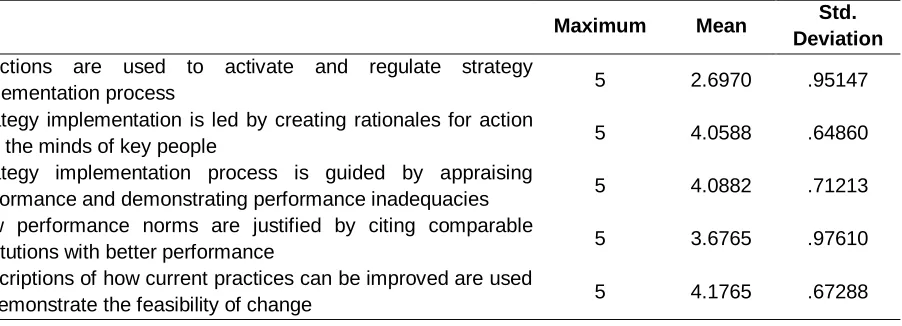
The views of the respondents regarding the influence of intervention tactic on effective strategy implementation are illustrated in Table 3.
Table 3: Effect of Intervention Tactic on Strategy Implementation
Maximum Mean Std.
Deviation Sanctions are used to activate and regulate strategy
implementation process 5 2.6970 .95147
Strategy implementation is led by creating rationales for action
is in the minds of key people 5 4.0588 .64860
Strategy implementation process is guided by appraising
performance and demonstrating performance inadequacies 5 4.0882 .71213
New performance norms are justified by citing comparable
institutions with better performance 5 3.6765 .97610
Descriptions of how current practices can be improved are used
to demonstrate the feasibility of change 5 4.1765 .67288
Inferential Findings
A correlation analysis was conducted to determine the correlation between the independent variables and dependent variable and the results are reflected in Table 4.
Table 4: Relationship between intervention tactic and effective strategy implementation
Effective Implementation
Intervention Tactic
Pearson Correlation .571**
Sig. (2-tailed) .001
N 34
Correlation is significant at the 0.01 level (2-tailed).** Correlation is significant at the 0.05 level (2-tailed).*
Licensed under Creative Common Page 1163
not to vary much regarding the factors tested in this Section B of the questionnaire. This implied that respondents held closely related views regarding the influence of intervention tactic in relation to effective strategy implementation and believe the tactic influences effective strategy implementation.
It can be reported that there exists a positive and relatively strong correlation (r = 0.571; p < 0.05) between intervention tactic and effective strategy implementation. This implies that there is a when there is continuous use of intervention as a management tactic in strategy implementation, there are chances that this approach may lead to effective strategy implementation and the inverse is true. No negative r-values were reported.
CONCLUSIONS
Intervention as a management tactic has been established to contribute positively towards the successful implementation of strategies in public universities. Though there are varied intervention approaches available for chairpersons of departments, sanctions were considered to contribute negatively when used to activate and regulate strategy implementation process. The study indicates that demonstration of feasibility of change by describing how current practices can be improved, is a significant intervention factor resulting to effective strategy implementation. In addition, performance appraisal and demonstration of performance inadequacies and creation of rationales for action in the minds of key people are other elements that demonstrated substantial intervention factors that influence effective strategy implementation.
The correlation analysis results in Table 4indicate that intervention tactic highly influences on effective strategy implementation, the results are consistent with the views shared by Jeanty, (2012) and Lewa et al., (2010) who observed that intervention tactics are of different approaches that enable businesses affect significant change within its organization, process and structure. Lewa et al., (2010) further add that by developing effective interventions, use of intervention tactics can make a significant difference in a business and considers intervention tactics as the only way to turn a business around or move it from good to fantastic.
REFERENCES
Balogun, J. (2006). Managing change: Steering a course between intended strategies and unanticipated outcomes. Long Range Planning, 39(1), 29-49.
Licensed under Creative Common Page 1164 Brown, S., Squire, B., & Blackmon, K. (2007). The contribution of manufacturing strategy involvement and alignment to world-class manufacturing performance. International Journal of Operations & Production Management, 27(3), 282-302.
Campbell, D. (2002). Business strategy: an introduction: Routledge.
Fourie, B. J. (2010). The role of strategic leadership in strategy implementation.
Freeman, R. E. (2010). Strategic management: A stakeholder approach: Cambridge University Press. Jeanty, J. (2012). What Are Business Intervention Strategies?Available at http://www.bizshifts-trends.com (accessed 22 February, 2015).
Lewa, P. M., Mutuku, S. M., & Mutuku, M. M. (2010). Strategic Planning in the Higher Education Sector of Kenya: Case Study of Public Universities in Kenya. Transforming Higher Education: Opportunities and Challenges, 272.
Martin, R. (2009). PathGoal Theory of Leadership. Ecyclopedia of Group Processes & Intergroup Relations. Ed. John M. Levine and Michael A. Hogg. Thousand Oaks, CA: SAGE, 636-637.
Miller, S., Wilson, D., & Hickson, D. (2004). Beyond Planning:: Strategies for Successfully Implementing Strategic Decisions. Long Range Planning, 37(3), 201-218.
Miller, S., Wilson, D., & Hickson, D. (2004). Beyond Planning:: Strategies for Successfully Implementing Strategic Decisions. Long Range Planning, 37(3), 201-218.
Muchira, W. N. (2013). Relationship Between Strategy Implementation And Performance In Commercial Banks In Kenya.
Nutt, P. C. (1986). Tactics of implementation. Academy of Management Journal 29.2: 230-261.
Okumus, F. (2003). A framework to implement strategies in organizations. Management Decision, 41(9), 871-882.
Pearce, J., & Robinson, R. (2007). Strategic Management: Implementation and Control, Boston: Richard D: Irwin McGraw-Hill, USA.
Seyranian, V., Levine, J., & Hogg, M. (2010). Contingency theories of leadership. Encyclopedia of group processes & intergroup relations, 152-156.
Sorooshian, S., Norzima, Z., Yusof, I., & Rosnah, Y. (2010). Effect analysis on strategy implementation drivers. World Applied Sciences Journal, 11(10), 1255-1261.
Tait, A., & Nienaber, H. (2010). Exploring the strategy-to-performance gap: the case of four South African Life insurers. Journal of Contemporary Management, 7, 271-289.
Thompson, A. A. (2003). Strategy: core concepts, analytical tools, readings: McGraw-Hill Companies. Thompson, A. A., Strickland, A. J., Gamble, J. E., & Gao, Z. a. (2008). Crafting and executing strategy: The quest for competitive advantage: Concepts and cases (Vol. 19): McGraw-Hill/Irwin.
Yabs, J. (2010). Strategic Management Practices.