FA C ILITY SPACE-TIM E M A N A G E M E N T
LINARIZA H A R O N
A Thesis subm itted to
The University o f London
In fulfilment o f the requirem ent for the degree o f
Doctor o f Philosophy
BARTLETT SCHOOL OF G RA D U A TE STUDIES
ProQuest Number: 10014318
All rights reserved
INFORMATION TO ALL USERS
The quality of this reproduction is dependent upon the quality of the copy submitted.
In the unlikely event that the author did not send a complete manuscript and there are missing pages, these will be noted. Also, if material had to be removed,
a note will indicate the deletion.
uest.
ProQuest 10014318
Published by ProQuest LLC(2016). Copyright of the Dissertation is held by the Author.
All rights reserved.
This work is protected against unauthorized copying under Title 17, United States Code. Microform Edition © ProQuest LLC.
ProQuest LLC
789 East Eisenhower Parkway P.O. Box 1346
ABSTRACT
One o f the main problem areas in the m anagem ent o f facility space in the office sector
is maintaining an appropriate balance between the supply and dem and for space as
organisations change. The need for balance necessarily requires m anagem ent to
recognise the constraints which limit the effective use o f space in any particular
situation and to prepare measures w hich will perm it adjustments to change over time.
The relationship between space and user has traditionally been m anaged through the
procedure o f allocating floor space per person. However, technology and working
practices have changed significantly during the last ten years, as has the nature and
pattern o f office work. As a result, the space standards and practices o f the past are
rapidly becom ing inadequate in terms o f m eeting contem porary demands and
conditions. An explicit inclusion o f time considerations w ithin m anagement
procedures promises to produce more reliable m ethod in the m anagem ent o f space.
The introduction o f such practices can be approached by conducting a space-time
budget analysis at different levels o f the organisation. The varying proportions o f time
which em ployees spend inside and outside o f the organisation's prem ises will affect
managem ent decisions concerning the amount, type and location o f facility spaces.
The relationship between space and user is now managed through allocation
procedures based on utilisation levels that relate people hours dem and load to space
hours supply availability.
A sequence o f com parative analyses between traditional and space-tim e m ethods were
undertaken through three case studies and against the conclusions o f extant literature.
the traditional method in solving capacity needs, allocation procedures and utilisation
target problems albeit w ith some disadvantages. It is anticipated the m ethod will not
completely eliminate traditional practices, rather will enhance and support
m anagement for making secure decisions about use and m anagem ent o f space in
rapidly changing circumstances and offer a basis to further develop a general theory o f
CO NTENTS
A BSTRACT 3
LIST OF CONTENTS 5
LIST OF FIGURES 9
LIST OF TABLES 11
ACK NO W LEDG EM ENTS 12
PART 1: CONCEPTS OF SPACE M AN AG EM EN T
CHAPTER TO INTRODUCTION 13
1.1 Area and Scope o f the Study 13
1.2 Aims and Objectives 16
1.3 Method o f Approach 16
1.4 Structure o f the thesis 19
References 23
CHAPTER 2.0: THE SUPPLY OF AND DEM AND FOR FACILITY SPACE 24
2.1 The dynamic nature o f supply and demand 25
2.2 Imbalances in supply and demand 27
2.3 Basic management options 28
2.4 The cycle o f supply, demand and use 35
References 45
CHAPTER 3.0 ESTIM ATING SPACE REQ UIREM ENTS 47
3.1 Space standards 50
3.2 Estimating qualitative requirements 54
3.3 Estimating quantitative requirem ents 56
3.4 Key issues in estimating space requirem ents 59
References 61
CHAPTER 4.0 M ETHODS OF SPACE A LLO CA TIO N 64
4.1 Allocation procedures: A ctivities to space 65
4.2 Allocation procedures: Space to activities 69
4.3 Effective allocation 78
4.4 Summary o f PART 1 83
References 85
PART 2: CHANG ING SIT U A T IO N S AND IM PLIC ATIO N S FOR M AN AG EM EN T
CHAPTER 5.0: CHANGING PATTERNS IN SUPPLY OF AND DEM AND
FOR SPACE 88
5.1 Basic directions and opportunities for change 91
5.2 Drivers and enablers o f change in supply and dem and 94
5.3 Changing patterns in the demand for facility space 97
5.4 Changing patterns in the supply o f facility spaces 105
5.5 Changing patterns in the utilisation o f space 107
References 110
CHAPTER 6.0: THE M AN A GEM ENT OF SPACE OVER TIM E 114
6.1 Limitations to the traditional m ethods o f space managem ent in changing
situations 114
6.2 Key management issues and problem s arising out o f changing conditions 123
6.3 The management o f space over time: Some selected responses 127
6.4 Influential factors in the m anagem ent o f space over time 134
PART 3 : SPACE-TIM E M A N A G E M E N T M ETH O D S AND TECHNIQUES
CH A PTER 7.0: SPACE-TIME M ETHODS AND TECH N IQ U ES 141
7.1 Space-tim e budgets 144
7.2 The basis for a facility space-time m anagem ent approach 149
7.3 Space-tim e management system 153
7.4 Key issues for development 168
References 178
C H A PTER 8.0 DEVELOPING THE SPACE-TIM E M AN A GEM ENT M ETHOD
8.1 Case study methodology 184
8.2 Space-time management procedures 192
8.3 Fram ework for analysis 207
References 212
PART 4: EXAM INING A NEW M E T H O D FO R SPACE-TIM E M ANAGEM ENT
CH APTER 9.0 THE FINDINGS FROM THE TH REE CASE STUDIES 215
9.1 M anagem ent problems emerging from the traditional approach 215
9.2 Exam ining the viability o f space-time m anagem ent m ethod and technique 219
9.3 Exam ining the disadvantages o f space-time m anagem ent approach 239
CH A PTER 10.0 CONCLUSIONS 249
10.1 Aims and Objectives o f the study 249
10.2 The space-time management approach 253
10.3 Re-examination o f the study's hypotheses 261
10.4 Applications o f the space-time m anagem ent m ethodology 270
10.5 Conclusions 276
References 282
PART 5: APPENDICES
APPENDIX 1:THE SUPPORTING DETAILS FOR LITERATURE
REVIEW 296
APPENDIX 2:CASE STUDIES AND CASE COMPARISONS 305
LIST OF FIGURES
F 1.1 Basic areas o f concern for facility space m anagem ent
F I .2 Structure o f study
F 2 .1 Circumstances for m anagement o f spatial resources
F2.2 Paths o f decisions around management options under recurrent problem
circumstances
F2.3 Two models o f the supply and demand o f facility space
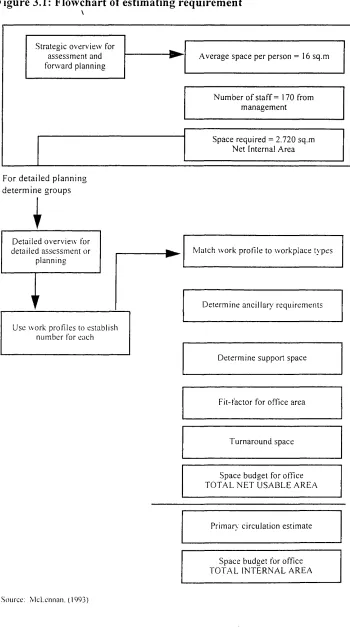
F 3 .1 Flowchart o f estimating requirement
F3.2 Components o f traditional requirements for usable spaces
F3.3 Space build-up term inology
F3.4 Procedures for estimating the net usable area
F4.1 The conceptual shift in space allocation
F4.2 Sub-divisioning, showing the possible levels o f occupancy
F4.3 Com m unication pattern diagram, based on staff assessm ents o f priorities
F4.4 Consistent measures for the supply o f space, matching dem and with effective
allocation
F4.5 Spatial features and their influence on allocation procedures
F4.6 Conceptual flowchart for the m onitoring stage
F4.7 Fit-factor as effective space allocation
F5.1 W ork organisation in space and time
F5.2 Opportunities for change and conceptual variations using the mode o f
communication, work practice and perform ance m easures
F5.3 Perspectives o f the drivers and enablers o f change
F5.4 M ulti-locational working arrangements by occupation type
F 6 .1 Limitations o f traditional space managem ent m ethods in contem porary
conditions
F6.2 Some real space m anagem ent arrangem ents, related to changes in working
practices
F7.1 Investigation o f space-time methods in facilities studies
F7.2 Space-time budget profile for an individual
F7.3 Space-time budget profile for an organisation
F7.4 Conceptual framework o f a space-time m anagem ent system
F7.5 Arithmetic relationships - supply and dem and
F7.6 Linear scale for utilisation rates
F7.7 Opportunities for change, using the occupancy and frequency matrix
F 8 .1 Case study research design
F8.2 Framework o f questions
F8.3 M anagement responses and activities across a spectrum o f problem s
F8.4 The space-time managem ent process
F9.1 Notional space diversity from the original allocation o f prim ary workspaces,
simulated in Case Study 1
F9.2 Re-allocation matrix for dem arcation o f net usable area sim ulated from Case
Study 1
F9.3 The level o f effective utilisation based on the space-tim e budget technique
across three case studies
F9.4 M atching people hours and space hours to show the level o f utilisation by
occupation types across three case studies
F9.5 Comparison o f facility spaces o f Cases 1, 2 & 3
F9.6 The extent o f impact from change against facility profiles by
space-time managem ent intervention profiles
F 10.1 The space-time managem ent process
F 10.2 The space-time managem ent system
F 10.3 Application areas o f space-time managem ent methodology
F 10.4 Some examples o f space-time m anagem ent m easures to accom m odate changes
in use over time
F 10.5 Practical concepts o f space-time m anagem ent
LIST OF TABLES
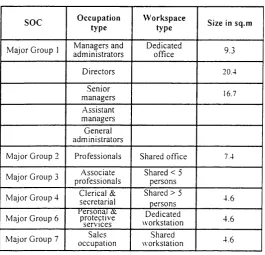
T3.1 Range o f space standards by occupation classification, sq.m
T3.2 Range o f space standards by workspace type
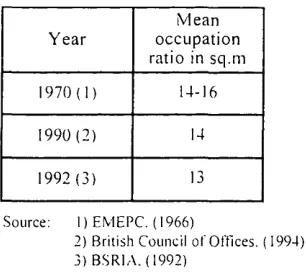
T3.3 Average Occupancy Density o f Offices
T 4 .1 Space allocation and use functions in two organisations types
T4.2 Summary policy options for space allocation
T 5 .1 Changing requirements for space as a result o f changing w orking practices
T6.1 Some management responses to achieve organisational change objectives
T6.2 Evaluation o f some managem ent arrangem ents in relation to space utilisation
T9.1 Comparing theoretical against actual space per person indicators
from traditional method
T9.2 Comparing theoretical against actual provision o f assigned spaces
T9.3 Comparison o f space classification in three case studies
T9.4 Problem situations and prevailing m anagem ent responses in current situations
T9.5 Comparing demand estimates between the traditional and space-time
approach, in net usable area (sq.m.)
T9.6 Time frame o f predictability o f each level o f m anagem ent across three
case studies
T9.7 Comparison between traditional method and space-time approach in
their capacity for creating the balance area for space diversity
T9.8 Comparison o f space dem arcation by varying allocation procedures
between the traditional method and the space-tim e method
T9.9 Levels o f utilisation o f workspaces across the three case studies
T9.10 Comparison o f individual workplace levels o f utilisation by
occupation type across three case studies
T9.11 Improved utilisation through changes in frequency factor
T9.12 Improving utilisation through changes in occupancy factor
workspaces
T9.13 To show that a facility space is below use capacity the facility is
capable o f supporting
T9.14 Perceived impact o f change by level o f organisation
ACK NO W LEDG EM ENTS
A ll praises be to Allah, L ord o f the Universe.
My deepest gratitude to my beloved parents, Hajah Hasnah Md. Jan and Haji Haron
Abdul Rahman (may A llah’s mercies be upon them), my sisters, Linzaw ati, Lindalia,
Linazita and Lizarina, for their incessant love; to the G overnm ent o f M alaysia and
Universiti Sains Malaysia, for the scholarship support; to Professor Bev N utt for his
tutelage and insight in this fascinating research and to my mentors. Professor John
Andrews and Professor S.N. Kazmi for their guidance.
My highest appreciation to Dr. Amal A1 Barbandi, Yusah Hamuth, Ray Turner, A.L.
Leow, Jane Crinnion, Mr. and Mrs. Gates, J.H. M cllwaine, R uth D ar and all UCL
Librarians, Richard Pettinger, Dr. Nalini Vittal, Dr. Charles Egbu, Jacqui Hollett, Jane
Wells and Chris Bindley, Alan Cox, Lucinda Colbatch, Tim Arnold, Brian Cullom,
David Tinkler and Chris Jack, Linda Dunn, Dr. Ashley Dabson, Bruce Lloyd, Peter
Wingrave, Tony Thomson, Davida Hamilton, Celia Stanworth, Richard Nissen,
Richard Watts, Lisa Becker, John Watson, Lynda Joeman, Terrie Hughes, Raja
Iskandar, Martin Taylor, Dr. Carole Rawlinson, Mike Gahan, Lew is Kirby, Dr.
Junedah Sanusi, Noel Hodson, Dr. M ichael Okoroh, David J. Rees, A drian H arrington
and David L. Petersen, to nam e a few, for their contribution in lightening my task. My
special thanks to Brian, M ark, Robin and John, the Beadles o f Philips House, for their
forbearance during the most critical stage o f completing the original thesis.
My work is a gift to Nur Rashina, Mohd. Razin, Mohd. Razi and M ohd. Reza, who
may get the opportunity in the future to produce better research accom plishm ents and
join the ranks of'th ose who are understanding and knowledgeable'.
C HAPTER 1.0 INTR O D U CTIO N
Physical space is one o f the prim ary resources required by all organisations to support
the functioning o f their business, operations and activities. The provision o f adequate
space depends on an organisation's specific requirem ents, w hich involve the way in
which individuals, groups and divisions w ork together to execute their tasks.
Space management is concerned with the cycle o f decisions covering the initial use,
re-use and changes in the use o f facility space at each operational level w ithin an
organisation. Some degree o f intervention is required to balance the levels o f supply
and demand o f facility spaces when unexpected, recurrent and uncertain problem
situations arise. This is know n when the facility spaces are evaluated as adequate,
suitable, o f acceptable utilisation and appropriately located. M anagem ent, on the other
hand, will classify the problem situation as and when it arises and will attempt to
identify the causal factors and recom m end potential solutions. These could be taken as
tactical, operational or strategic managem ent responses. The decision process is
crucial as organisational requirem ents change, there is a system atic procedure to
generate appropriate policies involving procurem ent, allocation, use, rearrangem ent,
modification and disposal o f space, which will affect the facility and its occupants
directly. Simultaneously, at the corporate level, space m anagem ent policies relate to
real estate, asset and relocation issues.
1.1 Area and Scope o f the Study
In this study, the managem ent o f space over time is defined as the process o f
decisions concerning facility, organisation and occupants, taken increm entally over
different time frames in relation to situations o f changing dem and at different
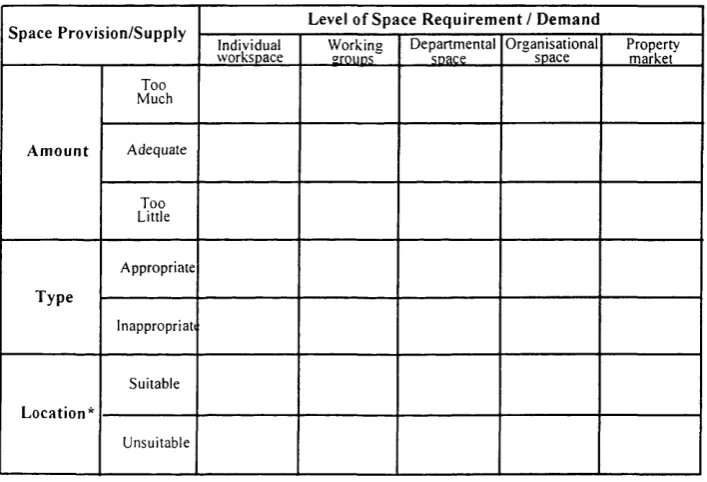
organisational levels. Figure 1.1 displays in a sim ple matrix form, the basic areas o f
concern in space management. The colum ns o f the matrix highlight the five
characteristic levels o f demand, ranging from workspace required for the individual,
for the working group, for departmental or business unit space requirements, to the
organisation's overall demand for space and m ore generally, the position in the
property market. The rows o f the m atrix represent basic supply-side factors,
concerning the amount, type and location o f provisions.
Figure 1.1 Basic areas of concern for facility space m anagem ent
Sp ace Provision/Supply Level o f S p a ce R eq u ir e m e n t / D em and
I n d iv i d u a l
w o r k s p a c e W o r k i n gzrouDS^'
D e p a r t m e n t a l s o a c e
O r g a n i s a t i o n a l s p a c e
P r o p e r t y m a r k e t
A m o u n t
T o o M u c h
A d e q u a t e
T o o Little
Typ e
A p p r o p r i a t e
In ap p ro p r ia ti
Location*
S u it a b le
U n s u i t a b l e
N o te ; * T h e b in a r y d i s t i n c t i o n o f l o c a ti o n h a s b e e n s i m p l i f i e d f o r th e p u r p o s e o f th is s t u d y
The major concern o f this study focuses on the quantitative and qualitative issues o f
space provision and management. Unless the supply o f space is reasonably m atched
across the different levels o f organisational requirem ents, spatial support in the
organisation would be considered to be in im balance and problem s o f inadequacy and
the unsuitability o f spaces w ould continue to prevail. Locational issues are o f
All these concerns are the outcomes from the im pact o f Inform ation Technology (IT)
on business operations (Birchall & Lyons, 1995). For exam ple, the imbalance in
supply and demand o f space has produced visible sym ptom s in property market
supply side, and the organisational dem and side. In the former, the indicators were the
escalating vacancy rates o f office space, som etim es reaching 20% in central city areas
(M orrison et al, 1994:22). In the latter case, the sym ptom s are visible in the high level
o f mism atch between what is really required and w hat is being provided in term s o f
spatial support, in both quantitative and qualitative term s (Cundell, 1988; Duffy &
Henney, 1989).
The effects o f these changing circumstances lead to several questions for those
involved in the management o f facility space, as shown below. Questions 1 and 6
relate to issues o f use management, question 5 relates to the m anagem ent o f dem and
for space and questions 2, 3 and 4 are concerned w ith the m anagem ent o f supply. All
tend to relate to change management or the m anagem ent o f responses, and to resource
management or the management o f constraints.
The six key questions which need to be addressed are as follows:
1. Which spatial factors significantly affect the activities, operations and
management o f an organisation in contem porary conditions?
2. How may the relative suitability o f facility space be assessed and reviewed
over time?
3. How may the relative severity o f the spatial constraint im posed by a facility on
the occupying organisation be measured?
4. To what extent are traditional space standards and space allocation procedures
relevant and applicable in an era o f rapid change?
5. How should an organisation calculate its total dem and for space over the
short, medium and long term period?
6. W hat method and techniques m ight be developed to assist in the m anagem ent
o f space through time?
1.2 Aims and Objectives
The principle aim o f the research is to develop a basis from w hich to plan the tools
needed to rationalise and support tactical, operational and strategic decisions
concerning the m anagement o f facility space. The research has two m ain objectives;
firstly, to establish a theoretical basis for estim ating the dem and for and allocation o f
space in rapidly changing circumstances, and secondly, to propose practical
techniques for the space-time m anagement o f facilities. It is anticipated that the results
o f the research will enhance existing m anagem ent measures, so that they can becom e
more secure in dealing with the contemporary circum stances o f rapid and continuous
organisational change.
1.3 Method of Approach
Given the situation in the past, the present circum stances o f rapid change, the general
ideas about the immediate future and o f developm ents over the longer term, (Birchall
& Lyons, 1995; Sproull & Kiesler, 1991; Toffler, 1980), three quite different types o f
investigation can be undertaken. The first, relates to m anagem ent practices used in the
past, the second to ongoing managem ent changes and the third, to future m anagem ent
possibilities. These types o f investigation inform one another, although trends in the
second and third may have a more im mediate im pact in term s o f m odifying
To establish the broad context o f the problem , an extensive literature survey on the
general concepts o f space m anagem ent over the past thirty years was carried out. The
survey involved a collation o f published case studies relevant to the area o f concern,
which includes the m anagem ent o f space over time. To com plem ent the case studies,
a literature review on space-time m ethods and techniques across all types o f facilities
was also undertaken. For example, between the late 1960s and early 1970s, the
development o f space-time m ethodology in Britain was led by studies on the use o f
space o f university facilities, which were undertaken by the Unit o f Architectural
Studies (UAS), University College London and the Land Use and Built Form Studies
(LUBFS) in Cambridge. After assimilating these reviews, an alternative m ethod was
devised as to how to research the same topic, based on the aims and objectives o f their
earlier works.
Case studies have been selected as the most appropriate research design for this type
o f inquiry because the investigation is to exam ine both past, contem porary and
possible future events. M oreover, the success o f the investigation depends on the
logistics o f gaining access to an organisation w ithin the constraints o f time and
resources available to com plete the research.
The three case study organisations were prim arily selected on the basis o f their current
commitment to some policies o f change w hich they are now in the process o f
undergoing. The cases reflect the different degrees o f anticipated changes; the first
case study is actively undergoing a business transform ation, and in the future, the
head quarters will adopt alternative operational methods, such as hotelling, hot
desking, telecottaging and the remote-site service satellite office. The second
organisation is actively restructuring and currently operating through team w orking
arrangements. In the future, work patterns will revolve around technology based
services, where transactions are carried out by telephone. Finally, the third case
organisation is also actively undergoing a business transform ation, w ith conscious
decisions being taken to increase the organised team effort in the head quarters. In the
future, functions which occur within the building w ill have little scope for change,
compared to whole functions which now operate out o f the buildings.
These organisations have also opted for the "stay and manage" strategy for their
facilities. This sampling plan is designed to generate and build on the theory o f
management o f space over time, particularly in the context o f "stay and manage",
"stay and modify", "stay and adapt" and "stay and extend", in ow ned or leased
buildings.
The data to support the study was collected from both prim ary and secondary sources,
the latter from published literature and com pany docum entation. The former was
obtained through structured interviews with the policy makers or project initiators o f
the changed conditions prevalent in organisations. Q uantitative data was extracted
from the self-administered questionnaire and the associated building plans.
Qualitative information was obtained through the interviews carried out with those
responsible for policy formulation and im plem entation with regard to facility space
use, i.e. managers and administrators. The purpose o f these interview s was to elicit
information about the management process within the given organisation. Questions
on organisational change were not highlighted because the questionnaire did not
concentrate on organisational matters from a sociological perspective. D irect
observations during site visits enhanced the overall picture given by the secondary
The case studies were also used to test the potential relevance o f applying the new
m ethod, which will then be com pared with the old m ethods. The purpose o f this is to
determ ine to what extent the new method will really answ er the questions w hich arise
and how far the new approach will be beneficial. D etailed case study reports are
docum ented in A ppendix 2, which incorporates case by case reports, an overview o f
the three cases and three sets o f paired com parisons. The results are re-exam ined
against m ain conclusions from other selected and prom inent research studies in the
academic and commercial sector and the key findings from this com parison indicates
the direction o f space-time managem ent m ethod o f approach.
1.4 Structure of the thesis
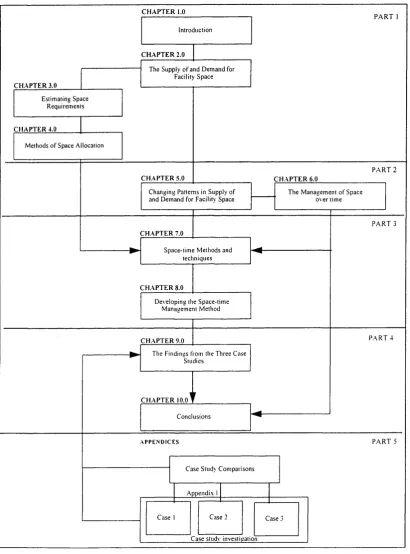
The structure o f the thesis is summarised in Figure 1.2, w hich has five main sections.
Concepts relating to the m anagement o f facility space are reviewed in Part 1. The
changing circumstances affecting the supply and dem and for space are described in
Part 2, together with the im plications for m anagement. Part 3 sets out to develop the
m ethods and practical techniques for space-tim e m anagem ent and establishes the
propositions that time must be explicitly included in planning and m anagem ent
techniques. This part also describes the case studies m ethodology. Part 4 exam ines the
new method o f space-time managem ent and presents the results and conclusions
derived from the study overall. Part 5 gives details o f the basic support material used
in the study and reports on the case study investigations w hich were undertaken,
presented in the form o f an Appendix.
Figure 1.2: Structure o f study
C H A PT E R 1.0
I n tro d u c tio n
C H A PT E R 2.0
C HAPTER 3.0
P A R T 1
T h e S u p p ly o f a n d D e m a n d for F a c ility S p a c e E stim a tin g Space
R e q u ire m e n ts
CHAPTER 4.0
M e th o d s o f S p a c e A llo ca tio n
P A R T 2
C H A PTER 5.0 C H A PT E R 6.0
C h a n g in g P a tte rn s in S u p p ly o f T h e M a n a g e m e n t o f S p a c e a n d D e m a n d for F a c ility S p ace o v e r tim e
P A R T 3
C H A PTER 7.0
S p a c e -tim e M e th o d s an d te c h n iq u e s
C H A PTER 8.0
D e v e lo p in g th e S p a c e -tim e M a n ag e m e n t M e th o d
C H A PTER 9.0 P A R T 4
T h e F in d in g s from th e T h re e C a se S tu d ie s
C H A PT E R 10.0
C o n c lu s io n s
A P P E N D I C E S P A R T 5
C a s e S tu d y C o m p a ris o n s A p p e n d ix
W ithin this five part structure, the key aspects o f supply and dem and for space, and
the ways in which others have dealt w ith them in the past are discussed in Chapter
2.0. The evolution o f space classification is review ed and the generic problem s w hich
affect the balance o f supply and dem and for space are explained, together with
practical ways o f resolving them. From the dem and perspective, the ways in w hich
organisational space requirem ents are estim ated is discussed in Chapter 3.0. This
chapter also highlights variations in requirem ents, ranging from individuals through to
the organisational level. Chapter 4.0 describes the supply perspective and the various
methods which have been developed to assist in the allocation o f available space to
meet a given demand.
An overview o f the changing situations affecting space since the early 1970s and the
ways in which these changes impact on the office sector, in terms o f em ploym ent,
work organisation and location selection, is discussed in Chapter 5. These trends have
given rise to the necessity for an innovative m anagem ent o f space, so as to m eet the
changing work situations which are organised around the lim itations and inadequacies
o f the traditional methods o f management, particularly when applied to contem porary
conditions, as described in Chapter 6.0. Chapter 7.0 details the proposition that an
explicit inclusion o f time w ithin space m anagem ent procedures will result in a more
reliable method o f m anaging space as changes occur. This chapter describes the
claims which have led to identification o f the key issues. These issues are
operationalised for potential exam ination through the case study m ethod. This is
elaborated in Chapter 8.0. The overall findings from the research investigation
conducted around the three case studies, are reported in Chapter 9.0. Finally, in
Chapter 10.0, the case findings are further com pared to the conclusions o f other
studies and the implications on the theoretical developm ent o f the space-tim e
management approach, are discussed. Some lim itations o f the research m ethod are
considered and the study ends with a sum m ary conclusion identifying areas for
References
Birchall, D., & Lyons, L., 1995, C reating Tomorrow's Organisation: Unlocking the benefits o f Future Work, London: Pitman.
Cundell, L, 1988, Planning For the City Offices In The 1990s: A Challenge Unmet?
London: London School o f Econom ics Geography D iscussion Paper, N ew Series No. 2 2.
Duffy, F. & Henney, A., 1989, The Changing City, London: Bulstrode Press.
M orrison, N., et al, 1994, Economic D evelopm ent & Property M arkets in Kent,
Discussion Paper 40, Dept, o f Land Economy, U niversity o f Cam bridge.
Sproull, L. & Kiesler, S., 1991, Connections: New Ways o f W orking in the N etw orked
Organisation, Cambridge, MA: MIT Press.
Toffler, A., 1980, The Third Wave, London: Pan Books.
C H A PTER 2.0: THE SUPPLY OF AND D E M A ND FO R FAC ILITY SPACE
A lready there is an emerging building stock which offers a variation in the property
market, based on size, type and quality o f space. Similarly, the nature o f dem and for
space can be described using organisational requirem ents, cost-in-use, IT, w orking
practices, user expectations and regulatory practices. However, a clear change in the
supply and dem and o f space is occurring, where the dem and side is moving m ore
continuously, qualitatively and subjectively. In practice, organisations rarely stay the
same and past standards have shown that over a time horizon o f ten years there w ould
be significant changes within an organisation. At present, significant changes w ithin a
time period o f eighteen to twenty four m onths are not unusual. On the other hand, the
supply side tends to move incrementally and is therefore secure, quantitative and
objective, for exam ple when undergoing extensions, adaptation and modifications.
Although the facility space experiences long periods o f little change, the cost o f
change in facility is higher than the cost to change in use and managem ent o f an
organisation. This goes back to the nature o f place fixity in the facility space, because
it is possible to change part o f the organisation, but it is inherently difficult to change
part o f the facility without incurring at least some cost.
Thus, changes which occur in organisations are not visible as com pared to changes
w hich occur in terms o f building and facility space. These dynam ics inevitably affect
the balance between supply and demand, through factors which link the quantitative
and qualitative requirements for space to the available supply. This chapter exam ines
the generic problem situations which can arise in such circum stances and the
corresponding m anagement options w hich can be adopted to deal with the range o f
concerns which arise. The essential aim o f maintaining a balance between the supply
2.1 The dynam ic nature o f supply and dem and
The fact that organisations very rarely stay the same, and that facilities undergo
incremental changes as needs arise, illustrates the dynam ic nature o f dem and and
supply for space. This occurs throughout the organisation and culm inates at the
property market level. The supply and dem and m ovem ent at the property m arket level
is well illustrated by Cowan, in his work on offices in the late 1960s (Cowan, 1969).
According to Cowan, the nature o f demand for office activities is linked to the pattern
o f 'birth-growth-death-process'. Each activity seeks its own choice o f accom m odation
in relation to the different phases o f its life cycle. At the birth stage o f an organisation,
small, cheap, and adapted premises are preferred. Over time, some o f these
organisations may cease to exist, whilst others thrive. Those w hich succeed would, in
essence require more space, and as they move through the available supply, each stage
o f progression necessitates a higher capital outlay in terms o f accom m odation space.
As a result, two types o f effect could occur. Either the duration o f stay at each
prem ises will be lengthened, or the organisation w ould move further away from the
centre. Eventually, the most successful organisation will have sufficiently expanded,
that a building is built to their particular specifications where the organisation w ould
probably stay for longer period. As business activities are perpetuated, and new ones
are created, the demand cycle will repeat itself (Cowan, 1969:18).
The nature o f office space supply is parallel to the nature o f dem and. At the supply
level, the buildings could be old, converted accom m odation or new. Converted space
types are predominantly occupied by small, new organisations w hich are represented
at the birth stage in the dem and cycle, whilst new buildings tend to contain a w ider
m ixture o f thriving and growing organisations (Cowan, 1969:19). This pattern
corresponds exactly to the demand-side dynam ics w hich have previously been
described.
The supply and dem and m ovem ent which characterises organisations and their
building or facilities, is the cum ulative effect o f the departm ental, w orking groups and
individual dynamics. On the organisational level, the requirem ent for space can be
differentiated along these two dim ensions- the nature o f change and the nature o f
work (Davis et al, 1985). At the facility level, the profile can be differentiated on the
basis o f type o f facilities and the extent o f adaptability. By applying the same pattern
o f movem ents as previously described on the property m arket level, at one extrem e a
low-change routine organisation type, for example, a district council office, w ould
typically occupy a simple facility with low adaptability. At the other extreme, a high
change, non-routine organisation type such as a high-tech office, w ould typically
occupy a complex and highly adaptable facility.
At the organisational level, the demand m ovem ent will resem ble “developm ent,
growth, maturity and decline” phases (see Section 2.1), and at the building level, the
provision will represent new built, modified, adapted and dem olished phases. It is to
be expected that, under these dynamic movements, the state o f balance throughout the
organisation and facility will continually be disturbed. These interruptions are
identified as problem situations and thus have a tendency to recur over time.
This process o f matching supply and demand over time gives rise to a set o f recurrent
problem circumstances. Figure 1.1 in Chapter 1.0, illustrated the m ajor areas o f
concern in managing facilities-in-use, in relation to three main factors; the amount,
type and location o f space. The recurrence o f inadequate amounts, or inappropriate
types o f space will be the m ain focus (because locational issues should be treated as a
major topic by itself). The problem o f inadequacy relates to a shortage o f space, w here
exceeds the demand. The problem s o f inappropriate type relates to qualitative
measures o f functional spaces, which will be discussed in the next section.
2.2 Imbalances in supply and dem and
There are two basic causes o f im balance in the relationship between supply and
dem and for space; quantitative and qualitative. Q uantitative im balance occurs when
the am ount o f space (in sq.m) falls short or exceeds organisational requirem ents at a
given time. This situation is norm ally indicated by unacceptable levels o f
overcrowding at one extreme and by perceived high levels o f underuse or partial
vacancy at the other. This situation can be best exam ined by carrying out surveys or
observational studies, so as to determ ine the level o f availability o f space across the
organisation and over a certain period o f time. For exam ple, in a situation o f scarcity
o f space, workstations may not be readily available for new employees, meeting
rooms may not be readily accessible at unpredictable times or departmental space may
not be immediately available unless further acquisitions are made. In a situation o f
oversupply, workstation spaces are unoccupied or tem porarily occupied for long
periods o f time. Working group spaces such as tim e-tabled rooms may not be booked
to capacity and departments may have vacant spaces which are neither occupied by
people, machines or equipment. At the operational level, there is no accum ulation o f
requests from businesses.
Across the situations o f scarcity, balance and surplus, those m anaging the space
normally employ occupancy density ratios as an approxim ate measure o f the
quantitative situation. This ratio is sim ply obtained by dividing the num ber o f spaces,
or the net internal area available, over the number o f occupiers. The resulting ratios
are compared against the organisation's expected density requirem ents and from there
the extent o f surplus or scarcity problem s can be identified.
Qualitative imbalance in the supply and dem and o f space can occur when, despite
being in quantitative balance, the types o f spaces becom e inappropriate in m eeting the
current and emerging dem ands o f an organisation. The qualitative features o f facility
space are floor depth, shape o f space, type o f space and configuration o f space. The
character o f the site and location and the building's image are all qualitative attributes
which are commonly considered to be o f importance. Some best practice measures o f
these qualities are summarised in A ppendix 1, A l.
Alternatively, qualitative im balance is indicated by the extreme utilisation levels
which vary hour by hour, day by day and week by week. In existing building-in-use
situations, this pertains to the patterns o f “adjacency patterns” o f facility space. An
imbalance is indicated by utilisation, which is sourced to the allocation procedure.
This issue is covered in chapter 4.
2.3 Basic m anagem ent options
When organisations are faced with any o f the general situations outlined above, there
are basically two families o f m anagem ent options from w hich to choose. The first set
o f options are those o f adjustm ent while staying in or keeping the existing premises.
The second family o f options is those w hich relate to m oving from all or part o f the
accommodation to more suitable premises. M oves can be differentiated further as
complete moves, partial moves and future moves (Jones Lang W ootton (JLW), 1994).
Each option can be com bined with different strategies; m odification, adaptation,
utilisation, extension, dem olition and newly built. W ithin each strategy the
management process will cover procurem ent, allocation, utilisation and disposal.
Decisions concerning an appropriate m anagem ent option revolve around five generic
steady state o f the facility space and its environm ent. The second applies to
incremental im provement and periodic m odification o f the space. The third is in
connection with major changes and renewal while the fourth includes planning and
design o f new resources. Finally, the fifth circum stance relates to portfolio
adjustm ents in terms o f procurem ent, consolidation and disposal o f space at the
corporate level.
Figure 2.1: Circum stances for m anagem ent o f spatial resources
S t a y a n d m a n a g e
S t a y a n d m o d i f v
M o v e an d m o d i f v M o v e an d
m a n a g e
S t a y an d a d a p t
M o v e an d b u il d S t a y a n d
e x t e n d M o v e an d
a d a p t
3 . A d a p t a t i o n o f e x i s t i n g b u i l d i n g s a n d f a c i l i t i e s
5. S t r a t e g i c o p t i o n s f o r p r o p e r t y p o r t f o l i o
m a n a g e m e n t I . M a n a g e m e n t a n d
m a i n t e n a n c e o f i n d i v i d u a l b u i l d i n g s a n d f a c i l i t i e s
4 . P l a n n i n g a n d d e s i g n o f n e w b u i l d i n g s a n d f a c i l i t i e s
2. M o d i f i c a t i o n a n d i m p r o v e m e n t o f f a c i l i t i e s
S o u r c e : A d a p t e d fr o m N u tt. B ( 1 9 8 8 ) .
In reference to the last point, with respect to the organisation's property portfolio, its
size, age and condition, ownership, location, cost and value will, to a signifieant
extent determine what activities need to be undertaken. This relates to the strategic
decisions taken by facilities' directors in large corporations, regional authorities and
governm ent agencies and usually involves many buildings on m any sites. Concerns
include freehold accom m odation which is old or in a poor state o f repair as to require
either renovations, m aintenance, disposal or developm ent, and secondly, in a short
term lease hold, where the em phasis is on lease adm inistration, negotiations or
acquisitions. Thirdly is a concern over the overall m aturity o f an organisation.
Occupied facilities tend to be more focused tow ards m odification and incremental
im provem ents and these would necessitate either a “stay and m odify” option or a
“move and m odify” option. N evertheless, com m on issues w hich arise rem ain the
same in all other circumstances: where to locate space, how m uch space is required,
what types o f space are needed, how to procure or dispose o f space, how to allocate,
reallocate and how to utilise and improve utilisation o f space through the changing
cycle o f use.
2.3.1 Procurem ent or Disposal of space
The procurem ent and disposal options are grouped together to identify the activity
interface between supply side and use. Procurem ent activities relate to categorising
and selecting the sources o f supply and to m aking the provision available in places
where needed. At this stage, how much, what type, where and for how long space is
required will have to be considered. If resources are not readily available, some
procurem ent activity will be necessary. The decision around w hether to purchase or
lease space depends on the tenure arrangem ent (although tenure is but a small part o f
the decision). This decision is made on two grounds: w hether to possess the property
as a potentially appreciating asset or to create a bespoke building, tailored to a specific
user’s needs. There are several routes to procurem ent. At the building level, these
include the option to buy and develop a site, to engage in a jo in t venture with a
developer to construct or lease space as a shell and core, or to collaborate w ith
developers on a building with fit-outs, furnished prem ises, etc.
Disposal activities relate to a point in time o f the occupied facility where the resources
This is typically carried out through sale or lease; the latter has greater flexibility and
variety. The decision to dispose is taken after a financial analysis has been carried out,
to assess particularly the cost o f the surplus property at the end o f the lease. The basic
routes are through using letting agents, informal tendering and sub-letting. Some
innovative routes have been developed lately w hich include, short-bold tenancies,
factoring through a property company, lease buyouts or leasing sections to other
com panies (N ACORE/IDRC, 1995). If the spaces are not w holly to be disposed of,
but partly maintained, the excess space should take account o f the terms o f the lease,
rental costs, and the existence o f any option clauses in the lease.
In summary, the choice o f decision would be based on the appropriate time factors
involved to either procure or dispose spaces, which allow the organisation to recoup
the benefits in time.
2.3.2 Allocation / reallocation of space
A llocation and reallocation options are grouped together to identify the interface o f
activities between demand side and use. The allocation activity distributes the spaces
which arise from utilisation to make them available for exchange at dem and markets.
Reallocation should be a reverse process. The m anagem ent core functions are in place
to allocate the available, and usually scarce resources, among com peting market
segments and conflicting interests, characterised mainly as scarcity, versatility,
multiplicity and ranking (Bender, 1983).
Scarcity is a function because it recognises that the availability o f each resource is
insufficient to meet all stated requirements, and that flexibility or versatility leads to
the possibility that any one resource is being used to satisfy more than one
requirement at any one time. Diversity or m ultiplicity in this context, is the need to
satisfy more than one requirement, and the ranking o f requirem ents is done according
to criteria which establishes the desired space types. The key questions are therefore
when, where and how much resources are to be allocated, all o f w hich depend on the
organisation's objectives (Bender, 1983:53).
The objectives o f some organisations to be met by resource allocation, could be profit
maximisation, cost m inim isation and m axim isation in throughput or service. In some
practices, a set o f priority lists is used. On the other hand, reallocation activities arise
when there are supplies o f space. A com m on exam ple is by subdivision o f the
available spaces, which can be carried out either inform ally or formally. This issue is
covered in Chapter 4.
2.3.3 Utilisation o f space
In recent years, real estate managers have been developing ways o f making their
portfolios more readily adaptable in dealing with new approaches to the use o f the
workplace (Avis & Gibson. 1996:27). U tilisation represents the interface between
supply and demand and is discussed in further detail in Chapters 6.0 and 7.0. This
activity is handled after resources have been acquired and allocated, and need to be
utilised to fulfil the organisation's mission and attain its goals and objectives.
Utilisation can be realised through activities such as production, conversion, growth,
transportation, storage and maintenance. Im proving the utilisation level is applicable
in “stay and manage" or “move and m anage" options. Utilisation is a typical m easure
when organisations are faced with limited spatial resources and there is a conscious
decision not to acquire any further space. It is also an issue when there is a problem o f
There are three parts to this discussion: the supply-side utilisation, the dem and-side
utilisation and the interface between supply and demand. In the first instance,
m anagem ent should ask what can be done on the supply-side to improve the use o f
space. In the second instance, what can m anagem ent do on the dem and-side to
improve the use o f space? For example, on the supply-side, a system o f booking
spaces can be organised; and the m anagem ent o f centralised facilities can be arranged
(reorganising the supply side). On the dem and-side, managem ent can be organised
through tim e-tabling arrangements: activity/w ork tim e-tabling (reorganising the
demand side) while on the supply and dem and interface, through work program m ing
arrangements, by extending the working day (time base), reorganising the 'supply-
demand' interface, multi-use functions and space sharing.
Examples abound from educational facilities and hotels, where the m ulti-use o f space
exists. In such organisations, a more intensive use o f space by the same or different
groups o f users, for different types o f activity, is a com m on feature. Sharing is made
more intensive through a pattern o f use by the same groups, or by different groups o f
users, for the same types o f activities im plem ented through tim e-tabling arrangem ents
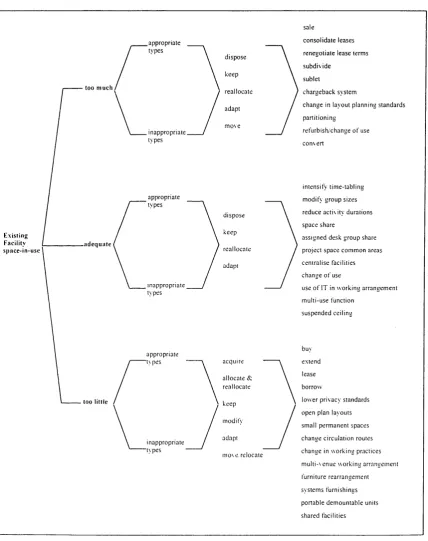
or the centralisation o f facilities (Kenny, 1977a; Kenny. 1977b). Figure 2.2 shows
some com mon paths o f decision around m anagem ent options, where recurrent
Figure 2.2: Paths o f decisions around m anagem ent options under recurrent problem circum stances
t o o m u c h
a p p r o p r i a t e
d i s p o s e
r e a l l o c a t e
m o \ e i n a p p r o p r i a t e
E x i s t i n g F a c i l i t y s p a c e - i n - u s e ]
. a d e q u a t e
a p p r o p r i a t e
d i s p o s e
r e a l l o c a t e
i n a p p r o p r i a t e
t o o l it t l e
a p p r o p r i a t e
a c q u i r e a l l o c a t e & r e a l l o c a t e
m o d i t \ i n a p p r o p r i a t e
m o v e , r e l o c a t e
s a l e
c o n s o l i d a t e l ea s e s r e n e g o t i a t e l e a s e t e r m s s u b d i v i d e
s u b l e t
c h a r g e b a c k s y s t e m
c h a n g e in l a y o u t p l a n n i n g s t a n d a r d s p a r t i t i o n i n g
r et ' u r b i s h j ' c h a n g e o f us e c o n v e r t
i n t e n s i f y t i m e - t a b l i n g m o d i f y g r o u p s i z e s r e d u c e a c t i v i t y d u r a t i o n s s p a c e s h a r e
a s s i g n e d d e s k g r o u p s h a r e p r o j e c t s p a c e c o m m o n a r e a s c e n t r a l i s e f a c i li t ie s c h a n g e o f u se
u s e o f IT in w o r k i n g a r r a n g e m e n t m u l t i - u s e f u n c t i o n
s u s p e n d e d c e i l i n g
b u y e x t e n d l e a se b o r r o w
2.4 The cycle of supply, demand and use
Many facilities' studies have identified that one o f the fundamental factors influencing
the m anagement o f space is utilisation. The m anagem ent o f space is the degree o f
intervention needed to support the users o f space. The task o f m anagem ent is to match
the supply and demand o f facility space at the appropriate tim e scale. The decision
making process o f facility organisation and occupation is usually undertaken
incrementally over time and com mitments and policies are made as far ahead as
requirements can be predicted in terms o f the spatial resources allowed.
The basis for the normative approach to this issue is that an assessm ent o f the future
demand for space will help to determine the am ount o f space which needs to be
provided or acquired in order to satisfy the predicted demands. This in turn will lead
to an account o f the use and performance o f the new provision, followed by a
reassessment in due course o f the degree to which dem and is being m et by supply
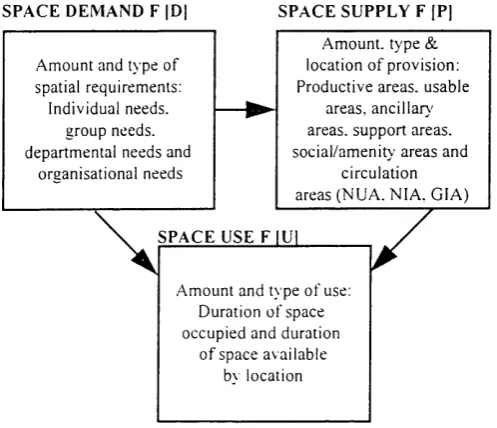
(Nutt. 1972a). The simple basis for this traditional view o f the supply and demand
Figure 2.3: Two models o f the supply and dem and o f facility space
S P A C E D E M A N D F |D] S P A C E S U P P L Y F [P]
Am ount and type o f
A m oun t, type & location o f provision:
spatial requirements: Productive areas, usable
Individual needs. --- areas, ancillary
group needs. areas, suppo rt areas.
departmental needs and social/amenity areas and
organisational needs circulation
areas (N U A . NIA , G IA )
S P A C E USE F lUI
A m ount and type o f use: Duration o f space occupied and duration
o f space available b\ location
Source: Nutt ( 1972a)
Facilit\ Plan
D E M A N D
organisational objectives staff functions gr oup interactions
space guidelines densit} o f space use
design guidelines
S U P P L Y
building siz e-GIA : N U A building form size o f floors planning grids structural grids service provisions density o f space use
efficiency o f space use effective use o f space
u se r's perception
IN USE
A N A L Y S I S
pre-occupancy surve\ post-occupancy survey
building appraisal STM review space budget space audit space syntax
Figure 2.3 illustrates a formal description o f the theoretical decision process which
was thought to be sufficient at that time. From the point o f view o f space
management, the am ount and type o f use may only be observed w ithin the context o f
the existing provision. The amount and type o f current and future dem and may be
assessed indirectly, through the use that is made o f the existing provision, unless the
client and users are directly questioned (Nutt, 1972a). It is necessary to distinguish
that while changes in dem and and supply are generally independent o f each other,
changes in the pattern o f use and the level o f utilisation will often sim ultaneously
affect supply and demand issues. Thus, supply and dem and for space depends upon
and varies with use and correspondingly, use depends on and varies with supply and
demand.
In another approach, if a demand-led sequence is adopted, given that the
organisational requirement is known, the question w hich im m ediately arises is will
the available supply be appropriate for the organisation? If how ever a supply-led
approach is adopted, the most immediate question is will the available supply be
suitable and sufficient for the organisation and client? The supply and dem and
interface is one where sufficiency and utilisation com m only occur.
The m anagem ent process may start from any o f the phases illustrated in Figure 2.3. It
is a way o f converting the spatial resources into specific plans o f action, with details
such as locating space for immediate growth, developing a program m e for sub-leasing
o f surplus space and the provision o f a site for expansion. These decisions are
important because building facilities are a source o f direct investm ent which account
for around 25 - 30 percent o f an organisations' assets. Planning is conducted on three
interrelated levels, with different time horizons and activity levels o f detail. The
shorter the time horizon, the greater the detail. These decisions in turn inform the
facilities policy at the tactical, operational and strategic levels. Typically, strategic
planning covers a period o f up to 2-3 years in the future, with the possibility o f
extending further. Operational planning will cover the year ahead and tactical
planning will cover the hourly or daily periods.
2.4.1 Strategic managem ent in relation to space
Strategic m anagement is distinctive from the non-strategic approach, particularly
when a time frame is included in the managem ent process, and issues o f uncertainty
are addressed. The time and uncertainty o f facilities could be anything from 5-10
years ahead, although the planning horizon is divided into irregular periods, typically
o f a one, two and five-year duration (Bender. 1983:85). The main influence in
strategic management is the set o f options available with regard to the dem and levels
within an organisation, and their consequences in financial or operational terms. In
this aspect options are available to enable organisations to meet the different demand
changes and their effects on space supply, use and m anagement. Scenarios are used to
explore and forecast important developments and to prepare for appropriate policies,
constraints and conditions which will guide tactical and operational planning (Bender.
1983:85).
In their study. Avis & Gibson (1995:33) dem onstrate an im proved representation o f
property at the upper levels o f the organisation m anagem ent hierarchy, which both
indicates an increased perception o f its importance and the greater consideration given
to it in terms o f strategic decision-making. A lthough property is still only specifically
included in the strategic plans o f 60% o f organisations, there is still room for
2.4.2 Operational m anagem ent in relation to space
Operational management is intrinsically m edium term, within a time horizon o f 1-3
years, and typically covers the year ahead, focusing on recurrent issues which are managed through the use o f operational plans. The m ain thrust in operational planning
is on how to use the resources which are available, through sequencing and scheduling
operations. Additionally operational m anagem ent translates such plans into
instructions for execution and into budgets (Bender, 1983).
Some general management literature has defined operational planning tim e frames to
include weekly and daily increments. In this study, the inclination is to include such
time frames in the context o f tactical m anagem ent. In order to guide execution
processes, operational plans require projection data to establish recom m ended actions
and reactions to outcomes. The allocation stage is realised at this level o f
management. In practice according to Avis & G ibson's (1995:34) report, 75% o f the
organisations which they surveyed, did not have anyone in operational departm ents
with direct responsibility for property, and 20% o f all organisations had no one in
house who was responsible for undertaking any professional property managem ent
work.
2.4.3 Tactical m anagem ent in relation to space
Tactical management is applicable in circum stances which have not been predicted.
and involves taking decisions with a short term perspective quickly and well. The
planning horizon, as m entioned earlier, is usually divided into weekly, daily and
hourly increments. The data required includes forecasts and projections o f statistical
extrapolations o f past trends, described as a tim e series, produced by regression
techniques and multiple correlation (Bender. 1983). This is used to develop
assessm ents and inform decisions which will guide operations. Typically, these
master space plan which covers a time frame from im mediate needs, short, m edium
and long term requirements (Binder, 1989).
2.4.4 Balancing supply and demand
In the traditional office sector, which is characterised by low rates o f organisational
change, m anagement activities are concentrated in operational decision-m aking which
affects the annual operations o f the facility. Decisions tend to focus on layout issues,
security, access, open and enclosed office space, inventories o f furnishings and
settings, stacking plans, procurem ent and tenure. As business changes more rapidly
over time, the merge o f facility plans with business plans over different time horizons
will inevitably require a new space m anagem ent approach. This approach is
established through the use o f real estate databases, by systematic appraisal or audit o f
an existing part. The intention is to build a coherent corporate premises strategy,
which will serve as a back-drop for establishing a strategic formulation, com prising a
full appraisal o f the company's current objective and com patibility with the existing
real estate structure (Elliot & Malien, 1995).
When balancing supply and demand in the managem ent o f facility space, the skill is
in matching the right provision to the required need (Avis & Gibson. 1996:28). In past
studies the performance o f space managem ent is measured by the level o f suitability
achieved between supply and demand, as in the ORBIT 1 study (Duffy, 1983). or the
capacity for buildings to respond to change, as in the ORBIT 2 study (Davis et al,
1985). Space management can also be m easured through the supply which is available
and the demand which is required. Thus the whole process o f m anagem ent revolves
around the activity o f balancing the availability and provision o f space. From a
management viewpoint, the balance is the degree o f tolerance between the activities
type o f activity element with any type o f spatial elem ent, or some quantity in dem and
with some quantity in supply, or some quantity o f use intensity per unit o f time with
some quantity o f capacity measures.
According to some authors, the balance o f qualitative aspects can be measured using
either organisational 'fit', or 'building utility ’ concepts. As the term implies,
organisational Tit' is "a definition o f corporate office quality not ju st in terms o f the
physical accommodation, but o f how well m atched this is to the organisation" (Ellis,
1984:255). On the other hand, the term 'building utility' is related to the issues o f
daily performance and its operations. It also relates to the inherent adaptability o f the
building to a range o f use patterns over time. In some aspects quality and utility can
be interrelated, such that poor quality space will relate positively to low building
utility.
From another perspective, the term 'fit' implies that it is com mon for buildings not to
be used 100% efficiently. Such inefficiency could be derived from the building
configurations, grid constraints and design obstructions (BWA. 1994; Becker, 1990).
or in achieving viable organisational boundaries. The fit-factor is an allowance which
takes account o f the fact that fitting into actual buildings inevitably causes some
inefficiencies in occupation due to natural obstructions from columns, awkward
angles and the size o f floors. The fit-factor has been estimated between 5% (Eley &
M armot, 1995 to 10% (Davis et al, 1993b). A factor o f 5% is com m on in regular
rectangular buildings, while a larger percentage may be appropriate in particularly
difficult buildings. Another requirem ent is the turn-around space, estim ated at 2% o f
the total usable area. This is the degree to w hich the 'requirem ents for' and the
'allocation o f space can and should be accom m odated. If the fit factor is too high then