929
Transformational Leadership, Mediating Effect Of
Knowledge Management System And Moderating
Effect Of Training In Human Capital Development:
SEM-SMART PLS Approach
Muhammad Shahid Khan, Duangkamol Chongcharoen, Premkamon JankaweekunAbstract: This is a knowledge-based economy era; consequently, the role of human capital cannot be neglected, constituting as it does an important competitive asset in today's global market. After leisure tourism and health tourism, the newest growth sector is education tourism, which attracts a huge number of international students. In the ASEAN region, Singapore and Malaysia are leading countries in this new growth industry. Education tourism is also recognized as a source of GDP growth. To compete with 21st century educational and technological challenges, the government of Thailand has to focus upon improving teachers’ knowledge, skills, and abilities. Human capital can play a vital role in achieving this objective; in turn, this research has developed a framework which identifies the mediating effects of knowledge management systems and the moderating effects of training in developing human capital. Quantitative methods have been used in this study, with data collected from different schools located in Bangkok and other provinces. In order to test the structural model, SMART PLS software has been used in this study. The results of this study reveal that knowledge management systems mediate the relationship between transformational leadership and human capital development. Results also evidence that variable training moderates the relationship between 360 degrees perforce appraisal and human capital development. This study, therefore, contributes to transformational leadership and human capital theory.
Index Terms: Human capital development (HCD), Knowledge Management system (KMS), Training, Transformational leadership (TL), 360 Degree performance appraisal (PA), Structural Equation Modeling, Smart-PLS.
—————————— —————————
1.
INTRODUCTION
The UNESCO’s latest report on Thailand's education system is ―a disappointment for the government and Thai people as a whole, as Thailand came 54th out of a total of 70 assessed countries, classified by subject, Thailand ranked 54th for mathematics, 57th for reading, and 54th for sciences’’ {1}.
Therefore, to compete with the rest of the world Thailand has to improve the education system, given that the quality of education represents the primary method for genuinely lifting the country.
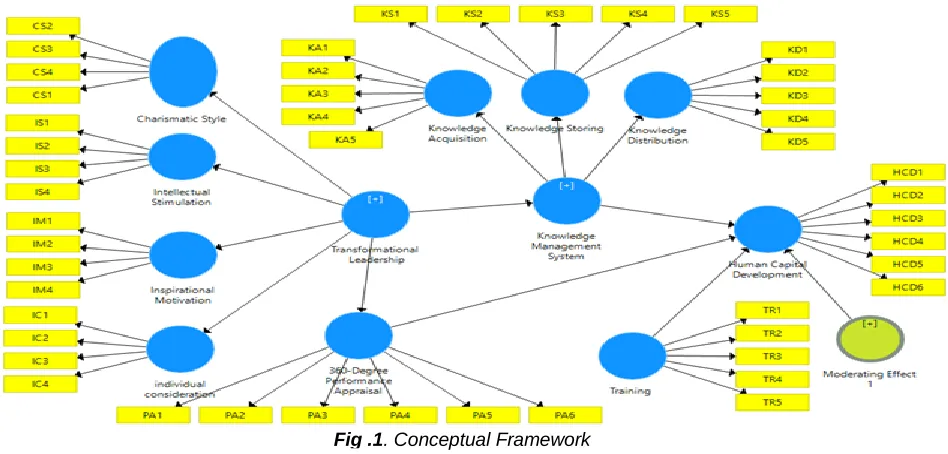
Fig .1. Conceptual Framework ————————————————
Muhammad Shahid Khan is currently working as an assistant Professor Suan Sunandha Rajabhat University,
Thailand, PH-+660908982324. E-mail:
Duangkamol Chongcharoen is currently working as a lecturer Suan SunandhA Rajabhat University, Thailand, PH-+66834565935. E-mail: [email protected] Premkamon Jankaweekun, Chongcharoen is currently
Singapore finished top in this global comparison of students’ respective mathematics and science abilities. Singapore's education contributes to its intensity and strictness. ―Singapore also invested heavily in a quality teaching force to elevate the status of teaching and to attract the best graduates, as noted by OECD education director Andreas Schleicher‖ {1}. Current research suggests that investment in HCD can transform the education system of Thailand, by utilising the latest technology and new techniques; these include knowledge management systems, transformational leadership styles and, 360-degree performance appraisal systems which can help the nation enhance the knowledge, skills, and abilities of Thai teachers. Up to date knowledge on the part of teachers can help the students acquire the latest knowledge and improve their skills. Researchers urge the identification of other variables which influence Human Capital Development (HCD) in addition to education and training {2}, {3}, {4}. This study bridges the theoretical gap by including Knowledge Management systems as mediatory, 360-degree performance appraisals and the function of training as a moderator. Such transformational leadership styles can transform working environments within organisations. Therefore, this study aims to identify the mediating effects of the knowledge management system, the effect of 360-degree performance appraisal and the moderating effect of training upon human capital development.
2 LITERATURE REVIEW
2. 1 Underpinning Theories: Human Capital Theory Becker (1993) appeals to the reader: ―I am going to talk about a different kind of capital. Schooling, a computer training course, expenditures on medical care, and lectures on the virtues of punctuality and honesty are capital too, in the real sense that they improve health, raise earnings, or add to a person’s appreciation of literature over a lifetime. Consequently, it is entirely in keeping with the capital concept as traditionally defined to say that expenditures on education, training, and medical care, etc., are investments in the capital. HCD is not a cost for any nation, but it converts humans into an asset. Thus, for government policy and western education systems, HC theory constitutes the most influential economic theory in the early 1960s {5}. The future success of a nation’s economy will depend in part on a ―well-educated and highly resourceful workforce that is capable of adapting existing knowledge and adopting new skills in order to remain competitive in a continually changing global market and economic development is greatly related to adult education‖ {6}. Since the implementation of economic reforms in the late 1970s, China’s GDP per capita has grown almost 100 times from 89.5 USD in 1960 to over USD 8123 in 2016 (the World Bank) lifting millions of Chinese out of poverty {6}. This shows how human capital development is essential for the success of any organisation and country. The focus of HC theory was mainly on education and health. Conversely, this study suggests that in today’s digital era education and skills could be transformed by adopting transformational leadership style which will transform the system and bring knowledge management system, training, and 360-degree performance appraisal system that will help in the human capital development process.
2.2 Transformational Leadership
Transformational leadership was first presented as an idea by Downton, J. V. 1973’s ―Rebel Leadership‖ study conducted within the ―sociological field‖ {7}. The concept of TL was subsequently used by James McGregor in his book ―Leadership" (1978), following which is in 1985, Bass developed these previous findings into a formal transformational leadership theory. This kind of leader motivates subordinates to achieve goals in an efficient way and beyond expected results; consequently, this kind of leader builds a high level of trust among the subordinates and leader {8}, {9}. TL provides a clear vision, concentrating individuals’ energies and thus motivating subordinates towards the achievement of goals {9}. Employees who trust a leader manifest more capacity to acquire knowledge and experiences. TL hence empowers employees to think differently and learn new ways to attain goals {10}, {8}, {11}, {12}. Transformational leaders can successfully change an organisation's culture, developing systems that can meet environmental demands through aligning or synthesising all strategies {13}.
Bass {14} defined four characteristics of transformational leadership: (a) ―charisma or idealized influence‖; (b) ―inspirational motivation‖; (c) ―intellectual stimulation‖; and (d) ―individual consideration‖.
(a) Idealised influence or charismatic qualities confirm a ―transformational leader‖ to be a ―visionary leader‖ who can build a clear mission, achieve respect and establish an organisation’s trustworthiness ({15}, {16}.
(b) ―Inspirational motivation‖ is known as a leadership trait, where the building of sophisticated standards constitutes a point of reference for other {16}, {8}, {12}, {17}).
(c) ―Intellectual stimulation‖ sets new challenges, fosters new ideas for subordinates and inspires them to challenge the old status quo of a working environment. Such leaders manifest intelligence, logical thinking ability and particular problem-solving traits {8}, {16}).
(d) The fourth dimension of TL is ―individual consideration‖ which is associated with the development of subordinates by training and mentoring them ({8}, {13}).
2.3 Knowledge Management system
931
Table1:
FACTORS OF KNOWLEDGE MANAGEMENT SYSTEM IMPLEMENTATION
Key Dimensions Description
Leadership and Support Management team support for KM activities
Technology and Infrastructure Establishment of an effective IT system
Knowledge Creation Development of new knowledge and workplace
Acquisition and Learning Search for new knowledge and enable the learning process Dissemination and Transfer
Facilitate the organisation to share the knowledge inside the organisation
Application and Exploitation
Employee’s attitudes and requirements for applying knowledge and putting it into practice
People Competency
To judge the effectiveness of KM activities in terms of advancement in employees' skills and knowledge.
Sharing Culture
Develop knowledge sharing culture inside the organisation and motivate and reward the employees who share the knowledge
Nonaka and Takeuchi {20} highlighted that knowledge management systems help organisations to acquire new knowledge, store the knowledge in the database and share it with employees. TL has been recognized as a significant influencing factor within KMS and innovation systems across a range of industries. However, there is a lack of research linking transformational leadership, knowledge sharing, and innovation within higher education, specifically within developing countries {25}, {4}. The knowledge management system can play a vital role in improving the knowledge of school teachers in Thailand. A proper database to acquire new knowledge and share it with all teachers can make it easy for them to get new knowledge. This can also help educators to access knowledge from their own homes. To develop and implement this potentially revolutionary system, school leaders have to adopt transformational leadership styles. A new method of teaching and new methods of learning will enable school teachers to upgrade their knowledge as per 21st-century requirements.
2.4 Employees Training
Training can take the organisation to a destination within a specific time frame {26}. Due to rapid changes in technology, an organisation must equip itself with new knowledge and skills; in this regard, training could be an excellent source to upgrade the employee’s KSA. Training is a significant factor in lifting the efficiency and effectiveness of employees and the organisation {27}. The concept of training itself is not new; its roots go back to 1400 years ago to the Prophet Muhammad’s (Peace Be Upon Him) time. During this era, as Azmi {28} notes ―Caliph Ali was sent for training when he was appointed as a judge as he was young and did not possess any knowledge about judiciary‖, while women were trained for treating injured soldiers and providing appropriate services to the soldiers such as preparing meals and others.
Literature suggests, to defines ―training [as] a well-structured procedure by which people learn knowledge and skills for a specific purpose‖. Tim and Brinkerhoff {29}, meanwhile, claim that human capital development is the result of training and development and education. Zigon {30} similarly defines training as a process whereby an individual’s behaviour is modified and Oforegbunam et al. {26} defined it as a process through which ―skills, talents, and knowledge of employees are enhanced‖. Therefore, despite formal education, training can help with human capital development. In this study, a training variable is observed as a moderating variable between the 360-degree PA system and HCD.
2.5- 360-DegreePerformance Appraisal
In the field of industrial/organisational psychology, performance appraisal has become a leading research topic ({31}. It is defined in different ways by researchers, for instance, Griffin and Ebert {32} describe performance appraisal as a ―formal evaluation of an employee's job performance in order to determine the degree to which the employee is performing effectively‖. The history of the performance appraisal process itself dates back thousands of years. In the past, the performance appraisal system was conventionally used as an assessment tool of employees’ performance; currently, however, it is used to bridge the gap between desired performance and actual employee performance and further provide appropriate training. The 360-degree appraisal is a comprehensive appraisal technique constituted by factoring in and amalgamating all forms of appraisal techniques. It includes contributions to feedback from subordinates, managers, peers, customers, suppliers ({33}. Sharma {34} defines PA as a core tool for employee ―career development‖ since it identifies staff training needs and consequently provides the means by which employee KSAs may be upgraded. This research is aimed at identifying the role of the PA system with the help of moderating variable Training and HCD.
2.6 Human Capital Development
2.7 Hypothesis Development
Researchers have explored the role of transformational leadership in changing the working environment, further, TL is positively associated with KMS ({48} {3}, {4} {49} & {50}. Therefore, this research assumes, H1a: TL has a significant and positive impact on the knowledge management system. Similarly, this study also hypothesised, H1b; KMS mediate the relationship between TL and human capital development. Laka-Mathebula {51} found a positive relationship between TL and Human Resource Practices. Therefore, this study hypothesised, H2a: TL has a significant and positive impact on 360-degree performance appraisal and H2b: 360-degree performance appraisal system has a significant and positive impact on HCD. Ishak
et al. {24} identified the role of Knowledge management in HCD and organisation performance effectiveness. A study conducted by Zhao {52} in China suggests that knowledge management and organisational learning culture build teacher professional development. Therefore, this study hypothesis, H3: KMS has a significant and positive impact on human capital development. Olufemi's {53} study in the banking sector found a significant positive relationship between training and human capital development. Hence this study hypothesises, H4: training moderate the relationship between 360-degree and human capital development.
TABLE 2
THEORETICAL JUSTIFICATION OF THE HYPOTHESIS
Hypothesis References
TL and Knowledge Management system
Song, et al. (2012) & Crawford (2005)
Politis (2002);(Khan, Bilal, Mateen & Haq, 2017); Khan, Sentosa & Salman, (2018)
TL and 360 Degree performance appraisal Laka-Mathebula (2004)
KMS and Human capital development Ishak et al. (2010) & Zhao (2009)
360 Degree Performance appraisal and Human capital
development Baniya (2004); Olufemi (2009) & Sharma (2012)
3. RESEARCH METHODOLOGY
This section discusses research methods undertaken in the course of the research. The methods undertaken can be found briefly described in the following sections.
3.1 Research Design
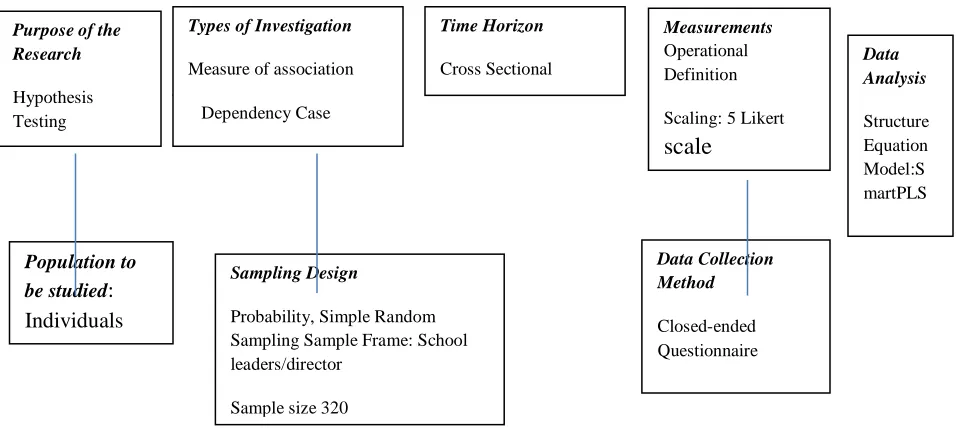
This study employs a quantitative method, the purpose of which is to test its hypothesis. A casual dependency case quantitative method is used to test this Data collection is conducted in a natural environment through a closed-ended
questionnaire and using a cross-sectional approach. Furthermore, to test the structural model, SMART PLS version 3 is used to analyse data.
3.2 Questionnaire Design
933
TABLE 3
ITEMS
Constructs Items Reference
Transformational Leadership
(a) Charismatic Style (4 items) CS1
CS2 CS3 CS4
b) Intellectual Stimulation IS1
IS2 IS3 IS4
C) Inspirational Motivation IM1
IM2 IM3 IM4
d) individual consideration IC1
IC2 IC3 IC4
16
Castiglione, (2006) {54}
Knowledge Management System
a)
Knowledge AcquisitionKA1 KA2 KA3 KA4 KA5
b)
Knowledge Storing KS1KS2 KS3 KS4 KS5
c)
Knowledge Distribution KD1KD2 KD3 KD4 KD5
15 Rene´e Filius, Jan A. de Jong, Erik C. Roelofs, (2000)
Training TR1 TR2 TR3 TR4 TR5
5 Audience, T., Service, P., & Service, P. (2004.)
Performance Appraisal PA1
PA2 PA3 PA4 PA5 PA6
6 To, Q, (2004).
Human Capital Development HCD1
HCD2 HCD4 HCD5 HCD6
3.3 Participation and Sampling Plan
The respondents (school leaders (director/policymakers) of this research survey were chosen from within Public and Private sector schools, located in Bangkok, Lampang and Ranong province. A probability sampling technique was used in this study, and the sampling technique was a simple random sampling method: the sample size was 320. To evaluate the reflective measurements model, this study examined outer loadings, the composite reliability method for its internal consistency, and the average variance extracted (AVE) for convergent validity. At the outset, the convergent validity of the measurement model was confirmed using factor loadings, while to confirm for internal consistency composite reliability analysis methods were used. This study used SmartPLS 3.2.8 to test the model and justify the hypotheses. A bootstrapping technique was directed through 3000 iterations to detect the statistical significance of the path coefficients {56}.
Fig. 2. Research design
4. Results and Findings
This section discusses the results and findings of the research.
4.1 Measurement Model Assessment:
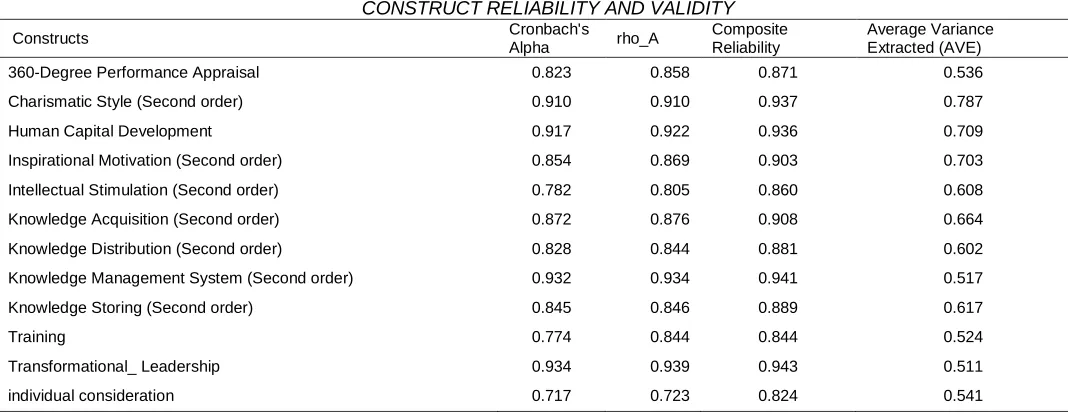
Measurement model assessment was firstly done by assessing construct reliability and validity. The results indicate that Cronbach’s alpha coefficients of all items ranging from 0.782 to 0.932 were higher than the proposed value of 0.7 {57}. Additionally, for testing construct reliability all the composite reliability (CR) values of all the items ranging from 0.871 to 0.941 were found to be higher than
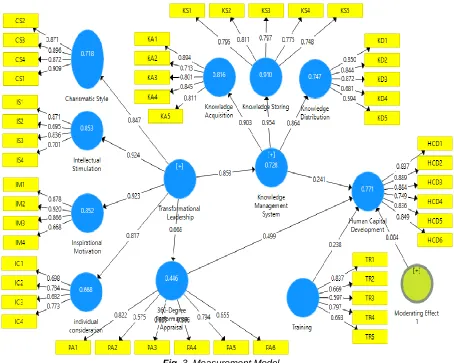
the proposed value of 0.7 {58}, {59}, which satisfactorily established that construct reliability was fulfilled as shown in Table 4. Therefore, the achieved Cronbach’s Alpha and CR for all constructs were considered to be sufficiently error-free. Factor loading methods were also used to assess indicator reliability. Hair et al. {60} suggest factor loading should be above 0.50: in this research factors loading for all the indicators were above 0.50 as mentioned in Figure 2. Table 4 results indicate that all AVE values were higher than the proposed value of 0.50 {60} ranging from 0.511 to 0.787. Hence there was no problem with the AVE, of all constructs since its value stands above 0.50.
Measurements
Operational Definition
Scaling: 5 Likert
scale
Time Horizon
Cross Sectional
Types of Investigation
Measure of association
Dependency Case
Purpose of the Research
Hypothesis Testing
Data Analysis
Structure Equation Model:S martPLS
Data Collection
Method
Closed-ended Questionnaire
Population to be studied:
Individuals
Sampling Design
Probability, Simple Random Sampling Sample Frame: School leaders/director
935
TABLE 4:
CONSTRUCT RELIABILITY AND VALIDITY
Constructs Cronbach's
Alpha rho_A
Composite Reliability
Average Variance Extracted (AVE)
360-Degree Performance Appraisal 0.823 0.858 0.871 0.536
Charismatic Style (Second order) 0.910 0.910 0.937 0.787
Human Capital Development 0.917 0.922 0.936 0.709
Inspirational Motivation (Second order) 0.854 0.869 0.903 0.703
Intellectual Stimulation (Second order) 0.782 0.805 0.860 0.608
Knowledge Acquisition (Second order) 0.872 0.876 0.908 0.664
Knowledge Distribution (Second order) 0.828 0.844 0.881 0.602
Knowledge Management System (Second order) 0.932 0.934 0.941 0.517
Knowledge Storing (Second order) 0.845 0.846 0.889 0.617
Training 0.774 0.844 0.844 0.524
Transformational_ Leadership 0.934 0.939 0.943 0.511
individual consideration 0.717 0.723 0.824 0.541
To assess the discriminant validity of the measurement, the model the Fornell-Larcker method was used. Table 3 shows the square root of the AVEs on the diagonals, as represented by the bolded values, and the values are higher than the correlations between constructs. This indicates that the constructs are strongly related to their
respective indicators, compared to other constructs of the model {61}, {56}. Hence, the results show a good discriminant validity. Furthermore, the correlation between exogenous constructs is less than 0.85 {62}: therefore, discriminant validity is successfully obtained.
TABLE 5
DISCRIMINANT VALIDITY FORNELL-LARCKER CRITERION
Constructs 360
PA CS HCD IM IS KA KD KMS KS TR TL IC
360-Degree Performance Appraisal 0.732
Charismatic Style (2nd Order) 0.547 0.887
Human Capital Development 0.846 0.523 0.842
Inspirational Motivation (2nd Order) 0.590 0.678 0.582 0.839
Intellectual Stimulation (2nd Order) 0.629 0.679 0.629 0.864 0.780
Knowledge Acquisition (2nd Order) 0.589 0.606 0.603 0.644 0.652 0.815
Knowledge Distribution (2nd Order) 0.720 0.644 0.705 0.673 0.718 0.614 0.776
Knowledge Management System 0.716 0.703 0.730 0.751 0.778 0.903 0.864 0.719
Knowledge Storing (2nd
Order) 0.643 0.666 0.681 0.728 0.749 0.831 0.759 0.954 0.785
Training 0.722 0.406 0.734 0.478 0.547 0.435 0.578 0.558 0.508 0.724
Transformational Leadership 0.667 0.848 0.664 0.923 0.924 0.755 0.754 0.853 0.813 0.535 0.715
individual consideration (2nd
Fig .3. Measurement Model
4. 2 Structure Equation Modeling
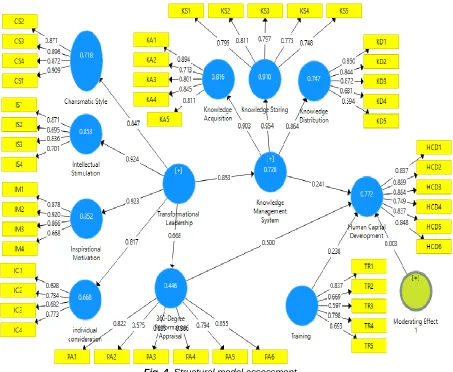
Researchers Hair, Hult, Ringle & Sarstedt {63} asserted that to assess SEM, beta (β), R² and t values should be used. They also advise reporting the effect sizes (f²) and the predictive relevance (Q²). Sullivan & Feinn (2012) {64} stated that merely relying upon the p-value might not explain the effect size. The structural model assessment as shown in Figure 4 and Table 6, reveals the results of hypothesis tests. In this study, all hypotheses are accepted since a value of p <0.005 was obtained. This corroborates
2
Fig .4. Structural model assessment
Transformational leadership significantly and positively predicts 360-degree performance appraisal. In this regard, H2a is supported (β=0.668=19.945; p <0.001). 360-degree performance appraisal system significantly and positively predicts human capital development; hence, H2a is likewise supported (β=0.5; t=7.979; p <0.001). Knowledge management systems significantly and positively predict human capital development; hence H3 is supported (β=0.241; t=5.093; p <0.001). Training significantly and positively moderates the relationship between 360-degree and human capital development, hence H4 is supported (β=003; t=3.001; p<0.001). Training significantly predicts human capital development (β=0.238; t=3.527; p <0.001). Hair et al., {63} suggest that in the case of testing mediating
effects, researchers should use the bootstrapping method of Preacher & Hayes {63}. Table 7 displays the result of the bootstrapping analysis, indicating that the indirect effect β = 0.206 was significant with a t-value of 5.011. This study can, therefore, conclude that the mediation effect of the knowledge management system is statistically significant when determining the impact of transformational leadership upon human capital development. The overall 77 % variance is observed in outcome variable human capital development. The R² values also attained a satisfactory power level as recommended by Cohen & Chin (1998) {65}, {56}.
TABLE 6
STRUCTURAL PATH ANALYSIS RESULT
Hypothesis
Original Sample (O)
Sample Mean (M)
Standard Deviation (STDEV)
T Statistics
(|O/STDEV|) P Values Decision 360-Degree Performance Appraisal -> Human
Capital Development 0.5 0.502 0.063 7.979 0.000
Supported Knowledge Management System -> Human Capital
Development 0.241 0.237 0.047 5.093
0.000 Supported Moderating Effect 1 -> Human Capital Development 0.003 0.0101 0.001 3.105 0.000 Supported Training -> Human Capital Development 0.238 0.242 0.068 3.527 0.000 Supported Transformational_ Leadership -> 360-Degree
Performance Appraisal 0.668 0.668 0.033 19.945
0.000 Supported Transformational_ Leadership -> Knowledge
Management System 0.853 0.853 0.019 44.437
TABLE 7
MEDIATION
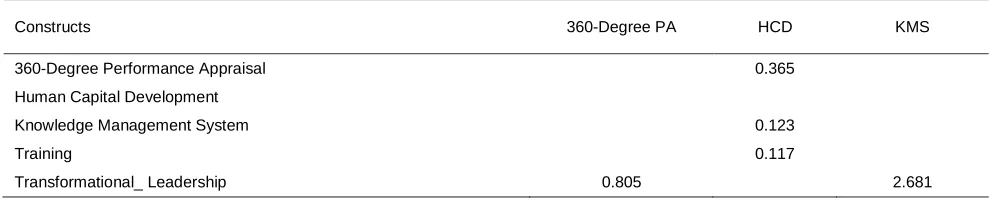
The Effect size f² describes whether an ―exogenous latent construct‖ has a substantial, moderate or weak effect on an ―endogenous latent construct‖ {66}. Cohen {65} recommends a magnitude of f² at 0.35 (showing large effects), 0.15 (showing medium effects) and 0.02 (showing
small effects). The result of f², as mentioned in Table 9, reveals a range of effect sizes between large effects and medium-size effects within this study. The blindfolding procedure is used in this study to examine the power of the proposed research model concerning predictive relevance.
TABLE 8
EFFECT SIZE
As suggested by Hair et al. {63} the ―blindfolding procedure‖ should only be used on endogenous constructs with a reflective measurement. If the value of Q² is greater than 0, then the ―predictive relevance of the proposed model exists for a certain endogenous construct‖ {63}. As Table 9 shows all the values of Q² range from 0.370 to 0.501, this, therefore, indicates that there is satisfactory ―predictive
relevance‖ for the proposed model to function. For the ―Q² values‖, Hair et al. {63} propose values of 0.35 (large), 0.15 (medium) and 0.02 (small) as a relative measure of predictive relevance. The result of this study shows that one endogenous construct has a large degree of predictive relevance, while the remaining have medium degrees of predictive relevance.
TABLE 9
PREDICTIVE RELEVANCE (Q2)
SSO SSE Q² (=1-SSE/SSO)
360-Degree Performance
Appraisal 5890 2984.432 0.501
Human Capital Development 1890 870.296 0.540
Knowledge Management System 4725 2978.955 0.370
TABLE 10
MODERATION EFFECT (STAGE 1)
Constructs:
Original Sample (O)
Sample Mean (M)
Standard Deviation (STDEV)
T Statistics
(|O/STDEV|) P Values 360-Degree Performance appraisal -> Human
capital Development 0.844 0.846 0.016 51.296 0
Transformational Leadership -> 360-Degree
Performance appraisal 0.672 0.676 0.035 18.995 0
The Measurement and structural model evaluation criteria, as discussed earlier, also applies when testing moderator models {63}. In this research, the two stages approach is used to determine whether the moderating variable (training) increases or decreases the relationship between exogenous (360-degree performance appraisal) and endogenous variables (Human capital development). In the
first stage, the direct relationship between 360-degree performance appraisal and human capital development was found to be significant and positive (β=0.844; t=51.296; p <0.001). The study, therefore, moved to the second stage by adding the moderator variable, since the researchers further identified that the direct relationship between training and human capital was also significant and positive. Hypothesis
Original Sample (O)
Sample Mean (M)
Standard Deviation (STDEV)
T Statistics
(|O/STD EV|)
P Values
Decision Transformational_ Leadership -> Knowledge
Management System -> Human Capital Development 0.206 0.202 0.041 5.011 0.000 Supported
Constructs 360-Degree PA HCD KMS
360-Degree Performance Appraisal 0.365
Human Capital Development
Knowledge Management System 0.123
Training 0.117
2
TABLE 11
MODERATION EFFECT (STAGE 2)
Hypothesis
Original Sample (O)
Sample Mean (M)
Standard Deviation (STDEV)
T Statistics
(|O/STDEV|) P Values Decision Moderating Effect 1 -> Human Capital
Development 0.003 0.0101 0.001 3.105
0.000 Supported
By adding a moderator variable (training) between exogenous variable 360-degree performance appraisal and endogenous variable (human capital development), it was observed and established that the relationship was significant and positive. Table 11 shows the results for the moderating effect (β=0.003; t=3.105; p <0.001) It has been observed that the moderating variable training significantly and positively moderated the relationship between 360-degree performance appraisal and human capital development. By comparing the beta value, it was observed that the direct effect was stronger than the moderating
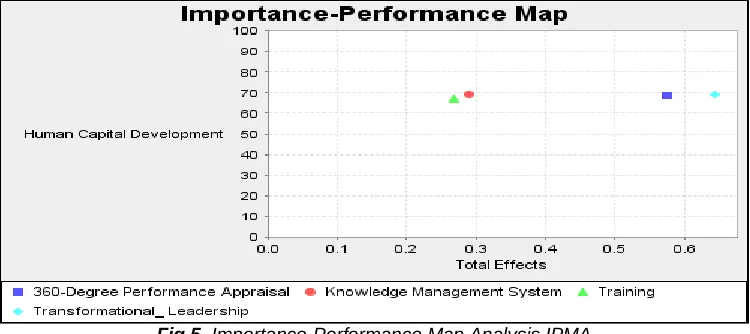
variable. As revealed in Figure 5, this study ―plotted the total effects scores and index values‖ in a priority map. Through this, it can be perceived that transformational leadership constitutes a very important factor in determining human capital development due to its relatively higher importance values compared to other constructs within the proposed model. 360-degree performance appraisal is the second important factor in determining human capital development. The knowledge management system is of third importance whilst training is fourth.
Fig.5. Importance-Performance Map Analysis IPMA
5. Conclusion and Discussions and Limitation
Based on its extension of transformational leadership and human capital theory’s scope, this study improves the understanding of the roles played by TL, Knowledge management system and 360-degree performance appraisal within the process of human capital development. As per UNESCO’s latest report on Thailand's education system, Thailand came 54th out of a total of 70 assessed countries, classified by subject, {1}. The current study framework is consequently useful for improving Thailand’s education system. The quality of the School education systems provides a strong foundation for students’ future: if the foundation level of students is weak then, naturally, they might not be in a position to pursue further education. To achieve quality standards within schools, knowledgeable teachers can play an important role. When rapid changes in technology occur, the school education system is also affected and forced to adapt. To cope with broader future challenges, human capital must be urgently developed. The findings of this study show that transformational leadership has a significant influence on human capital development by implementing a knowledge management system and 360-degree performance appraisal. Due to advancementsin information technology, a functional knowledge
management database is crucial. In Thailand, many schools are in disadvantaged places, and an online database of knowledge management can play a vital role in human capital development. This database would
system can judge employee performance thoroughly and identify the deficiencies within employee performance which in turn necessitate further training. If an employee’s performance is lower and the organisation identifies training needs for employees, this will help employees to develop their skills, which can further improve the performance of employees and organisations alike. The findings of this study reveal that 360-degree performance appraisal has a significant and positive relationship with human capital development; the relationship is also significantly moderated by the variable of training. Once an organisation completes the appraisal system, in the event of if there exists any deficiency in required skills, then it can arrange suitable training sessions which can help to develop the employee’s skills. Whilst this study has obtained its aim and objectives, there are few unavoidable limitations around scope and scale, which are necessary to briefly discuss within this section in order that future scholarship might properly build upon this study in seeking to analyses key factors and recommend policy. First, research can be generalised only to the Thailand school education system, since, due to limited resources, data were collected only from schools. With respect to the research method, only the mono method was used in this study: in future researchers can potentially use mixed-method to test the model and thus support and build upon its findings with more rigour. Other variables can also contribute to human capital development; therefore, in future studies, researchers can also test other leadership styles, for instance, transactional leadership and its relationship with human capital development.
REFERENCES
[1] https://www.bangkokpost.com/opinion/opinion/136 3115/thai-education-system-fails-to-pass-the-test-say [Accessed 13 Jan. 2020].
[2] Ukenna, S. Ijeoma, N., Anionwu, C., Olise, M.C. (2010). Effect of Investment in Human Capital Development on Organizational Performance: Empirical Examination of the Perception of Small Business Owners in Nigeria. European Journal of Economics, Finance and Administrative Sciences, (26).
[3] Khan, M., Bilal, H., Mateen, A., & Haq, Z. (2017). The Mediating Effect of Knowledge Management System and Learning Culture on Human Capital Development. International Journal Of Management And Applied Science, 4(5), 14-17. [4] Khan, M., Sentosa, I., & Salman, F. (2018).
Exploring the role of transformational leadership in human capital effectiveness. World Journal Of Entrepreneurship, Management, And Sustainable Development, 14(2), 191-204. DOI: 10.1108/wjemsd-10-2017-0075.
[5] Fitzsimons, P. (2017). Human Capital Theory and Education. Encyclopedia of Educational Philosophy and Theory, 1050– 1053. DOI:10.1007/978-981-287-588-4_331 . [6] Tan, G., Gupta, A., & Wilgus, G.
(2019). Investment in Early Childhood Education in a Globalized World. DOI:10.1057/978-1-137-60041-7.
[7] Simic, I. (1999).Transformational leadership the key to successful management of transformational organizational changes. The scientific journal Facta Universitatis , 1( 6) pp. 49 – 55.
[8] Bass, B. M. (1985). Leadership and Performance beyond Expectations. New York, Free Press. [9] Burns, J. M. (1978). Leadership. New York: Harper
& Row.
[10]Podsakoff, P. M., Mckenzie, S. B. & Bommer, W. H. (1996). Transformational Leader Behavior and Substitutes for Leadership as Determinants of Employee Satisfaction, Commitment, Trust, and Organizational Citizenship Behaviors. Journal of Management, 22(2), pp. 259-298.
[11]Katz, D., & St. KAHN, R. L. (1978). The social psychology of organization (2nd ed.). New York: Wiley.
[12]Bass, B. M., and Avolio, B. J. (1994). Improving Organizational Effectiveness through Transformational Leadership. Thousand Oaks, CA: Sage.
[13]Bass, B. M. (1990). Bass and Stogdill‟s Handbook of Leadership: Theory, Research, and Managerial Applications. (3rd ed.). New York: Free Press. [14]Martina, E.G., Böhmann, T., & Krcmar, H.E.
(2007). A strategy for knowledge management. Journal of Knowledge Management, 11 (6), pp. 3 – 15.
[15]Humphreys, J. H. & Einstein, W. O. (2003). Nothing New Under the Sun: Transformational Leadership from a Historical Perspective. Management Decision, 41(1/2), pp. 85-95.
[16]Andy, T., Timothy, O.C., Okwu, Akpa, Victoria O. Nwankwere & idowu a. (2011). Effects of leadership style on organizational performance survey of selected small scale enterprises in Ikosi-kcouncil development area of Lagos State, Nigeria. Australian Journal of Business and Management Research, 1 (7), pp. 100-111.
[17]Bass, B. M., and Avolio, B. J. (1997). Full Range Leadership: Manual for the Multifactor Leadership Questionnaire. Palo Alto, CA: Mind Garden. [18]Bhagat, R.S., Kedia, B.L., Harveston, P.D. and
Triandis, H.C., R.S. (2002). Cultural variations in the cross-border transfer of organizational knowledge: an integrative framework. Academy of Management Review, 27 (2), pp. 204-21.
[19]Martin, B. (2000). Knowledge management within the context of management: an evolving relationship, Singapore Management Review, 22 (2), pp. 17-37.
[20]Nonaka, I. and Takeuchi, H. (1995). The Knowledge-creating Company-How Japanese Companies Create the Dynamics of Innovation. Oxford University Press, Oxford.
[21]Popadiuk, S. and Choo, C.W. (2006). Innovation and knowledge creation: how are these concepts related? International Journal of Information Management, 26 (4), pp. 302-12.
941 [23]Nonaka, I. (1991). The knowledge-creating
company. Harvard Business Review, 69 (6), pp. 96-104.
[24]Ishak, N.B., Eze, U.C., & Ling, L.S. (2010). Integrating Knowledge Management and Human Resource Management for Sustainable Performance. Journal of Organizational Knowledge Management HTML Vol. 2010.
[25]Sawasn Al-Husseini, Ibrahim El Beltagi & Jonathan Moizer (2019) Transformational leadership and innovation: the mediating role of knowledge sharing amongst higher education faculty, International Journal of Leadership in Education, DOI: 10.1080/13603124.2019.1588381. [26]Oforegbunam, Ebiringa, T. and G. F. OKORAFOR (2010). Effects of human capital development on the performance of small and medium scaled enterprises in the southeastern region of Nigeria. Journal of Sustainable Development in Africa, 12 (8).
[27]Ikramullah, M. Shah,b., Sajjad-ul-hassan, F., ZAman, T., & Khan, H. (2011). Fairness Perceptions of Performance Appraisal System: An Empirical Study of Civil Servants in District Dera Ismail Khan, Pakistan. International Journal of Business and Social Science, 2 (21), pp.92-100. [28]Azmi, i.a.g. (2009). Human capital development
and organizational performance: a focus on Islamic perspective. Shariah Journal, 17(2), pp. 353-372.
[29]Tim, M. and R.O. Brinkerhoff, 2008. Courageous training: Bold actions for business results. Colorado: Berrett-Koehler Publishers.
[30]Zigon, J. (2002). How to Measure Employee Performance, Performance Group. Retrieved from:
www.ziponper.org.
[31]Fletcher, C. (2001). Performance appraisal and management: The developing research agenda. Journal of Occupational and Organizational Psychology, 74(4), 473-487.
[32]Griffin, R. W. & Ebert, R. J. (2002) Business, (6th ed.). London: Prentice-Hall.
[33]Aijaz, Z. (2019). Impact of 360-degree performance reviews on motivation of doctors and nurses in Ireland (Master). Dublin Business School.
[34]Sharma, S. (2012). Performance Appraisal and Career Development. VSRD-IJBMR, Vol. 2 (1), 8-16. Available ONLINE www.vsrdjournals.com. [35]Menjo Baye, F., Jean, D., & Marcellus Fonkem, N.
(2014). impact of intellectual capital efficiency on the financial performance of financial institutions in yaounde, cameroon. Nternational Journal Of Arts And Commerce, 3(4), 166-178.
[36]Snell, S. and Bohlander, G. (2007). Human Resource Management. Thomson South-Western, Mason, OH.
[37]Ulrich, D., Zenger, J. and Smallwood, N. (1999). Results-Based Leadership. Harvard Business School Press, Boston, MA.
[38]Skandia (1998). Human Capital in Transformation, Intellectual Capital Prototype Report. Skandia, Stockholm.
[39]Sullivan, P. (1999). Profiting from intellectual capital. Journal of Knowledge Management, 3 (2), pp. 132-42.
[40]Becker, G.S. (1962). Investment in human capital: a theoretical analysis. The Journal of Political Economy, 70 (5), pp. 9-49.
[41]Bartel, P., Ciaran, S. Phibbs, Beaulieu, N., & Stone, P. (2011) Human capital and organizational performance: evidence from the healthcare sector. Working Paper 17474. Available at: http://www.nber.org/papers/w17474.
[42]Becker, G. S. (1993). Human Capital: A Theoretical and Empirical Analysis with Special Reference to Education (3rd ed.). Chicago: University of Chicago Press.
[43]Schultz, T.W. (1993). The economic importance of human capital in modernization. Education Economics,1, pp. 13-19.
[44]Marimuthu, M., Arokiasamy, L. & M. Ismail, (2009). Human Capital Development and its impact on firm performance: Evidence from development economics. The Journal of International Research, 2, pp. 265 – 272.
[45]Katou, A. (2009). The impact of human resources development on organizational performance: Test of a causal model. Journal of Behavioral and Applied Management, 5, pp. 335 –356.
[46]Lall, S. (1999). competing with labor: Skills and competitiveness in developing countries. Development Policies Department, International Labor Office, Discussion Paper 31.
[47]Ogunade, A. (2011). Human capital investment in the developing world: an analysis of praxis. Schmidt Labor Research Center Seminar Series, University of Rhode Island.
[48]Politis, J.D. (2002). Transformational and transactional leadership enabling (disabling) knowledge acquisition of self-managed teams: the consequences of performance. Leadership & Organization Development Journal, 23 (4), pp. 186-97.
[49]Song, J.H. Kolb, J.A., LEE, Kim, H.K. (2012). Role of Transformational Leadership in Effective Organizational Knowledge Creation Practices: Mediating Effects of Employees’ Work Engagement. Human resource development quarterly, vol. 23, no. 1.
[50]Crawford, C.B., (2005) Effect of transformational leadership and organizational position on knowledge management. Journal of Knowledge Management, 9(6),pp.6-16.
[51]Laka-Mathebula, M.R. (2004). Modeling the relationship between, organizational commitment, leadership style Human Resource Management Practices and Organizational Trust. Unpublished Ph.D. thesis, University of Pretoria etd.
[53]Olufemi, A.J. (2009). Human Capital development practices and organizational effectiveness: a focus on contemporary Nigerian Banking Industry. Pakistan journal of social sciences, 6(4), pp.194-199.
[54]Castiglione, J. (2006). Organizational learning and transformational leadership in the library environment. Library Management, 27 (4), pp. 289 – 299.
[55]Bontis, N. & FITZ-ENZ, J. (2002) Intellectual capital ROI: a causal map of human capital antecedents and consequences. Journal of Intellectual Capital, 3 (3), pp. 223-47.
[56]Chin, W. W. (1998). Issues and opinion on structural equation modeling. MIS Quarterly, 22(1), 7–16.
[57]Kannana, V. R., & Tan, K. C. (2005). Just in time, total quality management, and supply chain management: understanding their linkages and impact on business performance. Omega: The International Journal of Management Science, 33(2), 153–162.
[58]Werts, C. E., Linn, R. L., & Jöreskog, K. G. (1974). Intraclass reliability estimates: Testing structural assumptions. Educational and Psychological Measurement, 34(1), 25–33.
[59]Kline, R. B. (2010). Principles and practice of structural equation modeling (3rd ed.). New York: The Guilford Press.
[60]Hair, J. F., Black, W. C., Babin, B. J., & Anderson, R. E. (2010). Multivariate Data Analysis (7th ed.). New York: Pearson.
[61]Fornell, C., & Larcker, D. F. (1981). Evaluating structural equation models with unobservable variables and measurement error. Journal of Marketing Research, 18(1), 39–50.
[62]Awang, Z. (2014). Structural Equation Modeling Using AMOS. Shah Alam.Malaysia: Penerbit Universiti Teknologi MARA.
[63]Hair, J. F., Hult, G. T. M., Ringle, C., & Sarstedt, M. (2017). A Primer on Partial Least Squares Structural Equation Modeling (PLS-SEM) (2nd ed.). London: Thousand Oaks: SAGE.
[64]Sullivan, G. M., & Feinn, R. (2012). Using Effect Size - or why the p-Value is not enough. Journal of Graduate Medical Education, 4(3), 279–282. [65]Cohen, J. (1988). Statistical Power Analysis for the
Behavioral Sciences (Second Ed.). New York: Routledge. Critical Human Capital Issues report. (2014). The Top 10 Critical Human Capital Issues: Enabling Sustained Growth through Talent Transparency, Institute for Corporate Productivity
(i4cp). Retrieved from
http://go.i4cp.com/criticalissues2014.
[66]Gefen, D., & Rigdon, E. E. (2011). An Update and Extension to SEM Guidelines for Administrative and Social Science.