Volume 2011, Article ID 745487,17pages doi:10.1155/2011/745487
Research Article
Co-Occurrence of Local Binary Patterns Features for Frontal Face
Detection in Surveillance Applications
Wael Louis and K. N. Plataniotis
Multimedia Laboratory, The Edward S. Rogers Department of Electrical and Computer Engineering, University of Toronto, 10 King’s College Road, Toronto, Canada M5S 3G4
Correspondence should be addressed to Wael Louis,[email protected]
Received 4 May 2010; Revised 16 September 2010; Accepted 9 December 2010
Academic Editor: Luigi Di Stefano
Copyright © 2011 W. Louis and K. N. Plataniotis. This is an open access article distributed under the Creative Commons Attribution License, which permits unrestricted use, distribution, and reproduction in any medium, provided the original work is properly cited.
Face detection in video sequence is becoming popular in surveillance applications. The tradeoffbetween obtaining discriminative features to achieve accurate detection versus computational overhead of extracting these features, which affects the classification speed, is a persistent problem. This paper proposes to use multiple instances of rotational Local Binary Patterns (LBP) of pixels as features instead of using the histogram bins of the LBP of pixels. The multiple features are selected using the sequential forward selection algorithm we called Co-occurrence of LBP (CoLBP). CoLBP feature extraction is computationally efficient and produces a high-performance rate. CoLBP features are used to implement a frontal face detector applied on a 2D low-resolution surveillance sequence. Experiments show that the CoLBP face features outperform state-of-the-art Haar-like features and various other LBP features extensions. Also, the CoLBP features can tolerate a wide range of illumination and blurring changes.
1. Introduction
Recently, surveillance cameras and Closed-Circuit Television (CCTV) are available in places that are highly occupied with people such as subway stations, airports, universities, and casinos. Increasing the number of cameras makes it a difficult task for the human to effectively monitor many cameras for suspicious activities simultaneously. As a result, much research is conducted to implement an intelligent system that mimics the human brain and achieves the monitoring job automatically with minimum human intervention. Monitor-ing the people is one task where findMonitor-ing the location of the face is used for surveillance applications; indeed, locating the place of the face is a preliminary step for other surveillance-related applications such as face recognition (i.e., find the identity of the person), emotion recognition, face tracking, and many other applications.
Humans can effortlessly detect and locate faces in real-life; however, locating faces using computer vision technol-ogy is not an easy task. Here we come to the problem of face detection for computer vision which can be interpreted as follows: given a still image or a video sequence frames, find
thelocation(s)andsize(s)of theface(s)in the frame or image ifexist(s)[1].
The face detection problem is tackled by numerous different methods since the 1970s. Face detection surveys in [1,2] illustrate a very comprehensive study on face detection that covers most aspects of face detection techniques up to 2002. Despite the many approaches and techniques in these surveys, none of these techniques was adequate to perform in real-time basis. The term real-time, in this paper, is interpreted as the ability to process frames with a rate close to the examined sequence frame rate, under the condition that the frame rate≥15 frames/second, that is, 15 frames/second in [3]. The first technique that could process in real-time basis was introduced in [3] in which it was published after these surveys.
illumination changes. The disadvantages of this approach are the dramatic performance failure in cluttered and difficult, nonfrontal face, multiple faces, and low-resolution images. The second stream is the image-based approach; in this approach, the face detection problem is treated as a binary pattern recognition problem to distinguish between face and nonface images. This approach is a holistic approach that uses machine learning to capture unique and implicit face features. Most of the works in the last decade, including this work, follow the image-based approach due to the superiority over the featurebased approach from an aspect of the capability to handle low-resolution images, nonfrontal face images, and the possibility to process images in real-time. However, tremendous amount of time (i.e., weeks in [7]) is required to train the detector due to several problems, some of these problems will be explained briefly.
Since the image-based approach is the core of this paper, then it will be discussed. Image-based approaches can be categorized, based on the classification strategy used in the design process, into two subcategories: appearance-based approach and boosting-based approach [8]. Appearance-based approach category is considered as any image-Appearance-based approach face detector that does not employ the boosting classification methods in it classification stage. However, other classification schemes are used such as neural networks [9, 10], Support Vector Machines (SVM) [11], Bayesian classifiers [12, 13], and so forth. All techniques in the appearance-based approach lack the ability to perform in real-time, and it takes an order of seconds to process an image [8]. The other image-based approach subcategory is the boosting-based approach, this approach started after the successful work of Viola and Jones [3] where high detection rate and high speed of processing (15 frames/second) using the AdaBoost (Adaptive Boosting) algorithm [14] and cascade of classifiers were used. Boosting-based approach is considered as any image-based approach that uses the boosting algorithm in the classification stage.
There are some problems associated with using the boosting-based approach to come about. Simple AdaBoost algorithm mechanism used in Viola and Jones is illustrated in Figure 1. AdaBoost uses a voting scheme from weak classifiers,ht(X), whereXis the input image,tis the iteration number. These weak classifiers are used to construct a strong classifier,H(X). The problem of the boosting algorithm in the face detection context is that each weak classifier,ht(X), is trained with asingle featureas in [7,11,15,16] following the pattern of the successful work of [3]. However, in earlier iterations, these single feature weak classifiers are capable of achieving a low classification error rate of 10%–30% [7] while in later iterations,ht(X) cannot achieve less than 40%–50% error rate.
This problem prevents the face detector from achieving a very highly accurate detection (i.e.,≈100% accuracy), also it increases the number of small contributorsht(X) to achieve the desired accuracy in which will correspondingly increase the training time.
Although progresses are made to solve the explained face detection problem, the long training time and the insufficient number of discriminative features remain as challenging
Input imageXn,n∈{1,2,..., number of samples}and its
class labelyn∈{1,−1}
Find weak classifierht(X)
Update the weights of the training samples
Addht(X) toH(X)
t=t+ 1 t > T
t: boosting iteration number
T: desired number of boosting iterations OutputH(X) No
Yes
Figure1: AdaBoost training mechanism.
Grayscale image of size n×n
n×n Multiple resolutions
LBP features
Reshaping the LBP matrices into
vectors CoLBP feature
vector
LBPP1,R1 LBPP2,R2 LBPP3,R3 LBPPm,Rm
Vectorization Vectorization Vectorization Vectorization
n1×n1 n2×n2 n3×n3 nm×nm
(n1)2×1 (n2)2×1 (n3)2×1 (nm)2×1
· · ·
· · ·
Feature vector (x) is concatenation of all the LBPs vectors
Figure2: Single CoLBP feature vector extraction without co-occurrence of features.
Initial RGB frame or
image RGB→YCbCr Y component is
the grayscale image
Scanning window Grayscale
image
Face detections’ widths and heights (i.e.
bounding box)
Multiple detections
merging
CoLBP feature extraction
Classification using gentleBoost algorithm
Cascade of classifiers Input
output
Figure3: Illustration of face detection system using CoLBP features.
In this work, a type of features called Co-occurrence of Local Binary Patterns features (CoLBP) is proposed. The CoLBP features are used to implement a frontal face detector that is capable to achieve a high-performance rate. This face detector is used for surveillance purposes; it is applied on a low-resolution 2D information from a static camera mounted in a position where mostly frontal faces are captured. The proposed CoLBP features are based on the rotational LBP features [20]. This paper uses the rotational LBP with all possible resolutions in the examined scanning window to capture the maximum possible structure of the window that can be obtained using the rotational LBP operator. Unlike most of the known LBP features extensions in [11,21,22] where the pixels of the examined scanning window are transformed to LBP values, then the features are the histogram bins of the LBP values; in this work, the features are the LBP values of the pixels, as explained in Figure 2. Hence, extracting a feature of the proposed features (CoLBP) requires computing one pixel’s rotational LBP value whereas in the histogram based LBP features as in [11,21,22], it requires to compute all of the examined
scanning window pixels LBP values in order to find their histogram bin. Therefore, the CoLBP features have less feature extraction computational overhead than histogram based LBP features. The main contribution of this paper is using the co-occurrence of multiple features to increase the feature’s discriminative power. The multiple features are selected using the Sequential Forward Selection (SFS) algorithm. CoLBP features are not only computationally efficient but also provide high discriminative power capable to achieve a high detection rate.
The rest of the paper is organized such that Section 2
introduces the proposed CoLBP features; this section also gives a brief explanation about the classification scheme used to train the face detector and the post-processing step. The conducted experiments are in Section 3. Finally, the conclusion is given inSection 4.
2. Methodology
Figure4: Multiple resolutions LBPP,Ron a gray-scale image to illustrate the ability to capture different image structure.
LBP features (CoLBP) features are built upon the rotational LBP features (see the Appendix for explanation about the rotational LBP features). The cascade of classifiers [3] and GentleBoost algorithm [24] are used to train the CoLBP detector. The multiple detections of the same face are merged using post-processing stage. Subsequent sections will explain in details the proposed CoLBP features as well as the method used to train the face detector using these features.
2.1. Co-Occurrence of Local Binary Patterns (CoLBP) Feature Extraction. LBP features drew much of the attention in object detection in general and face detection specifically due to its discriminative power as well as its high tolerance to illumination changes [11]. Detailed explanation about the LBP features and its feature extraction can be found in the Appendix. The main problem of the simple LBP features is that despite its capability to extract high discriminative face features [11], the number of features is limited to the number of pixels. This issue makes the simple LBP features insufficient to achieve a high-performance rate face detector. Various extensions are presented in the literature to solve this problem such as Sobel-LBP [25], CS-LBP [26], MB-LBP [22].
Despite the high discriminative power of the extended features [11, 22, 25, 26] in comparison to the rotational LBP feature, thefeaturesare the histogram bins of a region. Therefore, in theclassification stage, in order to transfer the image from the pixel space into the feature space to be classified, all histograms’ regions LBP features have to be computed to obtain the regions’ distributions.
The proposed CoLBP features have the following advan-tages.
(1) Less computational overhead than the extended LBP features that uses histogram bins as features as in [11,
22,25,26].
(2) Overcomplete set of discriminative face features to achieve an accurate face detector; hence, it solves the problem of insufficient amount of information obtained by the simple LBP features. Overcomple feature vector, in this paper, is a vector that its length exceeds the number of pixels of the examined window.
The CoLBP features proposed in this paper tackles the computation overhead problem by using the rotational LBPP,R, whereP,Rcorrespond to the number of points and radius, respectively. Therefore, the features are the LBPP,R value of the pixels. Hence, in the classification stage, only
0 0.01 0.02 0.03 0.04 0.05 0.06 0.07 0.08
Δ
PR
=
PR
−
min
P
R
10 15 20 25 30
P R=1
R=2
R=4
R=6
R=10
Figure5: The relation betweenPandRin LBPP,R.
the desired pixel’s LBPP,R features are extracted. Therefore, CoLBP features are more computationally effective than histogram bins features.
Moreover, in order to overcome the problem oflimited features number that prevents the system from providing enough information to achieve high-performance rate; the CoLBP feature vector is constructed by an exhaustive extraction for LBPP,R for all possible Rs with different P values as illustrated in Figure 2. Each LBPP,R is considered as a resolution to capture the image structure [11]; hence, having different LBPP,Rwith differentRs andPs capture the image structure with different resolutions [11] as it can be visualized throughFigure 4. To be consistent throughout the paper, the name CoLBP, which stands for Co-occurrence of LBP features, is called on the feature vector that con-sists of multiple resolutions LBPP,R features. Hence, when
Section 2.1.1explains the co-occurrence of features, then it flows as “c” multiple features from the same vector CoLBP.
In order to choose Ps for each R, an experiment is conducted that examines the relation of each possibleRwith a wide range ofPs.Ps that achieved the highest PR for eachR
are selected for the CoLBP feature vector. An example of this experiment is shown inFigure 5.
Input: (Xn,yn,wn)Nn=1,Xnis the training image andyn∈ {−1, +1}is the class label,wnis the weight, cis the number of co-occurred features;
Output: z(X); Initialize: z(X)= ∅;
(1) Retrieve the calculated CoLBP feature vectors (xn)Nn=1,xn∈Rk;
(2) Use decision stump to find all featuresf(X)∈Rkthreshold valuesθ∈Rkand parity valuesp∈Rk; fori=1, 2,. . .,cdo
forl=1, 2,. . .,kdo
z∗i(X) is concatenation ofz(X) withsi(X) that is trained with thelth feature, wherez∗i(X) is a temporary z(X)(s1(X),s2(X),. . .,si(X));
z∗i(Xn) binarizes all examples (Xn)Nn=1using (2);
Find the least weighted squared error of adding featurel,J(l), usingz∗i (Xn)=j, wherej∈A,A= {0, 1}i,{0, 1}iis the Cartesian product ofiterms;
forn=1,. . .,N do
For allj∈A, find the estimated class labelyj(n);
yj(n)=
1 ifP(yn=+1|z∗i(Xn)=j)≥P(yn= −1|z∗i (Xn)=j) −1 otherwise
end end
Selectsi(X) with thelth feature that makes arg minlJ(l); Updatez(X) withsi(X);
end
Algorithm1: SFS algorithm for selecting multiple CoLBP features.
LBP8,1, LBP9,2, LBP12,1, LBP12,2, LBP16,3, LBP18,4, LBP24,4, LBP24,5, LBP26,6, LBP24,7, LBP24,8, LBP24,9, LBP32,10, and LBP32,11.
To this end, it is shown how the CoLBP features can have less computational overhead than the histogram bins LBP features. Also, CoLBP has an overcomplete set of carefully selected discriminative features.
2.1.1. Co-Occurrence of Multiple CoLBP Features. The co-occurrence of features task can be defined as finding the joint probability of multiple features occurred simulta-neously. Similar approach was recently proposed in [17,
18]. The objective of feature co-occurrence is claiming that a higher discriminative power can be achieved using the co-occurrence of multiple CoLBP features than taking same number of features separately. Therefore, in order to find the joint probability among multiple features, feature binarization is carried on as in [3]. Each feature f(X) for the image X of the CoLBP has a threshold θ and parity
p ∈ {1,−1}calculated using a degenerative decision stump [27] from the training data such that the minimum number of examples are misclassified.
Having the parameters (f(X),θ,p), then given an input image X, s(X) binarizes the input to 1 as being a face detection or 0 as being a nonface detection as in
s(X)=
⎧ ⎨ ⎩
1 if p f(X)> pθ,
0 otherwise. (1)
f(X) is a single feature value,θis a threshold values, and
p ∈ {1,−1}is the party that indicates the direction of the inequality.
This is a single feature binarization as in [3]. It is a specific case of a generalized case where more than one feature occur. Equation (2) shows the generalized form, z(X), where it binarizes multiple features using(1)
z(X)(s1(X),s2(X),. . .,sc(X)), (2) wherecis the number of co-occurred features, eachsi(X) has (fi(X),θi,pi), wherei∈ {1, 2,. . .,c}.
Therefore, z(X) is a vector which hasc of the highest contributingsi(X) selected as in the following section.z(X) has 2cpossible outcomes.
If z(X) is used as a weak classifier for boosting-based approach detector with number of features co-occurrence of
c =1, then thisz(X) is similar to train each weak classifier withsingle featureas in many boosting-based approaches for the face detection problem in the literature including, but not limited to, [3,11,15,16].
2.1.2. CoLBP Feature Selection. The combinations of (s1(X),s2(X),. . .,sc(X)) in (2) are selected such that a minimum cost is achieved byz(X). Ifc = 1, then selecting z(X) for the minimum error is trivial since it is based on selecting one feature f(X), and this f(X) corresponds to the minimum error resulted using the decision stump. However, if c > 1 then finding z(X) which achieves the minimum error is not an easy task. The optimal solution would be using the exhaustive search, where the solution is considered optimal from an aspect that the selected c
vectorx,x ∈ Rk, wherek = 160, 000 features). Therefore, there arek
c
possible number of combinations for selecting (s1(X),s2(X),. . .,sc(X)) inz(X). As a result, a large number of combinations is possible; hence, many feature selection techniques have been proposed throughout the time, and below are some of them.
Sequential Backward Selection (SBS) [28] is a top-down approach that starts by a set that comprises all features then deletes features on one-by-one basis, where each deleted feature is the one that has the least contribution to minimize the error. On the other hand, the Sequential Forward Selection (SFS) [29] starts from a set of zero features and adds the feature that leads to minimum error. Both methods are suboptimal feature selection in comparison to the exhaustive search; however, they have the advantage of being less computational expensive than the exhaustive search method, and they are simple to implement. The disadvantage of SFS and SBS methods is the nesting effect in which the addition of the feature in the case of SFS or deletion of the feature in the case of SBS cannot be redone. For instance, in SFS, if a feature is added, then this feature will not be checked again whether it still has a high contribution to minimize the error; therefore, some features might lose their contribution after some iterations while they will still be considered. To solve the nesting issue, a method called Plus-l-Minus-r is introduced in [30] in which it adds l features using SFS and deletesr features using SBS; however, its main problem is the lack of theoretical approach to choosel andr. Also, it is more computationally expensive than SBS or SFS. An optimal decision is made by using the branch and bound method [31]; however, this method’s complexity increases exponentially with the required number of features to be selected. The Sequential Forward Floating Selection (SFFS) and Sequential Backward Floating Selection (SBFS) [32] are similar to Plus-l-Minus-r in some sense but instead of being tied up byl andr, they keep adding and deleting features until minima is achieved. SFFS and SBFS methods are proved to outperform SFS and SBS [32].
From all these techniques a tradeoffbetween computa-tion feasibility versus optimality is claimed in [32]. In this paper, the SFS is considered for the following reasons.
(i) Despite that SFFS method proved the superiority over SFS [32]; however, same results were obtained when small number of features selection were needed (i.e., c ≤ 4) [32]. Also, as will be proven exper-imentally in subsequent sections that the CoLBP face features tend to perform better when (c < 4). Therefore, using SFS or SFFS would give same results. One of the reasons that make SFS and SFFS perform similarly whencis small (i.e., 4) is that the nesting problem associated with SFS will not affect the system in the same manner as in the situation when several features are used.
(ii) SFFS is more computationally expensive than SFS [32].
The implemented SFS is a modification to the original SFS [29] as it binarizes the input feature vector and finds
the highest contributing c co-occurred features. The SFS algorithm is illustrated inAlgorithm 1.
P(y = +1 | z(X)), P(y = −1 | z(X)) are the conditional joint probability. Hence, for the input image X, the binarization function z(X) ∈ {0, 1}c,{0, 1}c is the Cartesian product ofcterms,cis the number of co-occurred features, andy∈ {−1, +1}is the class label such thaty=1 is a face object andy= −1 is a nonface.
Therefore, P(y = +1 | z(X)),P(y = −1 | z(X)) are computed such that
P y=+1|z(X)=
i∈{n|yn=+1}
wi,
P y= −1|z(X)=
i∈{n|yn=−1}
wi,
(3)
wherewiis the sample weight.
2.2. Classification. The proposed CoLBP features are used to implement a face detector (CoLBP detector). The CoLBP detector is trained using the GentleBoost algorithm [24] and cascade of classifiers [3]. The weak classifiers for the GentleBoost algorithm isz(X) obtained usingcco-occurred features as explained in the previous sections. Therefore, for each boosting iteration,t, iteration’s specific weak classifier, zt(X), with the minimum error, Jt, is selected. Also, the weight of each sample wn, wheren = 1, 2,. . .,N,N is the number of samples, is increased for the misclassified samples and decreased for the correctly classified samples in each iteration of the boosting. Therefore, extra attention is given to the wrongly classified samples. In GentleBoost algorithms, the weighted squared error is used as an error measure. The final strong classifier isH(X)=T
t=1ht(zt(X)), whereh(·) is a confidence function that optimizes the GentleBoost’s cost function. The overall training stage mechanism is as seen in
Figure 1, the weak classifier step inFigure 1is constructed by runningAlgorithm 1.
Many variations of boosting algorithms are explained in the literature [14, 19, 24, 27] where all of them have the same explained mechanism but might differ in one or more of either error calculation, weight update and/or feature selection criterion. The GentleBoost [24] was chosen for reasons such as GentleBoost proved the ability to outperform the Discrete AdaBoost and Real AdaBoost in face detection experiments [16], it is numerically stable, and it is simple to implement. Complete discussion about the GentleBoost algorithm can be found in [24].
the multiple detections problem, trivially, the number of detections in nonface regions is significantly less than that in the face regions since the classifier is trained to achieve a high accuracy. Therefore, the algorithm used in this paper finds the centroid position of each detection, and then cluster these positions.
Furthermore, the multiple detection algorithm is based on a threshold β which decides the minimum number of detections in each cluster to be considered as a detection. All the clusters that do not pass this test are deleted. Afterwards, the detection within each cluster with the highest confidence values is only considered. The confidence of the detection is the value of the strong classifierH(X).
3. Experiments
Previous sections have introduced the new CoLBP features with its method of extraction and properties studied. Also, the possibility of using the CoLBP features to train a classifier for object detection and a method to merge multiple detections are explained.
In this section, the explained CoLBP features will be applied for the face detection problem, and its performance will be evaluated. Specifically, it will be tested on a real-life 2D surveillance data, BioID dataset, as well as a face/nonface Ole Jensen and Viola and Jones datasets to investigate whether the proposed solution can achieve better detection results than the existing solutions.
The following experiments have been designed for the performance evaluation.
(1) Evaluate the discriminative power of CoLBP features and observe the performance of co-occurrence of multiple features versus the separate ones.
(2) Compare the CoLBP features to other various LBP features extensions presented in the literature. (3) Evaluate the performance of the CoLBP
features-based face detector and compare it to the Haar-like features-based face detector.
(4) Open the area to compare the CoLBP features face detector to the state-of-art face detectors by applying it on the BioID dataset.
(5) Observe the robustness of the CoLBP features towards different illumination and camera blurring noise.
There are several terms that are usually used for face detection evaluation such as Detection Rate (DR), Perfor-mance Rate (PR), True Positive (TP), and False Positive (FP). DR is the ratio between the number of correctly classified faces to the total number of examined faces. PR is the ratio of the number of correctly classifying a face image as a face image and nonface image as nonface image to the total number of images evaluated. TP indicates correctly classifying a face image as a face. FP detection indicates incorrectly classifying a nonface image as a face.
3.1. CoLBP Features As Face Discriminative Features. The CoLBP features explained inSection 2.1is examined in this
Figure6: Multiple detections merging example.
10−3
10−2
10−1
Gener
alizat
ion
er
ro
r
(er
ro
r
=
1
−
PR)
100 200 300 400 500 600 700 800 900 1000 Number of features
CoLBPc=1 CoLBPc=2
CoLBPc=3 CoLBPc=4 CoLBP features performance
Figure7: Generalization error for different number of co-occurred features.
experiment to prove the feasibility of providing face discrim-inative features. This experiment also compares different number of co-occurred features to prove the claim that hav-ing a co-occurrence of features produces higher performance rate than considering same number of feature separately.
10−4
10−3
10−2
10−1
T
raining
er
ro
r
(er
ro
r
=
1
−
PR)
10 20 30 40 50 60 70 80 90 100 Number of features
CoLBPc=1 CoLBPc=2
CoLBPc=3 CoLBPc=4 CoLBP Features performance
Figure 8: Training error for different number of co-occurred features.
The feature extraction of the CoLBP features follows the explanation inSection 2.1such that all LBPP,R radii are extracted. Hence, there are a maximum of 11 possibleRs for each window of size 24×24. HavingR =12 will require a radius of 12 pixel radius excluding the center point; therefore, a diameter of 25 pixels is needed. Based on the differentPs used, which are mentioned inSection 2.1, an overall number of features of 3, 164 features are extracted from each window. A comparison is made whenc = 1,c = 2,c = 3, and
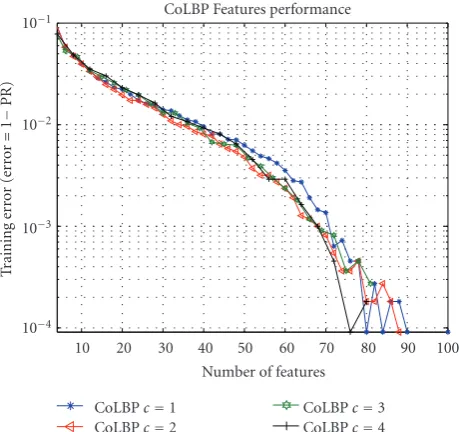
c=4 where the comparison is based on training the classifier with≈1000 features.Figure 7shows the generalization error whereasFigure 8illustrates the training error for the same experiment. The error is calculated as error =1−PR. The number of features in Figures7and8are chosen such that it is unrelated to the number of iterations used to train the classifier. For example, following Section 2.2, the samples weights are updated in every iteration where the iteration consists of 1 CoLBP feature if c = 1 or 2 CoLBP features if c = 2, and so forth. Therefore, for fair comparison and to investigate the higher discriminative feature power using the co-occurrence of features then Figures7and8show the number of features the GentleBoost classifier is trained with. Despite that all thec co-occurred features have almost same number of features when the training error converges to zero, all the co-occurred features outperformed the single CoLBP (i.e., CoLBP c = 1) features in the generalization error. The least generalization error resulted using c = 2, especially in early iterations. However, due to the fact that SFS reliability to select the best features decreases when the number of selected features increases, then it can be observed from Figures 7 that the performance of the system degrades when it is trained withc >2. Especially if the comparison is conducted in early iterations.
To understand the significance achieved usingc = 2 in comparison toc = 1 obtained inFigure 7, then taking an
arbitrary number of features, for example 50 features. The difference in PR between usingc = 1 and c = 2 with 50 features is 0.004. So if an image of size 490×330 pixels is examined, and exhaustive search scanning window of size 24×24 with 1 pixel step size is used, then 143, 369 windows is the total number of windows. Therefore, usingc=1 with 50 features will lead to anaverageof 573 wrongly classified windows more than that using same number of features with
c=2.
Co-occurrence of other types of features are introduced in the literature such as the co-occurrence of Haar-like features in [17, 18]. Despite it was claimed that the co-occurrence of Haar-like features increased their discrimina-tive power however it was observed that this co-occurrence is prone to overfitting.
From this experiment, the following can be concluded:
(i) CoLBP features are capable of extracting face dis-criminative features.
(ii) Co-occurred features have higher discriminative power than separate features.
3.2. CoLBP Features versus Various Types of LBP Features. Various extensions to the rotational LBP features are pro-posed in the literature including, but not limited to, the explained ones in Section 1. Therefore, to further prove the viability of the proposed CoLBP features, comparisons are made with Sobel-LBP [25], MB-LBP [22], and LBP Histogram [11] features. The comparisons are conducted in identical environment to examine the following: perfor-mance, training time, which consists of the time consumed to extract the feature vector and the time required to train a model, and classification time, which consists of the time required to extract the trained model features.
In addition to Ole Jensen dataset explained inSection 3.1; Viola and Jones dataset [3, 34] which consists of 4, 916 gray-scale frontal face images of size 24× 24 pixels and 7, 972 gray-scale nonface images of size 24×24 is used. Both datasets’ mirror images are obtained; hence, a total of 19, 832 frontal face images and 35, 744 nonface images are available. The datasets are divided into two halves; one half is used for training and the other half is used for evaluation. Therefore, the training dataset consisted of 9, 916 face images and 17, 872 nonface images of 24 ×24 pixels, and same number, but nonoverlapping, face and nonface images are used for the evaluation stage. The GentleBoost algorithm is used as a classifier. Hence, this experiment does not involve
βexplained inSection 2.3, and the decision is restricted to whether the detection is a face or a nonface image.
It is explained in [35,36] that LBP Histogram features setup with the combination (LBPu12,22 , LBPu8,12, LBP4,1) gives higher performance rate than the LBP Histogram combina-tion in [11] especially on the examined dataset; hence, this combination is used in this experiment. Furthermore, two setups for the Sobel-LBP, which is explained in [25], with 24×24 and 12×12 subregions are examined.
Table1: Comparisons between different types of LBP extensions. The times calculations are based on training and evaluating 27,788 images of size 24×24 pixels.
Feature type Training Classification
Feature vector length
Feature vector extraction time (sec)
Model training time (sec)
Trained model number of features
Model’s feature extraction time (sec)
LBP Histogram 978 10.779 43.927 22 9.117
MB-LBP 8464 31.814 761.491 41 0.368
Sobel-LBP 12×12 2049 4.042 298.221 75 2.026
CoLBPc=1 3164 25.245 219.693 38 0.296
CoLBPc=2 3164 25.245 169.158 18 0.280
75 80 85 90 95 100
PR
(%)
20 40 60 80 100 120 140 160 180 Threshold
Number of features Sobel-LBP 24×24
Sobel-LBP 12×12 CoLBP 1
CoLBP 2 LBP histogram MBLBP PR for various extensions of LBP features
with different number of features
Figure 9: Comparison between the CoLBP features and various other LBP features extensions.
including the CoLBP c = 1. To have a fair comparison between these features, a common PR target threshold is chosen, and the corresponding model that achieves that threshold is considered. Hence, the comparison is conduct under identical environment from an aspect that all models are trained with same dataset, are evaluated on same dataset, used same classifier, and are capable of achieving an arbitrary PR of≈96%. This arbitrary threshold was chosen since it is the maximum PR could be achieved with MB-LBP features, and it was desired that the MB-LBP features to undergo the comparison. Sobel-LBP with 24×24 pixels subregion was not considered in the comparison as it could not achieve the target PR. Having this threshold, the comparison results are tabulated inTable 1.
FromFigure 9, CoLBPc=2 trend outperforms all other experimented LBP extensions; however, judgement of the performance based on the number of features used to train the model is not meaningful. An argument can be raised to defeat such comparisons such that arguing: other LBP features might outperform CoLBPc=2 when larger number of features are used, yet might be able to classify the images faster if the feature extraction time is faster than CoLBP. Hence,Table 1 proves that CoLBPc = 2 not only achieves a higher PR than the other examined LBP features but also
extracts a trained model feature faster. The reason behind this result is as illustrated in Section 2.1 that the CoLBP features are based on pixels rather than regions. Hence, only the model’s specific LBPP,Rvalues are extracted rather than extracting all the LBP values for all examined window pixels, which is required in LBP extensions that use the histogram bins as features.
Furthermore, as explained in Section 3.1 that the co-occurrence of features not only increases the discriminative power of the features but also significantly reduces the training time by reducing the number of weak classifiers to half. For this reason, it can be seen fromTable 1, that CoLBP
c =2 training time is less than CoLBPc = 1 since CoLBP
c=1 required 38 weak classifiers while CoLBPc=2 required 18 weak classifiers. Also, CoLBPc = 1 required 38 features to achieve the target PR in comparison to 36 features in the case of CoLBPc = 2, since each weak classifier is trained with 2 features. Moreover, even though half the number of iterations are required in the CoLBPc=2 in comparison to CoLBPc=1, but it can be noticed that the training time is not reduced to half the time. The reason behind it is because of the overhead of using the SFS algorithm in CoLBPc=2. Another observation fromTable 1is that having the CoLBP
c=2 require less number of features extraction in contrast to the CoLBPc = 1 (i.e., 38 in CoLBPc = 1 versus 36 in CoLBPc=2) leads to a faster classification time.
Therefore, the following can be concluded from this experiment.
(i) CoLBP c = 2 features outperform the LBP His-togram, Sobel-LBP, and MB-LBP features.
(ii) CoLBPc=2 features require less execution time to extract the trained model features. Hence, faster face detection algorithm can be achieved.
(iii) Further proved Section 2.1that CoLBP c = 2 not only outperforms CoLBPc=1 but also requires less training time and has faster classification time.
Table2: CoLBP detector cascade of classifiers training stages.
Stage 1 Stage 2 Stage 3 Stage 4 Stage 5
Number of features 6 7 26 36 61
TP 0.9900 0.9907 0.9907 0.9900 0.9900
FP 0.4761 0.3946 0.2516 0.02003 0.2344
Stage 6 Stage 7 Stage 8 Stage 9 Total
Number of features 116 121 226 451 1050
TP 0.9900 0.9900 0.9900 0.9900 0.9135
FP 0.1604 0.1433 0.1881 0.1257 5.1453×10⁻⁶
considered for practical applications [7], and TP of>90%. FP and TP values are chosen to coincide with the Viola and Jones detector [3] in order to achieve a fair comparison between CoLBP detector and Haar-like feature based detector.
Despite the fact that we cannot judge which number of co-occurred features ofc > 1 performs better; however, it is clear fromFigure 7that CoLBP features withc = 2 has the least generalization error in earlier iterations. This is preferred since less number of features is required to reach the desired detection accuracy; hence, a faster classification speed is resulted. Therefore,c=2 is used to train the cascade of classifiers.
The 19, 832 frontal face images explained inSection 3.2
are used in this experiment. On the other hand, ≈20,000 nonface images are downloaded from the World Wide Web; these images were manually investigated to ensure that they do not contain any faces. The images were downsampled with different ratios to increase their number. A total of ≈120,000 nonface images were obtained. These images are of bigger resolution than the scanning windows. For example if an image is of size 490×330 pixels, and we use exhaustive search scanning window of size 24 ×24 with one pixel step, then 143, 369 nonface windows are obtained. Therefore based on this example, the large number of nonface images can be imagined.
On each stage in the cascade of classifiers, a randomly selected 6, 500 face images are used for training and ran-domly selected 1, 500 face images are used for validation, under the condition that the training and validation set have no image in common. Also, 10, 000 nonface images are used for each stage using the bootstrap strategy [3,11] such that each step is trained with the misclassified nonface images by all previous stages. Furthermore, each stage is designed to achieve a minimum of 99% TP and a maximum of stage’s dependant FP. The stage’s FP can be found fromTable 2by taking the ceiling of each FPto nearest one decimal place (i.e., 0.4761→ 0.5).
After 9 stages, the minimum achieved FP using the CoLBP features is 5.1453×10⁻⁶before depleting all nonface images dataset. The nonface dateset is depleted since the bootstrap strategy is used in training the cascade of classi-fiers.Table 2illustrates the number of features, FP, and TP of each stage.
Comparison betweenTable 2and Viola and Jones detec-tor, where both have same objective of achieving total FP= 10−6, and knowing that CoLBP detector is trained with
less number of face training dataset than Viola and Jones detector (i.e., 6, 500 faces in the CoLBP detector versus 9, 832 faces in Viola and Jones detector), shows that the CoLBP detector requires only 1, 050 CoLBP c = 2 features while Viola and Jones requires 6, 060 Haar-like features. Also the CoLBP features are selected from 3, 164 features whereas the Haar-like features are selected from 160, 000 features. Hence, it can be concluded that the CoLBP features cannot only extract discriminative face features to achieve a low total FP of 5.1453×10⁻⁶ but also require less number of features than Haar-like features in Viola and Jones detector, which indicates that the CoLBP features have higher discriminative power than the Haar-like features.
3.4. CoLBP Detector for Surveillance Application and Com-parison to the Haar-Like Detector. The implemented CoLBP detector performance is evaluated on a real-life scenario as well as its performance is compared to the state-of-the-art Haar-like detector. The evaluation dataset is a real-life footage from a realistic environment where data became available to the University of Toronto team for research purposes. The footage is taped by a camera mounted on the ceiling in vantage to capture frontal faces. The footage is an RGB colorspace sequence and is of Codec Video 1 format with video rate of 5 frames/second. Also, the sequence is of low-resolution of size 360×243 pixels, with decent illumination, and has multiple faces but noncrowded area. Faces appear in different sizes up to 80×60 pixels.
A total of 171 frames are extracted from the sequence where these frames contain all the frontal faces in the sequence in addition to some frames for vacant area. 105 frames are for single frontal face in different positions in order to examine the performance with different face sizes. 21 frames are for two people appearing in the screen to illustrate the ability of detecting more than one face, and finally 45 frames are for images where either a vacant place or nonfrontal faces appear in the scene to inspect the false positive detection tolerance. Some of the real-life frames are shown inFigure 10
Figure10: Sample frames of the examined real-life sequence to give an impression about the examined environment and to illustrate the different face sizes appearing in the sequence.
is very close to the successful work of Viola and Jones detector. Furthermore, just like the CoLBP detector, Haar-like detector’s weak classifier is based on decision stump. Furthermore, despite there are several extensions to the Haar-like features proposed in the literature as in [17,19]; however, many papers compare their results with this Haar-like detector since it is available in OpenCV.
The used scanning window is similar to Viola and Jones [7] with a size of 24×24 pixels. The scanning window is shifted by [ds×Δ], whereds is the image downsampling factor, Δ is the shifting parameters, and [ ] is rounding operator. ds downsamples the image by a factor of 1.25 until any dimension of the image becomes smaller than the scanning window.Δis the shifting parameter that is fixed to 1.
The Free Receiver Operator Characteristic (FROC) is plotted for CoLBP detector and Haar-like detector for all operating points. FROC is very similar to ROC, but it plots the detection rate (DR) versus number of false positive detections (nFP) instead of FP rate. The parameter
βexplained in Section 2.3is used to change the operating points of the detectors.
The method of evaluation used in this paper is similar to the proposed method in [37] but only the horizontal, vertical and scale errors are considered while the rotation error is dropped. The rotation error is dropped since the CoLBP detector is to be used for surveillance purposes from a camera mounted on the ceiling; hence, only straight with no in-plane rotation is expected; thus, keeping the rotation error penalty biases the decision since it will not occur. The scaling, horizonal and vertical errors are measured between the detected eyes with respect to the manually located eye.
Furthermore, the CoLBP detector and Haar-like detector output the size and location of the face’s bounding box. On the other hand, the used method of evaluation requires the position of the centers of the eyes. Therefore, the location
0 10 20 30 40 50 60 70 80
DR
(%)
0 50 100 150 200 250 300 350 400 n FP
Haar-like detector CoLBP detector
Figure11: FROC for the CoLBP and Haar-like detectors using error tolerance of±2.5% scaling and±5% vertical and horizontal errors.
of the eyes is estimated from the bounding box output by running the detectors on many examples.
A correct face detection is considered when the detected eyes lie within strict face detection criterion such that the acceptable range is±2.5% scaling error and±5% horizontal and vertical errors [37] from the manually located eye location.Figure 11shows the FROC for the CoLBP detector versus Haar-like detector.
issue is that the CoLBP detector is trained using two different training datasets Ole Jensen and Viola and Jones; hence, the training face images are not aligned perfectly (i.e., consistent place of the eyes and consistent cropped face area), also to mention that Viola and Jones faces dataset itself is aligned roughly as mentioned in [3]. Therefore, insensitivity to small face error occurs. While on the other hand, we have no knowledge about the training datasets used in the Haar-like detector [15], but it can be concluded fromFigure 11that the training dataset is consistent and aligned; hence, the Haar-like detector is less insensitive to small face error than our used dataset. Therefore, the following can be concluded.
(i) CoLBP detector outperforms the Haar-like detector with 5.50% detection rate (using the operating point that achieves the highest detection rate for both detectors).
(ii) CoLBP features have a higher discriminative power than the Haar-like features. The CoLBP detector with only 1, 050 CoLBP features distributed over 9 stages could outperform the Haar-like detector which is trained with ≈2,122 Haar-like features distributed over 20 stages [15].
(iii) CoLBP detector requires less time to train the clas-sifier than the Haar-like detector. Both detectors are trained using the GentleBoost algorithm and using the decision stump as weak classifier; hence, selecting 1, 050 features from a pool of 3, 164 features is less complicated than selecting ≈2,122 features from a pool of 117, 941 extended Haar-like features [16]. (iv) Haar-like detector outperforms the CoLBP detector
when nFP < 20 while CoLBP detector outperforms Haar-like detector afterwards. Therefore, the choice of the desired detector can be an application depen-dent; however, the training complexity difference explained in the previous point might play a crucial factor on the decision.
3.5. Detection Rate Sensitivity to Face Decision Criterion Parameters. This experiment is conducted to find the capa-bility of the CoLBP detector to detect faces using the same evaluation dataset in the previous section however examined with wide range of error tolerance instead of the strict method of evaluation. The error tolerance (δ) is changed from 0% scaling, horizontal, vertical errors to 25% scaling, horizontal, vertical errors using 1% step size.
Figure 12 illustrates the result of the error tolerance range. It can be observed fromFigure 12that the detection rate can reach up to 97.28%. Therefore, having this result can further prove the capability of the CoLBP features in detecting faces as well as illustrates the effect of the training dataset, which made the system insensitive to small error.
3.6. CoLBP Detector Examined on the BioID Dataset. Due to difficulties that make reproducing identical face detectors that are implemented in the literature infeasible, and in order to have a more comprehensive comparison of the CoLBP
65 70 75 80 85 90 95 100
DR
(%)
0 0.05 0.1 0.15 0.2 0.25
δ
Error tolerance effect on CoLBP detector performance
Figure12: CoLBP detector performance sensitivity to different face decision criterion function parameters.
80 82 84 86 88 90 92 94 96 98 100
DR
(%)
0 0.05 0.1 0.15 0.2 0.25
δ
Hear-like detector CoLBP detector
Figure13: The CoLBP detector versus the Haar-like detector when examined on the BioID dataset.
detector with the state-of-the-art detectors, the CoLBP detector is applied to the real-life BioID dataset.
BioID database [38] is recorded and distributed to be used as a benchmark for face detection and recognition experiments. BioID images are recorded to illustrate real world scenario such as the images have variation in illu-mination, different background, and various face sizes. The dataset consists of 1521 gray-scale frontal face images, each image has a resolution of 384×286 pixels captured for 23 different persons.
Figure14: Visualizing the illumination range by changing the contrast of the image from−100% to +100%.
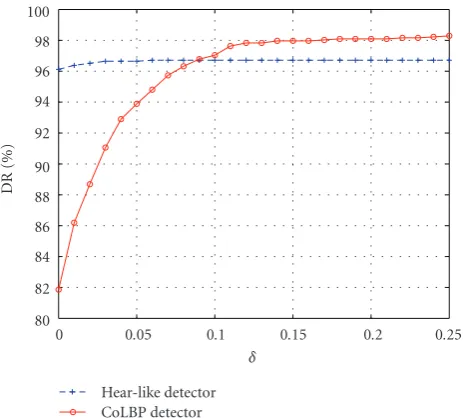
It can be concluded from Figure 13 that the CoLBP detector outperforms Haar-like detector. However, same conclusion explained in Section 3.4 can be drawn on the reasons made the Haar-like detector to be more consistent with its detection results over the entire range of different face decision criterion if compared to the CoLBP detector.
Even though several papers in the literature examined the BioID dataset; however, comparing the result still a daunting problem since different methods of evaluation are used (i.e., the method that decides whether the detected region is a face or not). However, if a comparison is conducted based on the highest detection rate achieved, then the CoLBP detector achieved 98.29% detection rate using 25% scaling and transitional error while 98.27% is reported in [8] using the Improved LBP (ILBP) features and measured using the method of evaluation explained in [38], but only 1511 images were considered in [8] instead of 1521. Furthermore, it can be observed that the CoLBP detector achieves a comparable result of>95% if compared to the state-of-the-art detectors in [21,39–42].
It can be concluded from this experiment that the CoLBP detector is not only capable to outperform the Haar-like detector on surveillance scenarios but also on the widely examined BioID dataset. Furthermore, the CoLBP detector can be regarded as not only computationally efficient but also is capable of achieving a comparative results to several state-of-the-art face detectors that are examined on the BioID dataset.
3.7. Robustness Towards Illumination and Blurring Noise. One of the properties of the examined surveillance dataset is having a decent illumination and nonblurred frames while both types of noise are common to occur in video sequences. Therefore, the CoLBP detector performance is evaluated in various artificially added illumination and blurring scenarios. In order to have a better understanding of the tolerance to noise, thenΔDR is measured
ΔDR=DRo−DRn, (4)
where DRois the detection rate in the nonnoisy dataset, and DRnis the detection rate when noise is applied.
Theβvalue explained inSection 2.3was fixed for the best PR when CoLBP detector is examined on the surveillance sequence.
−20 0 20 40 60 80 100
Δ
DR
(%)
−100 −80 −60 −40 −20 0 20 40 60 80 100
Linear contrast changes (%) Robustness towards illumination range
Figure 15: CoLBP detector robustness towards illumination changes.
3.7.1. Robustness Towards Illumination. One of the powerful facts that makes the LBP features to be superior over Haar-like features is its capability to handle illumination changes [11,21]; therefore, this experiment is conducted to examine the robustness of the proposed CoLBP features towards illumination changes. The evaluation set was brightened and dimmed by changing the contrast of the image using linear transformation in the range from−100% to +100%. Sample of the contrast range of the frames is shown inFigure 14.
The robustness of CoLBP detector towards illumination is as illustrated inFigure 15.
It can be concluded from this experiment that the CoLBP features holds the LBP features power in tolerating illumina-tion changes. Also CoLBP features can handle a wide range of illumination changes in the range from−30% to +70%.
(a) Original image (b) 1 pixel Gaussian blur
(c) 1.4 pixel Gaussian blur (d) 2 pixel Gaussian blur
Figure16: Visualizing the Gaussian filter blur on the image.
Table3: CoLBP detector robustness towards blurring.
Noise filter ΔDR (%)
Gaussian filter withσ=1 0
Gaussian filter withσ=1.4 1.3605
Gaussian filter withσ=2 2.0408
Hence it can be observed fromTable 3that the CoLBP detector has a wide range robustness towards blurring changes.
From the results presented in these experiments, several important observations can be made, and they are summa-rized below.
(i) The CoLBP features are capable to extract face discriminative features.
(ii) The co-occurrence of multiple features decreases the generalization error on the examined face dataset as well as decreases the training computational overhead in comparison to the separate features. (iii) The CoLBP features can achieve a faster face detector
than other various examined LBP extensions.
(iv) The CoLBP features have higher discriminative power than the Haar-like features on the examined face detection problem.
(v) CoLBP features are not only computationally effi -cient and have higher discriminative power than Haar-like features but also achieve a comparative
result to the state-of-the-art face detectors when examined on the BioID dataset.
(vi) CoLBP features hold the same properties of LBP features from an aspect of tolerating wide range of illumination changes.
(vii) CoLBP features are capable to handle different blur-ring noise.
4. Conclusion
25 98 20 15 73 37 79 80 10
0 0
0 0
0 1
1 1
Binary = 01100010 Decimal = 98
Figure17: Simple LBP feature.
25 98 20
37
10 80 79
15 73
0
0 0 0
0
1 1
1
98 Binary = 01100010Decimal = 98 R
#P
Interpolated values
Figure18: Rotational LBP8,2feature extraction.
face detection problem, but the proven capability of the CoLBP features to extract discriminative feature with their properties to handle wide range of noise can be used for different object detection problems.
Appendix
Review of Local Binary Patterns Features
Local Binary Patterns (LBP) features were first introduced in [43]. Due to their power to detect corners, edges, spots and flat ends as well as their high tolerance to illumination [20], they are used in texture classification. Simple LBP feature extraction algorithm operates by taking the value of the center pixel in a 3×3 pixels and assuming the texture of this 3×3 matrix is the joint distribution of nine gray-scale image pixels [44]. Furthermore, it subtracts the center pixel from all surrounding pixels. The center pixel is considered as the overall luminance factor in the 3×3 matrix, and it does not provide texture information. In order to achieve scaling of gray-scale invariance and preserve the texture of the matrix, the signs of the pixels are taken. Hence,
LBP xo,yo
= 7
i=0
sign gi−go
2i, (A.1)
where LBP(xo,yo) is the LBP value for the center pixel in the 3×3 matrix; the decimal value of LBP(xo,yo) represents the texture for this 3×3 pixel window.giis the gray-scale value of the surrounding pixels, andgois the gray-scale value of the center pixel.
Also,
sign(x)=
⎧ ⎨ ⎩
1 ifx≥0,
0 otherwise. (A.2)
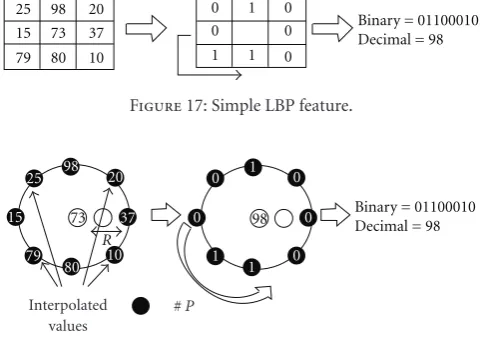
Figure 17 shows an example of simple LBP operation. Due to this procedure, 28possible LBP values can be obtained from 3×3 matrices.
The LBP features are not extracted on only 1 pixel neighbor or a square window, but as in [20], they can be extracted with a circular neighbor with different radii and points. Points are considered as the number of equally spaced points that construct the LBP operator and the radius is how far the points from the central pixel lie. This LBP features type is called rotational LBP features. Rotational LBP operator is symbolized as LBPP,R, where P, R correspond to the number of points and radius, respectively, therefore, there are 2Ppossible binary words for each LBP
P,R.Figure 18 shows an example of LBP8,2feature extraction.
Furthermore, it was found in [20] that there is a subset of the 2P LBP
P,Rthat spans most of the texture descriptor, this subset is called Uniform LBPP,R, LBPuP2,R. The Uniform LBPP,R words are the words that have only two flipping bits from 0 to 1 and 1 to 0 (e.g., 01110000).
Acknowledgments
This work is partially funded by the Natural Sciences and Engineering Research Council of Canada (NSERC) and ORF-RE program of the Ontario Ministry of Research and Innovation through MUltimodal SurvEillance System for SECurity-RElaTed Applications (MUSES SECRET) project. Also, MATLAB code available in [45] is used to implement some of the LBP features extensions.
References
[1] E. Hjelm˚as and B. K. Low, “Face detection: a survey,”Computer Vision and Image Understanding, vol. 83, no. 3, pp. 236–274, 2001.
[2] M. H. Yang, D. J. Kriegman, and N. Ahuja, “Detecting faces in images: a survey,”IEEE Transactions on Pattern Analysis and Machine Intelligence, vol. 24, no. 1, pp. 34–58, 2002.
[3] P. Viola and M. Jones, “Rapid object detection using a boosted cascade of simple features,” inProceedings of IEEE Computer Society Conference on Computer Vision and Pattern Recognition (CVPR ’01), vol. 1, pp. 511–518, December 2001.
[4] W. R. Schwartz, R. Gopalan, R. Chellappa, and L. S. Davis, “Robust human detection under occlusion by integrating face and person detectors,” inProceedings of the 3rd International Conference on Advances in Biometrics (ICB ’09), vol. 5558 of Lecture Notes in Computer Science, pp. 970–979, June 2009. [5] H. Moon, R. Chellappa, and A. Rosenfeld, “Optimal
edge-based shape detection,”IEEE Transactions on Image Processing, vol. 11, no. 11, pp. 1209–1227, 2002.
[6] K. C. Yow and R. Cipolla, “Feature-based human face detection,”Image and Vision Computing, vol. 15, no. 9, pp. 713–735, 1997.
[7] P. Viola and M. J. Jones, “Robust real-time face detection,” International Journal of Computer Vision, vol. 57, no. 2, pp. 137–154, 2004.
[8] Y. Rodriguez,Face detection and verification using local binary patterns, Ph.D. thesis, ´Ecole Polytechnique F´ed´erale de Lau-sanne, LauLau-sanne, Switzerland, 2006.
[10] D. Roth, M. H. Yang, and N. Ahuja, “A SNoW-based face detector,”Advances in Neural Information Processing Systems, vol. 12, pp. 855–861, 2000.
[11] A. Hadid, M. Pietik¨ainen, and T. Ahonen, “A discriminative feature space for detecting and recognizing faces,” in Proceed-ings of the IEEE Computer Society Conference on Computer Vision and Pattern Recognition (CVPR ’04), vol. 2, pp. 797–804, Washington, DC, USA, June-July 2004.
[12] T. F. Cootes, G. V. Wheeler, K. N. Walker, and C. J. Taylor, “View-based active appearance models,” Image and Vision Computing, vol. 20, no. 9-10, pp. 657–664, 2002.
[13] H. Jin, Q. Liu, H. Lu, and X. Tong, “Face detection using improved LBP under bayesian framework,” inProceedings of the 3rd International Conference on Image and Graphics (ICIG ’04), pp. 306–309, December 2004.
[14] Y. Freund and R. E. Schapire, “Experiments with a new boosting algorithm,” inProceedings of International Conference on Machine Learning (ICML ’96), pp. 148–156, 1996. [15] R. Lienhart and J. Maydt, “An extended set of Haar-like
features for rapid object detection,” in Proceedings of the International Conference on Image Processing (ICIP’02), vol. 1, pp. 900–903, September 2002.
[16] R. Lienhart, A. Kuranov, and V. Pisarevsky, “Empirical analysis of detection cascades of boosted classifiers for rapid object detection,” inPattern Recognition, vol. 2781 ofLecture Notes in Computer Science, pp. 297–304, 2003.
[17] T. Mita, T. Kaneko, B. Stenger, and O. Hori, “Discriminative feature co-occurrence selection for object detection,” IEEE Transactions on Pattern Analysis and Machine Intelligence, vol. 30, no. 7, pp. 1257–1269, 2008.
[18] T. Mita, T. Kaneko, and O. Hori, “Joint Haar-like features for face detection,” inProceedings of the 10th IEEE International Conference on Computer Vision (ICCV ’05), pp. 1619–1626, October 2005.
[19] P. M. Tri,Principled asymmetric boosting approaches to rapid training and classification in face detection, Ph.D. thesis, Nanyang Technological University, 2009.
[20] T. Ojala, M. Pietik¨ainen, and T. M¨aenp¨a¨a, “Multiresolution gray-scale and rotation invariant texture classification with local binary patterns,”IEEE Transactions on Pattern Analysis and Machine Intelligence, vol. 24, no. 7, pp. 971–987, 2002. [21] B. Fr¨oba and A. Ernst, “Face detection with the modified
census transform,” inProceedings of the 6th IEEE International Conference on Automatic Face and Gesture Recognition (FGR ’04), pp. 91–96, May 2004.
[22] L. Zhang, R. Chu, S. Xiang, S. Liao, and S. Z. Li, “Face detec-tion based on multi-block LBP representadetec-tion,” inAdvances in Biometrics, vol. 4642 ofLecture Notes in Computer Science, pp. 11–18, 2007.
[23] C. Shen, S. Paisitkriangkrai, and J. Zhang, “Face detection from few training examples,” inProceedings of IEEE Interna-tional Conference on Image Processing (ICIP ’08), pp. 2764– 2767, October 2008.
[24] J. Friedman, T. Hastie, and R. Tibshirani, “Additive logistic regression: a statistical view of boosting,”Annals of Statistics, vol. 28, no. 2, pp. 337–407, 2000.
[25] S. Zhao, Y. Gao, and B. Zhang, “Sobel-LBP,” inProceedings of IEEE International Conference on Image Processing (ICIP ’08), pp. 2144–2147, October 2008.
[26] M. Heikkil¨a, M. Pietik¨ainen, and C. Schmid, “Description of interest regions with local binary patterns,”Pattern Recogni-tion, vol. 42, no. 3, pp. 425–436, 2009.
[27] A. Vezhnevets and V. Vezhnevets, “Modest AdaBoost-teaching AdaBoost to generalize better,” in Proceedings of the Inter-national Conference on the Computer Graphics and Vision (GraphiCon ’05), pp. 322–325, Novosibirsk Akademgorodok, Russia, 2005.
[28] T. Marill and D. Green, “On the effectiveness of receptors in recognition systems,”IEEE transactions on Information Theory, vol. 9, no. 1, pp. 11–17, 1963.
[29] A. W. Whitney, “Direct method of nonparametric measure-ment selection,”IEEE Transactions on Computers, vol. 20, no. 9, pp. 1100–1103, 1971.
[30] S. D. Stearns, “On selecting features for pattern classifiers,” inProceedings of the International Joint Conference on Pattern Recognition, pp. 71–75, 1976.
[31] P. M. Narendra and K. Fukunaga, “A branch and bound algorithm for feature subset selection,”IEEE Transactions on Computers, vol. 26, no. 9, pp. 917–922, 1977.
[32] P. Pudil, J. Novoviˇcov´a, and J. Kittler, “Floating search methods in feature selection,”Pattern Recognition Letters, vol. 15, no. 11, pp. 1119–1125, 1994.
[33] O. H. Jensen and R. Larsen, Implementing the Viola-Jones face detection algorithm, M.S. thesis, Technical University of Denmark, Denmark, 2008.
[34] P. S. Carbonetto, “Robust object detection using boosted learning,” Tech. Rep., Department of Computer Science, University of British Columbia, Vancouver, Canada, 2002. [35] W. Louis and K. N. Plataniotis, “Weakly trained dual features
extraction based detector for frontal face detection,” in Pro-ceedings of IEEE International Conference on Acoustics, Speech and Signal Processing (ICASSP ’10), pp. 814–817, Dallas, Tex, USA, March 2010.
[36] W. Louis, K. N. Plataniotis, and Y. Man Ro, “Enhanced weakly trained frontal face detector for surveillance purposes,” in Proceedings of the 6th IEEE World Congress on Computational Intelligence (WCCI ’10), Barcelona, Spain, July 2010.
[37] V. Popovici, J. P. Thiran, Y. Rodriguez, and S. Marcel, “On performance evaluation of face detection and localization algorithms,” inProceedings of the 17th International Conference on Pattern Recognition (ICPR ’04), vol. 1, pp. 313–317, August 2004.
[38] O. Jesorsky, K. J. Kirchberg, R. W. Frischholz et al., “Robust face detection using the hausdorffdistance,” inAudio- and Video-Based Biometric Person Authentication, Lecture Notes in Computer Science, pp. 90–95, 2001.
[39] M. Nilsson, J. Nordberg, and I. Claesson, “Face detection using local SMQT features and split up snow classifier,” in Proceedings of IEEE International Conference on Acoustics, Speech and Signal Processing (ICASSP ’07), vol. 2, pp. 589–592, April 2007.
[40] W. K. Tsao, A. J. T. Lee, Y. H. Liu, T. W. Chang, and H. H. Lin, “A data mining approach to face detection,”Pattern Recognition, vol. 43, no. 3, pp. 1039–1049, 2010.
[41] K. J. Kirchberg, O. Jesorsky, and R. Frischholz, “Genetic model optimization for Hausdorffdistance-based face localization,” inProceedings of the European Conference on Computer Vision (ECCV ’02), pp. 103–111, Springer, 2002.
[42] P. Shih and C. Liu, “Face detection using discriminating feature analysis and support vector machine,”Pattern Recog-nition, vol. 39, no. 2, pp. 260–276, 2006.
[44] T. Ojala, M. Pietikainen, and T. Maenpaa, “Gray scale and rotation invariant texture classification with local binary patterns,” in Proceedings of the 6th European Conference on Computer Vision (ECCV ’00), vol. 1842 of Lecture Notes in Computer Science, pp. 404–420, Dublin, Ireland, June-July 2000.