Vol. 08, Issue 8 (August. 2018), ||V (III) || 62-71
Network Parametric Analysis in MIMO-OFDM Using Multiuser
Cooperative Relay
P. Samundiswary
1and R. Sophia Jeanne
21Asst. Professor, Dept. of Electronics Engineering, Pondicherry University, 605 014, India 2 M.Tech Student, Dept. of Electronics Engineering, Pondicherry University, 605014, India
Corresponding Author: P.Samundiswary1
Abstract:
Cooperative relaying is a significant technique in wireless communication technologies .The cooperative relay network mainly enables to improvise the channel entities and assures an error free transmission. Cooperative relaying promises an enhancement in the channel capacity and throughput. However, relay selection, power allocation and subcarrier assignment seems to be complex issue in cooperative relay MIMO-OFDM system. Hence, in this article, an attempt has been made to design a novel algorithm for cooperative relay MIMO-OFDM system by selecting an appropriate relay with proper subcarrier assignment in-order to improve the performance metrics such as BER, channel capacity and throughput. In this algorithm, as a first step, the number of subcarriers is selected according to the average channel gains and the target rates of users. After that, the subcarriers are assigned to the users with the best equivalent channel gains along with the relay selection. Then the, multiuser cooperative relay algorithm is developed for analyzing the above-mentioned performance metrics. And, finally the multiuser cooperative relay algorithm developed for MIMO OFDM system is compared with two other algorithms such as Successive Convex Approximation (SCA) and Energy Harvesting Successive Convex Approximation (EH-SCA). It is evident through the simulation results that the cooperative relay algorithm provides a lower BER value for a balanced interference oriented environment compared to that of SCA and EH-SCA algorithms. The attributes of the cooperative network aims to increase the channel capacity and enhance the data rate requirements. The Decode and Forward (DF) relaying technique used in this work re-encodes and processes the data to ensure maximum throughput efficiency. The cooperative relay algorithm can be further extended mainly to wireless sensor networks and it can also be used to manage the power requirements in cooperative multiuser MIMO-OFDM networks.Keywords: cooperative relays; Decode and forward relay; BER analysis; Channel capacity; Throughput Enhancement; Multiuser networks.
--- --- Date of Submission: 06-08-2018 Date of acceptance: 23-08-2018
---I.
INTRODUCTION
In the modern wireless era, MIMO-OFDM upholds a distinctive strategy of communication in the recent years. This system utilizes its allotted bandwidth to transmit more data bits and improves the spectral productivity. It also aids the network operators to support many users with large data requirements. MIMO-OFDM network is highly reliable in today‟s wireless communication trend with its high spectral efficiency and large data rate and its capability to increase the throughput without expanding the given bandwidth or transmit power, 1.
Although the MIMO-OFDM network stands distinctive in enhancing the information rate and SNR of the network, power minimization is one of the serious issues as it causes an adverse effect by reducing data rate and even data loss2. The power minimization problem when analyzed mathematically has seemed to be more non-linear in nature and it is bounced to be a non-convex form of problem. Further it is very challenging issue to be solved3,4. So a better procedure to solve this non-convex issue is handled by a technique known as the Successive Convex Approximation (SCA) 6. This SCA technique has projected as a convex form of solution in power minimization in the existing work.
enhance the QoS of the MIMO-OFDM network, an attempt has been made in this paper to develop a model by appending cooperative relay algorithm with the attributes of multiuser MIMO-OFDM system.
Multiuser cooperative relay technique is proved to be more significant because of its emphasis in enhancing the spectral efficiency and expanding the system coverage. It is assumed that the nodes in the network access the channel in a particular time division manner. The source nodes transmit to the relay in the first time slot, while the relay nodes transmit to the destination in the second time slot. Apparently, another assumption is done where the nodes transmit and receive simultaneously to the consecutive subcarriers. A multiuser cooperation methodology is completely based on the acknowledgement/negative acknowledgement exchange through the relay nodes without the Channel State Information (CSI) exchange between the nodes in the network.
The ultimate relaying strategy best suited for multiuser cooperate communication is Decode and Forward (DF) relaying method in which decoding of information is done by the source and the relay nodes. As an additional specification, subcarriers have multiple associations to boost the throughput of the system. One of the most important advantages of DF relaying is that, in case,if there is any error present in the information, the relaying signal aids in decoding the error part and enables to deliver the original information at the receiver end.
The key aspects of this paper are as follows:
In this paper, a new algorithm namely cooperative relaying with DF algorithm is introduced in the MIMO-OFDM system which substantially increases the efficiency of the network.
Subsequently, QoS performance metrics such as BER, channel capacity and throughput efficiency are also analysed for MIMO-OFDM network by using multi-user cooperative relay algorithm in this paper .
Finally, the newly developed cooperative relay algorithm is compared with the existing algorithms, EH-SCA and EH-SCA algorithms in terms of above mentioned networks performance parameters.
The paper could be sectored in the following manner, Section I discusses about the system model; Section II explains the concept of existing work. Section III presents the proposed work. Section IV deals with the simulation results of the proposed work. Finally, Section V concludes the work.
II.
EXISTING METHODOLOGY
The existing work involves an energy harvesting relay node implemented through the SCA technique in the downlink scenario in MIMO-OFDM system. The EH relay node consists of two terminals of the AF relay for simultaneous transmission and reception at the same frequency. It is assumed that all nodes have a perfect knowledge on the channel condition of both hops. The existing system model of MIMO-OFDM network with energy harvesting relay node consists on an inbuilt architecture of Time Switching Relay(TSR) and the Power Splitting Relay (PSR)protocols which facilitates wireless energy harvesting and information processing respectively 10,11.
As the transmission range expands, the energy harvesting relay technique improves the power and signal quality5. Energy harvesting Relay nodes capture the incoming signal and amplify it. The energy harvesting relay node configured through EH-SCA algorithm works best for approximating the power reduction values with less number of iterations.
2.1 System Model of Existing Methodology
The existing system model consists of a downlink MIMO-OFDM multiuser cooperative network with the consideration of N sub-channels. The system consists of „M’ energy harvesting relay nodes, „L‟ Remote Radio Heads(RRHs). All the components in the network are connected with the help of a backhaul link. This backhaul link is further connected to central processing unit where the power minimization algorithm is implemented6.
Figure 1. MIMO-OFDM downlink system with L=4 RRHs, K= 2Information Receivers andM=2 EHRs [9]
The energy harvesting relay nodes configured in the existing system is characterized with Amplify and Forward (AF) relaying mechanism, which enables to expand the transmission bandwidth. Thus, AF relaying improves reliability and data throughput. With the help of AF relaying mechanism, the energy harvesting relay node extracts energy from the incoming RF signal broadcasted by the source to transmit the data to the destination.
It also aids in refining the network connectivity and enhancing power efficiency8. The spectral productivity and communication reliability are amplified by the EH relays in communication networks. The existing algorithm is termed as EH-SCA algorithm which is configured through EH relay nodes. This algorithm begins with the initialization of the approximation constants, and the lagrange‟s multiplier which are pre-calculated in the existing model. This is done to minimize the power limits because of the relay effects 7. The convex approximation involves the lower bound expansion,
(1)
The relay allocates the power by means of the power splitter module to the source and destination and it is formulated by,
(2)
(3)
Where the and are the powers allocated at the source and receiver with its associated antenna gains. Then the powers are allocated to the associated antennas, the EH relay limits the over
transmission power by EH-SCA. The power minimization factor is given as,
(4)
Where and path loss factors pave way for a feasible error free transmission. The pre allocated power and the transmission distance act as balancing mode parameters. The capacity checking criteria is the main solution to determine the rate targets. The rate targets of the EH relay nodes are expressed as,
Where is the number of transmitting antenna and is the transmitting capacity, is the user rate target. The existing algorithm works as a fast iterative technique and the approximation point is achieved as much earlier. After achieving the optimization in terms of power and rate targets, the algorithm is terminated by checking whether the targeted rate capacity for the relay node is achieved or not.
III.
PROPOSED METHODOLOGY
The proposed system consists of cooperative relays introduced in the MIMO-OFDM network instead of energy harvesting relays. The basic technique of cooperative relay emerges from an assumption that all the nodes in the network operate in the same frequency band. The system is dissected into multiple broadband channels depending on the source and multipath access channel depending on the destination13. The main role of the cooperative relay is to determine the system resources and make the users to behave like information sources as well as relays. To enable the idea of cooperation among the users, various relaying techniques are employed with respect to the user location, channel conditions and transceiver complexity14,15. In this paper, Decode and Forward (DF) relaying is employed.
3.1 System model of the proposed methodology
The components of this network are connected with the backhaul link so that the data and the command signals could be easily distributed throughout the network.
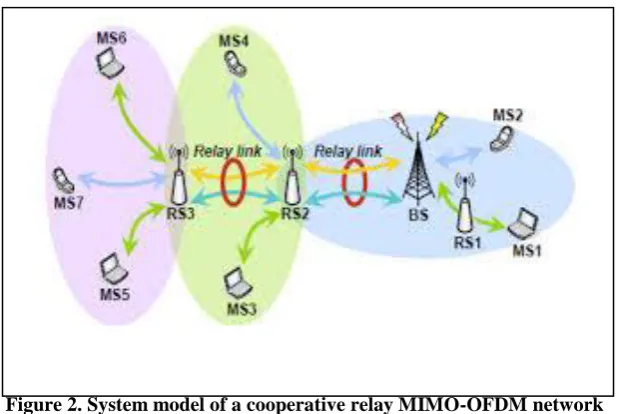
Figure 2. System model of a cooperative relay MIMO-OFDM network
In the figure 2, BS denotes the base station, RS1, RS2 and RS3 represent cooperative relays and the units MS1, MS2, MS3, MS4, MS5, MS6, MS7 denote the user equipment which are the end devices to provide maximum serviceability.
The basic idea of cooperating relay is as follows: When the source transmits some data signal, the cooperative relay eavesdrops the transmitted data signal from the source and relays it to the destination. At the destination, both the transmitted and the relayed signal are combined and the transmitted information is decoded efficiently. As the relay terminals cooperate with the transmitter to forward the data to the receiver, it is assumed that the cooperative mechanism consists of two phases: the listening phase and the cooperating phase. In the first phase, that is the listening part, the transmitter forwards the information to the relays. Here it is noted that in the listening phase, the source transmits data to the relays and it is assumed that the destination does not receive any data. The source allocates the relay terminals that are to be involved in cooperation according to relay selection criterion. The listening phase fixes the duration to decode the data correctly18. In the cooperating phase, the source and the relay cooperates to transmit the data to the destination. It is assumed that the source and the relay terminal both have the same average transmit power. The total transmit time, T, is given by,
Where is the channel capacity between source and the cooperative relay and is the channel capacity between the cooperative group (the source and the selected relays) and the destination. The corresponding channel capacities and given in eq.(6) are expressed as,
(7)
(8)
Where is the channel matrix between the cooperating group and the destination.
The relay selection mechanism mainly concentrates on the opportunistic behavior ofthe overhearing nodes, which evaluates the Channel State Information (CSI) from the source and destination links based on a timer. The nodes with better channel conditions are best suited as relays.Relay selection process is done in multi-user MIMO-OFDM networks in the following manner: the cooperative relays access the original data signal from the source and creates an overview of the receiver scenario, by overhearing the originally transmitted signal from the source. Then the relay forwards the data to the destination even if a direct link between the source and the destination is absent 19. This indicates that cooperative relays have received the information to be relayed directly from the source or from the intermediate nodes.
3.2 Decode and Forward Relaying in cooperative communication
The best suited relay mechanism for cooperative communication is Decode and Forward (DF) relaying mechanism which re-encodes the data signals into their source signals. Then it applies a detection or decoding algorithm to forward the processed signal to the destination. The decoding and re-encoding processes usually defines a non-linear transformation of the received signals. Although decoding at the cooperative relays have a benefit of decreasing the effect of receiver noise, it limits the efficiency due to the incoming fading effects.
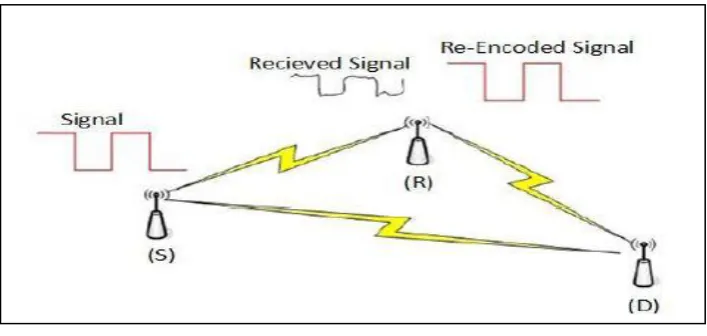
Figure 3. Block Diagram of a decode and forward relaying technique
The figure 3 depicts the architecture of a DF relay [20] that consists of three main components, the source, the cooperative relay and the destination. The components share mutual information on the data signal
and channel capacity. For instance, if the source transmits for bits, then the relay
formulates an estimate of by decoding its respective received data signal, for . Then a re-encoded form relayed signal, implements the coding process by transmitting the signal.
Again the received signal is processed by the destination for by cooperative method of diversity combining of the two sub-blocks of length n. The relay encodes the source message using a codeword, which is not exactly similar to the source codeword, and it is less complex.
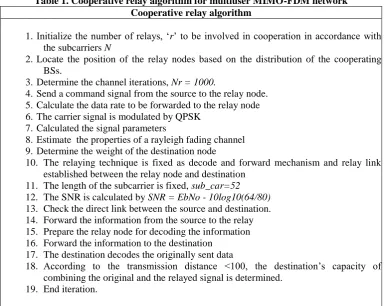
The QoS study is done through BER analysis, channel capacity measurement and throughput analysis via cooperative relay algorithm. Since the proposed algorithm follows decode and forward mechanism, the error rate will be low as the relaying signal is more powerful in decoding the original signal with its own purity. Further, the cooperative relaying mainly relies on DF mechanism, the destination can decode only if the relay can decode and process the data signal. The cooperative relay algorithm with DF relaying method is formulated as shown in table 1.
The below co-operative relay algorithm explains the step by step procedure about the working principle of the cooperative relay technique. A data signal is transmitted from the source and the cooperative relay in the network collects the information, processes it and then forwards it to the destination16. The receiving end combines the transmitted signal and the relayed signal and decodes it. By this type of cooperative signaling, all the elements in the network share a mutual knowledge on the data that is being transmitted and then network parameters are analyzed. The configuration of the cooperative relay algorithm consists of a 4x4 MIMO-OFDM network with 8 cooperating BSs and 2 co-operative relay nodes and a central processor to which all the network components are connected.
The co-operative relay algorithm is executed in the central processing unit of the network. It provides the command signals to the relay nodes present in the network 17. The relay nodes have a cooperative diversity link with all the network components
Table 1. Cooperative relay algorithm for multiuser MIMO-FDM network Cooperative relay algorithm
1. Initialize the number of relays, „r‟ to be involved in cooperation in accordance with
the subcarriers N
2. Locate the position of the relay nodes based on the distribution of the cooperating BSs.
3. Determine the channel iterations, Nr = 1000.
4. Send a command signal from the source to the relay node. 5. Calculate the data rate to be forwarded to the relay node 6. The carrier signal is modulated by QPSK
7. Calculated the signal parameters
8. Estimate the properties of a rayleigh fading channel 9. Determine the weight of the destination node
10. The relaying technique is fixed as decode and forward mechanism and relay link established between the relay node and destination
11. The length of the subcarrier is fixed, sub_car=52
12. The SNR is calculated by SNR = EbNo - 10log10(64/80)
13. Check the direct link between the source and destination. 14. Forward the information from the source to the relay 15. Prepare the relay node for decoding the information 16. Forward the information to the destination
17. The destination decodes the originally sent data
18. According to the transmission distance <100, the destination‟s capacity of combining the original and the relayed signal is determined.
19. End iteration.
IV. SIMULATION RESULTS
Table 2. Simulation parameters
4.1 BER analysis through cooperative relay algorithm
The study of BER analysis through cooperative relay algorithm describes the derivation for BER expression. Because the destination is assumed to perform selection of data signal by combining the original and the relayed signal received from the direct link and the relay link. BER is calculated with respect to the SNR values by means of relay selection and the maximum ratio at the relay terminal. The BER through cooperative relay algorithm is calculated by,
(10)
And its respective SNR value is calculated as,(11)
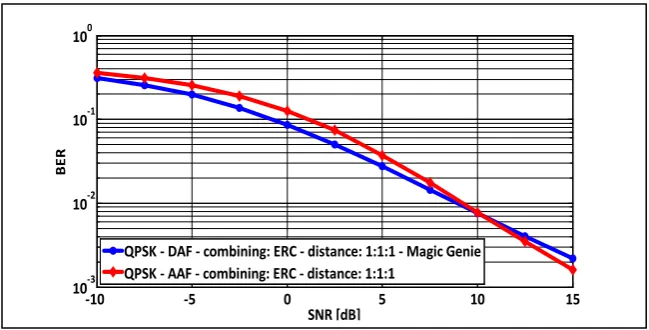
The BER analysis of cooperative relay algorithm is shown in figure 4. It is obtained by incorporating both the relaying techniques such as the AF relay and DF relay.Figure 4.Comparison of BER vs SNR between AF and DF techniques.
It is inferred through the BER analysis that the DF relay technique achieves better BER values than that of AF relay technique. Subsequently the BER analysis illustrated in figure 5 is defined by its estimation to measure of the error free transmitted signal calculated through cooperative relay algorithm.
S.NO SIMULATION PARAMETERS SYMBOL VALUES
1 No. of sub-channels 64
2 Length of cyclic prefix 16
3 No. of transmitters 4
4 No. of receivers 4
5 Frequency 2Ghz
6 Total no. of Frames - 100
7 No. of symbols 10^6
8 Modulation level (BPSK,QPSK) 2
9 No. of pilots - 12
10 Signal to noise ratio -10: 20
-10 -5 0 5 10 15
10-3 10-2 10-1 100
SNR [dB]
BE
R
Figure 5.Comparison of BER vs SNR for the three algorithms
It is illustrated through the figure 5 that BER is calculated for various values of SNR graph by considering four algorithms such cooperative relay algorithm with DF relaying technique and the existing algorithms SCA and EH-SCA with AF . It is inferred from the result that the cooperative relay algorithm with DF relaying achieves lower BER as the DF mechanism has the ability to predict the error level since the signal in higher manner than that of the others relaying algorithms.
4.2 Channel capacity analysis through the cooperative relay algorithm
The in-built cooperative diversity technique is the most important reason for maximizing the channel capacity with any bandwidth range especially for cooperative multi antenna network. It exploits user diversity by decoding and combining the original data signal and the relayed signal in a multi-user network. The channel capacity of the cooperative relay node is calculated by,
(12)
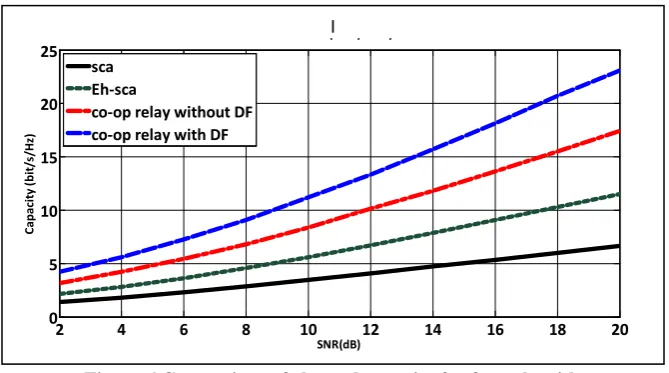
Here a comparison between the proposed cooperative relay algorithm and the existing algorithms such as SCA and EH-SCA is shown in Figure 6. It is depicted through the figure 6 that the channel capacity is much greater for cooperative relay algorithm than that of other existing algorithms. Next to cooperative relay algorithm, EH-SCA algorithm has higher capacity values because of energy harvesting node configuration which maximizes the channel capacity. Since SCA is merely an approximation technique, it does not provide rate enhancement procedures. Thus, it has the least channel capacity among all the three algorithms.-10 -5 0 5 10 15
10-4 10-3 10-2 10-1 100
SNR [dB]
BE
R
BER vs SNR
SCA E-Relay SCA AF Propsed DF
I
2 4 6 8 10 12 14 16 18 20
0 5 10 15 20 25
SNR(dB)
C
ap
acit
y
(b
it
/s
/H
z)
Channel capacity analysis
sca Eh-sca
In cooperative relay networks, the relay nodes forward the overheard original data signal and cause network overload problem, which in turn affects the throughput of the system. But, by the usage of DF relaying mechanism, the network overload issues are aborted because of the mutual cooperation between the relay nodes in the network. Hence, throughput efficiency is increased with low error percentage. The source to relay cooperation level is formulated as,
(13)
Where is the source-relay cooperation capability and is the source-relay link capacity. The relay to destination cooperation level is given below and it is denoted as and the relay-destination link capacity is denoted by , it is expressed as,(14)
The amount of data rate that can be transmitted by the source is fixed as 100Mbits/s. The overall throughput is calculated with respect to the rate capacity ,(15)
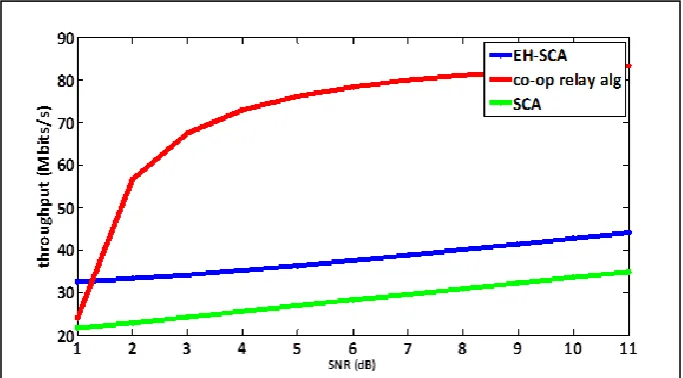
Where „ ‟ is the rate target of the users, is the number of users.Here the throughput analysis with respect to SNR considered is illustrated in figure 7. It is observed from the figure 7 , that the throughput efficiency calculated by the cooperative relay algorithm is much better than that of the other existing algorithms.
Figure 7.Comparison of throughput vs SNR for the three algorithms
V.
CONCLUSION
The cooperative relay networks play a vital role in maximizing the attributes of the network parameters compared to that of other approximation algorithms. In addition, it is evident that the cooperative network will soon emerge as dominating technique in the world of communication. Hence, the network performance parameters for MIMO-OFDM is analysed by using co-operative relay algorithm with DF method. The cooperative relay algorithm strands unique by the characteristic that it could configure all the essential requirements of users with better BER, channel capacity and throughput efficiency in the network on a single algorithmic formulation. Cooperative relays have still long way to go by playing a major role in power reduction mechanism so that the power in the network will be conserved even after the usage of cooperative relay. It stands as an undeniable fact that DF relaying technique is the best-suited technique when it comes to cooperative communication.
REFERENCES
[2]. W Hardjawana, B Vucetic, Y Li, “ Multi-user cooperative base station systems with joint processing and beam forming”, IEEE Journal Selected Topics Signal Processing, Vol. 3, No.6, pp. 1079–1093, 2009. [3]. R Zhang, “ Cooperative multi-cell block diagonalization with per-base-station power constraints”, IEEE
Journal on Selected Areas Communication, Vol. 28,No. 9, pp.1435–1445, 2010
[4]. CY Hsu, BS Krongold, “Coordinated multi-point transmission of MIMO-OFDM system with per-antenna power Constraints”, Proceedings of IEEE Global Communication Conference, Anaheim, 2012. [5]. Duy H. N. Nguyen, T Le-Ngoc, “Sum-rate maximization in the multicell MIMO broadcast channel with
interference coordination”, IEEE Transactions on Signal Processing, Vol. 62, No.6, pp. 1501–1513, 2014.
[6]. Chih-yu Hsu, Phee Lep Yeoh and Brian S. Krongold, “ Power minimization for cooperative MIMO-OFDM systems with individual user rate constraints”, EURASIP Journal on Wireless Communications and Networking, 2016. DOI 10.1186/s13638-016-0541-4
[7]. W Yu, W Rhee, S Boyd, JM Cioffi, “Iterative water-filling for Gaussian vector multiple-access channel”, IEEE Transactions on Information Theory, Vol.50, No.1, pp. 145–152, 2004.
[8]. Quentin H. Spencer, A.Lee Swindlehurst, M Haardt, “Zero-forcing methods for downlink spatial multiplexing in multiuser MIMO channels”, Proceedings of IEEE Transaction on Signal Processing, Vol. 52, No.2, pp. 461–471, 2004
[9]. D. W. K. Ng and R. Schober, “Resource allocation for coordinated multipoint networks with wireless information and power transfer”, Proceedings of IEEE Global Communication Conference , Austin, TX, USA, Dec. 2014.
[10]. L. Venturino, N. Prasad, and X. Wang, “Coordinated scheduling and power allocation in downlink multicell OFDMA Networks”, IEEE Transactions Vehicular Technology ,vol. 58, no. 6, pp. 2835–2848, Jul. 2009.
[11]. Dinh-Thuan Do, “Time Power Switching Based Relaying Protocol in Energy Harvesting Mobile Node: Optimal Throughput Analysis”, Hindawi Publishing Corporation Mobile Information Systems, Volume Article ID 769286, 2015.
[12]. Shenghong Li, and Ross D. Murch, “Realizing Cooperative Multiuser OFDMA Systems with Subcarrier Resource Allocation”, IEEE Transactions on Wireless Communications, vol. 12, no. 4, pp. 1923-1935, April 2013
[13]. Gerhard Kramer, Michael Gastpar and Piyush Gupta, “ Cooperative Strategies and Capacity Theorems for Relay Networks”, IEEE Transactions on Information Theory, Vol. 51, No. 9,pp. 3037- 3063,September 2005
[14]. Jiho Jang, and Kwang Bok Lee, “Transmit Power Adaptation for Multiuser OFDM Systems”, IEEE Journal on Selected Areas in Communications, Vol. 21, No. 2, pp. 171-178, February 2003
[15]. Leila Musavian, and Sonia Aıssa, “Capacity and Power Allocation for Spectrum-Sharing Communications in Fading Channels”, IEEE Transactions on wireless communications,. Vol. 8, No. 1, pp. 148-156, January 2009
[16]. Spriti Thakur and Gurleen Kaur Shergill, “A stable and energy based zone for cooperative routing protocol for wireless sensor network”, Indian Journal of Science and Technology, Vol.9, No. 26, July 2016. DOI:10.17485/ijst/2016/v9i26/95357, ,
[17]. Hadi Zayandehroodi , Hamzehbabaei and Mahdiyeh Eslami, “Optimization of energy consumption in cooperative wireless network using quadratic programming”, Indian Journal of Science and Technology, Vol. 8, No. 35, December, 2015 DOI:10.17485/ijst/2015/v8i35/87396.
[18]. Xia Gong, Yifei Wei, Yong Zhang, Da Guo, “Spectrum aggregation strategy in multiuser cooperative relay network”, Proceedings of 12th International Conference on Fuzzy Systems and Knowledge Discovery (FSKD), pp.2196-2202, August 2015.
[19]. Shiguo Wang, Haixia Peng, and Xianru Liu, “Sum power maximization in multiuser single DF relay networks with direct links”, International Journal of Distributed Sensor Networks, Article ID 8467294, Vol. 12, No.4, 2016.
[20]. Juhi Karg, Kapil Gupta and P.K. Ghosh, “Performance Analysis of MIMO wireless communication over fading channels- a review”, International Journal of Advanced Research in Electrical, Electronics and Instrumentation Engineering, Vol.2, No.4, pp. 1272- 1302,April 2013
![Figure 1. MIMO-OFDM downlink system with L=4 RRHs, K= 2Information Receivers andM=2 EHRs [9]](https://thumb-us.123doks.com/thumbv2/123dok_us/7809204.1662340/3.595.105.474.72.268/figure-mimo-ofdm-downlink-rrhs-information-receivers-ehrs.webp)