pg. 14
The Role of Organizational Development and Organizational Commitment on Business Performance SMES with Business Motivation as Variable Mediation in the Environmental Development Partnership Program: Case Study ofSmart Business Partners Fostered Community Development Center PT. Telkom Witel Bekasi Ety Sulianny
Master of Management Faculty of Economics Universitas Krisnadwipayana Po Box 7774 / Jat Cm Jakarta, Indonesia
Email: [email protected]
Indonesia
Wagiarto Husein Faculty of Economics Universitas Krisnadwipayana Po Box 7774 / Jat Cm Jakarta, Indonesia
Email: [email protected]
Indonesia
Dr Iwan Kurniawan Subagja Faculty of Economics Universitas Krisnadwipayana Po Box 7774 / Jat Cm Jakarta, Indonesia
Email: [email protected]
Indonesia ABSTRACT
This study aimed to analyze the influence of organizational development and organizational commitment to the SME business performance through motivation effort on SMEs Partners CDC PT. Telkom Witel Bekasi. This survey respondent accounted for 83 SMEs Partners CDC PT. Telkom Witel Bekasi. The sampling technique used purposive sampling means that the sample is determined by considering the purpose of the research is based on criteria determined beforehand, and analysis techniques using path analysis.
The results showed that fostering a positive and significant impact directly on the performance of SME.
Organizational development indirect effect on the performance of SME through business motivation. Organizational commitment and significant positive effect directly on the performance of SME. Organizational commitment indirect effect on the performance of the business through business motivation. Motivation efforts and significant positive effect on the performance of SME. The indirect effect of organizational development and organizational commitment to the performance of SMEs through venture motivation is greater than the direct effect. This suggests that the motivation of businesses contributes to the development and organizational commitment to business performance in SMEs associated Witel CDC Telkom Bekasi.
Keywords: Organizational Development, Organizational Commitment, Motivation Business and Business Performance of SMEs.
INTRODUCTION
In the current era of globalization, where technological development goes so fast, make trading across borders, even continents is no longer a major obstacle. The impact is a businessman in a state in this case Indonesia to face competition in the business world. This is because they are in business is not only competing with local businesses but also international businessmen, given the flow of goods and services from abroad into Indonesia flowed so profusely. On the positive side, if we can win this competition then the product of Indonesiapun entrepreneurs to penetrate the international market.
pg. 15
Performance by Aliminsyah and Pandji (2003:206-207), is a work performance, ie work for a certain period as compared to the possibilities. Performance is a general term used for part or all of the actions or activities of an organization in the period.Meanwhile, Samsudin (2003: 425), said that the performance was powerful, achievements or results. This means that performance is an act that can be seen, observed and it is possible to achieve the expected things (destinations). Performance can also be said to be a combination of ability, effort and opportunity that can be judged from their work acquired during a specific period.
A company's performance is the result of management activities. Parameters that are often used to assess the performance of a company is done by using an approach in which the financial information taken from the financial statements or other financial statements. The understanding of the company's performance by Rivai and Basri (2004: 16), is the work that can be achieved by a person or group of people in a company in accordance with the authority and responsibilities of each in an effort to achieve company goals legally, and do not break the law and not contrary to morals and ethics.
One area of business that is being aggressively populist empowered in Indonesia's economy is the Micro, Small and Medium Enterprises or shortened by SMEs. SMEs play an important role in the strategic and economic development in Indonesia. Besides a role in supporting economic growth and employment, SMEs have also been proven to withstand the economic crisis. When the monetary crisis hit Indonesia in the period 1997-1998, only SMEs are relatively able to survive than large firms. This is because the majority of small-scale businesses are less dependent on large capital or loans in foreign currency.
Micro, Small and Medium Enterprises (SMEs) can make a significant contribution to the national economy. The Central Bureau of Statistics in the News MSME Ministry of Planning/National Development Planning Agency (2016), shows the post-economic crisis of 1997-1998 the number of SMEs is not reduced, only increased and even able to absorb 85 million to 107 million jobs up to 2012. In 2012, The number of entrepreneurs in Indonesia recorded at 56.53956 million units. Of these, SMEs as much as 56,534,592 units or 99.99 percent, and the remaining 0.01 percent or 4968 units is a huge undertaking.
In 2015, the number of SMEs is expected to reach 60.7 million units and most are micro-scale enterprises amounted to 98.73 percent. The growth of SMEs in the period 2011-2015 to reach 2.4 percent by the greatest growth are medium-sized enterprises in the amount of 8.7 percent. The growth of small and medium enterprises was higher than the growth of micro-enterprises in the past five years may indicate rising business class, as well as a result of increased investment on a medium scale, recorded an average of 15.7 percent. In the same period, the capacity of SMEs to absorb the labor force continued to increase, which is an average of 5.9 percent. By 2015, the workforce of SMEs reached more than 132.3 million people. But the majority of the workforce of SMEs (88,
The contribution of SMEs in the economy can be seen in the establishment of the Gross Domestic Product (GDP). In the period 2009-2013, the contribution of SMEs reached 57.6 percent, with an average growth of 6.7 percent. Most of the SMEs' GDP contributed by micro-enterprises (49.6 percent). By sector, the largest GDP contribution of SMEs is in trade, agriculture, and manufacturing industries.
SMEs also have a considerable role in export and investment. These products are more in exports is a local product that is characteristic of Indonesia. It is also a campaign so that the outside world will be more familiar with the products and culture of Indonesia. SMEs' export value in 2015 reached Rp. 192.5 trillion. The export value increased by 3.5 percent compared with the export value in 2014. The medium-scale contribution's biggest export is 76.6 percent, while the contribution of micro-enterprises in exports is still very limited (7.9 percent). However, the contribution of SMEs export is still fluctuating, with the largest contribution was recorded in 2004, amounting to 20.3 percent and the lowest in 2012 of 14.1 percent. Meanwhile, the value of investments of SMEs continued to increase by an average of 10, 6 percent in the period 2011-2015. The contribution of investment SMEs contributed by medium-sized businesses (56.4 percent) and small businesses (31.6 percent).
pg. 16
development around the SOE. This means that the SOEs as a government enterprise can participate actively provide guidance and assistance to employers of economically weak groups, cooperatives, and communities. As a manifestation of the government's concern about economic growth and the social environment surrounding community is holding Partnership Program and Community Development (CSR) as part of corporate action.Every effort in achieving optimal performance needs to be supported by factors both from within and from outside the organization itself. Such factors include a sustainable development program, a strong commitment to promoting the organization and the necessity of motivating individuals to have a strong will to become better.
Rasyid et.al (2002:41), describes organizational development is a process or development that includes the sequence of understanding, beginning with establishing, cultivating, maintaining this growth is accompanied efforts to improve, enhance and develop it. Next Hidayat (2001:11), states that there are two aspects of small business development, namely: a) aspects of human resources, where HR can be enhanced by his efforts or from the encouragement of outsiders; and b) The management, in terms of business practices that consists of several things, among others: planning, implementation and monitoring.
Dewi (2008:15), states that the development activities cannot be separated from the factors supporting and inhibiting factors. The supporting factor may be the availability of funds, its cooperation with other agencies, the availability of facilities and infrastructure. While the inhibiting factors can be limited human resources, the inability of individuals to repay their loans, the limited number of staff and lack of information.
From the opinion of the experts can be concluded that SMEs require targeted organizational development to develop business prospects lived. Effective organizational development will be very beneficial for SMEs because then they will be able to better understand or pursue the field that they do. Previous studies conducted by Alhempi (2013), to the small businesses of partners Community Development Center (CDC) PT. Telkom Branch Pekanbaru, lead to the conclusion that training and organizational development simultaneously or simultaneously and partially positive and significant impact on the development of small businesses in the small business the partners Community Development Center (CDC) PT. Telkom Branch Pekanbaru. Organizational development is a variable that has the highest contribution or value to the development of small businesses, especially in motivating the partners.
While the research conducted by the Suci (2016), shows that the government fostering positive and significant impact on the attitude towards business growth, subjective norm and PBC entrepreneur; subjective norm and PBC businessman positive and significant impact on the growth of SME; stance on growth significantly influence business growth; subjective norm and PBC is shown to mediate the effect of organizational development on the growth of the business; as well as the attitude of the business growth is not proven mediate the effect of organizational development on business growth in SME. Need the right organizational development program on an ongoing basis to form positive attitudes and behaviors of entrepreneurs in developing the business.
Motivation is an incentive that can encourage someone to do an activity to achieve certain goals. While entrepreneurship is the process of applying innovation and creativity in the discovery of business opportunities is done with passion, and courage to take risks. It can be concluded that the entrepreneurial motivation is an incentive to encourage someone to do a business, which is done with passion, creative, innovative, and willing to take risks to gain, in cash or self-satisfaction.
Gemina et.al (2016) research results, show three things: there is the influence of business motivation to business success; there is influence the ability of a business to business success; and motivation affects the business to business success through business capacity as a mediator. Thirdly it is positive and proportional. While the results of research conducted by Lamsah (2018), found that there is a very close relationship between motivation and job satisfaction of employees of SMEs fabric on the performance of SMEs. So it can be said that the motivation given by businesses to employees proven to improve employee job satisfaction and are directly able to improve the performance of SMEs.
pg. 17
Limitations in the study of organizational commitment variable are not much research to discuss the influence of organizational commitment partially, more studies are only testing organization committed simultaneously, so that the reference material be limited in the discussion of research, in particular to partial analysis. Research conducted by Sukwadi (2014), concluded that there is a relationship between the variables job organizational development, job satisfaction and organizational commitment to the performance of members and level of staff turnover intention SME members in Sungkai Indah. This study demonstrated organizational commitment and a significant positive effect on the performance of the members.PT. Telekomunikasi Indonesia, Tbk (PT. Telkom) as a provider of telecommunications services and the largest network in Indonesia, is one of the largest state-owned enterprises in Indonesia which has a social responsibility. The role and social responsibility are carried out either by implementing the Partnership Program and Community Development (CSR), which is managed by a unit that is the Community Development Center (CDC). Community Development Program is a program of empowerment of social conditions in the area around Telkom's operating grants to be used. While the Partnership Program is the provision of working capital loans aimed at improving the ability of small businesses being trained partners PT. Telkom, to become strong and independent while providing a multiplier effect for the improvement of public welfare around the area of operation of PT. Telkom.
The partnership program at PT. Telkom Witel Bekasi started in 2002. Up to September 2017 revolving fund has been distributed by PT. Telkom Witel Bekasi Rp. 55.33955 billion, - with several partners as much as 1,787 Partners (MB). Besides the incessant lending by the state capital, on the other hand, bad credit problems arise. By the end of 2004 of bad debts of CSR programs in Indonesia reached 26.96% or Rp. 535.75 billion (Indonesian Banking Development Institute and Bank Indonesia, 2015). While the data from PT. Telkom Witel Bekasi shows, from 2012 to 2015, the provision of working capital loans has been disbursed to 479 Partners. Total Partners of the troubled loans (payment substandard, doubtful or loss) of 27,
Researchers suspect the bad loans are likely related to the business performance of SMEs themselves. Therefore, researchers are interested to analyze the factors affecting the performance of SME Partners PT. Telkom Witel Bekasi, particularly in terms of organizational development, organizational commitment and motivation of business. SME business performance, in this case, is the level of achievement for the efforts being operated.
To improve the performance of the SME Partnership Program, PT. Telkom Witel Bekasi not only provides relief from the financial aspect but also organizational development. Organizational development involves giving understanding and also the provision of skills to SMEs in managing the funds business. In this case, the guidance seems to be considered essential to improve the business performance of SMEs.
In addition to organizational development, the commitment of the members of the organization may also affect the business performance of SMEs. Organizational commitment is an attitude or orientation of the organization to associate the person's identity to the organization, which means that a person enters the organization because it is still something to do with the background of the individuals concerned. In other words, someone broke in the organization because of the similarity of mind therein that resulted in someone remain loyal to the organization.
Organizational development and organizational commitment in the absence of high motivation will be impossible to improve the performance of SMEs. Motivation in question is a creative or innovative effort to build value to create something that does not exist to be there and can be enjoyed by many people. The business is called business, which is busy doing activities that bring benefits by becoming entrepreneurs (Wiharto, 2007).
LITERATURE REVIEW
Performance
pg. 18
According to Aliminsyah and Panji (2003:206-207), the performance of the job performance or performance, ie work for a certain period compared with the possibilities. Performance is a general term used for part or all of the actions or activities of an organization in a period, often concerning several standards such as the costs of past or projected, a foundation of efficiency, responsibility or accountability of management and the like.According to Keban (2004:14), the performance is a translation of "performance" is often interpreted as performances, demonstrations or achievements. Performance is the rate of phase to the purpose of the organization on an ongoing basis, while according to Mahsun (2006: 25), the performance is an overview of the level of achievement of the implementation of a program, activity or policy in achieving the goals, objectives, mission, and vision of the organization as stated in the strategic planning of an organization.
Performance is a measure of the success of the organization in achieving its mission Simamora (2003: 45). While Samsudin (2005: 425), said the performance or performances are powerful achievements or results. This means that performance is an act that can be seen, observed and it is possible to achieve the expected things (destinations). Performance can also be said to be a combination of ability, effort and opportunity that can be judged from their work acquired during a specific period.
From the description above opinion, the concept of a performance is an overview of the achievements of individuals or groups within an organization in the implementation of activities, programs, and wisdom to realize the vision, mission, and goals of the organization are set.
Organizational Development
According to Rasyid et.al (2002:41), one definition of organizational development is a process or development that includes the sequence of understanding, beginning with establishing, cultivating, maintaining this growth is accompanied efforts to improve, enhance and develop it.
Organizational development showed an improvement, an increase over the range of possible improvements. Elements of the definition of organizational development are an act, process or statement of purpose. Organizational development also showed "improvement" over something. This is in line with the opinions Thoha (2003:16-17), defines the notion of organizational development that:
1. Organizational development is an act, process, or statements for the better.
2. Organizational development is a unique strategy for a new system and change.
3. Organizational development is a normative statement, which explains how to change and reform plan and its
implementation.
4. Organizational development seeks to achieve effectiveness, efficiency in change and renewal is done without
knowing the stop.
The target of small business organizational development is to develop a small business into a big business. According to Hidayat (2001:11), there are two aspects of small business development, namely: a) Human resources, where HR can be enhanced by his efforts or from the encouragement of outsiders; and b) The management, in terms of business practices that consists of several things, among others: planning, implementation, and monitoring.
Development activities cannot be separated from any factors supporting and inhibiting factors. The supporting factors such as availability of funds, its cooperation with other agencies, the availability of facilities and infrastructure, while inhibiting factors such as the limited resources of the entrepreneur, the entrepreneur's inability to repay the loans, the limited number of staff and lack of information (Dewi, 2008: 15).
SMEs require targeted organizational development to develop business prospects lived. Effective organizational development will be very beneficial for SMEs because then they will be able to better understand or pursue the field that they do. Organizational development is a continuous process, not final, but is always in need of repair. Therefore, organizational development is not the result of the planning process, but only as an interim report.
pg. 19
According to Emerson cited by Handayaningrat (2002:15), the notion of efficiency, namely: "The ratio of input to output, the benefit to cost (performance to be the use of resources), as that which maximizes the result with limited resources. In other words, it was the relationship between what is accomplished and what Might Be accomplished "Organizational Commitment
According to Allen and Meyer (2013:42), organizational commitment is an emotional attachment, identification and individual involvement with the organization and the desire to remain a member of the organization. Meanwhile, Griffin (2004:5), states that the commitment of the organization or organizational commitment, an attitude that reflects the extent to which an individual to know and adhere to the organization.
Furthermore, Allen and Meyer (2013:44), stated the three-dimensional shape of a person's commitment to the organization, namely:
1. Effective commitment. This commitment refers to the emotional connection to the organization's members. People with higher levels of affective commitment has the desire to remain in the organization because they support the goals of the organization and is willing to help to achieve that goal.
2. Sustainable Commitment. This commitment refers to the employee's desire to remain in the organization for their calculation or analysis of profit and loss in which the perceived economic value of surviving in an organization than by leaving the organization. The longer employees stay with their organization, the more they are afraid to lose what they have invested in the organization over the years.
3. Normative Commitment. This commitment refers to the feelings of employees where they are required to remain in the organization because of pressure from others. Employees who have a high level of normative commitment will be very attentive to what other people say about them if they leave the organization. They do not want to disappoint their boss and co-workers worried if they think badly of them because of the resignation.
More Allen and Meyer (2013:44), describes three factors that affect the commitment of the organization, namely:
1. Individual personal characteristics. Personal characteristics divided into two variables: demographic variables and dispositional variables. Demographic variables include gender, age, marital status, education level and duration of a person working in an organization. While the dispositional variables include, personality and values shared by members of the organization. The dispositional variables have a stronger relationship with organizational commitment, due to the different experiences of each member in the organization.
2. Characteristics of the organization. Included in the organization's characteristics, namely: the organizational structure, the design of discretion in the organization and how the organization's wisdom socialized.
3. Organizational experience. Organizational experience included in the satisfaction and motivation of members of the organization while in the organization, its role in the organization and the relationship between members of the organization with the supervisor leaders.
A person can have active feelings towards her relationship with organizations that have a common goal, there are three factors or indicators that affect the commitment of the organization, including:
1. A strong belief and acceptance of the purpose and values of the organization. 2. Willingness to pursue the achievement of the organization's interest.
3. A strong desire to maintain membership organization.
Motivation
pg. 20
Motivation can also be interpreted as an impulse (driving force) that is intended as a natural urge to satisfy and sustain life. Davies in Feryanto (2015:11), states that motivation is the hidden power within us that drives us to behave and act in a typical way.Based on the above understanding, it can be said motivation is a person's response to several statements about the whole venture arising from inside the person to grow the urge to act and purpose desired by someone reached.
Every single action is the motivation behind them. Motivation is the willingness to do something, while the motives are needs, desires, and impulses. The motivation of a person depends on the strength of the motive. Motif with enormous strength determines a person's behavior.
The theory of motivation is very popular is the need hierarchy theory proposed by Abraham Maslow. Maslow's hierarchy of human needs found can be used to describe and predict motivation. Maslow's theory in Reksohadiprojo and Handoko (2001:12), divided human needs become five parts, as follows:
1. Physiological needs. Physiological needs are a hierarchy of human needs of the most basic is the need for living such as eating, drinking, housing, oxygen, sleep and so on.
2. They need to feel safe. If the physiological needs relatively satisfied, it appears the second requirement, namely the need for security. The need for security includes security protection from the dangers of workplace accidents, will guarantee continuity of work and would guarantee his old days when they no longer work.
3. Social needs. If the physiological and safety needs have been satisfied by the minimum, it will display a social need, namely the need for companionship, an affiliate of funds closer interaction with other people. In organizations will relate to the need for a working group that is compact, good supervision, recreation together and so on.
4. Needs awards. These needs include the desire needs to be respected, valued over individual achievement, recognition of a person's capabilities and expertise as well as the effectiveness of one's work.
5. Self-actualization needs. Self-actualization is the Maslow hierarchy of needs of the highest. Self-actualization associated with the development process of one's true potential. The need to demonstrate knowledge, skills, and potential of the individual. Someone who is dominated by the need for self-actualization happy to be tasks that challenge the ability and expertise.
Many people in entrepreneurship because it does not like to work under a binding system and want to live their own business at hand. But the interesting entrepreneurs often begin with personal pleasure for a product either goods or services. An entrepreneur bait fishing, for example, departing from the pleasures of fishing, or painted shoe businessman moved from his love of painting and drawing. This is not just looking for money, but more toward seeking personal fulfillment and self-actualization of the entrepreneurs, in which humans will do the applied theory of the hierarchy of needs.
pg. 21
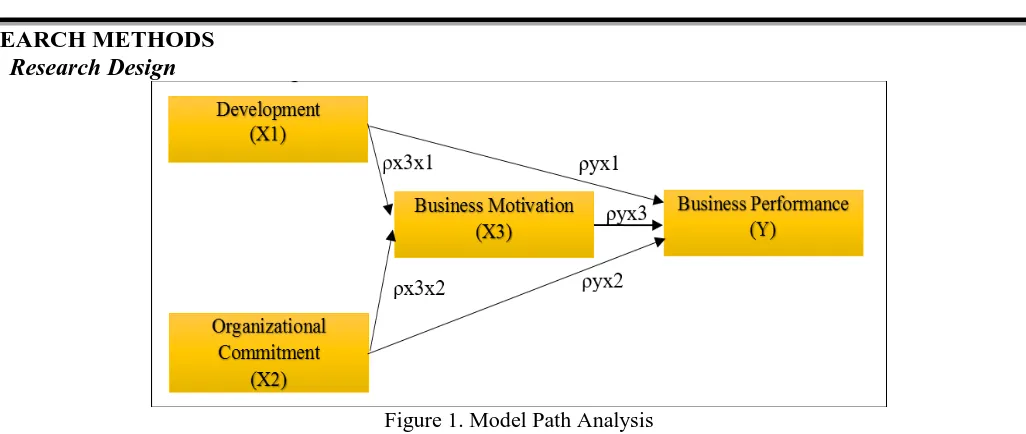
RESEARCH METHODSResearch Design
Figure 1. Model Path Analysis
Object of Research
The research was conducted on SMEs Partners CDC PT. Telkom Witel Bekasi, which is one of the states established by the government to implement the Community Development Partnership Program (CSR). The data used in this study is data from 2012 to 2015, according to the standard package runs that are for two years each period.
Population and Sample
The population in this study were all small businesses in Witel Bekasi being trained partners from 2012 to 2015. The data required in the research is a process that takes place throughout approximately two (2) years, following a standard package that runs for two years each period. Based on these criteria the importance of the total population of 479 trained partners. Seeing their characteristics, namely the population of the same profession as small businesses, it can be concluded that the study population is homogeneous.
The sample is part of the number and characteristics possessed by the population. Reasons for sampling are as follows:
1. Limitations of time, effort and cost. 2. Faster and easier.
3. Giving more information and inside. 4. It can be handled more carefully.
This study, a sampling using purposive sampling means is determined by considering the purpose of the research is based on criteria determined in advance. For samples taken in this study may represent the population, it can be determined the number of samples is calculated by using the formula Slovin (Umar, 2003:120). Based on the results obtained 83. Thus the study sample was 83 respondents.
RESULTS AND DISCUSSION
1. Influence of Organizational Development and Organizational Commitment to Business Motivation
SMEs Partners CDC PT. Telkom Witel Bekasi.
To find this out, it is necessary to use the F/ANOVA test. Based on the analysis found that the value of F-count is 47,006, while the F table is 3.12. F table is obtained by using the real level α = 5% (0.05), the degree of freedom of numerator = 2 and the degree of freedom of the denominator = 83, the values of F table = F (k; nk) = F (2; 83-2) = F (2; 81) = 3.12. Thus F-count > F-Table (47,006> 3.12), H0 is rejected and H1 is accepted at the real level. This gives the conclusion that organizational development and organizational commitment affect the business motivation of The CDC PT. Telkom Witel Bekasi PT. Telkom.
pg. 22
Pekanbaru Branch which concluded that training and organizational development simultaneously or simultaneously as well as partially positive and significant effect on the development of small businesses in small businesses Community Development Center (CDC) Partners PT. Telkom Pekanbaru Branch.2. Effect of Organizational Development on Business Motivation of SMEs Partners CDC PT. Telkom Witel Bekasi.
To test the effect of the influence of organizational development on business motivation, it is done by t-test. Based on the analysis results it is known that the results of the t-test for the organizational development variable obtained the value of t arithmetic = 9.568 and t table of 1.994. T table value is obtained by using a confidence level of 0.05, the number of samples 83, the number of variables X is 1, then the value of t table = t (∝ / 2; n-k-1) = t (0.025; 79) = 1.994. This means t arithmetic > t table (9,568> 1,994), which means H0 is rejected and H1 is accepted. Thus it can be concluded that there is a partial influence of organizational development on business motivation, where the effect is positive, it means increasing organizational development can increase business motivation.
3. Effect of Organizational Commitment on Business Motivation of SMEs Partners CDC PT. Telkom Witel Bekasi.
To test the effect of the influence of organizational commitment on business motivation, it is done by t-test. T-test results for the variable organizational commitment obtained t value = 3.122, and t table of 1.994. T table value is obtained by using a confidence level of 0.05, the number of samples 83, the number of variables X is 1, then the value of t table = t (∝/2; n-k-1) = t (0.025; 79) = 1.994. This means t arithmetic > t table (3.122> 1.994), which means H0 is rejected and H1 is accepted. Thus it can be concluded that there is a partial influence of organizational commitment on business motivation, where the effect is positive which means an increase in organizational commitment can increase business motivation.
4. Effect of Organizational Development, Organizational Commitment and Business Motivation on Business Performance of SMEs Partners CDC PT. Telkom Witel Bekasi.
To find this out, it is necessary to use the F / ANOVA test. The following is the testing of each variable. Based on the analysis found that the calculated F value was 23.572, while the F table was 2.74. F table is obtained by using the real level α = 5% (0.05), the degree of freedom of numerator =3 and the degree of freedom of the denominator = 83, then the table F value = F (k; nk) = F (3; 83-3) = F (3; 80) = 2.74. Thus F count > F table (23.572 > 2.74), H0 is rejected and H1 is accepted at the real level. This concludes that organizational development, organizational commitment, and business motivation simultaneously affect the business performance of the CDC Fostered MSME Partners. Telkom.
The above research results are in line with the results of previous research conducted by Sukwadi (2014), which concluded that job satisfaction, organizational development, and organizational commitment each had a positive effect on the performance of SME members.
5. Effect of Organizational Development and Organizational Commitment on Business Performance through Business Motivation of SMEs Partners CDC PT. Telkom Witel Bekasi.
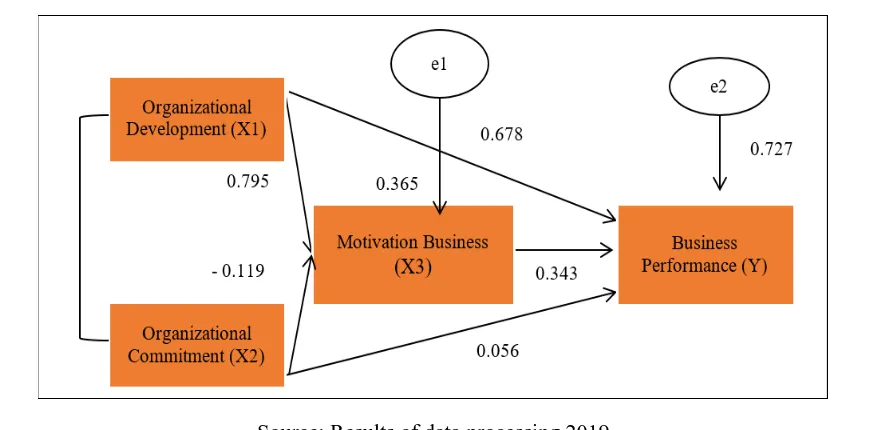
Variables Influence Development of the Business Performance through Business Motivation X1 → X3 → Y = (ρx3x1) x (ρyx3) = 0.795 x 0.343 = 0.273
The indirect effect value is obtained from the path coefficient value ρx3x1 multiplied by the value of the path coefficient ρyx3 to (0.795 x 0.343) = 0.273. The multiplication results show that the coefficient of the indirect effect {(ρx3x1) x (ρyx3)} is smaller than the value of the direct effect coefficient ρyx1, (0.273 <0.365).
This shows that the organizational development variable cannot be through the mediating variable, namely business motivation in influencing business performance, because the coefficient value without going through business motivation or directly on business performance is greater.
6. Influence Organizational Commitment to Business Performance through Business Motivation
pg. 23
The indirect effect value is obtained from the path coefficient value ρx3x2 multiplied by the value of the path coefficient ρyx3 to (0.119 x 0.343) = 0.041. The multiplication results show that the coefficient of the indirect effect {(ρx3x2) x (ρyx3)} is smaller than the value of the coefficient of influence ρyx2, (0.041 <0.056).This shows that the organizational commitment variable cannot be intervened, that is, business motivation in influencing business performance because the coefficient value without going through business motivation or directly to business performance is greater.
Total Effect
a. Influence of Organizational Development of the Business Performance through Business Motivation X1 → X3 → Y = ρyx1 + {(ρx3x1) x (ρyx3)} = 0.365 + 0.273 = 0.638
Total effect arising from the organizational development of business performance through motivation effort that is equal to 0.638.
b. Influence of Organizational Commitment to Business Performance through Business Motivation X2 → X3 → Y = ρyx2 + {(ρx3x2) x (ρyx3)} = 0.056 + 0.041 = 0.097
Total effect arising from organizational commitment to business performance through Business motivation that is equal to 0.097.
c. Influence of Development of the Business Performance X1 → Y = ρyx1 = 0,365
The total effect arising from the organizational development of business performance is equal to 0,365.
d. Influence of Organizational Commitment to Business Performance X2 → Y = ρyx2 = 0.056
Total effect arising from an organizational commitment to business performance that is equal to 0.056.
e. Influence of Business Motivation Influence on Business Performance X3 → Y = ρyx3 = 0.343
Total effect arising from the motivation of business to business performance that is equal to 0.343.
1. Residual Effect of Variable Coefficient of the Business Motivation The coefficient e1 = 0.678
2. Residual Effect of Variable Coefficient to Business Performance The coefficient e2 = 0.727
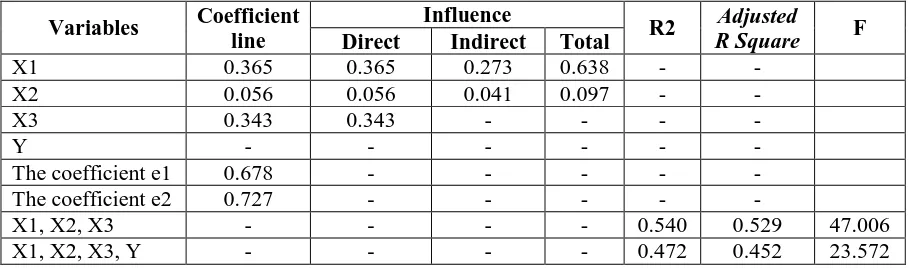
Table 1. Effect of Coefficient Line Direct, Indirect Influence, and Total Effect of Organizational Development, Organizational Commitment, Business Motivation and Business Performance of SMEs
Variables Coefficient line
Influence
R2 Adjusted
R Square F
Direct Indirect Total
X1 0.365 0.365 0.273 0.638 - -
X2 0.056 0.056 0.041 0.097 - -
X3 0.343 0.343 - - - -
Y - - - -
The coefficient e1 0.678 - - - - -
The coefficient e2 0.727 - - - - -
X1, X2, X3 - - - - 0.540 0.529 47.006
X1, X2, X3, Y - - - - 0.472 0.452 23.572
pg. 24
Path analysis of this research can be described as follows:Source: Results of data processing 2019 Figure 2. Results Path Analysis Model CONCLUSIONS AND SUGGESTIONS
Conclusion
Based on the results of research that have been conducted on the role of organizational development and organizational commitment in improving MSME business performance with business motivation as a mediating variable in the Community Development partnership program with a case study of MSME The CDC PT. Telkom Witel Bekasi, the following conclusions are obtained:
1. Organizational development has a direct positive effect on improving the performance of MSME businesses on SMEs Partners CDC PT. Telkom Witel Bekasi If the fostering is further improved, the MSME business performance will increase as well, and vice versa if the fostering provided to the Fostered Partners decreases, the MSME business performance will decrease. Organizational development has a direct role to improve business performance that will be generated by SMEs Partners CDC PT. Telkom Witel Bekasi
2. Organizational development has an indirect effect on business performance through business motivation as a mediating variable on SMEs Partners CDC PT. Telkom Witel Bekasi The indirect effect organizational development on business performance through business motivation produces a value of 0.638, while the direct effect organizational development on business performance produces a value of 0.365, which means the indirect effect is greater than the direct effect. This means that business motivation can be a mediating variable between organizational development and business performance, so business motivation needs to be considered to improve the business performance of PT. Telkom.
3. Organizational commitment has a direct positive effect on the business performance of CDC Fostered MSME Partners. Telkom, even though the value is only small. If the organizational commitment of the Fostered Partners increases, the business performance will increase as well, and vice versa if the organizational commitment of the Fostered Partners decreases, the business performance will also decrease.
pg. 25
5. Business motivation has a positive effect on the MSME business performance of The CDC PT. Telkom Witel Bekasi. If business motivation is high, the MSME business performance will increase. Vice versa, if the motivation is low, then MSME's business performance will decrease due to a lack of motivation in doing business. The influence of business motivation on MSME business performance is quite large, namely 0.343.Suggestion
Based on the results of research and observations in the field, suggestions that the author can convey in this study are as follows:
1. It is hoped that this research can add references and knowledge to as well as input or as a comparison material for other researchers conducting similar studies, or wider research.
2. It is expected that the results of this study can make a positive contribution to the CDC of PT. Telkom, in particular, Witel Bekasi involves the development of MSMEs in terms of coaching, motivation and organizational commitment to improving the business performance of PT. Telkom Witel Bekasi.
3. It is expected that PT. Telkom Witel Bekasi as the party providing capital loans as well as coaching to the Fostered Partners, can provide even more training with various aspects or materials that can support the business performance improvement of the Fostered Partners, such as product skills, business skills, and business legality.
4. PT. Telkom Witel Bekasi is expected to be more intense in monitoring the business of the Fostered Partners, through counseling activities, so that the company can play a greater role in overcoming the problems experienced by the Fostered Partner and help find a way out, which will ultimately be able to improve business performance and minimize the occurrence of bad credit.
5. The need to increase expertise or skills for CDC Fostered Partners of PT. Telkom Witel Bekasi and it is important to tie the ongoing commitment of the Fostered Partners, the need for the development of the Fostered Partners to increase business motivation and it is hoped that the CDC of PT. Telkom Witel Bekasi can provide basic capital for the Fostered Partners so that the business they are pioneering can develop properly.
References
Alhempi, Raden Rudi, Wismar Harianto. 2013, Pengaruh Pembinaan Dan Pembinaan terhadap Pengembangan
Usaha Kecil pada Program Kemitraan Bina Lingkungan, Pekanbaru.
Allen, N.J. & Meyer, J.P. 2013. The Measurement and Antecedents of Affective, Continuance and Normative Commitment to The Organization. Journal of Occupational Psychology. Vol. 63. 1-18.
Aliminsyah dan Panji. 2003. Kamus Istilah Akuntansi. Bandung: CV. Irama Widya.
Davies, Ivor K, Andri Feryanto. 2015. Pengantar Manajemen (3in1). Yogyakarta: PT. Pustaka Baru.
Dewi, Anggraeni. 2008. Pengaruh Motivasi dan Disiplin Kerja Terhadap Kinerja Karyawan pada PT. Human
Karya Wilayah Semarang. Semarang: UNNES.
Gemina, Dwi, dkk. 2016. Pengaruh Motivasi Usaha terhadap Keberhasilan Usaha dengan Kemampuan Usaha
Sebagai Variabel Mediasi pada Industri Kecil Menengah Makanan Ringan Priangan Timur-Indonesia. Bogor.
Jurnal Manajemen Teknologi Fakultas Ekonomi Universitas Djuanda Bogor, 2016 : 297-323, Vol. 15 number 3.
Griffin. 2004. Komitmen Organisasi, Terjemahan. Erlangga, Jakarta.
Handayaningrat, Soewarno. (2002). Pengantar Studi Ilmu Administrasi dan Manajemen. Jakarta: Haji Masagung.
pg. 26
Hidayat, S. 2001. Pemberdayaan Ekonomi Rakyat. Jakarta. PT. Pustaka Quantum.Keban, T. Yeremias. 2004. Enam Dimensi Strategis Administrasi Publik, Konsep, Teori dan Isu. Gaya Media. Yogyakarta.
Lamsah. 2018. Pengaruh Motivasi dan Kepuasan Kerja terhadap Kinerja UKM, At-Tadbir: Jurnal Ilmiah
Manajemen . Vol. 2 No. 2 (2018) 85-93.
Mahsun, Mohamad. 2006. Pengukuran Kinerja Sektor Publik : Cetakan Pertama. Yogyakarta : Penerbit BPFE-
Rasyid, A. S., Rahardjo., Sjafri, S. 2002. Reinterpretasi Konsep Pembinaan Masyarakat Terasing Menuju
Konsep Pemberdayaan Berorientasi Kearifan Lokal. Jurnal Penelitian Ilmu Sosial. 3 (2).
Rivai, Veithzal dan Basri. 2004. Performence Appraisal: Sistem yang Tepat untuk Menilai Kinerja Karyawan
dan Meningkatkan Daya Saing Perusahaan. Jakarta: Raja Gravindo Persada.
Robbin, Stephen P. dan Judge. 2007. Perilaku Organisasi. Jakarta: Salemba Empat.
Samsudin, Sadili. 2005. Manajemen Sumber Daya Manusia. Bandung: Pustaka Setia.
Simamora, Bilson. 2003. Penilaian Kinerja dalam Manajemen Perusahaan. Jakarta : Gramedia Pustaka.
Suci, Ni Made. 2016. Pengaruh Pembinaan Pemerintah terhadap Pertumbuhan Usaha yang Dimediasi oleh Sikap pada Pertumbuhan Usaha, Norma Subyektif dan Perceived Behavior Control Pengusaha UKM. Jurnal Ilmu
Sosial dan Humaniora. Vol. 5, No. 1, April.
Sukwadi Ronald dan Milkha Meliana. 2014, Faktor-Faktor yang Mempengaruhi Kinerja dan Turn Over Intention Anggota Usaha Kecil Menengah, Jurnal Rekayasa Sistem Industri .Vol. 3, No.1.
Thoha, Miftah, 2003, Pembinaan Organisasi : Proses Diagnosa & Intervensi. Raja Grafindo Persada. Jakarta.
Umar, Husein. 2003. Metode Riset Perilaku Organisasi. Jakarta: Gramedia.
Undang-Undang Nomor 22 Tahun 1999 tentang Otonomi Daerah.
Undang-Undang Nomor 19 Tahun 2003 tentang Badan Usaha Milik Negara.
Undang-Undang Nomor 25 Tahun 2007 tentang Penanaman Modal.
Undang-Undang Nomor 20 Tahun 2008 tentang UMKM.
Untung, Hendrik Budi, 2009. Corporate Social Responsibility. Sinar Grafika, Jakarta.