Seismic Performance of Base Isolated Buildings
with Plan Irregularity
Devi Sreenivas Ancy Mathew
M. Tech. Student Assistant Professor Department of Civil Engineering Department of Civil Engineering
Saintgits College of Engineering, Kottayam Kerala, India Saintgits College of Engineering, Kottayam Kerala, India
Abstract
Base isolation is one of the most powerful tools of earthquake resistant design. The concept behind the base isolation technique is to reduce the amount of energy transmitted to the superstructure during an earthquake and thus it has gained increasing acceptance during the last two decades. The past experiences showed that the irregular buildings are more prone to damages when compared with the regular structures. This paper presents a response spectrum analysis performed on two plan irregular r/c building with re-entrant corners using the software ETABS 2015. The main objective here is to study the seismic response control on a structure by providing isolators and comparing between the fixed based and isolated base building. The paper investigates the effectiveness of the rubber isolator against friction pendulum system for various plan irregular building. This paper studies various parameters such as total base shear force, storey acceleration, displacement and time period of a building with respect to the fixed base and isolated base. The study also compares the performance of two irregular buildings with L- shape and plus shape in plan having same area. The study concluded that the addition of isolators reduced the storey drift, acceleration and base shear values. The study indicated that the performance of the plus shaped building is better when compared to the L-shaped building.
Keywords: Base Isolation, Friction Pendulum System, Re-entrant Corners, Response Spectrum, ETABS
________________________________________________________________________________________________________
I. INTRODUCTION
Earthquake is one of the major natural hazards that can cause extensive damage to structures and property. When an earthquake occurs, large strain energy will be released which travels as seismic waves in all directions through the ground surface. Thus a structure will be set into motion laterally and vertically. The lateral motion is typically much greater than the vertical motion. The multistoried buildings must be designed for the lateral forces due to its virtue of its height as they provide large floor area in a relatively small area of land. The past experience shows that the buildings with asymmetry are more vulnerable to collapse when compared to symmetric buildings.
A lateral load resisting system is needed to resist the lateral forces acting on the buildings. A stiffer structure has a lower natural period of vibration and will respond to a given seismic event in a different manner than a more flexible structure with a larger natural period.
The conventional practice of earthquake resistant design involved the construction of moment resisting frames. Braces and shear walls. However these practices made the structures heavier. Since the ground acceleration produced during an earthquake depended on the mass of the structure, these methods had limitations. Base isolation mechanisms aims at isolating the superstructure from the foundation so that the dynamic response of the structure gets improved. This technique involves the installation of special bearings between the bottom of the building and its foundation. These bearings’, being flexible in the horizontal direction does not absorbs the vibration energy rather they deflects it through the dynamics of the system. In doing so, they lengthen the natural period of vibration of the structure so that the responses get considerably reduced. Thus the concept of base isolation has attained popularity in seismic resistant design since last decades.
II. OBJECTIVES
To analyze the seismic performance of irregular building by providing rubber bearing and friction pendulum bearing.
To illustrate the basic concept and behaviour of two plan irregular building having same plan area.
To study and compare total base shear force, storey acceleration, storey drift, lateral displacement and time period with respect to the fixed base and isolated base structure.
III. MODELLING AND ANALYSIS
different isolation techniques, namely Friction Pendulum System (FPS) and Lead Rubber Bearing (LRB) isolator was studied. Thus six different models associated with the study are as follows:
Model I: L-shaped Building with Fixed Base
Model II: L-shaped Building with FPS isolator
Model III: L-shaped Building with LRB isolator
Model IV: Plus-shaped Building with Fixed Base
Model V: Plus-shaped Building with FPS isolator
Model VI: Plus-shaped Building with LRB isolator
Building Description
Two G+6 storied buildings with typical floor height 3m was considered for the present study. The structural material was assumed to be isotropic and homogenous. The slab elements were modeled as rigid diaphragm.
Table - 1 Building Data
Column Size 500mm x 500mm
Beam Size 300mm x 500mm
Plinth Beam Size 500mm x 500 mm
Slab Thickness 150 mm
Wall Thickness 230 mm
Characteristics Strength of Concrete fck 30
Grade of Steel fy 415
Poisson’s ratio of concrete 0.15
Poisson’s ratio of masonry 0.16
Density of Concrete 25 kN/m3
The modulus of elastcity of the concrete is given by 5000(fck) 0.5. The building was assumed to be located on a medium type
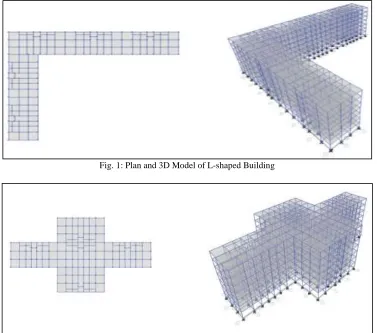
soil with zone factor 0.36. The building had an importance factor 1 and the response reduction factor was taken as 5. Response Spectrum Method of analysis was performed using design spectrum specified in I.S. 1893(Part1):2002. The loads acting on various rooms and passages were taken according to the specification given in IS 875(part 2). The plan and 3D model of the buildings are given below:
Fig. 1: Plan and 3D Model of L-shaped Building
Properties of FPS and LRB Isolators
The isolators were modelled as spring elements (point springs) in ETABS 2015 and their properties were given in Link Properties. The properties of the friction pendulum system isolator and lead rubber bearing isolator was referred from Torunbalci1 and G. Ozpalanlar octo.12-17(2008), based on which they are enlisted below in table 2 and table 3.
Table - 2
Properties of Friction Pendulum System Isolator U1 Linear Effective Stiffness 15000000 kN/m U1 Nonlinear Effective Stiffness 15000000 kN/m U2 and U3 Linear Effective Stiffness 750 kN/m
U2 and U3 Nonlinear Stiffness 15000 kN/m U2 and U3 Friction Coefficient, Slow 0.03
U2 and U3 Friction Coefficient, Fast 0.05
U2 and U3 Rate Parameter 40
U2 Radius of Sliding Surface 2.23 Table - 3
Properties of Lead Rubber Bearing Isolator U1 Linear Effective Stiffness 15000000 kN/m U2 and U3 Linear Effective Stiffness 800 kN/m
U2 and U3 Nonlinear Stiffness 2500 kN/m
U2 and U3 Yield Strength 80 kN
U2 and U3 Post Yield Stiffness Ratio 0.1
PYSR 0.1
IV. RESULTS AND DISCUSSIONS
The results of analysis conducted are discussed in detail. The parameters such as modal period, lateral displacement, storey drift, storey acceleration, and base shear were compared.
Modal Period Values of the Buildings
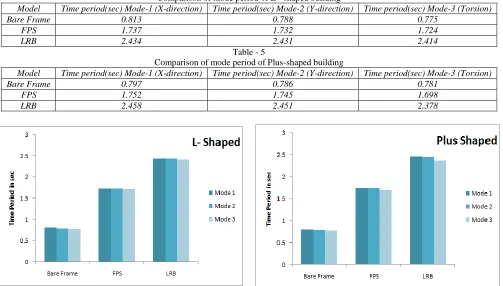
As per IS 1893: Part I, the natural period of a structure is its time period of undamped free vibration. The fundamental natural period (T1) is the first modal time period of vibration. The time period values T1, T2 and T3 for first three critical modes for the
two models are given below in table-4 and table-5.
Table - 4
Comparison of mode period of L - shaped building
Model Time period(sec) Mode-1 (X-direction) Time period(sec) Mode-2 (Y-direction) Time period(sec) Mode-3 (Torsion)
Bare Frame 0.813 0.788 0.775
FPS 1.737 1.732 1.724
LRB 2.434 2.431 2.414
Table - 5
Comparison of mode period of Plus-shaped building
Model Time period(sec) Mode-1 (X-direction) Time period(sec) Mode-2 (Y-direction) Time period(sec) Mode-3 (Torsion)
Bare Frame 0.797 0.786 0.781
FPS 1.752 1.745 1.698
LRB 2.458 2.451 2.378
Based on the values given in the above tables, graphs were plotted for the two models. It can be seen from the graphs that the period of vibration is higher for the models with base isolators. The time period of the buildings almost increased by 53 % after providing friction pendulum isolator whereas 66% increase in time period occurred in the case of buildings with LRB isolator. On comparing the two models, we can find that the plus shaped building with LRB isolator had the highest value of the time period.
Lateral Displacement of the Buildings
For all fixed base buildings, displacement increases gradually from base level to roof level. Usually the displacements of irregular buildings are found to be higher than the regular buildings. From the following Fig.4., we can find that the addition of isolators to the building increases the displacement at the base. However, the difference between the top and bottom displacement value is found to be lesser for the isolated buildings.
Fig. 4: Plot of lateral displacement in X direction v/s storey level in L-shaped and Plus shaped building
Storey Drift of the Building
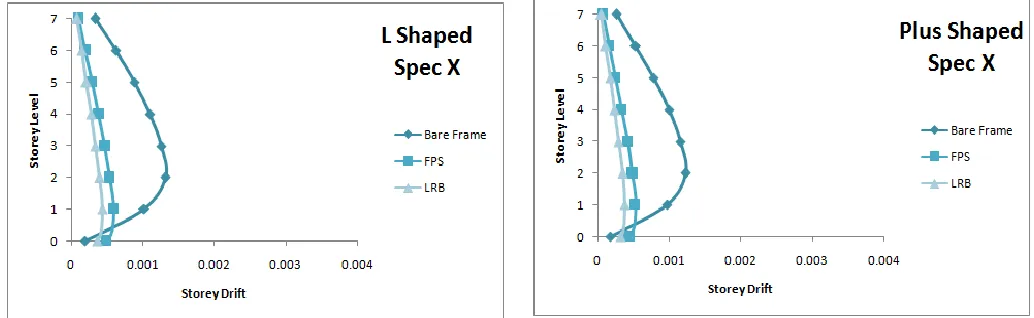
Storey drift is the relative displacement between consecutive floors produced by lateral forces. The graphical representations of variation of drift in X direction at each storey for the models under consideration are given below in Fig.5. It can be seen from the graphs that the fixed base buildings have less drift value at the base level, then gradually increases at first story level and finally reduces to very small values at top story levels. It is clear that the addition of base isolator to the building increases the drift value at the base level and then gradually decreases to a minor value at the top level which is lesser when compared to the bare frame model. It is obvious from the graphs that the building with Lead Rubber Bearing isolator has less drift value when compared to other models.
Fig. 5: Plot of storey drift in X direction v/s storey level in L-shaped and Plus shaped building
Storey Acceleration of the Buildings
Fig. 6: Plot of storey acceleration in X direction v/s storey level in L-shaped and Plus shaped building
Base Shear
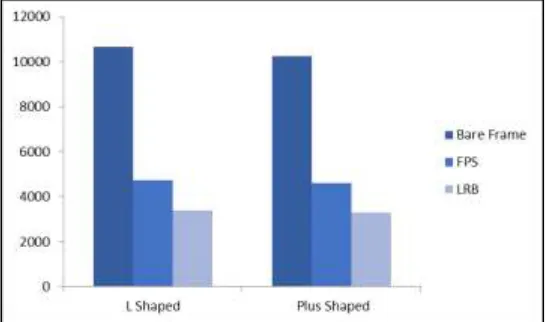
Base shear is the total design lateral force at the base of a structure. From the analysis results, the base shear value of the buildings under different isolation techniques for the two models is plotted as given in Fig.7. It was found that the base shear value decreased by 55% by the addition of the FPS isolator whereas 66% reduction in base shear value was found in the buildings with LRB isolator.
Fig. 6: Base shear value of the two models in X- direction
V. CONCLUSIONS
The important conclusions drawn from the various parametric studies are as follows:
The base isolators were found to be an excellent seismic control device for these plan irregular mid-rise buildings in controlling forced responses such as base shear, storey drift, storey acceleration and time period.
It is observed that fixed base building have zero displacement at base of building whereas the base isolated building models shows has considerable lateral displacements at base. However, it has been observed that the lateral displacements increases drastically as the floor height increases in fixed base building in contrast to that in the base isolated buildings.
The addition of the isolators decreased the value of storey drift when compared to the bare frame model. The isolated models had a greater value at its base in contrast to the bare frame model. However, the value decreased to a lesser value than in the bare frame model as the storey height increased.
The time period of the building increased by the addition of the isolators this may be due to the flexibility of the isolators.
The storey acceleration is found to decrease with the incorporation of base isolation techniques. It was found that the acceleration value got reduced by 73% in the FPS isolated building whereas there was 82% reduction in LRB isolated buildings when compared to the fixed based building.
On comparing the L- shaped and plus shaped building, the performance of the plus shaped building is found to be better which may be attributes to its symmetry in plan.
REFERENCES
[1] Anusha R Reddy, “Seismic Analysis of Base Isolated Building in RC Framed Structures”, International Journal of Civil and Structural Engineering
Research, Vol. 3, Issue 1, September 2015, pp:170-176.
[2] B.R. Anirudha, “Performance of Base Isolated Building Structures with Asymmetry in Plan”, International Journal of Engineering Research & Technology,
Vol. 4 Issue 09, September-2015.
[3] Minal Ashok Somwanshi, “Seismic Analysis of Fixed Based and Base Isolated Building Structures”, International Journal of Multidisciplinary and Current
Research , Vol.3 (July/Aug 2015).
[4] Mital N. Desai, “Comparative Study of Multi-Storey Building Different Base Isolators”, International Journal of Innovative Research in Science,
Engineering and Technology, Vol. 4, Issue 8, August 2015.
[5] Sonali Anilduke. “Comparison of building for seismic response by using base isolation”, International Journal of Research in Engineering and Technology,
Volume: 04 Issue: 06 , pp. 237-2237-241,( Jun-2015).
[6] Vindhya Bhagavan ,“Seismic performance of friction pendulum bearing by considering storey drift and lateral displacement”, International Journal of Research in Engineering and Technology,Volume: 03 Issue: 08,pp. 249-254(Aug-2014).
[7] Vinodkumar Parma, “Effect of base isolation in multistoried RC irregular building using time history analysis”, International Journal of Research in Engineering and Technology, Volume: 04 Issue: 06, pp. 289-292, (June-2015).
[8] N. Torunbalci1 and G. Ozpalanlar2” Earthquake Response Analysis of Mid –Story Buildings isolated with various Seismic Isolation Techniques” The 14th