Page 15 www.ijiras.com | Email: [email protected]
A Novice Approach To A Methodology Using Image Fusion
Algorithms For Edge Detection Of Multifocus Images
I. INTRODUCTION
Digital image processing is meant for processing digital computer. Is the use of computer program to perform image processing on digital images [3]. It is a widely used technology for digital image developed field on its own within image processing. Edge detection is mainly image segmentation technique, divides spatial domain [6], on which the image is describe, into meaningful parts or regions. Edges are significant local changes of intensity operations like feature extraction, pattern recognition, segmentation, image morphology etc [4]. Edges mainly occur on the boundary between two different regions in an image. Goal of edge detection is to create a line drawing of a scene from an image of that scene. - Important characteristics can be extracted from the edges of an image (e.g., corners, lines, curves). - These features are utilized by higher-level computer vision algorithms (e.g., recognition).
Edges may be defined as the discontinuities in image intensity from one pixel to another. Edges are very crucial characteristics and it indicates the region of higher frequency. Various edge detection techniques are present when we have a
good noise free focused image. But the problem arises in case of multifocus images; there are problems of false detection, missing edges, problems due to noise, large computational time
II. EXISTING EDGE DETECTORS
There are several edge detection operators available for image segmentation and object boundary extraction of digital images. Each operator is designed to be sensitive to certain types of edges. Among them Sobel, Prewitt, LoG, and canny is major concerning operators. The geometry of the operator determines a characteristic direction in which it is most sensitive to edges. Various existing edge detector operators are as follows:
A. SOBEL OPERATOR
The Sobel edge detector computes the gradient by using the discrete differences between rows and columns of a 3X3
Abstract: Edge detection is an initial step in many applications of image analysis. Edge detection methods transform original image into edge image benefits for the change of gray tones in the image. It is the method of segmenting images in to discontinuous regions. This paper describes a novel edge detection algorithm for multifocus images. This algorithm can be used when we try to find out the edges of some multifocus image for different applications. In this case we can apply the concept of combination of edge detection with the image fusion algorithm. It shows that proposed edge detection algorithm gives the better result for the multifocus image. In this paper we have done the comparison between the algorithm by changing the edge detector like canny operator, Sobel operator, Laplacian of Gaussian, and Prewitt operator. After simulation we have come to the conclusion that when fuse canny edge detector performs better than other algorithm. It evaluates the performance of each algorithm with MATLAB R2010a. The performance evaluation is done on the basis of MSE, PSNR and Entropy.
Keywords: Canny, Edge detection, Image fusion, MSE, PSNR, Prewitt, Sobel, LOG.
Rashmi Singh
Anamika Maurya
Rajinder Tiwari
Department of Electronics & Communication Engineering Amity University Uttar Pradesh
Page 16 www.ijiras.com | Email: [email protected] neighborhood. The Sobel operator is construct on convolving
the image with a small, separable, and integer valued filter [9].
Gx Gy
B. PREWITT OPERATOR
Prewitt operator edge detection masks are the one of the best and oldest understood approach of detecting edges in images [9] The Prewitt edge detector uses the following mask to approximate digitally the first derivatives Gx and Gy [11].
Gx Gy C. LOG OPERATOR
This detector finds edges by looking for zero crossings after filtering f(x, y) with a Laplacian of Gaussian (LoG) filter. In this approach, the Gaussian filtering is mixed with Laplacian to break down the image where the intensity varies to detect the edges effectively. It finds the suitable place of edges and testing wider area around the pixel [11].
D. CANNY OPERATOR
Canny edge detection is a multistage approach to detect a huge range of edges in images [11]. This detector finds edges by looking for local maxima of the gradient of f(x, y). The gradient is calculated using the derivative of a Gaussian filter. This approach uses two thresholds to detect strong and weak edges and includes the weak edges in the output only if they are connected to strong edges [12].
III. IMAGE FUSION
Image fusion is the amalgamation of two or more different images to form a new image by using a certain algorithm [16]
The aim of image fusion is to generate a result which describes the scene better than any single image with respect to some relevant properties [7]. Image fusion algorithm should
fulfill basic criteria that both the information source used for the fusion refers to a common underlying event.
The fused image contains higher information content of the scene of any of the individual image sources alone. Reliability and overall image detail is increased, due to the addition of analogous and complementary information [16] [5]. A. SIMPLE AVERAGE BASED IMAGE FUSION
This is a very fundamental technique of image fusion. Image fusion could be achieved by simple averaging corresponding pixels in each input image. The value of the pixel K (i, j) of both image is taken and added. This sum is divided by 2 to get the average. The mean value is assigned to the corresponding pixel of the output image is given in equation (1). This is repeated for all pixel values.
K (i, j) =(X (i, j) +Y (i, j)) /2 (1) Where X (i, j) and Y (i, j) are two input images
IV. PROPOSED ALGORITHM
Till now various edge detector are present but when we have multifocus images and we want to find the edges of those image, none of the existing edge detection techniques will be able to help us, so in this paper we try to implement a new approach towards the edge detection especially for multifocus image, we get the edges separately then we will try to fuse them using image fusion algorithm. The flow chart of the proposed step and the steps how the approach is implemented is given below.
STEP 1: We will take two images (one pair of multifocus images), although more than two images are taken into account, but for simplicity we restrict ourselves to two images one is foreground image and the other is background image.
STEP 2: Now we apply existing edge detector operators like Canny, LoG, Sobel, and Prewitt operators one at a time to get the edges of the images.
-1 -1 -1
-0 0 0
+1 +1 +1
-1 0 +1
-1 0 +1
-1 0 +1
-1 -1 -1
-0 0 0
+1 +1 +1
-1 0 +1
-1 0 +1
-1 0 +1
0 0 -1 0 0
0 -1 -2 -1 0
-1 -2 16 -2 -1
0 -1 -2 -1 0
0 0 -1 0 0
Image1 Image2
221
Edge detector operator Edge detector operator
Edges Edges
Fusion algorithm
Page 17 www.ijiras.com | Email: [email protected] STEP3: After applying edge detector our next step is to
fuse the edges together by applying simple image fusion average algorithm.
STEP4: Finally we get fused edges which are better result or outcome. It is an enhanced version of edge detector algorithm for the multifocus image.
V. EVALUATION CRITERIA A. PEAK SIGNAL TO NOISE RATIO (PSNR)[8]
PSNR calculates the peak signal-to-noise ratio, in decibels (dB), between two images. This ratio is used as a measure of quality between the original and a reconstructed image. The larger the PSNR, the better is the quality of the edges of fused image. To calculate the PSNR, we first calculate the mean squared error (MSE) using the following equation:
(2)
B. MEAN SQUARE ERROR (MSE)
Mean square error is a measure of image quality index [7]. The large value of mean square means that image is a poor quality. Mean square error between the reference image and the fused image is:
(3)
Assumptions made in the following equations are:
A - The perfect image
B - The edges of fused image to be assessed i – Pixel row index
j – Pixel column index
C. INFORMATION ENTROPY[8]
The information entropy measures the richness of information in an image. Entropy is an index to evaluate the information quantity contain in an image [21]. The entropy of the fused image F is defined as, the larger the entropy value better the fusion results.
(4)
Where p is the normalized histogram of the fused image, L is the maximum value for a pixel in the image which defines the total of grey levels.
VI. RESULT
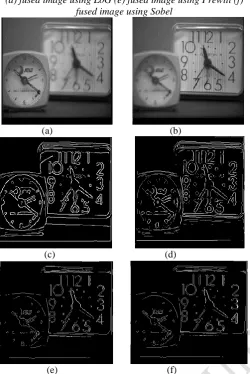
The proposed algorithm and the existing edge detection algorithm is implemented on Matlab R2012a using different pairs of multifocus image. We perform the test on a pair of nonreference based multifocus images. Proposed algorithm results are compared with each other by using existing edge detection techniques. Three well known image performance parameters for digital image have been selected to prove that performance of the proposed algorithm using canny is better than the other existing edge methods like Sobel, LoG, and Prewitt especially when it is the case of multifocus image.
Table: 6.1
Table: 6.2
(a) (b)
(c) (d)
(e) (f)
Figure 1: (a) input image with focus on right portion (b) input image with focus on left portion (c) fused image using canny S.No
Source image leaves PSNR
MSE
Entrop
y
1
Fusion
algorithm
using
Canny
operator
55.7092 .1746
.9792
2
Fusion
algorithm
using LoG operator
55.2178 .1956
.9627
3
Fusion algorithm
using Prewitt
operator
54.7509 .2170
.9198
4
Fusion
algorithm
using Sobel operator
54.7500 .2178
.9175
S.No
Source image Clock PSNR
MSE
Entrop
y
1
Fusion
algorithm
using
Canny
operator
54.6290 .2240
.9418
2
Fusion
algorithm
using LoG operator
54.4953 .2298
.9357
3
Fusion algorithm
using Prewitt
operator
54.2676
.9158
4
Fusion
algorithm
using Sobel operator
Page 18 www.ijiras.com | Email: [email protected] (d) fused image using LoG (e) fused image using Prewitt (f)
fused image using Sobel
(a) (b)
(c) (d)
(e) (f) Figure 2: (a) input image with focus on right portion (b) input
image with focus on left portion (c) fused image using canny (d) fused image using LoG (e) fused image using Prewitt (f)
fused image using Sobel
VII. CONCLUSION
The proposed algorithm considers the combination of different approaches. The main aim is to perform the edge detection on multifocus image by combining it with image fusion to enhance the quality of resulting image. In this paper we have studied and evaluate different edge detection techniques. We also proposed a better edge detection technique which is based on fusion approaches. As a conclusion, the ideal detection method doesn't exist for multifocus image. Being given an image, there exist several possible detection methods. Therefore, a good method will be that which provide the best interpretation of the resulting edges without loosing the important details but it is more difficult in case of multifocus images. Proposed Edge Detection method locates the edges better compare to other classical edge detectors but still some improvement is required.
REFERENCES
[1] Sukhdip kaur, Kamaljit kaur “Study and Implementation of ImageFusion Methods” International Journal of Electronics and Computer Science Engineering, 2010 [2] L.J. Chipman, Y.M. Orr, L.N. Graham, “Wavelets and
image fusion”, in: Proceedings of the International Conference on Image Processing, Washington, USA, 1995, pp. 248–251
[3] G. Piella, “A general framework for multiresolution image fusion: from pixels to regions,” Information Fusion, vol. 4, pp.
[4] Raman Maini and Himanshu Aggarwal, “Study and Comparison of Various Image Edge Detection Techniques”, International Journal of Image Processing (IJIP), Volume 3 pp-1-12, 2010
[5] B.Mitra, "Gaussian Based Edge Detection Methods- A Survey ". IEEE Trans. on Systems, Manand Cybernetics , 32, 2002, pp. 252-260
[6] Lau Wai Leung, Bruce King and Vijay Vohora,” Comparison of Image Fusion Techniques using Entropy and INI”, In: Pro. 22nd Asian Conference on Remote Sensing, 5-9 Nov 2001
[7] Rafael C. Gonzalez, Richard E. Woods and Steven L. Eddins, “Digital Image Processing Using MATLAB,” Pearson Education ptd. Ltd, Singapore, 3rd ed., 2005, pp.392-425.R. Nicole, “Title of paper with only first word capitalized,” J. Name Stand. Abbrev., in press.
[8] Yasuhiro Tsujimura and Mitsuo GEN, 1998. Entropy-based Genetic Algorithm for Solving TSP. In: IEEE Proceedings of the KES’98 April 21-23,2: 285-290. [9] Senthilkumaran. N & R. Rajesh (2009) “Edge Detection
Techniques for Image Segmentation –A Survey of Soft Computing Approaches”, International Journal of Recent Trends in Engineering
[10] A. Abdou and W. Pratt, “Quantitative design and evaluation of enhancement/thresholding edge detectors,” in Proceedings of theIEEE, vol. 67, no. 5, 1979, pp. 753– 766.
[11] Raman Maini and Himanshu Aggarwal, “Study and Comparison of Various Image Edge Detection Techniques”, International Journal of Image Processing (IJIP), Volume 3 pp-1-12, 2010
[12] J. Canny, "A computational approach to edge detection.", IEEE Trans. Patt. Anal. Mach. Intell., 8, 1986, pp. 679-698.
[13] Deepali A. Godse, Dattatraya S. Bormane (2011) “Wavelet based image fusion using pixel based maximum selection rule” International Journal of Engineering Science and Technology (IJEST), Vol. 3 No. 7 July 2011, ISSN: 0975-5462
[14] Lavanya, A., K. Vani, S. Sanjeevi, and R. S. Kumar, "Image fusion of the multi-sensor lunar image data using wavelet combined transformation.” In Recent Trends in Information Technology (ICRTIT), 2011 International Conference on, pp. 920-925. IEEE, 3-5 June, 2011 [15] A. Soma Sekhar, Dr. M. N.Giri Prasad. “A Novel
Page 19 www.ijiras.com | Email: [email protected] [16] Pohl, C.; Van Genderen, J.L. (1998). Multisensor image