Int. J. of Engg. Sci. & Mgmt. (IJESM), Vol. 3, Issue 2: April-June: 2013, 122-128
INTERNATIONAL JOURNAL OF ENGINEERING SCIENCES
&
MANAGEMENT
ICA BASED FACE RECOGNITION: APPLICATIONS
Meenakshi Ad*1, Prof. Prashant Jain2
*1,2
Jabalpur Engineering College (JEC),India
ABSTRACT
An amount of current face recognition procedures use face representations originate by unsupervised statistical approaches. Typically these approaches find a set of basis images and characterize faces as a linear combination of those images. Principal component analysis (PCA) is a prevalent example of such methods. The foundation images found by PCA depend only on pairwise relationships amongst pixels in the image database. In a task such as face recognition, in which imperative information may be contained in the high-order relationships among pixels, it seems reasonable to expect that better basis images may be found by methods sensitive to these high-order statistics. Independent component analysis (ICA), a generalization of PCA, is one such technique. We used a version of ICA for recognition of faces. ICA was performed on face images in the database, ICA representations were superior as compare to the representations based on PCA for recognizing faces across days and changes in expression. Results shows that a classifier that use ICA representations, gave the best performance.
Keywords: Face recognition, Independent Component Analysis, Principle Component Analysis.
INTRODUCTION
In most of these crimes, the criminals were taking advantage of a fundamental flaw in the conventional access control systems: the systems do not grant access by "who we are", but by "what we have", such as ID cards, keys, passwords, PIN numbers, or mother's maiden name. None of these means are really defining us. Rather, they merely are means to authenticate us. It goes without saying that if someone steals, duplicates, or acquires these identity means, he or she will be able to access our data or our personal property any time they want. Recently,
Corresponding Author*
Email- [email protected]
Int. J. of Engg. Sci. & Mgmt. (IJESM), Vol. 3, Issue 2: April-June: 2013, 122-128 civilian applications such as Banking,
e-Commerce, and access control.
The face is one of the most acceptable biometrics, and it has also been the most common method of recognition that human use in their visual interactions. Since the early 70's (Kelly, 1970), face recognition has drawn the attention of researchers in fields from security, psychology, and image processing, to computer vision. Numerous algorithms have been proposed for face recognition; Chellappa (1995) and Zhang (1997). Chan et al. (1998) use faces recognition techniques to browse video database to find out shots of particular people. Li et al. (1993) code the face images with a compact parameterized facial model for low-bandwidth communication applications such as videophone and teleconferencing. Recently, as the technology has matured, commercial products (such as
Miros’TrueFace (1999) and
Visionics’ FaceIt (1999)) have appeared on the market.
Face recognition algorithms try to solve the problem of both verification and identification [2]. When verification is on demand, the face recognition system is given a face image and it is given a claimed identity. The system is expected to either reject or accept the claim. On the other hand, in the identification problem, the system is trained by some images of known individuals and given a test image. It decides which individual the test image belongs to. The steps for face recognition system is given below:
• The first step for face recognition system is to acquire an image.
• Second step is face detection from the acquired image.
• Third step, face recognition that takes the face images from output of detection part.
• Final step is person identity as a result of recognition part.
A. Principle Component Analysis Principal Component Analysis, or simply PCA, is a statistical procedure concerned with elucidating the covariance structure of a set of variables. In particular it allows us to identify the principal directions in which the data varies.
PCA aims to determine a new orthogonal basis vector set that best reconstructs the face images, in other words with the smallest mean-square error for any given subspace dimensionality. These orthogonal basis vectors, also called eigenfaces, are the eigenvectors of the covariance matrix of the face images.
Principal components analysis can be defined as follows.
Consider a data matrix:
…….. (1)
Int. J. of Engg. Sci. & Mgmt. (IJESM), Vol. 3, Issue 2: April-June: 2013, 122-128 variable. We can then look for a linein this
space such that the dispersion of n points when projected onto this line is a maximum. This operation defines a derived variable of the form
…….. (2)
With coefficients satisfying the condition ∑ …….. (3)
After obtaining, consider the (p-1) subtract with dimensional subspace orthogonal to and look for the line in this subspace such that the dispersion of points when projected onto this line is a maximum. This is equivalent to seeking a line perpendicular to such that the dispersion of points when they are projected onto this line is the maximum. Having obtained consider a line in the (p-2)-dimensional subspace, which is orthogonal to both and , such that the dispersion of points when projected onto this line is as large as possible. The process can be continued, until p mutually orthogonal lines are determined. Each of these lines defines a derived variable:
…….. (4)
Where the constants are determined by the requirement that the variance of is a maximum, subject to the constraint of orthogonality as well as for each i.
The thus obtained are called Principal Components of the system and the process of obtaining them is called Principal Components Analysis.
B. Independent Component Analysis Independent component analysis (ICA) is a statistical and computational technique for revealing hidden factors that underlie sets of random variables, measurements, or signals. ICA defines a generative model for the observed multivariate data, which is typically given as a large database of samples. In the model, the data variables are
assumed to be linear mixtures of some unknown latent variables, and the mixing system is also unknown. The latent variables are assumed nongaussian and mutually independent, and they are called the independent components of the observed data. These independent components, also called sources or factors, can be found by ICA. ICA is superficially related to principal component analysis and factor analysis. ICA is a much more powerful technique, however, capable of finding the underlying factors or sources when these classic methods fail completely.
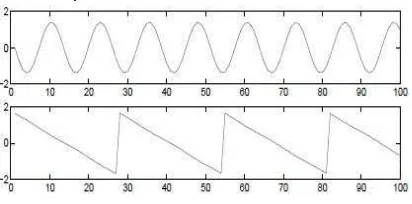
Imagine that you are in a room where two people are speaking simultaneously. You have two microphones, which you hold in different locations.
The two recorded time signals, are and, with and the amplitudes, and t the time index.Each of these recorded signals is a weighted sum ofthe speech signals emitted by the two speakers, and .Than linear equation:
…….. (5)
Int. J. of Engg. Sci. & Mgmt. (IJESM), Vol. 3, Issue 2: April-June: 2013, 122-128 Figure 3: The observed mixtures of the
source signals in Fig. 2.
We have to recover the data in Fig. 2 using only the data in Fig. 3.
One approach to solving this problem would be to use some information on the statistical properties of the signals to estimate the, . Actually, and perhaps surprisingly, it turns out that it is enough to assume that and at each time instant t, are statistically independent.
The recently developed technique of Independent Component Analysis, or ICA, can be used to detect the based on the information of their independence, which allows us to separate the two original source signals and from their mixtures and
.
Figure 4: The estimates of the original source signals, estimated using only the observed signals in Fig. 3. The original signals were very accurately
estimated, up to multiplicative signs.
Definition of ICA
Assume that we observe n linear mixtures of n independent components
. …….. (6)
We have now dropped the time index t; in the ICAmodel, we assume that each mixture as well as each independent component is a random variable, instead of a proper time signal. The observed values, e.g., the microphone signals, are then a sample of this random variable. Without loss of generality, we can assume that both the mixture variables and the independent components have zero mean: If this is not true, then the observable variables can always be centered by subtracting the sample mean, which makes the model zero-mean.
It is convenient to use vector-matrix notation instead of the sums like in the previous equation. Let us denote by x the random vector whose elements are the mixtures, and likewise by s the random vector with elements, Let us denote by A the matrix with elements ai j. Generally, bold lower case letters indicate vectors and bold upper-case letters denote matrices. All vectors are understood as column vectors; thus, or the transpose of x, is a row vector. Using this vector-matrix notation, the above mixing model is written as
…….. (7)
Sometimes we need the columns of matrix A; denoting them by the model can also be written as
∑ …….. (8)
The statistical model in Eq. 7 is called independent component analysis, or ICA model.
PROPOSED METHODOLOGY Feature extraction using ICA
Int. J. of Engg. Sci. & Mgmt. (IJESM), Vol. 3, Issue 2: April-June: 2013, 122-128 i-th feature of the recognized object
represented by the observed pattern vector x. The feature pattern can be formed from m independent components of the observed data pattern. The use of ICA for feature extraction is partly motivated by results in neurosciences, revealing that the similar principle of pattern dimensionality can be found in the early processing of sensory data by the brain.
In order to form the ICA patterns we propose the following procedure:
1. Extraction of element feature patterns xf from the recognition objects. Composing the original data set containing N cases { }. The feature patterns are representedby matrix and corresponding categorical classes are represented by column c.
2. Heuristic reduction of feature patterns from the matrix into element reduced feature patterns (with resulting patterns, ). This step could be directly possible for example for features computed as singular values of image matrices. 3. Pattern forming through ICA of
reduced feature patterns from the data set, .
• Whitening of the data set including reduced feature patterns of dimensionality into element whitened patterns xrfw (projected reduced feature patterns into
principal directions).
• Reduction of the whitened patterns into first element reduced whitened patterns through projection of reduced feature patterns into first principal directions of data.
4. Computing the unmixing matrix W and computing reduced number of independent components for each pattern obtained from whitening using ICA (projection patterns into independent component space).
5. Forming element reduced ICA patterns from corresponding independent components of whitened patterns, with the resulting data set, forming a data set containing pattern matrix Xicar and original class column c.
6. Providing rough sets based processing of the set containing ICA patterns . Discretizing pattern elements and finding relative reducts from set . Choosing one relevant relative reduct.
Selecting the elements of patterns corresponding to chosen reduct and forming the final pattern . Composing the final data set containing discrete final patterns and class column. Composing the real valued data set from the set choosing elements of real- valued pattern using selected relative reduct.
EXPERIMENTAL RESULTS
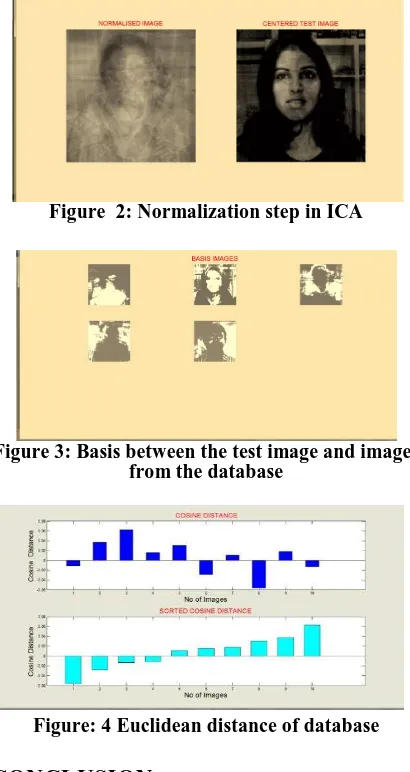
Int. J. of Engg. Sci. & Mgmt. (IJESM), Vol. 3, Issue 2: April-June: 2013, 122-128 Figure 2: Normalization step in ICA
Figure 3: Basis between the test image and images from the database
Figure: 4 Euclidean distance of database
CONCLUSION
ICA is implemented to maximise information transmission in the occurrence of noise, so it is more robust to variations such as lighting conditions, changes in hair, make-up, and facial expression, which are considered as the forms of noise with respect to the main source of information in our face database: the person’s identity. The PCA was found to be better in case of angular variations. We use PCA for pre-processing.
REFERENCES
[1] Oxford English Dictionary. Oxford Edition, 2004.
[2] S.A. Rizvi, P.J. Phillips, and H. Moon, “A verification protocol and
statistical performance analysis for face recognition algorithms”, pp. 833-838, IEEE Proc. Conf. Computer Vision and Pattern Recognition (CVPR), Santa Barbara, June 1998.
[3] Shen Maodong Cao Jiangtao ,Li Ping “Independent component analysis for face recognition based on two dimension symmetrical image matrix” IEEE, 23-25may 2012 [4] Kailash J. Sanjay N. Talbar Face
rcognition under variation of pose and illumination using ICAICGST-GVIP, ISSN 1687-398X,Volum (8)December 2008
[5] W. ZHAO, R. CHELLAPPA, P. J. PHILLIPS, A. ROSENFELD, “Face Recognition: A Literature Survey”, ACM Computing Surveys, Vol. 35, No. 4, December 2003 [6] Baek, B.A. Draper, J.R. Beveridge,
K. She, PCA vs ICA: A comparison on the FERET data set, presented at Joint Conference on Information Sciences, Durham, NC, 2002. [7] M.S. Bartlett, J.R. Movellan, T.J.
Sejnowski, Face recognition by independent component analysis, IEEE Transaction on Neural Networks 13 (2002) 1450–1464. [8] H. Moon, J. Phillips, Analysis of
PCA-based face recognition algorithm in: K. Boyer,
J. Phillips (Eds.), Empirical Evaluation Techniques in Computer Vision, IEEE Computer Society Press, Los Alamitos, CA, 1998. [9] H.K. Ekenel, B. Sankur “Feature
selection in the independent component subspace for face recognition”,Elsevier, 2004.
Int. J. of Engg. Sci. & Mgmt. (IJESM), Vol. 3, Issue 2: April-June: 2013, 122-128 Panoramic Research Inc., Tech. Rep.
PRI15, Palo Alto, CA, 1964.
[11] A. J. Goldstein, L. D. Harmon, and A. B. Lesk, “Identification of Human Faces,” Proc. IEEE, May 1971, Vol. 59, No. 5, 748-760.
[12] T. Kanade, “Computer Recognition of Human Faces.” Basel and Stuttgart Birkhauser, 1977. [13] M. Kirby, L. Sirovich,
“Application of the Karhunen-Loeve Procedure for the Characterization of Human Faces”, IEEE Transactions on Pattern Analysis and Machine Intelligence, vol. 12, No. 1, pp. 103-108, January 1990.