Fair Gain Based Dynamic Channel Allocation
for Cognitive Radios in Wireless Mesh
Networks
Jianjun Yang
a, Bryson Payne
a, Markus Hitz
a, Yanping Zhang
b, Ping Guo
c, Le Li
d a Department of Computer Science, University of North Georgia, Georgia,USA, 30597Email:{jianjun.yang, bryson.payne, markus.hitz}@ung.edu b Department of Computer Science, Gonzaga University,
Spokane, Washington, USA, 99258 Email: [email protected] c Department of Computer Science, University of Wyoming,
Laramie, Wyoming, USA, 82071 Email: [email protected]
d David R. Cheriton School of Computer Science, University of Waterloo,
Canada, N2L3G1 Email: [email protected]
Abstract—Wireless mesh networks have the potential to deliver Internet broadband access, wireless local area network coverage and network connectivity at low costs. The capacity of a wireless mesh network is improved by equipping mesh nodes with multi-radios tuned to non-overlapping channels. By letting these nodes utilize the available channels opportunistically, we increase the utilization of the available bandwidths in the channel space. The essential problem is how to allocate the channels to these multi-radio nodes, especially when they are heterogeneous with diverse transmission types and bandwidths. Most of current work has been based on the objective to achieve maximal total bandwidths. In this paper, we propose a new bipartite-graph based model and design channel allocation algorithms that maximize the minimal channel gain to achieve relative fairness. Our model maps heterogeneous network environment to a weighted graph. We then use augmenting path to update channel allocation status and use canonical form to compare the new status with previous status to achieve better fairness. Evaluations demonstrate that our algorithms improve fairness compared with related algorithms.
Index Terms—Dynamic Spectrum Allocation, Cognitive Radio, Mesh Networks
I. INTRODUCTION
R
ECENT advances in communication technologies and portable computing devices have resulted in the rapid development of wireless network systems. In wireless networks, devices(nodes) are equipped with wire-less interfaces and remain connected to the network through wireless links. The critical issue is to provide high bandwidth for nodes to communicate with each other. A wireless mesh network(WMN) is a communication network made up of nodes organized in a mesh topology [1]. WMNs are capable of connecting diverse network nodes such as desktops, laptops, iPads, and smart phones. Heterogeneous networks, e. g., static ad hoc networks, mobile ad hoc networks, and sensor networks, are able to gather together into a WMN network. WMNs have manyManuscript received January 10, 2014; revised March 20, 2014; accepted April 11, 2014. c⃝2014 IEEE.
This work was supported in part by the Presidential Professional Engagement Award in the University of North Georgia.
advantages such as low cost, easy network maintenance, robustness, and reliable service coverage. WMNs have inspired numerous applications due to their advantages over other wireless technologies. A typical wireless mesh network consists of mesh routers and mesh clients [1]. Networks, such as WiFi, 802.15, 802.16 and sensor net-works, are integrated into mesh networks through gate-ways and mesh routers. Mesh clients, either stationary or mobile, can link together, either by themselves or through connections with mesh routers.
WMNs are anticipated to significantly improve the per-formance of ad hoc networks, wireless local area networks (WLANs), wireless personal area networks (WPANs), and wireless metropolitan area networks (WMANs) [1]. Recent contributions on motion and mobile applications [36] [27] [39] [45] significantly extended various devices to WMNs. An important measurement for the quality of connections in wireless networks is capacity (bandwidth). It is well-known that wireless interference severely limits network capacity in multi-hop settings [2] [54] [37]. Traditionally, a WMN node was equipped with one IEEE radio with one channel. As a result, this single-radio mesh network only provides limited capacity for clients. Fortu-nately, the physical features of current IEEE radios make it possible for one node to be equipped with multiple network interfaces [3]. Recent research of computer hard-ware significantly improved the physical characteristics of radios [31] [23] [14]. Therefore, the nodes simultaneously use multiple radios over non-overlapping channels to increase the overall capacity of a wireless mesh network. For example, a mesh node with two interface cards is able to be assigned one 802.11a channel with 5.18G frequency and one 802.11b channel with 2.4G frequency allowing this node to communicate with two other nodes over two different channels simultaneously, thus increasing the overall capacity of the network.
within their transmission range at the same time [5] [6]. Static channel allocation algorithms allocate fixed channel slices to each user. This strategy prevents interference, but results in poor utilization and channel holes [7]. To solve the problem, various dynamic assignment solutions have been proposed to allocate channels among heterogeneous users with diverse transmission types and bandwidths. The users sense their available channels and utilize them opportunistically. This becomes possible because lower layer technical innovations equip nodes in wireless mesh networks with multiple radios and enable them to access different channels at different locations and time [8] [9] [10] [50] [43] [51].
Scholars have conducted related research [11] [12] [13] [16] [25] based on the objective of achieving maximal total channel utilization. That is, they are focused on maximizing the total channel bandwidths in the channel pool. In many scenarios, although the total bandwidths of assigned channels is maximal, some nodes are assigned very low bandwidth or even starving. Hence the capability of the whole system goes down.
A fairness based dynamic channel allocation algorithm is proposed in this paper. Our algorithm maximizes the minimal assigned channel bandwidth of the nodes and consequently results in the least starvation. We use a bipartite-graph based model to represent availabilities of channels and nodes. And then we use augmenting path and canonical form to find the better matching in the model. The rest of this paper is organized as follows. After reviewing related work in Section II, we describe the problem formulation in Section III. We then present our channel assignment mechanism in Section IV and per-formance evaluation in Section V. Section VI concludes the paper.
II. RELATEDWORK
Recent computer hardware and physical layer have significantly improved the characteristics of network de-vices and IEEE radios. Shen el at. developed smart grid and renewable energy power stations, which dramatically saved the power of mesh devices [24] [52] [22] [53]. X. Zhang et al. proposed grid model that significantly boost the reliability of hardware and devices. [26] [38] [28]. In addition, intelligence makes the radios cognitive [21] [30] [33] [34] [47] [35]. Moreover, Kunjie et al. significantly contributed to the performance modeling technique [15] [29] [44] [42]. They all provided solid foundation for wireless mesh networks.
The traditional assignment mechanism is to frequently change the channel on the interface [17]. For instance, each packet transmission is based on the current state of the medium. Such a dynamic channel assignment approach requires channel switching at a very fast time scale. The fast channel switching requirement makes the approach unsuitable for user with commodity hardware. Other dynamic channel assignment approaches require specialized MAC protocols or extensions of the MAC layer, making them unsuitable for commodity 802.11, or other wireless network hardware. To use multiple channels with commodity hardware electively, statical channel allocations are investigated in [1] [19]. Such static assignments are not changed when the network scenario changes.
Most dynamic channel allocation mechanisms use heuristic algorithms or graph theory [40] [20] to achieve the goal of increasing total bandwidth utilization. Zheng and Peng [13] proposed a greedy algorithm for dynamic channel allocation. In each step, the algorithm picks the vertex with the highest bandwidth and assigns the channel to its associated user. Then, it cuts the edges that interfere with this user. It repeats these two steps until all the channels are allocated. This algorithm reaches near-optimal total bandwidth utilization without considering any other constraints. But the algorithm may cause low assignment or even starvation for some nodes.
Marina and Das [12] proposed a centralized greedy heuristic algorithm called CLICA for channel allocation. They use degrees of nodes as a guide in determining the order of assignment. Each node is associated with a priority. The model feeds the node with the highest priority and all its adjacent nodes and then update the graph until all the nodes are fed. This algorithm achieves minimal interference and minimal starvation. However, it fails to consider the total bandwidths acquired by each node.
Yang and Fei [37] proposed an algorithm to maxi-mize the total bandwidths of channel allocation for mesh networks. Their approach achieves the maximal total bandwidths. The data structure to save wireless nodes and channels is bipartite graph. It is a novel data structure. In this paper, we use the same data structure to save wireless nodes and channels, but we develop a different algorithm with the objective on maximizing fairness.
Also related is Bhaskaran Raman’s work on channel allocation [5]. The paper uses bipartite graph to represent the traffic fraction between a pair of nodes. The traffic fraction from a given node to another is defined as f, and then the traffic fraction in the opposite direction is 1 - f. The objective of the algorithm is to minimize the mismatch, that is, to minimize the difference between the desired match fraction DF and the achieved fraction AF. This method achieves maximal total channel bandwidths but omits the minimal bandwidth among the nodes.
III. PROBLEMFORMULATION
Mesh networks contain relatively stationary devices such as routers, and mobile devices, such as the mesh clients including smart phones, iPads, laptops and PDAs [6] [37]. Fig.1 gives an example of the topology of a wireless mesh network, in which the mesh routers are equipped with multiple IEEE 802 family radios. The routers need not be equipped with the same number of radios nor do they need to use identical types of radios. The types of the radios and the number of channels depend on the number and physical parameters of their interfaces. At least one router in the mesh is designated as the Channel Assignment Server(CAS), which performs channel allocation. The dotted lines in Fig. 1 illustrate that there could be multiple possible channels assigned to a node.
00 00 00 00 00 00 00 00 11 11 11 11 11 11 11 11 000000 000000 000000 000000 000000 000000 111111 111111 111111 111111 111111 111111 000 000 000 000 111 111 111 111 00000000 00000000 00000000 00000000 11111111 11111111 11111111 11111111 00 00 00 00 00 00 11 11 11 11 11 11 000 000 111 111 00 00 00 00 00 11 11 11 11 11 00 00 00 11 11 11 00 00 00 11 11 11 000 000 000 000 000 000 000 000 000 111 111 111 111 111 111 111 111 111 0 0 0 0 0 0 1 1 1 1 1 1 0 0 0 0 1 1 1 1 0 0 1 1 0000 0000 0000 0000 0000 0000 0000 0000 0000 1111 1111 1111 1111 1111 1111 1111 1111 1111 0 0 0 0 0 1 1 1 1 1 00 00 11 11 00000 00000 00000 00000 00000 00000 11111 11111 11111 11111 11111 11111 000 000 000 000 000 000 000 000 000 000 000 000 111 111 111 111 111 111 111 111 111 111 111 111 0 0 0 0 0 0 0 0 1 1 1 1 1 1 1 1 00 00 00 00 00 11 11 11 11 11 0 0 0 0 0 0 0 0 1 1 1 1 1 1 1 1 000 000 000 000 111 111 111 111 000 000 111 111 000 000 000 111 111 111 000 000 000 000 000 000 000 111 111 111 111 111 111 111 00 00 00 00 00 00 11 11 11 11 11 11 000 000 000 111 111 111 000 000 000 111 111 111 00 00 00 11 11 11 Mesh Router Mesh Client
CAS
Fig. 1. An example of topology of a wireless mesh network.
channels. In order to achieve fairness, the objective of our assignment strategy is: the minimal gain among the nodes is maximal. The gain of a node is defined as the total bandwidths of channels allocated to the node.
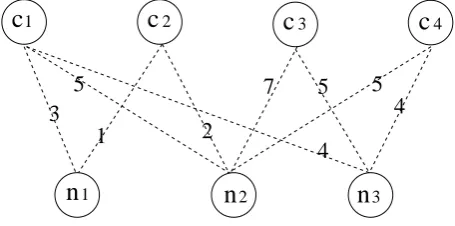
A Bipartite graph [5] is used to model the conflicts and available channels for nodes in this paper. In our model, the vertex set is composed of elements from two subsets, channel setCand node setN.V =C∪N andC∩N =∅. Edgee∈Eis in the form of(c, n)wherec∈Candn∈ N. Edge e= (c, n)means that channel c is available to noden. For each vertex noden∈N, there is at least one edge connecting it. Otherwise, we can remove the node from the graph. The same rule holds for channel vertices. We further define a weight function W :E−→R+ over the edge setE. The weightW(e)of edgee= (c, n)∈E is the bandwidth if channelc is assigned to noden.
Figure 2 illustrates a state of the availability and conflict of channels for nodes. For example,c1is possible forn1,
n2 and n3. The bandwidths are 3,5 and 4 respectively.
However, only one of those is available in the allocation result. Otherwise, there is a conflict among the nodes.
c
c
n
n
c
1 22 3 3
1
3
5
2
7
5
4
4
5
4c
n
1Fig. 2. A bipartite graph to represent availabilities of channels to nodes
Figure 3 shows a possible channel assignment result, in whichn1,n2 andn3 have gains 4,5 and 5. The channel
assignment problem is to find a subgraph G′ = (V, E′), whereE′⊆E(E′ is an assignment result), such that the minimal gain among the nodes is maximal. In this paper, dashed lines show the possibility of channels to nodes. Solid lines show channel assignments.
IV. CHANNELALLOCATIONALGORITHMS
In this section, we propose the algorithms to solve the channel assignment problem.
c
2c
3n
1c
1n
3n
2 5 5 1 3 4c
Fig. 3. A possible channel assignment result
A. Augmenting Path
For a given Bipartite graph G = (V, E), a matching M is a subset of E such that any two edges in M are disjoint. The result of channel allocation is an M over G. The vertices adjacent to the edges in M are said to be matched. Based on current matching M, we use the augmenting path approach to find a larger matching M′. If P is a path connecting two unmatched vertices in G and the edges belonging to M and not belonging to M appear in P alternately, then P is an augmenting path based onM [37]. The augmenting path fromvitovj has three characteristics:
1) The number of hops in an augmenting path from vi tovj is an odd number.
2) Neithervi norvj belongs to M.
3) A larger matchingM′ can be obtained byM and an augmenting path P based on M. Let M′ = M⊕P. That is, the larger matchingM′ includes the edges that either belong to M or belong toP but do not belong to bothM andP.
The ⊕ operation is critical in our approach because a channel is only assigned to one node. This ⊕ operation avoids multiple assignments. Larger matchings can be defined in various ways, depending on the objectives, such as larger cardinality, larger total weights, larger number of nodes, etc. In our approach, larger matching means the matching with larger minimal gain of the nodes. We use algorithm F indAugP ath(G, M)to find an augmenting path in G based on current matching M. We then use M ⊕ P to get larger matching. We assume that the channels arec1,c2,c3,..., and the nodes aren1,n2,n3,...,.
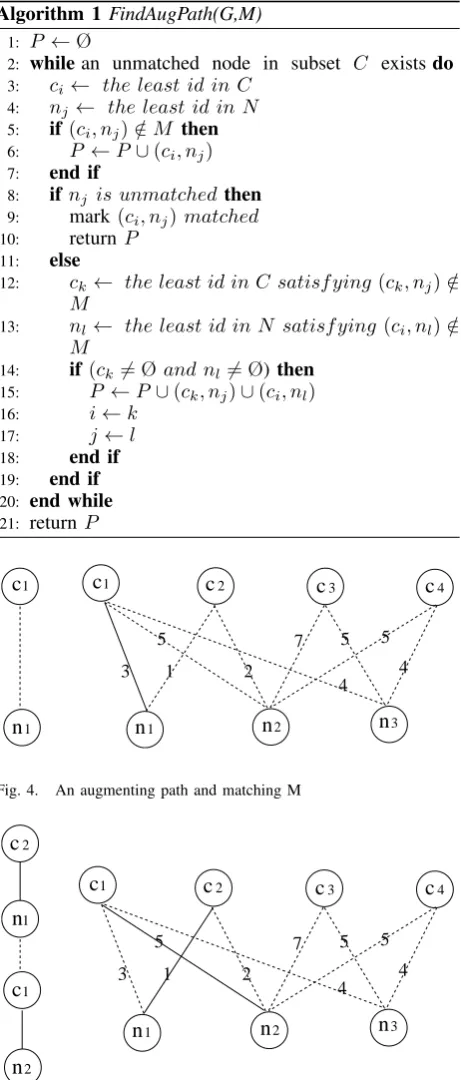
Algorithm 1 finds an augmenting path P in G based on current matching M. The algorithm begins from an unmatched node with least id in C, and try to find an augmenting path with the unmatched node with least id in N. The processing is continued to find an aug-menting path. When an augaug-menting path is found, by M′ = M ⊕P, a larger matching M′ is achieved. For example, in Fig 2, the algorithm selects (c1, n1) as the
augmenting path, then the matching M contains(c1, n1)
as shown in Fig 4. Based on thisM,c2 is the least id in
C satisfying(c2, n1)∈/ M(unmatched).n2 is the least id
inN satisfying(c1, n2)∈/M. Then the next augmenting
path is (c2, n1),(n1, c1),(c1, n2). By M =M ⊕P, the
newM will be(c2, n1)and(c1, n2)in Fig 5.
B. Canonical Form
Algorithm 1 FindAugPath(G,M)
1: P ←Ø
2: whilean unmatched node in subset C existsdo
3: ci← the least id in C
4: nj← the least id in N
5: if(ci, nj)∈/M then
6: P←P∪(ci, nj)
7: end if
8: ifnj is unmatchedthen
9: mark(ci, nj)matched
10: returnP
11: else
12: ck ← the least id in C satisfying (ck, nj)∈/ M
13: nl← the least id in N satisfying (ci, nl)∈/ M
14: if(ck ̸= Øand nl̸= Ø) then
15: P←P∪(ck, nj)∪(ci, nl)
16: i←k 17: j←l
18: end if
19: end if
20: end while
21: returnP
c
41
c
2
n
4 3
5
n
5 5 7
4 1 2
2
c
3n
3c
1
1
c
1
n
Fig. 4. An augmenting path and matching M
c
41
c
2
n
4 3
5 7 5 5
4
1 2
2
c
3n
3c
1
n
12
n
n
1 2
c
c
Fig. 5. Another augmenting path and larger matching M
the total bandwidths of the channels assigned to the node. The vector of gains is defined as the gains of all nodes, such as <4,5,5>in figure 3.
To compare relative fairness between allocations, we define an ordering over gain vectors. It is difficult to compare two vectors if their elements are not ordered. Our idea is that for each vector, we define a canonical form [18] in which the elements are ordered.
Def 1: The canonical form of vector F is denoted as C(F). If F =< v1, v2, ..., vn >, then
Algorithm 2 MaxFairnessMatching(G)
1: GainvectorF ←<0,0, ...,0> 2: M ←Ø
3: whileunmatched channel node existsdo
4: P ←F indAugP ath(G, M) 5: M =M⊕P
6: Compute‘F′ based on M 7: ifF ≺F′ then
8: F ←F′
9: end if
10: end while
11: returnM
C(F) =< u1, u2, ..., un >, where u1, u2, ..., un is a permutation of v1, v2, ..., vn , and ui ≤ ui+1 for all
1≤i≤n−1.
Def 2: An ordering ≺over canonical forms.
< s1, s2, ..., sn >≺< t1, t2, ..., tn > iff there exists an i(1 ≤i ≤n) such that si < ti, and for all 1 ≤j < i, sj=tj.
Def 3: Two vectorsF1≺F2 iffC(F1)≺C(F2).
The goal ofmax−minfair allocation is to maximize the minimal fairness values in the gain vector. With the ordering defined, the optimal solution is the one that maxi-mizesF over the ordering≺. We use the augmenting path approach to find a larger matching based on the current matching. The larger matching is neither the matching with more matched edges, nor the matching with larger total assigned bandwidths, but the larger gain vector over ≺. Algorithm 2 achieves fairness channel allocation. The input of the algorithm is a bipartite graph withmchannels and n nodes. The output is an allocation(matching) of max−min gain over the nodes.
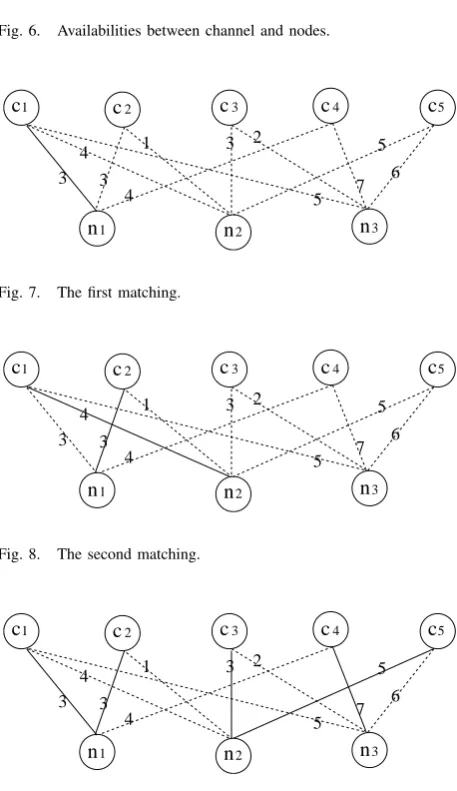
In the algorithm, while there exists an unmatched chan-nel node, the allocation is continued. If the gain vector based on a new matching is larger over canonical form, we update the matching status to the new matching. The processing is repeated until the maximal fairness matching is achieved. Fig 6 shows availabilities between channel and nodes. In the algorithm,(c1, n1)is selected as an
aug-menting path first. The matching is (c1, n1) then(Fig 7).
The gains of n1,n2 andn3 are 3,0, and 0. So the gain
vector is<0,0,3>in canonical form. Then the algorith-m chooses (c2, n1),(n1, c1) and (c1, n2) as augmenting
pathP. ByM ⊕P, we get a new matchingM:(c2, n1)
and(c1, n2)(Fig 8). The gain vector is<0,3,4>. Since
<0,0,3 >≺<0,3,4 >, the gain vector is updated to < 0,3,4 >. Then based on this M, the algorithm finds an augmenting path (c3, n2),(n2, c1) and (c1, n3). By
M⊕P, we get a new matching M:(c1, n3),(c2, n1)and
(c3, n2). The gain vector is<3,3,5>. Since<0,3,4>
Since there are a lot of intermediated steps, we ignore portion of them. By the algorithms proposed in this paper, the matching is:(c1, n1),(c2, n1),(c3, n2),(c4, n3)
and (c5, n2)(Fig 9).The gain vector is < 6,7,8 >. The
algorithm maximizes minimal gain. Hence starvation is avoided.
c1 c2 c3 c4 c5
n n2 n3
3 3
3 1
4
5 2
4 7
6 5
1
Fig. 6. Availabilities between channel and nodes.
c1 c2 c3 c4 c5
n n2 n3
3 3
3 1
4
5 2
4 7
6 5
1
Fig. 7. The first matching.
c1 c2 c3 c4 c5
n n2 n3
3 3
3 1
4
5 2
4 7
6 5
1
Fig. 8. The second matching.
c1 c2 c3 c4 c5
n n2 n3
3 3
3 1
4
5 2
4 7
6 5
1
Fig. 9. Final max-min matching.
We assume that the vertex number is |V| and the edge number is |E| in all algorithms. The objective of algorithm 1 is to find the augmenting path. The time complexity is O(|V| ∗ |E|) to find the augmenting path [37] [41]. Algorithm 2 is to find the maximal fairnes matching satisfying that each node is assigned at most one channel. This algorithm needsO(|V|)iterations. And algorithm 1 is called in each iteration. Since the time complexity of algorithm 1 isO(|V|∗|E|), the complexity of Algorithm 2 is O(|V|2∗ |E|). This algorithm will be
repeated at mostO(|E|)times. Hence the time complexity ofMaxF airnessMatchingalgorithm isO(|V|2∗|E|2).
The Channel Assignment Server(CAS) periodically checks the topology change of the network and calls the algorithms upon the changing of the top.
V. PERFORMANCEEVALUATION
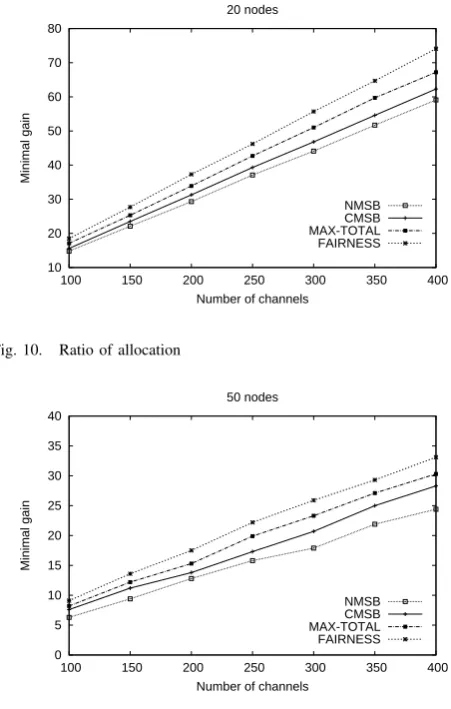
The performance evaluation was conducted in a sim-ulated noiseless radio network environment, where the nodes are distributed in a given area and each may have a different transmission range and bandwidth. We are focused on the comparison of fairness between our results and the outputs generated by other allocation approaches. We map this network to a weight graph G = (V, E), where the weight represents the bandwidth. We test both a sparse and a relatively dense network scenario; the numbers of nodes are 20 and 50 respectively. In each case, we let the number of channels vary from 100 to 400 with increments of 50. We set the bandwidths of channel distributed from 1 to 9. The channels in a network are arbitrarily available to the nodes. For the sparse network with 20 nodes, we randomly generate 10 graphs and conduct the experiment 10 times based on the graphs. We get the fairness value of each graph and then calculate the average value. For the relatively dense network with 50 nodes, we do the same experimentation.
The metric to evaluate the performance is the maximal minimal gain among the nodes. We compare our solution with three other approaches. The first one is NMSB (Non-collaborative-Max-Sum-Bandwidth). In each step, this ap-proach picks the vertex with the highest bandwidth and as-signs it to its associated user. Then the algorithm removes the edges that interfere with this user until all the channels are allocated. The second one is CMSB (Collaborative-Max-Sum-Bandwidth). This approach picks up the vertex with the highest label, defined as the bandwidth of a channel divided by the number of users interfering with each other with regard to this channel. The process is repeated until all channels have been allocated. The third approach is MAX-TOTAL, which tries to allocate the channels with larger weights to users and avoid starvation the same time.
In Fig. 10, we evaluate the fairness of these approaches based on 20 nodes. The results show that the minimal gain generated by our approach(FAIRNESS) is higher than other approaches. It is about 10% higher than MAX-TOTAL, 15% higher than CMSB and 18% higher than NMSB.
In Fig. 11, our evaluation is based on 50 nodes. The results indicate that the minimal gain generated by our approach(FAIRNESS) is higher than other approaches. It is about 10% higher than MAX-TOTAL, 15% higher than CMSB and 19% higher than NMSB.
VI. CONCLUSION
10 20 30 40 50 60 70 80
100 150 200 250 300 350 400
Minimal gain
Number of channels 20 nodes
NMSB CMSB MAX-TOTAL FAIRNESS
Fig. 10. Ratio of allocation
0 5 10 15 20 25 30 35 40
100 150 200 250 300 350 400
Minimal gain
Number of channels 50 nodes
NMSB CMSB MAX-TOTAL FAIRNESS
Fig. 11. Total bandwidth of allocated channels
and significantly improved fairness compared with related algorithms in dynamic channel allocation environment. Simulations demonstrate that our approach results in significant performance benefits over related approaches.
REFERENCES
[1] A. Adya,A Multi- Radio Unification Protocol for IEEE 802.11 Wireless Networks, Broadnets, San Jose, California, USA, Octo-ber 2004.
[2] I.F. Akyildiz and X. Wang,A Survey on Wireless Mesh Networks, IEEE Communications Magazine,2005.
[3] K. N. Ramachandran, E. M. Belding, K. C. Almeroth, and M. M. Buddhikot,Interference-Aware Channel Assignment in Multi-Radio Wireless Mesh Networks, IEEE Infocom, 2006.
[4] J. Yang and Z. Fei,HDAR: Hole detection and adaptive geo-graphic routing for ad hoc networks, Computer Communications and Networks (ICCCN), Proceedings of 19th International Con-ference. IEEE, 2010.
[5] B. Raman,Channel Allocation in 802.11-based Mesh Networks, IEEE Infocom 2006, Barcelona, Spain.
[6] K. Ramachandran, Interference-Aware Channel Assignment in Multi-Radio Wireless Mesh Networks, IEEE Infocom 2006, Barcelona, Spain.
[7] S. Haykin,Cognitive Radio: Brain-Empowered Wireless Commu-nications, IEEE Journal on Selected Areas in Communication-s,February, Vol.23, No.02. 2005.
[8] D. Grandblaise,Dynamic Spectrum Allocation (DSA) and Recon-figurability, SDR Forum Technical, 2002
[9] B. Ko,Distributed Channel Assignment in Multi-Radio 802.11 Mesh Networks, Columbia University Technical Report, 2006
[10] P. Kyasanur and N.H. Vaidya,Routing and Interface Assignment in Multi-Channel Multi-Interface Wireless Networks, UIUC Tech-nical Report, 2004
[11] L. Cao and H. Zheng,Distributed Spectrum Allocation via Local Bargaining, Sensor and Ad Hoc Communications and Networks, 2005.
[12] M. Marina and S. Das,A Topology Control Approach for Utiliz-ing Multiple Channels in Multi-Radio Wireless Mesh Networks, Broadnets 2005 Symposium, Boston, MA, 2005.
[13] H.Zheng, and C.Peng,Collaboration and fairness in opportunistic spectrum access, IEEE Journal on Selected Areas in Communi-cations, February, 2005.
[14] M. Zhang, Q. Yu and P. Ampadu, Fine-grained splitting methods to address permanent errors in Network-on-Chip links, Circuits and Systems (ISCAS), 2012 IEEE International Symposium on. IEEE, 2012.
[15] K. Xu, S. Tipmongkonsilp, D. Tipper, Y. Qian and P. Krish-namurthy, A Time Dependent Performance Model for Multi-hop Wireless Networks with CBR Trac, in Proceedings of 29th IEEE International Performance Computing and Communications Conference (IPCCC’10), Albuquerque, NM, USA, December 2010.
[16] J. Yang and Z. Fei, Bipartite Graph Based Dynamic Spectrum Allocation for Wireless Mesh Networks, ICDCS Workshops 2008 [17] P. Bahl, R. Chandra, and J. Dunagan, SSCH: Slotted Seeded Channel Hopping for Capacity Improvement in IEEE 802.11 Ad-Hoc Wireless Networks, ACM MobiCom 2004, Philadelphia, PA. [18] Z. Fei and M. Yang,Intra-session fairness in multi-cast commu-nications, Telecommunication Systems, vol.29, no.4, pp.235-255, August 2005.
[19] J. Tang, G. Xue and W. Zhang,Interference-Aware Topology Con-trol and QoS Routing in Multi-Channel Wireless Mesh Networks, International Symposium on Mobile Ad Hoc Networking and Computing (MobiHoc). 2005.
[20] Z. Xu et al., eneric rebooting scheme and model-based probabilistic pruning algorithm for tree-like structure tracking, Biomedical Imaging (ISBI), 2012 9th IEEE International Sym-posium on. IEEE, 2012.
[21] J. Wang, B. Halima, and G. Xin, Feature selection and multi-kernel learning for sparse representation on a manifold, Neural Networks (2013).
[22] Y. Su, Y. Wang, G. Agrawal and R. Kettimuthu,SDQuery DSI: integrating data management support with a wide area data transfer protoco,Proceedings of SC13: International Conference for High Performance Computing, Networking, Storage and Anal-ysis, 2013.
[23] M. Zhang, and P. Ampadu, Variation-tolerant cache by two-layer error control codes, In Defect and Fault Tolerance in VLSI and Nanotechnology Systems (DFT), 2013 IEEE International Symposium on, pp. 161-166. IEEE, 2013.
[24] S. Shen, et al., Nanocomposite Alloy Design for High Frequency Power Conversion Applications, Energy Technology 2012: Car-bon Dioxide Management and Other Technologies: 265-274.
[25] H. Zhang, Z.Zhang and H. Dai, On the Capacity Region of Cognitive Multiple Access over White Space Channels, Selected Areas in Communications, IEEE Journal on, Vol. 31, Number 11, Pages 2517–2527, (2013).
[26] X. Zhang, G. Karady, and S. Ariaratnam, Optimal allocation of the CHP based distributed generation on urban energy distribu-tion networks, IEEE Transactions on Sustainable Energy, vol. 5, no. 1, pp. 246-253, Jan. 2014.
[27] J. Shen, P. Su and S. Cheung, Virtual Mirror Rendering with Stationary RGB-D Cameras and Stored 3D Background, IEEE Transactions on Image Processing, vol. 22, issue 9, pp. 1-16. [28] X. Zhang, R. Sharma, and Y. He, Optimal energy management
of a rural microgrid system using multi-objective optimization, IEEE PES Conference on Innovative Smart Grid Technologies, Jan. 16-20, 2012, Washington DC, USA.
Conference on Computing, Networking and Communications (ICNC’13), San Diego, CA, USA, January 2013.
[30] J. Wang and B. Halima, Cross-domain sparse coding, Proceed-ings of the 22nd ACM international conference on Conference on information & knowledge management. ACM, 2013. [31] M. Zhang, V. Stojanovic and P. Ampadu, Reliable
Ultra-Low-Voltage Cache Design for Many-Core Systems, IEEE Trans. Circuits Syst. II, vol. 59, no. 12, pp.858 -862, 2012.
[32] J. Yang and Z. Fei,Broadcasting with Prediction and Selective Forwarding in Vehicular Networks, International Journal of Dis-tributed Sensor Networks, 2013 (2013).
[33] J. Wang and G. Xin, Beyond cross-domain learning: Multiple-domain nonnegative matrix factorization, Engineering Applica-tions of Artificial Intelligence (2013).
[34] L. Li, Evaluating Information Retrieval Systems With Multiple Non-Expert Assessors, (2013).
[35] Y. Zhou, L. Li, T. Zhao and H. Zhang, Region-based high-level semantics extraction with CEDD, Network Infrastructure and Digital Content, 2010 2nd IEEE International Conference on. IEEE, 2010.
[36] J. Shen and S. Cheung Layer Depth Denoising and Completion for Structured-Light RGB-D Cameras, IEEE Conference on Com-puter Vision and Pattern Recognition (CVPR 2013), Portland, USA 2013.
[37] J. Yang and Z. Fei, A New Channel Assignment Algorithm for Wireless Mesh Network, International Journal of Pervasive Computing and Communications , 5.3 (2009): 233-248. [38] X. Zhang, G. Karady, and Y. Guan, Design methods investigation
for residential microgrid infrastructure, European Transactions on Electrical Power, vol. 21, no. 8, pp. 2125-2141, Nov. 2011. [39] J. Shen and W. Tan, Image-based indoor place-finder using image
to plane matching, IEEE International Conference on Multimedia and Expo (ICME 2013), San Jose, USA 2013.
[40] Z. Xu et al., Spatially Constrained Random Walk Approach for Accurate Estimation of Airway Wall Surfaces, Medical Image Computing and Computer-Assisted InterventionMICCAI 2013. Springer Berlin Heidelberg, 2013. 559-566.
[41] J. Yang et al.,Fairness Based Dynamic Channel Allocation in Wireless Mesh Networks, 2014 International Conference on Com-puting, Networking and Communications(ICNC’14), Honolulu, Hawaii, USA, February, 2014.
[42] J. Shen et al., Automatic lip-synchronized video-self-modeling intervention for voice disorders, in e-Health Networking, Appli-cations and Services (Healthcom), 2012 IEEE 14th International Conference on, 2012, pp. 244-249.
[43] Q. Sun, W. Yu, Q. Hao and F. Hu,A Multi-agent Based Intelligent Sensor and Actuator Network Design for Smart House and Home Automation,Journal of Sensor and Actuator Network. vol. 2, no. 3, pp. 557-588, 2013.
[44] K. Xu and M. Zhou, Energy Balanced Chain in IEEE 802.15.4 Low Rate WPANs, in Proceedings of 2013 IEEE International Conference on Computing, Networking and Communications (ICNC’13), San Diego, CA, USA, January 2013.
[45] J. Shen, A. Raghunathan, S. Cheung and R. Patel, Automatic Content Generation for Video Self Modeling, IEEE International Conference on Multimedia and Expo (ICME 2011), Barcelona, Spain 2011.
[46] J. Yang and Z. Fei, Statistical Filtering Based Broadcast Pro-tocol for Vehicular Networks, 20th International Conference on Computer Communication Networks, Maui, Hawaii, USA, 2011. [47] Y. Zhou, L. Li and H. Zhang, Adaptive Learning of Region-based pLSA Model for Total Scene Annotation, ArXiv preprint arXiv:1311.5590 (2013).
[48] H. Zhang, Z. Zhang and H. Dai, Gossip-based Information Spreading in Mobile Networks, (2012).
[49] H. Zhang, Z. Zhang and H. Dai,Mobile Conductance in Sparse Networks and Mobility-Connectivity Tradeoff, arXiv preprint arX-iv:1403.7691 (2014).
[50] Q. Sun, F. Hu and Q. Hao,Mobile Target Scenario Recognition via Low-cost Pyroelectric Sensing System: Towards a Context-Enhancement Accurate Identification,IEEE Transactions on Sys-tems, Man and Cybernetics: Systems. pp. 2168-2216, 2013.
[51] Q. Sun, R. Ma, F. Hu and Q. Hao,Space Encoding Based Human Activity Modeling and Situation Perception,In Proceeding of 2013 IEEE International Multi-Disciplinary Conference on Cognitive Methods in Situation Awareness and Decision Support, pp. 186-189, 2013.
[52] Y. Wang, W. Jiang and G. Agrawal, SciMATE: A Novel MapReduce-Like Framework for Multiple Scientific Data For-mats,Cluster, Cloud and Grid Computing (CCGrid), 2012 12th IEEE/ACM International Symposium on, PP 443–450, 2012. [53] Y. Wang, Y. Su and G. Agrawal,Supporting a Light-Weight Data
Management Layer over HDF5,Cluster, Cloud and Grid Comput-ing (CCGrid), 2013 13th IEEE/ACM International Symposium on, PP 335-342, 2013.
[54] L. Li and M. Smucker, Tolerance of Effectiveness Measures to Relevance Judging Errors, European conference on Information Retrieval, 2014.
Jianjun Yangreceived his B.S. degree and his first M.S. degree in Computer Science in China, his second M.S. degree in Computer Science during his doctoral study from University of Kentucky, USA in May 2009, and his Ph.D degree in Computer Science from University of Kentucky, USA in 2011. He is currently an Assistant Professor in the Department of Computer Science at the University of North Georgia. His research interest includes wireless networking, computer networks, and image processing.
Bryson Payne received his B.S. degree in Mathematics from North Georgia College & State University, USA in 1997, his M.S. degree Mathematics from North Georgia College & State University, USA in 1999, and his Ph.D degree in computer science from Georgia State University, USA in 2004. He was the (CIO )Chief Information Officer in the Norther Georgia College & State University(former University of North Georgia). He is currently an Associate Professor and the chair in the Department of Computer Science at the University of North Georgia. He is also a CISSP(Certified Information Systems Security Professional). His research interest includes image processing, web application and communications.
Markus Hitz received his B.S. degree and M.S. degree of Computer Science in Europe and his Ph.D degree of Computer Science in USA. He is currently a Professor in the Department of Computer Science at the University of North Georgia. His research interest includes networking, simulation and commu-nications.
Yanping Zhang received her Ph.D from the University of Alabama. She is currently an Assistant Professor in Computer Science at Gonzaga University. Her research interests include Medium Access Control (MAC) layer optimization in wireless sensor networks (WSNs), intrusion detection in WSNs, wireless network security, protection from cybercrime, bio-computing, and telemedicine.
Ping Guo received her B.S. degree in Computer Science from Harbin University of Science and Technology, China, in 2005, and her M.S. degree in Computer Science from University of Kentucky, USA, in 2008. She is working toward her Ph.D degree in the Department of Computer Science at Universi-ty of Wyoming, USA. Her research interests include high-performance computing (HPC), cloud computing, networking, and image processing.