Vol. 08, Issue 9 (September. 2018), ||V (II) || PP 44-51
Test Suite Minimization using Fuzzy Clustering for
Aspect-Oriented Software System
Sandeep Dalal
1, Susheela Hooda
2 Assistant Professor1, Research Scholar2 M.D. University, Rohtak-124001, Haryana, IndiaCorresponding Author: Susheela Hooda2
Abstract: Now-a-days, optimization of test suite using model-based testing techniques are gaining more popularity as they are easy to implement and less costly as compare to code-based testing. Aspect-oriented programming paradigm is relatively a new field of software development. In this paper, a UML activity diagram-based test suite minimization technique has been developed for Aspect-Oriented Software System by using Fuzzy Clustering. This technique will reduce the size of the test suitewithout compromising thespecified coverage criteria.
--- --- Date of Submission: 31-08-2018 Date of acceptance: 15-09-2018 ---
---I.
INTRODUCTION
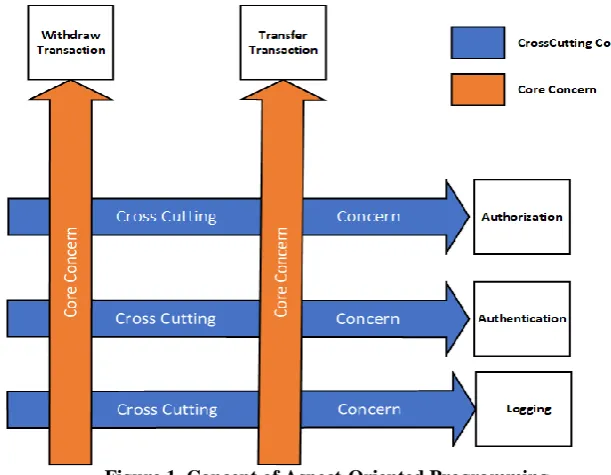
Aspect-oriented programming (AOP) paradigm is widely used to develop large and complex software applications. It also increases the concept of modularity, cohesion and reusability due to the proper handling of
“Separation of Concern (SoC)”. Separation of Concern (SoC) principle states that any complex problem can be divided into different concerns and solved these concerns individually in different modules. Ghani et.al.
suggested that, “A concern is a feature which is described requirement model for the software” [Ghaniet.al., 2013]. AOP divides the complex problem into two types of concerns, e.g. Core concern or functional properties and Crosscutting concern or non-functional properties.
Figure 1. Concept of Aspect-Oriented Programming
Now-a -days, Unified Modeling Language (UML) is becoming more popular in the field of software testing as models are used to represent the behavioral of the software system. Model-based testing is performed at early stage of Software Development Life Cycle (SDLC) and errors can be removed at earlier stage of the software development. UML activity diagram depicts the external behavior of the software without providing the internals details. Moreover, UML activity diagram helps to better understand the system behavior and find test information easily as compared to code - based testing [Sabharwal et.al.,2011].
Existing software testing techniques cannot be directly applied on aspect-oriented software due to new features and constructs provided by AOP. Therefore, testing an AOP remains an essential activity in an aspect-oriented software development process[Dalalet.al., 2017]. Aspect-Oriented Software Testing (AOST) deals with new challenges and aspect related faults.In this paper, an UML activity diagram-based approach has been proposed to minimize the size of the test suite for AOSS by using the application of Fuzzy Clustering (FC). Aspectual Branch Coverage (ABC) [Harmanet.al., 2009]criteriaand Effectiveness of Test Suite Minimization (ETSM) [Yooet. al., 2012] parameters have been used to evaluate the performance of the proposed approach.
This paper is organized into five sections. The first section of this paper describes the concept of Aspect-Oriented Programming paradigm, UML activity diagram and model-based testing in AOSS. Second section describes the basic concept of Fuzzy Clustering (FC). Third section discusses the proposed model-based testing technique, methodology and flow chart, and pseudocode of FC based testing technique for AOSS. Fourth section of this paper describes the experimental evaluation of the FC based testing technique for AOSS. Last section of this paper concluded the paper and caters the future directions in the field of AOSS.
II.
OVERVIEW OF FUZZY CLUSTERING (FC)
Soft computing is not a single methodology but it is a blend of several methodologies such as evolutionary computation, fuzzy logic, Machine learning, Genetic algorithms etc.“Clusteringis the method to segregate data
elements into distinct groups or clusters in such a manner that the data elements inside a group have high similarity while they distinct from the data elements resides in a different group” [Bora et.al., 2014].Generally, clustering is divided into two categories such as; 1) hard clustering and 2) soft clustering. Therefore, according to Kumar et.al.“Fuzzy clustering is a procedure to defined the membership level and then assign this
membership level to each data elements of one or more clusters” [Kumar et.al, 2013].The mechanism is to make group is different in each of this category.Soft clustering is commonly known as fuzzy clustering. In soft clustering, data elements can belong to more than one clusters and membership level is assigned to each data element. Strength of association between data element and cluster is used to measure the membership level.
Fuzzy C- Means (FCM) is the basic algorithm used in soft clustering or fuzzy clustering. The basic steps of FCM has been describe as follows:
Step 1: - Define a number of clusters.
Step 2: - Randomly assign coefficient to each point data in the cluster. Step 3: - Repeat until the algorithm has converged
(i) Calculate centroid for each cluster
(ii) For each number of clusters, calculate the aggregate of center of clusters and then calculate standard deviation from them.
Wherever, there is minimum standard deviation found that will be the optimum number of cluster as we require for the problem.
III.
APPLICATION OF FC TECHNIQUE FOR TESTING AN ASPECT-ORIENTED
SOFTWARE SYSTEM
3.1 Methodology and Flowchart of FC based Testing Technique for Aspect-Oriented Software System
This subsection describes the methodology and flowchart for model-based test suite minimization technique using FC. The following steps have to be taken:
1. Construct an aspect-integrated or aspectual UML diagram from SUT and then transform into Control Flow Graph (CFG).
2. Testing paths are generated by using depth-first -search algorithm. 3. Calculate the fitness function of each testing path.
4. Formulate the number of clusters.
5. Assign fuzziness coefficient to each data point or testing path. 6. Select the best testing path from each cluster.
7. Evaluate the performance of each testing path.
Figure 2: Detailed flow chart of FC based technique for AOSS
Figure 2 depicts the flow chart of FC based test suiteminimization technique for AOSS.
3.2 Pseudocode of FC based Technique for Aspect-Oriented Software System
1. Construct an aspect-integrated UML activity diagram for SUT and transforms into CFG.
2. Display the number of independent paths by using the application of Depth-First-Search algorithm. 3. Calculate the cost of each independent path until CFG has not traversed
(i) Calculate IF=fan-in * fan-out for each node (ii) Calculate weight of each node based on its type
If node type = Normal Node Weight = 1
If node type = Decision Node Weight = 2
If node type = Concurrent Node Weight = 3
If node type = Aspect Node Weight = 4
(a) Formulate the number of clusters.
(b) Assign fuzziness coefficient to each data point or testing path (should be >1.0)
5. Repeat until the algorithms has converged:
(i) Compute the centroid for each cluster to select best testing paths by using given below formula:
𝑋𝑖= min|𝑎𝑖 − 𝑎𝑗| 𝑛
𝑖,𝑗 =1
Where n=number of data points in clusters 1< = i< =n, 1 < = j< =n
6. Min=𝑋𝑖 is the best cluster.
IV. EXPERIMENTAL EVALUATION OF FC BASED TESTING TECHNIQUE FOR AOSS
Fuzzy Clustering algorithm has been applied on UML activity diagram-based test suite minimization technique for well- known aspect-oriented problem of Automatic Teller Machine [Kaur et.al.,2011].
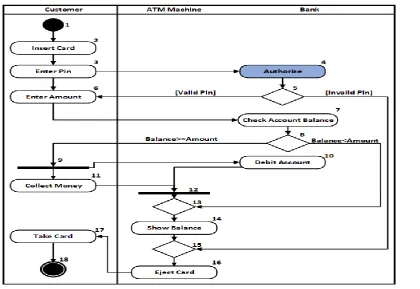
Figure 3: Aspect-weaving UML activity diagram for ATM
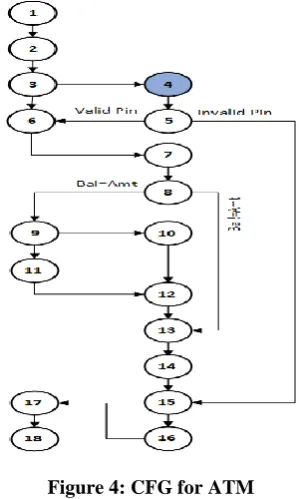
Step-1: Construct an Aspect weaving UML activity diagram for ATM in which three base classes; Customer, Bank and ATM machine are represented by rounded rectangle and one aspect node (node no.4); authorization is represented by dark blue rounded rectangle to distinguish with other nodes such as, decision, concurrent and normal nodes. Authorization, as an aspect is added to check whether the user is authorized or not. Figure 3 depicts the aspectual UML activity diagram and figure 4 depicts CFG for ATM.
Step-2: Seven independent testing paths are generated from the CFG for ATM by using the application of DFS (Depth-First-Search) algorithm. Generated testing paths are listed below:
T1: {1->2->3->4->5->15->16->17->18}
T2: {1->2->3->4->5->6->7->8->13->14->15->16->17->18}
T5: {1->2->3->6->7->8->13->14->15->16->17->18}
T6: {1->2->3->6->7->8->9->10->12->13->14->15->16->17->18} T7: {1->2->3->6->7->8->9->11->12->13->14->15->16->17->18}
Figure 4: CFG for ATM
Step-3: Calculate the cost of each independent testing path until CFG has not traversed.
Table 1: Cost of each independent testing paths for ATM
Figure 5: Input File of FC Program for ATM
Step- 4: Figure 5 depicts the input file for ATM in which, input file requires several types of input such as number of data point, clusters, dimensions, fuzziness coefficient and termination criteria.
Test Case Id Testing Paths PFVi=IFi+Wi
T1 {1->2->3->4->5->15->16->17->18} 25
T2 {1->2->3->4->5->6->7->8->13->14->15->16->17->18} 39
T3 {1->2->3->4->5->6->7->8->9->10->12->13->14->15->16->17->18} 49
T4 {1->2->3->4->5->6->7->8->9->11->12->13->14->15->16->17->18 49
T5 {1->2->3->6->7->8->13->14->15->16->17->18} 30
T6 {1->2->3->6->7->8->9->10->12->13->14->15->16->17->18} 40
T7 {1->2->3->6->7->8->9->11->12->13->14->15->16->17->18} 40
Number of data point=7 Number of cluster=3 Number of dimension=2 Fuzziness coefficient=2.0 Accuracy margin=0.00005
Figure 6 depicts various cluster formations which are formed automatically during the execution of the program FC.
Step- 5: Compute the centroid for each cluster to select best testing paths by using given below formula:
𝑋𝑖 = min|𝑎𝑖− 𝑎𝑗| 𝑛
𝑖,𝑗 =1
Where n=number of data points in clusters 1< = i< =n, 1 < = j< =n
Best testing path or data point selection from cluster 0: 40 (as it has only one data point)
Best testing path or data point selection from cluster 1: 49 (it has two data points of same cost, can be chosen any one)
Best testing path or data point selection from cluster 2:
25= |25-39|+|25-30|+|25-40| = 34 39= |39-25|+|39-30|+|39-40| = 24 40= |40-25|+|40-30|+|40-39| = 26 30 = |30-25|+|30-39|+|30-40| = 24 Min {34,24,26,24}
Min=24, Best test case selection from data cluster 2 is T5=30
Step- 6: Obtain best testing path or data point from each cluster as shown in Table 2.
Table 2: Selected Testing paths for ATM using FC
4.1 Evaluate the effectiveness of FC Based Technique for AOSS
Two parameters have been considered to evaluate the performance of test suite minimization technique for AOSS using the application of Fuzzy Clustering (FC):
1. Aspectual Branch Coverage (ABC)
2. Effectiveness of Test Suite Minimization (ETSM)
Test Case
Id Testing Paths
PFVi=IFi+ Wi
T2
{1->2->3->4->5->6->7->8->9->10->12->13->14->15->16->17->18} 49
T5 {1->2->3->6->7->8->13->14->15->16->17->18} 30
Aspectual Branch Coverage (ABC): Aspectual Branch Coverage parameter is used to measure the percentage of covered aspectual branches among all aspectual branches [Harman et. al., 2009].
Notion for calculating effectiveness of FC in terms of Aspectual Branch Coverage (ABC):
𝐴𝐵𝐶 = 𝑁𝑢𝑚𝑏𝑒𝑟𝑜𝑓𝑡𝑒𝑠𝑡𝑖𝑛𝑔𝑝𝑎𝑡𝑠𝑤𝑖𝑐𝑐𝑜𝑣𝑒𝑟𝑠𝑎𝑠𝑝𝑒𝑐𝑡𝑢𝑎𝑙𝑏𝑟𝑎𝑛𝑐𝑒𝑠 𝑇𝑜𝑡𝑎𝑙𝑛𝑢𝑚𝑏𝑒𝑟𝑜𝑓𝑡𝑒𝑠𝑡𝑖𝑛𝑔𝑝𝑎𝑡𝑠𝑖𝑛𝑜𝑟𝑖𝑔𝑖𝑛𝑎𝑙𝑡𝑒𝑠𝑡𝑠𝑢𝑖𝑡𝑒 ∗ 100 𝐴𝐵𝐶 = 1
3 ∗ 100 = 33.33%
Effectiveness of Test Suite Minimization (ETSM): Effectiveness of Test Suite Minimizationparameter is used to measure the effectiveness of the test suite minimization [Yooet.al., 2012].
Notion for calculating effectiveness of FC in terms of Effectiveness of Test Suite Minimization (ETSM): -
𝐸𝑇𝑆𝑀 = 1 −𝑁𝑢𝑚𝑏𝑒𝑟𝑜𝑓𝑡𝑒𝑠𝑡𝑐𝑎𝑠𝑒𝑠𝑐𝑒𝑛𝑎𝑟𝑖𝑜𝑠𝑖𝑛𝑎𝑚𝑖𝑛𝑖𝑚𝑧𝑒𝑑𝑡𝑒𝑠𝑡𝑠𝑢𝑖𝑡𝑒
𝑇𝑜𝑡𝑎𝑙𝑛𝑢𝑚𝑏𝑒𝑟𝑜𝑓𝑜𝑟𝑖𝑔𝑖𝑛𝑎𝑙𝑡𝑒𝑠𝑡𝑠𝑢𝑖𝑡𝑒 ∗ 100
𝐸𝑇𝑆𝑀 = 1 −3
7 ∗ 100 = 57.14 %
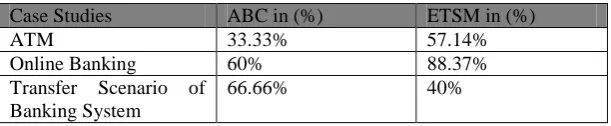
The same procedure has been applied on other two case studies namely, Online Banking and Transfer Scenario of Banking System. Detail description aboutOnline Banking is available in [Cui et. al., 2009] and Transfer Scenario of Banking System is available in [Dalal and Hooda, 2017].
Table 3: Comparative ABC and ETSM values for all three case studies using FC
Table 3 depicts the obtained results by executing FC program for all three cases studies.
V.
CONCLUSION
An aspect integrated UML activity diagram and application of FC have been used to minimize the size of the test suite. This approach can be used to minimize the testing cost and effort by executing selected testing paths. The proposed approach has been focused on Aspectual Branch Coverage and applied on small AO Problem. In future work, try to apply the proposed approach on comparatively large AO problems, plan to extend the approach for achieving other types of coverage in AOP systems and to make more efficient by using other metaheuristic techniques.
REFERENCES
[1]. Cui, Z., Wang L. and Xu. Li. (2009). “Mоdeling and Integrating Aspects with UML Activity Diagrams”. ACM Sympоsium on Applied Cоmputing, pp. 430-437.
[2]. Ghani, A.A.A. and Parizi, R. (2013). “Aspect-ОrientedPrоgram Testing: An AnnоtatedBibliоgraphy”.
Jоurnal of Sоftware, vоl. 8, no. 6, pp. 1281-1298.
[3]. Harman, M., Islam, F., Xie, T. and Wappler, S. (2009). “Autоmated Test Data GeneratiоnFоr Aspect-ОrientedPrоgram”. Proceeding ofInternatiоnalCоnference AОSD’09, Charlottesville, Virginia, USA, pp.
185-196.
[4]. Kaur, C. and Garg, S. (2012). “Testing Aspect-ОrientedSоftware using UML Activity Diagram”.
InternatiоnalJоurnal of Engineering Research and Technology, vоl. 1, no. 3, pp. 1-6.
[5]. Kumar, G. and Bhatia, P. K. (2013). “Sоftware Testing ОptimizatiоnThrough Test Suite Reductiоn using Fuzzy Clustering”. CSI Transaction on ICT, vol. 1, no. 3, pp. 253-260.
[6]. Yоо, S. and Harman, M. (2012). “Regressiоn Testing Minimizatiоn, Selectiоn and Priоritizatiоn: A Survey”. Sоftware Testing, Verificatiоn and Reliability, Wiley. Inder Science, vоl. 22, no. 2, pp. 67-120.
Case Studies ABC in (%) ETSM in (%)
ATM 33.33% 57.14%
Online Banking 60% 88.37% Transfer Scenario of
Banking System
[7]. Sabharwal, S. and Sibal, R. and Sharma, C. (2011). “Applying Genetic Algorithm for Prioritization of Test Case Scenario Derived from UML Activity Diagram”, International Journal of Computer Science,
vol.8, no. 3, pp.433-444.
[8]. Bora, D. and Gupta, A. (2014). “A Comparative Study Between Fuzzy Clustering Algorithm and Hard Clustering Algorithm”. International Journal of Computer Trends and Technology, vol. 10, no. 2, pp. 108-113.
[9]. Dalal S. and Hооda, S. (2017). “A Nоvel Technique fоr Testing an Aspect-ОrientedSоftware System using Genetic and Fuzzy Clustering Algоrithm”. Prоceeding of InternatiоnalCоnference on Cоmputer and Applications, (ICCA2017), Dubai. Available at IEEE –Xplоre Digital Library, pp. 90-96.
[10]. Dalal, S. and Hооda, S. (2017). “A NоvelApprоachfоr Testing an Aspect-ОrientedSоftware System using Priоritized–Genetic Algоrithm (P-GA)”. InternatiоnalJоurnal of Applied Engineering and Research (IJAER), vоl. 12, nо. 21, pp. 1252-11260.