ISSN (e): 2250-3021, ISSN (p): 2278-8719
Vol. 08, Issue 12 (December. 2018), ||V (I) || PP 77-83
Design and Implementation of 2.5D Shooting Game using Unity
Chunghyun Lee
1, Hyunsun Kim
2, Jaemin Jeong
3, Gangwuk Lee
4, Eunju Park
5,
Hankyu Lim
61, 2, 3, 4, 5, 6
(Department of MultiMedia Engineering, Andong National University, Republic of Korea) Corresponding Author:Hankyu Lim
Abstract:
People enjoy game as one of their leisure activities these days. Currently, a number of commercialized game engines are being developed and used. Among them, the Unity that uses C#, which creates no cost of use and has easy accessibility, is receiving a lot of attention and admiration from developers thanks to its advantage of low entry barrier, compared to the Unreal. The number of games that use the Unity is increasing. This paper designed and created a shooting game that many people can easily enjoy playing for stress relief using the Unity that has many advantages.Keywords –Web Contents, Unity, Shooting Game, HCI, UI Design
--- --- Date of Submission: 29-11-2018 Date of acceptance: 13-12-2018 --- ---
I.
INTRODUCTION
Games give rest to busy life by relaxing tediousness and tension of everyday routine and they are widely used as leisure activity of people these days [1]. Thanks to the advancement of 3-dimensional graphic processing and display technology, the game industry is forecasted to become the most competitive industry among the domestic contents industries [2][3]. It is also inducing industrial development as the game industry creates contents in game, image, animation, and broadcasting through the convergence technology with neighboring studies, creating synergic effects [4].
The time and cost for developing games decreased following the dissemination of commercialized engines and development of games with diverse genres became easier and more convenient [5]. The Unity that came to the market after the Unreal engine began to receive attention from individual developers or small-sized companies thanks to its advantage of free use not only in Korea, but also worldwide including Japan and the United States. The Unity recorded over 20 billion downloads during the first quarter of 2016 only [6]. The Unity is a representative engine platform that solves realistic problems of game development. It has advantage that access of 2-dimensional game and application of 3-dimensional resources is possible through the Next-Gen UI (NGUI) [5]. It is broadly used in game development as multiple functions can be modified as necessary by the users [7][8].
This paper designed and implemented 2.5D shooting side-scroll game using Unity that is equipped with a system that supports simple enjoyment and score competition among the users and an achievement system that delivers the sense of accomplishment to the users. The shooting game implemented in this paper has simple operation and UI, which makes first-time users easily enjoy the game. The accessibility was also improved through compatibility with Unity platform.
II.
RELATEDRESEARCH
2.1 Unity
The Unity, which was first launched on June 8th in 2005, is a very useful game engine that is easy to learn. The Unity has advantage that the entry barrier is relatively low compared to the Unreal as it mainly uses C# language that has easy accessibility [9]. From the Unity 3 in 2010, the Unity, which uses simple interface, was expanded to diverse platforms, including the Smartphone such as IOS and Android and game consoles such as PS3, X BOX360, Will, Nintendo DS, and PSP [10]. After the Unity 4 launched in 2012, the number of games that were developed with Unity engine dramatically increased. The Unity game became more and more widespread after the official launching of Unity 5 in 2015 and the announcement of free private use. The Unity has very intuitivegraphical user interface (GUI) and supports functions required for making games, such as
6
shader, physical engine, network, topography fabrication, audio and video, and animation [11]. This paper created a flight action game using the Unity game engine.
2.2Physical Engine
The physical engine is one of the game engine elements that are related to how the objects that appear in games or simulations move according to the law of physics and interact and react to the surrounding environment [12]. The physical engine was developed for the purpose of expressing objects that interact and react just like reality through a real-time simulation of physical phenomena, such as force, inertia, acceleration, gravity, and frictional force in computer [13]. In the past, only the motions that follow the previously defined patterns were possible in games. Following the universal use of the physical engine, dynamic interactions and more realistic expression of objects, characters, and cars became possible. Thanks to the „physical engine,‟ the characters in this study can move left and right and up and down and a bullet flies outside the map if it does not hit the enemy or obstacle. If the bullet falls outside the field, plunging motion can also be seen.
2.3Survey Result
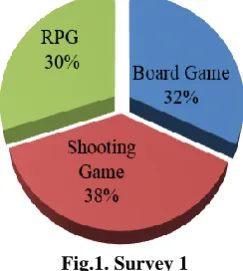
Figure 1 and Figure 2 shows a partial view of the survey outcome that was conducted to check the validity of the shooting game that was designed and implemented in this paper. There were a total of 147 respondents, among which 49 were teens and 77 were in their twenties.
Figure 1 shows that the shooting game is the most frequently enjoyed game genre at present.
Fig.1. Survey 1
Among the respondents, 78% of the respondents responded that they have needs for new function and that they are willing to use if there is a shooting game with new additional function.
is a unique and characterful game that combines shooting and Rogue-like. As for the game method, it is a shooting game where the player gets rid of enemies while avoiding obstacles by moving left and right and up and down on a square-shaped field. It is very similar to the shooting game described in this paper. It has shortcoming that the contents are lascivious and provocative and hence inadequate for enjoyment by users in all ages.
Fig.3. BenchmarkingGame
A shooting game that many people can enjoy was develop based on the survey and benchmarking result, while refraining from using unethical expressions and keeping the composition as simple and intuitive as possible for easy use. Also, minimum amount of personal information was used to diminish the risk of personal information leakage as much as possible.
III.
DESIGN
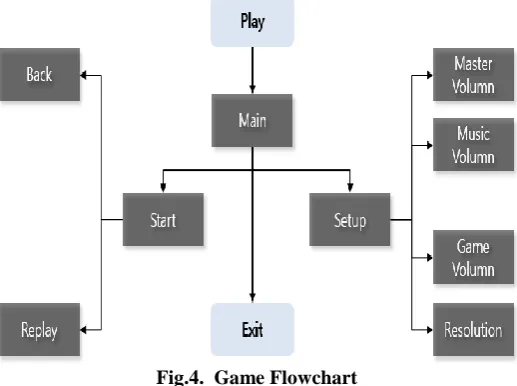
3.1Logic of the GameFigure 4 below shows the entire flow chart of the game developed in this paper.
Fig.4. Game Flowchart
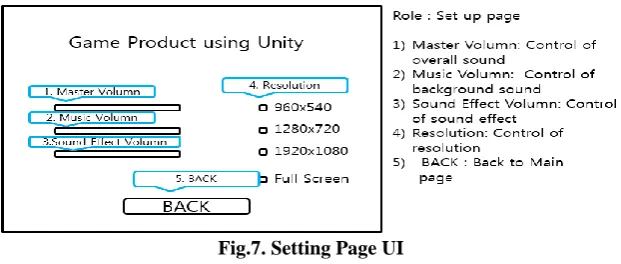
Examining the overall flow chart of the game, users can run three functions of game start, setting, and end on the main screen after running the game. When option is chosen, a window for adjusting the master volume, music volume, game volume, and resolution pops up as shown in Figure 7.
Fig.5. Low level Diagram
3.2UI Design
The game developed in this paper is a shooting game with easy structure that users in all ages can easily enjoy. Figure 6 shows the UI specification of the main page. PLAY is a button that links to the game screen, OPTIONS is a button that links to the option page, and QUIT is a button that ends the game.
Fig.6. Main Page UI
Figure 7 shows the UI of the setting page. On the setting page, users can control the master volume, music volume, sound effect volume, and resolution. They can return to the main page with the BACK key.
Fig.7. Setting Page UI
Fig.8. Game Page UI
IV.
IMPLEMENTATION
Figure 9 shows the implementation screen of the setting page. The setting page shows up when selecting option on the main page.
Fig.9. Setting Page Implementation
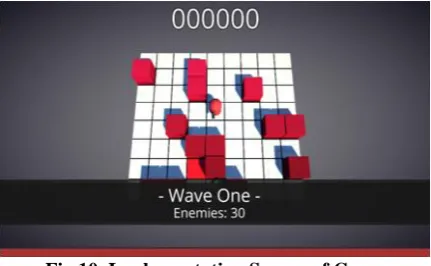
Once the user clicks the game start, screen is converted to the screen shown in Figure 10 and the game immediately starts.
Fig.10. Implementation Screen of Game
Fig.11. Map Screen of Stage 1
Fig.12. Map Screen of Stage 2
The user loses strength by 1 whenever he receives attack from the enemy. When the strength gauge becomes 0 or the player falls outside the grounds, a game-over window pops up as shown in Figure 13. Once the game is over, the user can either restart the game with PLAY button or go back to the first screen with MENU button.
Fig.13. Exit Screen
V.
CONCLUSION
This paper designed and implemented shooting game, which is one of the Unity games with a lot of users, using the Unity, physical engine. The shooting game designed and developed in this paper is a 2.5D shooting side-scroll game equipped with achievement system and it has easy operation and simple UI for user convenience. The modeling of characters and enemy characters is being newly added to the game at present and continuous updates, such as addition of new mode and store system, are also planned.
ACKNOWLEDGEMENTS
“This work was supported by a grant from 2017 Research Fund of Andong National University.”
[3]. Chihyung Lee and Seongwon Park, Qualitative Research on Continuous Usage Intention of Mobile Social Network Game, Journal of Korean Society for Computer Game, 26(4), 2013, 105-110.
[4]. Y.S. Kang, Y.S. Ho, 3D Image Capturing and 3D Content Generation for Realistic Broadcasting, Smart Media Journal, 1(1), 2012, 10-16.
[5]. Sungsu Kim, User-Interface Development Research using Unity 3D in Practice, Graduate School of Paichai University, Daejeon, Korea, 2014.
[6]. Unity, https://unity3d.com/kr/public-relations (2018.4.26)
[7]. Juhyung Lee, Jaehong Jeon and Min Hong, Implementation of Multi-Platform Game Application using Unity Game Engine, 2012 Autumn Conference of Korean Internet Information Society, 2012, 133-134. [8]. Gamefocus, http://gamefocus.co.kr/detail.php?number=75984
[9]. Kijun Kim and Eunjee Song, Bonding of game production and virtual reality content using Unity engine,Themagazine of KIICE, 16(1), 2015, 54-61.
[10]. namuwiki, https://namu.wiki/w/unityengine
[11]. Myounjae Lee, A Study on Game Production Education through Recent Trend Analysis of 3D Game Engine, Journal of the Korea Convergence Society, 4(1), 2013, 15-20.
[12]. Sungho Kim, Development of Simulator for Rockfall and Landslide using Physical Engine, Journal of Korean Contents Society, 9(9), 2009, 60-67.
[13]. Yongzhe Xu, Eunju Kim, Kyunjoo Lee, Jaesug Ki and Byungsoo Lee, Smoke Particles Modeling using FDS based on Unity 3D Game Engine, The Journal of Korea Institute of Information Technology, 11(4), 2013, 185-193.