GSJ: Volume 8, Issue 1, January 2020, Online: ISSN 2320-9186 www.globalscientificjournal.com
REDUCTION OF MERCURY CONTENT IN A SOLUTION BY ACTIVATED BENTONITE
Dr. SOURAV MAJUMDER
State Aided College Teacher Category I Kaliachak College, University of Gour Banga Email: [email protected]
KEYWORD Activated Bentonite, Acid activator, Mercury, Low-cost adsorbent
ABSTRACT
Bentonite deposits of major importance occur in association with volcanic rocks, tuffs and tuffaceous sediments of Miocene and Oligocene age, the bentonite layers and veins indicate the bentonization of the tuff having 1-2 m thickness of the beds. The chemical composition of bentonites is SiO2 (50-60%), Al2O3 17%, Fe2O3, FeO, MgO, CaO, Na2O, K2O and traces of TiO2 and cation exchange capacity value of bentonites are around 98 meq/100g. Due to the presence of exchangeable cations, the important applications are decolourising oil, manufacture of catalyst, production of oil well drilling muds softening of hard water and suitability of decontamination of radioactive wastes. Bentonites have been found a good adsorbent. The purpose of the present study is to find the best activator for bentonite to reduce the mercury content in a solution. Bentonite was activated by HCl, H3PO4, NaCl, ZnCl2, NaOH and KOH use different concentration such as 0.5 M, 1.0 M and 1.5 M. Activated bentonite has been characterized by x-ray diffraction, scanning electron microscope with energy dispersive spectroscopy and atomic absorption spectrometry. Activated bentonite has bigger pores than natural bentonite. Atomic absorption spectrometry showed that H3PO4, HCl, NaCl, ZnCl2, NaOH and KOH can reduce the mercury around 99.99%, 99.87%, 97.48%, 9.24%, 99.81% and 99.86%. Thus, H3PO4 is the best activator for activated bentonite as a low-cost adsorbent.
320
GSJ© 2020
INTRODUCTION
Heavy metals are toxic materials (Gai et al., 2019). Bentonites have been found a good adsorbent of hexavalent chromium and arsenic up to permissible limit. Maximum removal of Cr (VI) takes place at 120 min. First order kinetics is followed in the case of adsorption of Cr (VI) and As (III) by bentonites. This can be exploited on large scale in industry for decontamination of water pollutants. Mercury is a volatile metal in liquid phase at 25oC and easily to react with another compound (Aerts et al., 2014). Mercury can give some impact for environment and human health such as visual impairment, poisoning and death (Bernhoft, 2012). Thus, removal mercury from water has become an essential problem. Mercury is widely used in industrial activities such as gold mining, acid mine drainage on coal mining and another else (Kahhat et al., 2019; Li et al., 2012; Mason et al., 2019). In gold mining, mercury was used to draw gold granules. This activity will give some negative impacts in environment. Contaminated water by mercury can reduce use adsorption method (Liu et al., 2018). A numerous n u mb e r o f techniques such as chemical precipitation, ion exchange, coagulation, reduction, membrane filtration, and adsorption have been explored for the complete removal of mercury from solution. Among these techniques, adsorption is deemed to be most practical and economical approach (Fu & Wang, 2011). In this context bentonite is identified as efficient sorbent which have received considerable attention as sorbent caused by their widespread, exceptional water filtration capabilities, availability and high heavy metal adsorption capabilities (Jimtaisong & Sarakonsri, 2019).Activated bentonite which are cheap and environmentally benign sorbents (Naswir et al., 2019), can be extensively used for mercury adsorption. Indonesian bentonite deposit is 380 million of tons are spreading in Sumatera and Java Island. Jambi province have 650 hectare of bentonite as potential low-cost sorbent (Naswir et al., 2011). Bentonite has 2 layered structure that give impact for good ion exchange.
Activation of bentonite can be done by chemical and physical methods. Chemical activation can be done by using acid or base solution such as CaCl2, Ca(OH)2, NaCl, MgCl2, HNO3, HCl, Ca3(PO4)2, H3PO4, ZnCl2. Specific activator give different impact for pores and surface area, activation made ion cation exchange with H+. Activation of bentonites by using acid activators make biggest pores and surface area than base activation, it will give an impact for better sorption (Toor et al., 2014).
MATERIAL ABD METHOD
Collection and Characterization
Bentonite was collected from different parts of Rajmahal hills of Jharkhand. Activated bentonite characterized use x-ray diffraction, pxrd studies scanning electron microscope with energy dispersive spectroscopy and atomic absorption spectrometry.Hg(NO3)2, H3PO4, ZnCl2, NaCl, NaOH, KOH are the main acid activators used for bentonite activation
Preparation and Activation
The bentonite clay used in this study was produced by pyrolysis of natural bentonite. Firstly, water content of the sample is reduced in furnace at 105oC for 24 hours. Bentonite was pyrolized at temperature of 200oC for an hour. 50gr bentonite with particle size is 300 mesh was mix with activators in Erlenmeyer. 200 ml of activators with different concentration (0.5M, 1.0M and 1.5M) are mixed in 50gr of bentonite in Erlenmeyer. These treatment is done for enlarge the pores and surface area of bentonite. After that bentonite was filtered and washed out by distilled water to reduce activators from the bentonite. Distilled water has chosen to prevent the reaction between bentonite and activators. The resulting residue is dried by heating. In the heating process after activation, the activating material enters between layers and then opens the closed surface. Bentonite activation used HCl and H3PO4 to change ion of H+ by releasing Al3+, Fe3+ Mg2+ .Ion exchange of activated bentonite with HCl and H3PO4 as shown in Figure 1. Activated bentonite was mixed in 20ml of 5 ppm Hg (NO3)2 and mix by magnetite stirrer with 200rpm for 30 minutes.
ISSN 2320-9186
321
GSJ© 2020
Fig 1. Bentonite reaction use HCl and H3PO4
RESULT AND DISCUSSION
Bentonite activation
Activation of bentonite is done to maximize its sorption capacity. Chemical activation was done by H3PO4, HCl, ZnCl2, NaCl, NaOH and KOH with different concentrations. HCl and H3PO4 can change the minerals (Ca2+, Mg2+) in inter layers with H+. Chemical activation use HCl and H3PO4 on bentonite bellow:
Al4Si8O20 (OH)4+3H+Al3Si8O20(OH)2+Al3++2H2O
H+
This reaction illustrates that Al has changed to hydroxyl structure that give an impact of change of octahedral to tetrahedral. Changed of octahedral to tetrahedral made the crystal lattice is negatively charged, negative charged will neutralizing by alkali in bentonite (Krupskaya et al., 2019). Activated bentonite used ZnCl2 and NaCl make an exchange of Zn and Na. ZnCl2 is acting as hydrating agent. Hydrating agent can make biggest pores and surface of bentonite. Bentonite was soaked in deionization solution for reduce bentonite pores from another residues. NaCl is an effective activator because it is cheap, easily available and non-toxic. NaCl in solution phase will be dissociated and made positive and negative ions are Na+ and Cl-. Na will be surrounded by negative partial from water and Cl- will be surrounded by positive partial by water molecules (Ali et al., 2018).Base activators like NaOH and KOH will give an impact for silica and alumina in bentonite reacted with base solution and made salt product. These activators can reduce impurity and make biggest pores and surface area. Therefore this treatment can improve sorption ability (Lee, 2015).
Characterization
XRD Studies
Ray diffraction used to find peak of natural bentonite and activated bentonite and find the different of these peaks. X-ray diffraction of natural and activated bentonite informs that bentonite has created by Kaolinite, montmorillonite, quartz and cristobalite. Samples were examined by using BRUKER D8 Advance model X-ray diffractometer with Cu Kα radiation operated at 40 mA and 40 kV with a 0.01 step size, Ni β-filter, and Lynx-eye® position sensitive detector. Characterizations were made using randomly oriented grains. For this purpose, samples were finely grounded and put into an oven at 200°C for 1 h before analysis. Then these samples were put into sample holders and a flat glass plate
322
GSJ© 2020
pressed by hand to obtain powder having a flat compact surface. The natural bentonites have high 2θ angles (27o) with counts almost 9000 (Shown in Fig. 2). Bulk samples were scanned between 5° and 65° 2θ range using a 1 mm divergent slit. Natural bentonite composed by montmorillonite (PDF 01-073-6746), quartz (PDF 01-070-7344), cristobalite (PDF 00-001-0438) and Kaolinite (01-078-2110)
ISSN 2320-9186
323
GSJ© 2020
Fig 2. XRD Pattern of Natural Bentonite
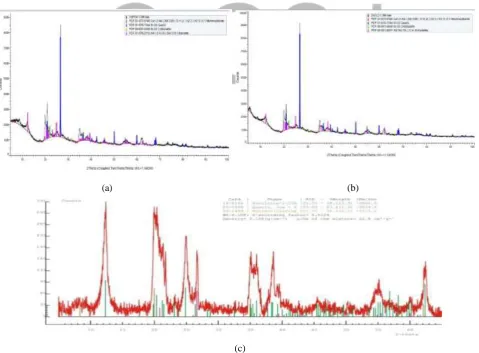
Activated bentonite use HCl, H3PO4 and ZnCl2 has characterized by x-ray diffraction patterns. XRD pattern informs that activated bentonite use HCl have strong intensity than ZnCl2 and H3PO4. Intensity of activated bentonite by HCl, ZnCl2 and H3PO4 activation is between 8000-9000 and 9000-1000. 2ϴ of x-ray diffraction is in 27o in all of bentonites.
Activated bentonite used H3PO4, HCl, ZnCl2 have minerals composition such as montmorillonite (Ca1.2.Al4 (Si8O20 (OH)2)O2.2(H2O)., quartz (SiO2), cristobalite (SiO2) and Kaolinite (OH)8(Si4O10). Generally all of bentonites do not have significant changed with the different treatment. These peaks inform that no strain caused any movement of peaks in diffraction line.
(a) (b)
(c)
Fig 3. XRD pattern of activated bentonite use H3PO (a), ZnCl2 (b), HCl (c)
324
GSJ© 2020
Scanning Electron Microscope with Energy Dispersive Spectroscopy
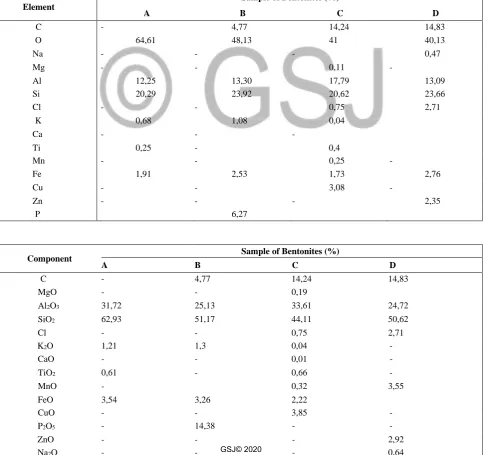
Scanning electron microscope used to find pore sizes of bentonites. Scanning electron microscope showed that the texture of had a coarser surface, a more abundant pore structure and rich white spherical particles with diameters between 0.5 and 2 μm. Natural bentonite have smooth surface than activated bentonite, activated bentonite used H3PO4 and ZnCl2 have coarser surface than activated bentonite used HCl (Fig. 4). The different of pores in surface area caused by different activators. Activator can make surface area coarser and biggest pores, it will give an impact on the ability of sorption. The correspondence energy dispersive spectroscopy informs elements of bentonite such as C, O, Na, Mg, Al, Si, Cl, K, Ca, Ti,
Mn, Fe, Cu, Zn, P and bentonites compounds such as C, MgO, Al2O3, SiO2, Cl, K2O, CaO, TiO2, MnO, FeO, CuO, P2O5.
ZnO and Na2O. Note A is natural bentonite; B is activated bentonite use H3PO4; C is activated bentonite use HCl and; D is activated bentonite use ZnCl2 (Table 1). Elements changed of bentonite caused by pyrolysis and activation process by different activators. Undetected element caused by element too small and undetected by Scanning Electron Microscope with Energy Dispersive Spectroscopy such as carbon, natrium, magnesium, chlorine, calcium, manganese, copper, zinc and phosphor and MgO, Cl, K2O, CaO, TiO2, MnO, CuO, P2O5, ZnO and Na2O
Table 1. Element of Bentonites
Sample of Bentonites (%)
Element
A B C D
C - 4,77 14,24 14,83
O 64,61 48,13 41 40,13
Na - - - 0,47
Mg - - 0,11 -
Al 12,25 13,30 17,79 13,09
Si 20,29 23,92 20,62 23,66
Cl - - 0,75 2,71
K 0,68 1,08 0,04
Ca - - -
Ti 0,25 - 0,4
Mn - - 0,25 -
Fe 1,91 2,53 1,73 2,76
Cu - - 3,08 -
Zn - - - 2,35
P 6,27
Component Sample of Bentonites (%)
A B C D
C - 4,77 14,24 14,83
MgO - - 0,19
Al2O3 31,72 25,13 33,61 24,72
SiO2 62,93 51,17 44,11 50,62
Cl - - 0,75 2,71
K2O 1,21 1,3 0,04 -
CaO - - 0,01 -
TiO2 0,61 - 0,66 -
MnO - 0,32 3,55
FeO 3,54 3,26 2,22
CuO - - 3,85 -
P2O5 - 14,38 - -
ZnO - - - 2,92
Na2O - - - 0,64
ISSN 2320-9186
325
GSJ© 2020
Sorption of Mercury by Activated Bentonite
Calibration curve originates to find calibration standard of Hg by plotting absorbance vs.
concentration. Hg was created by 1000 ppm of Hg (NO3)2 was diluted to 100 ppm (Fig. 5). Standard of Hg solution are 0 ppm, 10 ppm, 20 ppm, 30 ppm, and 40 ppm are taken for experiment.
Standard Calibration curve 1of Hg
First calibration curve showed five solutions of different ppm and have calibration curve y = 0.2163 x + 0.00832 with correlation coefficient (r) is 0.9991. Calibration curve showed linearity. This calibration curve will use to find sample concentration use equation:
Y = bx + a
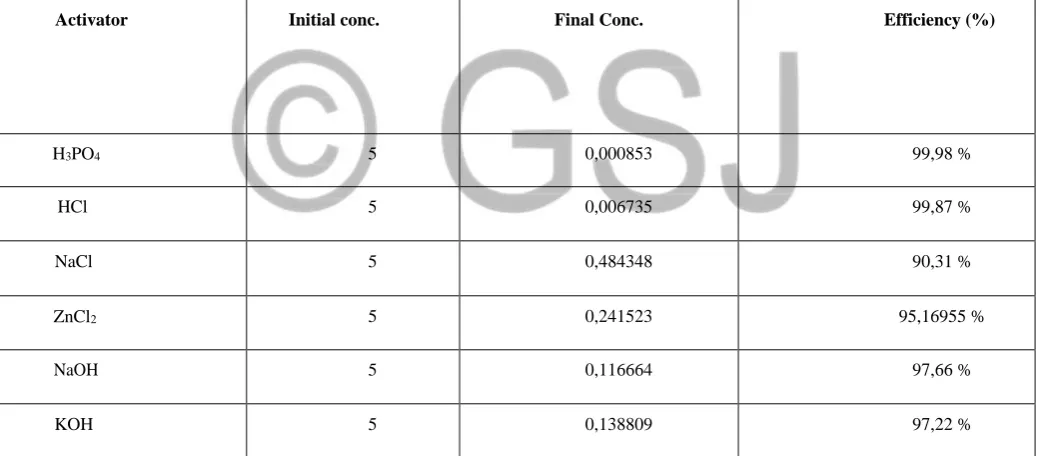
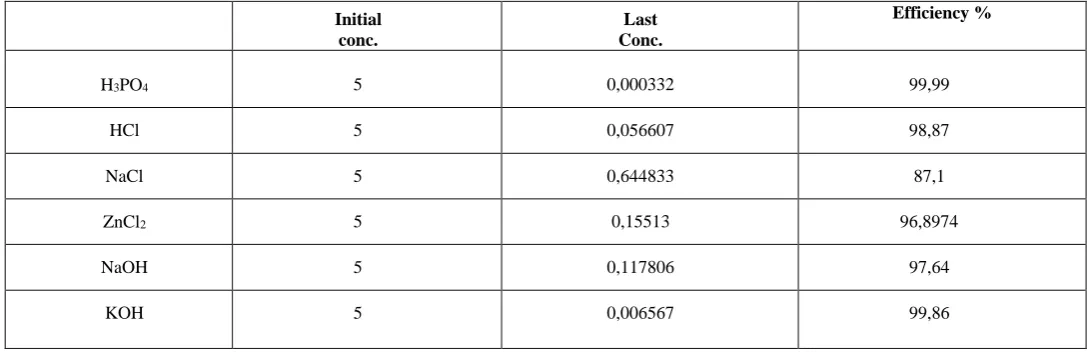
Where b is slope; a is intercept and Y is absorbance; X is concentration and r is regression linear. Result of atomic absorption spectrometry of Hg in solution is more than 97% in 0.5 M (Table 2), 90% in 1M (Table 3) and 87% in 1.5 M (Table 4), these phenomenon inform that every single activator did not have significant influence especially HCl and H3PO4. It caused by acid activators will give an impact for ability sorption.
Equilibrium adsorption of adsorbate is used to find adsorption isotherm. The isotherm results of activated bentonite at a constant temperature of 105o were analyzed using four important isotherms including the Langmuir, Freundlich, Temkin and Dubinin-Redushkevich (D-R) isotherm models.
The Langmuir adsorption model is based on the assumption that maximum adsorption corresponds to a saturated monolayer of solute molecules on the adsorbent surface, with no lateral inter- action between the adsorbed molecules. The Langmuir adsorption isotherm has been successfully used in many monolayer adsorption processes. The expression of the Langmuir model is given by Equation:
𝑞𝑒 = (QobCe)/ (1 + 𝑏𝐶𝑒)
𝐶𝑒 where qe (mg/g) and Ce (mg/L) are the amount of adsorbed adsorbate per unit mass of adsorbent and un-adsorbed adsorbate concentration in solution at equilibrium, respectively. The value of Q0 (mg/g) is the maximum amount of adsorbate per unit mass of adsorbent to form a complete monolayer on the surface bound at high Ce and b is a constant related to the affinity of the binding sites (L/mg). The Langmuir equation can be described by the linearized form
𝐶𝑒 1 1
𝑄𝑒 = 𝑄𝑜 𝐶𝑒 + 𝑄𝑜𝑏
The essential characteristics of the Langmuir isotherm can be expressed in terms of a dimensionless constant separation factor RL that is given by the following equation:
𝟏 𝐑𝐋 =
𝟏 + 𝒃𝑪𝒐
Concentration 30 40 50
20 10
Where C0 (mg/L) is initial concentration of adsorbate and b (L/mg) is Langmuir constant. There are four probabilities for the RL value: for favorable sorption, 0<RL <1; for unfavorable sorption, RL >1; for linear sorption, RL =1; for irreversible sorption, RL =0.
The Freundlich isotherm can be applied for non-ideal sorption on heterogeneous surfaces and multilayer sorption. The Freundlich equation is expressed as
qe = Kf Ce1/n
Where Kf and n are Freundlich constants with Kf (mg/g (L/mg) 1/n) being the sorption capacity of the adsorbent, and n giving an indication the favorability of the sorption process. Values of n>1 represent favorable adsorption condition. To determine the constants Kf and n, the Freundlich equation can be described by the linearized form:
log qe = log Kf + 1/n log C
Temkin and Pyzhev considered the effects of some indirect adsorbate/adsorbate interaction on adsorption isotherms and suggested that because of these interactions the heat of adsorption of all the molecules in the layer would decrease linearly with coverage. The Temkin isotherm has been
generally applied in the following form:
qe = (𝑅𝑇) ln (ACe)
𝑏
and can be linearized as: qe = B ln A + B ln Ce
where B=RT/b, b is the Temkin constant related to heat of sorption (J/mol), A is the Temkin isotherm constant (L/g), R is the gas constant (8.314J/mol K), and T is the absolute temperature (K).
The equilibrium data were also applied to the D–R model to determine the type of sorption (physical or chemical). The linear form of D–R isotherm is presented as the following equation:
ln qe = ln qm − β2
where qe is the amount of aniline adsorbed onto per unit dosage of Cr-bentonite (mol/g), qm is the theoretical monolayer sorption capacity (mol/g), ˇ is the constant of the sorption energy (mol2/J2), which is related to the average energy of sorption per mole of the adsorbate as it is transferred to the surface of the solid from infinite distance in the solution and β is Polanyi potential, which is described as:
1 𝛽 = 𝑅𝑇 ln (1 + 𝐶𝑒)
where T is the solution temperature (K) and R is the gas constant and is equal to 8.314J/mol K. The value of mean sorption energy, E (kJ/mol), can be calculated from D–R parameter β as follows:
E = 1
√−2𝛽
The value of mean sorption energy gives information about chemical and physical sorption. The E value ranges from 1 to 8 kJ/mol for physical sorption and from 8 to 16kJ/mol for chemical sorption (Zheng et al., 2009)
ISSN 2320-9186
327
GSJ© 2020
Table 2. Efficiency of 0.5 M Hg
Table 3. Efficiency of 1 M Hg
Activators Initial conc. Final conc. Efficiency (%)
H3PO4
5 0,002016 99,96
HCl 5 0,03376 99,33
NaCl 5 0,125948 97,48
ZnCl2 5 0,137608 97,24783
NaOH 5 0,009290 99,81
KOH 5 0,138328 97,22
Activator Initial conc. Final Conc. Efficiency (%)
H3PO4 5 0,000853 99,98 %
HCl 5 0,006735 99,87 %
NaCl 5 0,484348 90,31 %
ZnCl2 5 0,241523 95,16955 %
NaOH 5 0,116664 97,66 %
KOH 5 0,138809 97,22 %
328
GSJ© 2020
Table 4. Efficiency of 1.5 M Hg
Chemical activator in this research has three reactions such as mineral acid can reduce Fe2O3, Al2O3, CaO, and MgO in adsorbent pores. These phenomenon make the pores bigger that make better surface area. Second reaction is Ca2+ and Mg2+ in surface area of crystal has changed with H+ from acid mineral. Then, The Ca2+ and Mg2+ ion that changed with H+ will change with Al3+ in acid mineral. As the result of this research best activator of bentonite is H3PO4 that can sorption 99.99% mercury in solution (Fig. 4)
Initial conc.
Last Conc.
Efficiency %
H3PO4 5 0,000332 99,99
HCl 5 0,056607 98,87
NaCl 5 0,644833 87,1
ZnCl2 5 0,15513 96,8974
NaOH 5 0,117806 97,64
KOH 5 0,006567 99,86
ISSN 2320-9186
329
GSJ© 2020
Figure 4. Efficiency of activated bentonite
ACKNOWLEDGEMENT
Authors acknowledge the laboratory facility provided by Central Institute of Mining and Fuel Research, a CSIR lab in Dhanbad for XRD, SEM tests. Thanks are also due to Prof Bhabatosh Mandal, Deptt of Chemistry, Viswabharati, Santiniketan for providing FTIR analysis of the sample.
CONCLUSION
Mercury is dangerous material that gives negative impact for environment and human health. Bentonite as a local material can utilize as an adsorbent to reduce mercury in a solution. Bentonite has characterized use x-ray diffraction and scanning electron microscope with energy dispersive spectroscopy. Bentonite has activated used KOH, NaOH, HCl, ZnCl2, and H3PO4. These activators used to find the best activator for activated bentonite to reduce mercury 0.5 M, 1.0 M and 1.5 M in a solution. Result of this study showed that H3PO4, HCl, NaCl, ZnCl2, NaOH and KOH can reduce the mercury around 99.99%, 99.87%, 97.48%, 9.24%, 99.81% and 99.86%. Thus, best activator for activated bentonite as a low-cost adsorbent is H3PO4.
REFERENCES
A.Aerts , S.Danaci , B. G Prieto, J.Bosch,Van Den, & J.Neuhausen, (2014). Evaporation of mercury impurity from liquid lead – bismuth eutectic. JOURNAL OF NUCLEAR MATERIALS,
448(1–3), 276–281. https://doi.org/10.1016/j.jnucmat.2014.02.013
L.Ali, S.Valenzuela, M. Farooq, S.Ali, F.Rolando, & V.Díaz,(2018). Applied Clay Science Influence of preparation methods on textural properties of puri fi ed bentonite.
Applied Clay Science, 162(May), 155–164. https://doi.org/10.1016/j.clay.2018.06.001
R. A. Bernhoft, (2012). Mercury Toxicity and Treatment : A Review of the Literature.
Journal of Environmental and Public Health, 2012, 1–10.
https://doi.org/10.1155/2012/460508
F.Fu, & Q.Wang (2011). Removal of heavy metal ions from wastewaters : A review. Journal of
Environmental Management, 92(3), 407–418. https://doi.org/10.1016/j.jenvman.2010.11.011
1,5 M 1,0 M
Conc.
0,5 M 50%
KOH
60%
NaOH
70%
ZnCl2
NaCl
80%
HCl
90% H3PO4
110%
100%
Effici
ency
(
%
)
330
GSJ© 2020
Gai, K., Avellan, A., Hoelen, T. P., Lopez-linares, F., Evan, S., & Lowry, G. V. (2019). Impact of Mercury Speciation on its Removal from Water by Activated Carbon and Organoclay. Water Research, 157, 600–609. https://doi.org/10.1016/j.watres.2019.04.006
A.Jimtaisong, & T.Sarakonsri (2019). Chitosan Intercalated Bentonite as Natural Adsorbent Matrix for Water- Soluble Sappanwood Dye. International Journal of Biological Macromolecules, 129, 737–743. https://doi.org/10.1016/j.ijbiomac.2019.02.078
R.Kahhat, E.Parodi, Larrea-Gallegos, G., Mesta, C., & Vázquez-Rowe, I. (2019). Environmental impacts of the life cycle of alluvial gold mining in the Peruvian Amazon rainforest. Science of the Total Environment, 662, 940–951. https://doi.org/10.1016/j.scitotenv.2019.01.246
V.Krupskaya, Novikova, L., Tyupina, E., Belousov, P., Dorzhieva, O., & Zakusin, S. (2019). Applied Clay Science The in fl uence of acid modi fi cation on the structure of montmorillonites and surface properties of bentonites. Applied Clay Science, 172, 1–10. https://doi.org/10.1016/j.clay.2019.02.001
S.Lee, (2015). Activated bentonite as a low-cost adsorbent for the removal of Cu(II) and Pb(II) from aqueous solutions: Batch and column studies. Journal of Industrial and Engineering
Chemistry, 34, 213–223. https://doi.org/10.1016/j.jiec.2015.11.014
P.Li, Feng, X., Qiu, G., Shang, L., & Wang, S. (2012). Mercury pollution in Wuchuan mercury mining area , Guizhou , Southwestern China : The impacts from large scale and artisanal
mercury mining. Environment International, 42, 59–66.
https://doi.org/10.1016/j.envint.2011.04.008
C.Liu, Peng, J., Zhang, L., Wang, S., & Ju, S. (2018). Mercury adsorption from aqueous solution by regenerated activated carbon produced from depleted mercury-containing catalyst by microwave-assisted decontamination. Journal of Cleaner Production, 196, 109–121. https://doi.org/10.1016/j.jclepro.2018.06.027
R. P Mason,., Baumann, Z., Hansen, G., Yao, K. M., Coulibaly, M., & Coulibaly, S. (2019). An assessment of the impact of artisanal and commercial gold mining on mercury and methylmercury levels in the environment and fish in Cote d’Ivoire. Science of the Total
Environment, 665, 1158–1167. https://doi.org/10.1016/j.scitotenv.2019.01.393
M.Naswir, Arita, S., Hartati, W., Septiarini, L., & Wibowo, Y. G. (2019). Activated Bentonite : Low Cost Adsorbent to Reduce Phosphor in Waste Palm Oil. International Journal of
Chemistry, 11(2), 67–76. https://doi.org/10.5539/ijc.v11n2p67
M.Naswir, S.Arita, & Sani. (2011). Treatment of Peat Water Using Local Raw Material Formulations of Jambi, Indonesia. Asian Journal of Chemistry, 5(1), 43–46. https://doi.org/10.3153/jfscom.2011005
M.Toor, Jin, B., Dai, S., & Vimonses, V. (2014). Activating natural bentonite as a cost-effective adsorbent for removal of Congo-red in wastewater. 2Journal of Industrial and
Engineering Chemistry, 21, 653–661.
H.Zheng, Liu, D., Zheng, Y., Liang, S., & Liu, Z. (2009). Sorption isotherm and kinetic modeling of aniline on Cr- bentonite. Journal of Hazardous Materials, 167, 141–147. https://doi.org/10.1016/j.jhazmat.2008.12.093
ISSN 2320-9186
331
GSJ© 2020