159 Volume 6, 2008
TEACHINg TO LEARN SCHOOL
– CHALLENgES FOR BIOLOgy
EDUCATION IN KNOWLEDgE-BASED
SOCIETy
Katarzyna Potyrala
Pedagogical University of Cracow, Poland E-mail: [email protected]
abstract
School is usually perceived as an institution transferring knowledge, fulfilling educational tasks and realising educational objectives. The slogan ‘the learning organisation’ fashionable and popular since the nineties of the 20th century, is a notion which in reference to school is partly metaphorical and functioning without clear structure and organisational plan. Excess of information connected with new achievements in the field of biol -ogy science leads to the awareness of existence of knowledge whose resources are unavailable in the course of school education. Overloading of science and biology curricula, few hours allocated for working on them and perceiving only simple cause and effect relations accompanying the didactic processes by the majority of teach -ers increase the distance between the student and the concept of metacognition necessary for the possibility of permanent education. The concepts of school evolution towards ‘the learning organisation’ or rather ‘teaching to learn organisation’ have been presented in the article. Research issues have been focused arround the influ -ence of selected strategies and teaching models on improving metacognitive skills in students in the course of science and biology education. While verifying the research hypothesis assuming the effectiveness of applied procedures and educational models in improving students’ ‘knowledge about knowledge’ level, among others ICT tools were used. Experimental research results are students’ achievements measured with tests in control and experimental classes. 120 students of scecondary school level participated in the research. The analysis of the number of solutions in test and the results of pedagogical observation allow a statement that the applied experimental factors significantly affected the increase in students’ skills and can create new types of learning opportunities in science and biology education. Conclusions drawn from research results and literature allowed the elaboration of didactic solutions proposals supporting the mission of ‘learning school’ and the new role of knowledge-based society teacher.
Key words: ICT tools, learning organization, metacognition.
Introduction
School evolution concept towards ‘learning organisation’ is connected with conceptual approach to curriculum so that its content be meaningful for students and create an opportunity for social coopera
-tion. It is closely connected with a significant feature of ‘learning organisations’: individual motivation of a student and motivation of all the people building social dialogue about the objectives of educa
-tion. These objectives must be understood in such a detail and so really that they could be evaluated in a simple way. Such an opportunity is provided by operationalization of educational objectives: the conditions and standards of realization in accordance with differentiated norms of requirements and according to the needs of the learners.
-160 ficulty and its achievement is a long-term process with many stages. Particular stages are consecutive
degrees of development. Students should have a clear picture of what they are aiming at, be ready to change their concepts, their approaches and attitudes.
Hence, school as a ‘learning organization’ should be addapted for the general model of such an organization, however due to its own specific objectives it should be subject to slightly different pro
-cesses. The way of perceiving school by the environment, students’ parents and institutions cooperat
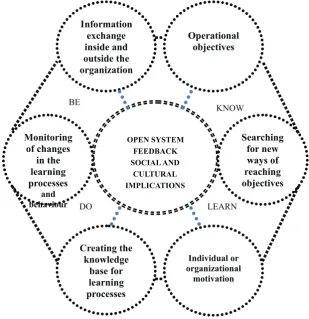
-ing with school is relevant here. Transformation processes (Diagram 1) should begin with curriculum guidelines, through curriculum, updated educational objectives until new procedures of achieving them. This ‘school confusion’ must, however be accepted socially, information about changes is important as well as gathering opinions about innovative ideas. One could refer here to parents’ interests, their own school achievements and influence of school education on the selection of their career.
Figure 1. transformation system towards ‘learning organization’.
First decision is needed regarding the types of processes which could strengthen the subject knowledge base and knowledge about learning processes. They must generate changes in the attitude to learning and to the teaching contents. Obviously, favourable atmosphere is necessary for undertaking such challenges. It means the proper didactic background and support for constant professional development, properly understood research freedom in order to use knowledge resources in a creative way.
School evolution towards a ‘learning organization’ can increase the distance from traditional cur
-riculum and traditional role of the teacher in the process of education. At a certain point ‘lerning schools’ can start following their own paths in connection with the ideas generated by them. Monitoring those paths is necessary. Like students learn from one another so ‘learning organizations’ must take advantage of each other’s experiences. Teachers must often contact one another and schools and students must have access to didactic materials. Free access to educational materials, information flow and comparative evaluation of effects are a priority. As the members of ‘strategic planning committee’ it is students who should help define future objectives and specify the ways of achieving them by instructions, ways of communication, technologies and strategies.
161
IN THE 21 CENTURY Volume 6, 2008
science and biology learning is comprehensive. Publications about school biology education often refer to places (laboratory, school garden, field classes, museum) where the teachers have tools and experience necessary for teaching of predicted contents, less frequently they refer to what the teachers need in order to create a chance for cooperation and learning from others.
The diffrences in approach may be related to the debate about the definition and concept of learning in connection with the relations between learning and development (Piaget, 1946; Vygotsky, 1989 [1934]), question about dimensions of learning (Illeris, 2006) or conditioning factors while taking into account individual cognitive structures (Ausubel, 1968).
It seems however, that differentiated approaches to learning can be compatibile with one another and they point to the situations where they develop various form of knowledge, both subject knowledge and metaknowledge. In his learning model, Kolb (1984) provides an interesting and inspiring image of the internal structure of learning processes, Giordan (1995), exceeds the three basic dimensions of the learning act and constructivistic learning model while elaborating his own ‘allosteric learning model’, which describes what is happening in the student’s mind when general conditions make learning (biol
-ogy learning) easier. In accordance with the latter model biol-ogy teaching and making it available for everybody or at least for the majority of people requires quite complex procedures. However it is possible through classifying the basic parameters which make the learning process easier on a regular basis. It supports the thesis that gradual transformation of school into a ‘learning organization’ and ‘learning to learn organization’ might begin with ourselves, formal and informal biology education understood and organized in a modern way.
Methodology of Research
Metacognition means the awareness of one’s own cognitive processes, due to which it is both mas
-tering the skills and the knowledge regarding the ways of learning as well as applying suitable strategies are possible (Annett, 2002). Elaboration of the author’s concept connected with the research on the new school’s model was preceded by the analysis of all the groups of learning models in the context of applica
-tion of ICT tools described in the available literature on the subject. A particularly big role was attributed to two processual models, due to the possibility of: /1/ broadening the opportunities regarding the formation of notions and teaching strategies supporting this process, indication of the ways of transforming infor
-mation into knowledge as well as and supporting the processes connected with collecting and analyzing information (induction model) and /2/ enabling students to analyze data and consider problems from vari
-ous perspectives (notion absorption model). The remaining two models of information processing found application to a lesser degree, however, one cannot neglect their role in: /1/ facilitating transforming ideas and concepts into optimal solutions and broadening perspective of considering the problem by students (synectic model) and /2/ consolidating and reorganizing information ‘deposited’ in long-term memory (mnemotechnical model). The mentioned models were earlier tested as a components of ‘metamodel’, combining model of genetics teaching and learning (Potyrala, 2007) but they haven’t been a subject of research on new types of education toward ‘school as learning organization’.
The following research issue was formulated: Can these models create new types of learning op
-portunities in science and biology education?
The research hypothesis was grounded on the theorethical perspective of how people learn, as it was discussed by Bransford, Brown & Cocking, (2001). According to it the models assuming the application of ICT tools can create new types of learning opportunities in science and biology education because can be used for:bringing exciting curricula based on real-world problems into the classroom; providing scaffolds and tools to enhance learning; giving students and teachers more opportunities for feedback, reflection, and revision; building local and global communities that include teachers, administrators, stu
-dents, parents, practicing scientists, and other interested people; and expanding opportunities for teacher learning. It was assumed that the applied metacognitive strategies oriented towards the enumerated types of active knowledge acquisition (learning models) influence the effectivenes of tasks solving which is expressed in the higher average score obtained by students in experimental classes in comparison with control classes.
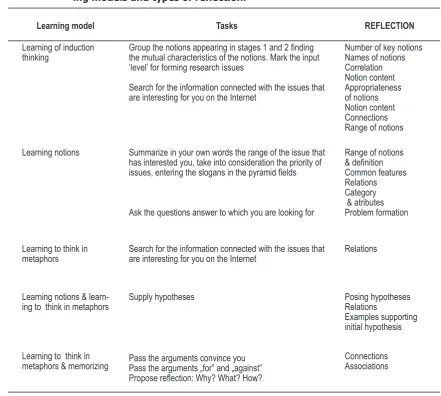
162 reflecting them in ‘metalearning cards’(Table 1) allows univocal qualifying of a given lesson objective
connected with students activity, to the group - of the realized or unrealized ones as well as the efficient evaluation of pedagogical observation.
table 1. examples of metalearning cards’ tasks in connection with the applied
learn-ing models and types of reflection.
Learning model Tasks REFLECTION
Learning of induction
thinking Group the notions appearing in stages 1 and 2 finding the mutual characteristics of the notions. Mark the input ‘level’ for forming research issues
Search for the information connected with the issues that are interesting for you on the Internet
Number of key notions Names of notions Correlation Notion content Appropriateness of notions Notion content Connections Range of notions
Learning notions Summarize in your own words the range of the issue that has interested you, take into consideration the priority of issues, entering the slogans in the pyramid fields
Ask the questions answer to which you are looking for
Range of notions & definition Common features Relations Category & atributes Problem formation
Learning to think in
metaphors Search for the information connected with the issues that are interesting for you on the Internet Relations
Learning notions &
learn-ing to think in metaphors Supply hypotheses Posing hypothesesRelations Examples supporting initial hypothesis
Learning to think in
metaphors & memorizing Pass thePass the arguments „for” and „against” arguments convince you Propose reflection: Why? What? How?
Connections Associations
The most suitable ones were found to be educational procedures supported by ICT tools enabling students of experimental classes independent knowledge acquisition through developing emotional learning through activities (situated teaching), learning through communicating (problem strategy) and learning through experiencing (creative thinking techniques). They could be called critical think
-ing form-ing in students. Critical think-ing is a rather diverse class of concepts and techniques to help students think better about complex subjects matters, make better decisions, and just learn in a more active way and focused around the questions: ‘Why?’, ‘What?’, ‘How?’. During lessons in experi
-mental classes students were confronted with opinions of special experts in various areas of biology, they verified their hypotheses in interactive virtual museums and they learned argumentation due to the applied techniques of effective learning. In control classes the strategy of traditional handing over ready knowledge by the teacher was applied. At the end of the experiment students of experimental and control classes did a twelve tasks test. Particular tasks tested (in accordance with the assumed learning models): induction learning, notion learning, metaphoric thinking and memorizing.
120 students of scecondary school level participated in the research (60 – experimental classes and 60 – control classes), altogether 64 lessons were observed and 1440 answers to the tasks ques
163
IN THE 21 CENTURY Volume 6, 2008
Results of Research
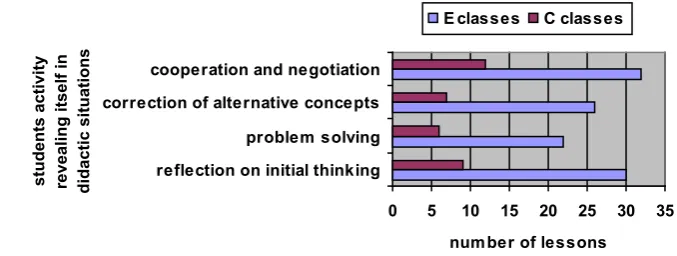
On the basis of lesson observation protocol in control (C) and experimental (E) classes students’ knowledge conceptual framework, their knowledge organization, students’ ability for critical think
-ing and problem solv-ing, transfer of learn-ing to new problems and contents can be specified. It was expressed in didactic situations and activities presented on Figure 1. In E classes they occurred even three times more frequently than in control classes.
0 5 10 15 20 25 30 35 reflection on initial thinking
problem solving correction of alternative concepts cooperation and negotiation
students activity revealing itself in didactic situations
number of lessons E classes C classes
Figure 1. Results of pedagogical observation in control (c) and experimental (e) classes. the basis for the analysis was the number of lessons at which
stu-dents activity revealing itself in specific didactic situations was observed.
the number of observed lessons in e classes = 32, in c classes = 32.
Lessons in E classes proved that metacognitive competence can be developed due to proper procedures which in turn are supported by ICT tools (Table2).
table 2. examples of procedures supported by Ict tools (STM - short – term memory; LTM - long – term memory).
Procedures
(metacognitive strategies for successful learning) Competence
Concentration on significant elements of the content Selective perception Gathering information about teaching objectives, defining
the learning goal, consideration of motivation level Motivation & support for the flow of information from STM to LTM Remembering earlier knowledge Pattern recognition
Information processing Division into portions, repetitions, encoding, semantic memory, episodical memory, cognitive schemes Application of new information Recalling
Feedback Enforcement, error correction, reflection on the learning process
Evaluation of correct reactions, monitoring own learning by
questioning and self-testing Enforcement, error correction
Support for memory & new skills in new contexts Remembering, recalling, generalization
In order to check the research issue a statistical hypothesis was verified: the average score ob
-tained in the school achievement test in experimental classes and control classes is the same (zero hypothesis) compared with the alternative that the average score obtained in the school achievement test by students in experimental classes is higher than the average score obtained by the students in control classes (uniform test). Significance of differences between the average couples was exam
164 were not uniform the version of the test with separate estimation of variance was applied. The zero
hypothesis was falsified at the level of significance α = 0.05. All the calculations (Table 3) were carried out with use of Statistica 8.
In all the analysed cases the average score obtained by students in experimental classes is higher than the average score obtained by students in control classes in which metacognitive strategies for successful learningwere not introduced and the satisfying students` activity was not observed. In control classes one may talk about the poorest students` efficiency in tasks solving testing memoriz
-ing and metaphoric think-ing.
table 3. the results of hypothesis testing that the models applied in experimental classes create new types of learning opportunities in science and biology education which is expressed in the number of the solved tasks. explana-tions: e – experimental classes, c – control classes
n
– number of students s- standard deviation,x
– average number of marks, v – degrees of freedom, t-St– t Student test with separate estimation of variance, * significant dif-ference at the level α = 0,05.
Statisctics
Tasks’ sub-groups Tasks
1,2,10 3,5,12 4,7,9 6,8,11 Altogether
E K E K E K E K E K
n
60x
2,4 1,06 2,4 1,03 2,8 1,6 2,8 1,9 10,5 5,6s 0,55 1,28 1,16 1,27 0,55 1,28 0,52 1,39 2,05 4,14
t-St 6,28 6,12 6,29 4,87 8,09
v 79,7 117,1 79,66 75,65 86,34
difference * * * * *
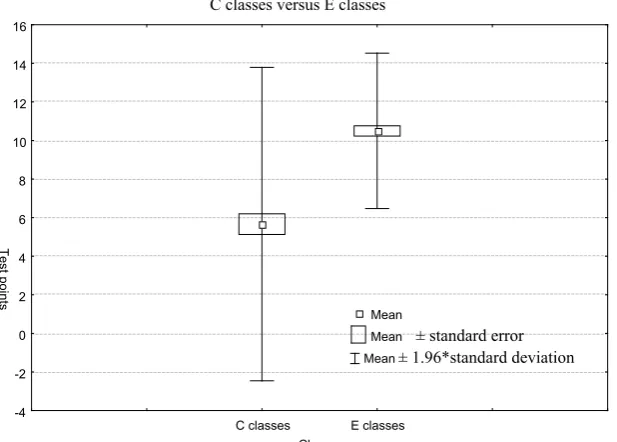
Students of experimental classes who solved the achievements tests had much better results than students in control classes (Figure 2). t - Student test proved that the difference between the results of the test in experimental and control classes is significant.
C classes versus E classes
C classes E classes
Classes -4
-2 0 2 4 6 8 10 12 14 16
Test points
Mean
Mean ± standard error
Mean ± 1.96*standard deviation
165
IN THE 21 CENTURY Volume 6, 2008
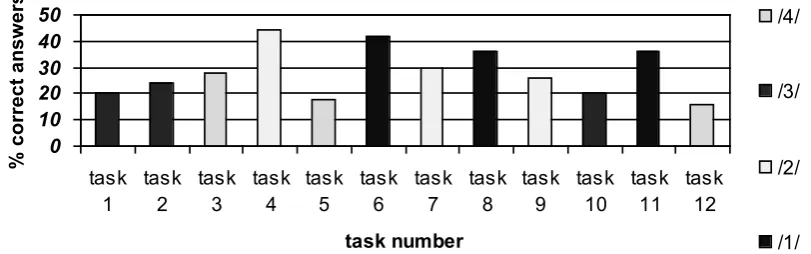
The following skills were tested (Figure 3 and Figure 4): producing ideas and verifying theories (task 1), communicating in various situations and solving problem situations basing on sience and biology knowledge (task 2), integrating knowledge from various areas of biology (task 3), ordering it in adequate structures (task 4), control and correction of task situation (task 5), analysis (task 6), categorizing (task 7), ordering (task 8), comparison and generalization (tasks 9 and 10), rearrang
-ing, creating and predicting (tasks 11 and 12). In E classes the best results were achieved within /1/ induction thinking model (tasks 6, 8, 11) and /2/ notion learning (tasks 4, 7 ,9). The results within /3/ metaphoric thinking (tasks 1, 2, 10) and /4/ memorizing (tasks 3,5,12) were only slightly worse.
0 20 40 60 80
task 1 task 2 task 3 task 4 task 5 task 6 task 7 task 8 task 9 task 10
task 11
task 12
task number
% correct answers
/4/
/3/
/2/
/1/ Figure 3. test results in experimental (e) classes (/1/tasks testing induction
think-ing model, /2/ tasks testthink-ing notion learnthink-ing, /3/ tasks testthink-ing metaphoric thinking, /4/tasks testing memorizing).
0 10 20 30 40 50
task
1 task2 task3 task4 task5 task6 task7 task8 task9 task10 task11 task12
task number
% correct answers
/4/
/3/
/2/
/1/ Figure 4. test results in control (c) classes (/1/ tasks testing induction thinking
model, 2/ tasks testing notion learning, /3/tasks testing metaphoric think-ing, /4/ tasks testing memorizing).
The results of pedagogical observation regarding the influence of selected strategies and pro -cedures supported by ICT toolson improving metacognitive competence in students in the course of science and biology education found confirmation in students’ achievement test results, in which the level of acquired competences was revealed in the efficiency of solving the tasks.
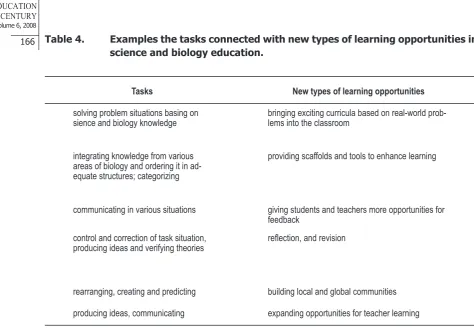
166 table 4. examples the tasks connected with new types of learning opportunities in
science and biology education.
Tasks New types of learning opportunities
solving problem situations basing on
sience and biology knowledge bringing exciting curricula based on real-world prob-lems into the classroom
integrating knowledge from various areas of biology and ordering it in ad -equate structures; categorizing
providing scaffolds and tools to enhance learning
communicating in various situations giving students and teachers more opportunities for feedback
control and correction of task situation,
producing ideas and verifying theories reflection, and revision
rearranging, creating and predicting building local and global communities
producing ideas, communicating expanding opportunities for teacher learning
The analysis of the test results in experimental classes in view of the functioning of particular detailed models allows the belief that the adapted learning models can create new types of learning opportunities in science and biology education.
Conclusion & Discussion
Student management in a learning organization /school should be focused on evaluation and encouragement for individual development. Organizational learning appears when people in the or
-ganization experience a problem situation and look for solutions in accordance with the mission of that organization. The most important success factor in school transformation towards the ‘learning organization’ is students’ willingness to share knowledge. Not regular learning of biological contents can be transformed into the will for permanent education in the situation of access to information and attention focus on all the students and not only on the best ones. It does not mean, however, that improving work with the students is sufficient for the realization of the idea of ‘learning organiza
-tion’. Coexistence of formal, informal and incidental education in the permanent education of the knowledge society is the reason why solving school biological problems may be only a proposition of possible ways and tools in search of answers to questions. First and foremost, school has to give up the mission of teaching and focus on showing how one can learn. New solutions result from the variety of approaches and contexts. School as a ‘learning organization’ should take advantage of the teachers’ knowledge potential, support them and motivate them for searching for knowledge regard
-ing new solutions in order to create, modify and transfer knowledge. A feature of this organization is also team work, creating knowledge structures, motivating for learning, creating conditions for using knowledge potential of both students and teachers. Moreover the student has a right to choose the way of gaining knowledge depending on individual style of learning.
The presented conclusions are confirmed in the literature (Jih & Reeves, 1992; Fullan, 1995; Wade, 1997) and support the concept of teaching biology in accordance with the mission of ‘learning school’. It is a new challenge for biology education in 21st century. The generator of changes can be
educationally understood Information & Communication Technology (ICT).
-167
IN THE 21 CENTURY Volume 6, 2008
titude and creative thinking. Techniques of creative thinking supported by computers, in connection with models of learning, open new research areas in the context of analysing rules concerning abstract conceptualisation (Wenta, 2000), and those shall be a starting point for research on specifying the areas of students’ intellectual activity and intentional mechanisms and those depending only on a stimulus situation (automatic transformation of data).
In connection with the role of the teacher and his activity in the process of obtaining by students these skills a lot of researchers draw the conclusion on development the attitude of active learning. For example Kubli (1979): ‘Although Piaget pleads explicitly for an active school, this does not
imply that the student alone takes the initiative if he is taught reversibly; the teacher must be just as active as the student’. The conducted research shows that in spite of computerized environment of teaching, it is possible. The role of teacher wasn’t limited by ICT tools, just the opposite, it requires to be engaged.
Metacognition of students in the experimental classes, that is ‘knowledge about knowledge’ and processes occurring in the course of cognitive activity, was displayed mainly in information organization and monitoring as well as regulating the course of own cognitive activity while per
-forming specific tasks (Słabosz, 2005). They were mostly problem tasks. The students constructed the problem representation (they asked questions on the basis of which they created an adequate description of situation or established mutual relations between elements of the problem – entry in the metalearning cards), and they performed the cognitive operations in order to solve the problem that were earlier agreed upon. The way of formulating problems by students revealed significant problems with defining them. Poorly defined problems in the control classes in connection with the strategy applied at lessons in those classes were reflected in the difficulties connected with their solution, which was confirmed by test results in the form of poorly acquired skills associated with, among others, communicating, using information and producing ideas.
These results are also confirmed by the information on cognitive support during problem solving at science lessons with computer tools use (Fund, 2005). In all cases, the effects of the experiment are justified on the basis of Anderson’s ACT-R theory which suggests that declarative knowledge is changed into the principles of creating in the context of problem solving activity (Anderson et al, 1995).
Biology education faces civilizational challenge that reveals new areas of research. Reflection regarding the access to new biological knowledge in view of the development of new information and communications technologies point to the necessity of broader application of the learning models in education; in particular in teachers’ continuous training.
School transformation system towards ‘learning organization’ (Diagram 1) refers to people (teachers and learners) who participate in the process of changes (‘be’), develop the ways of think
-ing (‘know’), build strategic partnerships (‘do’) and have the motivation and capacity to learn (‘learn’).
Education must constantly be adapted to new needs. The enumerated examples are conducive to the improvement of independent learning and constitute a significant step towards supporting students in the search for their own way of self-education.
References
Anderson, J. R., Corbett, A.T., Koedinger, K.R. & Pelletier, R. (1995). Cognitive tutors: lessons learned. The Journal of the Learning Sciences, 4, 167-207
Annett, J. (2002). Czynności ruchowe. Zdolności a proces uczenia się, Mackintosch & Colman (Eds), Wydawnictwo Zysk i S-ka, Poznan, 102.
Ausubel, D. P. (1968). Educational Psychology: A Cognitive View. New York: Holt, Rinehart and Winston. Bransford, J.D., Brown, A. L. & Cocking, R. R. (Eds). (1999). How People Learn: Brain, Mind, Experience. National Academy Press.
168 outcomes. Computer Based Learning in Science. Integrating New Technologies in Science and Education,
Zacharia & Constantinou (Eds.), University of Cyprus, Nicosia, 307-317.
Giordan, A. (1995). Les nouveaux modèles pour apprendre: dépasser le constructivisme ? Perspectives, 25, 109-127.
Jih, H.J. & Reeves, T.C. (1992), Mental models: a research focus for interactive learning systems, Educational Technology Research and Development, 40, 39-53.
Illeris, K. (2006). Trzy wymiary uczenia się. Poznawcze, emocjonalne i społeczne ramy współczesnej teorii uczenia się, Wydawnictwo Naukowe Dolnośląskiej Szkoły Wyższej TWP, Wrocław.
Kolb, D. A. (1984). Experiential learning. Englewood Cliffs: Prentice-Hall.
Kubli, F. (1979). Piaget’s cognitive psychology and its consequences for the teaching of science. European Journal of Science Education, 1, 5-20.
Piaget, J. (1946). La formation du symbole chez l’enfant. Neuchåtel : Delachaux et Nestlé.
Potyrala, K. (2007). L’exploration de l’influence des technologie de l’information sur les capacités métacogni
-tives des élèves de lycée, ACCEDIT.
Słabosz A. (2005). Twórczość a metapoznanie. Dydaktyka twórczości, Szmidt (Ed), Oficyna Wydawnicza Impuls, Kraków, 179-192.
Vygotsky, L.S. (1989) [1934]. Myślenie i mowa, Wydawnictwo Naukowe PWN, Warszawa. Wade, R. (1997). Lifting a school’s spirit. Educational Leadership, (54)8, 34-36.
Wenta, K. (2000). Abstrakcyjna konceptualizacja w rozwiązywaniu zadań wspomaganych technikami kom
-puterowymi. Kognitywistyka i Media w Edukacji, 3, 9-25.
Adviced by Daniel Raichvarg, University of Burgundy, France
Katarzyna Potyrala Adjunct/assistant professor, Pedagogical University of Cracow, Department of Biology
Didactics, 31-054 Cracow, Podbrzezie street no 3, Poland. Phone: +48126626705.