GSJ: Volume 7, Issue 12, December 2019, Online: ISSN 2320-9186 www.globalscientificjournal.com
CBN CASHLESS POLICY IMPLEMENTATION AS PREDICTOR OF SUSTAINABLE ADMINISTRATION OF HIGHER EDUCATION IN SOUTH-SOUTH
NIGERIA: IMPLICATION FROM MANAGEMENT PERSPECTIVE
1
Obia Eniang-Esien PhD & 2Martha Daniel Ekpe PhD
1&2
Department of Educational Management, Faculty of Education Cross River University of Technology, Calabar Cross
River State, Nigeria
ABSTRACT
The paper focused on assessment of the CBN’S cashless policy implementation as predictor of sustainable administration of higher educationin south-south Nigeria: Implication on educational management. Two hypotheses were formulated to guide the study. The study adopted the descriptive survey research design. It became expedient to adopt survey design because this method allowed the researchers to obtained data from a representative sample from a wider area of coverage (for an objective analysis and valid inference). The population for the study comprised 16, 238 administrative staff of tertiary institutions in south-south, Nigeria. The stratified and simple random samplings were employed in the study and relevant data for this study was obtained from the sampled respondents. The sample size for study was 627 respondents drawn from among six selected tertiary institutions in south-south, Nigeria. A well structured questionnaire titled “Cashless Policy and Sustainability of Higher Education Questionnaire (CPSHEQ)" which was face validated by three experts two in Educational Management and one in Measurement and Evaluation. The reliability was carried out using split half reliability method and the coefficient of internal consistency obtained ranged from .87 to .91. The data obtained from the research instrument were analyzed using descriptive statistics (simple percentages and bar charts) and inferential statistics (population t-test and multiple regression analysis). The results revealed the level of cashless policy implementation is significantly low. Also, there is a significant prediction of cashless policy in terms of infrastructure, security and awareness on sustainable administration of higher education. The study recommended that with the creation of numerous payment options, the process of cash collection will be made simple and the cost and risk associated with cash transfer and processing reduced. This will have a strong implication of the management of tertiary institutions across the country.
INTRODUCTION
Cashless implies an economy policy in which banking including all administrative
transaction can effectively be carried without necessarily carrying physical cash as a means of
exchange of transaction but rather with the use of credit or debit card payment for goods and
services. The cashless economy policy initiative of the Central Bank of Nigeria (CBN) is a move
to improve the financial terrain which will in turn support administration of educational activities
(Ejiro, 2012). This implies that a Cashless economy is an environment in which money is spent
without being physically carried from one person to the other. The first issue in the cashless
economy is the issue of electronic purse. This is electronic information that is transmitted to a
device which reveals the information about how much a person has stored in the bank and how
much he can spend.
The CBN cash policy stipulates a daily cumulative limit of N150, 000 and N1, 000,000
on free cash withdrawals and lodgments by individual and corporate customers respectively in
the Lagos State with effect from March 30, 2012. Individuals and corporate organizations that
make cash transactions above the limits will be charged a service fee for amounts above the
cumulative limits. The policy through the advanced use of information technology facilitates
fund transfer, thereby reducing time wasted in Bank(s). The idea of introducing cashless policy
in Nigeria began in Lagos State, Nigeria. According to Central Bank of Nigeria (CBN, 2011)
Lagos state accounted for 85% of POS and 66% of cheques transaction in Nigeria. Cashless
economy aims at reducing the amount of physical cash circulating in the Nigeria economy and
thereby encouraging more electronic–based transaction. According to Central Bank of Nigeria
(CBN, 2011) the policy is expected to reduce cost incurred in maintaining cash-based economy
by 90% upon its full implementation in Nigeria. This study aims to look at the impact of cashless
economy in Nigeria.
Cashless economy is not the complete absence of cash, it is an economic setting in which
goods and services are bought and paid for through electronic media. According to Woodford
(2003), Cashless economy is defined as one in which there are assumed to be no transactions
frictions that can be reduced through the use of money balances, and that accordingly provide a
reason for holding such balances even when they earn rate of return. In a cashless economy, how
much cash in your wallet is practically irrelevant (Roth, 2010) observed that developed countries
electronic ones, especially payment cards. Some aspects of the functioning of the cashless
economy are enhanced by e-finance, e-money, e-brokering and e-exchanges. These all refer to
how transactions and payments are effected in a cashless economy (Moses-Ashike, 2011). This
means that increased usage of cashless banking instruments strengthens monetary policy
effectiveness and that the current level of e-money usage does not pose a threat to the stability of
the financial system.
In spite of how robust the CBN cashless policy seems to be there are inherent challenges
of the cashless policy According to Ikechukwu (2017), the change from cash based economy to
cashless economy moved people inconvenienced the stakeholders, especially the populace, due
to lack of understanding and proper guidance on its implementation. These has hampered the
adoption and fuelled conspiracy theories among stakeholders. Okoli (2015: 12) stated that “There are several complaints from different quarters that sufficient facilities have not been
provided to make the system smooth. The e-payment system is said by many who have tried to
use it to be filled with hitches. Sometimes, one is charged for service not successfully rendered.
Infrastructure The use of e-cash, commonly known as “cashless” contains challenges that
are readily amplified by the inadequacies of physical infrastructure]. Access to the internet at
affordable price is poor and the lack of credible energy utilization (power supply) has led to a
series of challenges of its own as regards e-services. Other infrastructure and services that are
related to the policy and are inadequate in supply include the Point of Sale (POS) terminal,
Automated Teller Machine (ATM), Mobile banking (Ejoh, 2014).
Security system in the country is pivotal in the emergence of the cashless policy and can
be a deterrent if not handled well (Yaqub, Bello, Adenuga and Ogundeji (2013) report reveals
the first year of the scheme saw diverse fraudulent activities reported. These compromise the integrity of the monitoring bodies in Nigeria. In the CBN Annual report” Central Bank of
Nigeria (2018) a record of 25,043 fraud cases were raised as opposed a reduced rate of 19,531 in
2016 in which some of the funds were recovered.
Ndifon and Inah (2014) conducted a study on implementation of the cashless policy on
January 1st, 2012 in Lagos state which is aimed at reducing the high cost of cash production, circulation and distribution in Nigerian economy, the set-out goals have not been fully achieved
due to several on-going challenges. This survey research was conducted to review challenges of
of electronic payment for exchange of value. The Unified Theory of Acceptance and Usage of
Technology (UTAUT) were employed to identify various challenges from data gathered through
questionnaires distributed to different stakeholders in the economy. A total of 410 questionnaires
were collected and the research work adopted used Partial Least Square (PLS) method and used
Smart PLS software during the data analysis. The attendant findings were pivotal to
understanding the challenges encountered in implementing cashless policy in Nigeria. This study
shows that despite the implementation of this policy, a lot of users are still being faced with
various challenges and more efforts are still being required to achieve an effective cashless
society
Awareness coupled with literacy that is lacking, as most adults do not understand it,
hence are at a loss to actively participant in financial policies. Financial literacy, involves understanding how money works, its management pattern, how it’s earned, how to invest money.
Many people in the country lack banking culture as a result they save by crude and informal
means, while some lack access to banking services; for such people, e-transaction is a mere
story.
Sustainability of cashless policy on administration of higher education such as,
universities, colleges of education, polytechnics, Monotechnics and other institutions offering
correspondence courses. According to the National Policy on Education (FRN, 2014), the goals
of tertiary education include the following, to; (a) contribute to national development through
high level of relevant manpower training; (b) develop and inculcate proper values for the
survival of the individual and society; (c) develop the intellectual capability of individuals to
understand and appreciate their local and external environment; (d) acquire both physical and
intellectual skills which will enable individuals to be self-reliant and useful members of the
society; (e) promote and encourage scholarship and community services; It has been documented
that university education shall make optimum contribution to national development: intensify
and diversify its programmes for development of high level manpower within the context of the nation’s needs, among others (FRN, 2014).
In this environment of restricted revenues and mandated expenditures, higher education
funding is a tempting target to cut, not only because it is discretionary but also because colleges,
unlike many other state programmes, can tap from other revenue sources, and because a growing
education is increasingly viewed by both policy makers and the general public as primarily a
private benefit, rather than a broader social good. Many Nigerian adults believe that every
potential candidate who wants a four-year higher education should have the opportunity to gain
one, because to them, education is the right of individuals and should be provided by the
government. By implication therefore, state and federal governments are expected to invest more
money in higher education, while a few people believe that students and their families should
pay the largest share of the cost of a tertiary education. Given ongoing access barriers, these
perceptions may make it more difficult than in the past now that spaces for candidates in public
tertiary institutions could not meet the high demand from the intending candidates, hence, the
resort to private institutions that are not more often reliable compared to the conventional ones.
The Central Bank of Nigeria (CBN) stated that the introduction of cashless economic
policy in Nigeria would moderate the cost of cash management, encourage the use of electronic
payment channels and reduce lending rates to further make credit accessible to big and small
businesses. Central Bank of Nigeria (2012) maintained that the cashless Economic development
and modernization of the Nigeria in payment system in line with vision 2020, reduces the
amount of physical cash circulation in the Nigeria economic and thereby encouraging movement
of electronic-base transactions, reduce cost incurred in maintaining cash base economy by 90%
when fully implemented in Nigeria.
Ikpefan, Akpan, Godswill Evbuomwan and Ndigwe (2018) sought to determine the
impact electronic banking tools have on cashless policy in Nigeria for a ten year period which
spans from 2006 to 2015. In this research work, the ordinary least square method was used to
analyze the data. The data used for this research work was collected from the Central Bank of
Nigeria (CBN) annual report and the Nigerian Interbank Settlement System (NIBSS) website.
The major findings of this research work showed that there is no significant impact of electronic
banking tools on the currency in circulation. The study recommends that transaction charges
should be further reviewed to a little (single digit) or no charge, to encourage more patronage of
e-payment platforms and CBN, Deposit money banks (DMBs), and other non-banks financial
institutions should provide public enlightenment and awareness programs that will create
awareness and entice the unbanked individuals into the banking system especially those in the
Akpan (2009) observed that the introduction of cashless economic policy in Nigeria aims
at reducing the cost of banking services and drive financial institutions by providing more
efficient transaction options and greater reach to customers, improve the effectiveness of
monetary policy in managing inflation as well as curbing negative consequences associated with
the high usage of physical cash in the economy such as risk of cash related crimes , revenue
leakage arising from too much of cash handling , inefficient treasury management due to nature
of cash processing and high inflation of the economy. Despite the benefits posited by cashless
economic policy and its importance in sustainable and developing the economy of Nigeria, it has
brought confusion among the masses as many misconceived the term to be an economy there
will be no more cash in the circulation but card and other instruments. Many still believed that,
the cash limit set by Central Bank of Nigeria (CBN) in respect to cashless economic policy is too
low and query and how the Central Bank of Nigeria arrived at the bench-mark. Notwithstanding
the fact that the cashless policy come with enormous benefits; there are also some missing links
that confronted the policy such as financial constraints, infrastructure, deficit, literally levels,
fraudulent activities and poor power supply in Nigeria. Consequently, the policy failed to
achieve its objectives. Apart from the physical challenges, economic data and indicators are not
fully available and reliable. There is a great challenge in attempting to analyze the true impact of
the cashless policy on the economy of Nigeria as only few monetary and macroeconomic
indicators can be traced with subject matter.
This is a road map; of action plan for achieving sustainability in any activity that uses
resources and where immediate and intergenerational replication is demanded. Sustainable
development is the organizing principle for sustaining fruit resources necessary to provide for the
needs of future generations of life on the planet (Odior & Banuso, 2012). Sustainable
development is development that meets the needs of the present without compromising the
ability of the future generations to meet their own needs. Limitations imposed by advanced
technology vices within the environment and the ability to meet the present and future needs of
customers. Babalola (2008) opined that sustainable development is a roadmap and action plan for
achieving sustainability in any activity that uses resources and where immediate and
intergenerational replication is demanded. As such, sustainable development is the resource
necessary to provide for the needs of future generations. Okey (2012) said that sustainability is a
the needs of the present and future generation to meet their needs. Sustainable development is an
approach to growth and to manage natural product and social welfare of their generation.
Statement of the problem
The introduction monetary policy as a technique of economic was to bring accountability
and sustainability in economic growth and development through cashless policy. Since the
introduction of the cashless policy, there have been series of problems ranging from economic
data, administrative issues which have a lasting effect on the administration of education for
sustainable development. There is a great challenge in attempting to analyze the true impact of
the cashless policy on the economy of Nigeria as only few monetary and macroeconomic
indicators can be traced with relation to the subject matter. Several scholars have attempted to
analyze the cashless system or e-banking. However, it becomes clear that few studies present a
comprehensive evaluation of cashless banking implications in sustainable educational
development. In-spite of numerous studies conducted There impact on educational management
has not been fully outlined. Thus, the problem of this study is: what is the impact of cashless
policy implementation on sustainable administration of higher education in south-south Nigeria?
What are the possible implications of cashless policy from management perspective? Seeking
answers to these questions constitutes a central problem for this research study.
Research Questions
The following questions were answered in the study
1. How effective is the cashless policy on sustainable administration of higher education
policy?
2. What are the benefits accrued in the implementation of cashless policy in south-south,
Nigeria?
Statement of Hypotheses
The following null hypothesis were stated and tested at .05 level of significance
1. The level of cashless policy implementation is not significantly low
2. There is no significant prediction of cashless policy in terms of infrastructure, security
and awareness on sustainable administration of higher education.
This study adopts the descriptive Survey Research Design. It became expedient to adopt survey
design because this method allowed the researchers to obtained data from a representative
sample from a wider area of coverage (for an objective analysis and valid inference). The
population for the study comprised all administrative staff of tertiary institutions in south-south,
Nigeria. The stratified and simple random sampling were employed in the study and relevant
data for this study was obtained from the sampled respondents. The sample size for study was
627 respondents drawn from among six selected tertiary institutions in south-south, Nigeria. A
well structured questionnaire titled “Cashless Policy and Sustainability of Higher Education
Questionnaire (CPSHEQ)" which was face validated by three experts two in Educational
Management and one in Measurement and Evaluation. The reliability was carried out using split
half reliability method and the coefficient of internal consistency obtained ranged from .87 to
.91. The data obtained from the research instrument were analyzed using descriptive statistics
(simple percentages and bar charts) and inferential statistics (population t-test and multiple
regression analysis). The result is presented below.
RESULT
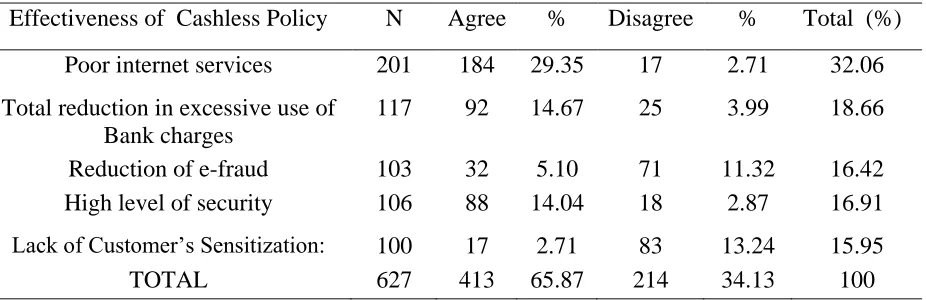
The result of the research questions are presented in Table 1 and 2.
Research Question 1: How effective is cashless policy on sustainable administration of higher
education. To answer this research question, descriptive statistics was employed as presented in
TABLE 1. Effectiveness of cashless policy on sustainable administration of higher education
Effectiveness of Cashless Policy N Agree % Disagree % Total (%)
Poor internet services 201 184 29.35 17 2.71 32.06
Total reduction in excessive use of Bank charges
117 92 14.67 25 3.99 18.66
Reduction of e-fraud 103 32 5.10 71 11.32 16.42
High level of security 106 88 14.04 18 2.87 16.91
Lack of Customer’s Sensitization: 100 17 2.71 83 13.24 15.95
TOTAL 627 413 65.87 214 34.13 100
Table 1 revealed the result of the level of effectiveness of cashless policy on sustainable
administration of higher education .as majority of the respondents 184 (29.35%) said that
cashless policy is not effective due to poor internet services while 17 (2.71%) disagree that
total reduction in excessive use of Bank charges while 25 (3.09%) disagree that it leads to total
reduction in excessive use of Bank charges. 32 (5.10%) agree that it leads to reduction of e-fraud
while 71 (11.32%) disagree that it does not lead to reduction in e-fraud. For high level of
security 88 (14.04%) agreed while 18 (2.87%) disagreed. Finally, lack of Customer’s
Sensitization: 17 (2.71) agreed that it leads to lack of Customer’s Sensitization: while 83 (13.24%)
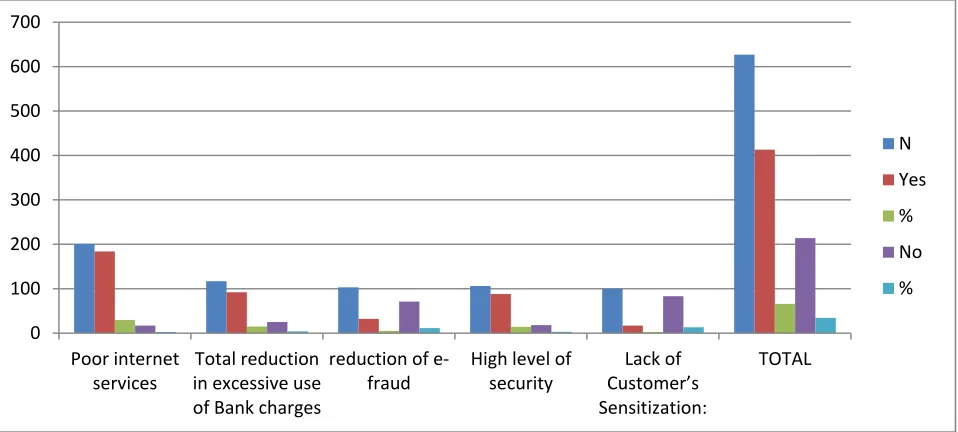
disagreed that it does not lead to lack of Customer’s Sensitization: the result is further presented in
figure 1:
Figure 1: Level of effectiveness of cashless policy on sustainable administration of higher
education.
TABLE 2: Benefits accrued in the implementation of cashless policy in south-south, Nigeria.
Increase employment
opportunities %
Reduce employment opportunities Enhanced economic activities Foster economic development Reduce cash related
fraud TOTAL
N N % N % N % N % N %
13 2.07 274 43.56 31 4.93 33 5.25 278 44.2 629 100
Table 1 shows the view of respondents on benefits of CBN cashless economy in Nigeria. The
lowest percentage, 2.07 % of the respondents, believed that cashless policy will increase
0 100 200 300 400 500 600 700 Poor internet services Total reduction in excessive use of Bank charges
reduction of e-fraud
employment opportunities. A higher percentage, 44.2% of the respondents, believed that cashless
policy in Nigeria will reduce cash related fraud, followed by 43.56% who re of the view that
Figure 2: Benefits accrued in the implementation of cashless policy in south-south, Nigeria
0 100 200 300 400 500 600 700
N N % N % N % N % N %
Increase emp. Opp
% reduce emp. Opp. Enhanced economic
activities
Foster economic development
Reduce cash related fraud
TOTAL
Test of hypotheses
The results of the hypotheses are presented in table 3 and 4.
Hypothesis 1: The level of cashless policy implementation is not significantly low. To test this hypothesis, population t-test is employed as presented in table 3.
Table 3: Level of cashless policy implementation in south-south
level of cashless policy implementation N Mean Std. Deviation
Std. Error Mean
626 15.6507 3.85448 .15393
level of cashless policy implementation
Test Value = 0 t Df Sig.
(2-tailed)
Mean Difference 95% Confidence Interval of the Difference
Lower Upper
101.672 626 .000 15.65072 15.3484 15.9530
Table 3 revealed the one sample t-test analysis of the level of cashless policy implementation on sustainability of higher education. The p-value of .000 is less than the chosen alpha of .05. Thus, the hypothesis is rejected. This implies that the level of cashless policy implementation is on sustainability of higher education is significantly low
Hypothesis Two
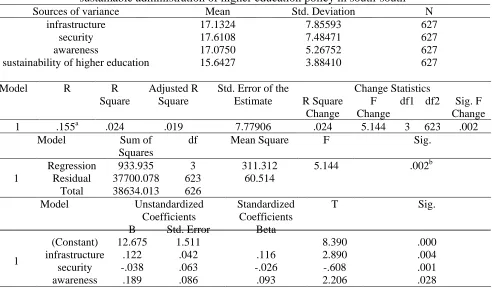
There is no significant prediction of cashless policy in terms of infrastructure, security and awareness on sustainable administration of higher education policy in south-south. To test this hypothesis, multiple regression analysis was employed as presented in Table 4.
Table 4
Multiple regression analysis of cashless policy in terms of infrastructure, security and awareness on sustainable administration of higher education policy in south-south
Sources of variance Mean Std. Deviation N
infrastructure 17.1324 7.85593 627
security 17.6108 7.48471 627
awareness 17.0750 5.26752 627
sustainability of higher education 15.6427 3.88410 627
Model R R
Square
Adjusted R Square
Std. Error of the Estimate Change Statistics R Square Change F Change
df1 df2 Sig. F Change
1 .155a .024 .019 7.77906 .024 5.144 3 623 .002
Model Sum of
Squares
df Mean Square F Sig.
1
Regression 933.935 3 311.312 5.144 .002b
Residual 37700.078 623 60.514 Total 38634.013 626
Model Unstandardized
Coefficients
Standardized Coefficients
T Sig.
B Std. Error Beta
1
(Constant) 12.675 1.511 8.390 .000
infrastructure .122 .042 .116 2.890 .004
security -.038 .063 -.026 -.608 .001
awareness .189 .086 .093 2.206 .028
The result in table 4 of the hypothesis that states there is no significant prediction of cashless
policy in terms of infrastructure and awareness on sustainable administration of higher education
policy in south-south revealed that the p-value of .004. .001 and .028 were found to less than the
chosen alpha of .05 for infrastructure, security and awareness. This implies that there is a
significant prediction of infrastructure, security and awareness (literacy) on sustainability of
higher institution in the study area.
Discussions of Findings
The findings of the study are discussed hypothesis by hypothesis as presented below
H01: The level of cashless policy implementation is not significantly low
The finding revealed that the level of cashless policy implementation is significantly low. This
may be due to poor implementation of te policy by stake holders in the academic environment.
The findings Ndifon and Inah (2014) whose findings were pivotal to understanding the
challenges encountered in implementing cashless policy in Nigeria. This study shows that
despite the implementation of this policy, a lot of users are still being faced with various
challenges and more efforts are still being required to achieve an effective cashless society the
authors also found that awareness coupled with literacy that is lacking, as most adults do not
understand it, hence are at a loss to actively participant in financial policies. Financial literacy,
involves understanding how money works, its management pattern, how it’s earned, how to
invest money. Many people in the country lack banking culture as a result they save by crude and
informal means, while some lack access to banking services; for such people, e-transaction is a
mere story.
H02: There is no significant prediction of cashless policy in terms of infrastructure, security
and awareness on sustainable administration of higher education policy in south-south. The
result revealed that there is a significant prediction of cashless policy in terms of infrastructure,
security and awareness on sustainable administration of higher education policy in south-south.
thus, the level of infrastructural development, security consciousness and level of awareness has
a significant relationship. The result is in harmony with that by Ikpefan, Akpan, Godswill
Evbuomwan and Ndigwe (2018) findings showed that there is no significant impact of electronic
should be further reviewed to a little (single digit) or no charge, to encourage more patronage of
e-payment platforms and CBN, Deposit money banks (DMBs), and other non-banks financial
institutions should provide public enlightenment and awareness programs that will create
awareness and entice the unbanked individuals into the banking system especially those in the
informal sector in Nigeria. The findings also agrees with Akpan (2009) observed that the
introduction of cashless economic policy in Nigeria aims at reducing the cost of banking services
and drive financial institutions by providing more efficient transaction options and greater reach
to customers, improve the effectiveness of monetary policy in managing inflation as well as
curbing negative consequences associated with the high usage of physical cash in the economy
such as risk of cash related crimes , revenue leakage arising from too much of cash handling ,
inefficient treasury management due to nature of cash processing and high inflation of the
economy.
CONCLUSION
The study was carried assess the CBN’S cashless policy on economic development of public
servants in south-south, Nigeria. It is expected that its impact will be felt in modernization of
Nigeria payment system, reduction in the cost of banking services as well as reduction in high
security and safety risks. This should also include curbing banking related corruptions and
fostering transparency. It is also assumed that the introduction of cashless policy in Nigeria will
help to reduce the amount of bills and notes circulating in the economy. This should, therefore,
reduce handling operation cost incurred on conventional money, as well as reduction in cash
related crimes. It should also help to provide easy access to banking services for Nigerians.
Recommendation
Based on the findings, the following measures on how to efficiently and effectively improve the
cashless policy are recommended:
1. Creating an awareness program for both literates and non-literates is a major way to
encourage the use of the system, educational seminars for late adopter of the cashless
policies should be considered and this should be done at reduced prices or no price to aid
participation.
2. Efficient and effective administration tools should be provided to facilitate these policy
3. Improved security systems should be installed in the various platforms and facilities
involved in e-banking which will help to reduce scamming among internet fraudsters and
other forms of fraudulent practices in the banking and administrative industries.
Policy implication on educational management in Nigeria population
1. With the creation of numerous payment options, the process of cash collection will be
made simple and the cost and risk associated with cash transfer and processing reduced.
This will have a strong implication of the management of tertiary institutions across the
country.
2. It is a good tool in the tracking of corruption and money laundering accustomed with a
number of internet fraud among administrative staff in all ministries in the country.
3. It will increase transparency in business transactions. It will increase the involvement of
in sustaining higher education hereby increasing public participation in decision making
that will help to facilitate growth and development of tertiary institutions.
REFERENCES
1. Akpan, I. (2009). Cross channel integration and optimization in Nigerian banks. Telnet
Press Release, 20 (1), 1-4.
2. Akpan, R. (2009). Cashless Banking in Nigeria: Challenges, Benefits & Policy
Implications. European Scientific Journal. 8, (4), 12 – 16.
3. Babalola, E. (2008). Monetary Policy, Monetary Areas and Financial Development with
Electronic Money, IMF Working Study, IMF.
4. Central Bank of Nigeria (2011): Towards a Cashless Nigeria: Tools & Strategies. Nigerian
Journal of Economy. 3(2), 344 – 350.
5. Central Bank of Nigeria (2012): Towards a Cashless Nigeria: Tools & Strategies. Nigerian
Journal of Economy. 21(6), 124 – 132
6. Central Bank of Nigeria (2018): Towards a Cashless Nigeria: Tools & Strategies. Nigerian
Journal of Economy. 9 (4), 76 – 81.
7. Ejiro, O. (2012): What Nigerians Think of the Cashless Economy Policy. Nigerian Journal
8. Ejoh, N. (2014). The Workability of the Cash-less Policy Implementation in, 5(17), 179–
192. [25]
9. Federal Republic of Nigeria (2014). National policy on education (4th Edition). Lagos:
NERDC Press
10. Ikechukwu, A. (2017). Cashless Policy in Nigeria : The Mechanics, Benefits and Problems
Innovative Journal of Economics and Financial Studies Cashless Policy in Nigeria : The
Mechanics, Benefits and Problems.
11. Ikpefan O. A., Akpan E Godswill O. O., Evbuomwan, G. & Ndigwe, C. (2018).
International Journal of Civil Engineering and Technology. 9, (10), 718–731.
12. Moses-Ashike, H. (2011). Cashless Economic can Reduce Risk of Carrying Huge Cash,
retrieved Available: http://www.businessdayonline.com/…/22217.
13. Ndifon E.. & Inah O. (2014). The Workability of the Cash-less Policy Implementation in
Nigeria. Journal of Economics and Sustainable Development 5, (17), 1-16.
14. Odior, S. E. & Banuso, B. F. (2012). Cashless Banking in Nigeria: challenges, benefits and
policy implication, European Scientific Journal, 8 (12), 13-17.
15. Okey, O. O. (2012). The Central Bank of Nigeria’s cashless policy in Nigeria: Benefits and
challenges, Journal of Economics and Sustainable Development, 3(14), 128-133.
16. Okoli, N. H. (2015). The Cash-Less Policy in Nigeria: Issues, Challenges and Prospects”
author-me.com, [Online]. Available: http://www.author-me.com/nonfiction/cashless.htm.
[Accessed: 17- Nov-2018].
17. Woodford, F. (2003). Electronic Retail Payment Systems: User Acceptability & Payment
Problems in Nigeria. Arabian Journal of Business & Management Review. vol.5, pp. 60 –
63.
18. Yaqub, J. O., Bello, H. T., Adenuga, I. A. and Ogundeji, M. O. (2013). The cashless policy
in Nigeria: Prospects and challenges. International Journal of Humanities and Social