Uplink
Performance
of
Cell-Free
Massive
MIMO
with
Access
Point
Selections
Toan
X.
Doan
1,*,
Long
D.
Nguyen
2 1Thu Dau Mot University, Binh Duong, Vietnam 2Queen’s University BelfastAbstract
Cell-free massive multiple-input multiple-output (MIMO), in which a massive number of access points (APs) distributed over a large area serve a smaller number of users in the same time and frequency resources, inherits advantages from conventional massive MIMO (i.e. favourable propagation and channel hardening), and distributed system (i.e. macro diversity gain). As a result, cell-free massive MIMO can provide a great spectral efficiency, high capacity and offer uniformly great service for all users. To contribute to this great concept, an uplink and downlink performance of cell-free massive MIMO are investigated in this work. Novel access point selection and signal detection schemes are proposed to reduce the requirements of backhaul links connecting the APs and the central processing unit, and to improve the system performance in terms of the achievable rate. Note that most of signal detection schemes for cell-free massive MIMO in the literature rely on the channel hardening property, with results in less accuracy for small and moderate number of APs. Firstly, closed-form expressions for the achievable rate of the downlink and uplink are derived. Then, performance comparisons between the proposed signal detection scheme and the conventional scheme are exploited. The result shows that the proposed scheme (with the novel AP selection and signal detection) outperforms the conventional scheme in terms of the achievable rate and the amount of data load exchanging over the backhaul links.
Keywords:classf ile,LATEX2ε,EAIEndorsedTransactions
Received on 13 November 2018; accepted on 20 November 2018; published on 29 November 2018
Copyright © 2018 Toan X. Doan and Long D. Nguyen, licensed to EAI. This is an open access article
distributedunder theterms ofthe Creative Commons Attribution license(http://creativecommons.org/licenses/
by/3.0/),which permitsunlimiteduse, distributionandreproduction inanymediumsolongas theoriginalworkis properlycited.
doi:10.4108/eai.29-11-2018.155998
1. Introduction
The fast-growing and unlimited requirement of wire-less network capacity with the limited resources is the most challenging for networks providers. Improving spectral efficiency is one of the feasible approaches. Particularly, massive multiple-input multiple-output (MIMO), first introduced in [1], can provide a great spectral efficiency by employing massive number of antennas at base station. Interestingly, a new kind of massive MIMO systems has been proposed in [2–4], in which antennas are spread over a large area instead of a compact area as in the conventional massive MIMO system, namely cell-free (CF) massive MIMO.
Similarly to the conventional massive MIMO, CF, which is simultaneously serves much smaller number
∗
Corresponding author. Email:[email protected]
of users compared to the number of access points (APs) in the same time and spectrum resources, has many advantages. Owing to the macro diversity gain property, CF can offer an uniformly great service for all users [2], which has been an issue for cell-edge users’ performance in the conventional cellular systems. Additionally, CF is also a good solution for energy efficiency due to the short distance between users and APs. This aspect was considered in [5, 6], i.e., the relationship between total energy efficiency and network’s parameters was studied, and a power allocation algorithm is also proposed. Another important advantage of CF is spectral efficiency, which was investigated in [7, 8]. Particularly, the authors in [3, 8] derived the expressions for achievable uplink and downlink rate, and compared the performance between CF and small cells. The results showed that CF
Research Article
EAI Endorsed Transactions
significantly outperformed small cell system in terms of throughput.
In CF, all APs are connected to a central processing unit (CPU) via backhaul links, where most of signal processing is performed. To minimise data exchanging over the backhaul link, conjugate beamforming or maximum-ratio processing is suggested for both uplink and downlink [8]. The reason behind the suggestion is that there is no requirement of sharing the instantaneous channel state information (CSI) in the system. To be more specific, APs can perform channel estimation locally, and the information that CPU needs to control transmit power of APs is large-scale fading which slowly changes over time. Thus, the payload data is the main load travelling on the backhaul link.
Along with the aforementioned research works, CF had been studied under many other aspects. The performance of multi-group multi-cast, where many users need the same information are grouped together, was investigated in CF [9]. In addition to this work, short-term power constraint was applied to beamforming information in the downlink. The work in [10] considered an optimal problem which aims to maximise the minimum uplink rate of user under limited backhaul constraints. Then, the work [11] proposed another solution to improve the max-min SINR which was proposed in [10].
1.1. Discussion on the requirement of backhaul links
By observing the works [5, 7–11], to detect desired information from any user (uplink data), CPU requires the received signal of all APs, which means that a large payload is transmitted through the backhaul links, and the CPU has to do a large number of computations. Moreover, the contributions of different APs on the signal-to-noise and interference ratio (SINR) at the CPU are not identical. Some APs have strong multi-user interference which can lead to a decrement in SINR value. Motivated from that, a new APs selection scheme is proposed in this work to deal with aforementioned issue by reducing the number of APs involved in the signal detection at the CPU.
Note that our proposed AP selection schemes is different from that in [5]. More precisely, two proposed schemes in [5] aim to improve the total energy efficiency, where the first scheme is based on power control coefficients with high computational complexity, and the second one chooses the AP that have strongest large-scale fading values. More importantly, in [5,10] and [11], after implementation of the APs selection, the signal detection is still based on channel hardening, which turns less accurate as the number of selected APs is small. This problem is presented more details in the sequel.
1.2. Discussion on the case of moderate APs number
Channel hardening, a result of the law of large numbers in statistical theory, is one of the useful properties in massive MIMO, which can help the system reduce complexity, such as it does not need pilot training process and simplicity in signal detection algorithm [12? , 13]. Different from massive MIMO, where the large-scale fading between antennas and a user is nearly equal due to the fact that all antennas are located in a compact area, the large-scale fading of the links between a user and APs in CF massive MIMO is different. Hence, the convergence speed of the law of large numbers in this case must be slower. This problem was addressed in [14], which shows that the channel hardening strongly depends on the number of antennas at a AP and the density of APs. However, in a certain aspect, the deployment of multiple antennas at AP is impractical due to a high implementation cost.
As discussed earlier, the channels have a lack of hardening for moderate and small number of APs, leading to the fact that the signal detection algorithm based on the knowledge of channel statistics becomes less accurate. We thus propose another signal detection in this work, which does not rely on the channel hardening property. The proposed scheme can be applied for general case of AP number.
1.3. Contributions
The contributions of this chapter are summarised as
• A novel AP selection scheme is introduced. Result shows that the proposed approach improves the throughput per user, provides a solution with less computational complexity and less requirement in backhaul links.
• A new signal detection based on the knowledge of estimated channel is considered to deal with the issues of lack of channel hardening, as a consequence of deploying the AP selection. The analysis and simulation results show that our scheme can enhance the system performance, particularly for moderate and small number of AP.
• The closed-form expressions for instantaneous and ergodic achievable rate of the uplink, given the location of APs and users and the estimated CSI, are derived the first time, to the best of my knowledge.
2. System model
AP
CPU
User
AP
AP AP
Figure 1. System model
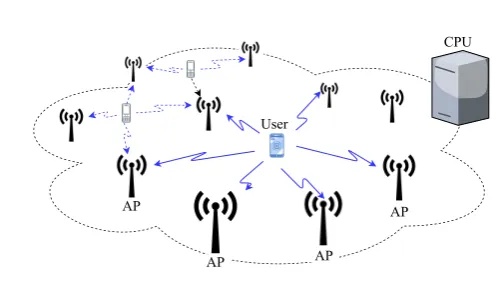
uniformly distributed over a large area. It is assumed that all APs and users are equipped with single antenna, and all APs are connected to a central processing unit (CPU) via a perfect backhaul link.
In the first phase of the time-division duplex protocol, users send pilot sequences to all APs. The APs then estimate the channels to users and share these information with a central processing unit (CPU). In the payload uplink data transfer, users send data to all APs. APs receive the transmitted signal, only selected APs forward their received signal to CPU. The selected APs is chosen by CPU as Algorithm1, which is discussed in the next section. Next, a signal detection is performed at the CPU based on the estimated information in the first phase.
The detail of all aforementioned processes in a coherence time is described as follows.
The channel coefficient between AP m and TUx is
denoted by
gmk=β1mk/2hmk, (1)
wherehmk∼ CN(0,1) is small scale fading and βmk is
large scale fading which is modelled as in [8], following the Hata-COST231 and a three-slope path loss model, as follows:
P L=
−L−34 log
10(dmk) , dmk> d1
−L−15 log
10(d1)−20 log10(dmk), d0< dmk≤d1
−L−15 log
10(d1)−20 log10(d0) , dmk≤d0,
(2)
where
L,46.3 + 33.9 log10(fc)−13.82 log10(hAP)
−(1.1 log
10(fc)−0.7)hu+ (1.56 log10(fc)−0.8), (3)
in which fc is the carrier frequency, hAP and hu are
the height of AP’s antenna and user’s antenna,dmk is
the distance from userk to APm,d0 andd1 are given distances.
Uplink Training Phase. Similar to the previous works
[2,5,7–11,14], the uplink training phase aims to help APs obtain the channel state information. Let ϕul,k∈
Cτ
(p)
ul×1 and τ(p)
ul be the pilot signal and its length (in symbols) that is sent by userk, the received pilot signal at APmis
y(p)m =
q
τul(p)ρ(p)ul X
k∈U
gmkϕul,k+wm, (4)
where ρul is the normalised transmit power, defined as the ratio of transmit power of the pilot signal over
noise power, U is the set of users,wm∈Cτul(p)×1 is the
additive white Gaussian noise (AWGN) vector and its elements are independent and identically distributed (i.i.d.) random variables CN(0,1). For the general
case of non-orthogonal pilot sequences, the greedy pilot assignment had been proposed in [8]. The pilot sequences in this work are assumed to be pairwise orthogonal. Then, the received pilot signal of userkat APm, ˜y(p)mk, can be extracted by projection the received signaly(p)m ontoϕHul,kas
˜
y(p)mk= q
τul(p)ρ(p)ul gmk+ϕHul,kwm. (5)
APmuses the information from (5) and minimum mean square error (MMSE) approach to estimate the channel gmk. Let ˆgmkdenote the estimation ofgmk, it is given by
[8,9]
ˆ gmk=
q
τul(p)ρul(p)βmk
1 +τul(p)ρ(p)ulβmk
˜
y(p)mk
(a)
=µ1mk/2zmk, (6)
where (a) is obtained due to ˜y(p)mk being Gaussian
distributed,µmk,
τul(p)ρul(p)βmk2
1+τul(p)ρ(p)ulβmk
,zmk∈ CN (0,1).
Let ˜εmk represent the channel estimation error, it is
defined by
˜
εmk,gmk−gˆmk. (7)
Then, from the MMSE channel estimation property [15], ˜εmk and ˆgmk are uncorrelated [10]. Since ˜εmk and
ˆ
gmkare Gaussian distributed, they are independent. As
a result, we obtain
E
n
|ε˜mk|2o=βmk−µmk. (8)
Uplink Data Transfer.
Let qk,E
n
|qk|2o= 1, be the transmit symbol of user
received signal at APmis
ym=
√
ρul X
k∈U
gmkqk+wm (9)
Next, APs forward the received signalsym,m∈ A, to
CPU via perfect back-haul link. To detect the desired information that userksent, the summation ofym,m∈
A, is weighted by gˆ
∗ mk
|gˆmk| as follows:
yk(e)= X
m∈A
√
ρul X
k0∈U
ˆ gmk∗
|gˆmk|gmk
0q
k0+
ˆ gmk∗
|gˆmk|wm
. (10)
Remark 1.The equation (10) is obtained for the case
of CPU using the information of all APs. For the case that CPU only selects some APs to involve the signal detection,mis inAsel, whereAseldefined in Algorithm
1is a subset ofA.
3. Achievable Uplink Rate
Given the location of APs and users, the expression for achievable uplink rate of an arbitrary userk based on the channel hardening property is tight when the number of APs is very large. In this section, by applying the information from estimation phase into the signal detection process, the derived expression can be applied to general case of number of APs.
3.1. Detect desired signal based on channel
information estimation
For this scheme, the desired signals are extracted from the received signal expressed in (10), and the estimated CSI defined in (6). Thus, APs need to share this information with the CPU.
Firstly, we can rewrite (10) as
yk(e)= X
m∈A
√
ρul gˆ
∗ mk
|gˆmk|gmkqk+
X
m∈A
X
k0∈Uk
√
ρul gˆ
∗ mk
|gˆmk|gmk0qk0
+X
m∈A
ˆ gmk∗
|gˆmk|wm, (11)
whereUk represents all users except userk.
Next, substituting (7) into (11), the expression for received signal at the CPU is given as
yk(e)=X
m∈A
√
ρul|gˆmk|qk+X
m∈A
√
ρul gˆ
∗ mk
|gˆmk|ε˜mkqk
+X
m∈A
X
k0∈Uk
√
ρul ˆ gmk∗
|gˆmk|gmk
0q
k0+
X
m∈A
ˆ gmk∗
|gˆmk|wm (12)
Observing (12), the first term is the desired signal, the second term is the estimation error, the third term
represents the multi-users interference, and the last is the AWGN. Similarly to [8], the third and the fourth term can be treated as the effective noise. Using [16], the expression for SINR is given by equation (13) in the next page.
Then, the result of equation (13) is presented in the following lemma.
Lemma 1.The SINR of CPU in relation to the userk at
CPU given estimated channel information is expressed by equation (14) in the next page.
Remark 2.By observing (14), the term
P
m∈APk∈Uρul(βmk−µmk) +M, representing
estimation error and AWGN, is proportional to M. It means that the more APs join to the signal detection, the stronger this term becomes.
Proof. See AppendixA.
The value of SINR in (14) changes over various coherence intervals, as ˆgmk and ˆgmk0 keep constant in
a coherence interval. To characterise the SINR, the cumulative distribution function (CDF) of SINR is derived in Lemma2.
Lemma 2.The CDF of SINRγul(e),kis derived as follows:
F
γul(e),k(γth) =
X
m∈A
X
k0∈Uk
Y
n∈A
Y
k00∈Uk
1−µnk00
µmk0
!−1
(n,k00 ),(m,k0
)
×exp
( a µmk0
)
1 + ΩX
ΘXµmk0γth
!−ΘXM , (15)
where ΩX and ΘX are defined in (B.5) and (B.6),
respectively.
Proof. See AppendixB.
From Lemma 2, the outage probability and ergodic achievable rate of a userkfor the uplink are presented in Theorem1and Theorem2in the sequel.
Theorem 1.The outage probability, defined as the
probability that the uplink rate of user k is below a given thresholdRth, is given as
Pout(Rth) =
X
m∈A
X
k0∈Uk
Y
n∈A
Y
k00∈Uk
1−µnk00
µmk0
!−1
(n,k00 ),(m,k0
)
×exp
( a µmk0
)
1 + ΩX
ΘXµmk0R¯th
!−ΘXM
, (16)
γul(e),k =
E
P
m∈A
√
ρul|gˆmk|
2
Var
P
m∈A
√
ρul ˆ
g∗
mk
|gˆmk|ε˜mk
+Var
P
m∈A
P
k0∈Ukρul
ˆ
g∗
mk
|gˆmk|gmk0
+Var
P
m∈A
ˆ
g∗
mk
|gˆmk|wm
(13)
γul(e),k =
P
m∈A
√
ρul|gˆmk|
2
P
m∈A
P
k0∈Ukρul|gˆ
mk0|2+
P
m∈A
P
k∈Uρul(βmk−µmk) +M
(14)
Theorem 2.The ergodic achievable uplink rate of userk
is shown as
R(e)=X
m∈A
X
k0∈Uk
Y
n∈A
Y
k00∈Uk
1−µnk00
µmk0
!−1
(n,k00 ),(m,k0
)
×exp
( a µmk0
)
MΘX
ln(2)(MΩX−1)
"
ΘXµmk0 ΩX(MΘX−2)
×2F1 1,1,3−ΘXM,ΘXµmk
0
ΩX
!
+−πCsc(πMΘX)
× ΩX
ΘXµmk0
−1
!1−MΘX
+ ln ΩX
ΘXµmk0
!
+ (MΩX −1)
,
(17)
where is the Euler’s constant, ψ(.) is Poly gamma function andCsc(.) is Cosecant function.
Proof.
R(e)=E
log2
1 +γul(e),k(x)
= Z ∞
0 log2
1 +γul(e),k(x)
fγ(e) ul,k
(x)dx, (18)
in which the PDF ofγul(e),k(x) is
fγ(e) ul,k
(x) =
X
m∈A
X
k0∈Uk
Y
n∈A
Y
k00∈Uk
1− µnk
00
µmk0
!−1
(n,k00 ),(m,k0
)
×exp
( a µmk0
) MΩX
µmk0x2 1 + ΩX ΘXµmk0x
!−ΘXM−1
(19)
By substituting f
γul(e),k(x) into (18), (18) is re-written as
R(e)= X
m∈A
X
k0∈Uk
Y
n∈A
Y
k00∈Uk
1−µnk
00
µmk0
!−1
(n,k00),(m,k0)
×exp
( a µmk0
) Z ∞
0
log2(1 +x) MΩX µmk0x2
× 1 + ΩX
ΘXµmk0x
!−ΘXM−1
dx (20)
By resolving the integral above, the final result is found.
3.2. APs Selection Scheme
Observing (14), the term P
m∈APk0∈Ukρul|gˆ
mk0|2
repre-sents the summation of interference caused by userk0∈ Ukon userk. To improve SINR, an AP selection scheme
is proposed which is based on a new criterion defined in Algorithm1.
Algorithm 1APs Selection
1: APs sendµmk(m∈ A,k∈K) to CPU
2: For each m in A, calculate a weight factor
corresponding to userk, which is defined bywm,k =
µmk
P k∈Ukµmk.
3: Order the set ofwm,k in the descending order.
4: CPU choosesN APs that have largest weight factors, denoted byAsel.
Remark 3.1) By reducing the number of APs involving
in the signal detection, the number of computations at CPU significantly decreases leading to gaining better performance in terms of high speed processing, energy efficiency and requirement of backhaul links; 2)The APs selection depends on the large scale fading, which slowly changes over time so that the selection does not require to be performed every coherence time; 3) The requirement of information of the large scale fading is not only for APs selection but also for power allocation. This means that there is no more data travelling over the backhaul links.
The results in Lemma 1, Lemma 2, Theorem 1 and Theorem 2 are also to be applied to the case of CPU deploying APs selection scheme with a substitution of
AbyAsel.
3.3. Detect desired signal based on statistical
knowledge of the channel
received signal at CPU is re-written as
yk(h)=E
X
m∈A
√
ρul ˆ gmk∗
|gˆmk|gmk
qk+
X
m∈A
√
ρul ˆ gmk∗
|gˆmk|gmk
−E
X
m∈A
√
ρul ˆ gmk∗
|gˆmk|gmk
qk
+X
m∈A
X
k0∈Uk
√
ρul gˆ
∗ mk
|gˆmk|gmk0qk0+
X
m∈A
ˆ gmk∗
|gˆmk|wm. (21)
Then, the expression for SINR is shown as
Using similar approach of finding the achievable downlink rate in [9], the achievable uplink rate for the considered system model is derived by the following theorem.
Theorem 3.The achievable uplink rate of userkfor the
case of using statistical knowledge of channel is given
R(h)=
log2
1 +
π
4 P
m∈A
√
ρulµmk
2
P
m∈APk∈Kmρulβmk−π4
P
m∈Aρulµmk+M
(23)
4. Numerical Results
To evaluate the performance of the proposed system, a net throughput of userkmetric is used, and it is defined as follows:
Smk =B τc−τ
p
ul τc
Rx (24)
where B= 20 (Mhz) is the bandwidth, τc= 200 is
the coherence interval in samples, τulp is equal to the number of users, andx={e, h}.
he system parameters are chosen as follows [8]: APs and users are randomly, uniformly located within a circle cell of radius R= 1000 m, pilot signals and symbol signals are modulated at the carrier frequency fc= 1.9 GHz, using the three slopes path loss which
is as shown in (2) with the standard deviation of the shadowing ofσsh= 8 dB. The height of users and APs arehu= 1.65 m,hAP = 15 m, respectively, noise power
N0 =−90 dBm, and the transmit power of pilot and
information signal areρ(p)ul =ρul= 100 (mW).
4.1. The CDF of SINR
The CDF of SINR with various users and APs location are shown in the figure2. It shows that the simulation results and analysis results are identical.
4.2. Net throughput per user
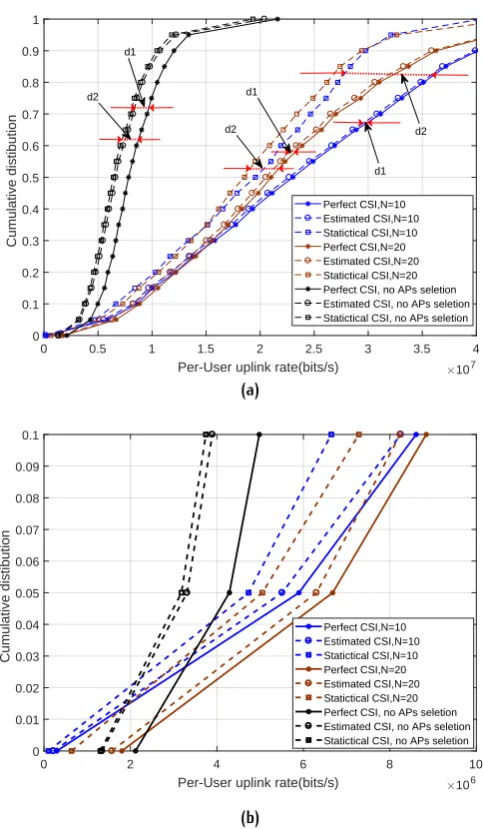
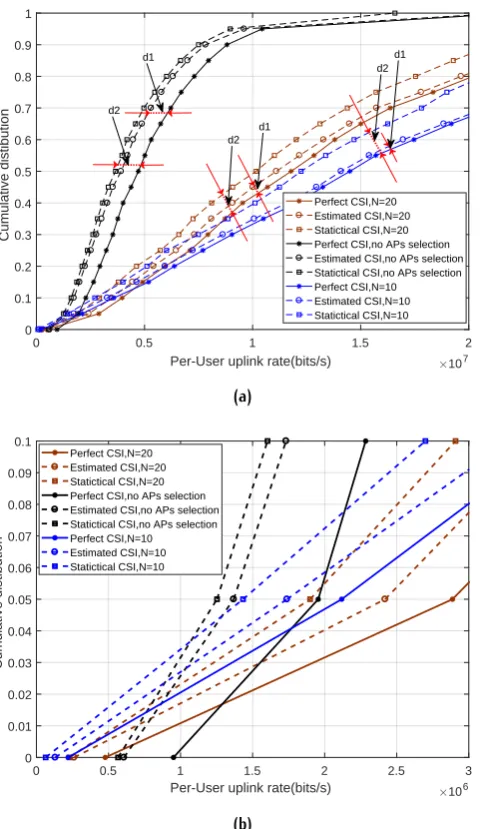
The aims of this subsection is to figure out the differences in systems performance between with and without deploying AP selection, between two signal detection approaches, i.e. based on the knowledge of statistical channels and based on the estimated channel knowledge. As can be clearly observed from Fig.3aand Fig.4a, we can achieve the followings
• For a large number of APs joining the process (without applying AP selection), the lines for the CDFs of per-user uplink rate of two signal detections are approximate to each other. This is because the channels experiences hardening, which results in their values being close to their expectation, close to the estimated values. However, there is a gap between the lines,d1 and d2, for perfect CSI and the rests. This is the result from estimation error and additive noise, which become stronger for largeM. This also reflects the discussion in Lemma1.
• For moderate and small number of APs joining the process, the distance d2 from the line representing the case of using statistical CSI to the line representing the case of perfect CSI is quite large, because the channels are less hardening. More importantly, the lines for using estimated channel is approximate to the line for perfect ISI. Thus, by using the estimated channel information in this case can gain better performance compared with using the channel hardening property.
Following are some remarks on the affects of deploying the proposed APs selection scheme:
• Fig. 3b shows that the CDF of per-user uplink rate with AP selection outperforms that without AP selection in 95%-likely performance, i.e., the 95%-likely net throughput of the case with AP selection and proposed signal detection is around 6.2 Mbits/s (for N = 20), which is twice as high as that of the case without AP selection (around 3.1 Mbits/s). Particularly, this improvement is more significantly with higher value of likely net throughput. This is because the system discards APs that have strong inter-user interference.
γul(h),k =
E
P
m∈A
√
ρul ˆ
g∗
mk
|gˆmk|gmk
2
Var
P
m∈A
√
ρul ˆ
g∗
mk
|gˆmk|gmk
−E
P
m∈A
√
ρul ˆ
g∗
mk
|gˆmk|gmk
+Var
P
m∈A
P
k0∈Ukρul
ˆ
g∗
mk
|gˆmk|gmk 0
+Var
P
m∈A
ˆ
g∗
mk
|gˆmk|wm
(22)
0 5 10 15 20 25 30
SINR
0 0.1 0.2 0.3 0.4 0.5 0.6 0.7 0.8 0.9 1
Cumulative distribution
Simulation Analysis
Figure 2. The CDF of SINR with various Users’ and APs’ locations
5. Conclusions and Discussion
A novel AP selection scheme is proposed and using estimated channel information to the signal detection is suggested for CF massive MIMO. Based on the proposed protocols, a new closed-form expression for ergodic uplink rate is derived. The results show that the system performance with the proposed schemes significantly improve. In addition to this advantage, by reducing the number of APs joining the signal detection, CPU can notably decrease the number of computations which leads to the enhancement of the energy efficiency and higher processing performance at the CPU.
Appendix A. Proof of Lemma 1
It is clear that E
P
m∈A
√
ρul|gˆmk|
2 =
P
m∈A
√
ρul|gˆmk| 2
as ˆgmk is known. The remainder
of this proof is to calculate the variances of terms which are considered as the effective noise as follow:
Var
X
m∈A
√
ρul ˆ gmk∗
|gˆmk|ε˜mk
=X
m∈A
ρulE
n
|ε˜mk|2o (A.1)
0 0.5 1 1.5 2 2.5 3 3.5 4
Per-User uplink rate(bits/s) 107
0 0.1 0.2 0.3 0.4 0.5 0.6 0.7 0.8 0.9 1
Cumulative distibution
Perfect CSI,N=10 Estimated CSI,N=10 Statictical CSI,N=10 Perfect CSI,N=20 Estimated CSI,N=20 Statictical CSI,N=20 Perfect CSI, no APs seletion Estimated CSI, no APs seletion Statictical CSI, no APs seletion d1
d2
d1 d1
d2
d2
(a)
0 2 4 6 8 10
Per-User uplink rate(bits/s) 106
0 0.01 0.02 0.03 0.04 0.05 0.06 0.07 0.08 0.09 0.1
Cumulative distibution
Perfect CSI,N=10 Estimated CSI,N=10 Statictical CSI,N=10 Perfect CSI,N=20 Estimated CSI,N=20 Statictical CSI,N=20 Perfect CSI, no APs seletion Estimated CSI, no APs seletion Statictical CSI, no APs seletion
(b)
Figure 3. The cumulative distribution of the per-user uplink net throughput for the case of M= 200 and K = 20. (3b) is the zoom
Var
X
m∈A
X
k0∈Uk
ρul ˆ gmk∗
|gˆmk|gmk0
=
X
m∈A
X
k0∈Uk
ρulE
gˆmk0+ ˜εmk0
2
= X X ρul
E
gˆmk0
2 +E
n
|ε˜mk0|2
o
0 0.5 1 1.5 2
Per-User uplink rate(bits/s) 107
0 0.1 0.2 0.3 0.4 0.5 0.6 0.7 0.8 0.9 1 Cumulative distibution Perfect CSI,N=20 Estimated CSI,N=20 Statictical CSI,N=20 Perfect CSI,no APs selection Estimated CSI,no APs selection Statictical CSI,no APs selection Perfect CSI,N=10 Estimated CSI,N=10 Statictical CSI,N=10 d1 d1 d1 d2 d2 d2 (a)
0 0.5 1 1.5 2 2.5 3
Per-User uplink rate(bits/s) 106
0 0.01 0.02 0.03 0.04 0.05 0.06 0.07 0.08 0.09 0.1 Cumulative distibution Perfect CSI,N=20 Estimated CSI,N=20 Statictical CSI,N=20 Perfect CSI,no APs selection Estimated CSI,no APs selection Statictical CSI,no APs selection Perfect CSI,N=10 Estimated CSI,N=10 Statictical CSI,N=10
(b)
Figure 4. The cumulative distribution of the per-user uplink net throughput for the case ofM = 100 and K = 20. (4b) is the zoom Var X m∈A ˆ gmk∗
|gˆmk|wm
=X m∈A E n
|wm|2o=M. (A.3)
By using E
n
|ε˜mk0|2
o
=βmk0−µmk0 and substituting
(A.1), (A.2) and (A.3) into (13), the expression for achievable uplink rate is obtained.
Appendix B. Proof of Lemma 2
F
γul(e),k(γth) =P
γul(e),k< γth
=P X
Y+a < γth
= 1−P
(
Y< X
γth
−a
!)
= 1−
Z∞
0
FY x
γth
−a
!
fX(x)dx (B.1)
whereFT(.) and fT(.) are the CDF and probability
den-sity function (PDF) of random variableT, respectively,
X ,P
m∈A
√
ρul|gˆmk|
2
,Y ,P
m∈A
P
k0∈Ukρul|gˆ
mk0|2and
a,P
m∈A
P
k∈UρulE
n
|ε˜mk|2o
+M. The CDF of Y, with
the assumption of all µmk, m= 1...M being distinct or
no APs having the same location, can be expressed as [17, eq.37]
FY(y) = 1−
X
m∈A
X
k0∈Uk
Y n∈A Y
k00∈Uk
1−µnk00
µmk0
!−1
(n,k00 ),(m,k0
) exp
( − y µmk0
) ,
(B.2)
Then, the equation (B.1) is re-written as
F
γul(e),k(γth) =
X
m∈A
X
k0∈Uk
Y n∈A Y
k00∈Uk
1− µnk
00
µmk0
!−1
(n,k00),(m,k0)
× Z∞ 0 exp − x γth −a
µmk0
fX(x)dx
= X
m∈A
X
k0∈Uk
Y n∈A Y
k00∈Uk
1−µnk00
µmk0
!−1
(n,k00 ),(m,k0
)
×exp
( a µmk0
)
Mf
X(x)
( 1 γthµmk0
)
, (B.3)
whereMT{s}is the moment generating function (MGF).
It is noted that a closed-form of MGF of a square of a summation of independent and non-identically distributed Rayleigh random variables does not exist (to the best of my knowledge). Thus, it is approximated as [18, eq.5]
Mf
X(x){s}= 1− ΩX ΘX
s !−ΘXM
, (B.4)
where
ΩX =
1 M
X
m∈A
µmk+
π 2M X m∈A M X
n=m+1
√
µnk00µmk (B.5)
and
ΘX =
MΩ2X
EX2 −M2Ω2X
E
n
X2o= 2X
m∈A
µ2mk+X
m∈A
M
X
n=m+1
(6µmkµnk00
+3π 2
q
µ3mkµnk00 +3π
2 q
µmkµ3nk00
+ 3πX
m∈A
M
X
n=m+1
M
X
t=n+1
q
µ2mkµnk00µtk
+ q
µmkµ2nk00µtk+
q
µmkµnk00µ2 tk
+3π 2
2 X
m∈A
M
X
n=m+1
M
X
t=n+1
M
X
l=t+1
√
µmkµnk00µtkµlk. (B.7)
Finally, the CDF of SINR is computed as
F
γul(e),k(γth) =
X
m∈A
X
k0∈Uk
Y
n∈A
Y
k00∈Uk
1−µnk00
µmk0
!−1
(n,k00 ),(m,k0
)
×exp
( a µmk0
)
1 + ΩX
ΘXµmk0γth
!−ΘXM . (B.8)
Acknowledgements
This work was supported by a Research Environ-ment Links grant, ID 339568416, under the New-ton Programme Vietnam partnership. The grant is funded by the UK Department of Business, Energy and Industrial Strategy (BEIS) and delivered by the British Council. For further information, please visit www.newtonfund.ac.uk./
References
[1] T. L. Marzetta, “Noncooperative Cellular Wireless with
Unlimited Numbers of Base Station Antennas,” IEEE
Trans. Wireless Commun., vol. 9, no. 11, pp. 3590–3600, Nov. 2010.
[2] H. Q. Ngo and A. Ashikhmin and H. Yang and E. G. Larsson and T. L. Marzetta, “Cell-Free Massive MIMO:
Uniformly great service for everyone,” in2015 IEEE 16th
International Workshop on Signal Processing Advances in Wireless Communications (SPAWC), vol. , no. , Jun. 2015, pp. 201–205.
[3] T. C. Mai, H. Q. Ngo, M. Egan, and T. Q. Duong, “Pilot
power control for cell-free massive MIMO,”IEEE Trans.
Veh. Technol., vol. 67, no. 11, pp. 11 264–11 268, Nov 2018.
[4] T. M. Hoang, H. Q. Ngo, T. Q. Duong, H. D. Tuan, and A. Marshall, “Cell-free massive MIMO networks: Optimal power control against active eavesdropping,” IEEE Trans. Commun., vol. 66, no. 10, pp. 4724–4737, Oct 2018.
[5] H. Q. Ngo and L. N. Tran and T. Q. Duong and M. Matthaiou and E. G. Larsson, “On the Total Energy
Efficiency of Cell-Free Massive MIMO,” IEEE Trans.
Green Commun. Netw., vol. 2, no. 1, pp. 25–39, Mar. 2018. [6] L. D. Nguyen, T. Q. Duong, H. Q. Ngo, and K. Tourki,
“Energy efficiency in cell-free massive MIMO with
zero-forcing precoding design,”IEEE Commun. Lett., vol. 21,
no. 8, pp. 1871–1874, Aug 2017.
[7] E. Nayebi and A. Ashikhmin and T. L. Marzetta and H.
Yang, “Cell-Free Massive MIMO systems,” in2015 49th
Asilomar Conference on Signals, Systems and Computers, vol. , no. , Nov. 2015, pp. 695–699.
[8] H. Q. Ngo, A. Ashikhmin, H. Yang, E. G. Larsson and T. L. Marzetta, “Cell-free massive MIMO versus small cells,” IEEE Trans. Wireless Commun., vol. 16, no. 3, pp. 1834– 1850, Mar. 2017.
[9] T. X. Doan and H. Q. Ngo and T. Q. Duong and K. Tourki, “On the Performance of Multigroup Multicast Cell-Free
Massive MIMO,”IEEE Commun. Lett., vol. 21, no. 12, pp.
2642–2645, Dec 2017.
[10] M. Bashar, K. Cumanan, A. G. Burr, H. Q. Ngo, and M. Debbah, “Cell-free Massive MIMO with limited
backhaul,” inin Proc. IEEE ICC, vol. , no. , May. 2018,
pp. 1–7.
[11] M. Bashar, K. Cumanan, A. G. Burr, , M. Debbah, and H. Q. Ngo, “Enhanced max-min SINR for uplink cell-free
Massive MIMO systems,” inin Proc. IEEE ICC, vol. , no. ,
May. 2018, pp. 1–6.
[12] J. Jose and A. Ashikhmin and T. L. Marzetta and S. Vishwanath, “Pilot Contamination and Precoding
in Multi-Cell TDD Systems,” IEEE Trans. Wireless
Commun., vol. 10, no. 8, pp. 2640–2651, Aug. 2011. [13] J. Hoydis and S. ten Brink and M. Debbah, “Massive
MIMO in the UL/DL of Cellular Networks: How Many
Antennas Do We Need?” IEEE J. Sel. Areas Commun.,
vol. 31, no. 2, pp. 160–171, Feb. 2013.
[14] Z. Chen and E. Bjoernson, “Can We Rely on Channel
Hardening in Cell-Free Massive MIMO?” in2017 IEEE
Globecom Workshops (GC Wkshps), vol. , no. , Dec. 2017, pp. 1–6.
[15] S. M. Kay, Fundamentals of statistical signal processing,
volume I: Estimation theory. Prentice Hall, 1993. [16] T. L. Marzetta, E. G. Larsson, H. Yang and H. Q. Ngo,
Fundamentals of massive MIMO. Cambridge University Press, 2016.
[17] A. Bletsas and H. Shin and M. Z. Win, “Cooperative Communications with Outage-Optimal Opportunistic
Relaying,”IEEE Trans. Wireless Commun., vol. 6, no. 9,
pp. 3450–3460, Sept. 2007.
[18] N. Zlatanov and Z. Hadzi-Velkov and G. K.
Kara-giannidis, “An efficient approximation to the
corre-lated Nakagami-m sums and its application in equal
gain diversity receivers,”IEEE Trans. Wireless Commun.,