FREACSIM - A Framework for Creating and Simulating
Real-Time Capable Network on Chip Systems and
Applications
Dominik Schoenwetter
Chair of Computer Science 3(Computer Architecture) Friedrich-Alexander-University
Erlangen-Nürnberg (FAU) Martensstr. 3, 91058
Erlangen, Germany
dominik.schoenwetter
@fau.de
Ronald Veldema
Chair of Computer Science 2(Programming Systems) Friedrich-Alexander-University
Erlangen-Nürnberg (FAU) Martensstr. 3, 91058
Erlangen, Germany
[email protected]
Dietmar Fey
Chair of Computer Science 3(Computer Architecture) Friedrich-Alexander-University
Erlangen-Nürnberg (FAU) Martensstr. 3, 91058
Erlangen, Germany
[email protected]
ABSTRACT
This paper presents the newFramework for Real-time capa-ble Embedded system and ArChitecture SIMulation
(FREACSIM), a highly configurable full-system simulation environment enabling and easing the modeling, simulation and verification of Network on Chip architectures for hard real-time systems. The framework is mostly geared towards software developers, supporting them in the simulation of NoCs at an instruction accurate level and offers a broad variety of real-world hardware components as part of the integrated virtualization toolbox.
FREACSIM provides a software-based routing strategy between nodes, with a single node consisting of a processor and required peripherals for enabling real-time capability. This allows a flexible and independent comparison of cur-rently implemented hardware strategies, as well as an easy adaption to better suit new hardware needs. The software-based routing, as well as distributed applications that can be implemented for the NoC hardware design, are able to use the real-time operating system eCos, which is part of our framework. As a result, real-time capable software can be implemented for, and tested on, complex NoC systems.
We demonstrate the flexibility and the benefits of our framework with a set of applications (use cases), which cover typical heavy and light load distributions between commu-nication and computation.
Categories and Subject Descriptors
C.3 [Computer Systems Organization]: Special-Purpose and Application-Based Systems—Real-time and embedded
systems; D.4.7 [Operating Systems]: Organization and
Design—Real-time systems and embedded systems; I.6 [
Si-mulation and Modeling]: Miscellaneous
General Terms
Design, Performance
Keywords
Embedded, Network on Chip, Real-Time, Simulation, Soft-ware-Based Routing
1.
INTRODUCTION
Over the last few years, parallel computing has gained more and more attention in different sectors of embedded in-dustry. Most importantly in the automotive domain where hard real-time requirements and many other life critical con-straints exist. Although, much innovation in this area is driven by entertainment systems and visualization, the amount of required compute performance also increases in more sensible areas, such as engine controllers and ambient sensor data acquisition and processing, e.g. LIDAR (LIght Detection And Ranging). For a long time, single core de-signs were powerful enough to satisfy performance require-ments. As we slowly reached similar constraining factors as in desktop environments almost a decade ago, these de-mands cannot be satisfied any longer. As a consequence, even real-time requirements could not be met any longer. Thus, the change to multi-core designs was a necessary step to increase performance and guarantee those hard real-time requirements. At the moment, more and more functionality is added to real-time capable applications and, as a conse-quence, more computing power is needed to satisfy the re-quirements. That resulted in Network on Chip architectures and systems, respectively, where hardware developers disso-ciate from traditional bus systems. Even if these systems are not used as the standard in current electronic systems, they will play a central role in the future of the embedded domains where hard real-time requirements exist.
From our point of view, the domains, where hard real-time is required, have many ideas how the respective NoC-hardware architecture can look like for their use cases, but often have none concrete idea what is the best. As a con-sequence, the likelihood of changes to the hardware layout
SIMUTOOLS 2015, August 24-26, Athens, Greece Copyright © 2015 ICST
during the design phase is very high. To avoid that often difficult and cost-intensive effort, the usage of an environ-ment that emulates the embedded Network on Chip hard-ware would be of great advantage. By using this method-ology the hardware can be modified, whenever necessary, without the effort of actual hardware redesigns. That is a big advantage for software developers as well. During the period of time of the redesign, software developers have no actual hardware to implement software for. This can result either in stagnation or bad code that does not exploit the features of the redesigned hardware. As a result, software developers often want a full-system simulation environment that enables them to develop and test their software quickly on emulated hardware, does not require too much time for the simulation and enables them flexibility in many ways. Concerning to fast simulation times and software evalua-tion, the instruction accurate simulation level is very well suited. It’s not as detailed as the cycle accurate level or levels below, but full-system simulation is possible, not only at a functional level. In comparison to the instruction ac-curate level, the cycle acac-curate level is very slow concerning to simulation speed. Weaver and McKee showed that there can be discrepancies of hours up to days [23].
A software developer also wants flexibility concerning to routing and communication. Routing algorithms, like XY routing [16] or wormhole routing [20], that are implemented in hardware, do not offer flexibility from a point of view of switching and routing. Often some leeway is required in the scope of flexibility, independence and performance. A software-based routing strategy enables the just mentioned flexibility. As a consequence, an easy adaption to better suit new hardware needs is possible.
On these grounds, we developed theFramework for Real-time capable Embedded system and ArChitecture SIMula-tion(FREACSIM), that targets software developers in the first instance. FREACSIM is an instruction accurate full-system simulation environment that enables the creation and simulation of a large number of real-time capable em-bedded NoC architectures in a fast way. Because the frame-work is a full-system environment, software developers have the possibility to simulate their applications on real-time ca-pable embedded NoC architectures. Furthermore, FREAC-SIM provides a software-based routing solution that enables the implementation of distributed and real-time capable ap-plications. The possibility of implementing real-time capa-ble applications is obtained by the real-time operating sys-tem eCos (embedded Configurable operating syssys-tem, [4]), which is included into our software-based routing and eluci-dated in section 4.
To avoid starting from scratch, we decided to use an ex-isting instruction accurate simulation environment as the simulation engine of our framework which can be adapted to our needs. This allows more flexibility in our designs, be-cause emulated hardware components are already available. We choose Open Virtual Platforms provided by Imperas. With the aid of OVP it is possible to build single- up to many-core hardware architectures, add desired peripherals and simulate real application code [14]. Because of the abil-ity to establish multi- and many-core architectures running real application code, it is possible to develop distributed applications that can be simulated, verified and evaluated. That is an important feature for our work and one of the reasons why we chose OVP as the virtual environment.
An-other reason why this environment was chosen is, that OVP offers a wide range of processor and peripheral models for the simulation. As a consequence FREACSIM can be ex-tended to more hardware components, if necessary. Because OVP is an instruction accurate simulator, as explained in section 3, the simulations are very fast.
This paper is organized as follows. The next section shows an overview of existing simulation environments and solu-tions, as well as further related work. In section 3 and sec-tion 4, a short overview of OVP and eCos is given. Secsec-tion 5 describes the framework FREACSIM and its tools. The software applications (use cases) we implemented for demon-strating the flexibility and the benefits of our framework are illustrated in section 6. Afterwards, the results of our mea-surements are shown (section 7). The paper concludes with a short summary and an outlook on future work.
2.
RELATED WORK
There is a wide range of free as well as commercial Net-work on Chip simulators and frameNet-works available. One commercial variant is NetSim [11]. NetSim is provided by Boson and uses Boson’s proprietary simulation and routing tools. This simulator is only available for Windows and the focus is on routing and switching. NetSim enables the simu-lation of routers, switches as well as PCs. Supported are 42 different routers and 6 different switches. The focus of this simulator is not on embedded Network on Chip systems.
One free variant of a network simulation tool is Graphite, presented by Miller et al. in 2010 [19]. This simulator of-fers the possibility to simulate hundreds or even thousands of cores. Graphite is not a complete cycle-accurate simu-lator, it uses different techniques to provide accurate per-formance results. The simulation environment offers pro-cessors, a memory subsystem, cache models as well as a network for realizing interconnections. All these models use further analytical timing models to guarantee accurate re-sults. However, the focus of Graphite is not on embedded systems.
The probably most widespread free and open source em-ulation environment is QEMU [8]. In most cases, QEMU is used to run one operating system on another, e.g. Windows on Linux. Because QEMU can be stopped during execution and the current state can be examined, debugging is also a use case. QEMU supports a couple of embedded processors, but does not target the embedded domain directly.
A simulation environment that focuses on the network simulation of NoC systems is BookSim [15]. This simulator is designed to be cycle accurate, but no full-system simula-tor that is able to simulate nodes and processors of nodes, respectively. The simulator provides accurate modeling of network components as well as flexibility. Flexibility is given by the possibility of configuring network parameters like the topology, flow control or the routing algorithm that shall be used. Furthermore, the microarchitecture of the router can be configured, including the management of buffers and different allocation schemes.
written in SystemC [6], the ability to simulate at transaction level is given, too.
A cycle accurate Network on Chip interconnection model called Garnet [7] was published in 2009 by Agarwal et al. The model is embedded into the GEMS (General Execution-driven Multiprocessor Simulator, [5]) environment. Details, such as flit-level input buffers or routing logic are modeled. GARNET in conjunction with GEMS provides a detailed, as well as accurate, timing model of the memory system. They evaluated the benefits and the potential of their model by comparing it against the network model provided by GEMS. Their setup consisted of 16 in-order 2-way SPARC proces-sors with 64 KB L1 I&D caches, L2 and direct caches, as well as 4 memory controllers and the respective NoC interconnec-tion model. GEMS is no longer under active development. The development has been shifted to the gem5 simulation system, an open source software, which is discussed in the next paragraph.
The gem5 simulation environment [9] combines the ben-efits of the M5 [10] and the GEMS environments. M5 is a configurable simulation environment offering multiple ISAs (instruction set architectures) as well as various CPU mod-els. The CPU can be configured to operate on different levels of detail and accuracy. In combination with GEMS, gem5 provides a detailed and flexible memory system as well as interconnection models. A wide range of instruction set architectures (e.g. x86, ALPHA or MIPS) is supported by gem5. This simulation environment is not designed to be pure instruction accurate and targets the embedded domain partially.
Madsen et al. published a paper on a modeling environ-ment for embedded System-on-Chip (SoC) designer, dealing with multiprocessor architectures [17]. They are focusing on real-time applications and the interconnection of single processors using NoCs. The base for their modeling envi-ronment is SystemC. As a consequence, the envienvi-ronment is neither complete cycle accurate nor complete instruction accurate what impacts the simulation performance in com-parison to a complete instruction accurate environment.
Recently, Schoenwetter et al. made eCos available to the simulation environment OVP [21]. They validated their work by showing that their implementation of an engine con-trol unit software that uses eCos and was simulated within Open Virtual Platforms works. Imperas, the founder of Open Virtual Platforms, published that work on their web-site [1].
3.
THE SIMULATION ENVIRONMENT
OPEN VIRTUAL PLATFORMS
TMWe use Open Virtual Platforms (OVP) as the engine that drives the simulation of our Network on Chip architectures. The instruction accurate simulation technology from Open Virtual Platforms was developed for high performance sim-ulation. The technology enables debugging applications, which run on the virtual hardware, as well as analysis of virtual platforms containing multiple processor and periph-eral models. The OVP simulation technology is extensible. Furthermore, it provides the ability to create new proces-sor models and other platform components by writing C or C++ code that uses application programming interfaces (APIs) and libraries supplied as part of OVP [13].
OVP multi-component platforms (multi-processor
plat-forms or single core platplat-forms with a specified number of peripherals) are not working simultaneously. For efficiency, each processor and peripheral, respectively, advances a cer-tain number of instructions in turn. So in multi-component simulations a single component is simulated until it has sig-naled that it has finished its quantum. The quantum is defined as the time period in which each component in turn simulates a certain number of instructions [13]. The just mentioned and changeable time period is called a time slice. Simulated time is moved forward only at the end of a quan-tum. This can create simulation artifacts, for example where a processor spends time in a wait loop, while waiting for the quantum to finish. To avoid this the quantum has to be set very low (perhaps even to one, which will have a significant impact on simulation performance) so that the measurements will not be affected by this simulation arti-facts. The time slice can be adjusted in the simulator set-tings [14]. The simulation can only figure out how many instructions were executed. Assuming a perfect pipeline, where one instruction is executed per cycle, the instruction count divided by the mips rate (millions of instructions per second) would give the amount of time the program runs. The OVP-simulator provides the possibility for measuring instruction counts within a program. As a consequence, the instruction counts for specific code snippets can be recorded.
4.
OVERVIEW ABOUT ECOS
eCos (embedded configurable operating system) is a free real-time operating system designed for embedded systems. A wide variety of popular embedded processor architectures is supported. This makes eCos a good choice for end users that have to deal with many diverse hardware architectures. The design of eCos corresponds to a configurable component architecture consisting of several key software components such as the kernel and the HAL (Hardware Abstraction Layer). This allows the construction of a complete embed-ded system from these reusable software components. Fur-thermore, different configuration options within the software component can be chosen and unused software components can be removed. To summarize, an operating system that specifically matches the requirements of an application can be created.
An application that uses eCos runs as a part of the op-erating system, contrary to opop-erating systems like Linux. Thus, an eCos application is a monolithic block where the operating system and the application are not considered sep-arately.
eCos provides a multilevel queue scheduler and a bitmap scheduler. The multilevel queue scheduler is able to execute multiple threads of the same priority level. This scheduler allows preemption between the different priority levels. The bitmap scheduler is able to execute threads at multiple pri-ority levels, too. However, just a single thread can exist at each priority level. As a result, the bitmap scheduler is very efficient because the same priority level for two threads is forbidden what simplifies the scheduling algorithm [18].
Our framework supports the usage of both schedulers.
5.
THE FRAMEWORK FREACSIM
mod-R0 R1 R2 R3
R4 R5 R6 R7
R8 R9 R10 R11
R12 R13 R14 R15
M0 M1 M2 M3
M4 M5 M6 M7
M8 M9 M10 M11
M12 M13 M14 M15
C0 C1 C2 C3
C4 C5 C6 C7
C8 C9 C10 C11
C12 C13 C14 C15
C : Computation node R : Routing node M : Shared memory
: Bidirectional link (read/write transfers) : Unidirectional link
(trigger interrupt)
Figure 1: 4×4 torus-2D architecture with routing and computing nodes as well as notification of computation
cores using interrupts if new data have arrived.
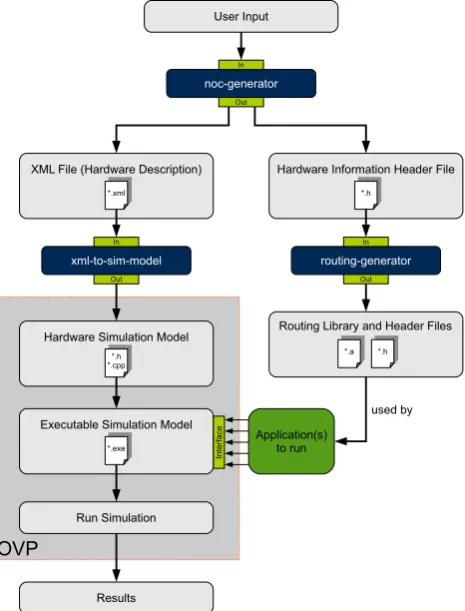
els afterwards. For each of those various hardware archi-tectures, a real-time capable, and software-based, routing li-brary can be generated. The real-time capability is achieved by using the real-time operating system eCos, which runs on every node core that requires real-time capability and is encapsulated in our routing library with a correspond-ing API. That API can be used by a software developer to implement distributed and real-time capable applications. A brief overview of eCos can be obtained from section 4. Concerning to the hardware, FREACSIM allows the usage of different topology schemes for the interconnection of the single nodes. At the moment, the topologies star, ring, grid-2D and torus-grid-2D are implemented and can be used within a design. Figure 1 shows an example and a visualization of one possible architecture (4×4 torus-2D) that can be gen-erated and simulated with FREACSIM. Figure 2 shows an overview of the framework.
Depending on the user input, like the topology or the number of nodes to use, the tool noc-generator creates a NoC-Design. The representation of this Design is within a self defined XML format, what we call an XML hardware description. This XML hardware description is the input for the toolxml-to-sim-model, which generates a complete Open Virtual Platforms simulation model out of the XML description. We decided to introduce this intermediate XML format for two reasons. First, the user has the ability to write self defined hardware descriptions in the given XML format, what results in more flexibility and independence. If there would be no XML interface, the tools noc-generator and xml-to-sim-model could be seen as one tool that is more complex. As a consequence, the user could only use the hardware descriptions that are generated by the tool noc-generator. Second, if a further simulation environment shall be added to the framework, only the adaption of the tool xml-to-sim-model has to be done.
The XML hardware description contains required com-ponents, like processors or memories, as well as the inter-connection of that single components that define the
NoC-Application(s) to run noc-generator
In
te
rf
ac
e
User Input
In
*.xml *.xml
XML File (Hardware Description)
xml-to-sim-model In
Out
*.h *.cpp*.h *.cpp Hardware Simulation Model
Executable Simulation Model
*.h *.h
Hardware Information Header File
routing-generator In
Out
*.a *.a
Routing Library and Header Files
*.h *.h
used by Out
OVP
*.exe *.exe
Run Simulation
Results
Figure 2: Overview of the tools and components of the framework FREACSIM.
about the created hardware design, e.g. which node is inter-connected directly with another node or at which address a memory (message buffer) is accessible for a processor of a node.
This hardware information header file is the input for the the tool routing-generator. That tool creates a soft-ware library and the required header files, that enables the (software-based) communication and routing between nodes in the design. The header files contain the prototypes of our API-functions, that have to be used to communicate between nodes, for example to send and receive data pack-ets/messages. The library also encapsulates the necessary libraries of eCos, to enable the real-time capability on the nodes.
Now the user is able to implement a distributed applica-tion for the NoC-Design. As already menapplica-tioned, the appli-cations for the single node processors have to use our API-functions to enable the communication between nodes. We provide a set of software applications and use cases, respec-tively (see section 6), that use our API.
After the implementation of the single programs of the distributed application, that single programms have to be loaded into the processor memories of the corresponding nodes, what is done using an interface provided by OVP. The user has the possibility to control the simulation using parameters. One particular parameter for the simulation is the time slice, which was elucidated in section 3. The time slice controls the simulation speed. After the simulation has terminated, the results can be inspected and evaluated.
5.1
Architectures of Nodes
We distinguish the nodes in our designs (cf. Figure 1) into routing nodes and computation nodes. The computation nodes shall only perform actions of applications and shall not be busy with routing tasks. As a consequence, the routing nodes take care of the routing. It is also possible to disable the routing nodes what results in an architecture, where no distinction between routing and computation nodes is made and the routing as well as the computations have to be done by the same node. The focus, however, is on architectures that distinguish between routing and computation nodes, because node cores of (hard) real-time capable embedded systems normally don’t want to spent time for routing tasks, because the computing time is required for CPU-intensive computation tasks.
The base for the implementation of our software-based routing, that uses the store and forward algorithm, are single shared memories, that are connected to some computation and routing nodes, respectively. These shared memories act as buffers, the store and forward routing algorithm works with (see Figure 1). Which computation nodes and which routing nodes are connected to a shared memory depends on the chosen topology and if routing nodes are enabled or not.
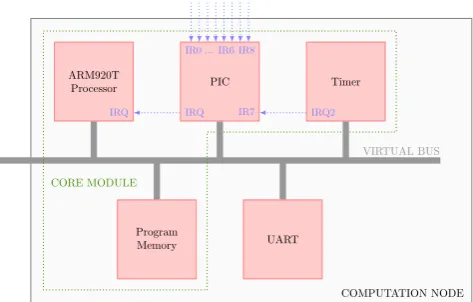
A computation node has a fixed architecture (Figure 3), a routing node has two possible architectures.
One single computation node consists of five hardware components. These five components are required because the real-time capability is achieved by using the real-time operating system eCos (see also section 4) that runs on every computation node in our NoC designs. The first component is a UART controller/interface. This interface is used for in-put and outin-put calls of C-functions likeprintf orgetc. The
Program Memory ARM920T
Processor PIC
UART Timer
IRQ IRQ IR7
IR8 IR0 ... IR6
IRQ2
VIRTUAL BUS
COMPUTATION NODE CORE MODULE
Figure 3: Architecture of a computation node.
association of the other four hardware components is called a core module. The core module consists of a processor, a programmable interrupt controller (PIC), a timer and some core local program memory. This memory is loaded with the application that uses our routing library, which contains the necessary eCos libraries. The timer generates periodically an interrupt on pin IRQ2, which is defined as the scheduler clock of eCos, and is forwarded to the processor’s interrupt pin (IRQ). All components are connected to a virtual OVP bus (see [14]). That bus is the interface where a shared memory (buffer) is connected to, independent of the chosen topology (cf. Figure 1).
A routing node can consist of the same components as a computation node (same processor, etc.) and one additional component called a signal generator. The signal generator component is a hardware component that is required for triggering interrupt pins on computation node cores. If the notification for new data of a computation node shall be realized using interrupts, the pins IR0 to IR6 and IR8 of the computation node interrupt controller are used to connect a corresponding pin of the signal generator component. As a consequence, it is possible to send interrupts from a routing node/core to a computation node/core for notification of new data.
Because the routing node has the same architecture as the computation node, with the exception of the signal generator component, eCos can also run on the routing node. Thus, the real-time capability is given on a routing node, too. The other possibility of the architecture of a routing node is that the real-time capability is disabled and the routing takes place without eCos. In that case, a routing node requires a processor, some processor local memory and the just men-tioned signal generator component for triggering interrupts, if desired. At the moment, the tool noc-generator allows to choose one of five processor types if no real-time capabili-ties for the routing shall be used or are required. These five processors type are ARM920T, ARM7TDMI, ARM926EJ-S, ARM Cortex A9 and ARM Cortex R4 [3]. As a consequence of these different types of processors, it is not only possible to build homogeneous architectures and systems, respectively, but also heterogeneous architectures.
of nodes, which is limited to 64 at the moment, or if routing nodes shall be used. If computation and routing nodes shall be used, the tool allows the configuration how the notifica-tion of a computanotifica-tion node, if new data for even that node are available, takes place. Possible settings therefore are polling or interrupt . Also the type of routing core, which is part of the routing node, can be configured as well as frequency/mips rates of computation and routing cores.
5.2
Routing / Communication
Routing in our NoC design means that packets are for-warded from one core to an adjacent core on the path to the packet’s destination, what corresponds to an implemen-tation of the store and forward algorithm [12].
As already mentioned, the base for the communication be-tween nodes and for realizing the different topology schemes are single shared memories, where specific computation and routing nodes are connected to (cf. Figure 1). These shared memories are used to hold the data/packets that have to be send from one computation node to another or that are received by a computation node. For the torus-2D topology with routing nodes, four routing nodes and cores, respec-tively, share such a memory (up, down, left and right).
Bounded packet sizes make memory management, flow-control, etc. much easier. Because we are geared towards routing around faulty or overloaded cores, we need to route messages dynamically. Thus, we prefix each message with an eight byte message header. Each hop in the network examines the message header to make routing decisions.
As the minimum, a single packet may be in flight between connected nodes at a time. To gauge the performance of this extreme point, we format the shared memory that only one packet can be placed into it at a time per attached core (single buffer). There needs to be a single buffer per di-rection (send and receive). Otherwise, a message sent from computation node to the other would overwrite a message concurrently sent in the opposite direction. A flag in each of the two buffers indicates whether the buffer is currently in use. The sender sets this occupied-flag once the message is completely placed into the buffer. The receiver resets the flag once the message is copied away into local memory.
A single buffer per hop and direction has one major dis-advantage: The sender needs to wait until the receiver has copied away the message before it can send the next message. A slow receiver can therefore stall the sender. This problem can be solved by spending more resources (buffers) per hop and direction. To be more precise, we can format the shared memory as linked lists of messages. The user has the choice between single buffer or linked list communication.
The receiver of a message can either poll for the arrival of messages or can be notified by an interrupt that a new message has arrived. Which mechanism shall be used can be configured in the routing settings.
To implement the store and forward routing efficiently, each computation node or routing node (when they are en-abled) maintains a routing table that encodes the topology of the network. To perform routing decisions, either the computation cores or the routing cores need two operations:
is-responsible-for-message and is-attached-core. We need
theis-responsible-for-messageto be able to elect a
computa-tion core (or routing core) if multiple computacomputa-tion nodes (or routing nodes), attached to a given shared memory, have a link to the destination core. The operationis-attached-core
is needed, that a core knows, that the destination core is one of its attached cores (and there is no need to forward the message elsewhere).
If at run-time a core or network connection dies, becomes hot, or is overloaded, a neighboring computation core or routing core can notice this and inform the others via a spe-cial broadcast message. The computation cores (or routing cores) can then patch their routing tables.
The implementation of bothis-responsible-for-messageand
is-attached-core operations devolve into a table look-up in a
pre-computed table so that the costs are negligible. Depending on the interconnection scheme/topology and the communication/routing settings (polling or interrupt, etc.), the required communication and routing mechanism for data packets between nodes and cores, respectively, is generated in software as a library. This library has a trans-parent interface (API) to the programmer. As a result, the NoC software developer does not need much knowledge about the hardware.
To use our NoC design in association with our API, the programmer needs to send explicit messages. Our API is not an end-user API such as MPI or MCAPI1 but rather
designed to build other APIs or hardware components on top of it. The API consists of send and receive commands (in both, blocking and non-blocking variants) to send mes-sages up-to the packet size. The message size (MTU-size, Maximum Transmission Unit) is configurable, what results in flexibility for the user. To make the system a little more flexible, each message has an associated tag so that types of messages can be differentiated. Each node keeps a set of lists (one per tag) in its private memory. Higher level layers can then build message fragmentation/reassembly, quality of service guarantees, and high/low priority messages on top of this message tagging scheme.
6.
APPLICATIONS / USE CASES
When a NoC design is created, the design is typically op-timized for some software application area. This software application area has a range from applications that perform almost no computation but mainly communicate to appli-cations that only compute and perform little communica-tion. We defined a set of four software applications and use cases, respectively, that cover the extremes and single parts of these range. All applications are written in C and are able to scale to any number of nodes supported by the framework. As a consequence, a designer can interpolate between these use cases to get the best answers for the application profile at hand.
6.1
Bandwidth
The bandwidth software application and use case, respec-tively, simply sends a MByte of data between the nodes and then waits for a single acknowledgement message.
6.2
Stencil kernel
The compute-bound Stencil kernel computes the average of all the direct neighbours of each point in a matrix and writes the result into a second matrix. Each core maintains a partition of the matrices. At the end of each iteration, the boundary rows are exchanged with the adjacent cores. We
1http://www.multicore-association.org/workgroup/
use a 512·512 matrix of floats. As a result, 512·4 = 2048 bytes are transferred after each iteration and in each direc-tion. There is a computation complexity of O(M2) with a communication complexity of O(M). Communication hap-pens rarely and in periodic bursts compared to the itera-tion’s computation time.
6.3
QR-codes
QR-codes are 2D bar codes that encode a simple bit-string (a black square corresponds to 1, a white square to 0) and are often printed and posted where a smartphone can take a picture of them. Because the phone’s camera may be rotated with respect to the QR-code and the QR-code may not be centered, the QR-code detection of this application rotates the picture to align the embedded QR-code and scans each rotated picture to find the QR-code’s position in the picture using the corner’s encoding pattern.
Computation core 0 repeatedly rotates the image by some angle (both, clockwise and anti-clockwise) and sends the results in a round-robin fashion to all other node cores in the design. These node cores scan the received and rotated image to detect a QR-code. For the application we use a 256·256 pixel RGB image (192 KByte) with an embedded 64·64 pixel rotated and translated QR-code. To send and re-ceive this image the application needs to fragment the image into packets and to reassemble them. The communication pattern is thus a series of burst communications (3072 mes-sages when using a 64 byte packet size) from core 0 to the core 1, a small wait (while it rotates the image), then a burst of packets to core 2, and so on. Bandwidth is important for this use case.
6.4
Packet Rewriter
Computation core 0 creates (artificial) Ethernet packets and sends them to the other computation cores for rewriting in a round-robin fashion. Once a packet has been rewritten, it is returned to computation core 0 (which could concep-tually forward it). Because an Ethernet packet can be far larger than a packet of our NoC, packet fragmentation and reassembly are needed for this application as well. We solve this problem by prefixing each packet, which is send over the NoC channels, with an extra offset field. Only after all small packets of an IP packet have arrived, the receiver rewrites the reassembled packet and sends it back to core 0, in fragments again.
Thus, the communication pattern in this application is a repeated sequence of a set of ( 1500
packet size) packets sent in
a small burst from computation core 0 to each of the other computation cores followed by an almost simultaneous burst from the other computation cores back to computation core 0. This application is mostly bandwidth-bound.
7.
RESULTS
We distinguish our results into flexibility and simulation speed of the framework FREACSIM. Some fixed settings for the measurements and some varying settings to demonstrate the flexibility and the simulation speed are used. The focus of the flexibility measurements is on the software-based rout-ing, not on the possibility to simulate different hardware de-signs and topologies. We chose only one varying parameter for the software-based routing. Considering more parame-ters and different hardware architectures would result in a design space exploration, what is not the goal of this paper.
The fixed settings for our measurements are elucidated in the following.
The hardware architecture used for the measurements is the 4 × 4 torus-2D architecture shown in Figure 1. This is one of the most complex Network on Chip architectures the framework can generate. As a consequence, our experi-mental setup consists of 16 computing nodes and 16 routing nodes. The size of each shared memory is set to 256 kilobyte (KB). Because the torus-2D topology is used, a single shared memory is connected to four routing nodes for realizing the network topology. The computing nodes use the architec-ture, introduced in Figure 3 and section 5.1. The routing nodes use the architecture that does not support real-time ability. The type of routing core used for the routing nodes is set to ARM Cortex-R4. Our routing library without real-time ability runs on the routing cores, the computation cores use the routing library with real-time ability (eCos enabled). eCos uses the multilevel queue scheduler. The frequency of a computation core contains the value 800 MHz and the frequency of a routing core is set to 500 MHz. For inform-ing the computation nodes that new messages have arrived, the routing nodes use the polling strategy provided by the routing library and linked list messages for transfering data. For each measurement, the applications elucidated in sec-tion 6 are running on the 4×4 torus-2D architecture. Each application utilizes our software base routing library and is, as a consequence, real-time capable.
Both parts of the measurements, simulation speed and flexibility of the framework, are illustrated in the following sections.
7.1
Simulation Speed
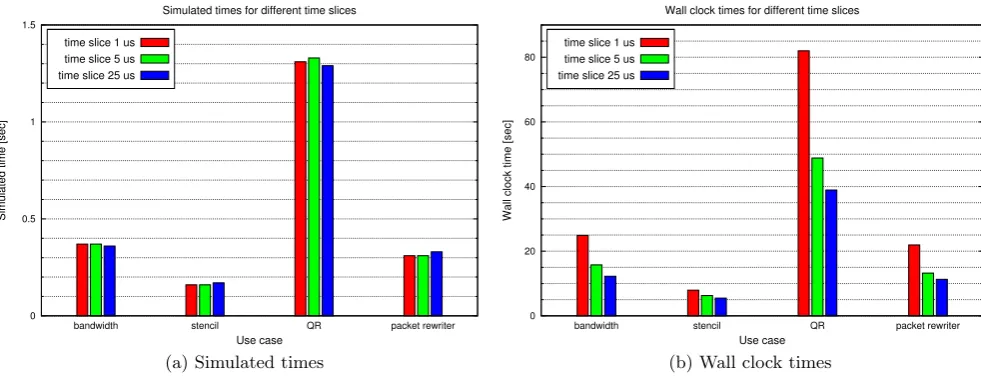
To show the simulation speed, and the possibility the soft-ware developer has to speed up simulation performance, we measured the simulated times of the four use cases against the wall clock times required for the simulation. Simulated time describes the overall time a use case ran on the 4×4 NoC-architecture. Wall clock time is the overall time taken by the simulation process on the host machine from start to end. We varied the parameter time slice, elucidated in section 3, of the simulation from 1 microsecond over 5 mi-croseconds to 25 mimi-croseconds. A packet size of 64 Bytes was used for the routing. The host machine, where the measure-ments were performed, was a 64 bit core i7 quad core [2] and the host operating system was fedora version 21.
Figure 4(a) shows the simulated times of the four use cases bandwidth, stencil, QR and packet rewriter for the different time slices. Figure 4(b) shows the corresponding wall clock times. As can be seen from Figure 4(a), the simulated times vary in a small range for different time slices, although they should be the same. The reason for that circumstance are simulation artifacts, e.g. where a routing core spends time in a polling loop while waiting for the quantum to finish (see section 3).
0 0.5 1 1.5
bandwidth stencil QR packet rewriter
Simulated time [sec]
Use case
Simulated times for different time slices
time slice 1 us time slice 5 us time slice 25 us
(a) Simulated times
0 20 40 60 80
bandwidth stencil QR packet rewriter
Wall clock time [sec]
Use case
Wall clock times for different time slices
time slice 1 us time slice 5 us time slice 25 us
(b) Wall clock times
Figure 4: Simulated times and wall clock times of the four use cases for time slices 1us, 5us and 25us.
For clarifying that circumstance, Figure 5 shows the av-erage wall clock times per simulated second of the different use cases.
0 10 20 30 40 50 60 70
bandwidth stencil QR packet rewriter
Average wall clock time per simulated second [sec]
Use case
Average wall clock times per simulated second for different time slices
time slice 1 us time slice 5 us time slice 25 us
Figure 5: Average wall clock times per simulated second.
The results in Figure 5 show, that one simulated second never requires more than a wall clock time of 71 seconds, independent of the use case. One simulated second includes the simulation of 16 computation nodes as well as 16 rout-ing nodes and the required peripherals. That corresponds to a high simulation performance and speed, respectively. As opposed to this, we measured a wall clock time of 639 sec-onds per simulated second for the gem5 environment, if just a single processor of profile ARMv7-a, e.g. Cortex A9 [3], is simulated and the level of accuracy is set to low. If the level of accuracy is set to high, the wall clock time per simulated second increases to 12771 seconds (about 3.5 hours).
By using the parameter time slice, the software devel-oper can select between simulation accuracy and simulation speed. That enables various possibilities to the software de-veloper, concerning to the trade off of simulation accuracy and speed. If functionality of real-time capable software
shall be tested, the time slice can be set to a large value, because functionality of software is not affected by the time slice.
7.2
Flexibility
To demonstrate the flexibility of our routing library, and the information a software developer can obtain from those flexibility, we chose one particular parameter that varies for every measurement. This parameter is the packet size. The packet size can be easily configured by setting one parameter before the build of the routing library, nothing else has to be changed. The packet size sweeps from 32 to 512 Byte and the time slice for the measurements was set to 1 microsecond. Figure 6 shows the simulated times for varying packet sizes and for the different use cases.
0 0.5 1 1.5 2 2.5
bandwidth stencil QR packet rewriter
Simulated time [sec]
Use case
Simulated times for different packet sizes
32 Byte 64 Byte 128 Byte 256 Byte
Figure 6: Simulated times for different packet sizes.
com-munication step. This is the reason why the simulated time wanes the larger the packet size.
8.
CONCLUSION
This paper presents the highly configurable Framework for Real-time capable Embedded system and ArChitecture SIMulation (FREACSIM). To the best of our knowledge, there is no other comparable fully integrated system-simula-tion environment, that covers the full stack of (real-time) applications, software-based routing as well as NoC specific hardware and architecture aspects for embedded systems.
A range of embedded processors where our configurable software-based routing can be cross compiled or adapted and changed, respectively, is supported. As a result, we are able to build heterogeneous as well as homogeneous Network on Chip architectures and systems, where real-time capable and distributed software can be developed for and tested on. As a consequence, different NoC-architectures and topologies can be evaluated with the framework FREACSIM.
We allow the implementation of real-time capable and dis-tributed applications by the usage of our routing library and the corresponding API. Software-based routing means, that special nodes implement the routing functionality in soft-ware and not in hardsoft-ware, what is a good solution, if flex-ibility and independence shall be given. A software devel-oper can change and adapt all parameters provided by the routing library to his own needs. This enables flexibility to the software developer and shows the influence on his soft-ware. Thus, the software developer can get a feeling how well his real-time capable software works on the respective NoC-architecture or what kind of changes have to be made. One main advantage of our framework is the simulation speed, as illustrated in section 7. From a point of view of a software developer, simulations of large embedded systems, like NoCs, have to be fast. Unfortunately, fast and pre-cise simulation are in a mutual tension relationship. For the simulation of large embedded systems, its always the question, what kind of accuracy should be used. Complete cycle accurate simulations are not a good solution for such large systems, because the wall clock time of the simula-tion is always much greater than the simulated time. Soft-ware development does not need precise modeled hardSoft-ware for testing software functionality in many cases. We think that instruction accurate simulation is the best solution for simulating distributed software functionality for such large embedded systems, even if the modelling of the hardware is not as precise as on other accuracy levels.
A further benefit of the framework is the possibility to per-form design space explorations over a wide range of already available parameters. Such parameters are for example the topology of the NoC or the frequencies of computation and routing cores. Furthermore, our routing library supports a range of possible parameters, like the packet size (see Fig-ure 4(a)) or the organization of the shared memories (single buffer or linked list communication). This enables flexibility and allows testing software with various configurations.
Because all virtualized hardware components exist as real components, it is possible to build a real design out of the hardware components FREACSIM provides. Even our con-figurable software-based routing can be used on real hard-ware.
9.
FUTURE WORK
In a next step, we have to validate the results of the sim-ulator concerning to non functional properties. The instruc-tion accurate simulainstruc-tion technology from OVP cannot make a clear statement about non functional properties like the execution time.
Single parts of the simulation, were precise results are nec-essary, could be performed on a more detailed accuracy level than FREACSIM supports at the moment. An example would be the cycle accurate level. If only single parts are of interest, not the whole simulation has to be cycle accurate for that purpose. Parts of interest can be particular mem-ory accesses or communication traffic. In order to realize the simulation of single parts, it is necessary to switch between the accuracy levels (instruction accurate to cycle accurate and back to instruction accurate in that example).
In future work we want to tether a second simulation en-vironment to our framework, that enables partial simula-tion on a more detailed level than the instrucsimula-tion accurate one. As a consequence of that partial simulation, the sim-ulation speed is still high, but the results are more precise. One possible solution for that purpose would be SystemC, but there are also other solutions and simulation environ-ments, respectively. Our XML interface between the tools noc-generator and xml-to-sim-model (refer to Figure 2 and section 5) is therefore a perfect point to start from.
Also, we will think about the integration of higher-level parallel programming models like OpenMP2 and MPI3.
10.
REFERENCES
[1] ecos on arm integrator compact platform.
www.ovpworld.org/operating-systems-support-ecos, 2015. Last visit on 04.02.2015.
[2] Intel core i7-4702mq processor website.
http://ark.intel.com/de/products/75119/Intel-Core-i7-4702MQ-Processor-6M-Cache-up-to-3 20-GHz, 2015. Last visit on 04.02.2015.
[3] Official arm website for processors.
http://www.arm.com/products/processors/index.php, 2015. Last visit on 02.02.2015.
[4] Official ecos website. http://ecos.sourceware.org/, 2015. Last visit on 04.02.2015.
[5] Official gems website.
http://research.cs.wisc.edu/gems/, 2015. Last visit on 02.02.2015.
[6] Official systemc website. http://www.systemc.org, 2015. Last visit on 02.02.2015.
[7] N. Agarwal, T. Krishna, L.-S. Peh, and N. Jha. Garnet: A detailed on-chip network model inside a full-system simulator. InPerformance Analysis of Systems and Software, 2009. ISPASS 2009. IEEE
International Symposium on, pages 33–42, April 2009.
[8] F. Bellard. Qemu, a fast and portable dynamic translator. InUSENIX Annual Technical Conference,
FREENIX Track, pages 41–46, 2005.
[9] N. Binkert, B. Beckmann, G. Black, S. K. Reinhardt, A. Saidi, A. Basu, J. Hestness, D. R. Hower,
T. Krishna, S. Sardashti, R. Sen, K. Sewell,
M. Shoaib, N. Vaish, M. D. Hill, and D. A. Wood. The
2http://openmp.org/wp/
gem5 simulator.SIGARCH Comput. Archit. News, 39(2):1–7, Aug. 2011.
[10] N. L. Binkert, R. G. Dreslinski, L. R. Hsu, K. T. Lim, A. G. Saidi, and S. K. Reinhardt. The m5 simulator: Modeling networked systems.IEEE Micro, 26:52–60, 2006.
[11] Boson.Boson NetSim 10 User Manual. Boson Software, LLC, 25 Century Blvd., Ste. 500, Nashville. Last access date: 02.10.2014.
[12] R. Cypher, F. Meyer auf der Heide, C. Scheideler, and B. V¨ocking. Universal algorithms for
store-and-forward and wormhole routing. In
Proceedings of the Twenty-eighth Annual ACM
Symposium on Theory of Computing, STOC ’96, pages
356–365, New York, NY, USA, 1996. ACM. [13] Imperas Software Limited.OVP Guide to Using
Processor Models. Imperas Buildings, North Weston,
Thame, Oxfordshire, OX9 2HA, UK, May 2014. Version 0.5, [email protected].
[14] Imperas Software Limited.OVPsim and Imperas
CpuManager User Guide. Imperas Buildings, North
Weston, Thame, Oxfordshire, OX9 2HA, UK, August 2014. Version 2.3.6, [email protected].
[15] N. Jiang, D. Becker, G. Michelogiannakis, J. Balfour, B. Towles, D. Shaw, J. Kim, and W. Dally. A detailed and flexible cycle-accurate network-on-chip simulator.
InPerformance Analysis of Systems and Software
(ISPASS), 2013 IEEE International Symposium on,
pages 86–96, April 2013.
[16] T. Karadeniz, L. Mhamdi, K. Goossens, and J. Garcia-Luna-Aceves. Hardware design and implementation of a network-on-chip based load balancing switch fabric. InReconfigurable Computing and FPGAs (ReConFig), 2012 International
Conference on, pages 1–7, Dec 2012.
[17] J. Madsen, S. Mahadevan, K. Virk, and M. Gonzalez. Network-on-chip modeling for system-level
multiprocessor simulation. InReal-Time Systems
Symposium, 2003. RTSS 2003. 24th IEEE, pages
265–274, Dec 2003.
[18] A. J. Massa.Embedded Software Development with eCos. Prentice Hall Professional Technical Reference, December 2002.
[19] J. Miller, H. Kasture, G. Kurian, C. Gruenwald, N. Beckmann, C. Celio, J. Eastep, and A. Agarwal. Graphite: A distributed parallel simulator for multicores. InHigh Performance Computer
Architecture (HPCA), 2010 IEEE 16th International
Symposium on, pages 1–12, Jan 2010.
[20] L. Ni and P. McKinley. A survey of wormhole routing techniques in direct networks.Computer, 26(2):62–76, Feb 1993.
[21] D. Schoenwetter, V. Sieh, and D. Fey. Porting an engine control application to a virtual environment by using an open source real time operating system. In DESIGN&ELEKTRONIK, editor,Embedded World
Conference Proceedings, 2013, Nuremberg, feb. 2013.
WEKA FACHMEDIEN GmbH, Haar. [22] SoClib. Official soclib developer website.
http://www.soclib.fr/trac/dev, 2015. Last visit on 01.02.2015.
[23] V. M. Weaver and S. A. McKee. Are cycle accurate
simulations a waste of time? InProc. 7th Workshop
on Duplicating, Deconstructing, and Debunking, June