Design and Performance Analysis of Sensor
Proxy-AAA Authentication Scheme Based on Fast
Handover and Forwarding Mode for IP-based
Internet of Things
Chulhee Cho
1, Byung-Hun Song
2, Jongpil Jeong
3, Tai-Myoung Chung
1,∗1CollegeofInformation and Communications Engineering, Sungkyunkw anUniversity,Suwon,Kyunggi-do, 440-745, Republic ofKorea
2IoTConvergence Research Center,Korea Electronics Technology Institute (KETI),Seongnam, Republic ofKorea 3Department of Human ICT Convergence, Sungkyunkwan University, Suwon, Kyunggi-do 440-745, Republic of Korea
Abstract
Recen tly interest in Internet of Things(I oT) is increasing, and a variety of the security technol ogies tha t are suitable for Internet of Things has being studied. In order to main tain the trustw orthy connectivity and the accessibility of distributed IoT, it is importan t to establish secure links for end- to-end comm unica tion with proper authen tica tion. AAA technol ogy is curren tly the best way of resol ving dela y issue when introd ucing authen tica tion process of mobile switching. However, there are still a number of issues among which the dela y time issue from authen tica tion and authoriza tion grea tly inf uences the process. AAA applica tion in mobile IP environmen t cannot f uen tly support continuous and fast handov er in both intra-domain and inter-domain. Mobile IPv6 (MIPv6) is a host-based protocol supporting global mobility . On the other hand, Proxy Mobile IPv6 (PMIPv6) is a netw ork-based protocol supporting localized mobility . This paper , the additional cost from combina tion of PMIPv6, authen tica tion, authoriza tion and accoun ting (AAA) and the way of red ucing extended dela y time will be explained. First , a new authen tica tion scheme (Proxy -AAA) is proposed tha t supports forw arding mode and fast handov er mode betw een other local mobility anchors (LMAs). Second, configur cost anal ysis model based on Proxy -AAA. Based on theoretical anal ysis, it was confirme tha t the cost is affected by average arriv al rate and residence time.
Receivedon 26 November 2016;accepted on 13 July 2017; published on 13 September 2017
Keywords: Proxy -AAA, Forw arding, inter-domain handov er, re-using the session key
Copyright © 2017 Chulhee Cho etal., licensed to EAI. This is an open access article distributed under the terms ofthe CreativeCommons Attribution license (http://creativecommons.org/licenses/by/3.0/),which permits unlimiteduse,
distribution and reproduction inanymedium solongastheoriginal workisproperlycited. doi:10.4108/eai.13-9-2017.153338
1. Introduction
Recen tly interest in Internet of Things(I oT) is increas-ing, and a variety of the security technol ogies tha t are
HThis article is a revised and expanded version of a paper entitled "Design and Perf ormance Anal ysis of Sensor Proxy -AAA Authen tica tion Scheme Based on Fast Handov er and Forw arding Mode for IP-based Internet of Things" , presen ted at 12th EAI Interna tional Conference on Heterog eneous Netw orking for Quality , Reliability , Security and Robustness, JULY 7-8, 2016 | SEOUL, SOUTH KOREA.
∗Corresponding author: Tai-Myoung Chung, Ph.D., research fie d:
distributed computing. Email: [email protected]
suitable for Internet of Things has being studied. Espe-ciall y sensor netw ork area of the device is an increased using and div ersifie for a low specific tion devices beca use of char acteristic of the Internet of Things. Many entities sensor nodes may move around in a real world environmen t, thus making the IoT devices attached to them mobile. In order to main tain the trustw orthy connectivity and the accessibility of distributed IoT, it is importan t to establish secure links for end- to-end comm unica tion with proper authen tica tion. In the internet of things environmen t, due to the open char ac-teristic of internet of things, the security issue rela ted
to authen tica tion of user accessing wireless netw ork is extremel y importan t. AAA technol ogy is curren tly the best way of resol ving dela y issue when introd ucing authen tica tion process of mobile switching [1,2]. How-ever, despite long dev elopmen t of AAA technol ogy, the mobility manag emen t in wireless netw ork environmen t has yet to be researched further . With the distribution of MIPv6 netw ork and dev elopmen t of new access technol ogies, the UDP-based Remote Authen tica tion Dial-In User Service (RADIUS) protocol can no longer satisfy requiremen ts. Diameter protocol, an improv ed version from RADIUS, provides extremel y improv ed functions in fail ure recov ery, security and reliability [3]. However, the dela y from authen tica tion and authoriza-tion process grea tly inf uences the process and AAA applica tion in mobile IP has a number of issues such as failing to support continuous and fast handov er in both intra-domain and inter-domain [4–7]. Moreov er, another mobility manag emen t protocol called PMIPv6 is in the limelight. PMIPv6 is an enhancemen t of MIPv6 and provides a netw ork-based localized mobility man-agemen t with support for leg acy mobile devices [8]. Due to its differen t char acteristics from MIPv6, PMIPv6 can be introd uced along with MIPv6. For exam ple, MIPv6 can be used for global mobility while PIMPv6 can be used in intra-domain mobility [9]. To address the shortcomings of the abov e men tioned schemes, this paper presen ts a Proxy -Authen tica tion Authoriza tion Accoun ting (Proxy -AAA) authen tica tion scheme. In this proposed technique, the AAA serv er will be imple-men ted on Local Mobility Anchor (LCA) to impleimple-men t fast handov er authen tica tion and hier archical authen-tica tion as well as red uce intra-domain authen authen-tica tion cost [10,11]. The perf ormance of Mobile IPv6 (MIPv6) and Proxy -AAA scheme to select the appropria te proto-col was evaluated. Netw ork sta tus and mobility par am-eters can be better selected according to the protocol. For the proposed Proxy -AAA, signaling overhead is alw ays less than with the traditional AAA method. Also, in cases where the Mobile Node (MN) moves farther away from the home domain, the proposed scheme is more efficien t than the traditional AAA scheme [12,13]. We firs describe and compare basic MIPv6 and PMIPv6 and describe 6LoWPAN netw ork in section 2. In section 3, we introd uce our proposed Proxy -AAA and proto-col selection scheme. In section 4, the perf ormance of the traditional AAA scheme and proposed Proxy -AAA scheme is compared. Section 5 concl udes the paper with a summary of the key resul ts of this work.
2. Related Work
2.1. Comparison of MIPv6 and PMIPv6
MIPv6 supports host-based mobility to MN and red uces high mobility signaling overhead while MN implemen ts frequen t handov er betw een subnets [14,
Figure 1. The architectures of MIPv6 and PMIPv6.
Figure 2. 6LoWPAN Network.
2.2. 6loWPAN
The Internet Engineering Task Force (IETF) define IPv6 Low -pow er Personal Area Netw orks (6LoWPAN) which is an IPv6-based LoWPAN on the basis of IEEE 802.15.4 for comm unica tions with the Internet. 6LoWPAN (IPv6-based Low -pow er Wireless Personal Area Netw orks) is a IP sensor netw orking technol ogy to implemen t a low pow er and low cost, theref ore, It is a technol ogy for a wireless environmen t for IP-based applica tions. Conventional sensor netw ork technol ogy is less compatible with IP Netw orks. On the other hand, 6LoWPAN (IPv6-based Low -pow er Wireless Personal Area Netw orks ) which is one of the IP-USN technol ogy has an adv antag e tha t may be directl y linked with the Internet infr astructure of the existing IPv4, IPv6, WiBro, WiFi, etc. With its vast address space, 6LoWPAN all ows global connectivity betw een a larg e number of IPv6 intellig ent devices over larg e areas. The protocol also enables the nodes to be self -organized i.e. can do self -detection, self -healing, and self -configuring without human interv ention [18]. Figure 2 shows the architectures of 6LoWPAN Netw ork.
3. Proposed Scheme
3.1. Operation procedures of sensor Proxy-AAA
The adapta tion of authen tica tion in mobile IP handov er process can lead to excessiv e cost. Curren t solutions cannot sufficien tly meet these requiremen ts. To deal with these issues, this study proposes an adv anced AAA authen tica tion scheme based on mobile IPv6. This proposed technique supports quick authen tica tion and introd uces the concept of hier archical AAA to mobile IP combined with diameter protocol. In this proposed technique, AAA serv er will be implemen ted on Local Mobility Anchor (LMA) to implemen t simple and fast handov er authen tica tion and hier archical authen tica tion as well as red uce intra-domain authen tica tion cost. Proxy -AAA technique improv es the previous authen tica tion schemes and binding upda ting methods in intra-domain handov er and authen tica tion as well as inter-domain process [19]. In the process of intra-domain handov er and authen tica tion, Proxy -AAA will reuse the session key based on LMA on HMIPv6. The proposed Proxy -AAAFigure 3. Forwarding scheme between different LMA.
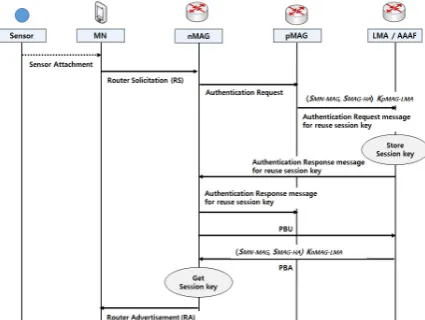
Figure 4. Intra-domain handover flow.
scheme adapts direct transmission strategy betw een LMAs in inter-domain handov er and authen tica tion process, and chooses the strategy for reusing session key on AAA serv er [20]. As shown in Figure 3, beca use informa tion can be directl y deliv ered betw een LMAs in close vicinity , the control overhead of overall system can be saved compared to comm unica tion via HA.
When an MN moves into a netw ork region, from the left to the right in the figure it passes by LMA1, LMA2 and final y reaches LMA3. When an MN reaches LMA2, it immedia tel y sends a BU messag e to LMA2. This will make LMA2 respond to LMA1. Upon receipt of the messag e, LMA1 compares the messag e with ones in the list of LMA, makes a request for informa tion on the MN, and upda tes the curren t LMA address of the MN. This will be followed by a direct transmission of packet data, from LMA1 to LMA2, without lev eraging HA fail over.
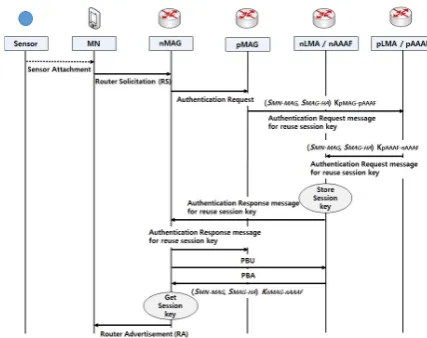
Figure 5. Inter-domain handover flow.
registers node name, type and lif etime in RD, this RD can have the informa tion of all nodes. MN deliv ers the collected data to informa tion demander via internet working. On receiving notific tion from MN, nMAG sends authen tication request messag e to pMAG to reuse the session key [21]. On receiving the request messag e, the mPAG encrypts session keys SMN−MAG and SMAG−HA using KpMAG−LMA and then deliv ers
it to the LMA. LMA saves the receiv ed session key and returns the response messag e on reusing session key to nMAG. nMAG deliv ers the receiv ed response messag e to pMAG and sends PBU messag e to LMA. On receiving PBU messag e, LMA deliv ers PBA incl uding the encrypted value of session keys SMN−MAG and SMAG−HA using KnMAG−LMA to nMAG. nMAG deliv ers the encrypted session key to MN. Here, a reliable binding upda te channel betw een MN and LMA is formed. In addition, Figure 5giv es the specifi messag e f ow in inter-domain handov er.
3.2. Protocol selection
To select the most appropria te mobility manag emen t protocol, the mobility manag emen t protocol provided by netw ork and MN’s mobility manag emen t protocol environmen t need to be taken into consider ation. In the authen tica tion process, MAG searches MN’s profil for MN’s pref erence. From the search, in case MN’s pref erred protocol matches wha t was provided from access netw ork, the matching protocol will be selected [22]. Otherwise, the MN’s pref erence has higher priority . In case MN does not have a pref erence, the netw ork is responsible to assess the perf ormance of basic MIPv6 and Proxy -AAA technique and select the appropria te protocol. To evaluate the perf ormance of basic MIPv6 and the Proxy -AAA scheme, the rela ted path latency is probed by MAG. While searching for path, MAG sends tw o types of proving messag es to
redirected to pLMA and the rela ted round- trip time (RTT) is denoted as RT Tproxy−AAA. The other probing messag e is sent directl y to pLMA and the rela ted RTT is denoted as RT Tmip. The average RTT of the MIPv6 path (zn) after path probing for times can be cal cula ted as
zn=αRT Tmip(n) + (1−α)zn−1 (1)
Where αreflect the significanc of past events in the
cal cula tion of the weighted average. For exam ple, we set
α to 0.8 in this paper , and then the most recen t value zn−1 will contribute to the cal cula ted znvalue with 20% weighting. This will avoid hysteresis if the value ofαis
carefull y selected [23]. The variable zis initialized with
the following value:
z0 =RT Tmip(0) (2)
In a similar manner , the average RTT for the Proxy -AAA scheme can be cal cula ted and denoted as tn. When path latency of MIPv6 hands over to much smaller and lower frequency than path latency and MN of Proxy -AAA technique, the perf ormance of MIPv6 will be improv ed. On the other hand, in case the latency of MIPv6 is not much smaller than the latency of Proxy -AAA technique and hands over at higher frequency of MN, the perf ormance of proposed Proxy -AAA technique will be improv ed. In appropria tel y selecting the better protocol according to netw ork condition and mobility par ameters, protocol selection can be used.
tn−zn
Nh
< Ht, select Proxy -AAA scheme
tn−zn
Nh
≥Ht, select Basic MIPv6 (3)
Here, Nh is the handov er frequency and the value of tn−zn
/
Nh is used as the quality indica tor to judg e which protocol can provide better perf ormance, and Ht is the quality threshol d to determine which protocol shoul d be selected.
4. Performance Evaluation
4.1. System Modeling
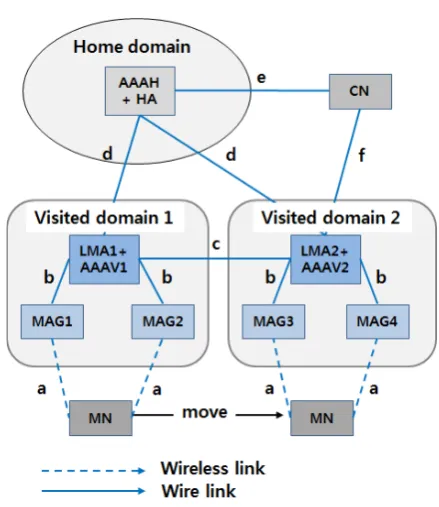
Figure 6. Cost analysis model of Proxy-AAA.
data transmission overhead Cpacket. Signal control overhead is composed of authen tica tion signaling control overhead Cauth and registr ation signaling control overhead Creg in gener al, and Creg is mainl y made of the data transmission overhead from CN to MN(CCN−MN).
Figure 6 shows the netw ork topol ogy of a specifi Proxy -AAA for a system overhead anal ysis. As shown in Figure 6, the proposed hospital contains three f oors, each with tw o wards. The hospital is considered as a one SPMIPv6 domain, in which sensor nodes are depl oyed on the patien t body as well as over the environmen t, ARs are used to control wards. Patien ts can get real- time care while moving betw een rooms, wards, and f oors, or when the patien t moves to another branch of the hospital.
Ctotal =Csignal+Cpacket =β(Creg+Cauth
)
+αCCN−MN (4)
Here, αrefers to the average velocity of packet data,
transmitted from the CN to the MN (the average arriv al rate of packet data), and β is the average switching
rate of an MN when it transf ers from a subnet to another , which is referred to as MN’s switching rate per unit time [24]. When it is assumed tha t the number of packets transmitted from an MN to a CN remains constan t, we can express the packet to mobility ratio (PMR) of the packets receiv ed by the MN as p=α/β.
Also, p=α/β refers to the average number of packets
receiv ed by a peer CN. PMR is the ratio of packet arriv al
rate and mobility rate, and it is a crucial indica tor for the presen t study . The larg er PMR is, the larg er the arriv al rate is than the mobility rate, meaning tha t the data transmission cost becomes larg er. When PMR becomes smaller , the arriv al rate becomes smaller than the mobility rate, meaning the binding upda te cost becomes larg er. Also, the average length of data packets is referred to as ld, and signaling packets as ls. The ratio of these is supposed to be l=ld/ls. For the convenience of cal cula tion, ld = 1024B and ls= 100B are set by lev eraging par ameters offered by [25]. The overhead of transmitting signaling packets is associa ted with the distance betw een entities, while the overhead required for a data packet transmission shoul d be l
times of tha t for a signaling packet transmission.
Ctotal =β (
Creg+Cauth
)
+αldLCN−MN =βls
(
Lreg+Lauth
)
+αldLCN−MN (5)
The presen t study adopts Ethernet LAN of 10Mbit/s for the wired netw ork environmen t and single-hop WLAN of 2Mbit/s for the wireless environmen t. For the cal cula tion of time dela ys in wired and wireless links, we use an empirical formula respectiv ely expressed by
Trt(h, k) and Wrt(k):
Trt(h, k) = 3.63k+ 3.21 (h−1), Wrt(k) = 17.1k (6)
Where k is for the packet length, with the unit KB
(kil obytes), and his for the routing hops. The following
section will provide some assum ptions. ηrepresen ts the
cost of signaling packets in wired transmission per unit distance. The cost in wireless transmission is 10η. In
addition, σ represen ts the cost of data packets in wired
transmission per unit distance. The cost in wireless transmission is 5σ.
Cpacket=αCCN−MN
=αld σ
(
lCN−HA+lHA−LMA+lLMA−MAG )
+ 5σ lMAG−MN
(7)
MN’s mobility is described by the simple equality f uid model. It is assumed tha t the area covered by the LMA is a 150m×150m square. When the pedestrian
walks at a speed of 3 miles/hour (mph), β= 0.01; when
Cpacket=βpld σ
(
lCN−HA+lHA−LMA+lLMA−MAG )
+ 5σ lMAG−MN
(8)
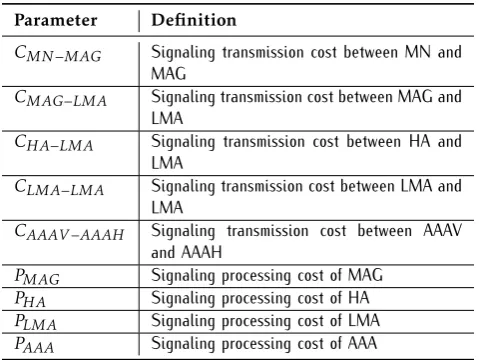
As the sug gested Proxy -AAA scheme aims to red uce the signaling overhead gener ated in authen tica tion and registr ation processes, this section compares Proxy -AAA with traditional -AAA schemes. Note tha t the traditional AAA is define as a simple combina tion of HMIPv6 and AAA. The relev ant par ameters and definitio descriptions are shown in Table 1.
Table 1. The parameter Definition.
Parameter Definition
CMN−MAG Signaling transmission cost between MN and MAG
CMAG−LMA Signaling transmission cost between MAG and
LMA
CHA−LMA Signaling transmission cost between HA and LMA
CLMA−LMA Signaling transmission cost between LMA and
LMA
CAAAV−AAAH Signaling transmission cost between AAAV
and AAAH
PMAG Signaling processing cost of MAG
PHA Signaling processing cost of HA
PLMA Signaling processing cost of LMA
PAAA Signaling processing cost of AAA
Assuming tha t MN moves out of the LMA region
m times in a certain period of time, then the
authen tica tion will be perf ormed m times. The earlier m−1 authen tica tions are intra-domain authen tica tions,
and the last one is for inter-domain authen tica tion. Suppose tha t the authen tica tion process as a resul t of MN’s movemen t is in line with Poisson distribution with λ, then
p(n) =
∫ ∞
t=0p(n, t)f (t)dt=
∫ ∞
t=0 (λt)n
n! e
−λtf (t)dt
= (−1)nλn n!
dnF(s) dsn
s=λ (9)
Assuming tha t the time for which MN is in the region of LMA accords with Gamma distribution, and the expecta tion and variance of density function f(t) can
be expressed as 1/µandv, the Laplace transf orm can be
expressed as
F(s) = (1 +µνs)−1 /
µ2ν (10)
dnF(s)
dsn = (−µν)
n n−1 ∏ j=0 ( 1
µ2ν +j
)(1 +µνs)−( 1 µ2ν+n
)
(11) However,f(t) can vary depending on the exponen tial
distribution, if µ2ν= 1. In tha t case, the expected
authen tica tion time (m) can be expressed as follows.
E(m) =
∞ ∑
n=1
nP(n) =
∞ ∑
n=1
n µλ
n
(λ+µ)n+1 = λ
µ (12)
Through cost model anal yses based upon HMIPv6, the inter-domain and intra-domain signaling overhead for a binding upda te under PMIPv6 can be expressed as follows.
BUintraP MIP v6 = 2CMN−MAG+ 2CMAG−LMA
+ 2PMAG+PLMA (13)
BUinterP MIP v6 = 2CMN−MAG+ 2CMAG−LMA+ 2CLMA−HA
+ 2PMAG+ 2PLMA+PHA (14)
In addition, the authen tica tion dela y under tradi-tional AAA methods can be expressed as follows.
Atraditional = 2CMN−MAG+ 2CMAG−LMA+ 2CLMA−AAA
+ 2CAAAV−AAAH+ 2CLMA−HA+PAAA
+ 2PMAG+ 4PLMA+PHA (15)
Through this anal ysis, the entire signaling overhead in the LMA region under the traditional AAA scheme can be expressed as follows.
Csignal−traditional =BUtotal+AtraditionalE(m) =BUintraP MIP v6(E(m)−1)
+BUinterP MIP v6+AtraditionalE(m) (16)
Through the anal ysis of the proposed Proxy -AAA scheme, the entire signaling overhead of its LMA region coul d be expressed as follows.
Csignal−proposed =BULMA+AP roxy−AAAintra (E(m)−1)
+AP roxyinter −AAA
=BUintraP MIP v6(E(m)−1) +BUP roxy−AAA
+AP roxy−AAAintra (E(m)−1) +AP roxy−AAAinter
It is assumed tha t under the proposed Proxy -AAA scheme, the binding upda te signaling cost incurred by MN movemen ts betw een LMA domains is expressed as follows.
BUP roxy−AAA= 2CMN−MAG+ 2CMAG−LMA
+ 2CLMA−LMA+ 2PMAG+ 3PLMA (18)
When using the Proxy -AAA scheme, LMA coexists with AAAV. Assuming lLMA−AAA= 0, then the authen-tica tion signaling overhead for inter and intra domain can be expressed as follows.
AP roxy−AAAintra = 2CMN−MAG+ 2CMAG−MAG
+ 2CMAG−LMA+ 4PMAG+PLMA (19)
AP roxy−AAAinter = 2CMN−MAG+ 2CMAG−MAG+ 2CMAG−LMA +CLMA−LMA+ 2CAAAV−AAAH+ 4PMAG
+ 2PLMA+PAAA (20)
CMN−MAG= 10ηlMN−MAGlsCMAG−MAG
=ηlMAG−MAGlsCMAG−LMA
=ηlMAG−LMAls (21)
CLMA−HA=ηlLMA−HAlsCLMA−LMA
=ηlLMA−LMAlsCLMA−AAA
=ηlLMA−AAAls (22)
CAAAV−AAAH=ηlAAAV−AAAHls (23)
AP roxy−AAAintra =(20ηlMN−MAG+ 2ηlMAG−MAG
+ 2ηlMAG−LMA)ls+ 4PMAG
+PLMA (24)
AP roxy−AAAinter =
20ηlMN−MAG+ 2ηlMAG−MAG
+2ηlMAG−LMA+ηlLMA−LMA
+2ηlAAAV−AAAH
ls
+ 4PMAG+ 2PLMA+PAAA (25) Assuming tha t the signaling overhead ratio of Proxy -AAA and traditional -AAA schemes is R, R can be
expressed as R=Csignal−proposed/Csignal−traditional. The
Figure 7. Packet data transmission overhead (µ= 0.1).
average overhead for signaling can be expressed as
Csignal−a=Csignal−proposed /
Taby anal yzing the signaling overhead equa tion in the LMA region abov e. In this expression, Ta refers to the average residence time in this LMA region. It shoul d be noted tha t the value must be smaller than 0.3 in the actual netw ork environmen t.
4.2. Numerical Results
This section will compare the system overhead. Specifi par ameters and values are shown in Table 2.
Table 2. The parameter Definition.
Parameter Value Parameter Value
lMAG−LMA 5 lMN−MAG 1
PMAG 4 lHA−LMA 10
lLMA−LMA 10 lLMA−AAA 10
σ 0.05 η 0.1
PLMA 3 PHA 4
PAAA 3 lCN−HA 50
lMAG−MAG 1
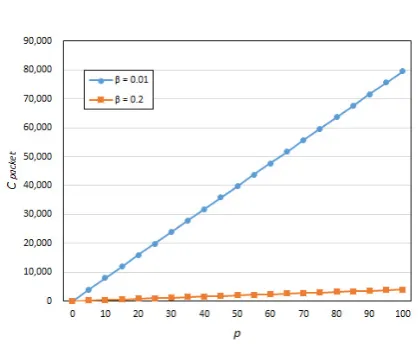
First of all, we establish MNs as a vehicle and pedestrian, anal yzing their differen t data pocket transmission overheads individ uall y. Figure 7shows the data packet transmission overhead under a condition tha t MNs are pedestrians (β= 0.01) and vehicles (β=
0.2). We can see tha t the data pocket transmission
overhead Cpacketincreases when the PMRpincreases. Figure 8 shows how the data packet transmission overhead chang es when the value of PMRp= 10,p= 50
or p= 100 . We can see tha t as the average switching
rate increases when the MN moves, the data packet transmission overhead Cpacketincreases.
Figure 9 anal yzes the average signaling overhead of Proxy -AAA. This implies tha t the signaling overhead
Figure 8. Packet data transmission overhead (µ= 0.1).
Figure 9. Signaling overhead (lAAAV−AAAH = 50).
rate of authen tica tion events λ increases. Frequen t
arriv al of MN brings increase in authen tica tion events arriv al rate and indica tes an increase in intra-domain authen tica tion in LMA domain and signaling overhead in registr ation.
Figure 10 anal yzes the average signaling overhead of Proxy -AAA. This shows tha t the increase of residence time leads to a red uced signaling overhead Csignal.
Figure 11 anal yzes the signaling overhead ratio R
betw een Proxy -AAA and traditional AAA schemes. This shows tha t R must be less than 1 all times. In other
words, the signaling overhead of the proposed Proxy -AAA scheme is alw ays smaller than signaling overhead value of traditional AAA schemes irrelev ant of whether MN moves betw een domains or to the same LMA region.
Figure 12 shows the chang es of the signaling over-head ratio betw een traditional AAA schemes and Proxy -AAA schemes, when the value ofAAAAV−AAAH =
Figure 10. Signaling overhead (lAAAV−AAAH = 50).
Figure 11. Ratio of signaling overhead (Proxy-AAA / traditional AAA).
10, AAAAV−AAAH= 50 and AAAAV−AAAH = 100 , respec-tiv ely. This shows tha t an increase in arriv al rate of authen tica tion event red uces signaling overhead ratio betw een proposed Proxy -AAA schemes and traditional AAA schemes.
Figure 13 shows anal ysis of the entire overhead based on PMR pincreases (β = 0.01, λ= 1). When the
pedestrian (β= 0.01) moves, we can see tha t as the
value of pincreases, entire overhead Ctotal increases. Figure 14 shows anal ysis of the entire overhead based onβincreases. When PMR fixed we can see tha t as the
value of βincreases, entire overhead Ctotalincreases.
5. Conclusions
Figure 12. Change of signaling overhead ratio (Proxy-AAA / traditional AAA).
Figure 13. Figure 12 Total overhead (β= 0.01,λ= 1).
Figure 14. Figure 13 Total overhead (p= 30,λ= 1).
additional overhead from movemen t of mobile device in mobile IP environmen t by combining AAA and PMIPv6. This scheme has established a saf e handov er by efficien tly red ucing signaling overhead gener ated by authen tica tion processes. Here we coul d confir tha t fast mobility mode and forw arding mode betw een various LMAs were supported. Moreov er, the overall signaling overhead also show ed tha t proposed Proxy -AAA scheme alw ays has smaller value than previous traditional AAA schemes, hence enabling efficien t movemen t betw een domains by AAA Authen tica tion Scheme in forw arding mode at PMIPv6 supporting local mobility . Also, during movemen t betw een LMA domains, it was confirme tha t the farther the distance betw een RAAAS (Root AAA Serv er) and home domain, the higher the perf ormance efficiency .
Acknowledgement. This work was supported by the
Technol ogy Innov ation Progr am (10054486, Dev elopmen t of Open Industry IoT (IIoT) Smart Factory Pla tform and Factory -Thing Hardw are Technol ogy) funded By the Ministry of Trade, industry & Energy (MI, Korea).
This work was supported by ąřThe Componen ts & Materials Technol ogy Dev elopmen t Progr am (10043800, Dev elopmen t of Micro Smart Environmen tal Sensor Measuremen t Module, Control Chip, and Applica tion Progr am)ąś funded by the Ministry of Trade, Industry & Energy (MI, Korea).
This work was supported by the Energy Technol ogy Dev elopmen t Progr am (2013T100200078, dev elopmen t of integr ated demand response system technol ogy for co-residen tial resources and demonstr ation of business model) funded by the Ministry of Trade, Industry & Energy (MOTIE, Korea).
This work was supported by Global Crea tiv e Softw are (GCS) Project (No. 2014-044-028-001, Dev elopmen t of ICT Convergence Technol ogy for Design Optimiza tion and Construction Technol ogy Innov ation of the Structur al Frame and Envelope) funded by the Ministry of Science, ICT & Future Planning (MSIP).
References
[1] C. de Laatand G. Grossand L. Gommansand D. Spence
(2000) Generic AAA Architecture(RFC 2903).
[2] Francesco Palmieri and Ugo Fiore and Aniello Castiglione(2011) Automatic security assessment for next
generation wireless mobile networks(Mobile Informa tion Systems), Volume 7, pp. 217-239.
[3] P. Calhoun and J. Loughney and E. Guttman and G. Zorn and J. Arkko (2003) Diameter Base Protocol(RFC
3588, September 2003).
[4] Le Fand Patil B and Perkins C, et al(2004) Diameter
mobile IPv6 application(Internet IETF Draft , 2004). [5] Lee S Yand Huh E Nand Kim S B, et al(2005) An efficient
pp. 628-637, May 2005.
[6] Kim M and Kim M and Mun Y (2005) A hierarchical
authentication scheme for MIPv6 node with local movement property(Proceedings of the Interna tional Conference on Computa tional Science and its Applica tions (ICCSA’05)), pp. 550-558, May 2005.
[7] Song Meiand Wang Liand Song Jun-de(2008) A secure
fast handover scheme based on AAA protocol in mobile IPv6 networks(The Journal of China Univ ersities of Posts and Telecomm unica tions, 15 (Sup1)), pp. 14-18, 2008. [8] Ilsun Youand Takahiro Hara(2010) Mobile and Wireless
Networks(Mobile Informa tion Systems), Volume 6, pp. 1-3, 2010.
[9] G. Giaretta (2009) Interactions between PMIPv6 and
MIPv6: scenarios and related issues(draft-ietf -netlmm-mip-interactions-04, June 2009).
[10] Arjan Durresi and Mimoza Durresi and Leonard Barolli (2008) Secure authentication in heterogeneous
wireless networks(Mobile Informa tion Systems), Volume 4, pp. 119-130, 2008.
[11] Hakseon Hwang and Jongpil Jeong (2013) Reduction
of Authentication Cost Based on Key Caching for Inter-MME Handover Support(The Journal of the Institute of Webcasting, Internet and Telecomm unica tion), Volume 13, pp.209-220, October 2013.
[12] JeongBae Han and Seung-Hyun Lee and Dongryeol Shin and Jongpil Jeong (2011) Performance Analysis of
Proxy-AAA Authentication Scheme in PMIPv6 Networks with Forwarding Mode Supporting(The Fourth Workshop on Informa tion Technol ogies and Communica tion -WOTIC 2011), pp. 81, October 2011.
[13] Seung-Hyun Lee and Dong-Ryeol Shin and Jongpil Jeong(2012) Performance Analysis of Proxy-AAA
Authenti-cation Scheme in PMIPv6 Networks with Forwarding Mode Supporting(Journal of Korean Society for Internet Infor-mation), Volume 13, pp.15-25, February 2012.
[14] Se-Won Yoo and Jongpil Jeong (2012) Analytical
Approach of Fast Inter-Domain Handover Scheme in Proxy Mobile IPv6 Networks with Multicasting Support(The KIPS Transactions:P artC), Volume 19C, pp.153-166, April 2012.
[15] Hyun-Suk Chai and Jongpil Jeong (2012) Security
Analysis and Implementation of Fast Inter-LMA domain Handover Scheme in Proxy Mobile IPv6 Networks(The KIPS Transactions:P artC), Volume 19C, pp.99-118, June 2012. [16] Jae-Hoon Kim and Jongpil Jeong (2011) Performance
Analysis of Cost-Effective Handoff Scheme in PMIPv6
Conference on Internet - ICONI 2011), pp. 149-153, December 2011.
[17] J.-F. Guan, et al(2009) Implementation and analysis of
proxy MIPv6(Published Online, WCM), September 2009. [18] A.J. JaraandM. A. Zamoraand A. F. G. Skarmeta(2010)
An Initial Approach to Support Mobility in Hospital Wireless Sensor Networks based on 6LoWPAN (HWSN6)(Journal of Wireless Mobile Netw orks, Ubiquitous Computing, and Dependable Applica tions), vol. 1, no. 2/3, pp. 107-122, 2010.
[19] SeungYoon Parkand Jongpil Jeong (2013) On Pointer
Forwarding Based Mobility Management for Cost-Optimized Proxy Mobile IPv6 Networks(2013 Sev enth Interna tional Conference on Innov ativ e Mobile and Internet Services in Ubiquitous Computing - IMIS 2013), pp. 29-36, July 2013. [20] Do-Kyoung Raand Jongpil Jeong(2012) Cost-Effective
Mobility Management Scheme in Proxy Mobile IPv6 Net-works with Function Distributor Support(The Journal of the Institute of Webcasting, Internet and Telecomm uni-cation), Volume 12, pp.97-107, February 2012.
[21] J. Jeongand M. Kangand Y. Choand J. Choi(2013) 3S:
Scalable, secure and seamless inter-domain mobility manage-ment scheme in proxy mobile IPv6 networks(Interna tional Journal of Security and its Applica tions), Volume 7, Issue 4, pp. 51-70, July 2013.
[22] Jongyoun Kim and Jongsun Park and Jongpil Jeong
(2012) LC-GM2: Low-Cost Global Mobility Management Scheme in Proxy Mobile IPv6 Networks(KIPS Transactions on Computer and Communica tion Systems), Volume 1, pp.193-204, December 2012.
[23] D.-G. Anderson(2005) Improving end-to-end availability
using overlay networks(Massachusetts Institute of Technol-ogy), February 2005.
[24] Jain Rand Raleigh Tand Graff C, et al(1998) Mobile
Internet access and QoS guarantees using mobile IP and RSVP with location registers(Proceedings of Interna tional Conference on Communica tions (ICC’98)), Vol 3, pp. 1690-1695, June 1998.
[25] Lee K and Mun Y (2005) An efficient macro mobility