Research Article
Response of rice varieties to different
temperature regimes
Mahmooda Buriro
1, Ihsan Ahmed Soomro
1, Shahla Karim Baloach
2*,
Nighat Seema Soomro
1, Saiqa Buriro
1and Muhammad Tahir Khan
3 1. Department of Agronomy, Faculty of Crop Production, Sindh Agriculture University, Tandojam, Sindh-Pakistan 2. Department of Biotechnology, Faculty of Crop Production, Sindh Agriculture University, Tandojam, Sindh-Pakistan3. Nuclear Institute of Agriculture-Pakistan
*Corresponding author’s email: [email protected] Citation
Mahmooda Buriro, Ihsan Ahmed Soomro, Shahla Karim Baloach, Nighat Seema Soomro, Saiqa Buriro and Muhammad Tahir Khan. Response of rice varieties to different temperature regimes. Pure and Applied Biology. Vol. 8, Issue 1, pp232-238. http://dx.doi.org/10.19045/bspab.2018.700181
Received: 02/08/2018 Revised: 17/10/2018 Accepted: 25/10/2018 Online First: 02/11/2018
Abstract
A laboratory experiment was conducted to find out the influence of temperature on germination traits of various rice varieties. Seeds of ten differentrice varieties (IR-6, DR-83, DR-92, Shahkar, Bangelo, IR-8, DR-82, Kangni-27, Shandar and Sarshar) were observed the different germination linked traits influenced by 5 different temperatures regimes (30, 35, 40, 45,50oC) in germinator. The germinability and related traits of various rice varieties showed significantresponse to changes in temperatures. The highest seed germination (89.02%) was observed after 48 hours under 40oC temperature. However, 35oC was found to be themost suitable temperature for growth
and vigor of seedlings.Whereas,in seedling growth and vigor traits, variety Bangelo showed superiority with highest shoot length, root length, shoot fresh weight, root fresh weight, shoot dry weight, root dry weight, and vigor index. It was concluded that for obtaining higher germination in rice varieties, 35oC proved to be most suitable temperature, while germination and almost all other studied traits were adversely affected with increasing temperature.
Keywords: Germination, Rice seed vigor, Temperature stress
Introduction
Rice (Oriza sativa L.) is principal food for about half of the world’s population.Moreover, its consumption and demand has increased over the years. Itis an essential cash crop and one of the main export items of Pakistan accounting for 6.4 percent of value added in agriculture and 1.6 percent in GDP. Rice is grown in all four provinces of the country however, Punjab and Sindh count for more than 90% production in Pakistan.In Sindh province, Kangni-27, Sonhari Kangni, Kangni× Torhi, Dokri Basmati, Bangalo,
Sugdasi, Lari, Motia Ratria, Irri-6 and Irri-8 are the commonly cultivated varieties. It is a selection from the local indigenous stock with high yielding quality and wide range of adaptability [1].
by water stress is also expected to double by the end of this century. In high temperature stress, rice’s damage and sensitivity is determined by its growth stage. The highest sensitivity is known to be recorded at the reproductive stage [4].
Seed germination is one of theessential parametersin plant development forultimately obtaininghigher seed yield. However, these traits may strongly decline as a result of drought stress that is perhaps one of the most important stresses which limitthe germination as well as growth of the seedlings [5-7]. The difference response by germination of rice again higher temperature day night temperature mentioned. The higher temperature is usually linked with increased rat of respiration percentage that causes low production [8]. While particular level of overlap physiological and biochemical reactions such as reduction in number of pollens on stigma germinated and reduced in pollination with increased in fertility of spikelet in higher day night temperature effects are also reported by [8, 9]. Influence of environment hot and cold temperature effect enhance the reactive oxygen species (ROS) production, at high elevated concentration cause oxidative destruction and death of cell [10]. In order to know that plant respond sense for particular combination of stress is a important part of research [11]. For instance higher level of (ROS) can increase transcriptional changes in cold and hot environmental conditions. While hormones production with signaling can also bring change during the variation of temperature stress [12].
Present study was carried-out to investigate the effect of temperature stress on thegermination of rice varieties and to assess the interaction between different varieties and temperature on the related traits of rice seedlings.
Materials and methods
Site, experimental design and treatments
Present investigation was performed during the year 2011 to 2012 under the (STL) Seed Testing Laboratory, Department of Agronomy, Faculty of Crop Production, Sindh Agriculture University, Tando Jam. To assess the influence of higher temperature stress of the germination traits of seed of various rice varieties. Experiment was arranged in completely randomized design (CRD) having three replications. Five temperature regimes were used in the experiment including 30°C, 35°C, 40°C, 45°C and 50°C, whereas tested rice cultivars were IR-6, DR-83, DR-92, Shahkar, Bangelo, IR-8, DR-82, Kangni-27, Shandar and Sarshar.
Experimentation and data recorded
In this study experimental treatments were set out in (complete randomized design with 3 replications. A set with total 50 complete randomly selected seed from all every varieties were kept in the petri dishes with 13.5 cm in diameter fifty germinator model –PL3 at different temperature as described above. The seed were moisten when it was necessary.
Seedling vigor index were collected through multiplication of germination percentage and length of seedling in cm.
Statistical analysis
The collected data were typed on computer and used for statistical analyze variance in means of treatments. The LSD (least significant difference) test was used to find out the statistical difference among the treatment with below described procedure as suggested by Gomez and Gomez (1984).
Results and discussion Seed germination
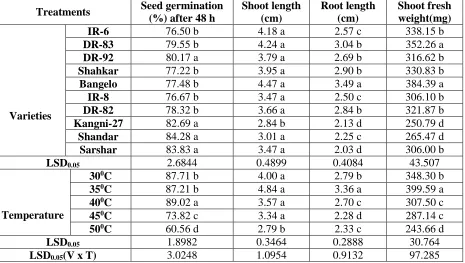
Varietal behavior for seed germination in this study indicated that Shandar showed the
highest seed germination (84.28%) after 48 hours, followed by Sarshar (83.83%), Kangni-27 (82.69%) and DR-92 (80.17%). The seed germination was relatively lower in varieties IR-6 (76.50%) and IR-8 (76.67%). The seed germination of various rice varieties were assortedsignificantly due to temperature stress, whereas the highest seed germination (89.02%) was noted under moderate temperature (40oC), while temperature 30, 35 and 45oC resulted in relatively lower seed germination of 87.71, 87.21 and 73.82%, respectively (Table 1).
Table 1. Seed germination and related traits of rice cultivars as affected by different temperature regimes
Treatments Seed germination
(%) after 48 h
Shoot length (cm)
Root length (cm)
Shoot fresh weight(mg)
Varieties
IR-6 76.50 b 4.18 a 2.57 c 338.15 b
DR-83 79.55 b 4.24 a 3.04 b 352.26 a
DR-92 80.17 a 3.79 a 2.69 b 316.62 b
Shahkar 77.22 b 3.95 a 2.90 b 330.83 b
Bangelo 77.48 b 4.47 a 3.49 a 384.39 a
IR-8 76.67 b 3.47 a 2.50 c 306.10 b
DR-82 78.32 b 3.66 a 2.84 b 321.87 b
Kangni-27 82.69 a 2.84 b 2.13 d 250.79 d
Shandar 84.28 a 3.01 a 2.25 c 265.47 d
Sarshar 83.83 a 3.47 a 2.03 d 306.00 b
LSD0.05 2.6844 0.4899 0.4084 43.507
Temperature
300C 87.71 b 4.00 a 2.79 b 348.30 b
350C 87.21 b 4.84 a 3.36 a 399.59 a
400C 89.02 a 3.57 a 2.70 c 307.50 c
450C 73.82 c 3.34 a 2.28 d 287.14 c
500C 60.56 d 2.79 b 2.33 c 243.66 d
LSD0.05 1.8982 0.3464 0.2888 30.764
LSD0.05(V x T) 3.0248 1.0954 0.9132 97.285
Means followed by different letters in each column are significantly different from each other at 5% levels of probability
Shoot length
The varietal effect suggested that shoot length in Bangelo variety was the highest (4.47cm), followed by DR-83 (4.24cm) and IR-6 (4.18cm). However, lowest shoot length was observed in variety Kangni-27 (2.84cm). The varieties respondingto temperature variably and differences were
temperature, whereasseedlings kept under 30oC temperature showedshoot length of 4.00 cm. Moreover, seedlings under 40 and 45oC temperature recorded theshoot length of 3.57 and 3.34 cm, respectively. Seedlings raised in highest tested temperature (50oC)
resulted in lowest shoot length of 2.79 cm.
Root length
Rice varieties tested in this study were of diversified origin; hence, their response to varying temperature regimes differed significantly from each other, as shown in Table 1.The varietal effect indicated that root length in variety Bangelo was maximum (3.49cm), followed by DR-83 (3.04cm) and Shahkar (2.90cm). Whereas, the lowest root length was observed in variety Sarshar (2.04cm). Maximum root length (3.36 cm) was observed under 35oC temperature, while seedlings raised under 30oC temperature ranked 2nd with root length of 2.79 cm.Moreover, seedlings raised under 40oC and 45oC temperature
resulted in root length of 2.70 cm and 2.28 cm, respectively.
Shoot fresh weight
The analyzed data in Table 1 showed the maximum mean shoot fresh weight of384.39 mg, in Bangelo followed by 338.15 and 352.26 mg in DR-83 and IR-6, respectively. On the other hand, the lowest shoot fresh weight (250.79 mg) was observed in variety Kangni-27.The highest shoot fresh weight of rice seedlings (399.59 mg) was recordedwhen kept under 35oC temperature, followed by 30oC, 40oC and 45oC temperatures with shoot fresh weight of 348.30, 307.50 and 287.14 mg, respectively. Whereas, highest tested temperature regime (50oC) resulted in lowest shoot fresh weight
of 243.66 mg.
Root fresh weight
The results (Table 2) showed that the highest root fresh weight (262 mg) was noted in variety Bangelo, followed by 83 (228.50 mg), Shahkar (217.50 mg),
DR-82 (213.50 mg) and DR-92 (202.00 mg). However, the lowest root fresh weight was observed in variety Sarshar (152.50 mg).Root fresh weight of rice was maximum(252.25 g) under 35oC temperature, followed by 30, 40 and 45oC
temperatures with root fresh weight of 209.50, 203.00 and 171.00 mg, respectively.Further increase in temperature up to 50oCresulted in the lowest root fresh weight of 157.00 mg.
Shoot dry weight
The highest shoot dry weight (23.44 mg) was recorded by variety Bangelo, followed by 83 (21.48 mg), IR-6 (20.62 mg), DR-82 (19.63 mg) and DR-92 (19.31 mg). The shoot dry weight was lower in varieties Shandar (16.19 mg), Sarshar (18.66 mg) and IR-8 (18.66 mg). Whereas, the lowest shoot dry weight (15.29 mg) was observed in variety Kangni-27.The highest shoot dry weight (24.37 mg) was noted when rice seedlings were kept under 35oC temperature,
followed by 30, 40 and 45oC temperatures with shoot dry weight of 21.24, 18.75 and 17.51 mg, respectively.
Root dry weight
It is evident from Table 2 that the highest root weight of15.50 mg was noted in variety Bangelo, followed by DR-83 (14.39 mg), Shahkar (13.70 mg), DR-82 (13.45 mg) and DR-92 (12.72 mg). However, the lowest root dry weight was observed in variety Sarshar (9.60 mg). The root dry weight 15.89 mg was increased whenseeds were kept under 35oC followed by 30 and 40oC with root dry weight of 13.19 and 12.87 mg; however, shoot dry weight of rice seedlings decreases with increasing the temperature further (50oC).
Seed vigor index
temperature regimes are presented in Table 2. The effect of temperature, varieties, and their interaction on vigor index was significant (P<0.05).Different rice varieties, showed significant behavior for vigor index amongst each other.Highly significant data showed themaximum vigor index was recorded in Bangelo(270.54), followed by Shahkar (248.36). However,the lowest vigor
index was noted for variety Kangni-27 (173.60).The vigor index was the highest (317.6) at 300C. whereas, vigor index of
seedlings under temperature 30oC, 40oC and 45oC ranked 2nd, 3rd and 4th with vigor index of 264.7, 233.9 and 179.8, respectively as shown in Table 2.Moreover, the vigor index of seedlings raised in highest temperature (50oC) was lowest (119.93).
Table 2. Root fresh weight (mg), shoot fresh weight (mg), root dry weight (mg), and seed vigor index of rice cultivars as affected by different temperature regimes
Treatments Root fresh
weight (mg)
Shoot dry weight (mg)
Root dry weight
(mg) Seed vigor index
Varieties
IR-6 173.00 c 20.62 b 12.11 c 221.59 b
DR-83 228.50 b 21.48 a 14.39 b 242.38 a
DR-92 202.00 b 19.31 b 12.72 c 218.74 b
Shahkar 217.50 b 20.18 b 13.70 b 248.36 a
Bangelo 262.00 a 23.44 a 15.50 a 270.54 a
IR-8 187.50 c 18.66 b 12.81 c 202.85 b
DR-82 213.50 b 19.63 b 13.45 b 243.40 a
Kangni-27 160.00 d 15.29 c 10.08 d 173.60 c
Shandar 169.00 c 16.19 c 10.64 c 186.72 c
Sarshar 152.50 d 18.66 b 9.60 d 224.56 a
LSD0.05 30.628 2.6541 1.9095 29.864
Temperat ure
300C 209.50 b 21.24 b 13.19 b 264.70 b
350C 252.25 a 24.37 a 15.89 a 317.57 a
400C 203.00 b 18.75 c 12.87 b 233.88 c
450C 171.00 c 17.51 c 10.68 c 179.83 d
500C 157.00 c 14.86 d 9.89 c 119.93 c
LSD0.05 21.657 1.8768 1.3502 21.117
LSD0.05(V x T) 68.487 5.9348 4.2698 66.779
Means followed by different letters in each column are significantly different from each other at 5% levels of probability
Discussion
Higher seed germination is essential for achieving optimal seedling numbers that would result in higher seed yield [5]. Similar results were found [13], who described germination percentage was observed positively influenced through temperature as well as other alternative treatments. The low temperature stress at germination level on observed germplasm of rice due to reduction of last germination percentage and coleoptiles and radicle length rat in their
increased sensitivity was observed at reproductive stage. The differential responses of rice with germination in higher day night temperature have also investigated. Same statement repeated by [14], described that healthy and normal seed start to germinate within the time of 36 hours after the inhibition germinations was fulfilled at seven days under the control temperature 25C but late under other temperature treatments. At high temperature regime (50oC) reduction in root length 1.93 cm was observed. These results are in line with the findings of [15], who reported that the temperature variations effect the growth parameters of the plants, and the responses of rice crop to changing temperatures particularly on root and leaf tissues, depend upon the genotypes under the stress. These results are in conformity with the [16], that temperature and different abiotic effect are reducing the factors for cultivation of crop at different marginal and sub marginal lands, while the production of crop mostly due to environmental changes. It was observed that regardless of the varieties; the shoot fresh weight was straight away higher when sown under 35oC temperature and other than this optimum level of temperature, the shoot fresh weight was adversely affected. Apart from the temperature regimes, variety Bangelo resulted higher shoot fresh weight than rest of the varieties. Irrespective of varietal effect, the root fresh weight was linearly increased when the rice seedlings were kept under 35oC temperature and either lower to the optimum temperature, or under higher temperature, the root fresh weight was negatively influenced [17], Risein temperature up to 50oC decreased the shoot
dry weight(14.86 mg).Moreover, it was also observed that regardless of the varieties, increasing temperature did not suit well for sowing of rice over 35oC.[18], found that both high and low temperature stresses can alter multiple aspects of cellular physiology.
used 15 genotypes of rice crop with 9 fixed temperatures (12oC, 16oC, 20oC, 25oC, 27oC, 30oC, 33oC, 36oC and 40oC) and
reportedthat the effect of genotype, temperature and their interactions on germination characteristics were significant and significant reductions in the germination of rice at temperature less than 16oC and upper than 30oC were observed. [19], argued that for stress of heat and response with expression heat influenced transcripts factors that then enhance the expression various stress linked transcripts. The root dry weight was markedly increased when the rice seedlings were sown under 35oC temperature and reduced with increase or decrease in the temperature. Rice is relatively sensitive to high temperature and germination is generally affected by such variations [20]. The above discussion clearly indicates that temperature plays very important role in the germination of seed, and varieties with diversified origin should be considered for their proper temperature requirement for seed germination, and ultimately, the higher seed yield.
Conclusions
It was concluded that for obtaining higher seed germination in rice varieties, 35oC proved to be most suitable temperature, while germination and almost all the other growth and vigor traits studied were adversely affected with increasing temperature. Moreover, seed germination was the highest (84.28%) in variety Shandar after 48 hours, but the seedling growth in terms of fresh and dry weight of shoots and roots as well as the seed vigor was markedly higher in variety Bangelo as compared to rest of the varieties.
Authors’ contributions
Conceived and designed the experiments: M
Buriro & IH Soomro, Performed the
References
1. Peyman & Sharifi (2010). Evaluation on
Sixty-eight Rice Germplasms in Cold
Tolerance at Germination Stage. J L Rice
Sci 17 (1): 77-81.
2. Yoshida S (1981). High temperature stress
in rice. Different solute levels in two spring wheat cultivars induced by progressive field water stress at different developmental
stages. J Arid Environ 62: 1–14.
3. Nakagawa H, Horie T & Matsui T (2002).
Effects of climate change on rice
production and daptive technologies. In: Mew, TW, Brar, DS, Peng, S, Dawe, D, Hardy, B Eds.), Rice Sci., pp 635–657.
4. Almansouri MJM & Lutts S (2001). Effect
of salt and osmotic stresses on germination
in durum wheat (Triticum durum Desf.).
Plant Soil 231: 243-254.
5. Atak M, Kaya MD, Kaya G, Cikili Y and
Ciftci CY. 2006. Effects of NaCl on the germination, seedling growth and water
uptake of triticale. Turkey J Agri and Fore
30: 39-47.
6. Kaya MD, Okcu G, Atak M, Cikili Y &
Kolsarici O (2006). Seed treatments to overcome salt and drought stress during
germination in sunflower (Helianthus
annuus L.). Eur J Agron 24: 291-295.
7. Jagadish SVK, Craufurd PQ & Wheeler TR
(2007). High temperature stress and
spikelet fertility in rice (Oryza sativa L.). J
Exp Bot 58: 1627-1635.
8. Mohammed AR & Tarpley L (2009).
Impact of high night time temperature on respiration, membrane stability, antioxidant
capacity and yield of rice plants. Crop Sci
49: 313-322.
9. Jagadish S, Muthurajan VR, Oane R,
Wheeler TR, Heuer ST, Bennett J & Craufurd PQ (2010). Physiological and proteomic approaches to address heat
tolerance during anthesis in rice (Oryza
sativa L.). J Experimental Bot 61: 143-156.
10. Apel K. & Hirt H (2004).Reactive oxygen
species: metabolism, oxidative stress, and
signal transduction. Ann Rev Plant Biol 55:
373-399.
11. Suzuki N & Mittler R (2006). Reactive
oxygen species and temperature stresses: a delicate balance between signaling and
destruction. Physiologia Plantarum 126:
45-51.
12. Kotak S, Larkindale J, Lee U,
Koskull-Doring P, Vierling E & Scharf KD (2007). Complexity of the heat stress response in
plants. Current Opinion in Plant Biol 10:
310-316.
13. Peyman & Sharifi (2010). Evaluation on
Sixty-eight Rice Germplasms in Cold
Tolerance at Germination Stage. J L Rice
Sci 17(1): 77-81.
14. Sharifi P & Hashem A (2010). Evaluation
Eighteen Rice Genotypes in Cold Tolerance
at Germination stage. World App Sci
11(11): 1476-1480.
15. Frank G, Pressman E, Ophir R, Althan L,
Shaked R, Freedman M, Shen S & Firon N
(2009). Transcriptional profiling of
maturing tomato (Solanum lycopersicum
L.) microspores reveals the involvement of heat shock proteins, ROS scavengers, hormones, and sugars in the heat stress
response. J Exp Bot 60: 3891-3908.
16. Solomon S, Qin D, Manning M, Marquis
M, Averyt K, Tignor MMB, Miller HL & Cheng Z (2007). Climate change: the physical science basis. Contribution of Working Group I to the Fourth Assessment Report of the Intergovernmental Panel on
Climate Change. New York: Cambridge
University Press.
17. Tilebeni HG, Yousefpour H Farhadi R and
Golpayegani R (2012). Germination
Behavior of Rice (Oriza Sativa L.)
Cultivars Seeds to Difference
Temperatures. Adv in Environ Bio 6(2):
573-577.
18. Usman M (2017). Contribution of
Agriculture Sector in the GDP Growth Rate
of Pakistan. J of Global Econ 2(2): 2-4.
19. Wang WX, Vinocur B & Altman A (2003).
Plant responses to drought, salinity and extreme temperatures: towards genetic
engineering for stress tolerance. Planta