Research Article
Combining ability analysis of yield and
yield components in second filial (F
2
)
generation of mustard (Brassica juncea)
Sumayya Inayat
1, Muhammad Zakirullah
2*, Lubna Naz
1, Amna
Shafi
3, Safia Akbar
1, Muhammad Ali
2and Shitab Khan
2 1. Department of Plant Breeding and Genetics, The University of Agriculture Peshawar-Pakistan 2. Agricultural Research Institute Tarnab, Peshawar-Pakistan3. Department of Plant Pathology, The University of Agriculture Peshawar-Pakistan *Corresponding author’s email: [email protected]
Citation
Sumayya Inayat, Muhammad Zakirullah, Lubna Naz, Amna Shafi, Safia Akbar, Muhammad Ali and Shitab Khan. Combining ability analysis of yield and yield components in second filial (F2) generation of mustard (Brassica juncea). Pure and Applied Biology. Vol. 8, Issue 2, pp1469-1477.
http://dx.doi.org/10.19045/bspab.2019.80086
Received: 25/02/2019 Revised: 29/04/2019 Accepted: 02/04/2019 Online First: 09/05/2019
Abstract
This study was conducted at The University of Agriculture, Peshawar in 2006-07 to evaluate the performance of eight Mustard genotypes and their 56 combinations in F2 population. The Mustard genotypes (009, 103, 105, 113, 117, NUMYT-120, NUMYT-123, and NUMYT-124) were crossed in a complete diallel fashion. All the F2 recombinants along with parental lines were sown in RCB design. Data were collected for plant height, primary branches plant-1, pods main raceme-1, pod length, seeds pod-1, and seed yield plant -1.
Mean values for all the genotypes showed highly significant (P≤0.01) differences for all the traits except primary branches plant-1. Combining ability studies revealed that all the traits showed significant general combining ability (GCA) effects. Most of the traits also gave significant specific combining ability SCA effects except seed yield plant-1 for which non-significant SCA effects were observed. Reciprocal effects for all the traits were significant. The genotype NUMYT-103 and NUMYT-123 proved to be the best general combiner among all the cultivars because they showed desirable positive GCA effects for two traits (pods main raceme-1and pod length) and desirable negative GCA effect for plant height. F2 specific cross combination, NUMYT-103 × NUMYT-117 showed highest desirable positive SCA effects for seed yield plant-1.The best reciprocal cross for pod length was NUMYT-117 × NUMYT-103. These genotypes may prove to be effective for improvement of the important traits in future breeding program.
Keywords: Brassica juncea; Combining abilities; Yield
Introduction
Indian mustard also known as Brassica juncea is one of the most important oil seed crop grown in the Indian subcontinent during winter season [1]. In Pakistan the yield of the B. juncea is low, although it has the great potential for high production. In low rainfall areas, B. juncea cultivars perform better and are more heat, drought and shattering resistant as compare to B.
napus [2]. Under semi-arid condition of Pakistan, B. juncea matures earlier than B. napus and subsequently easily escape the attack of hairy caterpillars and aphid [3].
hybrids [4]. It can also help elucidating the nature of gene action responsible for the expression of yield and its component that could be further used to select parents for hybridization program [5].
In mustard the yield advancement needs the information about the nature of gene action and different combining abilities of parental lines involved in expression of different desirable characters that are responsible for increase in yield [6]. Diallel analysis has widely been used to explore the inheritance of important traits where the selected parents are crossed in all the possible combinations [6, 7]. Diallel crossing are specifically used to find out the combining ability of parental lines in order to identify the superior parent which will be further used in the hybrid development program
[7]. Diallel analysis partitioned the total genetic variability in to general combining ability (GCA), which enlighten the combining ability of parents as well as indicating the importance of additive type of gene action [8]. Whereas specific combining ability (SCA) includes the nature of gene action involved in inheritance of characters among the hybrid arising mainly from non-additive type of gene action [8, 9].Most of the past studies indicated significant GCA, SCA and maternal effects for yield and yield related traits [6, 10]. Correspondingly both additive as well as non-additive type of genetic pattern were found important for inheritance of different yield related traits
[11, 12]. Therefore the present study is designed to investigate the genetic potential and gene action of eight genotypes of mustard (B. juncea) and their F2
recombinants for yield traits and to identify the best general and specific combiners which could be used as a source material for future breeding program.
Material and methods
Genetic material and field procedure
The research work on combining ability analysis of yield and yield components in F2
generation of mustard crossed in an 8×8 diallel fashion was conducted at The
University of Agriculture, Peshawar. Seeds for the experiment were obtained from the pool of National Uniform Mustard yield Trial (NUMYT). All the 56 Second filial generation (F2) populations along with eight
parents were sown with hand drill in a randomized complete block (RCB) design with three replications during mid of September in three rows of five-meter length with plants and rows spacing of 05 and 30 cm, respectively. Data were recorded on selected F2 plants and single plant selection
was carried out in this generation. Selection in F2 was carried out on basis of phenotypic
performance of the plants. The data were recorded on;
1. Genetic Variability
The genetic variability obtained in F2
generation was further partitioned in to General and specific combining ability, as defined by Spargue and Tatum 1942 and the reciprocal effect as outlined by Griffing 1956 Method I, Model II.
2. Plant Height (cm)
Five plant in each experimental unit were randomly selected and with the help of meter rod plant height (cm) was recorded from base to tip of the plant.
3. Pods Receme -1
Randomly several receme were collected from various plant in each experimental treatment,counted manu ally number of pods per receme and then average were calculated accordingly.
4. Pod Length (cm)
Randomly 25 pods were selected in every experimental unit and their length (cm) were recorded through measuring tap and the average pod length (cm) was worked out.
5. Seed Pod -1
Some 25 number of pods were chosen randomly in every experimental unit, counted number of seeds per pod in each pod and then average seed per pod was recorded.
6. Seed yield (g)
All the recommended cultural practices and inputs were applied uniformly to all the entries from sowing till harvesting.
Results and discussion Genetic variability
The data (Table1) revealed highly significant (P≤0.01) differences among genotypes for plant height, pods main receme-1, pod length, seeds pod-1and seed yield plant-1. However, the primary branches plant-1 was found non-significant . The total genetic variability obtained in F2
generation was further partitioned in to General and specific combining ability, as defined by Spargue and Tatum 1942 and the reciprocal effect as outlined by Griffing 1956 Method I, Model II.
Plant height
The mean square (Table 2) for combining ability indicated that the effect due to GCA, SCA and RCA were highly significant (P≤0.01) for plant height. In Brassica taller plants are not desirable, therefore six out of eight parents exhibited negative GCA for plant height. The desirable maximum negative GCA (Table 3) was shown by NUMYT-123 (-6.56) followed by five other genotypes having also negative GCA effects for plant height ranged from -0.05 to -4.70. The two genotypes out of eight parents showed positive GCA NUMYT-103 (11.89) followed by NUMYT-105 (7.40).
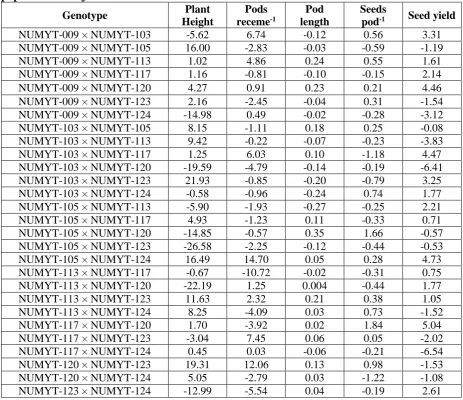
According to SCA (Table 4) in plant height 11 out of 28 F2 specific combinations
showed negative SCA effects, whereas the best specific combination was NUMYT-105 × NUMYT-123 with maximum negative value (-26.58) followed by NUMYT-103 × NUMYT-120 (-19.59). For plant height, the maximum positive SCA effects (21.93) were found in the cross
NUMYT-103 × NUMYT-123.The
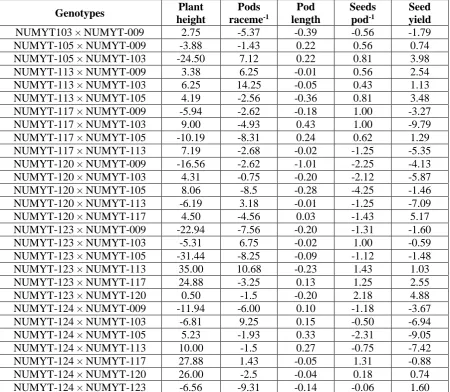
reciprocal effects (Table 5) also showed that twelve crosses showed negative maternal effects for plant height. The cross combination NUMYT-123 × NUMYT-105 exhibited maximum desirable negative reciprocal effects for plant height (-31.44). From breeding point of view in B. juncea, the taller plants are susceptible to lodging
thus medium or short stature plants are desirable. Hence negative combining ability for plant height is required for better yield. In our experiment, the significantly negative GCA and SCA (Table 2) effects were recorded both for parents and crosses for plant height thus indicating that these parents and crosses could be used for developing short stature plants with higher yield. Parents and crosses having negative general, specific and reciprocal combining ability effects could be used to develop short stature lines in mustard breeding program. Our results are in agreement with the earlier reports of Kumar et al. [17] who observed that the GCA and SCA variances for plant height were highly significant which directed the importance of both additive and non-additive type of gene action. They observed additive type of gene action involved in the expression of plant height, as the GCA values for plant are comparatively higher than the SCA values. Similar results were also observed bySingh
et al.[21] who observed the importance of additive genetic effect for plant height.
Pods main raceme-1
For pods main raceme-1, the mean square
values (Table 2)for GCA were
significant(P≤0.05) and were found highly significant (P≤0.01) for SCA and RCA.For pods main raceme-1, out of eight parents five showed positive GCA values with the range of 0.83 to 4.42 (Table 3). The maximum GCA effects were observed in NUMYT-103 (4.42) found to be best general combiner for pods main raceme-1 followed by NUMYT-117 (4.11). The NUMYT-123 was a poor general combiner by exhibiting the minimum negative GCA value (-7.31)
Similarly the SCA (Table 4) effect for pod main receme-1 indicated that 11 out of 28 F2 hybrid showed positive SCA positive
effects, where the maximum values were exhibited by F2 population NUMYT-105 ×
crosses showed positive value for pods main raceme-1, while the best reciprocal cross was NUMYT-113 × NUMYT-103 (14.25). For pods main raceme-1 significant GCA was reported by Singh and Sachan [23]. Similar results were also presented by Iqbal et al. [16]
and Khan et al. [6].
Pod length
According to combining ability ANOVA (Table 2), the effects due to GCA, SCA and RCA for pod length was found highly significant(P≤0.01).In Mustard, plants with long pod length are contributing to the higher yield therefore positive GCA and SCA effects are desirable. In case of pod length, the three parents (NUMYT-103,
NUMYT-120 and NUMYT-123)
manifested maximum positive GCA effect (0.25, 0.15 and 0.06), respectively. Minimum GCA effects for pod length were exhibited by NUMYT-009 (-0.20).
For SCA effect (Table 4), 15 crosses out of 28 exhibited positive effects, while the best specific performance was observed in the F2 cross NUMYT105 × NUMYT-120 with
the maximum positive SCA value 0.35. The minimum SCA effects were recorded in crosses NUMYT-105 × NUMYT-113 and NUMYT103 × NUMYT124 (0.27, -0.24) for pod length. The reciprocal effects (Table 5) also showed that 9 reciprocal crosses showed positive maternal effects for pod length. Maximum RCA effects for pods length was recorded in NUMYT-117 × NUMYT-103 (0.43) followed by
NUMYT-124 × NUMYT-105
(0.33).Parents and hybrid combination having positive general, specific and reciprocal combining ability effects for pod length could be utilized in future breeding program to produce longer pods. Higher values of GCA effect the SCA and RCA effect showed that the character is under the control of additive type of gene action(Khan
et al. [6] and Nassimi et al. [10]. Hu et al.
[15] and Singh et al. [22] reported significant GCA and SCA effects for pod length in mustard. Both additive and non-additive type of genetic control were observed by Muhammad et al. [18] and
Upadhyay and Kumar [24] in mustard and rapeseed.
Seeds pod-1
Mean square values (Table 2)for seeds pod -1showed highly significant (P≤0.01)
differences for GCA, SCA and RCA representing the importance of both additive and non-additive type of gene action as reported by Muhammad and Raziuddin [9]. Seeds pod-1 is considered
one of the major yield-contributing factor, hence positive combining ability effect is desirable for this trait. For seeds pod-1, the
maximum GCA (Table 3) values were owned by parent NUMYT-120 (1.40) followed by NUMYT-117 (0.14). The minimum GCA effects for said trait were given by four genotypes i.e. NUMYT-009,
NUMYT-123, NUMYT-124, and
NUMYT-105 with range of -0.66 to -0.10. According to seeds pod -1 (Table 4) the cross combination NUMYT117 × NUMYT-120 was on the top among 13 good specific combinations and revealed maximum positive values (1.84), while NUMYT-120
× NUMYT-124 showed the worst
performance (-1.22) for SCA
determination. In reciprocal effect, 14 combination exhibited positive effect with
the maximum RCA exhibited by
combination NUMYT-123 × NUMYT-120 (2.18) (Table 5). In Brassica significant GCA, SCA and RCA effect were observed by Nassimi et al.[10]. Similar results were also discussed by Hu et al. [15] Whereas Khan et al. [6] observed the non-significant effect due to GCA and SCA for seed pod-1 in B. juncea.
Seed yield
NUMYT-123 (-3.86). It is evident from Table 5.4.1 for seed yield plant-1 that the maximum positive SCA was shown by cross combination NUMYT-105 × NUMYT-124 (4.47) followed by 12 other genotypes showing positive SCA effects for seed yield plant-1 ranged from 0.71
to 4.46, while minimum value (-6.54) was observed in 117 × NUMYT-124(Table 4). Similarly positive RCA (Table 5) was recorded in 11 crosses where highest RCA effects were given by cross NUMYT-105 × NUMYT-103 (3.98) followed by NUMYT-113 × NUMYT-105 (3.48). The analysis of variance indicated highly significant differences for seed yield plant
-1(Table 1). Our results are further supported
by the findings of Nassimi et al. [10] who studied variability for seed yield and yield components in B. napus. They found significant differences among genotypes for most of the traits. The maximum genotypic and phenotypic variations were available for yield plant-1.
The higher yield in Brassica is the major goal of majority of the breeding programs; therefore improvement in the yield and its components is necessary. Hence, positive combining ability is considered desirable for yield and yield contributing traits. In our
studies, significantly positive GCA, SCA and RCA effects were recorded for majority of the parents, crosses and their reciprocals, respectively. In present study, seed yield was governed by additive portion of gene action. Ali et al. [3] reported significant GCA and non-significant SCA effect for seed yield and suggested additive genetic portion for inheritance of seed yield in B. juncea.
Fray et al. [14] found that in B.napus and Arabidopsis, mean squares due to GC were significant for yield and its components. Our results are further supported by the earlier findings of Youping and Peng [25]
who reported significant GCA for seed yield and 1000 seed weight. The results are further strengthened by Hu et al. [15] who reported that GCA was significant for seed yield plant-1 , pod length and 1000 seed weight. Qian et al. [20] also reported significant GCA effects for seed yield in inter-specific cross of B.napus and rapa. However, Zhou et al. [26] developed hybrids in B.napus, which were morphologically intermediate between their parents and had a significantly higher GCA for 1000 seed weight.
Table 1. Analysis of variance for various traits in an 8×8 F2 diallel population of
B.juncea
Parameters Mean square
Reps Genotypes Error
Plant height 1297.88** 1288.32** 266.42
Pods main receme-1 0.01 ns 273.06** 86.24
Pod length 0.006 ns 0.42** 0.07
Seeds pod-1 2.69 ns 9.36** 1.39
Seed yield 1261.43** 131.09** 43.92
Primary branches 19.83 ns 7.67 ns 10.48
**= Highly significant, *= Significant, ns = Non-significant,
Table 2. Analysis of variance for combining ability in 8×8 F2 diallel hybrids in B.juncea
Parameters Mean squares
GCA SCA RCA Error
Plant height 655.04** 332.62** 469.85** 16.76
Pods raceme-1 251.44* 65.56** 76.36** 28.74
Pod length 0.36** 0.07** 0.15** 0.02
Seeds pod-1 6.66** 1.36** 4.24** 0.46
Seed yield 130.28** 22.30ns 43.44** 14.63
Table 3. General combining ability effects for all the 8 genotypes in B.juncea
Parameters
NUM
YT-009
NUM
YT-103
NUMY T-105
NUMY T-113
NUMY T-117
NUMY T-120
NUMY T-123
NUMY T-124
Plant height -4.7 11.9 7.40 -1.24 -3.94 -2.79 -6.56 -0.05
Pods raceme-1 0.83 4.42 -3.67 0.93 4.11 1.88 -7.31 -1.20
Pod length -0.20 0.24 -0.05 -0.003 -0.14 0.15 0.063 -0.063
Seeds pod-1 -0.66 0.12 -0.11 .004 0.14 1.40 -0.62 -0.28
Seed yield -1.32 0.34 -2.30 -1.84 1.27 3.63 -3.86 4.07
Table 4. Estimates of specific combining ability effects for various traits in an 8×8 F2 population of B. juncea
Genotype Plant
Height
Pods
receme-1
Pod length
Seeds
pod-1 Seed yield
NUMYT-009 × NUMYT-103 -5.62 6.74 -0.12 0.56 3.31
NUMYT-009 × NUMYT-105 16.00 -2.83 -0.03 -0.59 -1.19
NUMYT-009 × NUMYT-113 1.02 4.86 0.24 0.55 1.61
NUMYT-009 × NUMYT-117 1.16 -0.81 -0.10 -0.15 2.14
NUMYT-009 × NUMYT-120 4.27 0.91 0.23 0.21 4.46
NUMYT-009 × NUMYT-123 2.16 -2.45 -0.04 0.31 -1.54
NUMYT-009 × NUMYT-124 -14.98 0.49 -0.02 -0.28 -3.12
NUMYT-103 × NUMYT-105 8.15 -1.11 0.18 0.25 -0.08
NUMYT-103 × NUMYT-113 9.42 -0.22 -0.07 -0.23 -3.83
NUMYT-103 × NUMYT-117 1.25 6.03 0.10 -1.18 4.47
NUMYT-103 × NUMYT-120 -19.59 -4.79 -0.14 -0.19 -6.41
NUMYT-103 × NUMYT-123 21.93 -0.85 -0.20 -0.79 3.25
NUMYT-103 × NUMYT-124 -0.58 -0.96 -0.24 0.74 1.77
NUMYT-105 × NUMYT-113 -5.90 -1.93 -0.27 -0.25 2.21
NUMYT-105 × NUMYT-117 4.93 -1.23 0.11 -0.33 0.71
NUMYT-105 × NUMYT-120 -14.85 -0.57 0.35 1.66 -0.57
NUMYT-105 × NUMYT-123 -26.58 -2.25 -0.12 -0.44 -0.53
NUMYT-105 × NUMYT-124 16.49 14.70 0.05 0.28 4.73
NUMYT-113 × NUMYT-117 -0.67 -10.72 -0.02 -0.31 0.75
NUMYT-113 × NUMYT-120 -22.19 1.25 0.004 -0.44 1.77
NUMYT-113 × NUMYT-123 11.63 2.32 0.21 0.38 1.05
NUMYT-113 × NUMYT-124 8.25 -4.09 0.03 0.73 -1.52
NUMYT-117 × NUMYT-120 1.70 -3.92 0.02 1.84 5.04
NUMYT-117 × NUMYT-123 -3.04 7.45 0.06 0.05 -2.02
NUMYT-117 × NUMYT-124 0.45 0.03 -0.06 -0.21 -6.54
NUMYT-120 × NUMYT-123 19.31 12.06 0.13 0.98 -1.53
NUMYT-120 × NUMYT-124 5.05 -2.79 0.03 -1.22 -1.08
Table 5. Estimates of reciprocal combining ability effects for various traits in an 8×8 F2 population of B. juncea
Genotypes Plant
height
Pods
raceme-1
Pod length
Seeds
pod-1
Seed yield
NUMYT103 × NUMYT-009 2.75 -5.37 -0.39 -0.56 -1.79
NUMYT-105 × NUMYT-009 -3.88 -1.43 0.22 0.56 0.74
NUMYT-105 × NUMYT-103 -24.50 7.12 0.22 0.81 3.98
NUMYT-113 × NUMYT-009 3.38 6.25 -0.01 0.56 2.54
NUMYT-113 × NUMYT-103 6.25 14.25 -0.05 0.43 1.13
NUMYT-113 × NUMYT-105 4.19 -2.56 -0.36 0.81 3.48
NUMYT-117 × NUMYT-009 -5.94 -2.62 -0.18 1.00 -3.27
NUMYT-117 × NUMYT-103 9.00 -4.93 0.43 1.00 -9.79
NUMYT-117 × NUMYT-105 -10.19 -8.31 0.24 0.62 1.29
NUMYT-117 × NUMYT-113 7.19 -2.68 -0.02 -1.25 -5.35
NUMYT-120 × NUMYT-009 -16.56 -2.62 -1.01 -2.25 -4.13
NUMYT-120 × NUMYT-103 4.31 -0.75 -0.20 -2.12 -5.87
NUMYT-120 × NUMYT-105 8.06 -8.5 -0.28 -4.25 -1.46
NUMYT-120 × NUMYT-113 -6.19 3.18 -0.01 -1.25 -7.09
NUMYT-120 × NUMYT-117 4.50 -4.56 0.03 -1.43 5.17
NUMYT-123 × NUMYT-009 -22.94 -7.56 -0.20 -1.31 -1.60
NUMYT-123 × NUMYT-103 -5.31 6.75 -0.02 1.00 -0.59
NUMYT-123 × NUMYT-105 -31.44 -8.25 -0.09 -1.12 -1.48
NUMYT-123 × NUMYT-113 35.00 10.68 -0.23 1.43 1.03
NUMYT-123 × NUMYT-117 24.88 -3.25 0.13 1.25 2.55
NUMYT-123 × NUMYT-120 0.50 -1.5 -0.20 2.18 4.88
NUMYT-124 × NUMYT-009 -11.94 -6.00 0.10 -1.18 -3.67
NUMYT-124 × NUMYT-103 -6.81 9.25 0.15 -0.50 -6.94
NUMYT-124 × NUMYT-105 5.23 -1.93 0.33 -2.31 -9.05
NUMYT-124 × NUMYT-113 10.00 -1.5 0.27 -0.75 -7.42
NUMYT-124 × NUMYT-117 27.88 1.43 -0.05 1.31 -0.88
NUMYT-124 × NUMYT-120 26.00 -2.5 -0.04 0.18 0.74
NUMYT-124 × NUMYT-123 -6.56 -9.31 -0.14 -0.06 1.60
Conclusion
On the basis of combining ability ANOVA, it is concluded that all the traits were governed by additive type of gene action and intensive selection in the said breeding material will provide the basis for further improvement and to boost up the seed yield of the mustard. However SCA and RCA effects of the hybrids were also significant hence it necessitates the use of further integrated breeding strategies to efficiently utilize the present genetic material in the future breeding programs.
Authors’ contributions
Conceived and designed the experiments: S Inayat & M Zakirullah, Performed the experiments: S Inayat, M Zakirullah & L Naz, Analyzed the data: A Shafi & S Akbar,
Contributed materials/ analysis/ tools: M Ali & S Khan, Wrote the paper: S Inayat & M Zakirullah.
References
1. Kant L, Gulati S & Kant L (2001). Genetic analysis for yield and its components and oil content in Indian mustard (Brassica juncea L. Czern and Coss). Indian J Genet 61(1): 37-40. 2. Arifullah M, Munir M, Mahmood A &
Khan S (2012). Combining ability analysis of some yield attributes in Indian mustard (Brassica juncea L.).
Pak J Agric Res 25(2).
(Brassica juncea L.). J Agri & Bio Sci
1(4): 1-5.
4. Pal A & Prodhan H (1994). Combining ability analysis of grain yield and oil content along with some other attributes in maize (Zea mays L.).
Indian J Genet & Plant Breed 54(4): 376-380.
5. Vaghela P, Thakkar D, Bhadauria H, Sutariya D, Parmar S & Prajapati D (2016). Heterosis and combining ability for yield and its component traits in Indian mustard [Brassica juncea (L.)]. J Oilseed & Brassica
1(1): 39-43.
6. Khan N, Hassan G, Bakht J, Khan S & Shafi M (2011). Combining ability for yield related traits in Brassica juncea.
Pak J Bot 43(2): 1241-1248.
7. Shaboon SA, SadekM, Gamea HA & El-Koomy MB (2012). Combining ability analysis for nine promising white maize inbred lines in a half-diallel cross. Egypt J Plant Breeding
16(2): 161-172.
8. Gupta P, Chaudhary H & Lal SK (2010). Heterosis and combining ability analysis for yield and its components in Indian mustard (Brassica juncea L. Czern and Coss).
Frontiers of Agric in China 4(3):
299-307.
9. Muhammad I & Raziuddin (2016). Combining ability analysis for maturity and plant architecture traits in intra-specific crosses of rapeseed (Brassica napus L.). Sarhad J Agric
32(3): 168-176.
10. Nassimi AW, Sardar R, Ali A, Ali N& Bakht S (2006). Analysis of combining ability in Brassica napus L. lines for yield associated traits. Pak J Biol Sci
9(2): 2333-2337.
11. Cheema K& Sadaqat H (2004). Potential and genetic basis of drought tolerance in canola (Brassica napus): I. Generation mean analysis for some phenological and yield components.
Inter J Agric Biol 6(1): 74-81.
12. Rameah V, Rezaei A & Saeidi G (2003). Estimation of genetic parameters for yield, yield components and glucosinolate in rapeseed
(Brassica napus L.). J Agric Sci
Technol 5.
13. Ali N, KhanN, Ali S, Gul S, Saeed M & Naveed K (2015). Combining ability studies for quantitative traits in
Brassica juncea. J Anim & Plant Sci
25(2): 494-501.
14. FrayM, Puangsomlee P, Goodrich J, Coupland G, Evans E, Arthur A & Lydiate D (1997). The genetics of stamenoid petal production in oilseed rape (Brassica napus) and equivalent variation in Arabidopsis thaliana.
Theoretical & Appl Gene 94(6-7): 731-736.
15. Hue B, Chen F, Li C& Li Q (1996). Comparison of heterosis between cytoplasmic male sterile three-way cross and single crosses hybrids in rape (Brassica napus L.). Rosliny Oleiste
17(1): 61-71.
16. Iqbal M, Hassan G, Ahmad R, & Khan S (2007). Combining ability analysis for yield and its components in brown mustard. Sarhad J Agri (Pakistan). 17. Kumar S, Singh H & Sharma J (2007).
Combining ability analysis for grain yield and other associated traits in rice.
Inter J Rice 44(2): 108-114.
18. Muhammad A, Raziuddin MS, Bacha QU, Rahman AU & Khan SA (2014). Combining Ability and Heritability Studies for Yield Contributing Traits in F Populations of Brassica napus.
American-Eurasian J Agric & Environ Sci 14 (6): 509-515.
19. Odetola T & Etumnu C (2013). Contribution of Agriculture to Economic Growth in Nigeria.
Conference of the African
20. Qian W, Liu R& Meng J (2003). Genetic effects on biomass yield in interspecific hybrids between Brassica napus and B. rapa. Euphytica 134(1): 9-15.
21. Singh M, Singh G, Kumar V & Dhaka A (2008). Combining ability analysis for some metric traits related to seed yield in Indian mustard (Brassica
juncea (L.) Czern and Coss).
Progressive Agric 8(1): 57-60.
22. Singh M, Singh L & Srivastava S (2010). Combining ability analysis in Indian mustard (Brassica juncea L. Czern and Coss). J Oilseed & Brassica
1(1): 23-27.
23. Singh Y & Sachan J (2003). Combining ability analysis for seedyield, and its components in Indian
mustard [Brassica juncea (L.) Czern and Coss.]. Indian J Genet & Plant
Breeding 63(1): 83-84.
24. Upadhyay D & Kumar K (2014). Genetics of agronomic characters in Indian mustard [Brassica juncea (L.) Czern and Coss.] under normal and late shown conditions. Inter J Agri Sci
10(1): 202-210.
25. Youping W & Peng L (1998). Intergeneric hybridization between Brassica species and Crambe abyssinica. Euphytica 101(1): 1-7. 26. Zhou X, Li S, Gu L & Zhuang J (2000).
Genetic analysis of geno-cytoplasmic male sterile line “3213A” in rapeseed
(Brassica napus L.). Shanghai Nongye