GSJ: Volume 6, Issue 10, October 2018, Online: ISSN 2320-9186
www.globalscientificjournal.com
C
OMPOSITE
M
ATERIALS
H
YBRID AS
S
TABILIZER OF
D
ELTAIC
L
ATERITIC
S
OILS
Enamuotor Blessing1, Tobi Derebebeapade Stanisslous2, Charles Kennedy3
1D.G Delta State Direct Labour Agency, Delta State, Nigeria.
2Department of Architecture, School of Environmental Technology, Kenule Beeson Saro-Wiwa Polytechnic, Bori, Rivers State, Nigeria.
3 Faculty of Engineering,Department of Civil Engineering, Rivers State University, Nkpolu, Port Harcourt, Nigeria
Authors E-mail: [email protected], [email protected], [email protected].
ABSTRACT
The study evaluated the modification of geotechnical properties of Niger deltaic lateritic soils of fragile and manipulative characteristics that are prone to severe cracks and differential settlement with the composite materials hybrid of plantain rachis fibre + cement with 0.25% + 2.5%, 0.5% + 5.0%, 0.75% + 7.5% and 1.0% + 10% to soils percentage ratio inclusion to improve their strength. Preliminary investigations computed the percentage (%) passing BS sieves #200 as 38.46%, 39.40%, 36.85%, and 36.42%, reddish brown color, plasticity index are 17.11%, 22.5%, 14.10%, and 18.51%, California bearing ratio (CBR) values unsoaked are 9.25%, 9.48%, 7.85% , 8.65 %, and soaked 7.40%, 8.05%, 6.65% and 6.65 % and unconfined compressive strength (UCS) values of 168kPa, 178kPa, 163kPa and 175kPa. Soils are classified as A-2-6 SC and A-2-4 SM on the AASHTO classification schemes / Unified Soil Classification System and are less for use as embankment materials for road constructional materials. Stabilized lateritic soils comparative results showed decreased values of maximum dry density (MDD) and increased values of optimum moisture content (OMC) with relating values to percentages ratio fibre + cement inclusion demonstrated graphically in figures. Computed results illustrated increased values of both unsoaked and soaked California bearing ratio to percentages inclusion increase, with 0.75% + 7.5% optimum mix ratio to soils. Cracks and reductions in values were noticed beyond optimum. Results showed that fibre percentages ratio increase hoisted the values of unconfined compressive strength. Results of fibre + cement stabilized lateritic soils showed decreased in plastic index as against un-stabilized. Entire results showed the potential use of plantain rachis fibre + cement as soil stabilizers.
Key Words: Lateritic Soils, Plantain Rachis Fibre, Cement, CBR, UCS, Consistency, Compaction
1.0 INTRODUCTION
Soil strengthening is an obvious method required to improve soils of weak properties and could be mechanical (if simply compacted with or without the addition of sand addition), chemical (if compacted with controlled proportions of stabilizing agents, including bitumen, lime and cement), thermal (which could produce dehydrated hard-pans) and even electrical (through, for example, electro-osmosis). For a temperate soil to be suitable for cement stabilization as single and combined state as and useful in the construction of road pavement structure, the HRB specify that the percentage fines, liquid limit and plasticity index must not
exceed 50 %, 40 % and 18 % respectively, while Millard and O‟Reilly [1]specify that the product of the
plasticity index and the percentage passing through a 42 μm sieve (no 40) must not exceed 1 000.
Charles et al. [2]evaluated the effectiveness in the used of lime and costus afer fibre (Bush sugarcane bagasse
fiber ash (BSBFA) in single and combined actions as soil stabilizer to improve its properties. Considering the fact that Niger Deltaic soils fall short of the minimum requirements for such applications on Specifications for road pavement structural materials (after FMW 1997). Entire results showed tremendous strength increased in soil properties with the inclusion of additives. The entire results showed the potential of using bagasse BSBFA as admixture in lime treated soils of clay and laterite with 8 % lime + 7.5% lime + BSBFA. Treated soils with Lime decreased in liquid limits and increased in plastic limits. Soils with Lime and fibre products in combinations increased CBR values appreciably both at soaked and unsoaked conditions respectively At 8% of both cement and lime, CBR values reached optimum, beyond this range, cracks exist and 7.5% lime+ 7.5% BSBFA, optimum value are reached.
Manikandan and Moganraj [3]had found that the combined effect of bagasse ash and lime were more
effective than the effect of bagasse ash alone in controlling the consolidation characteristics of expansive soil along with the improvement in other properties.
Charles et al. [4] evaluated the geotechnical properties of an expansive clay soil found along Odioku –
Odiereke road in Ahoada-West, Rivers State, in the Niger Deltaic region. The application of two cementitious agents of cement and lime, hybridized with costus afer bagasse fiber to strengthen the failed section of the road. The preliminary investigation values indicated that the soils are highly plastic. The results showed the potential of using bagasse, BSBF as admixtures in cement and lime treated soils of clay and laterite with optimum values of 8 % cement and lime and 7.5% +7.5 % of cement / lime + BSBF.
Ramakrishna and Pradeep [6] studied combined effects of RHA and cement on engineering properties of black cotton soil. From strength characteristics point of view they had recommended 8 % cement and 10 % RHA as optimum dose for stabilization.
Sharma et al. [7]investigated the behavior of expansive clay stabilized with lime, calcium chloride and RHA.
The optimum percentage of lime and calcium chloride was found to be 4 % and 1% respectively in stabilization of expansive soil without addition of RHA. From UCS and CBR point of view when the soil was mixed with lime or calcium chloride, RHA content of 12 % was found to be the optimum. In expansive soil – RHA mixes, 4% lime and 1% calcium chloride were also found to be optimum.
Charles et al. [8] investigated the problematic engineering properties of soils with high plasticity level, high
swelling and shrinkage potentials used in pavement design in the Nigerian Niger Delta region. The application of stabilizing agents of cement and costus afer bagasse fibre ( Bush Sugarcane Bagaase Fibre) were mixed in single and combines actions to improved their unique properties. Results showed that inclusion stabilizing material improved strength properties of the soils. Results of tests carried out show that the optimum moisture content increased with increasing cement ratios to both soils (clay) and (laterite). Treated soils with Cement decreased in liquid limits and increased in plastic limits. Soils with Cement and fibre products in combinations increased CBR values appreciably both at soaked and unsoaked conditions. At 8% of lime, CBR values reached optimum, beyond this range, cracks exist and 7.5% cement + 0. 75% BSBF, optimum value are reached.
2.0 MATERIALS AND METHODS 2.1 Materials
2.1.1 Soil
The soils used for the study were collected from Ogbogoro Town Road, in Obio/Akpor Local Government, Egbeda Town Road, in Emuoha Local Government Area, Igwuruta Town Road, in Ikwerre Local Government Area and Aleto Town Road, in Eleme Local Government area, all in Rivers State, Niger Delta region, Nigeria. It lies on the recent coastal plain of the North-Western of Rivers state of Niger Delta.
2.1.2 Plantain Rachis Fibre
The Plantain Rachis fibres are obtained from Iwofe markets, in Obio/Akpor Local Area of Rivers State, they are abundantly disposed as waste products both on land and in the river.
2.1.3 Cement
The cement used was Portland cement, purchased in the open market at Mile 3 market road, Port Harcourt, Rivers State
2.2.1 Sampling Locality
The soil sample used in this study were collected along Ogbogoro Town, (latitude 4.81° 33„S and longitude 6.92° 18„E), Egbeda a Town, (latitude 5.14° 15„N and longitude 6.45° 23„E), Igwuruta Town, latitude 4.97° 93„N and longitude 6.99° 80„E), and Aleto Town, latitude 4.81° 32„S and longitude 7.09° 28„E) all in Rivers State, Nigeria.
2.2.2 Test Conducted
Test conducted were (1) Moisture Content Determination (2) Consistency limits test (3) Particle size distribution (sieve analysis) and (4) Standard Proctor Compaction test, California Bearing Ratio test (CBR) and Unconfined compressive strength (UCS) tests;
2.2.3 Moisture Content Determination
The natural moisture content of the soil as obtained from the site was determined in accordance with BS 1377 (1990) Part 2.The sample as freshly collected was crumbled and placed loosely in the containers and the containers with the samples were weighed together to the nearest 0.01g.
2.2.4 Grain Size Analysis (Sieve Analysis)
This test is performed to determine the percentage of different grain sizes contained within a soil. The mechanical or sieve analysis is performed to determine the distribution of the coarser, larger-sized particles. 2.2.5 Consistency Limits
The liquid limit (LL) is arbitrarily defined as the water content, in percent, at which a part of soil in a standard cup and cut by a groove of standard dimensions will flow together at the base of the groove for a distance of 13 mm (1/2in.) when subjected to 25 shocks from the cup being dropped 10 mm in a standard liquid limit apparatus operated at a rate of two shocks per second.
2.2.6 Moisture – Density (Compaction) Test
This laboratory test is performed to determine the relationship between the moisture content and the dry density of a soil for a specified compactive effort.
2.2.7 Unconfined Compression (UC) Test
2.2.8 California Bearing Ratio (CBR) Test
The California Bearing Ratio (CBR) test was developed by the California Division of Highways as a method of relegating and evaluating soil- subgrade and base course materials for flexible pavements.
3.0 RESULTS AND DISCUSSIONS
Preliminary results on lateritic soils as seen in detailed test results given in Tables: 5 showed that the physical and engineering properties fall below the minimum requirement for such application and needs stabilization to improve its properties. The soils classified as A-2-6 SC and A-2-4 SM on the AASHTO classification schemes / Unified Soil Classification System as shown in table 3.1 and are less matured in the soils vertical profile and probably much more sensitive to all forms of manipulation that other deltaic lateritic soils are known for (Ola
[9],; Allam and Sridharan [10],; Omotosho and Akinmusuru [11],; Omotosho [12],).
The soils are reddish brown color (from wet to dry states) plasticity index of 17.11%, 22.5%, 14.10%, and 18.51% respectively for Ogbogoro, Egbeda, Igwuruta and Aleto Town Roads. The soil has unsoaked CBR values of 9.25%, 9.48%, 7.85% and 8.65 %, and soaked CBR values of 7.40%, 8.05%, 6.65% and 6.65 %, unconfined compressive strength (UCS) values of 168kPa, 178 kPa, 163kPa and 175kPa when compacted with British Standard light (BSL), respectively.
3.1 Compaction Test Results
Table 3.1 presented the compaction test of lateritic soils sampled results at 100% natural state of maximum dry
density (MDD), 1.755 KN/m3, 1.838KN/m3, 1.924 KN/m3, 1.865 KN/m3, and Optimum moisture content
(OMC), 14.85%, 14.40%, 15.03% and 16.05%. Plantain rachis fibre + cement stabilized soils with 0.25% + 2.5%, 0.5% + 5.0%, 0.75% + 7.5% and 1.0% + 10% to soils percentage ratio inclusion maximum values of
MDD are 2.215KN/m3, 2.335KN/m3, 2.505KN/m3, 2.486KN/m3 and OMC, 16.15%, 17.36%, 15.70% and
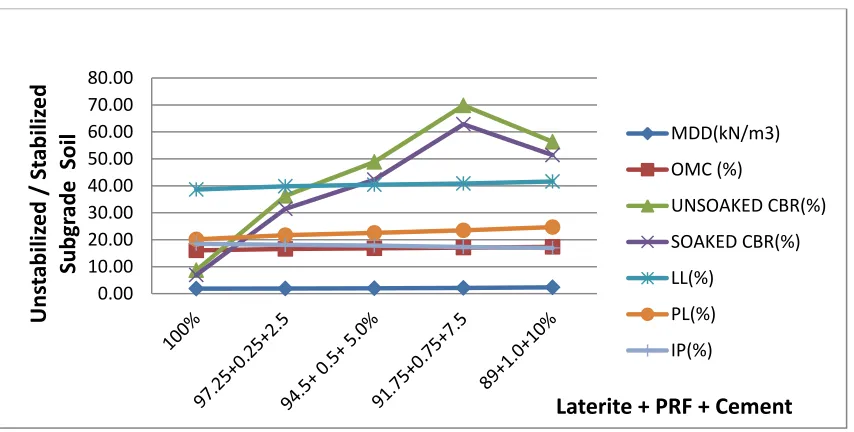
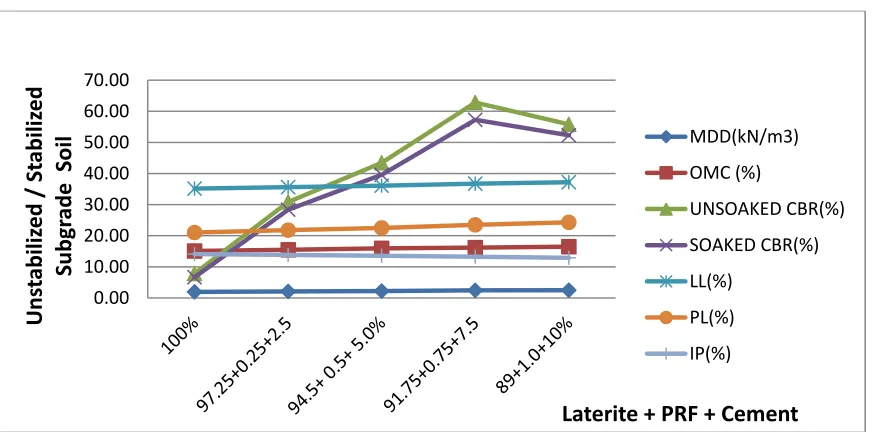
16.47%. Computed comparative results of un-stabilized and stabilized soils showed increased compaction parameters of maximum and optimum moisture content with increase to corresponding percentages inclusion as demonstrated graphically in figures 3.1 – 3.4.
3.2 California Bearing Ratio (CBR) Test
percentages ratio inclusion increase, with 0.75% + 7.5% optimum mix ratio to soils. Cracks and reductions in values were noticed beyond optimum.
3.3 Unconfined Compressive Strength Test
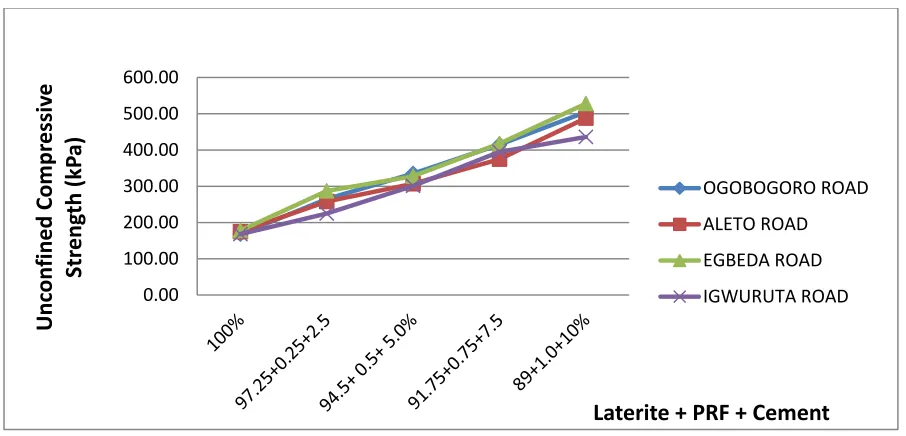
Investigated and computed results of unconfined compressive strength test at 100% lateritic soils of sampled roads are 168kPa, 178kPa, 163kPa and 175kPa. Results of fibre + cement stabilized lateritic soils are 505kPa, 488kPa, 528kPa and 436kPa. Results showed that fibre percentages ratio increase hoisted the values of unconfined compressive strength.
3.4 Consistency Limits Test
Table 3.1: Engineering Properties of Soil Samples
Location Description OGOBOGOR O ROAD OBIO/AKPOR
L.G.A
EGBEDA ROAD EMUOHA
L.G.A
IGWURUTA ROAD IKWERE
L.G.A
ALETO ROAD ELEME
L.G.A
Depth of sampling (m)
1.5
1.5
1.5
1.5
Percentage(%) passing BS sieve #200
38.35 42.15 36.35 39.40
Colour Reddish Reddish Reddish Reddish Specific gravity 2.59 2.78 2.77 15.35 Natural moisture content (%) 22.6 19.48 10.95 15.35
Consistency
Liquid limit (%) 38.46 42.35 35.15 38.65 Plastic limit (%) 21.35 19.85 21.05 20.14 Plasticity Index 17.11 22.50 14.1 0 18.51 AASHTO soil classification
Unified Soil Classification System
A-2-4/SM A-2-4/SM A-2-4/SC A-2-4/SC
Optimum moisture content (%) 14.85 14.40 15.08 16.05 Maximum dry density (kN/m3) 1.755 1.883 1.924 1.865 Gravel (%) 3.25 2.85 3.83 2.35
Sand (%) 38.65 36.50 32.58 39.45 Silt (%) 23.85 38.75 33.45 37.85 Clay (%) 34.25 22.90 30.14 20.35 Unconfined compressive
strength (kPa)
168 178 163 175
California Bearing Capacity (CBR)
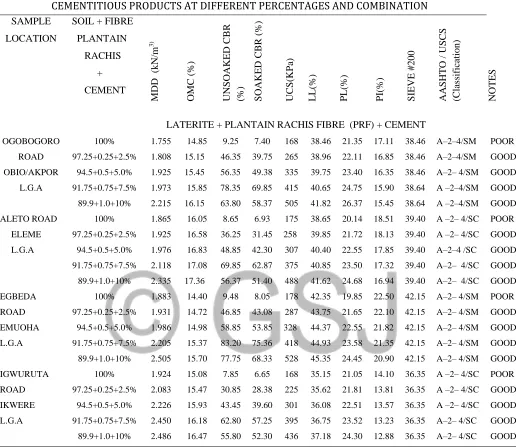
TABLE 3.2: RESULTS OF SUBGRADE SOIL (LATERITE) TEST STABILIZATION WITH BINDING
CEMENTITIOUS PRODUCTS AT DIFFERENT PERCENTAGES AND COMBINATION
SAMPLE LOCATION
SOIL + FIBRE
PLANTAIN RACHIS + CEMENT M D
D (
kN/m 3) OM C ( % ) UNSO A KED CB R
(%) SOAKE
D CB R (%) UCS (KP a) LL(% ) PL(% ) PI (% ) SI E VE #200 AASHT O / USC S (Cla ssific at ion) NO T ES
LATERITE + PLANTAIN RACHIS FIBRE (PRF) + CEMENT
OGOBOGORO ROAD OBIO/AKPOR
L.G.A
100% 1.755 14.85 9.25 7.40 168 38.46 21.35 17.11 38.46 A–2–4/SM POOR
97.25+0.25+2.5% 1.808 15.15 46.35 39.75 265 38.96 22.11 16.85 38.46 A–2–4/SM GOOD 94.5+0.5+5.0% 1.925 15.45 56.35 49.38 335 39.75 23.40 16.35 38.46 A–2– 4/SM GOOD 91.75+0.75+7.5% 1.973 15.85 78.35 69.85 415 40.65 24.75 15.90 38.64 A –2–4/SM GOOD 89.9+1.0+10% 2.215 16.15 63.80 58.37 505 41.82 26.37 15.45 38.64 A –2–4/SM GOOD ALETO ROAD
ELEME L.G.A
100% 1.865 16.05 8.65 6.93 175 38.65 20.14 18.51 39.40 A –2– 4/SC POOR 97.25+0.25+2.5% 1.925 16.58 36.25 31.45 258 39.85 21.72 18.13 39.40 A –2– 4/SC GOOD
94.5+0.5+5.0% 1.976 16.83 48.85 42.30 307 40.40 22.55 17.85 39.40 A–2–4 /SC GOOD 91.75+0.75+7.5% 2.118 17.08 69.85 62.87 375 40.85 23.50 17.32 39.40 A–2– 4/SC GOOD 89.9+1.0+10% 2.335 17.36 56.37 51.40 488 41.62 24.68 16.94 39.40 A–2– 4/SC GOOD EGBEDA
ROAD EMUOHA L.G.A
100% 1.883 14.40 9.48 8.05 178 42.35 19.85 22.50 42.15 A–2– 4/SM POOR
97.25+0.25+2.5% 1.931 14.72 46.85 43.08 287 43.75 21.65 22.10 42.15 A–2– 4/SM GOOD 94.5+0.5+5.0% 1.986 14.98 58.85 53.85 328 44.37 22.55 21.82 42.15 A–2– 4/SM GOOD 91.75+0.75+7.5% 2.205 15.37 83.20 75.36 418 44.93 23.58 21.35 42.15 A–2– 4/SM GOOD 89.9+1.0+10% 2.505 15.70 77.75 68.33 528 45.35 24.45 20.90 42.15 A–2– 4/SM GOOD IGWURUTA
ROAD IKWERE L.G.A
100% 1.924 15.08 7.85 6.65 168 35.15 21.05 14.10 36.35 A –2– 4/SC POOR 97.25+0.25+2.5% 2.083 15.47 30.85 28.38 225 35.62 21.81 13.81 36.35 A –2– 4/SC GOOD
Figure 3.1: Subgrade Stabilization Test of Lateritic Soil from Ogbogoro in Obio/Akpor L.G.A of Rivers State with PRF + Cement at Different Percentages and Combination
Figure 3.2: Subgrade Stabilization Test of Lateritic Soil from Aleto in Eleme L.G.A of Rivers State with PRF + Cement at Different Percentages and Combination
0.00 10.00 20.00 30.00 40.00 50.00 60.00 70.00 80.00 90.00
Uns
tabil
iz
ed / St
abil
iz
ed
Subgr
ade So
il
Laterite + PRF + Cement
MDD(kN/m3)OMC (%)
UNSOAKED CBR(%)
SOAKED CBR(%)
LL(%)
PL(%)
IP(%)
0.00 10.00 20.00 30.00 40.00 50.00 60.00 70.00 80.00
Uns
tabil
iz
ed / St
abil
iz
ed
Subgr
ade So
il
Laterite + PRF + Cement
MDD(kN/m3)OMC (%)
UNSOAKED CBR(%)
SOAKED CBR(%)
LL(%)
PL(%)
Figure 3.3: Subgrade Stabilization Test of Lateritic Soil from Egbeda in Emuoha L.G.A of Rivers State with PRF + Cement at Different Percentages and Combination
Figure 3.4: Subgrade Stabilization Test of Lateritic Soil from Igwuruta in Ikwerre L.G.A of Rivers State with PRF + Cement at Different Percentages and Combination
0.00 10.00 20.00 30.00 40.00 50.00 60.00 70.00 80.00 90.00
Uns
tabil
iz
ed / St
abil
iz
ed
Subgr
ade So
il
Laterite + PRF + Cement
MDD(kN/m3)OMC (%)
UNSOAKED CBR(%)
SOAKED CBR(%)
LL(%)
PL(%)
IP(%)
0.00 10.00 20.00 30.00 40.00 50.00 60.00 70.00
Uns
tabil
iz
ed / St
abil
iz
ed
Subgr
ade So
il
Laterite + PRF + Cement
MDD(kN/m3)OMC (%)
UNSOAKED CBR(%)
SOAKED CBR(%)
LL(%)
PL(%)
Figure 3.5: Unconfined Compressive Strength (UCS) of Niger Deltaic Laterite Soils Subgrade with PRF + Cement of (Ogbogoro, Aleto, Egbeda andIgwuruta Towns) all in Rivers State
4.0 Conclusions
The following conclusions were made from the experimental research results.
i. Soils are classified as A-2-6 SC and A-2-4 SM on the AASHTO classification schemes / Unified Soil
Classification System.
ii. Comparatively, results showed decreased values of MDD and increased values of OMC with relating
values to percentages ratio fibre inclusion.
iii. Computed comparative results of un-stabilized and stabilized soils showed increased compaction
parameters of maximum and optimum moisture content with increase to corresponding percentages inclusion as demonstrated graphically in figures 3.1 – 3.4.
iv. Computed results illustrated increased values of both unsoaked and soaked California bearing ratio to
percentages ratio inclusion increase, with 0.75% + 7.5% optimum mix ratio to soils. Cracks and reductions in values were noticed beyond optimum.
v. Results showed that fibre percentages ratio increase hoisted the values of unconfined compressive
strength.
vi. Results of fibre + cement stabilized lateritic soils showed decreased in plastic index as against
un-stabilized.
0.00 100.00 200.00 300.00 400.00 500.00 600.00
Unc
on
fin
ed Com
pr
es
siv
e
Str
eng
th
(kP
a)
Laterite + PRF + Cement
OGOBOGORO ROADALETO ROAD
EGBEDA ROAD
REFERENCES
[1] M.S. Millard, and M. P. O'Reilly,”Standards of Road Building Practice in the Tropics”, Proc., 2nd
Conf, Road Res. Board,Australian Road Research Board, Melbourne, Australia, pp. 830-854, 1965.
[2]K. Charles, O. A. Tamunokuro, T. T. W. Terence,”Comparative Evaluation of Cement. Effectiveness of
Cement/Lime and Costus Afer Bagasse Fiber Stabilization of Expansive Soil”, Global Scientific Journal,
vol. 6, no.5, pp. 97-110, 2018.
[3]Manikandan, A.T. and Moganraj, M, “Consolidation and Rebound Characteristics of Expansive Soil by
using Lime and Bagasse Ash”, International Journal of Research in Engineering and Technology.
vol.3, no.4, pp. 403-411, 2014.
[4]K. Charles, T.T.W. Terence, S. K. Gbinu,“Effect of Composite Materials on Geotechnical
Characteristics of Expansive Soil Stabilization Using Costus Afer and Lime”, Journal of Scientific and
Engineering Research, vol.5, no.5. pp. 603-613, 2018.
[5]A. K. Sabat, “Effect of Polypropylene Fiber on Engineering Properties of Rice Husk Ash –
Lime Stabilized Expansive Soil”, Electronic Journal of Geotechnical Engineering, no. 17(E),
pp. 651-660, 2012.
[6]A.N. Ramakrishna, and A.V. Pradeepkumar, “Stabilization of Black Cotton Soil using Rice Husk Ash
and Cement, Proc. of National Conference”, Civil Engineering Meeting the Challenges of Tomorrow, pp. 215-220, 2006.
[7]R.S. Sharma,, B. R. Phanikumar, and B.V. Rao, “Engineering Behaviour of a Remolded Expansive Clay
Blended with Lime, Calcium Chloride and Rice-Husk Ash”, Journal of Materials in Civil Engineering,
vol. 20, no. 8, pp. 509-515, 2008.
[8]K. Charles, L. P. Letam, O. Kelechi, “Comparative on Strength Variance of Cement / Lime with Costus
Afer Bagasse Fibre Ash Stabilized Lateritic Soil”, Global Scientific Journal, vol.6, no.5, pp. 267-278, 2018.
[9]S. A. Ola, “Need for Estimated Cement Requirements for Stabilizing Lateritic Soils”, Journal of
Transportation Engineering, ASCE, vo.100, no. 2, 379–388, 1974.
[10]M. M. Allam, and A. Sridharan, “Effect of Repeated Wetting and Drying on Shear Strength”, Journal of
Geotechnical Engineering, ASCE, vol.107, no.4, pp. 421–438, 1981.
[11]P. O. Omotosho, “Multi-Cyclic Influence on Standard Laboratory Compaction of Residual Soils”,
Engineering Geology, no .36, pp.109–115, 1993.
[12]P .O. Omotosho, and J .O. Akinmusuru, “Behaviour of Soils (Lateritic) Subjected Multi –Cyclic