ISSN: 2334-2382 (Print), 2334-2390 (Online) Copyright © The Author(s). All Rights Reserved. Published by American Research Institute for Policy Development DOI: 10.15640/jeds.v5n1a4 URL: https://doi.org/10.15640/jeds.v5n1a4
The Problem of Taking Advantage of Foreign Direct Investment Technology in
Developing Countries: The Case of China
Dr. Guedri Salah Eddine
1, Dr. Bendhiba Mohammed
2, Pr. Khouni Rabeh
3& Djabi Amina Hana
4Abstract
The world is nowadays more oriented than ever towards a knowledge-based economy. Technology is one of most stuck elements of knowledge to the economic and social development. The world is nowadays witnessing radical mutations in the market of technology, such as the growing importance of technological inputs in the processes of production and services, and the concentration of technology creation in a little number of countries and firms through the operations of integration and intellectual right protection. The Developing Countries endeavoured to acquire this technology to bridge the gap between them and the developed countries by attracting Foreign Direct Investment (FDI), because they think it is the magic solution for technology transfer. However, the experiences proved the insufficiency of this method for technology transfer. As part of this context, the present paper aims to define the participation of FDI technology in different stages of the technological process in Developing Countries, and to precise the determinants of taking advantage of them in each stage through the examination of the Chinese experience as a successful one.
Key words: Foreign Direct Investment (FDI); Technology; Absorption Capacity; Innovation; Algeria.
Preamble
The world is going through great mutations in technology transfer while getting oriented into globalisation and economic integration. It also knows acceleration in technological creation and monopolization by its manufacturers. In these circumstances, the Developing Countries attempt to adopt some policies and strategies of science and technology that are able to participate in resolving many crucial problems which hinder the diversification of national economy and the rise of productivity competitiveness. In fact, these countries are convinced that this era is one of knowledge in which technology is the most bound to economic and social development. Since the national system of innovation in Developing Countries is insufficient on its own to keep up with the developed countries. So, the Developing Countries must transfer technology in order to enhance the said national system of innovation. They are following policies to encourage attracting the FDI and to prepare the appropriate climate for it since it is the most important means for technology transfer.
1 Tebessa University, Algeria, email: [email protected] 2 Jijel University, email: [email protected]
3
Method of the study
We have adopted the descriptive historical method for the theoretical aspects, and the historical one for the study of FDI, technology and aspects relating to them. The analytical method is used to analyze the economic data and the technological situation in China as a successful experience in this field. This study is done using a series of references in Arabic and foreign languages: books, magazines, websites, reports from different international organizations, such as UNTCAD investment reports, research papers and scientific studies.
1. Results and Discussion:
1.1. The Technological Process and the Role of FDI:
The word “technology” is linked to the modern applications of science in different fields of life. It also refers to all what is new. But there are some divergences that emerged over whether the technology is the final product or is it the technique that leads to the embodiment of that product. In this sense, it is necessary to address the concept of this word and know what it means. Generally speaking, we can define “technology” as a set of knowledge, experience, aptitudes and tools used to produce goods or to develop and innovate an existing one, i.e. to transform the results of scientific research into practical tools and applications which help progress and economic development. This means that technology is not the product which comes out of a factory, but a set of knowledge and aptitudes used to build the factory then to make production in it (oxford, 2011; Mohammed F.H and others, 2011). Technology plays a major role in economic development. The more there is a universal orientation towards knowledge and economy of knowledge, the more the role of technology is important. There are a lot of studies and scientific contributions about the relationship between development and technology. But all of them agree that the greater is the rate of spending in order to create new technologies, the more is there a continuous increase in economic growth (Ivo de loo and luc socte, 1999; Dwight H Parkins and others, 2008; Mohammed F.H and others, 2008). Technology transfer between countries plays a major role in sustaining their technological independence and autonomy. The main goal of technology transfer and the criterion of its success are to achieve a better position in the future which allows the State which imports technology to progressively get phased out of imports and achieve self-reliance.
1.1.1. The Role of Foreign Investment in Technology Transfer:
There are many ways to make technology transfer, such as licenses, turn-key contracts and manufacturing contracts. But, the FDI is the main means of technology transfer into Developing Countries because the multinational firms are the source of the operations of research and development and have got a higher technological level than Developing Countries. In addition, the new technologies are often expensive and rarely afforded in commerce. Technology transfer differs according to the form of investment, being either a wholly-owned investment, or a joint-venture investment.
1.1.1.1. Technology Transfer via Wholly-owned Investment by the Foreign Investor:
In this case the parent (mother) company “resident in industrialized countries” gives all the necessary equipment to create the project for its subsidiary or branch company. Technology transfer is done into the host countries through the subsidiary companies in four ways:
Vertical Links with Local Suppliers: The multinational firms ensure supply of supervision, technical support, and different information that are necessary to improve the quality of products of local suppliers. The multinational firms may also help their local suppliers in renewing their production lines (Abobaker Salem, 2011), as shown in the following figure:
Figure 1. Foreign direct investment and technology Transfer to Local firms (Host countries).
Source: personal realization, results of our research.
MNES « Foreign Firms »
« Foreign direct
Local Firms « Host countries »
Technology knowledge
Output Input
From the figure above, we notice that the multinational firms make transfer of knowledge and technology to the local companies then repurchase their products and output. This leads to technology transfer to local companies;
Horizontal Links with Local Firms: The competition between local and foreign firms pushes the local ones to improve their production methods. In this way, local firms enhance their ability and become more creative (Monaj fant and Sangeta Mondal, 2010).
The Migration of Qualified Human Resources: The rotation of qualified workforce between multinational firms leads to the transfer of important knowledge and information to the local firms. In fact, training takes place during work or through education which may occur in the mother firm.
Imitation: There may be a spread of technology when local firms start to imitate technologies of multinational firms (Suzana Idayu wati Osman and others, 2012).
1.1.1.2. Technology Transfer via Joint-venture Investment:
The process of participation to joint ventures is not limited to a share in the capital, but is rather extended to the participation of all parties in the management of the joint activity. This means that the joint venture includes also direct contact through learning by contact or learning by observation. This allows the local party to acquire administrative and technical experiences, and enhances confidence in local firms and their products. So, technology transfer through joint ventures leads to the acquisition of effective experience by the national workers, and greatly facilitates technology transfer.
1.1.2. The Effect of Intellectual Property of Technology Transfer through FDI:
Specialized studies have shown that establishing laws to protect intellectual property and their efficient implementation encourages technology transfer into Developing Countries via FDI. This makes investors tend to enter into joint ventures with local ones in sectors of advanced technology, and to increase budgets of research and development. On the contrary, if there is no efficient protection, investors will be obliged to prefer creating wholly-owned projects or to make transfer of old technology and to monopolize advanced one between the parent firm and its subsidiaries (CHIKHA Layla, 2010). According to previous studies, the protection of intellectual property rights has an effect on FDI flow of technology. This effect is stronger than other variables linked to general policy of FDI attraction (ABO KAHAF Abdessalam, 2010). The World Bank published a study of the economist researcher Edwin Mansfield about the effect of intellectual property rights protection abroad on the decision of making an FDI by the American firms. The study gave full results as shown in the following table:
Table 01: The Effect of Strong or Weak Intellectual Property Rights on Investment Decisions of American Firms Outside The U.S. (In %)
Mean Research and développent facilites Facilities to manufacture complete products Facilites to manufacture components Redimentary production and assembly facilities Sales and distribution ourlets Industries Number of companies 65 100 87 71 46 19 Chimicals (+Charmaceuticals) 16 36 80 33 33 17 17 Transportation Equipment 06 53 80 74 57 40 15 Electrical Equipment 35 37 60 43 25 29 29 Food 08 48 80 50 50 40 20 Metals 5 48 77 65 50 23 23 Machinery 25 48 80 59 48 32 20 Mean 94
Thus, technology transfer depends on the level of protection, i.e. when there are high levels of strong protection; there is a technology transfer into Developing Countries. In this case, technology owners get rid of the fear of having their technology copied of imitated. The inverse is true in case of weak level of protection. In the same time, the existence of a strong system of protection of property rights is not necessarily a prior condition to have multinational firms making investments of advanced technology. So, intellectual property rights have to be protected using appropriate policies regarding competition, mainly in the filed of taxes and laws of project property.
1.1.3. Internalization of FDI Technology:
The internalization or assimilation of technology occurs when local or national specialists become able to understand production processes and the characteristics of production materials, and to develop and improve them in order to keep up with the international progress in this technology. There are many factors which effect the operation of internalization; divided according to the study of the Mexican economist Aida Caldera in 2010 into a set of factors as follows (L.Tohmoores nejad, 2011):
- Local firm: Local firms play an important role in the internalization of transferred technology. They have to enhance their scientific abilities and knowledge; to reinforce and develop their human competence to assimilate technology; to develop and care of their infrastructure of research and development; and finally to invest in technology development;
- State: State may contribute to the internalization of technology through helping local firms to develop their new products depending on transferred technology; and also through setting governmental policies and legislative systems which lead to an increase in demand on products of transferred technology;
- Institutes: Institutes play an efficient role in preparing the appropriate ground to assimilate technology, through
- enabling firms to acquire unavailable knowledge via institutes;
- organizing scientific conferences which contribute to realize the meeting of national competences with experiences from developed industrialized countries;
- internalization of technology requires the preparation of competent, qualified and skilful human resources in the field of science and technology; an instructed and cultivated society in matters of science and technology, and higher education and scientific research institutions which play a major role in this filed;
- mobilisation of laboratories, workshops, libraries, and consulting offices of universities to meet the needs of industrial establishments, and vice-versa, i.e. mobilisation of the potentials of industry to serve the operation of engineering and technical education;
- establishing technical colleges in the sites of main industrial groups in the country to dispense teaching specialties which fit these groups;
- caring for the projects of students of final course, so that these projects deal with a real engineering problem from the field of work, and that students implement inside the industrial firm for its account or in partnership(GUEDRI Salah Eddine and CHAKOUR Said Chaouki, 2016);
1.1.4. Creation of Technology and the Role of FDI in It:
Figure 1: The role of FDI in sustaining the process of technological operation in Developing Countries
Source: our achievement, results of our research
2.
The Chinese Experience in Taking Advantage of FDI Technology
2.1. The Role of FDI in Technology Transfer into China:
China adopted since 1979 a policy of openness towards FDI in order to obtain advanced technology. Encouraging FDI was of the main axes of the policy of change and openness adopted by China. Since 1999, the sight of Chine was oriented towards attracting foreign centres of research and development through declaring tax exemption for investors who would direct imported equipments and technology to local research laboratories instead of directing them to production (Long Guoqiang, 2005).
Moreover, China is characterized by low costs of production to the extent that it has become a preferred ground for foreign firms which tend to reduce production costs (DREIC, 2011).
The following figure shows the development of inflow of FDI into China during the period 1984-2000.
Figure 2: The inflow of FDI into Chine: 1984-2000 (in Million USD)
Source: Ministry of Commerce of the People's Republic of China, 2015.
We notice from the figure above that the incoming FDI into China is continuously developing since 1992. This means that the policy adopted by China has given its fruits. However, the technology used by foreign investors was, at first, not advanced one.
0 10 20 30 40 50
1984 1985 1986 1987 1988 1989 1990 1991 1992 1993 1994 1995 1996 1997 1998 1999 2000 Technology and knowledge
Local industry "goods and services"
Creation of Technology locally
Competitive goods and services National capacities
to absorb the technology transferred
A national system of innovation
Qualified human capital
Protection of intellectual property rights
Research and development (Research and development
talents, Research and development centers, spending on research and
development)
Technology transfer through Wholly-owned Investment by the Foreign
In fact, a study made by Chen and al. (1995) has proven that technology transfer into China was relatively weak and that the majority of FDI projects in the sector of industry were using non advanced technology; and, in the best cases, medium or less advanced one (Yimin zhang and others, 2003). Thanks to the improvement of the situation of intellectual property rights in China, multinational firms changed their investment strategy and shifted from creating projects which depend on manpower to creating projects which depend on intensive research, development, technology and capitals. To that is added the increase of inflow of foreign investment in high rates as shown in the figure bellow:
Figure 2: The inflow of FDI into Chine: 2000-2014 (in Million USD
Source:Ministry of Commerce of the People's Republic of China, 2015
The figure shows an increase in FDI inflow into China, to reach 199 billion USD in 2014, while it was of 41 billion USD in 2000. This equals to an increase of 190%. The majority of studies made by researchers about technology transfer into China by these investments has shown multinational firms had really transferred advanced technology into China. The study made by Jiang Xiaojuan in 2002 on 127 foreign firms in China has found that 65% of the sample of the study have provided technology which relatively reduced the technological gap in China; while the remaining rate (35%) used locally developed technology. The comparison of the level of technology used between 1997 and 2002 has found that 60% of the sample of the study used relatively advanced technology dating of two to three years in their origin countries. The situation was different in 1997 when the rate reached 54%, while 33% of the sample used non efficient technology in the parent firm (Long Guoqiang, 2005).
In addition, multinational firms contributed to enhance the national scientific and technological capacities of China through their activities in the field of research and development therein. U.S. firms investing in China have made activities of research and development of a value of 1141 million .U.S.D. in 2007, while this value was just of 319 million .U.S.D. in 1999, and 5 million .U.S.D. in 1993. The Japanese firms invested 314 million .U.S.D. in research and development in 2007, while this value did not exceed 60.3 million .U.S.D. in 1999 and 1.9 million .U.S.D. in 1993 (UNCTAD, 2010).
2.2. Indicators of Science and Technology in China:
To take advantage of the transferred foreign technology, China has adopted a set of programs and policies through enhancing the national system of innovation as a decisive first step.
The Human Capital: Due to the important role of the human capital in the operation of attracting foreign
investment, mainly in the field of research and development as well as in that of internalization of transferred technology and knowledge to reach the stage of innovation, China has attached importance to the intellectual factor and provided it with facilities which enable it to fulfil the above mentioned missions. The following table shows the evolution of human development indicators in China:
0 20 40 60 80 100 120 140
Table 2: Evolution of human development indicators in China (1980-2014)
years 1975 1980 1985 1990 1995 2000 2005 2010 2014
human development indicators
- 0.368 - 0.460 0.518 0.567 0.777 0.663 0.943
Source: Personal realization based on
- PNUD, Human Development Report 2010, The Real Wealth of Nations, p 153 ; - PNUD, Human Development Report 2014, Sustaining Human Progress , p31.
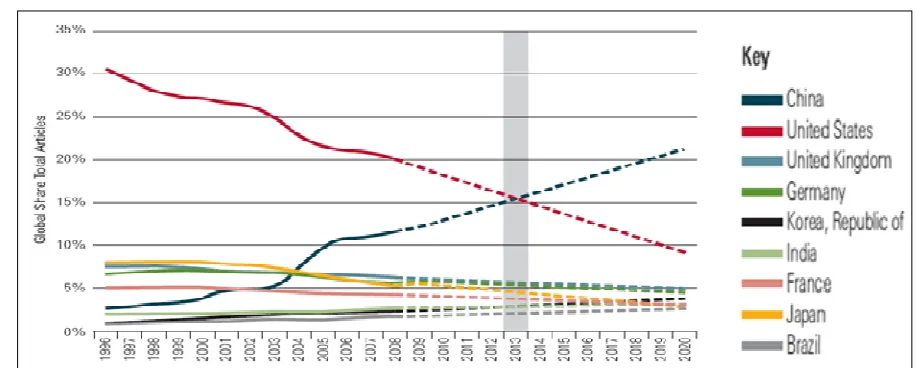
The table shows that the human development indicators in China are continuously evolving and shifted from 0.368 in 1980, to 0.943 in 2014. This tells about the efforts made to improve the level of intellectual factor. China is ranking among countries of high human development, according to 2010 human development report. The successive Chinese governments have been emphasizing the role of education, training, scientific research and innovation and creativity culture in human development. This concern with the intellectual factor is noticeable through the number of scientific publications which surpassed in 2004 those of France, Japan, Germany and other developed countries
Figure 4: Linear extrapolation of future publication trends” The dotted lines indicate projections”.
Source: - knowledge, networks and nations global scientific Collaboration in the 21st century, report 03/11, the
royal society, U.K, 2011, p43.
The figure shows the continuous increase in the number of scientific publications mainly between 2003 and 2004, when the number of Chinese publications surpassed that of French, German and British ones respectively.
Intellectual Property: The adhesion of China to the International Organisation of Intellectual Property as a member of full membership has led to the improvement of intellectual property situation therein. In addition to the attraction of foreign investment which use advanced technology, this improvement has also led to protect the rights of inventors and to encourage them to give more. This resulted in an increase of the number of invention licenses registered within the Chinese Society of Intellectual Property, as shown in the following table:
Table 3: The number of invention licenses agreed in Chinese Society of Intellectual Property 2002-2005
2002 2003 2004 2005 2013 2014
Total patents registered 3144 6895 12176 14761 825136 928177
% Change - 19.30 76.59 21.32 - 12.5
Source: Personal realization based on:
Research and Development: Until 1995, there was neither a policy nor a clear strategy to promote research and development in China. But, in the ninth five-year (quinquennal) plan (1996-2000), the Chinese government announced its determination to gradually increase its contribution to develop science and culture using a series of procedure, mainly through (GUEDRI Salah Eddine and BABOURI Hamza, 2012):
- increasing the amount of credits allocated to do scientific and cultural research, as well as allocating credits by the banks especially to put into practice the results of cultural research, and to extend the use by societies (public, private and joint) of modern cultural means;
- the governmental departments concerned with science and culture provide financial support to research institutes which implement a program of structural reforms so that they be able to achieve a standard of international level; - As part of this plan, the government has chosen 800 laboratories of different ministries to implement the system
of scientific and cultural development. There will be built strong links between institutes and State-owned firms in the aim of promoting the competence and efficiency of Chinese industries, and improve the quality of products to increase the power of competitiveness of Chinese goods in local and international markets.
After the adhesion of China to the International Organisation of Intellectual Property, the Ministry of Science and Technology decided in its 10th session to start implementing the national programs of research and development,
namely 973 programs, which are sufficient to enter China into the international arena of competitiveness in matters of innovation and creativity. The said ministry also determined the necessary mechanisms to launch the implementation of programs, based on the preparation of human resources, gathering qualified and proficient scientific teams, setting the characteristics and conditions of registration of invention licenses and ensuring necessary financial resources for researches.
Figure 5: PRC National R&D Expenditures and Expenditures as a Percentage of China’s GDP (1995-2015)
Source :- Micah Springut et all, China's, program for science and technology Modernization, Report prepared for the U.S-China Economic and security Review Commission , CENTRA Technology Inc, Virginia, U.S.A, January2011,p39.
The figure shows the continuous increase of spending on research and development, which reached 1.8% of the GDP. However, the contribution of the private sector to research and development remains low in China. it did not exceed 20% of the total spending in 2009. During the tenth five-year plan (2001-2005), China set the National Program for Research and Development in Worldwide Technology which aims to enhance and increase the rates of innovation and invention in the sectors of advanced technologies, and to produce goods and equipments which compete with those existing in the international markets, emphasizing on the following (GUEDRI Salah Eddine and BABOURI Hamza, 2012):
- determining the research priorities, the coordination mechanisms and the main projects of implementation priority; setting administration system and organising the operations of research and development;
- setting a system of management of research projects which includes the method of implementation of the project, the method of ensuring the necessary financing and the operation of marketing and industrialization; and making necessary measurement, experience and tests to implement the project;
0 200 400 600 800 1000 1200 1400 1600
0 0.5 1 1.5 2 2.5
1995 1996 1997 1998 1999 2000 2001 2002 2003 2004 2005 2006 2007 2008 2009 2010 2011 2012 2013 2014 2015
- enhancing the procedure of protection of the results of researches; managing the operations of their production and marketing; integrating the research programs with the local needs for development; and developing major techniques to build and develop the Chinese infrastructure and encourage invention and innovation;
The following figure shows the evolution of the exports of Chinese advanced technologies (1992-2014):
Figure 6: A. High-Technology Exports in China (% of Manufacturing Exports)
Source: CHAKOUR Said Chaouki and GUEDRI Salah Eddine, The role of the university in the national system of innovation and support the development of industrial performance in China, Third International Forum Industrial performance and the new role of the university Opportunities and Challenges, Mohamed El Bachir El Ibrahimi University, Algeria, 21/22 November 2016.
We notice from the figure that the rate of Chinese exports of advanced technologies are continuously increasing to that extent they surpassed the rate of U.S. exports in the tenth five-year plan (Thomas J.Holmes and others, 2011). This confirms the success of the Chinese experience in matters of human and economic development, and of constructing a society of knowledge; but also that China has reached the stage of creating a local internationally-competitive technology.
3.Conclusion:
Technological development in Developing Countries which allows them to achieve independence and self-reliance is a subject of concern. Undoubtedly, the attempt of Developing Countries to reach this objective is truly a crucial reason of their openness to and permitting FDI to enter and practise their production activities therein; since FDI are a means of transfer of technological and procedural knowledge. Experiences have proven, as in the case of China, that FDI is insufficient for itself for technology transfer into Developing Countries, and that taking advantage of this technology - in matters of transfer, internalization then creation – needs a high capacity of assimilation mainly in terms of highly qualified human resources that are able to assimilate the said technology and to adapt it with local environment. Another condition to taking advantage of this technology is the existence of research and development centres which participate to enhancing the national system of innovation and creativity
Results
Constructing an independent technology does not mean getting isolated from the international scientific progress. Taking advantage of it is rather one of the ways of constructing one’s own technology. The presence of foreign investors inside the host country is an important factor of technology internalization and of support to the national system of innovation. It is widely better than purchasing production licenses and different other methods of technology transfer;
One cannot speak about technology transfer and internalization without the existence of a national system of innovation and creativity which can assimilate modern progress and give it a local character. In fact, highly qualified human capital and qualified workforce (manpower) are among the most important elements which contribute to attract FDI in the filed of research and development, so that local research centres be able to acquire the most modern findings of international firms in terms of technology and research methods.
0 5 10 15 20 25 30 35
Recommendations
It is necessary to take advantage of international experience in order to benefit from technology of FDI, mainly the experience of China, India and Malaysia, and other countries of South Eastern Asia. To do so, the concerned authorities should create research centres inside operative ministries and investment attraction agencies; not for the sake of comparison, but in order to draw lessons and take advantage of; as preferring foreign investment in the field of research and development and of increasing ownership percentage in the local project;
It is necessary to draw a clear scientific and technological policy which goes in pair with development plans; and to encourage researchers to innovate and renew through material and moral motivation and working to find out linkage between research centres and economic sectors;
It is recommended to encourage university graduates to create their own small enterprises and provide them with material and moral support; especially in matters of industrial and technological incubators, in order to contribute to enhance local firms’ competitiveness and increase their assimilation and creative capacity as well; It is finally recommended to create, reinforce and develop national centres of technology creation, and to link
them to production sectors to allow them to meet the effective needs, and to link them as well to education establishments in order to allow them to draw a scientific policy in harmony with the technical one and to draw overall development plans for the State.
Problem of the Research:
The Developing Countries are facing many obstacles and challenges in the process of technology. The main obstacle is the lack of a clear vision to develop the national system of innovation. The main cause is probably the huge technological gap between them and the developed countries, the difficulty to catch up with their technological development and that of competing them. So the main problem searched in this paper is: What are the opportunities for Developing Countries to benefit from foreign direct investment (FDI) technology to achieve economic development? What are the lessons learnt from China's experience? As a prior answer to the main question we pose the following hypothesis: "Although the technology internalization and transfer is a real challenge for Developing Countries, there are opportunities for them to take advantage of this technology, mainly foreign direct investment, especially in the light of the global economic and trade openness. The degree of taking advantage of foreign direct investment technology, "in terms of transfer and internalization" is subject to the degree of advancement of the national system of innovation as a decisive first step. "
References:
CHAKOUR Said Chaouki and GUEDRI Salah Eddine (2016). The role of the university in the national system of innovation and support the development of industrial performance in China, Third International Forum Industrial performance and the new role of the university Opportunities and Challenges, Mohamed El Bachir El Ibrahimi University, Algeria, 21/22 November.
DREIC (2011). World investment prospects, foreign direct investment and the challenge of political risk, publication of Dominican Republic export and investment centre, Columbia, p 125.
Dwight H Parkins et al (2008). Economie du développement, édition de Boeck université, France, 3me édition. Emma Xiaoqin Fan (2002). Technological Spillovers from Foreign Direct Investment—A Survey, Economics And
Research Department Erd Working Paper Series No. 33, Asian Development Bank, December.
GUEDRI Salah Eddine and BABOURI Hamza (2012). Foreign Direct Investment Technology and the problem of Taking Advantage in it in Developing Countries: Showing experiences, Master thesis in Economic Sciences, Guelma University.
Ivo de loo, luc socte (1999). The impact of technology on economy growth: some new ideas and empirical considerations, economic research Institute on Innovation and technology, University of Maastricht, Netherlands, April, p1.
Lila Chikha (2010). The impact of patent protection on technology transfer through foreign direct investment: China's experience, Faculty of economics and management sciences, Batna University, p02. www.cha.edu.kw%2fwtou%2fdownload%2fconflaila.pdf.
Long Guoqiang (2005). Does Foreign direct investment promote development?, Publication of institute of international Economics, Washington, USA, 2005, p p 329, 330.
Mohammed F.H et al (2011).Impact of Innovation , Technology and Economic Growth Entrepreneurship, American International journal of contemporary research, Vol 1, N.1, Centre for Promoting Ideas, USA, P 47.
Monaj fant and Sangeta Mondal (2010). FDI, Technology Transfer and Spillover: A case study of India, Discussion paper 10-04 in Economics, Center International Trade and development, India, November 2010, P05.
Sazali Abdul Wahab et al (2012). Defining the Concepts of Technology and Technology Transfer: A Literature Analysis, International journal of Business Research, Vol. 5, No. 1 , Published by Canadian Center of Science and Education , National Defense University of Malaysia , January, p70.
See: oxford learner's packet dictionary (2011). Oxford university press, 4th edition, p456.
Suzana Idayu wati Osman et al (2012). Exploring the Technology Transfer Mechanisms by the Multinational Corporations, Journal Asian Science end Education, Malaysia, March, p 145.
UNCTAD (2010). foreign direct investment, the transfer and diffusion of technology, and sustainable development, publication of United nations conference on Trade and development, 08-december, p 13.
Yared Lemma and others (2014). The Impact Of Foreign Direct Investment On Technology Transfer In The Ethiopian Metal And Engineering Industries, International Journal of Scientific & Technology Research Volume 3, ISSUE 4, April.
Yimin zhang et al (2003). the role of foreign direct investment in china’s fast- 1978 economic development, Lancaster university management school, working paper No-002, united kingdom, p 23.