Amarnath et al. World Journal of Engineering Research and Technology
ADVANCED E-LEARNING MODEL AND ARTIFICIAL EMOTIONAL
INTELLIGENCE
1
*Amarnath Singh and 2R. C. Tripathi
1
Research Scholar, Monad University, Hapur, Uttar Pradesh, India.
2
Professor, Monad University, Hapur, Uttar Pradesh, India.
Article Received on 15/11/2018 Article Revised on 06/12/2018 Article Accepted on 27/12/2018
ABSTRACT
The research and development on Artificial Intelligence (AI) with
Artificial Emotional Intelligence (AEI) issues and associated
challenges is fast coming up as an emerging area of research. It has
been observed that the current research and development activities on
Al based systems do not have enough data on the emotional aspects of human intelligence.
Therefore, all the emotional issues are to be incorporated in future artificial intelligence based
systems. We have studied some of the emotional intelligence issues from various
respondents, the faculty members of different background, different locations, different
experiences, different designations and age group. We have proposed an advanced e-learning
model which will evaluate the performance of the students.
KEYWORDS: Artificial Emotional Intelligence, Artificial Intelligence, Human Intelligence, Faculty members, e-learning.
INTRODUCTION
The research activities on Artificial Intelligence (AI) has been able to include several
important components like the recognition of pattern and voice, identification of face and
machine learning. However, it has been observed that AI should be able to include various
emotions like surprise, happiness, anger, fear, frustration, impatience, disappointment,
frustration etc. Human emotions are deeply associated with several parameters (Kumar et. el.
2018).[1,2]
World Journal of Engineering Research and Technology
WJERT
www.wjert.org
SJIF Impact Factor: 5.218*Corresponding Author
Amarnath Singh
Emotional Intelligence separates us from the machines. The functions of emotional
intelligence are given in Table 1. It includes the activities and functions of artificial emotional
intelligence.
Table 1: Emotional Intelligence, Functions and Activities. Emotional Intelligence Functions of Human
Emotions
Activities of Human Emotions
is the ability to recognize, understand and manage one’s own emotions
Emotions include the ability to identify them
ability to recognize human emotions
is the ability to recognize and influence the emotion of others
to recognize their powerful effects
ability to respond appropriately
to use that information to guide behavior
Thus, the recognition and understanding of human emotions is of paramount importance for
artificial emotional intelligence systems Kumar et. al. (2018).[1,2] The research and
development activities in the recent years have made it possible to include emotions into
machine intelligence. It is possible to develop a system that allows the computer to recognize
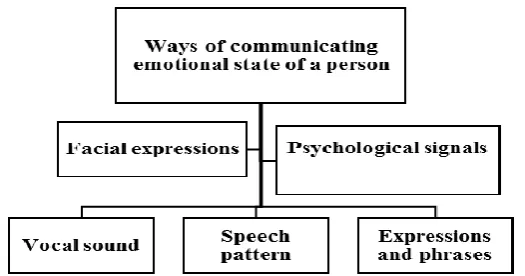
human feelings using physiological reactions and facial features. The possible ways of data
communicating the emotional state of a person to a machine are many and are shown in
Fig.1. Thus, understanding emotions of large section of the people will help in artificial
intelligence for future machines.[1,2]
Fig. 1: Ways of Data Communicating the Emotional State of a Person to a Machine.
I. Characteristics of the respondents
We have conducted research on the faculty members of different gender, age group, teaching
experience, discipline and location etc. The data at 6 different locations (Ranchi, Patna,
Lucknow, Indore, Noida, Chennai) was collected from 1000 faculty members. In this paper,
II. RESULTS FOR EMOTIONS
1. I know when I am happy: The responses of the Assistant Professors (Male and Female) to this question is shown in Fig. 2. We have observed variation with respect to the location
and gender. In male, it varies from 94 % to 98 % whereas in females it varies from 88 % to
94 %. The average being 96 % and 92 % respectively.
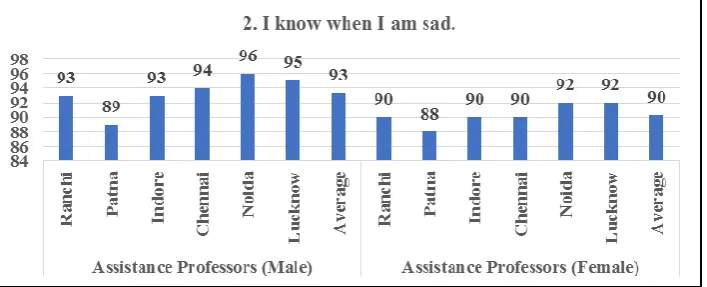
2. I know when I am sad: The responses of the Assistant Professors (Male and Female) to this question is shown in Fig. 3. We have observed variation with respect to the location and
gender. In male, it varies from 89 % to 96 % whereas in females it varies from 88 % to 92 %.
The average being 93 % and 90% respectively.
3. I know when I am surprised: The responses of the Assistant Professors (Male and Female) to this question is shown in Fig. 4. We have observed variation with respect to the
location and gender. In male, it varies from 89 % to 94 % whereas in females it varies from
85 % to 90 %. The average being 92 % and 88% respectively.
4. I know when I feel fear: The responses of the Assistant Professors (Male and Female) to this question is shown in Fig. 5. We have observed variation with respect to the location and
gender. In male, it varies from 89 % to 94 % whereas in females it varies from 85 % to 90 %.
The average being 92 % and 88% respectively. This is identical to the previous question
related to surprise.
5. I know when I am disgust: The responses of the Assistant Professors (Male and Female) to this question is shown in Fig. 6. We have observed variation with respect to the location
and gender. In male, it varies from 88 % to 93 % whereas in females it varies from 85 % to
90 %. The average being 91 % and 88 % respectively.
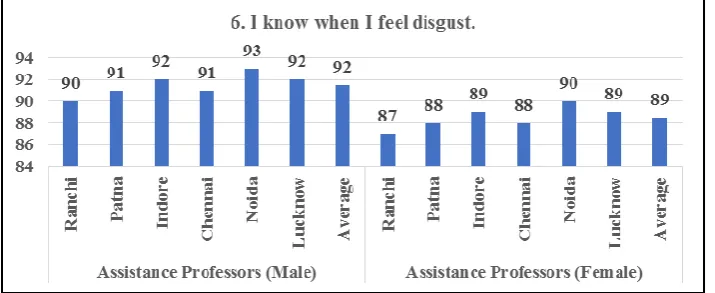
6. I know when I feel disgust: The responses of the Assistant Professors (Male and Female) to this question is shown in Fig. 7. We have observed variation with respect to the location
and gender. In male, it varies from 90 % to 93 % whereas in females it varies from 87 % to
90 %. The average being 92 % and 89 % respectively.
7. I know when I feel boredom: The responses of the Assistant Professors (Male and Female) to this question is shown in Fig. 8. We have observed variation with respect to the
location and gender. In male, it varies from 88 % to 90 % whereas in females it varies from
8. I know when I feel hopeful: The responses of the Assistant Professors (Male and Female) to this question is shown in Fig. 9. We have observed variation with respect to the location
and gender. In male, it varies from 88 % to 92 % whereas in females it varies from 88 % to
90 %. The average being 90 % and 91 % respectively.
9. I know when I feel anger: The responses of the Assistant Professors (Male and Female) to this question is shown in Fig. 10. We have observed variation with respect to the location
and gender. In male, it varies from 94 % to 98 % whereas in females it varies from 91 % to
94 %. The average being 96 % and 92 % respectively.
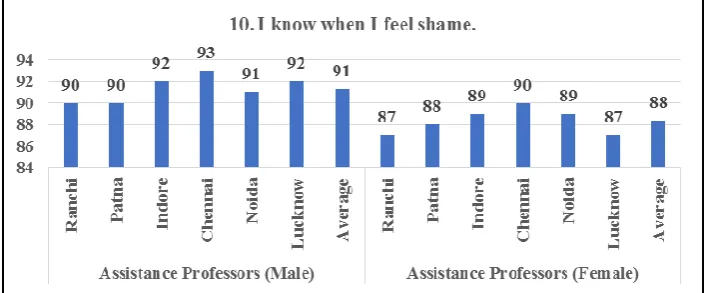
10. I know when I feel shame: The responses of the Assistant Professors (Male and Female) to this question is shown in Fig. 11. We have observed variation with respect to the location
and gender. In male, it varies from 90 % to 93 % whereas in females it varies from 87 % to
90 %. The average being 91 % and 88 % respectively.
The corresponding results for Associate Professors and Professors shows that they are more
or less similar in nature with marginal changes and hence are not discussed.
Fig. 2: Response of the Faculty Members to the Question 1 (%).
Fig. 4: Response of the Faculty Members to the Question 3 (%).
Fig. 5: Response of the Faculty Members to the Question 4 (%).
Fig. 6: Response of the Faculty Members to the Question 5 (%).
Fig. 8: Response of the Faculty Members to the Question 7 (%).
Fig. 9: Response of the Faculty Members to the Question 8 (%).
Fig. 10: Response of the Faculty Members to the Question 9 (%).
III. Interactive Open Education Resources (OER) (Advanced e-learning)
Once we understand the emotions of the faculty members, it is important that they are built in
learning model. In an interactive OER (advanced e-learning), the system will evaluate the
performance of the students in successive manner i.e. as and when they are able to understand
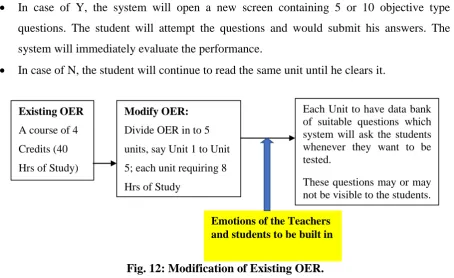
the subject. This requires modification of existing OER as shown in Fig. 12.
The methodology of how students will read, learn and how the system will evaluate the
performance is described below:
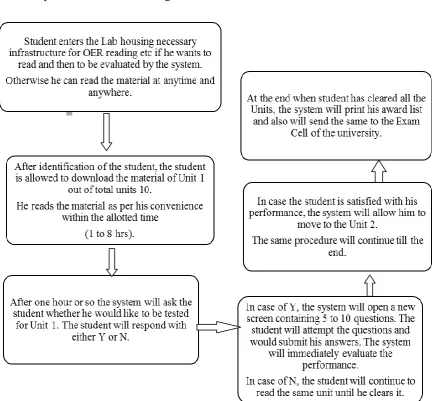
(1) Get Started
Student enters the Lab housing necessary infrastructure for OER reading etc. if he wants
to read and then to be evaluated by the system.
Otherwise he can read at anytime and anywhere.
(2) Start Reading
After identification of the student, the student is allowed to download the material of
Unit 1.
He reads the material as per his convenience within the allotted time (1 to 8 hrs).
(3) Get Examined
After one hour or so the system will ask the student whether he would like to be tested for
Unit 1. The student will respond with either Y or N.
In case of Y, the system will open a new screen containing 5 or 10 objective type
questions. The student will attempt the questions and would submit his answers. The
system will immediately evaluate the performance.
In case of N, the student will continue to read the same unit until he clears it.
Fig. 12: Modification of Existing OER.
Existing OER
A course of 4 Credits (40 Hrs of Study)
Modify OER:
Divide OER in to 5 units, say Unit 1 to Unit 5; each unit requiring 8 Hrs of Study
Each Unit to have data bank of suitable questions which system will ask the students whenever they want to be tested.
These questions may or may not be visible to the students.
(4) Clear the Course
In case the student is satisfied with his performance, the system will allow him to move to the Unit 2.
The same procedure will continue till the end.
At the end when student has cleared all the Units, the system will print his award list and
also will send the same to the Exam Cell of the concerned university.
The entire process is described in Fig. 13.
Fig. 13: Operational Scheme for Advanced e-learning.
IV. E-learning and Emotional Intelligent Models
The e-learning environments has now started to consider the emotional state of the teachers
as well as learners for enhancing their capabilities and performance. The emotions, if built in
the e-learning and evaluation process, will help in a big way not only the students but also the
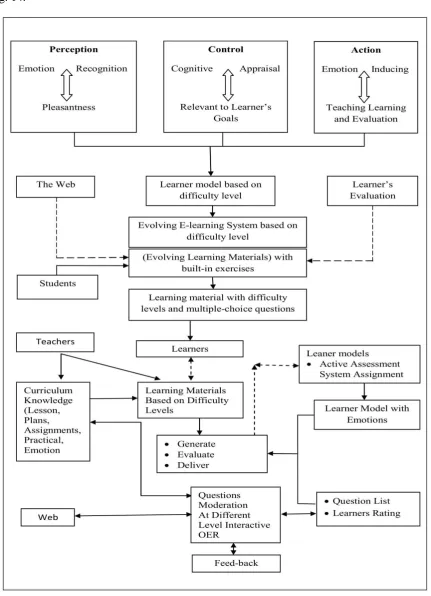
We have proposed an advanced evolving e-learning system originally developed by Tang and
Mccalla (2002).
The architecture of the proposed system having all the necessary components is shown in
Fig. 14.
V. CONCLUSIONS
We have studied emotional intelligence issues from various respondents, the faculty members
of different disciplines and teaching experiences. It has been observed that responses of the
respondents vary with their locations, experiences. This indicates that future intelligent
machines based on artificial emotional intelligence have to consider emotional intelligence
deeply. We have proposed a model for advanced e-learning which can have learning,
emotions and evaluation.
REFERENCES
1. Kumar Arvind, Singh Rajiv and Ram Chandra, Emotional Intelligence for Artificial
Intelligence: A Review, International Journal of Science and Research, 2018; 7(8):
479-487.
2. Kumar Arvind, Singh Rajiv and Ram Chandra, A Study of Emotional Intelligence Issues
among the Students of Different Background, International Journal of Science and
Research, 2018; 7(8): 870-874.
3. Tang, T. Y. and Mccalla, G. Smart recommendation for an Evolving E-Learning