Volume-6 Issue-2
International Journal of Intellectual Advancements
and Research in Engineering Computations
IOT based on water pumping system for agriculture using pic
microcontroller
G.Praveen Santhoshkumar1, S.A.Saran2, G.Magudeshwaran3, E.Vignesh4, P.Sabareeswaran5 [1]
Assistant Professor, [2345] UG Scholar Department of EIE, Nandha Engineering College, Erode, Tamilnadu, India
Abstract—This project about day-to-day problems in agricultural surrounding. Wireless Sensing Technology is extensively used future and extensive in the current systematic globe. As Wireless sensing Network (WSN) helps to enhancement the knowledge. In the make inquiries field of wireless sensor networks the power resourceful time is a major issue. This problem can be overcome by using the IOT technology. The main idea of this is to recognize how data movements through a wireless medium transmission using wireless sensor network and monitoring system. This paper design an irrigation system which is computerized by using controllable constraint such as temperature, soil moisture and air humidity because they are the important factors to be restricted in exactness Agricultures.
Keywords—Energy consumes; Humidity sensor; PIC Controller; soil moisture sensor; Temperature Sensor; wireless Sensor network; IOT.
I. INTRODUCTION
Agriculture is the worldwide prime occupation of human being, 64% of total available land is occupied by the agriculture, and it consumes 85 % of available fresh water. This figure of water consumption increases every year due to globalization and population growth. There is a challenge in front of every country to sustain the fresh food requirement and reducing the farm water consumption.
Irrigation is the process of watering the soil. The requirement of water to the soil depends on soil properties like soil moisture and soil temperature. It also depends upon the crop which grows in the soil. From last decade, few existing system working for reducing the agriculture water consumption, but
these systems have some limitations. These systems, watering is done without analyzing the soil properties, due to which systems apply non uniform water to the soil results in less yields. Also systems required more human intervention and time consuming. So we require modern technology to
resolve this problem and support better irrigation management.
For that we have proposed system which is iot based automatic irrigation system using wsn. The wireless sensor network creates the networks of multiple devices having capable of computation, communication and sensing. It provides a bridge between the real physical world and virtual worlds and having a wide range of
Potential applications of Agriculture, home
automation, science, civil infrastructure and security. This proposed system ‘an automatic irrigation using
IOT helps to know the conditions of the soil for the irrigation. There is a sensor which gives the information about temperature, humidity and moisture content in the soil if the value of sensed data matches with the threshold values which are required for the proper crop production then it will start irrigation automatically.
II.
DESIGN
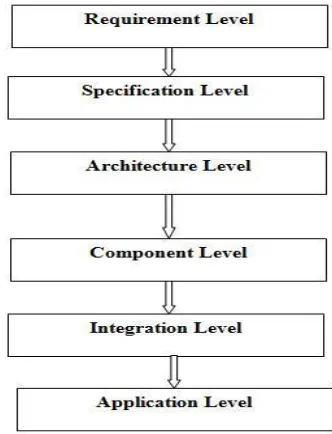
The proposed system design sequence is divided into two methods one is Top –Down and other is Bottom Up method . The design process of the proposed system is divided into five levels and they are as follows.
B. Specification Level
C. Architecture Level
D. Component Level
E. Integration Level
F. Application Level
Below figure shows the design sequence for the proposed system.
Fig1. Design sequence of proposed automatic irrigation system
A. Requirement Level
It is a first level of the design process of proposed an automatic irrigation system it is divided into two types and they are as follows
I. Functional requirement
Functional requirements consist of technical details, data manipulation and processing, sensing and indication. The proposed system uses a sensing device to detect soil moisture, temperature and humidity. It uses an automatic indication to detect an automatic operation such as Motor Pump, Fan (ON/OFF), and Buzzer Blow.
II. Non functional requirement
It is mutually exclusive of functional equirement.The proposed system consists of monitoring and controlling water level of soil, environmental temperature and humidity. When this factor crosses the threshold value of particular crop
it automatically start respective operation of Pump, Fan and Buzzer.
B. Specification Level
Specification is a detailed assessment of requirements of devices. The table gives a specification of devices used
Sr. no Devices Specification
1 IOT Up to signal interrupt
2 Microcontroller CAN bus, Inbuilt ADC,
PIC 16f877a high performance
3 Display LCD(16*2),
LCD(16*4)
4 Sensors LM-35, SY-HS-220, Soil
moisture
5 Solar panel Photovoltaic cell
TABLE I DEVICES SPECIFICATION
C. Architecture Level
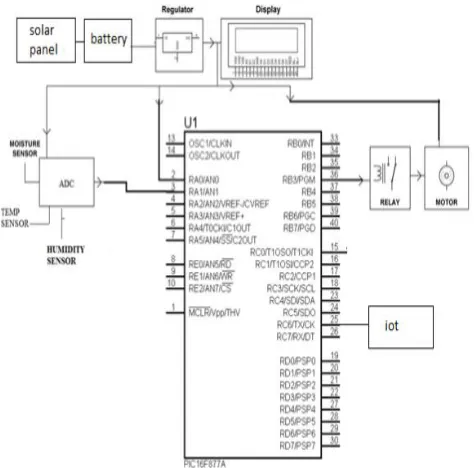
It consists of the specified hardware device partition, performance and trouble shooting. The proposed system consists of two nodes .Node 1 called as sensing node and Node 2 called as receiver node. The receiver node play an important role in an automatic irrigation system. In Node 1 the address of the destination is set on receiver node. Node 1 sensed the information by using sensor this sensing information transmitted to ADC
type and it will be the display threshold value of crop on the LCD and Mobile and it compares the threshold value of crop and running value. When running value crosses the threshold value then automatic operation start.
Fig 2. Architecture of proposed automatic irrigation system
D. Component Level
It is an important and independent part of system which performs the function in the architecture .It is the most important level for the design of the system. It consist of hardware and software component
I. Hardware Component
Hardware component is a physical device that is a part of the system which connects the other component, provide input and output to and from the application. The proposed system hardware components are Solar panel, Temperature sensor, humidity sensor, soil moisture sensor, IOT, PIC Microcontroller 16F877A, Fan, Motor pump, Buzzer, Relay.
II. Software Component
It is interfaced between the hardware and mobile. The features are inbuilt in a software application is called as a software component
E. Integration Level
System integration consisting of connecting all the components together and building a proper structure .It also consists of troubleshooting tasks in order to run the system smoothly. It is a difficult stage as we have to find why the system is not working properly. The proposed system consists of a sensor which gives a signal to the microcontroller. There are three channels respectively, for temperature sensor, soil moisture sensor and humidity sensor. Sensory information is converted into digitized with the help of ADC and it is transmitted to LCD to display. Then this information is transmitted to iot. iot also compares the sensor output with the set values and gives output to the driver. The data are transmitted to iot to the master node. It collects information from node1 There are four which can be used to select sets values of a particular crop. Switches are interfaces to Port E Using resister. There are three relays are used for Buzzer, Fan, Pump Motor. This relay is interfaced to Pin RA0, RA1, RA2, BC547 is used to control more power create by a coil of the relay and it amplifies the signal of PIC 16f877a microcontroller. The information displays from Master Node LCD 16*4 and mobile
F. Application Level
The proposed system is applied in agriculture field to detect the temperature, humidity, moisture, which will improve the quality and quantity of crop productions.
III.
AUTOMATED IRRIGATION
SYSTEM
IV.
RESULT
The farmer has the ability to Monitor the Sensors information at his/her home, the sensor information displays on the master node LCD as well as mobile. The farmer can set crop type such as Wheat, Rice, Jowar and Bajara in the master node. Moisture, temperature and humidity value required for a particular crop are set in the microcontroller as a threshold value. Soil moisture, temperature and humidity sensor fixed in the field sense the actual values. These values are compared with the threshold values. If the actual value crosses the threshold values then corresponding pump, fan or Buzzer switched ON. The Farmer pressed his or her choice as 1 in master node, crop type rice is selected, then actual values of moisture, temperature and humidity for rice will be displayed on master node as well as mobile through Terminal and compare it and automatically perform the operation.
V. EXPERIMENTAL ANALYSIS
When irrigation system is OFF then the value o crop temperature, humidity, soil moisture is normal.
When Irrigation System is ON then the value of crop temperature, humidity, and Soil moisture crossed the threshold value.I. when the humidity value crossed the threshold value of the crop, then buzzer gets ON and displays
on master node LCD and mobile.
Fig.4 Buzzer on when cross threshold value.
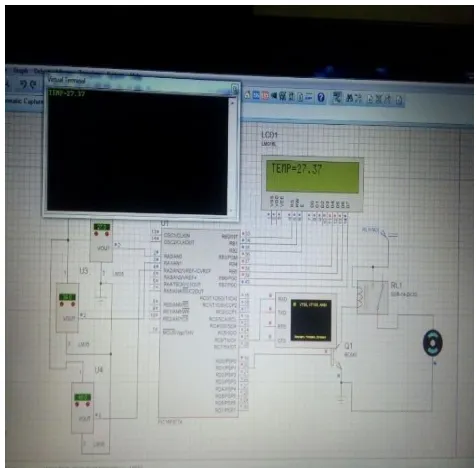
II. When Temperature value crosses the threshold value of the crop, then Fan get ON and displays on master node LCD and mobile
Fig 5 Fan on when cross threshold value
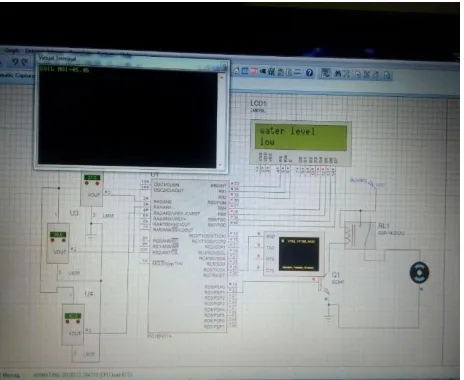
Fig.6 Pump on when cross threshold value
As per the above result we experimentally analysis that it perform automatically operation without taking any man power it also take the accurate result for monitoring the soil content, enviourmental content and efficient use of energy
I.
CONCLUSION
The automated irrigation system implemented was found to be feasible and cost effective for optimizing water resources for agricultural production. This irrigation system allows cultivation in places with water scarcity thereby improving sustainability.
The automated irrigation system developed proves that the use of water can be diminished for a given amount of fresh biomass production. The use of solar power in this irrigation system is pertinent and significantly important for organic crops and other agricultural products that are geographically isolated, where the investment in electric power supply would be expensive.
Fig 7: stimulation output by proteus software.
The irrigation system can be adjusted to a variety of specific crop needs and requires minimum maintenance. The modular configuration of the automated irrigation system allows it to be scaled up for larger greenhouses or open fields.
Besides the monetary savings in water use, the importance of the preservation of this natural resource justify the use of this kind of irrigation systems.
REFERENCES
[1] Soledad Escolar Díaz, Jesús Carretero Pérez, Alejandro Calderón Mateos, Maria-Cristina Marinescu, Borja Bergua Guerra, “A novel methodology for the monitoring of the agricultural production process based on wireless sensor networks,” Computers and Electronics in Agriculture , no.76, pp. 252– 265,2011.
[2] Aqeel-ur-Rehman, Abu Zafar Abbasi, Noman Islam, Zuba Ahmed Shaikh, “A review of wireless sensors and networks' applications in agriculture “,Computer Standards & Interfaces, pp.xxx– xxx,2011. [3] W. Su, Y. Sankara subramaniam, E. Cayirci,
I.F, Akyildiz, ” Wireless sensor networks: a survey,” Computer Networks , no.38, pp- 393–422,2002.
[4] R. Challooa, A. Oladeindea, N. Yilmazera, S. Ozcelikb, L.Challoo, “An Overview and Assessment of Wireless Technologies and Coexistence of ZigBee, Bluetooth and Wi-Fi Devices,” Procedia Computer Science, no.12, pp.386 – 391,2012.
[5] Francesca Cuomo , Anna Abbagnale, Emanuele Cipollone, “Cross-layer network formation for energy-efficient IEEE
802.15.4/ZigBee Wireless Sensor
Networks”, Ad Hoc Networks, no. 11, pp.672–686, 2013.
[7] Cost Irrigation System Using ZigBee Technology.” International Conference on Networks Security
[9] X. Wang, W. Yang, A. Wheaton, N. Cooley, and B. Moran, “Efficient registration of optical and IR images for automatic plant water stress assessment,” Comput. Electron. Agricult., vol. 74, no. 2, pp. 230–237, Nov. 2010.
[10] G. Yuan, Y. Luo, X. Sun, and D. Tang, “Evaluation of a crop water stress index for detecting water stress in winter wheat in the North China Plain,” Agricult. Water Manag., vol. 64, no. 1, pp. 29–40, Jan. 2004.
[11] S. B. Idso, R. D. Jackson, P. J. Pinter, Jr., R. J. Reginato, and J. L. Hatfield,
“Normalizing the stress-degree-day
parameter for environ-mental variability,” Agricult. Meteorol., vol. 24, pp. 45–55, Jan. 1981.