Abstract
— In this study of investigation of rice husk ash, it can be used in preparation of rice husk ash brick. Engineering properties like compressive strength ,water absorption ,size and shape have been studied. .F2R cement is special used for increasing the workability for M-sand. M-sand is used to satisfy the carsity of river sand. Since rice husk ash has more absorption of water, to minimize the water absorption Perma plaster AC is used .From the studies it is observed that optimum proportion for RHA + M-sand + F2R cement was observed as minimum 30% of RHA .when compared to all other possible proportions after 28 days curing period the rice hush ash brick achieve nominal strength compare to clay brick.Key words F2R cement, M-sand ,Perma Plast AC , RHA
I.
INTRODUCTION
Shelter is a basic human need and owning a house becomes a life long struggle as majority of Indians find housing costs prohibitively expensive. This problem becomes even more accurate when considering the low income families who accounts for about 60-70% of Indian population. This brings out the need to reduce the cost of the housing and make it affordable for the booming population. Burnt clay bricks are being used extensively and the most important building material in construction industry. In India the building industry consumes about 20000 million bricks and 27% of the total natural energy consumption for their production.
Avoid dumping and land filing RHA can be used in replacement of cement.in our project RHA is used as part of brick combination , combination RHA ,M-sand,F2Rcement with admixture of Perma Plast AC (which reduce the water absorption).similar ratio of combination of brick have been moulded and test to find properties and to find the strength of the brick.
1.1 DEFINITION OF RHA
India is the second highest rice producing country in the world after China. Rice Husk Ash (RHA) is generated by burning rice husk in boilers. Disposal of such a big amount is hazardous for the rice producing nations. For every thousand kilogram of paddy around 220kg of rice husk is produced and on burning this 220kg of rice husk around 55kg of rice husk ash is generated which is 25% of rice husk (Koteswara Rao. D, 2011)
1.2 DEFINITION FOR M-SAND
Manufactured sand (M-sand) is a substitute of river sand for concrete construction. Manufactured sand is produced from hard granite stone by crushing. The size of manufactured sand
(M-sand) is less than 4.75mm. The use of M-sand is more availability and in case of less transportation cost. It can be readily available at the nearby place, reducing the cost of transportation from far-off river sand bed.
Volume-6 Issue-2
International Journal of Intellectual Advancements
and Research in Engineering Computations
Experimental investigation of rice husk ash brick using M-Sand
and F2R cement with perma plast AC
Mathiyalagan.S[1],Mohanram.T[1],Naveenkumar.K[1],Sathyaprabhu.M[1]
Gowtham.S.K[2]
Students of Final year B.E Civil Engineering [1]
Assistant Professor[2]
Nandha Engineering College
Perundurai
1.3 DEFINITION FOR F2R CEMENT
ACC F2R cement is a new product from the F2R family developed to address specific consumer needs and faviour workability of M-sand
II.
ABBREVATION
RHA - Rice Hush Ash
F2R cement - Foundation to Roof
Perma Plast AC - Acclerator
III.
M
ATERIALSa) F2R cement b)Fine aggregate ( M-sand ) c) Perma Plast ACd) RHA e) Water
a)F2R cement
Portland slag cement of grade 53 was used as per IS 455-1989 code and result have been observed and tabled
Table 1
Properties of F2R cement
Initial setting time 33 Minutes
Final setting time 570 Minutes
Specific gravity 2.94
Finess 3.5
Consistency 26.4
b)Fine aggregate ( M-sand )
As per IS 383-1970 code properties and nature of M-sand have been tested
Table 2
Properties of M-sand
Specific gravity 2.45
Finess 6%
Moisture content NIL
c) Perma PlastAC
As per IS 9103-2007 code admixture is used reduce water absorption
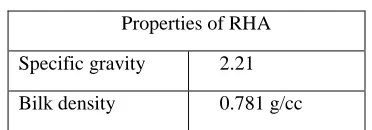
d) RHA
As per IS code RHA is examined and result have been tabulated
Table 3
Properties of RHA
Specific gravity 2.21
Bilk density 0.781 g/cc
e) Water The water used for mixing should be potable drinking water having ph 6 TO 8.
IV.EXPERIMENTAL RESULT
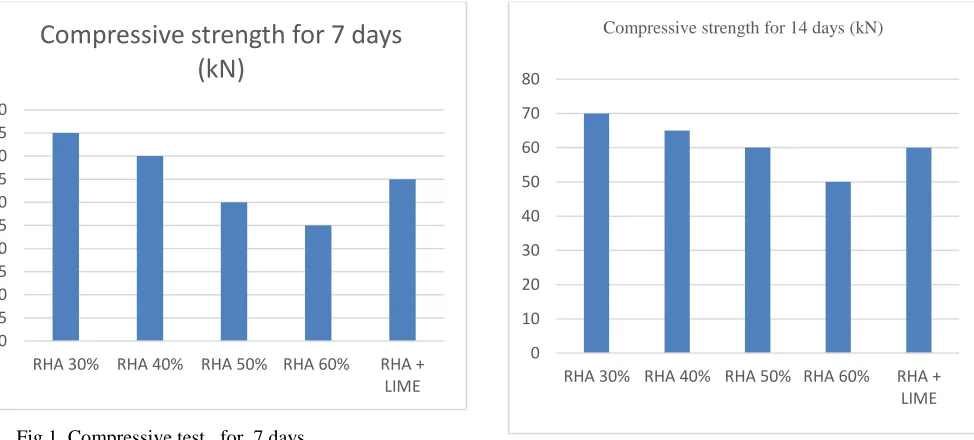
The test are considered for Compressive strength ,soundness ,shape and size, water absorption, hardness are given below.
4.1 Compressive test
Table 4
Material Percentage % Weight
(gm)
Test for 7 days
RHA 30 831
45 kN
M sand 60 1662
F2R cement 10 277
RHA 40 864
40 kN
M sand 50 1080
F2R cement 10 216
RHA 50 920
30kN
M sand 40 736
F2R cement 10 184
RHA 60 1026
25 kN
M sand 30 513
F2R cement 10 184
RHA 40 900
35 kN
M sand 40 900
F2R cement 5 112.5
Fig 1. Compressive test for 7 days
Table 5
Material Percentage % Weight
(gm)
Test for 14 days
RHA 30 831
70 kN
M sand 60 1662
F2R cement 10 277
RHA 40 864
65 Kn
M sand 50 1080
F2R cement 10 216
RHA 50 920
60 kN
M sand 40 736
F2R cement 10 184
RHA 60 1026
50 kN
M sand 30 513
F2R cement 10 184
RHA 40 900
60 kN
M sand 40 900
F2R cement 5 112.5
Lime 15 337.5
Fig 2 . Compressive strength for 14 days
Table 6
Material Percentage % Weight
(gm)
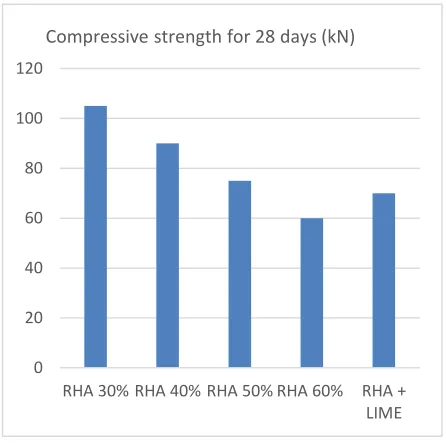
Test for 28 days
RHA 30 831
105 kN
M sand 60 1662
F2R cement 10 277
RHA 40 864
90 kN
M sand 50 1080
F2R cement 10 216
RHA 50 920
75 kN
M sand 40 736
F2R cement 10 184
RHA 60 1026
60 kN
M sand 30 513
F2R cement 10 184
RHA 40 900
70kN
M sand 40 900
F2R cement 5 112.5
Lime 15 337.5
0 5 10 15 20 25 30 35 40 45 50
RHA 30% RHA 40% RHA 50% RHA 60% RHA +
LIME
Compressive strength for 7 days
(kN)
0 10 20 30 40 50 60 70 80
RHA 30% RHA 40% RHA 50% RHA 60% RHA +
LIME
Fig 3 .compressive strength for 28 days
4.2 Water absorption and Soundness
Table 7
Material Percentage
%
Water
Absorption %
Soundness
RHA 30
13.35
Clear and ring sound
M sand 60
F2R cement 10
RHA 40
14.58
M sand 50
F2R cement 10
RHA 50
15.76
M sand 40
F2R cement 10
RHA 60
16.90
M sand 30
F2R cement 10
RHA 40
14.67
M sand 40
F2R cement 5
Lime 15
Fig 4 . Water absorption of bricks
4.3 Structure and Size and Shape
Table 8
Material Percentage
%
Structure Shape an size
RHA 30
Homogenous
Rectangle size with sharp edge
23x11x7
M sand 60
F2R cement 10
RHA 40
M sand 50
F2R cement 10
RHA 50
M sand 40
F2R cement 10
RHA 60
M sand 30
F2R cement 10
RHA 40
Small
lumps
M sand 40
F2R cement 5
Lime 15
0 20 40 60 80 100 120
RHA 30% RHA 40% RHA 50% RHA 60% RHA +
LIME
Compressive strength for 28 days (kN)
0 2 4 6 8 10 12 14 16 18
RHA 30%RHA 40%RHA 50%RHA 60% RHA + LIME
V. Conclusion
As per study and result RHA 30% is cost Efficient and achieve the strength .the cost of the brick less compare to the ordinary clay brick and fly ash brick
RHA brick is very useful brick as a good interior materials of building construction because of its light weight as compare to any other conventional brick
Due to less weight and cost efficient is satisfies the middle people .It will reduce dumping and land filling
By the addition of RHA upto 30% to M-sand the strength gradually decreased and beyond the addition of 30% of RHA the compressive strength decrease rapidly
As the percentage of RHA increased the water absorption of RHA ash brick also increased
As per percentage of lime increased water absorption of RHA decreased
By use Perma Plaster AC the water absorption of the brick decreased.
VI.Reference
1. N.Vamsi Mohan, Prof.P.V.V.Satyanarayana, Dr.K.Srinivasa Rao / International Journal of Engineering Research and Applications (IJERA) ISSN: 2248-9622 www.ijera.com Vol. 2, Issue 5, September- October 2012, pp.1906-1910 1906 | P a g e Performance Of Rice Husk Ash Bricks
2. N.Banumathidas, N.Kalidas, “Newtrends in Bricks and Blocks, the role of Fal-G”, July 1992, the Indian concrete journal.
3. Rozainee, M., Ngo, S.P. and Salema, A.A. (2008) Effect of Fluidising Velocity on the Combustion of Rice Husk in a Bench-Scale Fluidised Bed Combustor for the Production of Amorphous Rice Husk Ash. Bioresource Technology, 99, 703-713.
4. Mohan, N.V.P., Satyanarayana, V.V. and Rao , K .S .(2012) performance of Rice Hush Ash Bricks. International Journal of Engineering Research and Application (IJERA),2,1906-1910.
5. Alam, M.K., Islam, M.R., Saha, S., Islam, M.N. and Islam, S.M.A. (2013) Quality Study of Hand Made Brick-DK Using Neutron Radiography Technique. Bangladesh Journal of the Scientific and Industrial Research, 48, 237-246.