Pharmacophore
ISSN-2229-5402
Journal home page: http://www.pharmacophorejournal.com
Corresponding Author: Mohammad Beigi Elahe, Master Degree in Nursing, School of Nursing and Midwifery, Tehran
University of Medical Sciences, Tehran, Iran. Email: [email protected]
EFFECT OF PEER EDUCATION ON THE MEDICATION
ADHERENCE AND THE QUALITY OF LIFE OF HYPERTENSIVE
PATIENTS
Masroor Roudsari Daryadokht
1, Mohammad Beigi Elahe
2*, Haghani Hamid
31-
Faculty member, Medical-surgical Dept., School of Nursing and Midwifery, Iran
University of Medical Sciences, Tehran, Iran
2-
Master Degree in Nursing, School of Nursing and Midwifery, Tehran University of
Medical Sciences, Tehran, Iran
3-
Faculty member, Statistics Dept., School of Management and Medical Information, Iran
University of Medical Sciences, Tehran, Iran
A R T I C L E I N F O A B S T R A C T
Received:
04th January 2017
Received in revised form: 18th Apr 2017
Accepted:
28th Apr 2017
Available online:
29th May 2017
Keywords: Peer education, Patient, Medication adherence, Quality of life, Hypertensive
.
Background: Patients’ adherence to the treatment regimen predicts the success of treatment, and reduces the negative side effects of the disease and its severity. Considering the positive role of education in improving the quality of life, introducing appropriate educational method for patients’ medication adherence and improving their quality of life are important. The study aimed at investigating the effect of peer education on the medication adherence and the quality of life of hypertensive patients.
Methods: In this quasi-experimental study in 2016, 110 hypertensive patients were randomly divided into two groups of the intervention and control. Three peer to peer training sessions were held for the intervention group. Data collection tools included demographic and social information forms, patients’ adherence to the treatment regimen and health-related quality of life questionnaires, which were completed by both of the groups before and two months after the intervention. The collected ata were analyzed by SPSS version 16 using descriptive and inferential statistics.
Findings: The mean scores of adherence to the treatment regimen, before the intervention, were 4.89±1.92 and 4.04±1.77, in the control and peer groups respectively. 63.6 and 83.6 percent of the patients in the control and the intervention groups had poor adherence to medication regimen, respectively, and there was a significant difference between the two study groups (p= 0.018). Statistical analysis showed that two intervention and control groups, before the intervention, had statistically significant differences in terms of health problems (p= 0.004), pleasure and happiness (p= 0.023), social functioning (p= 0.024), somatic pain (p= 0.003), general health (p< 0.001), the two main dimensions of physical health (p= 0.001), mental health (p= 0.021), and in general quality of life (p= 0.002).
Conclusion: Peer education can improve and enhance the quality of life of hypertensive patients. Accordingly, it is suggested that by educating the patients, and efforts to increase their adherence to treatment, a step can be taken towards enhancing the life quality of these patients.
Copyright © 2013 - All Rights Reserved - Pharmacophore
To Cite This Article: Masroor Roudsari Daryadokht, Mohammad Beigi Elahe*, Haghani Hamid, (2017), “Effect of Peer Education on the Medication Adherence and the Quality of Life of Hypertensive Patients”, Pharmacophore, 8(3), 19-23
Introduction
Hypertension is the most common chronic disease among adults in developed societies [1]. Nowadays, more than 25% of the world population are suffering from hypertension and it is estimated that will increase to 29% in 2025 [2].
such as heart, brain, kidneys and blood vessels [4]. Some studies have estimated that 19.4% to 22% of Iranians are suffering from hypertension [5]. Statistical analysis has shown that a large number of hypertensive patients in Iran were not aware of their disease, and the known and treated cases did not have adequate and appropriate control over their disease [6].
Despite the proper treatment, the management of this problem is unfavorable. Despite patients' awareness of the risk of hypertension, they do not adhere to their drug regimens. Poor adherence to the medication regimen in the treatment of hypertension is one of the biggest barriers in controlling this disease [7]. It is important to adhere to the medication regimen in patients with chronic diseases, if the patients do not follow this regimen, they will suffer from adverse consequences, including relapses and disability progression, so they will be required immediate treatment and hospitalization [8]. The adherence to the drugs is a complex behavior and has many aspects [9]. Non-adherence to the medication regimen is associated with complications of hypertension, limitation of the effectiveness of prevention strategies leading to a significant enhancement in the rate of cardiovascular events [10]. Patients’ adherence to the medication regimen has a positive effect on the quality of life through education and is also an important criterion for evaluating the treatment’s success [11].
Quality of life as a comprehensive concept, recently is considered as one of the most important treatment purposes. Considering the increasing number of patients with hypertension in Iran and the world, and the adverse effects of the disease on the quality of life, caring the quality of life in this group of patients is of utmost importance [12]. Hypertension can significantly reduce the quality of life [13]. Given the importance of the adherence to the drug and the quality of life of patients with hypertension, education in this group of patients is considered as one of the most basic methods of prevention, treatment and control [6]. Patient education is a process that provides learning opportunities for patients and families on the disease, treatment, coping mechanisms and enhancing skills. The purpose of patient education is to achieve behavioral changes through the provision of appropriate knowledge [14]. The peer education is a method of the patient education, which has many effects on health and provision of learning environment [15]. The peer education is a humanitarian and philanthropic support which can be used as a complementary approach in conjunction with other health promotion strategies [16]. In the peer education, patients’ information is more easily accepted by the counterparts who share secrets with them [17].
Recently, this approach has been more widely used in the field of chronic diseases. Several studies have confirmed the effectiveness of the peer education, including [18] that studied the effect of the peer education on the quality of life of mastectomy patients. The results of their study showed a significant promotion in all functional aspects of quality of life and reduction of disease symptoms in the experimental group. Therefore, this study aimed to evaluate the effect of peer education on the adherence to the drugs and the quality of life of hypertensive patients in hospitals affiliated to Iran University of Medical Sciences in 2016.
Methods
The present study has been designed as a semi-experimental study which was done to scrutinize the influence of peer education on the adherence to the drugs and the quality of life of hypertensive patients in Rasoul Akram and Firoozgar hospitals affiliated to Iran University of Medical Sciences in 2016. The participants of this study were all the hypertensive patients who have been diagnosed as having hypertension since at least six months before the study, and referred to the study centers during June and July of 2016. The convenience sampling method with random allocation was used, hence, after determining the number of patients in each hospital, the number of samples for each center were determined. To determine the sample size considering a significance level of 0.05 and powers of 80% and assuming that the impact of peer education on the quality of life in patients with hypertension compared to the control group is at least 0.3 (d=0.3), 55 cases were selected for each group. Inclusion criteria for this study included the following: being diagnosed as having hypertension at least six months before the study that was confirmed by a cardiologist, having primary hypertension, having over 15 years of age, not having any experience of participation in training programs in the field of adherence to the drugs during the past six months, consuming at least one antihypertension drug, being literate, having the ability to speak Persian, not having any cognitive difficulties, not having any cognitive difficulties, physical disabilities and education or occupation associated with medical field. Samples were selected from Rasoul Akram hospital for the control group (on even days) and Firouzgar hospital for the case group (on odd days) using questionnaires of quality of life (SF-36) and adherence to treatment (MMAS-8). The data were analyzed by SPSS software version 21 using descriptive and inferential statistical tests such as Chi-square test.
Data collection tools included three questionnaires: 1- demographic (age, sex, marital status, education level, job, duration of disease and experience of participation in training programs in the field of hypertension), 2- medication adherence questionnaire with eight questions; seven questions with two scores (Yes = 0, no = 1; the fifth question scoring was yes = 1 and No = 0) and a five-choice questions (never = 0, rarely = 0.25, occasionally = 0.5, often = 0.75, always = 1). The total score of range from zero to eight was that the higher scores reflected higher treatment adherence. The scores of 0 to <6, 6 to <8 and equal to 8 indicated low, average and high adherence, respectively. The reliability of this instrument was achieved through
Cronbach's alpha coefficient (α=0.697) and test-retest method (r=0.940). As a result, this study showed that the Persian version
of MMAS-8 has acceptable validity and reliability [19]. 3- SF-36 quality of life questionnaire containing 36 questions which measured eight dimensions of health (general health, physical functioning, role playing limitations due to physical problems, role playing limitations due to emotional problems, somatic pain, social functioning, fatigue and mental health or vitality). The overall score was calculated per person per dimension, the minimum and maximum scores were zero to 100 respectively, and this means that the higher scores indicated better and higher quality of life. The reliability of this instrument was achieved through internal consistency (Cronbach's alpha coefficient). The validity of this instrument was achieved using the
Persian version of SF-36 scales had a minimum standard of reliability coefficients in the range of 0.77 to 0.90. The statistical analysis of the known-groups’ validity showed that the questionnaire can differentiate between sub-groups of the population by sex and age so that the elderly and women at all scales, got a lower rating. The convergent validity in order to control the measure assumptions using evaluating any questions' correlation with the hypothesized scale presented favorable results, so that all correlation coefficients was more than the recommended extent (0.4). Factor analysis revealed two main components that 65.9 percent of the variance among scales of this questionnaire was justified. Therefore, the questionnaire was reliable and valid [20].
After determining the intervention and control groups using Quality of Life and medication adherence Questionnaires, the patients with hypertension were assessed. An intervention phase began with peer education to the case group, and the patients in the control group underwent routine training, including training by a physician using posters in the clinics. The patients in the case group passed the routine training educated by the trained peers during three one-hour sessions over three days, and in case of any questions, were answered by the peers. The peers shared their experiences on how to control the disease in the patients by collaborating with each other. The phone numbers of all the patients were recorded to remind them to attend training classes, the time of classes and the places in the hospitals. Two months after the intervention, the quality of life (SF-36) and the adherence to the drugs (MMAS-8) in the both groups were identified.
For the ethical considerations, after receiving permission from the deputy of research management of Iran University of Medical Sciences, an informed consent was obtained from all the patients, and they were assured that their information will remain confidential with the option to withdraw from the study at any time. This study was recorded in the Research Ethics Committee of Iran University of Medical Sciences (ID: IRCT2016102629809N1).
Findings
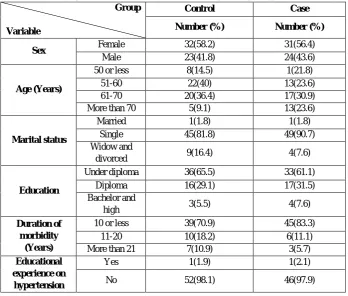
Most of the participants in both groups were male, married, under diploma, had disease duration less than 10 years and had not participated in training courses in the field of hypertension.
Table 1. Demographic characteristics of the hypertensive patients participating in the study
Group
Variable
Control Case
Number (%) Number (%)
Sex Female 32(58.2) 31(56.4)
Male 23(41.8) 24(43.6)
Age (Years)
50 or less 8(14.5) 1(21.8)
51-60 22(40) 13(23.6)
61-70 20(36.4) 17(30.9)
More than 70 5(9.1) 13(23.6)
Marital status
Married 1(1.8) 1(1.8)
Single 45(81.8) 49(90.7)
Widow and
divorced 9(16.4) 4(7.6)
Education
Under diploma 36(65.5) 33(61.1)
Diploma 16(29.1) 17(31.5)
Bachelor and
high 3(5.5) 4(7.6)
Duration of morbidity
(Years)
10 or less 39(70.9) 45(83.3)
11-20 10(18.2) 6(11.1)
More than 21 7(10.9) 3(5.7)
Educational experience on
hypertension
Yes 1(1.9) 1(2.1)
No 52(98.1) 46(97.9)
The mean age of the intervention group was 60.45 ± 8.66 and 61.47 ± 12.66 years, respectively, and the duration of disease in the control and intervention group were 9.85 ± 9.27 and 7.26 ± 6.86 years, respectively. The mean adherence to the drug before intervention in the control and intervention group was 4.89 ± 1.92 and 4.04 ± 1.77, respectively. 63.6% and 83.6% of the participants in the control and intervention group had a poor adherence to the drugs, and there was a significant difference in the two study groups (p = 0.018).
difference in the two study groups (p = 0.084). The changes in adherence to the drugs in the intervention group showed that the average adherence in the intervention group increased after the intervention, but in the control group, it decreased. (p = 0.001) indicated the significance of this difference between the groups.
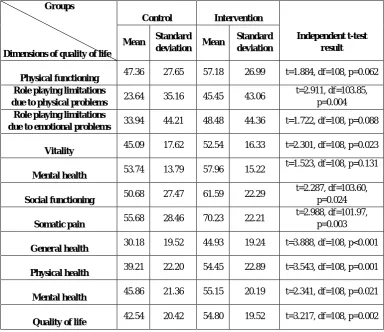
The significant differences existed between the two groups before the intervention which were shown by the statistical analysis. These differences included the differences in the fields of: physical problems (p = 0.004), vitality (p = 0.023), social functioning (p = 0.024), somatic pain (p = 0.003), general health (p = 0.001), two main dimensions of physical health (p = 0.001), mental health (p = 0.021) as well as the quality of life in general (p = 0.002). (Table 2)
Table 2. Indicators of the quality of life and its areas in the two groups of patients before the intervention
Groups
Dimensions of quality of life
Control Intervention
Independent t-test result
Mean Standard
deviation Mean
Standard deviation
Physical functioning 47.36 27.65 57.18 26.99 t=1.884, df=108, p=0.062
Role playing limitations
due to physical problems 23.64 35.16 45.45 43.06
t=2.911, df=103.85, p=0.004
Role playing limitations
due to emotional problems 33.94 44.21 48.48 44.36 t=1.722, df=108, p=0.088
Vitality 45.09 17.62 52.54 16.33 t=2.301, df=108, p=0.023
Mental health 53.74 13.79 57.96 15.22
t=1.523, df=108, p=0.131
Social functioning 50.68 27.47 61.59 22.29
t=2.287, df=103.60, p=0.024
Somatic pain 55.68 28.46 70.23 22.21
t=2.988, df=101.97, p=0.003
General health 30.18 19.52 44.93 19.24 t=3.888, df=108, p<0.001
Physical health 39.21 22.20 54.45 22.89 t=3.543, df=108, p=0.001
Mental health 45.86 21.36 55.15 20.19 t=2.341, df=108, p=0.021
Quality of life 42.54 20.42 54.80 19.52 t=3.217, df=108, p=0.002
Findings showed that the two groups had significant differences after the intervention in all areas, especially in the two main dimensions of physical health and the overall quality of life. According to the results of Paired t-test, the mean adherence to the drugs in the intervention group was significantly different before and after the intervention (p<0.001), indicating the increase of the adherence to the drugs in the intervention group after the intervention. In the control group, the mean adherence to the drug was also significantly different before and after the intervention (p=0.001), showing the increase after the intervention, but this enhancement was less than the intervention group. (Table 3)
Table 3. Indicators of quality of life and its areas in the two groups of patients after the intervention
Groups
Dimensions of quality of life
Control Intervention
Independent t-test result
Mean Standard
deviation Mean
Standard deviation
Physical functioning 47.73 26.92 68.34 19.68
t=4.585, df=98.89, p=0.001
Role playing limitations due to physical problems
26.36 38.31
51.83 43.51 t=3.258, df=106.30,
Role playing limitations due to emotional
problems
35.15 46.00 60.61 44.02 t=2.965, df=108,
p=0.004
Vitality 47.00 16.74 58.82 13.74
t=4.047, df=108, p=0.001
Mental health 54.62 13.14 63.05 13.01
t=3.383, df=108, p=0.001
Social functioning 53.37 24.84 67.50 16.94
t=3.484, df=95.29, p=0.001
Somatic pain 61.51 25.29 76.86 17.54
t=3.699, df=96.18, p<0.001
General health 32.48 20.81 49.16 18.87
t=4.405, df=108, p<0.001
Physical health 42.02 22.24 61.55 20.69
t=4.768, df=108, p<0.001
Mental health 47.53 20.61 62.49 18.19
t=4.036, df=108, p<0.001
Quality of life 44.78 19.86 62.02 18.72
t=4.685, df=108, p<0.001
Discussion
The aim of this study was to evaluate the impact of peer education on the medication adherence and the quality of life of the hypertensive patients. The findings of the present study revealed that the mean total score of quality of life before and two months after the intervention was significantly different and the statistical analysis indicated the significant relationship between the peer education and the medication adherence and quality of life of the hypertensive patients.
The results also demonstrated a significant difference in terms of the adherence to the drug in the hypertensive patients of both groups before the study. In a study by [9] on 532 hypertensive patients with the title of “The study of the determinants of adherence to medication in patients with hypertension ", 60.4 percent of the patients had less than 90% adherence. And the adherence in patients older than 50 years, with insurance support, with good knowledge about hypertension and a positive attitude to drug treatment, and less frequently visiting the doctor has been better than the others.
The adherence to the drug in patients is a multifactorial behavior in which the role of attitude is very important, and unluckily the adherence to the medication among hypertensive patients is low. The present study found that medication adherence in hypertensive patients in both groups two months after the intervention was significantly different. The mean medication adherence in the intervention group has increased after the intervention, but this change was lower in the control group. A study by [16] on 60 patients undergoing coronary artery bypass graft surgery showed that the mean anxiety scores of the intervention and control groups had no statistically significant differences, but peer education had a positive impact on anxiety in patients undergoing coronary artery bypass graft surgery. [21] in a study entitled "Comparison of peer education with standard approaches in the field of diabetes to control blood sugar in Mexicans living in America" showed that peer education significantly improves metabolic symptoms, glucose levels and the self-management of diabetes patients.
Two months after the intervention, the quality of life of hypertensive patients in the intervention and control groups was compared, and this comparison revealed that the two groups were significantly different after the intervention in all areas, especially in the two main dimensions of physical health and the overall quality of life. A study by [22] was done on the effect of peer education on the students' knowledge about breast self-examination (BSE) and health belief was on 250 students, which showed that this educational approach had a considerable effect on the knowledge and health beliefs of the students. The results of the study by [18] on the evaluation of peer education on the quality of life in patients with breast cancer referring to a cancer clinic at Shiraz University of Medical Sciences on 99 women with stage 1 and 2 cancer one year after the modified radical mastectomy, revealed that this educational method, is an effective approach to recovery and improve the quality of life in patients with mastectomy. Also, after 2 months it was observed that the various aspects of life of these patients, including public health, psycho-socio-spiritual function, cognitive function and their role playing were increased, and their fatigue, loss of appetite and insomnia decreased. It was also found that the participants' sexual function, body image, sexual performance satisfaction and positive attitude to life have improved. One limitation of their study was the generalizability of the results to the other private and public hospitals in Iran.
Conclusion
of health care professionals to communicate with patients, and less attention to education. The present study also showed that in the intervention group, peer education could effectively improve and enhance the medication adherence and quality of life of the hypertensive patients. Accordingly, it has been suggested that by educating the patients and enhancing their adherence to treatment, a step can be taken towards enhancing the quality of life of these patients, so the peer education can be applied as a modern educational method in order to create an appropriate and friendly learning environment for the exchange of useful information between patients. It is hoped that by using this approach, efficient practices will be made to meet the educational needs of patients and enhancement of the rate of medication adherence and life quality of hypertensive patients.
Acknowledgement
This study is part of the thesis of master's degree in nursing at Iran University of Medical Sciences. The authors would like to acknowledge all of the hypertensive patients for participating in this study.
References
1. Pantelis A, George L ,2008, Resistant Hypertension: An Overview of Evaluation and Treatment, J Am Cull
Cardiol;52:1749–57.
2. Kearney PM, Wheaton M, Reynolds K, Manner P, Wheaton PK, 2005, He J: Global Burden of hypertension: analysis
of worldwide data. Lancet, 365(9455):217–223.
3. World Health Organization. World Health Report 2002: Reducing Risks, Promoting Healthy Life. Geneva,
Switzerland: World Health Organization.
4. Virgínia de Carballo M, Batista Siqueiros L, Luiz Lima Sousa A, César Brando Vega Jar dim P, 2013, The Influence
of Hypertension on Quality of Life, Ark Bras Cardiol,;100(2):164-174.
5. Tayyebi A, Shasti S, Ebadi A, Eynollahi B, Tadrisi SD,2012, The relation-ship between blood pressure and dialysis
adequacy in dialysis patients. Int J Crit Care Nurse; 5(1):49–54.
6. Izadirad, H., Masoudi, G.H., Zareban, I., Shahraki Poor, M. and Jadgal, K., 2013. The Effect of Educational Program
Based on BASNEF Model on Women’s Blood Pressure with Hypertension. Journal of Torbat Heydariyeh University of Medical Sciences, 1(2), pp.22-31.
7. Ong KL, Cheung BMY, Man YB, Lau CP, Lam KSL,2006,Prevalence, Awareness, Treatment, and Control of
Hypertension Among United States Adults 1999–2004.Hypertension,49:69–75.
8. Abbasi M, Salemi S, Fatemi NS, Hosseini F,2005, Hypertensive Patients, their Compliance Level and its’Relation
to their Health Beliefs. Iran Journal of Nursing; 18(41):61-8.
9. Hadi N., Rostami Gooran, N., Jafari, P, 2004, Determinant factors of medication compliance in hypertensive patients
of Shiraz, Iran. Arch Iranian Med; 7(4): 292 -6
10. Baune BT, Aljeesh Y, Bender R, 2005, Factors of non-compliance with the therapeutic regimen among hypertensive
men and women: A case-control study to investigate risk factors of stroke. Eur J Epidemiol; 20(5):411-9
11. Mohammad Ali Karimzadeh and Mojgan Javedani (2010). An assessment of lifestyle modification versus medical
treatment with clomiphene citrate, metformin and clomiphene citrate–metformin in patients with polycystic ovary syndrome, Fertility and Sterility Vol. 94, No. 1, June 2010, doi:10.1016/j.fertnstert.2009.02.078
12. Jabalameli S, Moulavi H, 2010, Efficacy of cognitive-behavioral stress management intervention on quality of life
and blood pressure in female patients with hypertension. Scientific Journal of Kurdistan University of Medical Sciences;15(2):88-97.
13. Menon P, Rao KL, Bhattacharya A, Thapa BR, Chowdhary SK, Maha-jan JK, et al, 2005,Extrahepatic portal
hypertension: quality of life and Somatic growth after surgery. Eur J Pediatr Surg; 15(2):82–7.
14. Wakefield BJ, Ward MM, Holman JE, Ray A, Scherubel M, Burns TL, et al..,2008, Evaluation of home telehealth
following hospitalization for heart failure: a randomized trial. Telemed J E Health; 14(8): 753-761.
15. Webel A R, Okonsky J, Trompeta J, Holzemer W,2010, A systematic review of the effectineness of peer- based
interventions on health related behaviors in adult. Am j. public health, 100, 247, 253.
16. Varaei, S., Cheraghi, M.A., Seyedfatemi, N., Talebi, M., Bahrani, N. and Dehghani, A., 2013. Effect of peer
education on anxiety in patients candidated for coronary artery bypass graft surgery: a randomized control trial. Journal of Nursing Education, 2(3), pp.28-37.
17. Van Rompay k,Madhivanan P, Rafiq M, Krupp K, Chakrapani V,2008,Empowering the people: development ofan
HIV peer education model for low literacy rural communities in india. Human resourses for health, 6,6.
18. Sharif F, Abshorshori N, Tahmasebi S, Hazrati M, Zare N, Masoumi S.2010. The effect on the life of peer-led
19. Moharamzad, Y., Saadat, H., Shahraki, B.N., Rai, A., Saadat, Z., Aerab-Sheibani, H., Naghizadeh, M.M. and Morisky, D.E., 2015. Validation of the Persian version of the 8-item Morisky Medication Adherence Scale (MMAS-8) in Iranian hypertensive patients. Global journal of health science, 7(4), p.173.
20. Montazari, A., Gashtasb,i A., Vahdaninia, S.M (2006). Translation, reliability and validity of Persian standard tool
SF-36. Payesh Journal.5(1):49-55.
21. Philis-Tsimikas, A., Fortmann, A., Lleva-Ocana, L., Walker, C. and Gallo, L.C., 2011. Peer-led diabetes education
programs in high-risk mexican americans improve glycemic control compared with standard approaches a project dulce promotora randomized trial. Diabetes care, 34(9), pp.1926-1931.
22. Karayurt, Ö., Dicle, A. and Malak, A.T., 2009. Effects of peer and group education on knowledge, beliefs and breast