R E S E A R C H
Open Access
Joint timing synchronization and channel
estimation based on ZCZ sequence set in
SC-MIMO-FDE system
Yu Wang, Shiwen He
*, Yu Sun, Qinzhen Xu, Haiming Wang and Luxi Yang
Abstract
In this paper, we investigate the channel estimation and time synchronization problem based on the zero correlation zone (ZCZ) sequence set for single carrier multiple-input multiple-output frequency domain equalization (SC-MIMO-FDE). A factorized construction of ZCZ sequence set considering the properties of both ZCZ and nonzero correlation zone (NCZ) is proposed with efficient generator and correlator, which can be in favor of timing synchronization and channel estimation both in performance and computation complexity. Using the ZCZ sequence set, a new algorithm called twice section-maximum algorithm is put forward to eliminate energy interference among channels from different transmitting antennas to the same receiving antenna. The performance achieved by the developed algorithm which performs joint timing synchronization and channel estimation with lower computational cost is better than that of the conventional method.
Keywords: ZCZ sequence set, Efficient generator, Efficient correlator, Timing synchronization, Channel estimation, SC-MIMO-FDE
1 Introduction
In wireless communication system, it is well known that timing synchronization (TS) and channel estimation (CE) are two main tasks achieved by training signal in the receiver. Since accurate TS and CE play important roles in improving the overall system performance, the design of the training sequence set which is known to both trans-mitter and receiver is the crucial point. Motivated by this, this paper takes TS and CE of single carrier multiple-input multiple-output frequency domain equalization (SC-MIMO-FDE) [1, 2] transmission mode into consid-eration. In [3–6], the periodic complementary sequence set (PCSS) is chosen to be the training sequence set. In
the PCSS, there areNT groups of sequences which are
transmitted fromNTantennas, separately, and each group
containsNTdifferent sequences. However,NT sequences
needNT cyclic prefixes (CP) to counteract interference
of multi-path time delay channel, which exaggerates over-load. This problem is solved by generating special PCSS
*Correspondence: [email protected]
School of Information Science and Engineering, Southeast University, Nanjing 210096, China
[6]; but it could not get rid of the restriction of the rela-tion between length of CPLCP, the length of PCSSL, and
number of PCSSNS transmitted in one antenna, which
is LCP ≤ L/NS. In [7], the Zadoff-Chu (ZC) sequence is selected as the training sequence; but ZC sequence is multi-phase and introduces multiply operation in the receiver which costs much computational resource. This paper chooses zero correlation zone (ZCZ) sequence set as the training sequence set for the SC-MIMO-FDE sys-tem to overcome all drawbacks mentioned above.
ZCZ sequence set is first introduced to enhance TS robustness in code division multiple access (CDMA) sys-tem [8, 9]. It has also shown that ZCZ is the optimal CE training sequence for MIMO system [10–12]. However, few works use ZCZ sequence set to perform TS due to the existence of the uncertain side lobes of autocorrelation and cross-correlation in nonzero correlation zone (NCZ). The author pointed out that in his construction, there are only m shifting points where the correlation values are
not equal to zero in NCZ area, where m is the size of
the ZCZ sequence set; but the magnitude of those values are not mentioned, which is also one of the properties in NCZ [13].
There are two kinds of constructions of ZCZ sequence set mainly, whose optimized objects are the length of ZCZ. One is based on the properties of ZCZ sequence set either in its direct domain or transform domain [14]. The other is based on the fundamental sequence set, such as the following: those constructed in [15, 16] are based on complementary sequence set (CSS) [17], and those gen-erated in [18, 19] are based on perfect sequence (PS) [20] using interleaving technique. All of these ZCZ sequence sets(L,M,Z)generated above are bounded by a general
bound Z < Zg and achieve expected boundZ = Ze,
where L, M, and Z denote sequence length, sequence
number, and ZCZ length, separately;Zg=L/M[21],Ze=
k2−2L/k2M[18],k is the number of polyphase. In this paper, we propose the factorized construction of ZCZ sequence set considering both ZCZ and NCZ, which is an extension of above constructions based on fundamental sequence set.
In order to achieve high speed of signal processing, effi-cient correlator is put forward for Golay sequence set [22, 23]. In addition, several efficient generations and correlations are also developed for PCSS [24–28]. The authors of [29, 30] have proposed efficient calculation of fast Fourier transform (FFT) of ZC sequence. Also, an efficient correlation method for the corresponding ZCZ sequence set is developed in [13].
In this paper, we focus on the investigation of the joint TS and CE based on ZCZ sequence by taking the advan-tage of the ZCZ in CE and overcoming the shortcoming in the TS in multi-path communication system. At the same time, in order to reduce the computational complexity and speed up the implementation, an efficient generator and correlator construction is obtained by extending the existing generation methods.
This paper is organized as follows. In Section 2, we present system model and state problems we need to address. In Section 3, a factorized construction of ZCZ sequence set is proposed to respond stating problem in Section 2 with efficient generator and correlator. Then, in Section 4, the constructed ZCZ sequence set is applied to joint MIMO TS and CE. At the same time, a new algorithm called twice section-maximum algorithm is put forward to eliminate channel energy interference. In Section 5, performance and computational complexity is analyzed in the simulation based on the selected ZCZ sequence set and the given communication scenario. And the last, conclusions are provided in Section 6.
Notations: In this paper, the correlation between two sequences is referred to periodic correlation if not specif-ically pointed out; and we will use upper (lower) boldface letters to denote matrix (column vectors). AnN×N iden-tity matrix,N×Nall-zero matrix,M×Nall-zero matrix, and M × N all-one matrix will be denoted as IN, 0N, 0M×N, and1M×N, respectively. Superscript H will denote
the Hermitian transpose, T transpose, and∗conjugation.
We will reserve ⊗for Kronecker product, ·for round
up to an integer, |·| for absolute value operation, andN for the set of natural numbers without including zero; and mod{a,b} denotes a modulo b, tr{·} tracing operation, E{·} averaging operation, round{·} rounding operation, max{·}maximum value operation, and diag{·} diagonal-ization. We define diagn{·}as an all-zeroN ×N matrix except the(N− |n|)×(N− |n|)diagonal matrix in its top-right corner (n > 0) or bottom-left corner (n < 0), and diag0{·} = diag{·}. Also, Circ{x,K,S}denotes a circulant matrix with thekth column obtained by circularly shifting
k+Selements on the columnx,k = 0,· · ·,K−1. For
2 System model and problem statement
Consider a multi-path time delay and frequency-selective
MIMO channel with NT transmitting antennas and NR
receiving antennas. Under this model, the discrete-time signalrqatqth receiving antenna is given by
rq= the training sequence transmitted by thepth antenna, and
ZDdenotes the number of discrete-time channel impulse
response (CIR) taps,Lis the length of a training sequence;
hp,q =
discrete-time CIR tap of the MIMO channel from thepth transmitting antenna to theqth receiving antenna;nq =
n0q,· · ·,nqi,· · ·,nLq−1
T
denotes a noise column vector in which ni
q follows identity distribution (i.i.d.) with the
mean zero and the varianceσ2. For ease of deduction, the form of system model in (1) is rewritten by
rq=Shq+nq, (2) Then, the least square (LS) estimator ofhqis given by
ˆ
hq=
ˆ
wherehˆp,q=
, the mean square error (MSE) of ˆ
It is well known that the sufficient and necessary condition to reach classical Cramér-Rao low bound (CRLB) is
SHi Sj= called an optimal training sequence set.
Note that (5) can be rewritten by
Rsi,sj(τ)= a ZCZ sequence set with the period of sequencesL, the
number of sequences M, and the length of ZCZ Z; and
it means thatZ(L,NT,ZD)can serve as optimal training
sequence set for CE in MIMO system.
There are already many different ways to construct ZCZ sequence set used for CE as discussed in Section 1, but few of them consider the properties of NCZ which need to be taken into account for TS. In the following section, we give a construction of the ZCZ sequence set which is suitable for joint TS and CE considering the properties of NCZ.
3 Factorized construction of ZCZ sequence set
The method of the factorized construction is intro-duced to apply to the generation of ZCZ sequence set based on base ZCZ sequence set, which has the shortest length according to the size of the set, with interleaving technique.
At the same time, the corresponding efficient correlator is proposed to speed up the implementation.
3.1 Efficient generator of ZCZ sequence set
The efficient generation of ZCZ sequence set is summa-rized as the following steps.
Step 1 : Let the base ZCZ sequence set beA={am}Mm=−01 after each element,N∈N, defined by
a0m=
Step 3 : LetWnbe thenth coefficient matrix, given as
Wn=
IMN−2−n⊗diagwn0,wn1,· · ·,wnM−1 ,n=0,· · ·,N−2
diagwn0,wn1,· · ·,wnM−1 ,n=N−1 , wherewni=1.
Step 4 : A recursive sequence generation method is proposed byAn+1=AnVnWn. Then,
AN =aN0,· · ·,aNm,· · ·,aNM−1
=A0V0W0V1W1· · ·VN−1WN−1. (7) Note that the matrixVnis the interleaving matrix, which interleave the columns ofAn; and the matrix
Wngives an coefficient to each column ofAnVn.
Lemma 1.In the above generation, aNmMm=−01 = Z(L,M,Z), and the length of ZCZ satisfies Z ≥ MNZa. Specifically, if the ZCZ length between aM−1 and a0 is equal to Za, which is the ZCZ length ofA = {am}Mm=−01 = Z(La,M,Za), then Z=MNZa.
Proof 1.See Appendix 1.
of the interleaving constructed sequence set. In fact, the ZCZ length is not only determined by the ZCZ length of base sequence set but also the order of each ZCZ length between every two sequence among the set. Considering the complex cases of the order, we only give the best case using the shifting PS as base ZCZ sequence set in the fol-lowing theorem. At the same time, the property in NCZ area is given and proofed.
Theorem 1.Let PS a = a0,a1,· · ·,aLa−1 T
, where |ai| = 1; and let {am=Circ{a, 1,−mM1}}Mm=−01, where La = MM1. Then, for
aNmMm=−01= Z(L,M,Z), the length of ZCZ satisfies Z ≥ (M1−1)MN + (M−2)MN−1; and in NCZ, the area with nonzero value is bounded by mM1MN+(M1−1)MN ≤ |l| ≤(m+1)M1MN+MN− 1, where m=0, 1,· · ·,M−2, and l is the shifting point in correlation.
Proof 2.See Appendix 2.
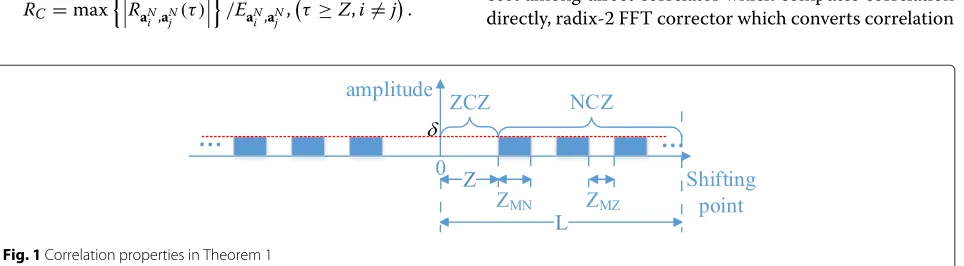
According to Theorem 1, the generalized ZCZ sequence set is illustrated in Fig. 1, where ZMN and ZMZ are the length of middle nonzero area and middle zero area in NCZ, and 0 ≤ δ ≤ 1 is a threshold, separately. Here, we list the properties of them:
(p1)Z≥ZaNTN+(NT−2)NTN−1;
(p2)ZMN≤
(m+1)M1MN+MN−1
−
mM1MN +(M1−1)MN
+1≤2MN;
(p3)ZMZ=LaMN−1−ZMN≥(La/M−2)MN =
(M1−2)MN;
(p4)RA≤δandRC ≤δ.
Note that (p1), (p2), and (p3) can be directly obtained from Theorem 1; and by changing the coefficient matrixWnin step 3, the ZCZ sequence set which satisfies (p4) can be selected, where
RA=maxRaN i,aNj (τ)
/EaN
i,aNj ,
τ ≥Z,i=j,
RC =maxRaN i,aNj (τ)
/EaN
i,aNj ,
τ ≥Z,i=j.
Since this factorized construction of ZCZ sequence set is an extension of existing construction based on inter-leaving method, here, we state the distinctive points which are different from the conventional one using the same technique. First, the interleaving construction is factor-ized by the matrix multiplication. This factorfactor-ized forma-tion is used widely in the construcforma-tion and applicaforma-tion of CSS [4–6, 25, 27, 28]. Note that it is the basis to deduce the efficient correlator in the next subsection. Second, since the ZCZ part is well qualified to perform CE thanks to the researches which have been done before, our works focus on the properties of NCZ part which contributes to TS: The coefficient matrix, which can be changed easily in application to generate different ZCZ sequence sets with differentRAandRC, is added to the iteration construction;
and the area with nonzero value in NCZ is determined by Theorem 1, given particular shifting PS as base ZCZ sequence set.
3.2 Efficient correlator of proposed ZCZ sequence set Based on the proposed generation of ZCZ sequence set, an efficient correlator corresponding is derived and expressed in the following theorem.
Theorem 2.Lety=y0,· · ·,yL−1T,Y=Circy,L, 0, then the efficient correlator between sequenceyand each sequenceaNm,m=0, 1,· · ·,M−1, separately, is
YTaN0,aN1,· · ·,aNM−1∗=YTAN∗
=YTA0∗V0W0∗· · ·VN−1WN−1∗ (8)
where the complexity of complex multiplication is jLLa+ NLM2and addition is jL(La−1)+NLM(M−1)in the condition that {am}Mm=−01are results of the circulation of j (j=1, 2,· · ·,M) sequences in{am}Mm=−01.
Proof 3.See Appendix 3.
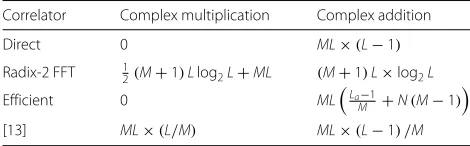
Table 1 illustrates the comparison of computation cost among direct correlator which computes correlation directly, radix-2 FFT corrector which converts correlation
Table 1Computation complexity comparison of polyphase correlators
Correlator Complex multiplication Complex addition
Direct ML×L ML×(L−1)
into multiplication by radix-2 FFT, the efficient correla-tor this paper proposed (j= 1), and the correlator of the constructed ZCZ sequence set in [13]. From this table, it is obvious that the proposed efficient correlator decreases computation complexity from exponential order to linear
order for iteration numberN on both complex
multipli-cation and addition, while the correlator in [13] decreases to 1/Mcomplexity. Note that while the efficient correla-tor reduces large number of computation comparing with the direct correlator, it seems that there is no computa-tional reduction speaking of the radix-2 FFT correlator. However, if we put the restrictionsam,l generation process, then the elements in ZCZ sequence set belong to±1,±j. Thus, in both the direct and the efficient correlator, there is no multiply operation, which reveals the advantage comparing to the radix-2 FFT cor-relator. But in [13], the alphabet size is harder to reduce to 2 or 4 even though the reduced alphabets method is used according to Section 3. So, the multiply operation can-not translate into a shifting operation. The comparison of computation cost among correlators is listed in Table 2.
4 Joint MIMO TS and CE using ZCZ sequence set
In this section, we introduce how to use the ZCZ sequence as a training sequence for joint TS and CE. Using the base ZCZ sequence setZ(La,NT,Za=La/NT−1) which is
obtained from shifting PS, the proper ZCZ sequence set
ZL=NTNLa,NT,Z
erties of (p1), (p2), (p3), and (p4). In order to achieve effectively the TS and CE, here, we further give two
Table 2Computation complexity comparison of binary/ quadriphase correlators
Correlator Complex multiplication Complex addition
Direct 0 ML×(L−1)
4.1 Mechanism of joint MIMO TS and CE According to (2), it can be deduced that
ZHrq=ZHShq+ZHnq. (9)
then (9) can be expanded by
ZHprq=Ez
disturbance impulse responses (DIRs), where dzp,zi =
According to (a2) and (p3), we have
Thus, the second inequality of (11) is deduced; and the last equation of (11) is achieved by the requirement which is
maxhi,q=maxhp,q,i=0, 1,· · ·,NT−1. (13)
If
δ≤1/2NTN+1
, (14)
then
max
NT−1
i=0
Dzp,zihi,q "
≤maxhp,q. (15)
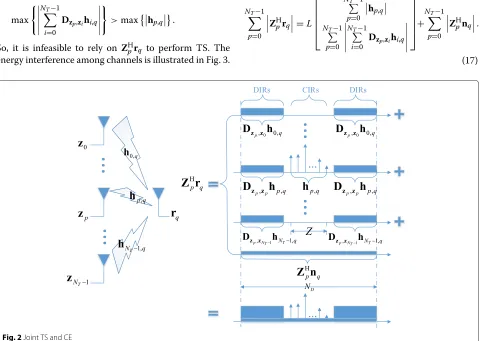
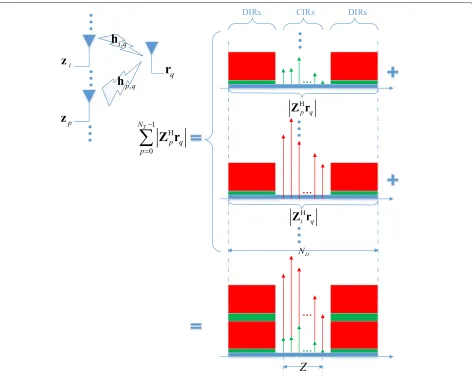
Using this, we can achieve TS by looking for the max-imum value inZHprq. This mechanism is illustrated in
Fig. 2. Note that the impulse responses which represent complex value are described in the form of absolute value in the figure.
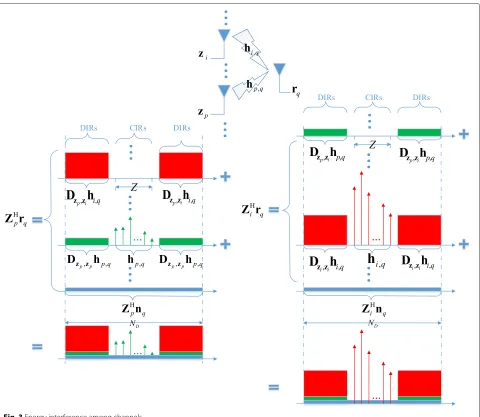
However, in practice, because of the randomness of the MIMO channel, the energy ofhi,q,i=pcan be larger than
that of hp,q, which is called energy interference among
channels. Thus, in that case, (13) is substituted by
maxhi,q>maxhp,q,(i=p,i=0, 1,· · ·,NT−1).
Then, (15) could be changed by
max
NT−1
i=0
Dzp,zihi,q "
>maxhp,q.
So, it is infeasible to rely on ZHprq to perform TS. The
energy interference among channels is illustrated in Fig. 3.
4.2 Solutions of the energy interference among channels To deal with the energy interference among channels for TS, the direct way, called solution 1, is only considering the largest energy of CIR such ashi,qand discarding all the
others which may be submerged by DIRs such ashp,q, as
illustrated in Fig. 3. Solution 1 is indicated by
max
maxZHprq
NT−1
p=0 . (16)
When the energy interference among channels is severe, just in the case like Fig. 3, (16) works well. However, when that interference is mild, meaning that energies of all channels are similar, (16) loses nearly (NT−1) /NT
information which is useful for TS. This deficiency of (16) makes the performance of TS decline.
To perform TS better in the situations that the energy interference among channels are both severe and mild, an easier way is taking account of all the correlation results in
ZHprq
NT−1
p=0 jointly. This idea is indicated by (17).
NT−1
p=0
ZHprq=L
⎡ ⎢ ⎢ ⎢ ⎣
N!T−1
p=0 hp,q
N!T−1
p=0
N!T−1
i=0
Dzp,zihi,q
⎤ ⎥ ⎥ ⎥ ⎦+
NT−1
p=0 ZHpnq.
(17)
Fig. 3Energy interference among channels
Similar to (11), it is deduced that
max ⎧ ⎨ ⎩
NT−1
p=0
NT−1
i=0
Dzp,zihi,q ⎫ ⎬ ⎭
≤max ⎧ ⎨ ⎩
NT−1
p=0 NT−1
i=0
Dzp,zihi,q ⎫ ⎬ ⎭
≤δNT NT−1
i=0 ZMZ−1
k=0 hki,q
≤2δNTN+1 NT−1
i=0
maxhi,q.
(18)
If it is satisfied that
max ⎧ ⎨ ⎩
NT−1
p=0 hp,q
⎫ ⎬
⎭=
NT−1
i=0
maxhi,q, (19)
then based on (14) and (18),
max ⎧ ⎨ ⎩
NT−1
p=0
NT−1
i=0
Dzp,zihi,q ⎫ ⎬
⎭≤max
⎧ ⎨ ⎩
NT−1
p=0 hp,q
TS can be achieved by looking for the maximum absolute value in!NT−1
p=0 ZHprqwithout considering (13); and it is
presented in Fig. 4 vividly.
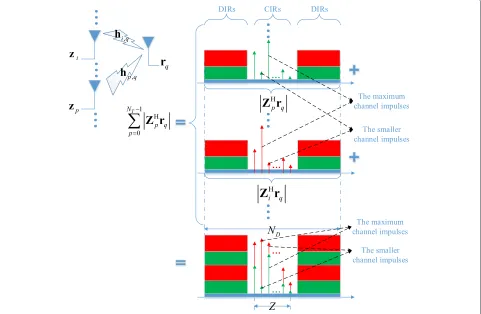
But in some cases, and they are not quite rare, the condi-tion in (19) which needs to be fulfilled cannot be achieved. Note that the position of maximum ofhi,qis different
from that ofhp,qto a large extent because of randomness
of MIMO channel (i=p); and even worse, the position of maximum ofhi,qmay be corresponding to the position
of a very small value of hp,q. In that case, the risk that
CIRs are overwhelmed by DIRs is much higher. This bug is shown in Fig. 5.
To fix the bug, the maximum of each hp,q, p =
0,· · ·,NT −1 should be selected to add together to get !NT−1
i=0 maxhi,q according to (18). To achieve this
goal,ZHprqis grouped intoNX parts successively
indi-cated bycnp,q, and the length of the each group isln,n =
0,· · ·,NX−1. Then, find the value of (20) to perform TS
forqth receiving antenna.
max ⎧ ⎨ ⎩
NT−1
p=0
maxcnp,q
NX−1
n=0 ⎫⎬
⎭ (20)
To let (20) make sense in application, it needs to make sure the maximum of hp,qNp=T0−1 be grouped to one
group. First,ln satisfiesln ≥2MP with restriction lower
better to avoid the bug, where MP < ZD is the
maxi-mum distance between positions of the maximaxi-mum value ofhp,qpN=T0−1. Thus,ln
= 2MP orln
= 2MP+1.
Sec-ond, it groupsZHprqtwo times to get two different sets of
groups by starting from two different start pointsSp1and Sp2, whereSp1−Sp2 = MP. By doing so, it is guaran-teed that the maximum ofhp,qNp=T0−1be grouped in one
Fig. 5The bug of correlations summing solution
of the two sets of groups. The process called solution 2 is demonstrated in Fig. 6.
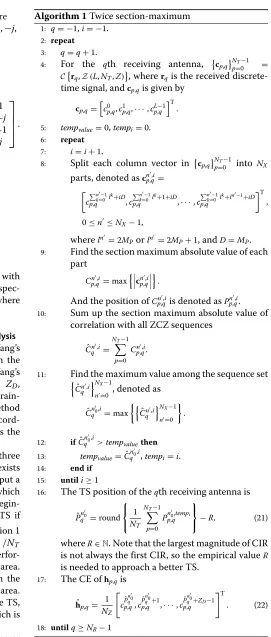
Taking advantage of the idea of solution 2, we propose an algorithm called twice section-maximum algorithm to perform TS and CE jointly. In the following algorithm, we use Crq,Z(L,NT,Z)
to denote the correlation
opera-tion between column vectorrq andNT ZCZ sequences
in the set Z(L,NT,Z) utilizing the efficient correlator
obtained from Theorem 2.
5 Simulations
5.1 Communication scenario setting
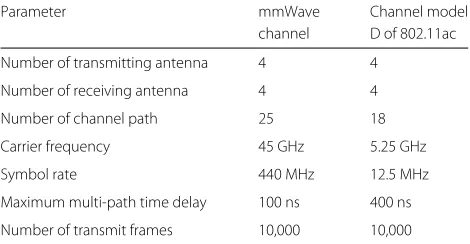
To evaluate the performance of joint TS and CE using constructed ZCZ sequence set, numerical simulations are performed in millimeter wave (mmWave) channel [31] and channel model D of 802.11 ac [32] based on the SC-MIMO-FDE system. We assume 4 transmitting anten-nas and 4 receiving antenanten-nas to transmit 4 spacial data streams, and the number of transmit frame is 10,000. For mmWave channel, the small-scale MIMO channel fading model is a virtual model with 25 paths obtained by the timing overlap of the Saleh-Velenzuela (SV) model, the
carrier frequency is set to beFC = 45 GHz in mmWave
band, the chip rate isFS = 440 MHz, and the maximum
multi-path time delay isTM =100 ns. For channel model
D of 802.11 ac, there are 18 channel paths. The carrier fre-quency isFC =5.25 GHz, the chip rate isFS=12.5 MHz,
and the maximum multi-path time delay isTM =400 ns.
These parameters are summarized in Table 3.
5.2 ZCZ sequence set selection
Since there are 4 transmitting antennas, and ZD =
TMFS ≤ 50, we construct a ZCZ quadriphase sequence
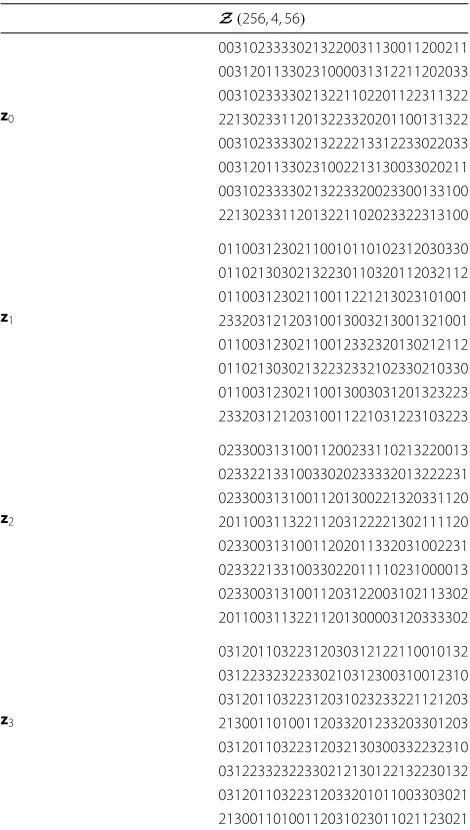
setZ(256, 4, 56)based on Theorem 1, whereZ = 56>
ZD, ZMN = 22 ≤ 32, and ZMZ = 38 ≥ 32. When
searching for the proper ZCZ sequence set, the restric-tions ofRA< δandRC < δare considered. By randomly
changing coefficient matrixWnusing the efficient
gener-ator, a ZCZ sequence set with δ = 0.3 is found. While
theoretical restriction in (14) isδ ≤ 1/2NTN+1 = 1/128
and more precise restriction in (18) isδ≤1/ (ZMNNT)=
1/88, both of which seem unapproachable, but
consid-ering the fading and the random distribution of phase
of CIR taps in the real communication system, δ is
allowed to be much larger than the restriction, and
prac-tically the performance of δ = 0.3 is excellent in the
(1) Base ZCZ sequence set isA= {am}3m=0, where
(4) Coefficientswn
m(m=0, 1, 2, 3;n=0, 1) are
The autocorrelation and cross-correlation results with the largestRAandRC are shown in Figs. 7 and 8,
respec-tively. For the detail ofZ(256, 4, 56), see Table 4, where 0,1,2,3 represent 1,j,−1,−j.
5.3 Performance and computational complexity analysis In this section, we compare our works with Wang’s method [33] mainly. We use the ZC sequence with the length of 256 as MIMO training sequence in Wang’s
method. And the length of CP is set to be 50 ≥ ZD,
which satisfies the demand of Wang’s method. The train-ing sequence transmitttrain-ing arrangement of Wang’s method and this paper’s method are described in Fig. 9. Accord-ing to this figure, our method cost almost as half as the preamble consumption of Wang’s method.
Figures 10 and 11 show the precise rate of the three methods mentioned to deal with TS. Note that there exists CP=64 in front of each data block; it is feasible to put a start position in the range of CP tolerance calledR, which isR = CP−TMFS. Suppose that the true symbol
begin-ning position is PT, then we treat it as a correct TS if −R≤ ˆPn0
q −PT ≤0. It is clear that accuracy of solution 1
is degraded by overlooking approximately(NT −1) /NT
channel information. Solution 2 has an excellent perfor-mance in both the lower SNR area and higher SNR area. While the Wang’s method performs pretty good in the higher SNR area, it degrades badly in the lower SNR area. The reason is that it needs coarse TS before accurate TS, and the coarse TS uses slide correlation method, which is more sensitive to noise disturbance.
Figure 12 shows the normalized mean square error (NMSE) performance of CE using the LS estimator.
Algorithm 1Twice section-maximum 1: q= −1,i= −1.
9: Find the section maximum absolute value of each
part
Cpn,q,i=maxcnp,q,i.
And the position ofCnp,q,iis denoted asPn ,i p,q.
10: Sum up the section maximum absolute value of
correlation with all ZCZ sequences
ˆ Cqn,i=
NT−1
p=0 Cpn,q,i.
11: Find the maximum value among the sequence set
ˆ
q >tempvaluethen
13: tempvalue= ˆC
n0,i
q ,tempi=i.
14: end if
15: untili≥1
16: The TS position of theqth receiving antenna is
ˆ
whereR∈N. Note that the largest magnitude of CIR is not always the first CIR, so the empirical valueR
Fig. 6Solution 2 of energy interference among channels
Table 3Simulation parameters
Parameter mmWave Channel model
channel D of 802.11ac
Number of transmitting antenna 4 4
Number of receiving antenna 4 4
Number of channel path 25 18
Carrier frequency 45 GHz 5.25 GHz
Symbol rate 440 MHz 12.5 MHz
Maximum multi-path time delay 100 ns 400 ns
Number of transmit frames 10,000 10,000
In the simulation, MIMO channels are normalized by 1
NTNR !NR−1
q=0 hHqhq=1. Based on (4), the CRLB of NMSE
is
NMSECRLB=MSE/E
hip,q
= σ2
NTZD
trSHS−1
/ ⎛
⎝ 1
ZDNTNR NR−1
q=0 hHqhq
⎞ ⎠
= σ2ZD
σ2
DL
= σ2NTZD
L ,
Shift Points
-300 -200 -100 0 100 200 300
Normalized Correlation Value
0 0.1 0.2 0.3 0.4 0.5 0.6 0.7 0.8 0.9
1 Periodic Autocorrelation, ZCZ(256,4,56)
22 22 22 22
56 56 22 22
38 38 38
38
Fig. 7Normalized autocorrelation of ZCZ sequence set with maximum side lobes
where σD2 is the energy of transmitting signal, and it
is normalized by NTσD2 = 1, so the last equation
in (23) is demonstrated; and the NMSE of CE is
NMSECE = E
!NR−1
q=0 hˆHqhˆq
/E!NR−1
q=0 hHqhq
. It indi-cates that both of the CE methods attain CRLB.
Table 5 gives a joint TS and CE computational cost comparison between the twice section-maximum
algorithm and Wang’s method. In this simulation,
L = 256, NR = NT = 4, NX = 8, La = 16,
N = 2,ZD = 50, so the addition complexity of twice
section-maximum algorithm is about 4×256×41, while
Wang’s method 4 × 256 × 265; Since the elements of
Z(256, 4, 56) are quadriphase, the complex multiplica-tion in twice secmultiplica-tion-maximum algorithm is substituted
Shift Points
-300 -200 -100 0 100 200 300
Normalized Correlation Value
0 0.05 0.1 0.15 0.2 0.25
0.3 Periodic Cross-correlation, ZCZ(256,4,56)
56 56
22 22 22 22
22 22
38 38 38
38
Table 4ZCZ sequence set
by shifting operation, which is much faster than multi-plication, while it is about 4× 256×259. Overall, it is generalized that the twice section-maximum algorithm is more computational efficient.
6 Conclusions
A factorized construction of ZCZ sequence set with the efficient generator and correlator has been investigated and applied to TS and CE jointly for the SC-MIMO-FDE system. Considering the properties of ZCZ and NCZ, the efficient generator can generate ZCZ sequence set suitable for CE and TS simultaneously. Further, the twice section-maximum algorithm is proposed and behaves well to eliminate the energy interference among channels; and the efficient correlator reduces complex multiplication,
which can be avoided for efficient quadriphase or binary correlator, and complex addition from exponential order to linear order. Both efficient correlator and mechanism of joint TS and CE can reduce the processing time for the receiver.
Appendix 1 Proof of Lemma 1
Let the shifting matrix be Tl = Circ{eL,L,l}, l =
0,±1,· · ·,±(L−1), where eL is a unite vector of the
sizeL×1 with the first entry equal to 1. The base ZCZ sequence setAsatisfies
Rai,aj(τ)=
satisfies the two situations using (24):
50- point 256-point
100- point
150- point
200- point
256-point
256-point
256-point 200- point
150- point
100- point
50- point The first
antenna
The second antenna
The third antenna
The fourth antenna
64- point 256-point
The first antenna
The second antenna
The third antenna
The fourth antenna
64- point 256-point
64- point 256-point
64- point 256-point
This paper Wang’ s method [34]
Cyclic Prefix
Cyclic Prefix
Cyclic Prefix
Cyclic Prefix Cyclic Prefix
Fig. 9Training sequence transmitting arrangement
If the length of ZCZ betweenaM−1anda0isZa, then RaM−1,a0(Za+1)=Ra0,aM−1(−Za−1)=0, so
TlAN
H
AN =0M. Otherwise, the length of ZCZ
betweenaM−1anda0is larger thanZa, then RaM−1,a0(Za+1)=Ra0,aM−1(−Za−1)=0, so
TlAN
H
AN =0M.
Combining (a) and (b), we can obtain the conclusion: If the length of ZCZ betweenaM−1anda0isZa, then Z=MNZa; Otherwise,Z>MNZa.
Appendix 2 Proof of Theorem 1
-5 0 5 10
SNR (dB) 0.4
0.5 0.6 0.7 0.8 0.9 1
Precise rate
TS, channel model D of 802.11ac
Sloution 1 Sloution 2 Wang's method [34]
-5 0 5 10
SNR (dB) 0.55
0.6 0.65 0.7 0.75 0.8 0.85 0.9 0.95 1
Precise rate
TS, mmWave channel
Sloution 1 Sloution 2 Wang's method [34]
Fig. 11Performance of TS (mmWave channel)
Based on the definition of PS, it is easy to deduce that
Rai,aj(τ)=
Ea,
mod{τ,MM1} =i−jM1,i=j
0, (others).
(25)
(a) First, we proveZ≥(M1−1)MN+(M−2) MN−1.
(a. 1)N =1TlAN
H
AN =V0W0HTlA0
H
A0V0W0satisfies the two situations: (a. 1. 1)|l| ≤(M1−1)M
-5 0 5 10
SNR (dB) -12
-10 -8 -6 -4 -2 0 2 4 6
NMSE (dB)
CE in both channels of mmWave and model D of 802.11ac
CRLB CE, This paper CE, Wang' method [34]
Table 5Computational cost comparison between joint TS and CE methods
Complex addition Complex multiplication
Twice section-maximum algorithm NR
Wang’s method [33] (radix-2 FFT) NRL
The proof is the same as case (a) in Appendix 1. (a. 1. 2)(M1−1)M+1≤ |l| ≤(M1−1)M+M−2
From (25), it is known that
Rai,aj(M1)=
Using the ZCZ sequence set generated in (a. 1), we can easily getZ≥(M1−1)MN+(M−2)MN−1 according to Lemma 1.
Combining (a. 1) and (a. 2),
Z≥(M1−1)MN+(M−2)MN−1is proved. (b) Now, we prove both the autocorrelation and cross-correlation haveZN ≤4(M−1)MNnonzero
according to case (a) in Appendix 1.
Except case (b. 1) and (b. 2) where ZCZ across whole correlation, the area with nonzero value is bounded bymM1MN+(M1−1)MN ≤ |l| ≤(m+1)M1MN +MN−1,m=0, 1,· · ·,M−2.
Appendix 3 Proof of Theorem 2
The efficient correlator can be easily obtained by
YTAN∗=YTA0V0W0V1W1· · ·VN−1WN−1∗
=YTA0∗V0W0∗· · ·VN−1WN−1∗. Next, we analyze computational complexity of the cor-relator step by step.
(a) Computational complexity ofA0: LetYTa0m∗=g0m, then
YTA0∗=G0=G00,· · ·,G0m,· · ·,G0M−1,
whereG0m=Circg0m,MN−1,mMN−1. So, onlyg0m
is needed to constructG0m; and it takesLMLa
complex multiplication andLM(La−1)complex addition. In general, if{am}Mm=−01are results of the
(b) Computational complexity ofViWi
(0≤i≤N−2): multiplication andLM(M−1)complex addition. Combining (a), (b), and (c), we can obtain the conclusion: The efficient correlator takes
jLLa+NLM2complex multiplication and
jL(La−1)+NLM(M−1)complex addition in the condition that{am}Mm=−01are results of the circulation
Competing interests
The authors declare that they have no competing interests.
Acknowledgments
This work was supported by 863 Program of China under Grant
2015AA01A703, National Natural Science Foundation of China under Grants 61471120, and 61372101.
Received: 28 August 2015 Accepted: 28 January 2016
References
1. D Falconer, SL Ariyavisitakul, A Benyamin-Seeyar, B Eidson, Frequency domain equalization for single-carrier broadband wireless systems. IEEE Commun. Mag.40(4), 58–66 (2002)
2. AJ Paulraj, DA GORE, RU Nabar, H Bolcskei, An overview of MIMO communications—a key to gigabit wireless. Proc. IEEE.92(2), 198–218 (2004)
3. SQ Wang, A Abdi, Low-complexity optimal estimation of MIMO ISI channels with binary training sequences. IEEE Signal Proc. Lett.13(11), 657–660 (2006)
4. HM Wang, XQ Gao, B Jiang, XH You, W Hong, Efficient MIMO channel estimation using complementary sequences. IET Commun.1(5), 962–969 (2007)
5. HM Wang, XQ Gao, B Jiang, W Hong, Improved channel estimator for MIMO-SCBT systems using quadriphase complementary sequences. IEICE Trans. Commun.94, 342–345 (2011)
6. HM Wang, Efficient generator and correlator for MOPCSSs and their application to MIMO channel estimation. IEICE ComEX.1, 16–22 (2012) 7. XQ Gao, B Jiang, XH You, ZW Pan, YS Xue, E Schulz, Efficient channel
estimation for MIMO single-carrier block transmission with dual cyclic timeslot structure. IEEE Trans. Commun.55(11), 2210–2223 (2007) 8. PZ Fan, N Suehiro, N Kuroyanagi, XM Deng, Class of binary sequences
with zero correlation zone. Electron. Lett.35(10), 777–779 (1999) 9. PZ Fan, Spreading sequence design and theoretical limits for
quasisynchronous CDMA systems. EURASIP J. Wirel. Commun. Netw.
1, 19–31 (2004)
10. SA Yang, JS Wu, Optimal binary training sequence design for multiple-antenna systems over dispersive fading channels. IEEE Trans. Veh. Technol.51(5), 1271–1276 (2002)
11. PZ Fan, WH Mow, On optimal training sequence design for multiple-antenna systems over dispersive fading channels and its extensions. IEEE Trans. Veh. Technol.53(5), 1623–1626 (2004) 12. R Zhang, X Cheng, M Ma, B Jiao, Interference-avoidance pilot design
using ZCZ sequences for multicell MIMOOFDM systems. Global Communications Conference (GLOBECOM), 3-7 December 2012, Anaheim, California: 5056–5061
13. BM Popovic, O Mauritz, Generalized chirp-like sequences with zero correlation zone. IEEE Trans. Inf. Theory.56(6), 2957–2960 (2010) 14. YC Liu, CW Chen, YT Su, New constructions of zero-correlation zone
sequences. IEEE Trans. Inf. Theory.59(8), 4994–5007 (2013)
15. R Appuswamy, AK Chaturvedi, 52. IEEE Trans. Inf. Theory.8, 3817–3826 (2006)
16. CG Han, TS Hashimoto, N Suehiro, A new construction method of zero-correlation zone sequences based on complete complementary codes. IEICE Trans. Fundam. Electron. Commun. Comput. Sci.E91-A(12), 3698–3702 (2008)
17. CC Tseng, C Liu, Complementary sets of sequences. IEEE Trans. Inf. Theory.18(5), 644–6552 (1972)
18. H Torii, M Nakamura, N Suehiro, A new class of zero-correlation zone sequences. IEEE Trans. Inf. Theory.50(3), 559–565 (2004)
19. HG Hu, G Gong, New sets of zero or low correlation zone sequences via interleaving techniques. IEEE Trans. Inf. Theory.56(4), 1702–1713 (2010) 20. PZ Fan, M Darnell,The synthesis of perfect sequences. Cryptography and
coding. (Springer, Berlin, 1995), pp. 63–73
21. XH Tang, PZ Fan, S Matsufuji, Lower bounds on correlation of spreading sequence set with low or zero correlation zone. Electron. Lett.36(6), 551–552 (2000)
22. SZ Budisin, Efficient pulse compressor for Golay complementary sequences. Electron. Lett.27(3), 219–220 (1991)
23. BM Popovic, Efficient Golay correlator. Electron. Lett.35(17), 1427–1428 (1999)
24. CD Marziani, J Urena, A Hernandez, M Mazo, FJ Alvarez, JJ Garcia, P Donato, Modular architecture for efficient generation and correlation of complementary set of sequences. IEEE Trans. Signal Proc.55(5), 2007 25. MN Hadad, MA Funes, PG Donato, DO Carrica, Efficient simultaneous
correlation of M mutually orthogonal complementary sets of sequences. Electron. Lett.47(11), 673–674 (2011)
26. E Garcia, J Urena, JJ Garcia, MC Perez, D Ruiz, Efficient generator/correlator of GPC sequences for QS-CDMA. IEEE Commun. Lett.16(10), 1676–1679 (2012)
27. MA Funes, PG Donato, MN Hadad, DO Carrica, M Benedetti, Improved architecture of complementary set of sequences correlation by means of an inverse generation approach. IET Signal Process.6(8), 724–730 (2012) 28. E Garcia, J Urena, JJ Garcia, MC Perez, Efficient architectures for the
generation and correlation of binary CSS derived from different kernel lengths. IEEE Trans. Signal Proc.61(19), 4717–4728 (2013)
29. S Beyme, C Leung, Efficient computation of DFT of Zadoff-Chu sequences. Electron. Lett.45(9), 461–463 (2009)
30. BM Popovic, Efficient DFT of Zadoff-Chu sequences. Electron. Lett.46(7), 502–503 (2010)
31. J Zhu, HM Wang, W Hong, Large-scale fading characteristics of indoor environments channel at 45 GHz. Antennas Wirel. Propag. Lett.14, 735–738 (2015)
32. IEEE Standard for Information technology—Telecommunications and information exchange between systemsLocal and metropolitan area networks—Specific requirements—Part 11: Wireless LAN Medium Access Control (MAC) and Physical Layer (PHY) Specifications – Amendment 4: Enhancements for Very High Throughput for Operation in Bands below 6 GHz, inIEEE Std 802.11 ac - 2013 (Amendment to IEEE Std 802.11 - 2012, as amended by IEEE Std 802.11ae - 2012, IEEE Std 802.11aa - 2012, and IEEE Std 802.11ad - 2012), (2013), pp. 1–425
33. CL Wang, HC Wang, Optimized joint fine timing synchronization and channel estimation for MIMO systems. IEEE Trans. Commun.59(4), 1089–1098 (2011)
Submit your manuscript to a
journal and benefi t from:
7Convenient online submission
7 Rigorous peer review
7Immediate publication on acceptance
7 Open access: articles freely available online
7High visibility within the fi eld
7 Retaining the copyright to your article