Volume 45, 2012 63
morris, J. d., ehren, b. J., & lenz, b. K. (1991). building a model to predict which fourth through eighth graders will dropout in high school. Journal of Experimental Education, 89 (3), 289-292.
nwagwu, r. (1999). boys drop-out ube for nigeria. proceedings of the education mini-summit, (ems ‘99). lagos: federal ministry of education.
obondo, a., & dhadphale, m. (1990). family study of Kenyan children with school refusal. East Africa Medical Journal, 67, 100-108.
oloko, s. b. (1996). Perception of Sexual Harassment and Hazards by Young Working Students: Implications for School Discipline and Remedies. lagos: premier press and publishers.
omoegun, m. (1995). The Adolescent and You. lagos: mobolak publishing co.
osarenren, n. a. (1996). absenteeism and truancy. in e.o. obe (ed.) School Indiscipline and Remedies. lagos: premier press publishers.
owodunni, a. a. (2008). prevalence of cigarette smoking behaviour among school truants in ijebu ode, ogun state, nigeria: implications for counselling. African Journal of Cross-cultural Psychology and Sports Facilitation, 10, 170-181.
oyesola, G. o. (2002). discipline in schools. in durosaro, f. and s. ogunsaju (eds.). The Craft of Educational Management. ilorin: haytee press and publishing co.
petegem, V. p. (1994). truancy as a social, educational and psychological problem: causes and solutions.
Scientia Paedagogica Experimentalis, 31, 271-286. reids, K. (1999). Truancy and Schools. london: routledge.
reids, K. (2002). Truancy: Short and Long Term Solutions. london: routledge falmer.
rohrman, d. (1993). combating truancy in our schools: a community efforts. NASSP Bulletin, 76
(549), 40-45.
rothman, s. (2001). school absence and students’ background factors: a multilevel analysis.
International Educational Journal, 2 (1), 59-68.
rumberger, r. W. (1987). high school dropouts: a review of issues and evidence. Review of Educational Research, 57 (2), 101-121.
siziya, s., muula, s., & rudatsikira, e. (2007). prevalence and correlates of truancy among adolescents in swaziland: findings from the Global school-based health survey. Child and Adolescent Psychiatry and Mental Health, 1, 1-15.
stoll, p. (1993). truancy in english secondary schools. Education Today, 441, 35-37.
tyrer, p., & tyrer, s. (1974). school refusal, truancy, and adult neurotic illness. Psychological Medicine,
4, 416-21.
uwakwe, c. b. u. (1998). prevalence estimate of risk-taking behaviours in nigeria: health implications.
Nigerian Journal of Applied Psychology, 4, 18-38.
Advised by Eric C. Amadi, Rivers State �niversity of Science and Technology, NigeriaEric C. Amadi, Rivers State �niversity of Science and Technology, Nigeria
received: May 04, 2012 accepted: June 17, 2012
Iheanyi N. Okwakpam B.Sc, M.Ed, Assistant Lecturer, Faculty of Technical and Science Education, �i�ers State �ni�ersity of Science and Technolo�y, ���olu�i�ers State �ni�ersity of Science and Technolo�y, ���olu – Oroworu�wo, P.M.B. 5080, Port Harcourt, �i�ers State, �i�eria. E-mail: io�wa��[email protected]
Website: htt�://www.ust.edu.n�/
EVALUATION OF MANPOWER
DEVELOPMENT PROGRAMMES OF CRAFT
DEVELOPMENT CENTRES: A CASE STUDY
OF RIVERS STATE, NIGERIA
Suobere T. Puyate, Iheanyi N. Okwakpam
Rivers State University of Science & Technology, Port Harcourt, Nigeria E-mail: [email protected], [email protected]
Abstract
The study evaluated craft development centres’ programmes and manpower development in Rivers State, Nigeria. The research sample consisted of 80 students and 25 instructors and was randomly sampled. Two research questions and two hypotheses were posed, formulated and tested respectively. A twenty items structured questionnaire was developed for the study. T-test, standard derivation and mean were used to analyze the data collected. Based on the findings, some recommendations were made towards the enhancement of craft development centres in Rivers State, Nigeria.
Key words: craft development centre, development, evaluation, manpower development, Rivers State, Nigeria.
Introduction
the word education as a concept has as many definitions as there are many authorities in the field. however, it is generally accepted that education involves a desirable change in human behavior through the process of learning and teaching.
fafunwa (1974), contributing to the many definitions of education said that education is that which generation gives to its young ones, meant to make them develop good attitudes, abilities, skills, and other behaviors which have positive value to the society in which they find themselves. some people have stressed the fact that education is an unending task. if this is true then, it is not a provision only for the young ones. manilla (1988), defined education as a transformation aimed at realizing all the necessary conditions for fulfilling the personality of the individual.
with which an individual or society pursues what it needs and thus it is termed “motivation”. abraham maslow has been quoted by adesina (1977), as having given the best modules of human needs and classified need in a five level hierarchical order of need.
a critical look at the nigerian society clearly portrays the fact that the country has hardly climbed above the most basic needs which are needs for food, shelter and clothing. although, the national policy on education tried to direct education to the need of the society (frn, 2004). the 1969 education curriculum conference was the first serious attempt of indigenous education that provides a sense of direction quoted by manilla (1988). it was at this conference that the 6-3-3-4 system of education was advocated. the philosophy behind the system is based on the integration of the individual into a sound and effective citizen. it implies that education has to be oriented towards self-realization, better human relationship, and national consciousness, scientific and technological progress.
amaewhule (2011) said that, lack of proper guideline and frequent policy charges, coupled with economic strangulation have crippled the 6-3-3-4 programme. he also said that the idea of the 6-3-3-4 programme is good but the implementation is the log in the wheel of the system, which is geared towards practical orientation to education. he regretted that equipment for the programme are not available in most schools with the implication, that after finishing Jss 3, the vocational skills are not required defeating the aim of the 6-3-3-4 system.
however supporting amaewhule (2011), shade (1994) stated that the system involves functional education which makes an average school leaver fit into the labour market. according to him, the system that operates now is basically theoretical which places graduate in the market place without skills to sell. even if all were well with the implementation of the system, shade (1994) pointed out that one very important issue or element is improper planning. according to him, it should be noted that technical people of all specialties, function in a certain hierarchical order, artisans, craftsman, technicians, technologist and engineer in that sort of order. each craftsman needs so many artisans to be effective and every technician also needs many craftsmen as to be effective. in other words, the training scheme must take their relatives in numbers in account. otherwise, there will be a freak surplus of skilled manpower at various levels because of the lack of supporting personnel.
it was in effort to convert some of these anomalies that the okilo led administration in rivers state converted the rivers state college of science and technology to a full-fledged university. this administration went further to establish junior and senior technical colleges as well as craft development centres in almost all the local government areas of the former rivers state.
according to okilo (1982), the craft development centres were established in response ‘to the immediate need of craftsmen and artisans of which the state could only provide 7.5 percent of its needs. he said that, the craft development centres were industry oriented to produce masons, plumbers, fitters, electricians, motor mechanics, etc. in course of 6 to 24 months duration, he further added that, opportunities were to be made available in the craft development centres for gifted and talented students to be developed for direct entry into appropriate classes in the junior and senior technical colleges.
of education in the 21st century Volume 45, 2012 65
Statement of the Problem
the craft development programme is a technical programme with emphasis towards practically oriented skill education. according to adekola (2010), the effectiveness of a programme cannot be complete without evaluation of its activities to enhance further good performance of its objectives. the lack of basic infrastructural facilities such as equipment in workshops, materials for practical work and tools pose a serious problems to the achievement of the objectives of the process of teaching and learning especially in the case of craft development centres and manpower development.
Significance of the Study
the priority of the craft development centres is to enhance the quality of skilled manpower in rivers state. it is therefore paramount that this study will be beneficial to the management of craft development centres as an institution. the study will also be profitable to the national board for technical education (nbte) in policy making. the rivers state and federal Government of nigeria will not be left out of the benefit, if they will embrace the suggestions in this study prior to the youth development and empowerment which give rise to socio-economic growth. instruction and learning will be improved, students will turn out to be good ambassadors of their schools and graduates with sense of fulfillment.
Scope of the Study
the priority of this study is to evaluate craft development centre programmes and manpower development in rivers state, nigeria. the areas covered in this study are assessing the curriculum, funding and disbursement, the effectiveness of the workshop, equipment and instructional methodology, assessing the incentive factors put in place like salary, loan, promotion and over-viewing appraisal of the programmes in terms of job placement of graduates in the industry, companies as it affect the desired goal.
Research Questions
two research questions as shown below were posed for the study:
1. What instructional factors affect craft development centres in the development of human skills in rivers state?
2. What human factor affects the basis for choice of specialization by craft development centre students in human skills development?
Purpose of the Study
the main purpose of the study was to evaluate craft development centres programmes in rivers state, nigeria.
specifically, the purposes of the study are to;
Hypotheses of the Study
based on the purpose of this study, the two null hypotheses were formulated for the study:
ho1: there is no significant difference in the responses of students and instructors on instructional factors in the development of human skills in craft development centres in rivers state, nigeria.
ho2: there is no significant difference in the means scores on the responses of choice of specialization by craft development centres students on human skills development in rivers state, nigeria.
Research Methodology
of education in the 21st century Volume 45, 2012 67
Results of Research
Research Question 1
What instructional factors affect craft development centres in the development of human skills?
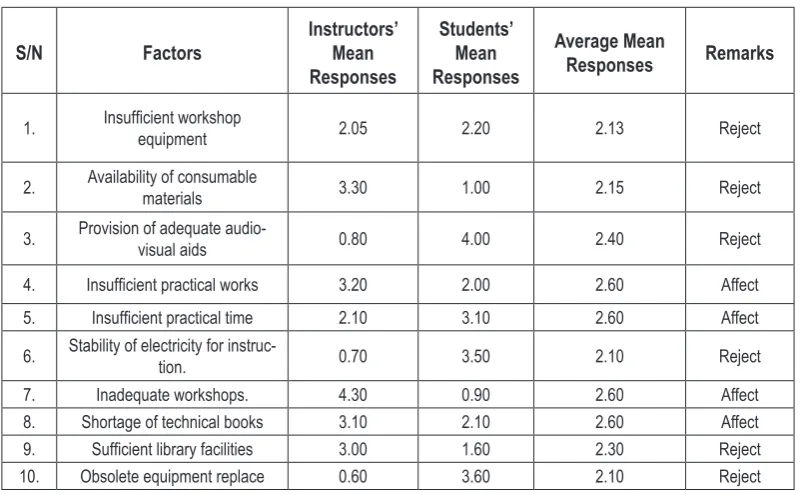
Table 1. Analysis of Mean Responses for Instructional Related Factors.
S/N Factors Instructors’ Mean
Responses
Students’ Mean Responses
Average Mean
Responses Remarks
1. Insufficient workshopequi�ment 2.05 2.20 2.13 �e�ect
2. A�ailability of consumable materials 3.30 1.00 2.15 �e�ect
3. Pro�ision of adequate audio- �isual aids 0.80 4.00 2.40 �e�ect
4. Insufficient practical works 3.20 2.00 2.60 Affect
5. Insufficient practical time 2.10 3.10 2.60 Affect
6. Stability of electricity for instruc-tion. 0.70 3.50 2.10 �e�ect
7. �nadequate wor�sho�s. 4.30 0.90 2.60 Affect
8. Shorta�e of technical boo�s 3.10 2.10 2.60 Affect
9. Sufficient library facilities 3.00 1.60 2.30 �e�ect
10. Obsolete equi�ment re�lace 0.60 3.60 2.10 �e�ect
the results in table 1 above show the mean responses of instructional related factors results presented in table 1 above indicate that non-availability of instructional materials are major factor affecting human skill development in craft development centre in rivers state. from the table above, insufficient workshop equipment has a grand mean of 2.13; availability of consumable materials has 2.15 as grand mean; provision of adequate audio-visual aid has a grand mean of 2.40; insufficient practical works has a grand mean of 2.60; stability of electricity for instruction with 2.10 as grand mean; inadequate workshop (has a grand mean of 2.60; shortage of technical books has a grand mean of 2.60; sufficient library facilities has a grand mean of 2.30 and obsolete equipment with a grand mean of 2.10.
Research Question 2
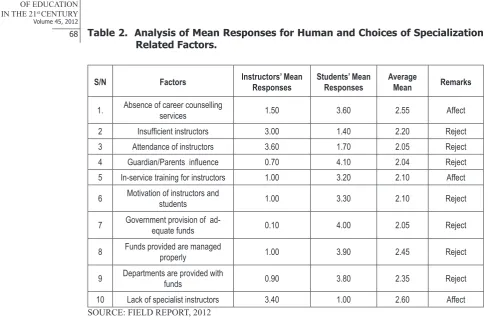
Related Factors.
S/N Factors Instructors’ Mean Responses Students’ Mean Responses Average Mean Remarks
1. Absence of career counsellin� ser�ices 1.50 3.60 2.55 Affect
2 Insufficient instructors 3.00 1.40 2.20 �e�ect
3 Attendance of instructors 3.60 1.70 2.05 �e�ect
4 Guardian/Parents influence 0.70 4.10 2.04 �e�ect
5 �n-ser�ice trainin� for instructors 1.00 3.20 2.10 Affect
6 Moti�ation of instructors and students 1.00 3.30 2.10 �e�ect
7 Go�ernment �ro�ision of ad-equate funds 0.10 4.00 2.05 �e�ect
8 Funds �ro�ided are mana�ed �ro�erly 1.00 3.90 2.45 �e�ect
9 De�artments are �ro�ided with funds 0.90 3.80 2.35 �e�ect
10 Lac� of s�ecialist instructors 3.40 1.00 2.60 Affect
source: field report, 2012
the results in table 2 above, show the mean responses of human and choices of specialization related factors. the result indicates that personnel related matter is one of the major factors affecting the choice of specialization in human skills development of craft development centres students in rivers state, nigeria. the results revealed that absence of career counseling services has a grand mean of 2.55; insufficient instructors with 2.20 as grand mean; attendance of instructors has a grand mean of 2.05; guardian/parent influence has a grand mean of 2.04, in-services training for instructors and motivation of instructors and students has grand mean of 2.10 respectively, government provision of adequate funds has grand mean of 2.05, departments are provided with fund has grand mean of 2.35. lack of specialist instructors has grand mean of 2.60 and funds provided are managed properly has grand mean of 2.45.
Testing of Hypothesis
hypothesis i (ho1)
of education in the 21st century Volume 45, 2012 69
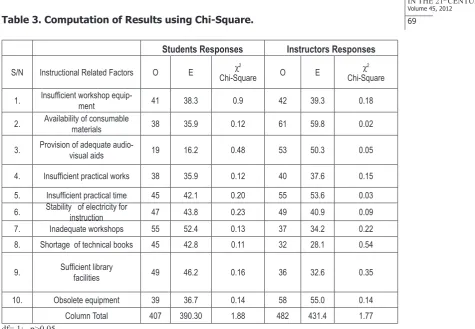
Table 3. Computation of Results using Chi-Square.
Students Responses Instructors Responses
S/� �nstructional �elated Factors O E Chi-Squareχ2 O E Chi-Squareχ2
1. Insufficient workshop equipment - 41 38.3 0.9 42 39.3 0.18
2. A�ailability of consumable materials 38 35.9 0.12 61 59.8 0.02
3. Pro�ision of adequate audio-�isual aids 19 16.2 0.48 53 50.3 0.05
4. Insufficient practical works 38 35.9 0.12 40 37.6 0.15 5. Insufficient practical time 45 42.1 0.20 55 53.6 0.03
6. Stability of electricity for instruction 47 43.8 0.23 49 40.9 0.09
7. �nadequate wor�sho�s 55 52.4 0.13 37 34.2 0.22
8. Shorta�e of technical boo�s 45 42.8 0.11 32 28.1 0.54
9. Sufficient libraryfacilities 49 46.2 0.16 36 32.6 0.35
10. Obsolete equi�ment 39 36.7 0.14 58 55.0 0.14
Column Total 407 390.30 1.88 482 431.4 1.77
df= 1; p>0.05
Results from Table 3 revealed that Chi-Square (χ2) calculated value of student responses’
indicate 1.88 while the responses of instructors’ Chi-Square (χ2) calculated value indicate 1.77.
in course of the above result, the hypothesis is upheld; which proves that there is no significant difference in their responses on the effect of instructional factors in the development of human skills in craft development centre in rivers state, nigeria.
hypothesis 2 (ho2)
Students Responses Instructors Responses
S/� �nstructional �elated Factors O E χ2 O E χ2
1 Absence of career counselin� ser�ices 42 38.3 0.19 43 42.6 0.03
2 Insufficient Instructors 42 36.4 0.33 0.48 47.2 0.01
3 Attendance of�nstructors 35 33.2 0.09 47 46.7 0.00
4 Guardian/Parent influence 3B 35.9 0.12 48 46.7 0.06
5 �n ser�ices trainin� to �nstruc-tors 47 46.1 0.02 51 50.2 0.01
6 �nstructors and StudentMoti�ation of 47 43.8 0.23 44 43.6 0.08
7 Go�ernment �ro�ision of adequate funds 55 52.4 0.12 49 46.2 0.16
8 Funds �ro�ided are mana�ed �ro�erly 44 42.4 0.05 47 46.7 0.01
9 �ro�ided with fundDe�artment are 49 44.2 0.52 45 43.1 0.08
10 Lac� of S�ecialist �nstructors 45 44.7 0.00 50 44.2 0.01
Column Total 443 419.4 1.67 472 503.4 0.45
df= 1; p> 0.05
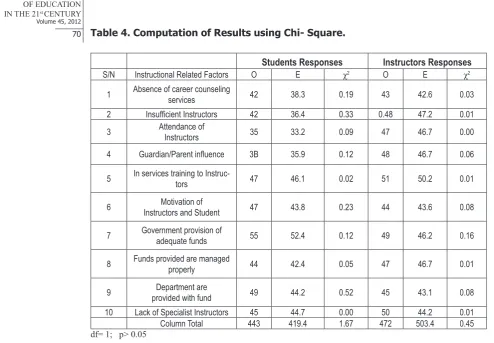
Results from Table 4 above, revealed that the calculated value of Chi-Square (χ2) for
male student is 1.67. And the calculate value of Chi-Square (χ2) for female student is 0.45. the
hypothesis was rejected in view of the fact that the calculated value of male responses is greater than the female calculated value with 1.22. this shows that there is a significant variation in the opinions of the two groups of respondents with respect to choice of specialization towards human skill development in craft development centres of rivers state, nigeria.
Discussion
from the above analysis, it is very clear that many factors affect manpower development programme in the craft development centres of rivers state, nigeria. these factors range from instructional factors, human factors to funding factors such as, insufficient workshop equipment, non availability of consumable materials, non-provision of audio visual aids, insufficient workshop practice, shortage of technical books, instability of power supply, obsolete equipment, absence of career counselling services, non provision of adequate funds, inadequate instructors, lack of motivation for staff and students, etc.
of education in the 21st century Volume 45, 2012 71
Conclusion
the study highlighted the programmes of craft development centres and their evaluation in other to improve on human skills development. it must be noted that for teaching to be meaningful, especially in the area of science and technology, the appropriate training equipment must be put in place, and more so, the appropriate trained personnel to operate the equipment and facilitate the instructional process for conceptualization of the subject matter should also made available.
Recommendations
based on the findings, the following recommendations are made:
1. the authorities concerned should formulate policies whereby consumable materials should be provided for effective practical instructions through the mega oil producing companies in the state such as shell petroleum development company of nigeria, nigeria agip oil company, totalelfina, exxonmobil producing company, chevron, etc.
2. Government should provide generators to complement the electricity supply from the national grid.
3. career counsellors should be posted to all the centres to assist students in their career choices.
4. the workshops in the centres should be provided with modern day’s equipment and tools to enhance training.
5. companies should encourage the pace of technical education by accepting students sent for industrial training. the industrial training fund (itf) should be given enough power by government to enforce this.
6. adequate supply of suitably trained and qualified instructors is the foundation on which successful schooling is built. if the effectiveness of the programmes is to be realized, government should therefore employ more instructors to meet the requirement of the craft development centres/units.
7. Government should also try to retain and motivate the few instructors by improving their conditions of services.
8. Government should come up with a renewed policy on technical education funding. 9. adequate funds should be made available for craft development centres to enable
them acquire and equip up to date workshops.
10. finally authorities of the centres should provide adequate security to obviate the vandalization of training material.
References
adekola, a. m. (2010). The Place of Technical Education in Nigeria’s Future. a paper presented at the 23rd natt national annual conference in uyo.
adesina, s. (1977). Planning and Educational Development. lagos: academy press ltd.
of Vocational education, university of nigeria, nsukka.
nwosu, V. c. (2007). the economic Value of craft development centres in developing technology culture in rivers state. �npublished Journal. port harcourt.
okilo, o. m. (1982). Rivers State Government Policy on Skills Acquisition Training. port harcourt: ministry of education.
shade, a. (1994). 6:3:3:4 system awaits proper funding. Daily Sunray, march 28.
Advised by Eric C. Amadi, Rivers State �niversity of Science and Technology, NigeriaEric C. Amadi, Rivers State �niversity of Science and Technology, Nigeria
received: May 04, 2012 accepted: June 14, 2012
Suobere T. Puyate B.Sc, M.Ed, Senior Lecturer, Faculty of Technical and Science Educa-tion, �i�ers State �ni�ersity of Science and Technolo�y, ���olu – Oro-�i�ers State �ni�ersity of Science and Technolo�y, ���olu – Oro-woru�wo, P.M.B. 5080, Port Harcourt, �i�ers State, �i�eria.
E-mail: �[email protected]
Iheanyi N. Okwakpam B.Sc, M.Ed, Assistant Lecturer, Faculty of Technical and Science Education, �i�ers State �ni�ersity of Science and Technolo�y, ���olu�i�ers State �ni�ersity of Science and Technolo�y, ���olu – Oroworu�wo, P.M.B. 5080, Port Harcourt, �i�ers State, �i�eria. E-mail: io�wa��[email protected]