Journal of Engineered Fibers and Fabrics 69 http://www.jeffjournal.org Volume 9, Issue 4 – 2014
Effect of Cellulase Enzyme on the Mechanical and Surface
Properties of Regular and Compact Yarns
M. Mettilda, PhD1, Menaka2, V.Subramaniam3, B. Kothandaraman4
1
Central Institute of Plastics Engineering and Technology, Chennai, Tamil Nadu INDIA
2
Rajas Institute of Technology for Women, Nagercoil, Tamilnadu INDIA
3
Textile Technology, Jaya Engineering College, Chennai, Tamil Nadu INDIA
4
Madras Institute of Technology, Chennai, Tamil Nadu INDIA
Correspondence to:
Venkatraman Subramaniam email: [email protected]
ABSTRACT
The degrading property of cellulose by the enzyme is utilized in improving the surface properties by removing the protruding fibers from the surface of the yarn. In this work, the regular and compact yarns made out of same mixing at various stages of chemical processing were treated with cellulase enzyme with different levels of concentration and temperature. Measurement of the weight loss, bending rigidity, wicking rate, work of rupture, shrinkage loss, tenacity and elongation of the yarn were studied for the two different yarns. Bending rigidity and wicking rates were found to decrease and increase respectively in normal yarns compared to compact yarns. All the above trends therefore suggest that the compact yarns are not much affected by the concentration of the enzyme compared to the regular yarns. As the concentration of the enzyme was increased, the weight loss, bending rigidity, shrinkage loss, twist liveliness, tenacity, work of rupture, elongation and wicking rate were also found to vary irrespective of the spinning system.
Keywords: Cellulase, Regular yarns, compact yarns, Tenacity, Wicking rate, SEM
INTRODUCTION
Cotton holds its place as a textile material due to its excellent properties such as higher water absorbency, hydrophilic character coupled with high fiber tenacity, easy care, rapid moisture absorption and desorption which led to the development of a wide variety of characteristic textiles ranging from apparel fabrics to house hold furnishings to artists canvas. Cotton fiber contains approximately 90% cellulose and various non-cellulosic substances such as waxes, fats, pectin and coloring matter. Surface waxes are
Journal of Engineered Fibers and Fabrics 70 http://www.jeffjournal.org Volume 9, Issue 4 – 2014
achieve a variety of effects including enhancement of fabric surface appearance and softening of denim garments without or with low environmental impacts [18-23].They have become the third largest group of enzymes used and also their worth has proved in textiles as its advantages include improved elasticity, hydrophilicity and dye affinity.In the initial stages of the hydrolysis, cellulases primarily act on fiber surfaces due to their large size. Simultaneously, considerable mechanical action is usually involved in industrial applications by the use of jets or tumblers for the enzymatic treatment. Mechanical action during the treatment in the initial stages helps enzyme adsorption and desorption processes as well as aids the removal of enzymatically loosened material from fiber surfaces, leaving the fibers very smooth. Due to this polishing effect, some weight loss is observed, which however does not yet indicate any fiber damage. Only with prolonged treatment duration, degradation also occurs in the accessible amorphous areas of large pores and at crystallite surfaces.
As the efficiency of cellulase action on solid substrate is known to be related to the specific surface area [24] it could be expected that the accessibility of cotton for enzymatic modification would increase in the following order: fabric<yarn<fiber [25].
This process can eventually lead to significant fiber deterioration, indicated by a high weight and strength loss. Cracks in fibril direction as well as extensive surface peeling occur as indicators of this effect which is additionally overlaid by the effect of pure mechanical abrasion during the treatment. Cellulases are strictly substrate-specific in their action. Any change in the structure or accessibility of the substrate can have a considerable influence on the course of the hydrolysis reaction. Since the enzymatic treatment is often performed prior or subsequent to dyeing and finishing, it is very important to study the interaction of enzymes with compounds used for this process. Radhakrishnaiah et al [26] have conducted studies in which the effect of enzymatic treatment, on the low stress mechanical behavior of 100% cotton yarns produced, from ring, rotor and friction spinning systems has been reported. Tyagi GK et al [27, 28] have conducted studies on mechanical and surface properties of cotton ring and OE rotor yarns.
A considerable amount of research has been done on finishing of cellulosic textile materials using enzymes. However the yarns having different
structural aspects have not been examined so far following these treatments. The new types of yarns such as regular and compact when treated with enzymes are likely to have different effects. The response of these yarns to enzymatic treatment in terms of weight loss, shrinkage, tensile strength, bending and wicking has been examined in this paper. This will provide some guidelines in understanding the problems involved in wet processing on them.
MATERIALS AND METHODS
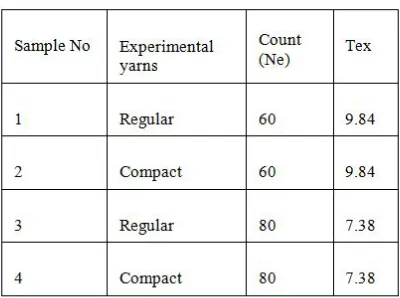
Two sets of regular and compact cotton yarns of 9.84 and 7.38 Tex and 7.4 Tex were taken for investigation. Cotton being a hygroscopic fiber, changes its weight with respect to the relative humidity of its atmosphere. Thus the cotton yarn is to be conditioned prior to experimentation. Conditioning can be done by many methods like keeping the yarn in the air conditioned room or keeping the yarn in mini atmosphere of saturated salt solution. The yarn samples were placed in a desiccator filled with saturated salt solution to maintain a RH for three days to achieve the correct amount of weight. Table I gives the particulars of regular and compact yarns made from same mixing with the same amount of twist which are under study.
TABLE I. Types of yarns under study.
Yarn Pretreatments
Scouring
Batches of cotton yarns (144 samples) were scoured with caustic boil (sodium hydroxide, sodium carbonate and soap) at 100° C for 60 minutes. The yarns were washed thoroughly with distilled water.
Bleaching
Journal of Engineered Fibers and Fabrics 71 http://www.jeffjournal.org Volume 9, Issue 4 – 2014
Mercerization
The scoured and bleached leas were mercerized at room temperature with 20% NaOH for 45 minutes followed by washing and drying.
Enzymatic Treatment
Enzymatic treatment of the original and the pretreated cotton yarns was performed with acidic cellulase enzyme. The treatments were conducted in 50mM Sodium acetate buffer (pH 5) at 40°and 50° C with various concentrations like 0.5, 1 , 2 % solutions. The MLR ratio was 1:50 taken in High temperature, High pressure dyeing machine with gentle mechanical agitation for cotton yarns (9.84 and 7.38 tex). The treatments were performed at 50°C for 1.5 hours and carried out in triplicates. After the incubation period, enzyme activity was ceased by raising the temperature to 80°C for 10 minutes. The yarns were washed three times with distilled water and dried at 40°C overnight prior to further analysis.
TESTING OF YARNS
Yarn number was defined according to the standard SFS 2703. Weight loss, shrinkage loss, wicking rate, tensile strength and bending properties of the yarns were studied.
Weight Loss
The masses of the yarn samples before (w0) and after the enzyme treatment (w) were determined and the weight loss was calculated by the following equation
Weight loss = {w0 – w/w0}*100
Wickability
Vertical wicking test was carried out on treated yarns following DIN 53924.
Tensile Properties
Tensile properties of all the yarns were measured on an Instron using 500mm test specimen and 200mm/min cross head speed. The mean yarn tenacity and breaking extension were averaged from 50 observations for each yarn sample.
Flexural Rigidity of Yarns
Yarn flexural rigidity was measured using the ring loop method.
Shrinkage
Residual shrinkage of yarns was estimated by the method mentioned in BSI handbook.
Scanning Electron Microscopy
The morphology of the different yarns were studied using a scanning electron microscope, ZEISS EVO 60, Germany at an acceleration voltage of 5-10 kV.
RESULTS AND DISCUSSION
Comparison of Compact and Regular Yarns
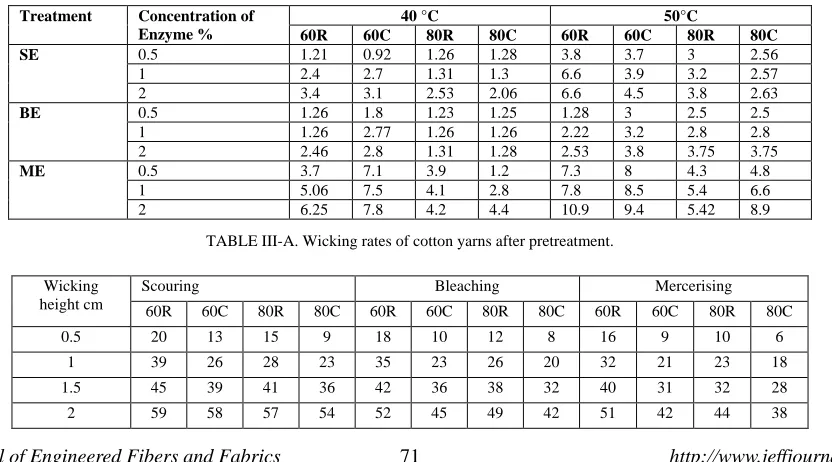
TABLE II. Weight loss of cotton yarns after various treatments at 40°C and 50°C.
TABLE III-A. Wicking rates of cotton yarns after pretreatment.
Wicking height cm
Scouring Bleaching Mercerising
60R 60C 80R 80C 60R 60C 80R 80C 60R 60C 80R 80C
0.5 20 13 15 9 18 10 12 8 16 9 10 6
1 39 26 28 23 35 23 26 20 32 21 23 18
1.5 45 39 41 36 42 36 38 32 40 31 32 28
2 59 58 57 54 52 45 49 42 51 42 44 38
Treatment Concentration of
Enzyme %
40 °C 50°C
60R 60C 80R 80C 60R 60C 80R 80C
SE 0.5 1.21 0.92 1.26 1.28 3.8 3.7 3 2.56
1 2.4 2.7 1.31 1.3 6.6 3.9 3.2 2.57
2 3.4 3.1 2.53 2.06 6.6 4.5 3.8 2.63
BE 0.5 1.26 1.8 1.23 1.25 1.28 3 2.5 2.5
1 1.26 2.77 1.26 1.26 2.22 3.2 2.8 2.8
2 2.46 2.8 1.31 1.28 2.53 3.8 3.75 3.75
ME 0.5 3.7 7.1 3.9 1.2 7.3 8 4.3 4.8
1 5.06 7.5 4.1 2.8 7.8 8.5 5.4 6.6
Journal of Engineered Fibers and Fabrics 72 http://www.jeffjournal.org Volume 9, Issue 4 – 2014
TABLE III-B. Wicking rates of cotton yarns after enzymatic treatments.
Wicking height cm
Scouring + Enzyme Bleaching + Enzyme Mercerising + Enzyme
60R 60C 80R 80C 60R 60C 80R 80C 60R 60C 80R 80C
0.5 15 10 12 5 13 9 10 4 8 7 4 3
1 28 20 24 15 24 18 22 15 20 14 11 11
1.5 40 38 38 32 38 28 30 27 32 24 26 26
2 59 55 56 52 55 48 50 46 50 44 48 48
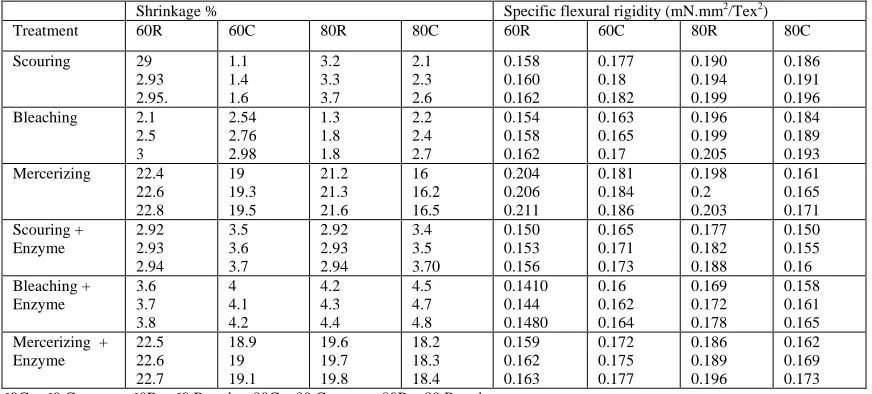
TABLE IV. Shrinkage and flexural rigidity of regular and compact yarns after various treatments.
Shrinkage % Specific flexural rigidity (mN.mm2/Tex2)
Treatment 60R 60C 80R 80C 60R 60C 80R 80C
Scouring 29
2.93 2.95. 1.1 1.4 1.6 3.2 3.3 3.7 2.1 2.3 2.6 0.158 0.160 0.162 0.177 0.18 0.182 0.190 0.194 0.199 0.186 0.191 0.196
Bleaching 2.1
2.5 3 2.54 2.76 2.98 1.3 1.8 1.8 2.2 2.4 2.7 0.154 0.158 0.162 0.163 0.165 0.17 0.196 0.199 0.205 0.184 0.189 0.193
Mercerizing 22.4
22.6 22.8 19 19.3 19.5 21.2 21.3 21.6 16 16.2 16.5 0.204 0.206 0.211 0.181 0.184 0.186 0.198 0.2 0.203 0.161 0.165 0.171 Scouring + Enzyme 2.92 2.93 2.94 3.5 3.6 3.7 2.92 2.93 2.94 3.4 3.5 3.70 0.150 0.153 0.156 0.165 0.171 0.173 0.177 0.182 0.188 0.150 0.155 0.16 Bleaching + Enzyme 3.6 3.7 3.8 4 4.1 4.2 4.2 4.3 4.4 4.5 4.7 4.8 0.1410 0.144 0.1480 0.16 0.162 0.164 0.169 0.172 0.178 0.158 0.161 0.165 Mercerizing +
Enzyme 22.5 22.6 22.7 18.9 19 19.1 19.6 19.7 19.8 18.2 18.3 18.4 0.159 0.162 0.163 0.172 0.175 0.177 0.186 0.189 0.196 0.162 0.169 0.173 60C – 60 Compact; 60R – 60 Regular; 80C – 80 Compact; 80R – 80 Regular;
G-Grey ; S- scoured; B- Bleached; M- Mercerized; SE – Scoured & Enzyme treated; BE – Bleached & Enzyme treated; ME – Mercerized and Enzyme treated
Weight Loss
Weight loss is an indication of extent of hydrolysis which shows an increasing trend with increase in enzymatic add on. Weight loss of cotton yarns after enzymatic treatments at 40°C and 50°C are represented in Table II. Pre-treatments namely scouring and Bleaching have led to weight losses, the former showing higher values than the latter. However a pre-treatment with sodium hydroxide namely, mercerisation clearly increases the weight loss for 60s and 80s compact yarns. This may be attributed to lower twist. This is also due to improved accessibility of fibers for the large enzyme molecule. With the exception of 60R, 80R, 80C weight losses show significant increase following mercerisation. Mercerised and enzyme treated samples show greatest losses due to greater activity. Higher temperature has led to greater weight losses. But maximum weight loss was observed in 60R at 50° C for 2% concentration as listed in Table II.
Wickability
Wickability showed substantial increase after the enzyme treatment as shown in Table III A and III B.
Compact yarns show better wickability in
comparison with regular yarns. This is due to the lowest twist given to them (24.01tpi) as against (34.3tpi) given to conventional yarns. Wickability of 80s yarn is better as compared to 60s. Enzyme treated yarns following pre-treatments with sodium hydroxide show a significant improvement in wickability which is due to more amorphous in nature and greater accessibility.
Shrinkage
Journal of Engineered Fibers and Fabrics 73 http://www.jeffjournal.org Volume 9, Issue 4 – 2014
Bending Rigidity
The bending rigidity values of the scoured yarns are greater than those of scoured enzyme treated yarns, whereas the bleached yarns showed higher flexural rigidity than bleached enzyme treated yarns. Table IV
gives the bending rigidity of conventional and compact yarns. With the exception of mercerised yarns, the compact yarns show highest bending rigidity in comparison with conventional yarns. An interesting observation is that, in both 60s and 80s yarns the conventional yarn shows a higher value for mercerised yarns. In the case of 60s yarns with the exception of mercerisation treatment, values of bending rigidity are higher in compact yarns. The opposite effect is noticed in 80s yarns where compact yarns show an increase. Perhaps enzyme treatment following pre-treatments in respect of finer yarns offers the best advantage as a lower value of bending rigidity would imply better handle of fabric made from them. This may be due to a considerable freedom of movement of fibers during yarn bending.
S B M SE BE ME
0 3 6 9 12 15 18 21 24
60 R 60 C 80 R 80 C
S
hr
ink
a
ge
Treatments
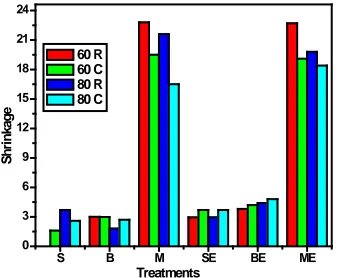
FIGURE 1. Shrinkage of cotton yarns after various treatments.
Tenacity
S B M SE BE ME
0 2 4 6 8 10 12 14 16 18 20 22 24
T
en
aci
ty
g
m
/t
ex
Treatments 60 R 60 C 80 R 80 C
FIGURE 2.Tenacity of cotton yarns after various treatments.
G S B M SE BE ME
0 50 100 150 200 250 300 350 400
60 R 60 C 80 R 80 C
W
or
k
of
R
upt
ur
e
gf
.c
m
Treatments
FIGURE 3. Work of rupture of cotton yarns after various treatments.
Figure 2 depicts the tenacity of various treated yarns in which the bleached and bleached enzyme treated yarns show higher tenacity. A 60s and 80s compact yarn has higher tenacity following enzyme hydrolysis. Tenacity is the ratio of breaking strength to yarn tex.
Elongation and Work of Rupture
Form Figure 3 it is observed that the elongation of 60R and 80R after mercerization show higher values amongall. Maximum values of work ofrupture were observed for mercerized 60 R and 80R as shown in
Figure 4. Sincework of rupture and elongation are synonymous, the increase is due to higher elongation of yarn following mercerisation.
G S B M SE BE ME
0 1 2 3 4 5 6 7 8 9
60 R 60 C 80 R 80 C
E
longa
ti
on %
Treatments
Journal of Engineered Fibers and Fabrics 74 http://www.jeffjournal.org Volume 9, Issue 4 – 2014
Scanning Electron Microscopy
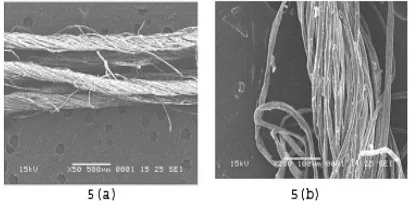
SEM images of 80R grey yarn and Bleached and Enzyme treated yarns are depicted in Figure 5(a) and 5(b).
FIGURE 5(a) SEM of 80R 5 (b)SEM of Bleached and Enzyme
treated 80R.
CONCLUSION
Weight loss which is an indication of hydrolysis, shows an increasing trend with increase in enzyme add on. The regular and compact yarns show an increase in strength following enzymatic treatment. The differences noticed between the 80s regular and compact yarns even after the treatments are maintained. The response of 80s yarn to enzymatic treatment in terms of bending rigidity seems to be better than those of 60s treated yarns. All the treated yarns show a decrease in bending rigidity which is an indication of decrease in stiffness. In the case of 60s scoured yarns, the compact yarn shows better wickability in comparison with regular yarn. Wickability is attributed to their lower twist. Wickability of 80s yarn is better as compared to 60s yarn. In the case of bleached yarns, the same trend is being maintained. In the case scoured and enzyme treated, again the same trend is maintained. However the yarn seems to have better wickability. The mercerized treatment has led to an increase in shrinkage.
REFERENCES
[1] Hsieh, Y. L; Thompson, J.; Miller, A.; Text Res J, 66, 1996, 456.
[2] Rossner, U.; Melliand; Textilber, 72, 1993, 144. [3] Lange, N. K.; Text Chem Color, 29, 1997, 23. [4] Li, Y.; Hardin, I.R.; Text Chem Color, 29, 1997,
71.
[5] Buschle – Diller, G.; Yang, X. D.; Yamamoto, R.; Text Res J, 71, 2001, 388.
[6] Patni, A. K.; Agarwal, G.; Garg, A.; Indian Text J, 114, 2004, 25.
[7] Wakida, T.; Moriya, T.; Leel, M.; Yoshika, H.; Yanai, Y.; Text Res J, 70, 2000, 161. [8] Cava Co – Paulo, A.; Text Res J, 71, 2001, 842. [9] Jin, C.; Maekawa, M.; Text Res J, 71, 2001,
779.
[10] Kang, T. K.; Kin, M. S.; Text Res J, 71, 2001, 295.
[11] Samanta, A. K.; Singhee, D.; Basu, G.; Mahalanabis, K. K.; Indian J Fibre Text,
30, 2005, 451.
[12] Mori, R.; Haga, T.; Takagisi, T.; Text Res J, 69, 1999, 742.
[13] Mecloskey, S. G.; Jump, J. M.; Text Res J, 75, 2005, 480.
[14] Doshi, R.; Shelke, V.; Indian J Fibre Text, 26, 2001, 202.
[15] Buschle – Diller, G.; Traore, L.; Text Res J, 68, 1998, 185.
[16] Cava Co – Paulo, A.; Almeidal; Tex Res J, 71, 2001, 842.
[17] Koo, H.; Veda, M.; Wakida, T.; Text Res J, 64, 1994, 70.
[18] Wadham, M.; JSDC, 110, 1994, 367.
[19] Blanchard, E. E.; Graves, S. L.; Batiste, TCC ADR 32, 5, 2000, 37.
[20] Cortez, J. M.; Ellis, J.; Bishop, D.P.; Text Res J,
72, 8, 2002, 673.
[21] Bohringer, J.; Rupp; ITB 48, 6, 2002, 6. [22] Nicolai, A.; Nechwatal; ITB 48, 6, 2002, 6. [23] Paulo, A. C.; Text Res J, 71, 9, 2001, 842. [24] Grethlein, H.; JBiotechnol; 2, 1985, 155. [25] Jaakko pere; Arja puolakka pertti Nousiainen et
al.; J Biotechnol, 89, 2001, 247.
[26] Radhakrishnaiah, P.; Jingwu He.; Fred L.Cook.;
Text Res J, 73, 2008, 265.
[27] Tyagi, G. K.; Bhattacharya, S.; Gupta, S.; Pretreatment dependence of mechanical and surface properties of cotton ring and OE rotor- spun yarns; Indian J Fibre Text, 34, 2009, 20.
[28] Tyagi, G. K.; Gupta, S. K.; Study on cotton ring and OE rotor yarns characteristics: Part III – Effect of enzymatic wet processing on various characteristics; Indian J Fibre Text,
Journal of Engineered Fibers and Fabrics 75 http://www.jeffjournal.org Volume 9, Issue 4 – 2014
AUTHORS’ ADDRESSES M. Mettilda, PhD
Central Institute of Plastics Engineering and Technology
F1 1/2 Ramalingam V cross street Gandhi Nagar, Avadi, Chennai Chennai, Tamil Nadu 600054 INDIA
T. Menaka
Rajas Institute of Technology for Women Ozhuginasery
Nagercoil, Tamilnadu 629001 INDIA
Venkatraman Subramaniam, PhD Jaya Engineering College
Textile Department Sripuram First Street
Chennai, Tamil Nadu 600014 INDIA
B. Kothandaraman, PhD Madras Institute of Technology Chromepet