23
Calculation of Morse Potential Parameters of bcc Crystals and
Application to Anharmonic Interatomic Effective Potential,
Local Force Constant
Nguyen Van Hung
1,*, Trinh Thi Hue
1, Nguyen Ba Duc
21
VNU University of Science, 334 Nguyen Trai, Thanh Xuan, Hanoi, Vietnam
2
Tan Trao University, Km6, Trung Mon, Yen Son,Tuyen Quang, Vietnam Received 24 February 2015
Revised 28 April 2015; Accepted 15 July 2015
Abstract: In this work, Morse potential parameters of bcc crystals have been calculated based on the calculation of volume per atom and atomic number in each elementary cell, as well as the energy of sublimation, the compressibility and the lattice constant. They are used for studying the anharmonic interatomic effective potential, local force constant in XAFS (X-ray Absorption Fine Structure) theory. Numerical results for Fe, W and Mo are found to be in good agreement with experiment and with those of other theories.
Keywords: Morse potential parameter, effective potential, local force constant, bcc crystals.
1. Introduction∗∗∗∗
Anharmonic interatomic potentials including Morse potential parameters [1,2], have been intensively studied [1-17]. They are used for the calculation and analysis of the thermodynamic parameters, especially, the anharmonic effects contained in XAFS (X-ray Absorption Fine Structure) [10-15] which influence on the physical information taken from these spectra. Morse potential is an empirical potential [1,2] and their parameters are often extracted from experiment [16,17]. Therefore, calculation and analysis of Morse potential parameters are of great interest, especially in XAFS theory. This work is a next step of our previous work [18] for the calculation and analysis of Morse potential parameters of bcc crystals based on the calculation of volume per atom and atomic number in each elementary cell. This calculation of atomic number is our further development compared to the previous theory [18], and due to that the present method can be generalized to the calculation for the other crystal structures. The energy of sublimation, the compressibility and the lattice constant used in the present considerations are available [19-21]. The obtained Morse potential parameters are applied _______
to the calculation and analysis of the anharmonic interatomic effective potential, local force constants and anharmonic effects in XAFS theory. Numerical results for Fe, W and Mo are compared to experiment [17] and to those of other theory [2] which show good agreement.
2. Formalism
2.1. Calculation of Morse potential parameters
Following [18] the potential energy ϕ
( )
rij of two atoms i and j separated by a distance rij is givenin terms of the Morse function by
( )
(
)
(
)
−
=D e− rij−ro e− rij−ro
rij α α
ϕ
2 2 , (1)where
α
,D are constants with dimensions of reciprocal distance and energy, respectively; ro is the equilibrium distance of the two atoms. Sinceϕ
( )
ro =−D, D is the dissociation energy.In order to obtain the potential energy of the whole crystal whose atoms are at rest, it is necessary to sum Eq. (1) over the entire crystal. This is most easily done by choosing one atom in the lattice as an origin, calculating its interaction with all the others in the crystal, and then multiplying by N/2, where N is the total atomic number of the crystal. Thus, the total energy Φ is given by
∑
− = Φ − − − − j o r j r o r j r e eND α 2 α
2
1 2
. (2)
Here rj is the distance from the origin to the jth atom. It is convenient to define the following quantities
L ND e ro rj
[
mj nj lj]
a Mja= +
+ = =
= ; ; 2 2 2 1/2
2
1
β
α , (3)where mj,nj,lj are position coordinates of any atom in the lattice. Applying Eq. (3) to Eq. (2), the energy can be rewritten as
( )
∑
−∑
− − = Φ j j j j aM aM e L e La
β
2 2α 2β
α . (4)The first and second derivatives of the energy of Eq. (4) with respect to
a
are given by∑
∑
− − + − = Φ j j j j j j aM aM e M L e M L dad α α
βα
β
α
22 2 2 , (5)
∑
∑
− − − = Φ j j j j j j aM aM e M L e M L dad α α
β
α
β
α
2 2 2 2 22 2
2
At absolute zero T = 0, ao is value of
a
for which the lattice is in equilibrium, then Φ( )
ao gives the energy of cohesion,[
/]
00 =
Φ da a
d , and
[
d2Φ/da2]
a0 is related to the compressibility. That is,( )
a0 =U0( )
a0Φ , (7)
where U0
( )
a0 is the energy of sublimation at zero pressure and temperature, i., e.,0
0=
Φ
ada
d
, (8)
and the compressibility is given by
0 0 2 2 0 2 0 2 0 00
1
a adV
d
V
dV
U
d
V
K
Φ
=
=
, (9)where V0 is the volume at T = 0, and K00 is compressibility at zero temperature and pressure. Our further development compared to the previous calculation [18] is proposing a method for determining the volume per atom Va for bcc crystal
n V N V
Va = = EC , (10)
where VEC = a3 is the volume of an elementary cell of a cubic crystal including bcc, n is the atomic
number in this elementary cell and a is the lattice constant.
Substituting Eq. (10) in Eq. (9), the compressibility is expressed by
0 2 2 0 00 9 1 a a da d Na n K = Φ
= . (11)
Using Eq. (5) to solve Eq. (8), we obtain
j j j j j j aM aM e M e
M α α
β
=∑
− /∑
−2 . (12)Consequently, from Eqs. (4,6,7,11) we obtain the relation
0 00 0 2 2 2
2 2 9
4 2 2 2 Na K nU e M e M e e j j j j j j j j j j aM aM aM aM = − −
∑
∑
∑
∑
− − − − α α α αα
β
α
β
, (13)
which is different from that in [18] by containing the atomic number n in an elementary cell.
depend on the value n separated for different crystal structures, and we will calculate it in the next subsection for bcc crystals.
2.2. Application to calculation of anharmonic interatomic effective potential and local force constant in XAFS theory
Fig. 1 shows Fourier transform magnitudes of XAFS at 293 K and 393 K, as well as XAFS of Fe, measured at Novo-Simbirk (Rissia) [17]. They are different at these temperatures illustrated by their shifts which show the evident anharmonic effects in XAFS. For describing these effects an anharmonic XAFS theory is necessary [7-15].
Fig. 1. Fourier transform magnitudes of experimental XAFS of Fe at 293 K and 393K and XAFS spectrum at 393 K [17] measured at Novo-Simbirk (Russia).
The expression for the K-edge anharmonic XAFS function [11] is described by
( )
R rn ik ikR e e k F k n n n k i kR k R = + =
∑
− , ! ) 2 ( 2 exp Im ) ( ( ) ( ) 2 ) ( / 2σ
χ
ϕ λ, (14)
where F(k) is the real atomic backscattering amplitude, φ is net phase shift, k and
λ
are the wave number and the mean free path of the photoelectron, respectively, r is instantaneous bond length between two immediate neighboring atoms andσ
(n) (n = 1,2,3, …) are the cumulants.For describing this anharmonic XAFS, an anharmonic interatomic effective potential [10,12] of the system is derived which in the present theory is expanded up to the 4th order and given by
( )
( )
∑
≠
+
=
+
+
+
≅
i j ij i eff effx
M
V
x
V
x
k
x
k
x
k
x
V
R
ˆ
.
R
ˆ
1
M
andM
2 (e.g., absorber and backscatterer) in a given system. Their oscillation is influenced by their neighbors given by the last term in the left-hand side of Eq. (15), where the sum i is over absorber (i=1) and backscatterer (i=2), and the sum j is over all their near neighbors, excluding the absorber and backsctterer themselves. The latter contributions are described by the termV
( )
x
.The advantage of this model is that the three-dimensional interactions can be taken into account in the present one-dimensional model by a simple measures based on including the contributions of nearest neighbors of absorber and backscatterer in XAFS process.
For bcc crystals the anharmonic interatomic effective potential Eq. (15) has the form
− +
+
− + =
6 6 6 6 2 2 ) ( )
(x V x V x V x V x
Veff . (16)
Applying Morse potential given by Eq. (1) expanded up to the 4th order around its minimum
(
)
+ +
− +
− ≅ −
= − − 4 4
12 7 1
2 )
(x De 2 e D 2x2 3x3 x
V αx αx
α
α
α
, (17)containing our calculated Morse potential parameters (MPP) to Eq. (16) and comparing that to the first equation of Eqs. (15), we obtain the anharmonic effective potential Veff , effective local force constant
eff
k , anharmonic parameters k3, k4 for bcc crystals presented in terms of our calculated MPP D and
α
.3. Numerical results and discussion
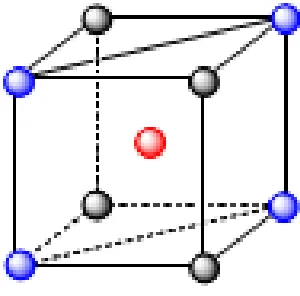
For calculating the above equations to obtain Morse potential parameters (MPP) of bcc crystals, we calculate the atomic number n in each elementary cell of bcc crystals.
Fig. 2. Atomic distribution in an elementary cell of bcc crystal.
sublimation, the compressibility and the lattice constant from [18-20], we calculated Morse potential parameter D, α, ro using our created computing programs. They have been used for calculating the
anharmonic effective local force constants of bcc crystals. Table 1 show good agreement of the results calculated using the present theory with those of L. A. Girifalco et al [2] and with experiment of I. V. Pirog at al [17].
Table 1. Morse potential parameters (MPP) D, α, ro calculated using the present theory and effective local force constants keff calculated using these MPP for Fe, W, Mo compared to those of L. A. Girifalco et al [2] and to the
experimental values of I. V. Pirog et al [17].
Crystal D(eV)
α
(Å-1)o
r (Å) keff (N/m)
Fe, Present 0.418 1.397 2.849 47.9242
Fe, Girifalco et al [2] 0.417 1.388 2.845 47.2295
Fe, Expt., Pirog et al [17] 0.42±0.12 1.40±0.13 2.856 48.3605
W, Present 0.979 1.441 3.042 119.5910
W, Girifalco et al [2] 0.9906 1.442 3.032 116.0254
W, Expt., Pirog et al [17] 0.89±0.13 1.44±0.2 3.052 120.5995
Mo, Present 0.8051 1.5102 3.012 107.8709
Mo, Girifalco et al [2] 0.8032 1.5079 2.976 107.2888 Mo, Expt., Pirog et al [17] 0.75±0.13 1.44±0.2 3.016 109.1992
The Morse potentials calculated using the present theory presented in Fig. 3 for a) Fe and b) W are found to be in good agreement with experiment of I. V. Pirog et al [17] and with those calculated by L. A. Girifalco et al [2]. They satisfy all their fundamental properties, i. e., they describe the repulsive force in short distance when atoms approach each other obeying Pauli exclusion principle, and describe the attractive force in long distance when atoms go far from each other. The reason of this attraction is that the atoms have diffusion moments which attract each other in long distance.
a) b)
a) b)
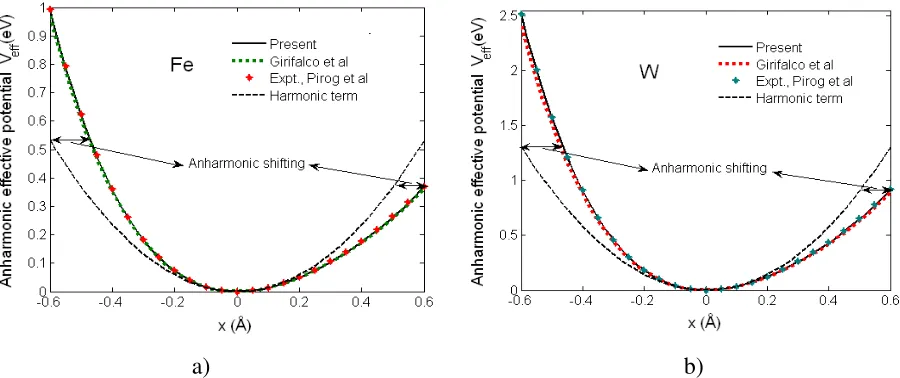
Fig. 4. Anharmonic interatomic effective potentials for a) Fe and b) W calculated using the present theory and MPP presented in Table 1 and in Fig. 3, respectively, compared to experiment obtained from MMP of I. V. Pirog
et al [17] and to those calculated from MPP of L. A. Girifalco et al [2].
Figure 4 illustrates good agreement of the anharmonic interatomic effective potentials for a) Fe and b) W calculated using the present theory and the MPP presented in Table 1 and in Fig. 3 with experiment obtained from the measured Morse parameters (MPP) of I. V. Pirog et al [17] and with those calculated from MPP of L. A. Girifalco et al [2]. They show strong asymmetry of these potentials due to including the anharmonic contributions in atomic vibrations of these bcc crystals illustrated by their anharmonic shifting from the harmonic terms. Such anharmonic effects of the anharmonic interatomic effective potentials lead to the shifts of the peaks of Fourier transform magnitudes of the experimental XAFS spectra of Fe at different temperatures [17] presented in Fig. 1.
4. Conclusions
In this work, a method for the calculation and analysis of Morse potential parameters for bcc crystals has been developed based on the calculation of volume per atom and atomic number in each elementary cell, as well as the energy of sublimation, the compressibility and the lattice constant. This method can be generalized to the other crystal structures based on the calculation of their volume per atom and atomic number in each elementary cell.
The obtained Morse potentials satisfy all their fundamental properties and are suitable for the calculation and analysis of the anharmonic interatomic effective potentials describing anharmonic effects in temperature-dependent XAFS theory.
References
[1] P. M. Morse, Phys. Rev. B. 34 (1929) 57.
[2] L. A. Girifalco and V. G. Weizer, Phys. Rev. 114 (1959) 687.
[3] E. C. Marques, D. R. Sandrom, F. W. Lytle, R. B. Greegor, J. Chem. Phys. 77 (1982) 1027. [4] E. A. Stern, P. Livins, and Z. Zhang, Phys. Rev. B 43 (1991) 8550.
[5] T. Miyanaga and T. Fujikawa, J. Phys. Soc. Jpn. 63 (1994) 1036 and 3683. [6] T. Yokoyama, K. Kobayashi, and T. Ohta, Phys. Rev. B 53 (1996) 6111. [7] N. V. Hung and R. Frahm, Physica B 208-209 (1995) 91.
[8] N. V. Hung, R. Frahm, and H. Kamitsubo, J. Phys. Soc. Jpn. 65 (1996) 3571. [9] N. V. Hung, J. de Physique IV (1997) C2 : 279.
[10] N. V. Hung and J. J. Rehr, Phys. Rev. B 56 (1997) 43.
[11] N. V. Hung, N. B. Duc, and R. Frahm, J. Phys. Soc. Jpn. 72 (2003) 1254. [12] N. V. Hung, N. B. Trung, and B. Kirchner: Physica B 405 (2010) 2519. [13] N. V. Hung, C. S. Thang, N. C. Toan, H. K. Hieu, Vacuum 101 (2014) 63. [14] N. V. Hung, J. Phys. Soc. Jpn. 83 (2014) 024802.
[15] N. V. Hung, T. S. Tien, N. B. Duc, and D. Q. Vuong, Mod. Phys. Lett. B 28 (2014) 1450174.
[16] I. V. Pirog, I. I. Nedosekina, I. A. Zarubin, and A. T. Shuvaev, J. Phys.: Condens. Matter 14 (2002) 1825. [17] I. V. Pirog and T. I. Nedosekina, Physica B 334 (2003) 123.
[18] N. V. Hung, Commun. in Phys. 14 (2004) 7.
[19] Charl. Kittel, Introduction to Solid-State Physics, John Wiley & Sons ed., Inc. New York, Chichester, Brisbane, Toronto, Singapore (1986).