Original Research Article
Knowledge about epidemiological determinants of rabies and its
prevention amongst medical interns of Marathwada region of
Maharashtra, India
Purushottam A. Giri, Avinash R. Magare*
INTRODUCTION
Rabies is a fatal zoonotic disease of significant public health importance. Domestic dogs are the main reservoir and transmitter of this disease particularly in developing countries. Rabies is a 100% fatal disease which can be pevented by timely and appropriate use of post exposure prophylaxis using primary care of wound, anti-rabies vaccines and rabies immunoglobulin. According to the national multi-centric rabies survey, conducted in 2003 by the Association for Prevention and Control of Rabies
in India (APCRI) in collaboration with the World Health Organization (WHO), about 20,565 deaths occurs from rabies per year.1 The majority of the cases of rabies (about 97%) are due to bites from rabid dogs, followed by bites from other animals like jackal, cat, cow, monkey, horse, pigs, and camels.2 Inadequate knowledge among health care personnels on basic principles of animal bite management can have detrimental effect on rabies prevention.3 Considering its fatality, any animal bite should be dealt with utmost care. So, it becomes imperative that the health care professionals have
ABSTRACT
Background: Rabies is one of the most important zoonotic diseases in India. About 99% of all human deaths from rabies occur in the developing nations. Dogs are the main reservoir of rabies in India. It is invariably fatal if proper treatment is not instituted promptly. One of the important factors associated with successful treatment is the knowledge of the caregiver in the proper management of animal bites and rabies vaccination. Hence the present study was conducted to assess the knowledge about epidemiological determinants of rabies & its prevention amongst medical interns.
Methods: A cross-sectional study was carried out amongst 76 interns of a Private Medical College in Marathwada region of Maharashtra during the period of September to October 2018. Pre-designed, pre-structured questionnaire was used for data collection. Data was entered in MS Excel sheet and analyzed accordingly.
Results: Out of 76 interns, there were 36 (47.3%) males and 40 (52.7%) females. Majority 61(80.3%) were Muslims followed by 14(18.4%) were Hindus. About 68.4% interns correctly knew that the route of administration of vaccination could be either intra-muscular or intra-dermal (p=0.0220). About 1/4th i.e. 25% interns didn’t know about incubation period of rabies in human (p=0.0079). However, 29(38.2%) interns didn’t know about exact site of administration of rabies immunoglobulin is at wound site.
Conclusions: The present study concluded that there were significant gaps in the knowledge about prevention of rabies which needs to be overcome immediately with proper training.
Keywords: Epidemiological determinants, Knowledge, Rabies, Medical interns
Department of Community Medicine, Indian Institute of Medical Science & Research Medical College Medical College, Badnapur, Jalna, Maharashtra, India
Received: 05 November 2018
Revised: 03 December 2018
Accepted: 04 December 2018
*Correspondence:
Dr. Avinash R. Magare,
E-mail: [email protected]
Copyright: © the author(s), publisher and licensee Medip Academy. This is an open-access article distributed under the terms of the Creative Commons Attribution Non-Commercial License, which permits unrestricted non-commercial use, distribution, and reproduction in any medium, provided the original work is properly cited.
appropriate knowledge about the animal bites, risk prevention of rabies and be better equipped to tackle this menace more efficiently. The World Rabies Day is observed every year on 28 September across the world, to raise the awareness about rabies prevention and to highlight progress in defeating this horrifying disease; as this day also marks the anniversary of Louis Pasteur’s death, the French chemist and microbiologist, who developed the first rabies vaccine.4
Medical interns were expected to have sufficient knowledge on the epidemiological determinants, prevention and management of rabies. These interns represent the physicians who would graduate and practice medicine from next year. Therefore, they are expected to play an imperative role in limiting the increasing number of this fatal zoonotic disease of humans and in promoting health education in India. Hence keeping this in mind, the present study was carried out to assess the knowledge regarding epidemiological determinants of rabies and its prevention amongst medical interns, so that necessary intervention programmes can be executed during their academic sessions.
METHODS
A cross-sectional epidemiological study was carried out amongst 76 interns of IIMSR Medical College, Badnapur Dist. Jalna which is located in Marathwada region of Maharashtra, India during the period of September to October 2018. IIMSR Medical College has been offering the MBBS course since 2013, with a maximum annual intake of 100 students, majority were minorities. All 79 interns of regular batch of 2018 year were enrolled and gave a briefing about the design and objectives of the study. The informed consent was obtained from each participant. Ethical approval was obtained from the institutional ethics committee. On the day of the study i.e. on 28th September 2018 as the World Rabies Day, out of total 79 interns, 78 were present and filled the questionnaires, out of which one was returned unfilled and one was incomplete, that’s why they were excluded from the final analysis; at the final 76 questionnaires were filled complete and included in the study and data were analyzed accordingly.
The self-administered, pre-designed, pre-structured questionnaire was developed for the study by the investigator after reviewing the relevant literature.5-9 The questionnaire was in English and consisted of questions related to knowledge of rabies as regards to epidemiological determinants, prevention & management of rabies. Knowledge was assessed through fourteen questions. Demographic details like age, gender and religion of the respondents were also recorded. Data were entered into Microsoft Excel sheet and analyzed by using
RESULTS
It was seen from Table 1 that total 76 interns participated in the study, out of them 36 (47.3%) were males and 40(52.7%) were females. Majority 39 (51.3%) interns belonged to age group 21-22 yrs followed by 21 (27.6%) belonged to 22-23 yrs and 15 (19.7%) belonged to 23-24 yrs. Majority 61 (80.3%) were Muslims followed by 14 (18.4%) were Hindus and only 01 (1.3%) from Christian religion.
Table 1: Demographic characteristics of the study population.
Demographic characteristics
Number
(n=76) Percentage Age (in years)
21-22 39 51.3
22-23 21 27.6
23-24 15 19.7
Above 24 01 01.3
Gender
Male 36 47.3
Female 40 52.7
Religion
Hindu 14 18.4
Muslim 61 80.3
Christaian 01 01.3
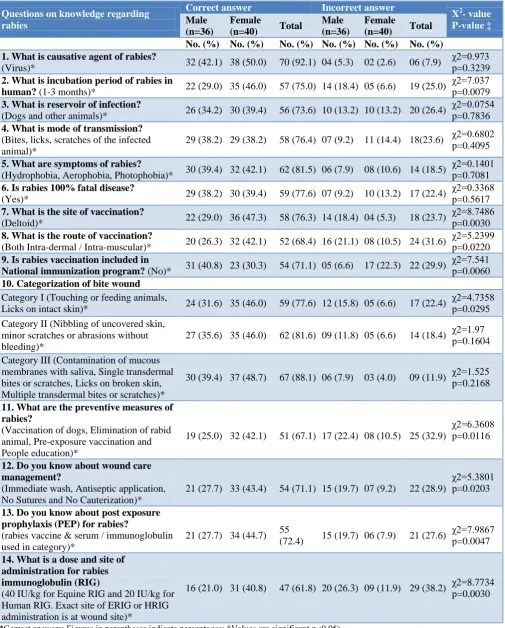
The responses of the interns regarding their knowledge towards rabies were depicted in Table 2.
Table 2: Gender wise distribution of respondent’s knowledge regarding rabies.
Questions on knowledge regarding rabies
Correct answer Incorrect answer
X2- value P-value ‡ Male
(n=36)
Female
(n=40) Total
Male (n=36)
Female
(n=40) Total No. (%) No. (%) No. (%) No. (%) No. (%) No. (%) 1. What is causative agent of rabies?
(Virus)* 32 (42.1) 38 (50.0) 70 (92.1) 04 (5.3) 02 (2.6) 06 (7.9)
χ2=0.973 p=0.3239
2. What is incubation period of rabies in
human? (1-3 months)* 22 (29.0) 35 (46.0) 57 (75.0) 14 (18.4) 05 (6.6) 19 (25.0)
χ2=7.037 p=0.0079
3. What is reservoir of infection?
(Dogs and other animals)* 26 (34.2) 30 (39.4) 56 (73.6) 10 (13.2) 10 (13.2) 20 (26.4)
χ2=0.0754 p=0.7836
4. What is mode of transmission?
(Bites, licks, scratches of the infected animal)*
29 (38.2) 29 (38.2) 58 (76.4) 07 (9.2) 11 (14.4) 18(23.6) χ2=0.6802 p=0.4095
5. What are symptoms of rabies?
(Hydrophobia, Aerophobia, Photophobia)* 30 (39.4) 32 (42.1) 62 (81.5) 06 (7.9) 08 (10.6) 14 (18.5)
χ2=0.1401 p=0.7081
6. Is rabies 100% fatal disease?
(Yes)* 29 (38.2) 30 (39.4) 59 (77.6) 07 (9.2) 10 (13.2) 17 (22.4)
χ2=0.3368 p=0.5617
7. What is the site of vaccination?
(Deltoid)* 22 (29.0) 36 (47.3) 58 (76.3) 14 (18.4) 04 (5.3) 18 (23.7)
χ2=8.7486 p=0.0030
8. What is the route of vaccination?
(Both Intra-dermal / Intra-muscular)* 20 (26.3) 32 (42.1) 52 (68.4) 16 (21.1) 08 (10.5) 24 (31.6)
χ2=5.2399 p=0.0220
9. Is rabies vaccination included in
National immunization program? (No)* 31 (40.8) 23 (30.3) 54 (71.1) 05 (6.6) 17 (22.3) 22 (29.9)
χ2=7.541 p=0.0060
10. Categorization of bite wound
Category I (Touching or feeding animals,
Licks on intact skin)* 24 (31.6) 35 (46.0) 59 (77.6) 12 (15.8) 05 (6.6) 17 (22.4)
χ2=4.7358 p=0.0295 Category II (Nibbling of uncovered skin,
minor scratches or abrasions without bleeding)*
27 (35.6) 35 (46.0) 62 (81.6) 09 (11.8) 05 (6.6) 14 (18.4) χ2=1.97 p=0.1604 Category III (Contamination of mucous
membranes with saliva, Single transdermal bites or scratches, Licks on broken skin, Multiple transdermal bites or scratches)*
30 (39.4) 37 (48.7) 67 (88.1) 06 (7.9) 03 (4.0) 09 (11.9) χ2=1.525 p=0.2168
11. What are the preventive measures of rabies?
(Vaccination of dogs, Elimination of rabid animal, Pre-exposure vaccination and People education)*
19 (25.0) 32 (42.1) 51 (67.1) 17 (22.4) 08 (10.5) 25 (32.9)
χ2=6.3608 p=0.0116
12. Do you know about wound care management?
(Immediate wash, Antiseptic application, No Sutures and No Cauterization)*
21 (27.7) 33 (43.4) 54 (71.1) 15 (19.7) 07 (9.2) 22 (28.9)
χ2=5.3801 p=0.0203
13. Do you know about post exposure prophylaxis (PEP) for rabies?
(rabies vaccine & serum / immunoglobulin used in category)*
21 (27.7) 34 (44.7) 55
(72.4) 15 (19.7) 06 (7.9) 21 (27.6)
χ2=7.9867 p=0.0047
14. What is a dose and site of administration for rabies immunoglobulin (RIG)
(40 IU/kg for Equine RIG and 20 IU/kg for Human RIG. Exact site of ERIG or HRIG administration is at wound site)*
16 (21.0) 31 (40.8) 47 (61.8) 20 (26.3) 09 (11.9) 29 (38.2) χ2=8.7734 p=0.0030
DISCUSSION
Rabies is 100% fatal zoonotic disease which can be preventable by pre and post exposure prophylaxis in the form of anti-rabies vaccination and anti-rabies serum and with the administration of immunoglobulin, but once contracted the disease is invariably fatal.9
Present study revealed that 92.1% of interns were aware of the viral cause of rabies. However, 75% know the correct incubation period of rabies in human. Likewise, 81.5% of the interns know the symptoms of rabies. Similarly a study done by Mishra et alamong medical interns revealed that 94% of interns know the viral cause of rabies.However, only 27% of interns know the correct incubation period of rabies.7 Another study done by Sarkar et al found that 95% medical students were aware of the viral cause of rabies and 83% knew about the signs and symptoms of rabies correctly.8 Whereas a studies done by Praveen et al and Vinay et alamong medical students also found that 88.8% and 93.4% knew that rabies is caused by virus, whereas 48% and 67.3% knew about symptoms of rabies correctly respectively.10,11 A study by Nayak et al also showed the similar findings.12 Majority 76.4% of interns identified that the modes of transmission of rabies are bites, licks and scratches of the infected animal in the present study. Similar findings by Shashikantha et al, Sarkar et al and Praveen et al among medical students, revealed that 74%, 98% and 97% of students had correct knowledge regarding mode of transmission of rabies respectively.5,8,10 Another study by Mishra et al among medical interns revealed that 95% interns had correct knowledge regarding mode of transmission of rabies.7
The present study showed that 68.4% interns knew that route of administration of vaccination could be either intra-muscular or intra-dermal which was still higher than the studies done by Shashikantha et al, Chowdhury et al and Sarkar et al were found 30%, 10% and 35% respectively.5,6,8
Of the total participants, 77.6% interns could correctly classify Category I animal bite wound, whereas 81.6% could classify Category II and 81.1% could classify Category III. Similarly a study done by Chowdhury et al among medical interns found that majority of the interns could correctly classify (Category 1 - 62%, Category 2 – 66% and Category 3 –72.0%) animal bite wound.6 Another study done by Sarkar et al revealed that the knowledge regarding categorization of the wound was overall poor i.e. (Category 1- 67%, Category 2 – 19% and Category 3 –57%).8
In the present study, on the assessment of knowledge of interns on preventive measures, it was found that 67.1%
71.1% interns know the immediate wash of the wound and antiseptic applications to the wound or sites is necessary and do not suture and cauterization of the wound. Similar findings by Chowdhury et al revealed that 96.2% of interns correctly responded regarding wound care management.6 Another study by Sarkar et al found that 89% of the participants correctly responded about wound care management, whereas 33% participants were not aware about the preventive measures of rabies.8
In our study, 72.4% interns had the correct knowledge regarding post-exposure prophylaxis (PEP) for rabies. Similarly a study by Sarkar et al found that 80% interns had correct knowledge regarding post exposure prophylaxis.8 However, low level of knowledge about post exposure prophylaxis for rabies among medical interns was also revealed by Mishra et al, whereas studies by Praveen et al and Vinay et al among medical students, found that more than 50% of the students knew about post exposure prophylaxis correctly.7,10,11 Information about local beliefs can identify knowledge gaps that may affect prevention practices and lead to unnecessary deaths. Prevention is the most efficient and humane means toward improved health. Medical interns are the potential part of the community who shall be the role models for the general population.
Limitations
Limitations of this cross-sectional study is that the findings are from a single private medical college and a certain group of population i.e. medical interns only and as a small sample size; therefore the findings cannot be generalized to all interns or other healthcare professionals in the country.
CONCLUSION
The present study concluded that the knowledge of the interns regarding epidemiological determinants, prevention and management of rabies was not adequate. This implies the fact that interns are lacking in therotical as well in practical exposure. Interns are the physicians of the future. CMEs during internship will also help to address specific knowledge deficiencies. Inadequate knowledge of healthcare personnel will on one hand endanger the life of the patients attending the centers for treatment and increase the healthcare budget of the government on unnecessary vaccines and immunoglobulins on the other.
ACKNOWLEDGEMENTS
but not the least, the authors express their sincere gratitude to all interns of 2018 regular batch for sparing their time to participate in this study.
Funding: No funding sources Conflict of interest: None declared
Ethical approval: The study was approved by the Institutional Ethics Committee
REFERENCES
1. Sudarshan MK. Assessing Burden of Rabies in India: WHO Sponsored National Multicentric Rabies Survey- 2003. Indian J Community Med 2005;30:100-01.
2. Bhargava A, Deshmukh R, Ghosh TK, Goswami A, Prasannaraj P, Marfatia SP, et al. Profile and characteristics of animals bites in India. J Assoc Physicians India. 1996;44:37-8.
3. Mohanty N, Giri PP, Sahu D. Study on the profile of animal bite cases attending the anti rabies vaccination OPD in SCB Medical College and Hospital, Cuttack, Orissa. J APCRI. 2009;10(2):23-6.
4. Balaram D, Taylor LH, Doyle KAS, Davidson E, Nel LH. World Rabies Day – A Decade of Raising Awareness. BioMed Central. 2016;2:19-21.
5. Shashikantha SK, Sheethal MP, Shashank KJ. Awareness among Students of a Medical College Regarding Management of Animal Bite in Bijapur, Karnataka. Natl J Community Med. 2017;8(7):421-4.
6. Chowdhury R, Mukherjee A, Naskar S, Lahiri SK. knowledge of animal bite management and rabies immunization among interns of government medical
college in Kolkata. Int J Med Public Health. 2013;3:17-20.
7. Mishra N, Solanki SL. Assessment of knowledge about rabies in interns of Geetanjali medical college, Udaipur. Int J Community Med Public Health 2015;2:121-3.
8. Sarkar A, Bhavsar S, Bundela C, Gohel A, Makwana N, Parmar D. An assessment of knowledge of prevention and management of Rabies in interns and final year students of Shri M. P. Shah Government Medical College, Jamnagar, Gujarat. J Res Med Den Sci. 2013;1(2):62-6.
9. Park K. Rabies. In: Park K, eds. Park’s Textbook of Preventive & Social Medicine. 21st edn. Jabalpur: Banarsidas Bhanot; 2013: 251-256.
10. Praveen G, Rajashekar HK. Knowledge, awareness and perception of medical college students on rabies and its prevention. Int J Med Sci Public Health. 2014;3:1484-6.
11. Vinay M, Sheetal MP, Mahendra BJ. Awareness regarding rabies and its prevention among medical college students of Mandya Institute of Medical Sciences, Mandya. J APCRI. 2012;13(2):13-5. 12. Nayak RK, Walvekar PR, Mallapur MD.
Knowledge, attitudes and practices of rabies among general practitioners of Belgaum city. Al Ameen J Med Sci. 2013;6(3):237-42.
Cite this article as: Giri PA, Magare AR.