Original Research Article
Knowledge, attitudes and practices of primary schools learners on
sanitation and hygiene practices
Anna P. K. Shilunga
1*, Hans J. Amukugo
1, Kabwebwe H. Mitonga
2INTRODUCTION
The purpose of water, sanitation and hygiene (WASH) in schools is to improve the health and learning performance of school-aged children by reducing water and sanitation related diseases.1 Other social benefits that can be derived from adequate hygiene and sanitation are self-worth, convenience, privacy, security for women and girls, as well as an increase in school enrolments for girls.2 In addition to disease prevention, sanitation and hygiene
play a significant role on learning, the wider community and life-long skills settings.3 The above confirmed by studies that indicated that school children with better knowledge and practices of hand hygiene have fewer sick days and absenteeism and attain higher grades.4,5 However, United Nations Children's Emergency Fund (UNICEF) found that 298 schools in Namibia do not have sanitation facilities, and 93% (276) of these schools are in the five flood-prone northern regions of Oshikoto, Omusati, Ohangwena, Kavango East and Kavango West, and Zambezi regions.6
ABSTRACT
Background: Water, sanitation and hygiene played a significant role in schools by reducing water and sanitation related diseases; subsequently improving the health and learning performance of school-aged children. However, ppeople’s knowledge and attitudes on sanitation and hygiene determine the actual practice towards it. This study aimed at assessing and describing the knowledge, attitudes and practices of primary school learners towards sanitation and hygiene.
Methods: A quantitative, descriptive design was used. A questionnaire was used to collect data among 450 learners in 10 selected primary schools in Ohangwena region. The study population was grade five, six and seven primary school learners. A three staged probability sampling method was employed. Statistical analysis was done using the Statistical Package for Social Sciences version 23.
Results: The result indicated that younger learners in lower school grades, has poorer knowledge, attitudes and practices towards hygiene and sanitation than older learners irrespective of their gender, school circuits or location. This is a logical conclusion because, as learners become older, they become more aware and take precautions about hygiene and sanitation issues.
Conclusions: Younger learners in lower school grades, has poorer knowledge, attitudes and practices towards hygiene and sanitation irrespective of their gender, school circuits or location. The older learners become more aware, and cautious about hygiene and sanitation issues comparing to younger learners. The practice and knowledge of sanitation and hygiene are implicated by the reality of the conditions of the sanitation facilities available to them.
Keywords: Knowledge, Attitudes, Practices, Schools learners, Hygiene, Sanitation
1
School of Nursing, Faculty of Health Sciences, University of Namibia, Windhoek, Namibia
2
School of Public Health, Faculty of Health Sciences, University of Namibia, Oshakati, Namibia
Received: 01 June 2018
Accepted: 05 July 2018
*Correspondence:
Dr. Anna P. K. Shilunga, E-mail: [email protected]
Copyright: © the author(s), publisher and licensee Medip Academy. This is an open-access article distributed under the terms of the Creative Commons Attribution Non-Commercial License, which permits unrestricted non-commercial use, distribution, and reproduction in any medium, provided the original work is properly cited.
Although the Ministry of Education (MoE) in Namibia aims for the schools to have at least one toilet per 30 learners, the situation at hand is that in many schools, more than 60 learners share a toilet facility.7 Inadequate sanitation and hygiene is a major concern in schools due to the greater potential for disease transmission among school learners, who are considered to be a vulnerable group. However, improved knowledge and effective hand hygiene practices especially among children can effectively reduce gastrointestinal and respiratory tract infections, the two leading causes of childhood morbidity and mortality globally.8.9 A study among primary schools in India shows that there was a wide gap between practice and knowledge regarding personal hygiene.10 A cross-sectional survey, conducted in schools in Nicaragua, showed that self-reporting of handwashing practice produced higher rates than those observed practices.11 Conversely, effective hygiene promotion and practice in schools can be severely affected by the level of knowledge and attitudes learners have. Hygiene behaviors and practices are only made possible through a combination of hygiene education, water, sanitation and hygiene, as well as suitable facilities.
Findings from A study among school learners in Ethiopia shown that 76.7% of learners knew the importance of washing hands after toilet use, however, only 14.8% reported actually washing hands.5 Inadequate sanitation facilities lack of appropriate resources such as soap that do not suit learners’ needs and practices, made learners to not always practice according to the knowledge they have.12 Children, whose schools have adequate sanitation and hygiene facilities and resources, are more able to assimilate hygiene education into their daily lives, and can be effective messengers and agents for change in their own homes and the wider community.3 Children are keen to learn and adopt healthy behaviors at a younger age than adults, and if they are brought into the development process as active participants, they can become change agents within their families, and communities.13
The United Nations recognized sanitation and hygiene as one of the world’s utmost life-threatening problem. As a response to the need, the United Nations adopted sustainable development goals (SDGs), of which the sixth one is intended to ensure availability and sustainable management of water and sanitation to all by 2030.14 In 2012, 45% of deaths that occurred in the WHO African Region, was attributed to unsafe WASH services, while for Namibia was 9.8% per 100 000 population. 14 Schools are settings where many children are introduced to good hygiene behavior, practices and hygiene skills that may not be encouraged, or possible, in their own homes.
A lack of improved WASH may also contribute to school absences among learners which are associated WASH related illnesses, reduced school performance, drop-out rates, and delays in academic and social development. WASH related illnesses spread faster in environments
where many children are together for a long time.15 The background above prompted the researcher to consider the following questions:
How do learners practice hygiene at schools despite lack of sanitation facilities?
What knowledge and attitudes do learners have when it comes to sanitation and hygiene practice?
The purpose of this study was to report on the knowledge, attitudes and practices (KAP) of primary school learners on hygiene practices. Consequently, the study will fill the gap by contributing to the achievement of the 6th SDG of the United Nations, especially the sustainability part.
METHODS
A cross-sectional survey was conducted in 2016 among grade five, six and seven learners in ten primary schools in Ohangwena region. A quantitative, descriptive was used to assess and describe the KAP of school learners on sanitation and hygiene practices.
Population and sample
This population was targeted because: they are more likely to be older than 7 years old and cognitively developed to be able to give coherent meanings.16 At each school, the principal, or a teacher assigned by a principal, signed an ’in loco parentis’ consent form granting permission for learners’ participation. In addition, learners themselves provided their assent to participate in the study, and those who refused to participate were not coerced to participate, since participation was voluntary. The population is being taught about sanitation and hygiene, hence the researcher wished to determine if learners KAP correlate with what they are leaning. There were nine circuits, 45 clusters, and 81 primary schools in the Ohangwena region. Eight clusters out of 45 had no primary schools. A three staged stratified sampling method was employed as follow:
Stage 1: a list of the nine circuits in the region was made. Subsequently, five circuits were randomly selected.
Stage 2: a list of 20 clusters within the five sampled circuits was made, whereby10 clusters randomly selected
Stage 3: Primary schools, in each sampled cluster were listed. In the end, 10 out of 24 schools were sampled.
Inclusion criteria
The has to be seven years or older, in grades five, six or seven, willing to participate by giving assent and ability to speak and understand English or Oshikwanyama language.
Exclusion criteria
Younger than seven years, not willing to participate,
unable to communicate in either English or
Oshikwanyama language.
Data collection instrument and procedure
Permission and Ethical clearance was granted by the
University of Namibia’s Postgraduate Studies
Committee, Research Ethical Committee, and the Ministry of Education. Written informed consent and accent was obtained from parents and participants, as well as by teachers as “loco parentis”. Confidentiality and anonymity were ensured. The principles of non-maleficence, beneficence, autonomy and justice were adhered in the study.
A questionnaire with mostly closed ended questions and a few open-ended questions, was used to collect data. The questionnaire was written in English and translated to Oshikwanyama, a local language in Ohangwena region. The questionnaire was pilot tested in July 2015 in three primary schools in Oshikoto region because it was not part of the study.
The questionnaire consisted of five sections: section A:
Demographic information, section B: knowledge
questions, section C questions, Section D practices questions and Section with general questions on hygiene and sanitation promotion in school. Possible responses on Likert’s 5 point scale was used in both section B and C as follow: Strongly agree (SA), Agree (A), Do not know (DK), Disagree (D), and Strongly Disagree (SD), with 5 being the highest score and 0 the lowest score. In addition, learners’ personal hygiene was observed by the as follows: cleanliness of learners’ school uniforms, fingernails, face, hair, scalp, fingernails as well as eyes for the presence of discharges. A 4-point Likert-type scale was included: Very clean (VC), Clean (C), Dirty (D), and Very dirty (VD). Although the questionnaire was intended to be self-administered, the researcher was available to interview those experiencing difficulties in understanding questions, as well as those who could not read properly.
Data analysis
Statistical analysis was done using a [Statistical Package for Social Sciences version (SPSS)] 23. Checklists were checked for completeness before information entered into SPSS. The findings were presented in tables and figures (Table 1).
RESULTS
Data was collected from 450 learners in grade five, six and seven, in ten sampled primary schools in Ohangwena region, with a response rate of 100%. Table 1 presents the socio-demographic information of the respondents. Of the 450 learners, 48.4% were boys, and 51.6% were girls. The majority of learners (80%) were from rural schools; 20% were from urban and peri-urban schools, respectively. The mean age of the learners was 12.82, while the median age was 13 years. The youngest learner was 10 years old, and the oldest was 22 years old.
Learners’ knowledge on hygiene and sanitation
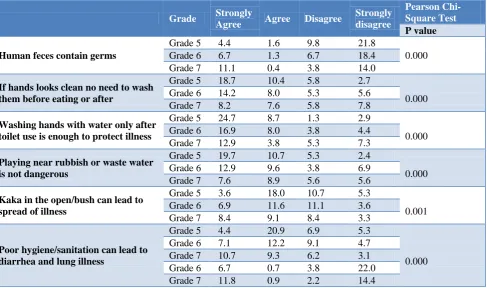
With regard to the knowledge whether human faces contain germs or not, 62.9% knew that human feces contain germs; 37.1% did not have the appropriate knowledge. Pearson Chi-Square statistical test, indicated a statistically significant association between the learner’ school grades and the knowledge whether human feces containing germs (p=0.002). More than half (53%) of learners had the correct knowledge on when to wash hands. 53% did not know that hands have to be cleaned before eating or after using a toilet even if they look clean.
A statistically significant association was found between the learner’ school grades and the question on cleaning of hands before eating or after using a toilet (p=0.000). Only 45% of learners knew that washing hands with water only, after visiting a toilet does not protect illness. The rest of the learners (55%) did not have the correct knowledge. The majority of these learners (42.3%) who did not have the correct knowledge were in the lower grades, 5 and 6. Analysis showed that 62.9% knew that human feces contain germs. Over a half of learners (53%) did not know whether defecation in the open or bush can lead to the spread of illness, whereas the remainder (43%) did confirm this fact. The majority of the leaners (27.7%) without the correct knowledge were in grades 5 and 6. The response to the question that playing near rubbish is not dangerous was that 49.56% disagreed with this statement, and 50.44% did not have the relevant knowledge. Whether poor hygiene and sanitation can lead to diarrhea and lung illness, 38% strongly agree, 18% agree, 27% do not know, 9% disagree while 8 strongly disagree. Furthermore, 45% of learners strongly agreed that washing hands with water only after visiting a toilet does not protect illness. In addition, 53% of learners disagree that “kaka” or defecation in the open or bush can lead to the spread of illness, whereas the remainder (43%) did confirm this fact. Almost half of the learners (49.56%) agreed that playing near rubbish is not dangerous. Many learners, 74% disagreed that human feces contain germs. No association found between gender and knowledge (p=0.537) or between learners’ knowledge and the circuits (p=0.018) or location (p=0.259).
Table 1: Distribution of study participants by socio-demographic characteristics.
Characteristic Sex Total
(n=450) (%) *P value
Male (n=218) (%) Female (n=232) (%) Age of learners (years)
10–12 20.0 24.9 44.9
0.330
13–15 25.3 24.4 49.8
16–18 2.9 2.2 5.1
>19 0.2 0.0 0.2
Grades
Grade 5 18.0 19.6 37.6
0.935
Grade 6 16.4 16.7 33.1
Grade 7 14.0 15.3 29.3
Locations
Urban 5.1 4.9 10.0
0.852
Peri-urban 5.1 4.9 10.0
Rural 38.2 41.8 80.0
Education circuits
Eenhana circuit 9.1 11.1 20.2
0.764
Endola circuit 10.0 10.0 20.0
Ondobe circuit 10.0 10.0 20.0
Ongha circuit 10.4 9.3 18.8
Ohangwena circuit 8.9 11.1 20.0
*P value determined by Pearson chi-square test
Table 2: Association between school grades and learners’ knowledge on hygiene and sanitation.
Grade Strongly
Agree Agree Disagree
Strongly disagree
Pearson Chi-Square Test P value
Human feces contain germs
Grade 5 4.4 1.6 9.8 21.8
0.000
Grade 6 6.7 1.3 6.7 18.4
Grade 7 11.1 0.4 3.8 14.0
If hands looks clean no need to wash them before eating or after
Grade 5 18.7 10.4 5.8 2.7
0.000
Grade 6 14.2 8.0 5.3 5.6
Grade 7 8.2 7.6 5.8 7.8
Washing hands with water only after toilet use is enough to protect illness
Grade 5 24.7 8.7 1.3 2.9
0.000
Grade 6 16.9 8.0 3.8 4.4
Grade 7 12.9 3.8 5.3 7.3
Playing near rubbish or waste water is not dangerous
Grade 5 19.7 10.7 5.3 2.4
0.000
Grade 6 12.9 9.6 3.8 6.9
Grade 7 7.6 8.9 5.6 5.6
Kaka in the open/bush can lead to spread of illness
Grade 5 3.6 18.0 10.7 5.3
0.001
Grade 6 6.9 11.6 11.1 3.6
Grade 7 8.4 9.1 8.4 3.3
Poor hygiene/sanitation can lead to diarrhea and lung illness
Grade 5 4.4 20.9 6.9 5.3
0.000
Grade 6 7.1 12.2 9.1 4.7
Grade 7 10.7 9.3 6.2 3.1
Grade 6 6.7 0.7 3.8 22.0
Grade 7 11.8 0.9 2.2 14.4
*P value determined by Pearson chi-square test
Learners’ attitudes towards hygiene and sanitation
Two thirds of the learners (66.7%) had a poor attitude towards hygiene and sanitation. The rest (33.3%) had a
association was found between the attitude and the learners’ age (p=0.000). While 22.8% learners did not know that hands should be cleaned after defecation, 18.2% did not know that hands should be cleaned before eating. Although many learners strongly agree on cleaning of hands after nose-blowing with plain hands, 23.8% disagreed, 19.3% of those learners who disagreed were mostly in grades 5 and 6. In terms of learners keeping toilet facilities, 27% did not know that it is their
duty to keep the toilet facilities or the school environment clean. There was a statistical significant association between the learners’ gender and the questions related attitude towards keeping the toilet clean, as indicated by the p=0.004.
The study revealed that 97.8% reported washing their hands at school, and only 2.2% that do not do so. Only 21.3% that spits everywhere in the school environment.
Table 3: Association between school location and learners’ attitudes towards hygiene and sanitation.
Location Strongly
agree Agree Disagree
Strongly disagree
Pearson Chi-Square Test
P value
Hands should be cleaned before eating at school/home
Urban 3.8 3.3 2.7 0.2
0.350
Peri Urban 2.2 2.9 4.2 0.7
Rural 22.0 27.3 24.0 6.7
Hands should be cleaned after kaka
Urban 3.1 2.9 3.3 0.7
0.449
Peri Urban 3.3 1.8 4.2 0.7
Rural 19.1 24.9 28.2 7.8
Hands should be cleaned after blowing nose with plain hands
Urban 3.6 0.7 1.6 4.2
0.235
Peri Urban 2.2 0.4 2.7 4.7
Rural 18.4 23.1 23.1 30.2
It is my duty to keep the toilet clean
Urban 3.6 0.2 0.2 6.0
0.495
Peri Urban 2.2 0.2 1.1 6.4
Rural 18.9 2.0 8.2 50.9
It is my duty to keep the school environment clean
Urban 3.3 0.2 0.0 6.4
0.212
Peri Urban 2.0 0.0 0.9 7.1
Rural 16.9 2.9 4.2 56.0
*P value determined by Pearson chi-square test.
Learners’ practices of hygiene and sanitation
In terms of using toilets at school, 92.2% of learners confirmed that they did, and the remaining 7.8% did not do so. While 88.2% of learners used a toilet at school to micturate or defecate; 11.8% did so outside a toilet. The number of learners that always wash their hands before eating and after toilet use were 94.4%. The majority of learners (83.7%) reported always taking care when using the toilet to avoid making it dirty. With regard to personal hygiene observation, 17.6% learners had very dirty clothes, 18.7% had dirty clothes. Furthermore, 32% had clean clothing while 31.8% had very clean clothes. Almost half of the learners (46.7%) had dirty finger nails, and 16.9% had very dirty finger nails.
Learners with very clean finger nails were 14.9%, 21.6% had clean finger nails. Over half of the learners (59.3%) had clean faces; 37.1% with very clean faces, 3.7%) had very dirty faces. An association was found between cleanliness and learners’ age, school circuits and locations (p=0.005). Learners with very clean hair were 49.3%, 29.8% had clean hair, 18.9% had dirty hair, and 2.0% had very dirty hair. There was a statistical significant association between learners’ school grade and cleanliness of hair, shown by a p=0.005. Learners
(16.5%) with dirty hair were in grades 5 and 6. Learners had trimmed finger nails were 56.4%). Ringworms were observed in 11.3% of learners.
DISCUSSION
about hygiene and sanitation issues. The study revealed that some differences in knowledge such as “if hands look clean no need to wash them before eating or after using the toilet” was due to geographic location. This indicates a health challenge that requires urgent attention as confirmed by a p value of 0.002. The normal distribution for the score on knowledge was right skewed meaning more learners scored less than the average score of 16 out of 30. No association was found between the learners’ gender and their knowledge on hygiene and sanitation. This is indicated by the p-value of greater than the common alpha level of 0.05 (ranging between 0.088 and 0.939) in all questions related to knowledge, which indicates that the findings are not statistically significant.
The attitudes vis-à-vis hygiene and sanitation were also similarly scored with an overall correct attitudes score of 25.This means more learners scored less than the average score of 11 out of 25. There were not much gender differences in terms of poor attitudes with regard to gender. Two thirds of the leaners (66.7%) had a poor attitude towards hygiene and sanitation of which 78.7% were in grades 5 and 6. This indicated that the younger the learners in low school grades, the poorer their attitudes towards hygiene and sanitation compared to older learners in higher grads, irrespective of their gender, school circuits or location. There were not much gender differences in terms of poor attitudes: females (50.7%) and males (49.3%). There was no significant statistical association noted between attitudes and school circuits (p-value 0.937), or geographic location of schools: urban, peri-urban and rural (p value is 0.592). All the p-value in those areas were greater than 0.005, as shown in Table 3.This evidence shows that as learners advance and get older in school they are more likely to be responsible and adopt positive attitudes. Like with knowledge, a statistical significant association was found between the attitude and the learners’ age (p=0.000).
The majority of the learners were in the two age groups of 10-12 years and 13-15 years, which indicated that younger learners are not careful enough or they adopt a do not care attitude when it comes to hygiene, unlike older learners. While many learners had the right attitude towards cleanliness of hands, 22.8% of them did not know or believe in cleanliness of hands after defecation. Furthermore, 18.2% did not know or believe in cleanliness of hands before eating, whether at home or at school. Hands are important vehicles that transport infectious illness among children. This is worrisome because even if there is water available at schools, the learners with this belief will not make an attempt to wash their hands after visiting the toilet. The implication is that illness can be easily transmitted through hands; the oral-fecal transmission route can easily infect many learners. There was a statistical significant association between the learners’ gender and the questions related attitude towards keeping the toilet clean, as indicated by the p-value of 0.004. The negative attitude towards keeping the toilet facilities clean might be attributed to the availability
of cleaners who are employed at all schools to oversee the cleanliness of the school environment.
In this study 94.4% of learners report to always wash their hands before eating and after toilet use. This is contrary to the findings by Dajaan et al whereby only few learners always washed their hands with soap before and after eating (32%).17 However, the observation was contrary to self-report on hand wash, since only very few went to the buckets provided as hand wash facilities to wash their hands after toilet use. The handwashing facilities in 80% schools were located outside far from the toiletfacilities, which may have discouraged learners to immediately wash their hands after using a toilet. Xuan and Hoat found that handwashing with water and soap was not a part of a school and home schedule, where nobody reminded schoolchildren.18 The same reason for not washing hands was confirmed Steiner-Asiedu et by in their study among school children in Ghana.19 As with Dajaan findings whereby 53.33% school children claimed to never been educated on how to wash their hands, close to half of the learners (41.6%) in this study were never taught how to wash hands at school.17 Majority of those who had not been taught (38.5%) were young learners in the age groups of 10-12 and 13-15 years old. Despite being taught, vast majority (99.3%) stated that they were never shown or demonstrated to the correct way of washing hands. Joshi and Amadi highlighted the positive effect of an education component on the adherence towards hygiene practices.20,21
92.2% of learners confirmed using toilets at school. While 88.2% of learners used a toilet at school to micturate or defecate; the findings indicated that 11.8% did so outside a toilet. The majority of these leaners (58.5%) were males. Reasons provided for not using toilets at school included: “toilet too dirty, toilet seat is not clean and steady, toilet not open, toilet is not working, toilet is broken, and air (smell) in the toilet is different, toilet occupied. The same practice reported in Kenyan study whereby learners got discouraged from using a school latrine if the building was compromised or if they found something disgusting inside a latrine.12,22
CONCLUSION
This study offers insights into the level of knowledge, attitudes and practices of learners towards sanitation and hygiene that if addressed may positively impact hygiene promotion and practices in primary schools. While the level of knowledge on sanitation is generally high among learners, it does not correlate with the hygiene practices. Insufficient sanitation facilities and their compromising settings that do not meet learners’ needs, made them to not always reflect the knowledge they have, since they are underprivileged to practice proper sanitation-related behaviors they are taught. Lack of hygiene promotion materials and supplies implicate learners’ attitudes and practice of hygiene at school. Since some practices are determined by opportunities available at home, collaboration with parents and communities may greatly improve hygiene practice. The older learners become more aware, and cautious about hygiene and sanitation issues comparing to younger learners. Effective sanitation and hygiene practices in schools is important not only in
disease prevention, but in enhancing academic
performance. The conclusion indicated the extent to which learners struggle to balance the practice and knowledge of sanitation and hygiene they are taught in school and the reality of the conditions and accessibility of the facilities available to them..
ACKNOWLEDGEMENTS
The authors would like to express their heartfelt appreciation to the Ministry of Education and Ohangwena Education Regional Directorate for granting permission for this study, and the learners who dedicated their time in answering the questionnaires.
Funding: No funding sources Conflict of interest: None declared
Ethical approval: The study was approved by the Institutional Ethics Committee
REFERENCES
1. United Nations Children's Emergency Fund
(UNICEF). Water, sanitation and hygiene (WASH) in Schools. 2012.
2. Ministry of Agriculture, Water and Forestry, Namibia. 2009.
3. Adams J, Bartram J, Chartier Y, Sims J. Water, sanitation and hygiene standards for schools in low-cost lettings. Geneva, Switzerland: World Health Organization (WHO), 2009.
4. Mohammed G, Nihar D, Bashayer A, Hiba I, Rasha
A, Zaid A. Knowledge and Practice of Personal Hygiene among Primary School Students in Sharjah-UAE. J Health Sci. 2016;6(5):67-73. 5. Vivas A, Gelaye B, Aboset N, Kumie A, Berhane Y,
Williams MA. Knowledge, Attitudes, and Practices (KAP) of Hygiene among School Children in
Angolela, Ethiopia. J Prev Med Hyg. 2010;51(2):3– 9.
6. United Nations Children's Emergency Fund
(UNICEF). Sanitation in Namibian schools: A dream or a reality? Namibia. 2013.
7. United Nations Children's Emergency Fund
(UNICEF). Addressing low coverage of sanitation and hygiene. 2010. Available at: www.unicef. org/namibia/health_nutrition_13817.html
8. Curtis V, Cairncross S. Effect of washing hands with soap on diarrhea risk in the community: a systematic review. Lancet Infect Dis. 2003;3:275– 81.
9. Mohammed G, Nihar D, Bashayer A, Hiba I, Rasha
A, Zaid A. Knowledge and Practice of Personal Hygiene among Primary School Students in Sharjah-UAE. J Health Sci. 2016;6(5):67-73. 10. Sarkar, M. Personal hygiene among primary school
children living in a slum of Kolkata, India. J Prev Med Hyg. 2013;54 (3):153–8.
11. Jordanova T, Cronk R, Obando W, Medina O Z, Kinoshita R, Bartram J. Water, sanitation, and hygiene in schools in low socio-economic regions in Nicaragua: A cross-sectional survey. Int J Env Res Pub He. 2015;12:6197-217.
12. Caruso BA, Dreibelbis, Robert D, Ogutu EA, Reingans R. If you build it will they come? Factors influencing rural primary pupils' urination and defecation practices at school in western Kenya. J Water Sanit Hyg De. 2014;642:1-52.
13. United Nations Children's Emergency Fund
(UNICEF). Water, Sanitation and Hygiene Annual Report 2013, 2014.
14. World Health Organization (WHO). World health statistics 2016: monitoring health for the SDGs, sustainable development goals. 2016.
15. Eseoghene DI, Igbudu U. Availability and
Utilization of Hand washing Facilities among Primary school Pupils in Ughelli North L.G.A of Delta state. Academic Research International. 2013. 16. Grove S, Burns N, Gray J. The practice of nursing research: Appraisal, synthesis and generation of evidence. 7th ed. Elsevier: St Louis, Missouri; 2013.
17. Dajaan DS, Addo HO, Ojo L, Amegah KE,
Loveland F, Bechala BD, Benjamin BB. Hand washing knowledge and practices among public primary schools in the Kintampo Municipality of Ghana. Int J Community Med Public Health. 2018;5:2205-16.
18. Xuan LT, Hoat LN. Handwashing among
schoolchildren in an ethnically diverse population in northern rural Vietnam. Glob Health Action. 2013;6:18869.
19. Steiner-Asiedu M, Van-Ess SE, Papoe M, Setorglo J, Asiedu DK, Anderson AK. Hand Washing Practices among School Children in Ghana. Current Res J Social Sci. 2011;3(4):293300.
among school children. Int J Env Res Pub He. 2013:984626.
21. Lau HC, Springston EE, Sohn M, Mason I, Gadola E, Damitz, M, et al. Hand hygiene instruction decreases illness-related absenteeism in elementary schools: a prospective cohort study. BMC Pediatr. 2012;12:52.
22. Fehr A. Stress, menstruation and school attendance: effects of water accesss among adolescent girls in
South Gondar. Summary report for CARE Ethiopia. 2010.