Original Research Article
Public private mix in tuberculosis control: is it really working in India?
Ram Gopal Nautiyal
1, Rajesh Kumar Singh
2*
INTRODUCTION
The revised national tuberculosis control programme (RNTCP) of India is the world’s largest Tuberculosis (TB) control programme.1 Despite country wide accessibility of free of cost TB diagnostic and treatment service under the programme, 60-88% of Indian patients irrespective of their financial status, seek TB care from the private health sector, and about 90% of them prefer to buy anti-TB drugs from the market.2-5 This dominance of the private health sector where TB management practices
are largely sub-optimal and treatment completion rate as low as 5-59%, and which usually do not notify TB cases to RNTCP, may seriously jeopardize the success of RNTCP in India.6-10 The RNTCP has been therefore putting in efforts to involve allopathic private practitioners (PPs) through its public-private mix (PPM) with the Indian Medical Association (IMA). IMA is a national level professional body of qualified private and public allopathic practitioners which had declared its support to RNTCP in year 2004 and had endorsed the international standards of TB care in year 2008.11 The RNTCP-IMA PPM project – Indian Medical Professional
ABSTRACT
Background: As significant proportions of the tuberculosis (TB) patients in India are managed by the private sector, integration of the private sector with the revised national tuberculosis control programme (RNTCP) is crucial to achieve TB control in the country. The RNTCP of India has been therefore involving allopathic private practitioners (PPs) since its beginning through its RNTCP- Indian Medical Association public-private mix (RNTCP-IMA PPM) project for inclusive involvement of PPs in the programme to fight against TB. The objectives of the study were to evaluate whether or not the RNTCP-IMA PPM project in India could mobilize the support of the allopathic private practitioners (PPs) by analyzing their knowledge and perception about RNTCP, and their readiness to support the programme.
Methods: A questionnaire based cross- sectional study was conducted in urban areas of districts of Kumaon division of Uttarakhand State of North India.
Results: Of 71 PPs, almost83% knew that in RNTCP sputum acid fast bacillus (AFB) examination was the most important diagnostic test for pulmonary tuberculosis, 66.2% knew that intermittent regimens under direct observation are practiced in RNTCP, 32.4% believed drug regimens in RNTCP of questionable efficacy, 29.6% felt ignored by the programme and only 2.8% felt RNTCP a successful strategy. 50.7% PPs showed readiness to support the programme with government support.
Conclusions: The RNTCP-IMA PPM project seems to have performed sub-optimally as majority (97.2%) PPs did not perceive RNTCP as a successful strategy. For successful RNTCP-IMA PPM, India needs to upscale the existing PPM with strong political will and administrative commitment.
Keywords: TB, RNTCP, IMA, PPM
1Department ofRespiratory Medicine, 2Department of Community Medicine, Government Medical College Haldwani,
Haldwani, Nainital, India
Received: 09 December 2017
Accepted: 03 January 2018
*Correspondence:
Dr. Rajesh Kumar Singh,
E-mail: [email protected]
Copyright: © the author(s), publisher and licensee Medip Academy. This is an open-access article distributed under the terms of the Creative Commons Attribution Non-Commercial License, which permits unrestricted non-commercial use, distribution, and reproduction in any medium, provided the original work is properly cited.
Association Coalition Against TB (IMPACT) aided by Global Fund to fight AIDS, TB and Malaria (GFATM) round-6 (April 2007 to March 2012) was operational in the State of Uttarakhand of India from year 2009 to 2012.12,13
However, there was no documented information available on the effectiveness of RNTCP-IMA PPM project in aligning the PPs with RNTCP in Uttarakhand State of North India. Hence, there was a felt need to conduct this study among PPs practicing in the urban areas of Kumaon division of State of Uttarakhand which is comprised of six of the total thirteen districts of the state. The information so obtained would be useful for planning future targeted approach to ensure inclusive involvement of PPs in RNTCP.
METHODS
The research question for the study was– could the RNTCP-IMA PPM mobilize the support of the PPs in Uttarakhand State of India. The objective of the study was to analyze the knowledge and perception of the PPs about RNTCP and their readiness to support the programme.
Study design and setting
An observational cross- sectional study conducted from October 2013 to November 2014 among PPs practicing in urban areas of Kumaon region of Uttarakhand State of North India.
Study population
There were about 700 allopathic medical practitioners (private+public) registered with IMA in the Kumaon division of State of Uttarakhand, of which 500 were PPs among whom the study population was selected.
Sample size calculation
In the absence of reliable information, we assumed that 50% of the PPs were actively involved in RNTCP activity. The sample size was calculated by using the formula (1.96)2 pq/d2 at 95% confidence interval, and d= 10% desired level of precision. Thus the sample size came out to be 96. Since the sample size exceeds 5% of the source population, we used correction formula of nf= ni/(1+ni/N) where nf= corrected sample size, ni= uncorrected sample size, and N= total number of all the source population.14 Using this formula, final sample size of 80 was required.
Sampling technique and study sample
The participants were selected using purposive sampling. First author (RGN) of this study had been working in the study region for more than a decade as tertiary care academician in the field of TB and was frequently engaged as faculty in academic activities organized for PPs in the region. The investigator was hence well informed about the PPs who had rich clinical practice in the region and were frequently visible in various academic activities.
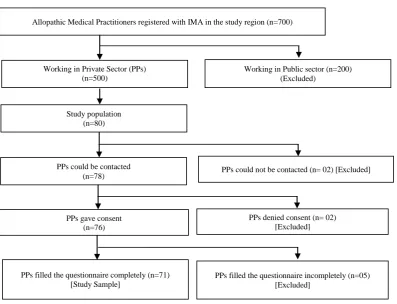
Figure 1: Study sample selection.
Allopathic Medical Practitioners registered with IMA in the study region (n=700)
Working in Private Sector (PPs) (n=500)
Working in Public sector (n=200) (Excluded)
Study population (n=80)
PPs could be contacted
(n=78) PPs could not be contacted (n= 02) [Excluded]
PPs gave consent (n=76)
PPs denied consent (n= 02) [Excluded]
PPs filled the questionnaire completely (n=71) [Study Sample]
Based on this knowledge, the investigator line listed the PPs for inclusion in the study. A semi-structured questionnaire was administered to the listed PPs during different scientific activities, and the PPs were requested to fill the questionnaire in the presence of the investigator. Some listed PPs, who were missed during the scientific sessions, were approached by the investigator at their clinics. Purpose of the study, confidentiality and anonymity were explained to PPs before taking their due consent. After exclusions, a study sample of 71 PPs could be obtained for final analysis (Figure 1).
Statistical analysis
Data was entered in MS excel and descriptive analysis of data was done using numbers and percentages.
Ethical consideration
The study protocol was approved by the Institute Ethical Committee of Government Medical College Haldwani, Nainital, India.
RESULTS
A total of 71 PPs were included in the present study for assessment of their knowledge and perception about RNTCP, and their readiness for involvement in the programme.
Table 1 shows that majority (81.7%) PPs in the study were post-graduates specialized mainly in internal and respiratory medicine, and 18.3% were graduates. About half (52.1%) PPs had some experience of working with public sector before settling in private. The average duration of practice of PPs was 17.5 years with a range from 6 months to 50 years, and majority (36.6%) had more than 20 years of practice.
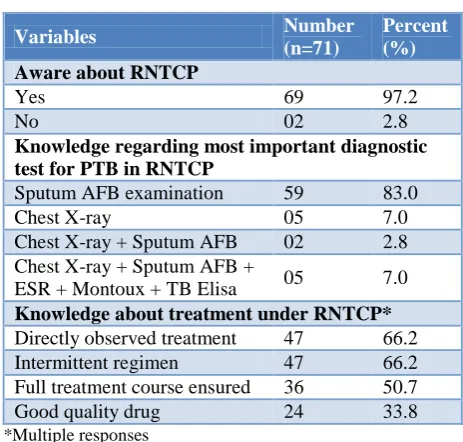
Table 2 shows the knowledge of PPs about RNTCP. Majority (97.2%) PPs were aware of RNTCP and almost 83% knew that in RNTCP, sputum Acid Fast Bacillus (AFB) examination was the most important test for diagnosis of pulmonary tuberculosis (PTB). Two-third (66.2%) PPs were aware that in RNTCP intermittent drug regimens were administered under direct observation, and 50.7% knew that full course of anti TB drugs was ensured in the programme. Only one-third (33.8%) knew that drugs provided by RNTCP were of good quality.
Table 3 shows PPs’ perceptions about RNTCP. About one-third (32.4%) perceived that intermittent drug regimens in RNTCP were of questionable efficacy and 22.5% believed these regimens might create multi-drug resistant TB (MDR-TB), 29.6% felt ignored by RNTCP and only 2.8% PPs perceived RNTCP as a successful strategy.
Table 1: Socio-demographic profile of private practitioners.
Variables Number
(n=71)
Percent (%)
Professional qualification
Graduate 13 18.3
Post-graduate (internal
medicine) 32 45.1
Post-graduate (respiratory
medicine) 10 14.1
Post graduate (other
disciplines) 16 22.5
Place of practice (district)
Nainital 26 36.6
Udham Singh Nagar 32 45.1
Almora 09 12.7
Pithoragarh 03 04.2
Champawat 01 01.4
Past experience of working in public sector
Yes 37 52.1
No 34 47.9
Duration of practice (years)
0–5 16 22.5
6–10 13 18.3
11–20 16 22.5
>20 26 36.6
Table 2: Awareness and knowledge of private practitioners regarding RNTCP.
Variables Number
(n=71)
Percent (%)
Aware about RNTCP
Yes 69 97.2
No 02 2.8
Knowledge regarding most important diagnostic test for PTB in RNTCP
Sputum AFB examination 59 83.0
Chest X-ray 05 7.0
Chest X-ray + Sputum AFB 02 2.8
Chest X-ray + Sputum AFB +
ESR + Montoux + TB Elisa 05 7.0
Knowledge about treatment under RNTCP*
Directly observed treatment 47 66.2
Intermittent regimen 47 66.2
Full treatment course ensured 36 50.7
Good quality drug 24 33.8
*Multiple responses
Table 3: Practitioner’s perception about RNTCP.*
Perception Number
(n=71)
Percent (%)
Questionable efficacy 23 32.4
May create MDR-TB 16 22.5
Poorly tolerated 13 18.3
Compulsory sputum test is
unnecessary 11 15.5
Ignores the private sector 21 29.6
Compromises patient privacy 03 4.2
Successful strategy 02 2.8
*Multiple responses
Table 4: Involvement of private practitioners in RNTCP.
Variables Number
(n=71)
Percent (%)
Running any RNTCP service
Yes 00 00.0
No 71 100.0
Obstructions felt in starting RNTCP services*
Needs extra man power 39 54.9
Needs extra space 17 23.9
Needs extra time 34 47.9
It is Government’s duty 04 5.6
Readiness to start RNTCP service with government support
Yes 36 50.7
No 35 49.3
Referral of TB patients
Diagnose and treat most
patients self 68 95.8
Refer to Government hospitals 02 2.8
Refer to private chest specialist 01 1.4
Record keeping of TB patients
Yes 00 00.0
No 71 100.0
*Multiple responses.
DISCUSSION
In India, RNTCP is implemented through public health infrastructure. As health is a low priority state in India, resultant deficiencies prevalent in the public health sector render it less attractive to patients. Further, for reasons of convenience, flexibility, patient friendliness and individualized care available in private, majority TB patients seek treatment from private health sector.15 This phenomenon has the potential to disrupt RNTCP’s TB control efforts in India. Therefore, success of RNTCP in India critically depends on catering the private TB patients through a strong PPM. In India several small scaled earlier PPMs with limited impact had shown that integration of the private health sector into RNTCP had the potential to improve TB notifications and overall TB control in India.16-18 Over the time, as the RNTCP moved
towards universal access, the RNTCP managers felt the need of a large scale generic PPM. As a result, RNTCP-IMA PPM project– IMPACT came into existence in India to seek support of PPs to the cause of RNTCP.
Our study examined whether the GFATM round- 6 aided RNTCP-IMA PPM project– IMPACT could really succeed in getting support of PPs in Uttarakhand State of North India where it was operational from year 2009 to 2012.
On the question of knowledge of the PPs about RNTCP, our study documents that majority (97.2%) PPs were aware of RNTCP. De Costa et al from Ujjain district of Madhya Pradesh and Basu et al from West Bengal (India) had also reported that most of the PPs in their studies were aware of RNTCP.19,20 Most PPs (83%) in our study knew that in RNTCP, sputum AFB examination was the most important diagnostic test for PTB. About two-third (66%) of the PPs knew that treatment under RNTCP was intermittent and directly observed. Half (50.7%) of the PPs were aware of the fact that once registered under RNTCP, full course of anti-TB treatment is ensured to the patient, and one-third (33.8%) PPs knew that the anti-TB drugs dispensed in RNTCP were of good quality. These findings in our study highlight that the RNTCP-IMA PPM project had provided educational input to the PPs in the State. However, ignorance among half of the PPs about provision of availability of ensured full course of anti-TB drugs and doubt in the minds of nearly two-third PPs about quality of anti-TB drugs in RNTCP reflects lack of wholesome efforts by the PPM project in educating the PPs about RNTCP.
(97.2%) may have significant public health implications in India. The PPM still needs to go a long way to overcome this perception.
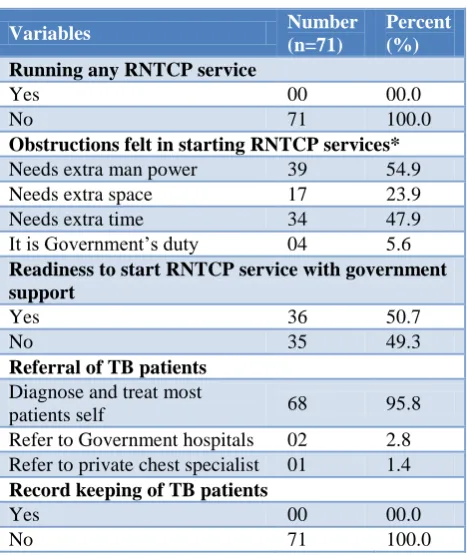
Regarding involvement of the PPs in the RNTCP, it was evident in this study that PPs did not provide RNTCP service at their clinics due to constraints of manpower, space and time. This shows their indifference for a programme of much public health importance in India. However, about half (50.7%) the PPs were willing to start RNTCP service at their clinics if government would support them. In a study by Basu et al only 10% of the PPs expressed willingness to get involved in the programme which is much lower in comparison to our study.20 Dutta et al had reported that about two-third PPs in their study showed willingness for involvement in RNTCP where Thakur et al had reported 82% of PPs expressing their willingness to participate in the programme. RNTCP can utilize this opportunity in future.24,25
It is pertinent to note that most (95.8%) PPs in this study did not want to refer their TB patients to the public health sector for diagnosis and treatment. There may be many reasons for non-referral. First, majority PPs did not perceive RNTCP as a successful strategy. Second, PPs felt ignored by RNTCP. Third, as TB patients may constitute a large part of practice of many PPs, referrals may cause monetary loss to them. Poor referral and no record keeping of TB patients by the PPs as is evident in this study and other studies is detrimental to successful TB notification in India.10 Unless RNTCP infuses a strong public health sentiment in PPs, they may not keep records and refer their TB patients to public health sector.
Limitations
This study was conducted using purposive sampling. However, the idea behind this type of sampling among the PPs was to examine the knowledge, perception and level of involvement of those who were academically active lead practitioners of repute in the urban areas of Kumaon region of Uttarakhand State, and were hence supposed to be maximally exposed to the PPM and best informed about RNTCP. Further, we could not interview 11% of the desired study sample. These are the usual limitations in any questionnaire based study. This study did not provide information on the non allopathic medical practitioners and practitioners practicing in rural areas. Further, the result of this study is applicable only up to year 2014, what changes in this regard happened after this period is matter for subsequent studies.
CONCLUSION
As majority (97.2%) PPs did not perceive RNTCP as a successful strategy, the RNTCP-IMA PPM project IMPACT seems to have performed sub-optimally in convincing majority PPs to support the cause of RNTCP in India. The project’s activities were probably limited to
provide only superficial formal educational input to PPs about RNTCP and hence could not succeed in infusing anti-TB public health sentiment among the PPs despite willingness for involvement in RNTCP expressed by 50% PPs in this study. As poor performance of this PPM may potentially challenge the success of RNTCP, future research is needed to find reasons for sub-optimal performance of the RNTCP-IMA PPM project. For successful RNTCP-IMA PPM, India needs to upscale the existing PPM with strong political will and administrative commitment.
Funding: No funding sources Conflict of interest: None declared
Ethical approval: The study was approved by the Institutional Ethics Committee of Government Medical College Haldwani, Nainital, India
REFERENCES
1. Central TB Division, Directorate General of Health Services, Ministry of Health & Family Welfare, Government of India, TB India 2009, RNTCP status report.
2. Uplekar M, Juvekar S, Morankar S, Rangan S, Nunn P. Tuberculosis patients and practitioners in private clinics in India. Int J Tuberc Lung Dis. 1998;2(4):324-9.
3. Suganthi P, Chadha VK, Ahmed J, Umadevi G, Kumar P, Srivastava R, et al. Health seeking and knowledge about tuberculosis among persons with pulmonary symptoms and tuberculosis cases in Bangalore slums. Int J Tuberc Lung Dis. 2008;12(11):1268–73.
4. Hazarika I. Role of Private Sector in Providing Tuberculosis Care:Evidence from a Population-based Survey in India. J Global Infect Dis. 2011;3(1):19-24.
5. Pinto LM, Udwadia ZF. Private patient perceptions about a public programme;what do private Indian tuberculosis patients really feel about directly
observed treatment?. BMC Public Health.
2010;10:357-61.
6. Prasad R, Nautiyal RG, Mukherji PK, Jain A, Singh K, Ahuja RC. Treatment of new pulmonary tuberculosis patients:what do allopathic doctors do in India?. Int J Tuberc Lung Dis. 2002;6(10):895-902.
7. Udwadia ZF, Pinto LM, Uplekar MW. Tuberculosis Management by Private Practitioners in Mumbai, India:Has Anything Changed in Two Decades? PLoS ONE. 2010;5(8):e12023.
8. Uplekar MW, Shepard DS. Treatment of
tuberculosis by private general practitioners in India. Tubercle. 1991;72(4):284-90.
10. The Centre for Health Research and Development (CHRD). Involvement of private practitioners in the RNTCP - the rationale, problems encountered and likely operational models. Health Admin. 2003;15(1-2):61-71.
11. Prasad R, Nautiyal RG, Mukherji PK, Jain A, Singh K, Ahuja RC. Diagnostic evaluation of pulmonary tuberculosis:what do doctors of modern medicine do in India? Int J Tuberc Lung Dis. 2003;7(1):52-7. 12. Central TB Division, Directorate General of Health
Services, Ministry of Health & Family Welfare, Government of India, TB India 2011, RNTCP status report.
13. World Health Organization. A brief history of tuberculosis control in India. Geneva, WHO 2010. Available at: http://apps.who.int/iris/bitstream/ 10665/44408/1/9789241500159_eng.pdf. Accessed on 14 November 2017.
14. Bartlett JE, Kotrlik JW, Higgins CC. Organizational Research: Determining Appropriate Sample Size in Survey Research. Information Tech Learning, Performance J. 2001;19(1):43-50.
15. Social assessment study for RNTCP- Final Report, submitted to: Central TB Division, Ministry of Health and Family Welfare (Government of India ), New Delhi. ORG Centre for Social research 2003. 16. Lonnroth K, Uplekar M, Arora VK, Juvekar S,
Nguyen TNL, Mwaniki D, et al. Public-private mix for DOTS implementation: what makes it work? Bull World Health Organization. 2004;82:580-6. 17. Dewan PK, Lal SS, Lonnroth K, Wares F, Uplekar
M, Sahu S, et al. Improving tuberculosis control
through public-private collaboration in
India:literature review. BMJ. 2006;332:574-8. 18. Bhatia V. Enhancing private sector contribution to
TB care in India. Samm health International.
Funded by the Global Fund to Fight AIDS, TB and Malaria. 2010.
19. De Costa A, Kazmi T, Lönnroth K, Uplekar M, Diwan VK. PPM:'public-private' or 'private-public' mix? The case of Ujjain District, India. Int J Tuberc Lung Dis. 2008;12(11):1333-5.
20. Basu M, Sinha D, Das P, Roy B, Biswas S,
Chattopadhyay S. Knowledge and practice
regarding pulmonary tuberculosis among private practitioners. Ind J Comm Health, 2013;25(4);403-12.
21. Dosumu EA. Survey of knowledge, attitudes, and practices regarding management of tuberculosis among general practitioners in Nigeria. Afr J Resp Med. 2008;1:17-9.
22. Azhar GS. DOTS for TB relapse in India:A systematic review. Lung India. 2012;29(2):147-53.
23. Salve S, Sheikh K, Porter JDH. Private
Practitioners’ Perspectives on Their Involvement With the Tuberculosis Control Programme in a Southern Indian State. Int J Health Policy Manag. 2016;5(11):631–42.
24. Datta K, Bhatnagar T, Murhekar M. Private practitioners' knowledge, attitude and practices about tuberculosis, Hooghly district, India. Indian J Tuberc. 2010;57(4):199-206.
25. Thakur JS, Kar SS, Sehgal A, Kumar R. Private sector involvement in tuberculosis control in Chandigarh. Indian J Tuberc. 2006;53:149-53.