Original Research Article
A KAP study of oral health status among adults in a rural area of
Jammu District
Kiran Bala
1, Reecha Gupta
2*, Anjum Ara
1, Bhavna Sahni
1INTRODUCTION
Demographic, nutritional and epidemiological transitions with improved standard of living in India have resulted in increased burden of both infectious and lifestyle diseases. Of all the non communicable diseases, oral diseases are the most common and can result in discomfort, disfigurement and even death.1 Moreover oral health is a key indicator of overall health and general wellbeing of an individual.
According to the Global Burden of Disease Study 2016, 3.58 billion people worldwide are affected by oral
diseases with caries of the permanent teeth being the most prevalent of all conditions assessed. Globally, it is estimated that 2.4 billion people suffer from caries of permanent teeth and 486 million children suffer from caries of primary teeth.2
Oral diseases are still a burden in developing countries like India and their prevalence is determined by number of factors like geographical region, availability and accessibility of oral health services. Dental caries and periodontal diseases are the two most common oral diseases in India.3 India has also earned the name of “oral cancer capital” of the world due to high intake of both ABSTRACT
Background: Oral health is an integral part of general health and well being. It is important to know about the factors which having a bearing on oral health so that preventive measures can be taken. A research activity was planned to assess the oral health status and oral health practices of people in a rural community of Jammu region as very little is known about the knowledge and oral health practices of adults residing in this area.
Methods: A cross sectional study for a period of four months was conducted in a village Tanda of R.S.Pura block of Jammu district. 324 adults above the age of 20 years (145 males and 179 females) were interviewed face to face with the help of a questionnaire consisting of questions from WHO technique of self assessment of oral health along with some more questions exploring the knowledge, attitude and local oral health practices.
Results: The overall results showed adequate knowledge but poor attitude regarding oral health. Out of 324 subjects studied, 41.7% paid dental visits on having pain in teeth, gums or mouth and only 3.0% visited dentist routinely. 85.6 % of participants reported using brush and toothpaste but only 24.0% of all respondents brushed twice a day and only 16.7% of the respondents changed their tooth brush within three months.
Conclusions: Oral health awareness, by promoting community based programs should be undertaken at periodic intervals for better oral health and hygiene.
Keywords: Oral health practices, Knowledge, Brushing, WHO questionnaire
1
Department of Community Medicine, Government Medical College, Jammu, India
2
Department of Prosthodontics and Dental Materials, Indira Gandhi Government Dental College, Jammu, India
Received: 26 November 2018
Revised: 12 December 2018
Accepted: 13 December 2018
*Correspondence:
Dr. Reecha Gupta,
E-mail: [email protected]
Copyright: © the author(s), publisher and licensee Medip Academy. This is an open-access article distributed under the terms of the Creative Commons Attribution Non-Commercial License, which permits unrestricted non-commercial use, distribution, and reproduction in any medium, provided the original work is properly cited.
smoked and smokeless tobacco products, which are strongly associated with oral cancers.4 These diseases are concentrated more in rural areas and in socially and economically backward population groups.
The main etiological risk factors leading to oral diseases are genetic predisposition, developmental problems, poor oral hygiene and traumatic incidences.5 Socio cultural determinants like poor living conditions, low education, traditions beliefs and practices in support of oral health also play a major role in aetiology of oral diseases. Unhealthy diet, use of tobacco in any form and alcohol are the major risk factors for both oral diseases and leading chronic diseases– cardiovascular diseases, cancer, chronic respiratory diseases and diabetes.
For assessing the current oral health status of population, the World health organization has developed manual health surveys for different age groups for all countries to conduct standardized oral health surveys.6 According to World Health organization (WHO), promotion of oral health is a cost-effective strategy to reduce the burden of oral health diseases and maintain oral health and quality of life.7 Lack of knowledge and following wrong practices related to oral health are very important factors resulting in poor oral hygiene, therefore it is important to assess the knowledge, attitude and practices of community so that we can focus on health related behaviours and improve knowledge and awareness which would be instrumental in the effective prevention of dental diseases.
There are number of studies related to oral health which are done on school children but very few are done in adults and there is dearth of literature of such studies in our set up. With this background, this community based study was planned and conducted to assess the oral health knowledge, attitude and practices of adults residing in village Tanda of R.S Pura block in Jammu district.
METHODS
A cross sectional study on oral health of adults was conducted in R.S. Pura for a period of four months from (1st April 2018 to 31st July 2018). R.S. Pura is also a rural health training centre of Community Medicine Department GMC Jammu and the block is divided into 8 health zones. For study purposes, village Tanda was chosen randomly from Miran Sahib Zone. Complete enumeration of all the residents of the village was done by house to house visits. All adults both females and males above the age group of 20 years, residing permanently in the study area and who gave their consent for participation were included in the study. Those who were not present for two consecutive visits at their respective homes and those who did not gave consent for the study were excluded from the study. The final sample size was 324. After explaining the purpose of the study the information was collected by using face to face interview method. The data was mainly collected using
the WHO technique of „Self-assessment of oral health through use of questionnaires‟ for adults. Along with WHO adult questionnaire, some closed ended questions adapted from previous similar studies, exploring the knowledge, attitude and practices regarding oral health were also included.
The WHO oral health questionnaire is a simplified structured questionnaire for collection of self-assessed data on oral health and risk factors for adults. The WHO questionnaire has a set of sixteen questions with multiple choice answers. The questions range from knowledge about importance of cleaning of teeth, frequency of cleaning, use of toothpaste, use of aids for oral hygiene, use of toothpaste containing fluoride, dental visits, reasons for dental visit, use of tobacco, type and frequency, consumption of alcohol and level of education etc. Additional questions assessing the attitude and practices included inquiry about the health facility they used in case of dental problems, importance of oral health to general health and whether they were afraid of visiting dentist or not, cleaning of tongue, rinsing of mouth after meals, timing of changing toothbrush. The questions were translated into local language and simplified for the understanding of the subjects. During the study, dental problems requiring immediate attention were referred to the dentist for appropriate management.
The overall knowledge, attitude and practices concerning oral hygiene were assessed based on the responses to the questionnaire. Knowledge variables were scored and respondents answering ≥70% of the knowledge questions correctly were considered as having good level of knowledge and others were considered to have unsatisfactory knowledge. The attitude variables comprised of 6 questions and ≥70% correct responses for a statement were considered as having positive attitude towards that aspect. While the practice variables comprised of 8 questions and if a question had a ≥70% or more of correct responses, the participants were said to have good practices regarding that aspect, otherwise considered to have unsatisfactory practices regarding the same. All recorded data were coded and entered into Microsoft Excel 2007. Descriptive statistics was used to summarize the responses of the questionnaire.
RESULTS
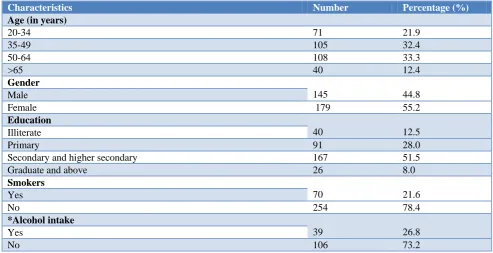
Two third of the study participants were in the age group of 35 to 64 years followed by 20 to 34 year old age group. 55% of the study population was constituted by females, while half of the participants had completed secondary or higher secondary school of education and 12.5% had no education at all. 21.6% of the participants were currently smoking (Table 1).
found to be good whereas the knowledge regarding the use of dental floss and the role of fluoride in tooth decay was poor. Only half of the participants were aware of the fact that one should visit dentist for maintenance of oral health.
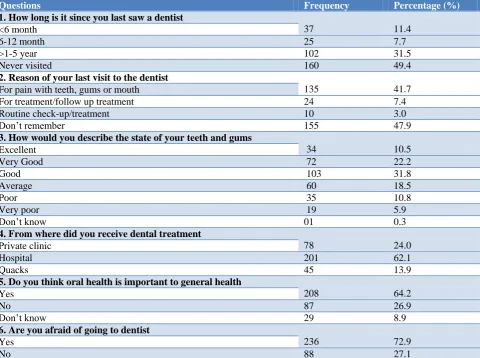
Table 3 shows the attitude of participants toward dental care. Half of the study population never visited dental clinics and 31.5% have visited between two to five years. 41.7% of the sample went to the dentist solely for treatment of pain with teeth, gums or mouth. Only 3% have visited for routine check ups. Approximately 64.5% of the study participants were satisfied with their oral
health (both teeth and gums) and graded them from excellent to good. 62.1% of the study population relied upon hospital for managing dental problems and almost same percentage of participants believe that oral health is as important as general health.
A total of 73.1% subjects cleaned their teeth regularly. Almost all the participants used toothbrush and toothpaste (93.5%). 61% of the subjects change their toothbrush within 3 months and 9.3% use fluoridated tooth paste. Approximately two third of the respondents cleaned their tongue every day and three fourths rinsed their mouth after meals (Table 4).
Table 1: Socio demographic characteristics of study participants.
Characteristics Number Percentage (%)
Age (in years)
20-34 71 21.9
35-49 105 32.4
50-64 108 33.3
>65 40 12.4
Gender
145 44.8
Male
Female 179 55.2
Education
40 12.5
Illiterate
Primary 91 28.0
Secondary and higher secondary 167 51.5
Graduate and above 26 8.0
Smokers
70 21.6
Yes
No 254 78.4
*Alcohol intake
39 26.8
Yes
No 106 73.2
*Only males were included.
Table 2: Oral health knowledge among study participants.
Questions based on knowledge about oral health Frequency Percentage (%)
1. Teeth are an important part of your body
Yes 229 70.6
No 95 29.4
2. Daily cleaning of teeth can prevent dental caries
Yes 243 75
No 81 25
3. Regular visit to dentist helps to keep your teeth in a healthy state
Yes 144 44.4
No 180 55.5
4. Consuming sweetened food products or drinks cause dental caries
Yes 278 85.8
No 46 14.2
5. Use of fluoridated toothpaste prevents tooth decay
Yes 24 7.2
No 31 9.5
Don‟t know 270 83.3
Questions based on knowledge about oral health Frequency Percentage (%)
6. Smoking/chewing paan/guthka is harmful for oral health
Yes 286 88.3
No 38 11.7
7. Do you know about the use of dental floss
Yes 05 1.5
No 319 98.5
8. How many natural teeth you have
None 06 1.9
1-9 teeth 21 6.5
10-19 teeth 29 8.9
20 teeth or more 268 82.7
Table 3: Attitude of study participants towards dental care.
Questions Frequency Percentage (%)
1. How long is it since you last saw a dentist
37 11.4
<6 month
6-12 month 25 7.7
>1-5 year 102 31.5
Never visited 160 49.4
2. Reason of your last visit to the dentist
135 41.7
For pain with teeth, gums or mouth
For treatment/follow up treatment 24 7.4
Routine check-up/treatment 10 3.0
Don‟t remember 155 47.9
3. How would you describe the state of your teeth and gums
34 10.5
Excellent
Very Good 72 22.2
Good 103 31.8
Average 60 18.5
Poor 35 10.8
Very poor 19 5.9
Don‟t know 01 0.3
4. From where did you receive dental treatment
78 24.0
Private clinic
Hospital 201 62.1
Quacks 45 13.9
5. Do you think oral health is important to general health
208 64.2
Yes
No 87 26.9
Don‟t know 29 8.9
6. Are you afraid of going to dentist
236 72.9
Yes
No 88 27.1
Table 4: Distribution of study populations based on practices regarding oral health.
Practices Number Percentage (%)
1.Do you clean your teeth
237 73.1
Regularly
Sometimes 53 16.3
Never 34 10.6
*2.Aid used for cleaning teeth
Toothbrush 264 81.5
Wooden and plastic toothpicks 40 12.4
Finger 12 3.7
Dental floss 08 2.4
Practices Number Percentage (%)
3. Material used for cleaning teeth
Tooth paste 291 89.8
Charcoal 2 0.6
Miswak/chewstick 31 9.6
4.Which type of toothpaste do you use
Non fluoridated 24 7.4
Fluoridated 30 9.3
Don‟t know 270 83.3
5. Do you clean your tongue
Everyday 205 63.3
Sometimes 30 9.3
Never 89 27.4
6. How often do you change your toothbrush
<3 months 54 16.7
3-6 Months 70 21.6
>6 months 200 61.7
7. Do you rinse mouth after meals
249 76.9
Yes
No 75 23.1
8. How often do you clean your teeth
198 61.1
Once a day
Twice a daily 78 24.1
More than twice a daily 48 14.8
DISCUSSION
Each one of us loves to smile and look beautiful but very few of us take our oral health problems seriously. People are either not aware of the consequences of improper oral health care or they underestimate it. In our study 145 males and 179 females were interviewed. The results of our study showed that the community had adequate knowledge but unsatisfactory attitude towards oral health. The oral health practices of the community were relatively good with regard to some variables and below average with regard to others.
Overall knowledge was found to be average as participants answered 57% of the questions correctly with approximately 70% to 80% of the participants giving correct responses to questions pertaining to brushing, affects of tobacco and sweets on oral health. 98.2% of the participants had no idea of dental floss and 83.3% had never heard of fluorides.
Only 19.1% participants had visited a dentist in the last 12 months which is quite low as compared to the study conducted by Shammari et al in which 60% of the participants had visited a dentist in the last 12 months.8 49.4% of the subjects in the present study had never visited a dentist for oral health problems. This is in concordance with the study conducted by Singh et al in patients attending the North Indian School.9
In our study 41.7% of the respondents reported pain in tooth, gums or mouth as the most commonly cited reason for visiting a dentist which is in concordance with the
findings of Al-Beiruti who found that 69.5% of the participants visited a dentist when they had pain.10 Approximately half 47.9% of the participants did not remember the reason for their visit thereby showing their casual attitude towards dental care.
In the present study, 10.8% of study participants perceived health status of their teeth and gums as poor and 5.9% as very poor which was almost half in comparison to the study conducted by Diwan et al and meagre when compared to a study conducted by Varenne et al.11,12
For receiving dental treatment 62.1% of study participants visited nearby Government hospital whereas 24.0% visited private clinics. Due to lack of awareness, 13.9% sought advice and treatment from unqualified dental care providers or traditional healers. In addition, on asking about the relationship between oral health and general health, only 64.2% agreed to know this association and 26.9% were of the opinion that there is no association this is in agreement with the findings of Singh et al.9 Majority of the respondents 72.9% stated that they are afraid of visiting the dentist.
In our study, we found 61.1% people brushed only once a day, which is in agreement with the study conducted by Singh et al and Gupta where 69.0%, 68.5% people brushed only once a day.9,15 However for maintaining good oral hygiene the Indian Dental Association recommends brushing the teeth twice a daywhich was reported only by 24.0% of the subjects and it was quite less than the study conducted by Al-Johani 38.5%.13,16
Regarding the practice of changing the brush, 3 month duration of time has been advocated as ideal. 16 This time frame was practiced by only 16.7% of our population which is similar to the study conducted by Jain et al while it was found to be double among the subjects studied by Gupta 35.8%.15,17 Education and awareness at dentist level is hereby required to lay stress on the change of brush at 3 months interval. The use of other methods for cleaning teeth like dental floss, fingers, wooden and plastic tooth pick was reported as 2.4%, 3.7% and 12.4% respectively. The use of less dental floss is similar to a study conducted by Jamjoom in Saudi Arabia whereas in a study done by Padma et al 7.6% of the subjects use dental floss.18,19 This emphasizes the urgent need for educating and motivating the public to use this efficient method for oral health care. The less use can be attributed to the lack of oral health education and awareness in rural set ups.
Practice of cleaning tongue is an essential component of oral health hygiene and it was found to be adequate 63.3% whereas in another study conducted by Jain et al only 20% of sample has the habit of cleaning tongue.17 In our study, practice of rinsing mouth after meals was found to good with response rate of 76.9%. Tooth paste containing fluorides was used by only 10% of the participants and it was quite surprising that 83.3% of respondents did not know about such toothpastes whereas in a study conducted on dentists revealed use of fluoridated toothpaste in more than half of study respondents.20 This could be due to the fact that study was conducted among dental professionals who are fully aware of benefits of fluorides. We cannot generalise our findings due to small sample size.
CONCLUSION
To conclude, our study provided the base line information of oral health status among rural adult population. The findings of our study showed that there is a need to sensitize the adults in rural area by organizing community based outreach sessions so that they can prioritize oral health and inculcate better oral health practices in their daily regimens and that of their children‟s at early age.
Funding: No funding sources Conflict of interest: None declared
Ethical approval: The study was approved by the Institutional Ethics Committee
REFERENCES
1. Oral health. Available at: www.who.int/ news-room/factsheets/detail/oral-health. Accessed on 25 Nov 2018.
2. Global, regional, and national incidence, prevalence, and years lived with disability for 328 diseases and injuries for 195 countries, 1990-2016: a systematic analysis for the Global Burden of Disease Study 2016. Lancet. 2017;390(10100):1211-59.
3. Bali RK, Mathur VB, Talwar PP, Chanana HB. National oral health survey and fluoride mapping. New Delhi: Dental Council of India; 2002-03. 4. Global Adult Tobacco Survey (GATS) India
2009-2010. Ministry of Health and Family Welfare, Govt. of India, New Delhi.
5. Parveen M, Ahmed B, Bari A, Butt AM. Oro Dental Health: Awareness and Practices. J Univ Med Dent Coll. 2011;2:5–11.
6. World Health Organisation 2013. Oral Health Surveys: Basic Methods. 5th edition. WHO Oral Health Questionnaire for adults. Annex 7. Available from www.who.int/oral health.
7. World Health Organization. Oral health:action plan for promotion and integrated disease prevention. 2007. Available at: http:/www.who.int/iris/ handle/10665/21909. Accessed on 26 Nov 2018. 8. Al-Shammari KF, Al-Ansari JM, Al-Khabbaz AK,
Dashti A, Honkala EJ. Self-reported oral hygiene habits and oral health problems of Kuwaiti adults. Med Princ Pract. 2007;16:15-21.
9. Singh A, Gambhir RS, Singh S, Kapoor V, Singh J. Oral health: How much do you know? - A study on knowledge, attitude and practices of patients visiting a North Indian dental school. Eur J Dent. 2014;8:63-7.
10. Al-Beiruti N. Oral health behaviour among a sample of schoolteachers, physicians and Nurses in the Syrian Arab Republic. East Mediterr Health J. 1997;3:258–62.
11. Diwan S, Saxena V, Bansal S, Kandpal SD, Gupta N. Oral Health: Knowledge and practices in Rural Community. Indian J Community Health. 2011;22:29-31.
12. Varenne B, Petersen PE, Ouattara S. Oral health behavior of children and adults in urban and rural area of Burkina Faso, Africa. Int Dent J. 2006;56:61-70.
13. Johani HA. Oral hygiene practice among Saudi patients in Jeddah. Cairo Dent J. 2008;24:395-401. 14. Ali NS, Khan M, Butt M, Riaz S. Implications of
practices and perception on oral hygiene in patients attending a tertiary care hospital. J Pak Dent Assoc. 2012;1:20-3.
16. Indian dental association. General oral health guide. Available at: www.ida.org.in. Accessed on 26 Nov 2018.
17. Jain N, Mitra D, Ashok KP, Dundappa J, Soni S, Ahmed S. Oral hygiene-awareness and practice among patients attending OPD at Vyas Dental College and Hospital, Jodhpur. J Indian Soc Periodontol. 2012;16(4):524-8.
18. Jamjoom HM. Preventive oral health knowledge and practice in Jeddah, Saudi Arabia. JKAU Med Sci. 2001;9:17-25.
19. Padma KB, Arun Kumar, Aruna CN. Preventive oral health knowledge, practice, and behavior of
patient attending dental institution in Bangalore, India. J Int Oral Health. 2010;2(2):1-12.
20. Gopinath V. Oral hygiene practices and habits among dental professionals in Chennai. Indian J Dent Res. 2010;21:195-200.