Original Research Article
Tuberculosis in North-East India: patient profile and treatment
outcome of patient attending RNTCP
T. Kayia Priscilla Kayina*, M. Shyami Tarao, Polly Nula
INTRODUCTION
Tuberculosis (TB) is still a disease of global concern with United Nations targeting its elimination from the world by 2030, and WHO with End TB Strategy targeting reduction in number of new cases to 80% i.e. <20/ 100,000 population by 2030.1,2 In 2015, there were 10.4 new million cases in the world according to WHO, and the epidemic was found to be more profound than previously estimated with newer data coming in from India.2 India alone is responsible for one fourth of all TB burden in the world, and India along with five other countries are responsible for 60% of all global TB cases.2 India, China and the Russian Federation are also responsible for 45% of all multi drug resistant TB (MDR-TB) cases, making the country with highest burden of both TB and MDR-TB. TB in India has gained further
momentum due to co-infection with HIV and now has high number of HIV-TB cases making it one of the countries with triple high burden of TB, MDR TB and HIV-TB Co-infection and taken tremendous toll on its denizens.2
In the country in 2016, there were 27.9 lac TB incident cases, with 1.47 lac incident cases of MDR TB and 0.87 lac incident cases of HIV-TB. With the world, struggling to attain set targets for achieving TB elimination, increasing drug resistant cases, and increasing HIV-TB, the need to study and research every aspect of TB has become pertinent for its control and elimination. Manipur is a state in the north eastern region of India, where the incidence of HIV is high and has been selected as one of the 100 priority districts under revised national tuberculosis control program (RNTCP) for intensifying
ABSTRACT
Background: Tuberculosis is a disease of global concern. India with its high burden of Tuberculosis, HIV and HIV-TB co-infection, this disease continue to have tremendous impact on its denizens especially the north-eastern states of the country because of its problem of HIV. It is imperative to understand every aspects of the disease for effective prevention and control.
Methods: A retrospective record study of tuberculosis units was conducted.
Results: The proportion of males was more as compared to females, with more cases seen with increasing age. Pulmonary TB was seen more among males, whereas extra-pulmonary TB was seen more among females. Favorable treatment outcome was seen in 84.7% of the population. HIV-TB Co-infection was seen 6.5% of the patients, with 46.3% having extra-pulmonary TB. Favorable treatment outcome was seen among them too.
Conclusions: More common in males, showing increasing number of patients in older age group with favourable outcomes on treatment in all categories including HIV-TB co-infection patients.
Keywords: TB, North-East, Treatment outcomes, HIV-TB
Department of Community Medicine, Jawaharlal Nehru Institute of Medical Sciences, Imphal, Manipur, India
Received: 15 February 2019
Revised: 16 April 2019
Accepted: 29 May 2019
*Correspondence:
Dr. Th Kayia Priscilla Kayina, E-mail: [email protected]
Copyright: © the author(s), publisher and licensee Medip Academy. This is an open-access article distributed under the terms of the Creative Commons Attribution Non-Commercial License, which permits unrestricted non-commercial use, distribution, and reproduction in any medium, provided the original work is properly cited.
diagnosis of TB.4 Thus the study was undertaken to understand the patient profile and TB treatment outcome of patients in the state under RNTCP.
METHODS
A retrospective record study was conducted in Imphal district of Manipur, which has high literacy rate and having slightly more urban population. The district was selected randomly through simple random sampling. From the selected district, all the tuberculosis units (TU) were included in the study. The study was conducted in months of November and March 2017. Information from treatment card for all patients took treatment under RNTCP from May 2012 to February 2016 were extracted using a questionnaire. The secondary data collected were then entered into MS excel spreadsheet and analyzed using SPSS v20 are importing the data. Mean and percentages were used for descriptive statistics and tests such as chi-square and fisher’s exact test were used to find out associations and p value less than 0.05 were taken as significant. Permission to conduct the study was taken from the concern district tuberculosis officer. Permission for the conduct of the study was taken from the institutional ethics committee and from the concerned administration.
RESULTS
There were 630 tuberculosis patients registered at the TUs under RNTCP in the district. There were 61.7%
males, giving male to female patient ratio of 1.6:1, who underwent treatment. The minimum and maximum age of the study participants were 1 and 87 years respectively, with the mean age being 46.3 years (Standard Deviation-17.89). The common occupations of the patients were homemakers, government employees, farmers, self-employed individuals and students. The DOT providers in the district were mostly ASHAs, community volunteers (CV), and nurses.
Table 1: Distribution of types of patients.
Sl.
no Type of patient
Frequency (%)
1 New cases (Category I) 524 (83.1)
2 Retreatment cases (Category II) 106 (16.9)
Total 630 (100)
In the study, 83.1% of them were new cases and 6.6% cases as failure, relapse and treatment after default as shown in Table 1. Pulmonary TB cases constitute 66.9% of the total patients, with 36.5% sputum positivity. The common extra-pulmonary tuberculosis were pleural TB which was responsible for 40% of all extra-pulmonary TB, followed by TB lymphadenitis accounting for 37.5%. The other extra-pulmonary TB seen were Koch’s abdomen, Pott’s spine, Skin TB etc.
The distribution of patients according in different treatment categories is given in Table 2 and 3. In category II patients, most of the patients were pulmonary cases.
Table 2: Distribution of patients belonging to category I.
Sl. no Type of patient Frequency (%) Pulmonary Extra-pulmonary
1 Pulmonary sputum positive 190 (36.5) 183 7
2 Pulmonary sputum negative 169 (32.4) 143 26
3 Extra-pulmonary 164 (30.9)
4 New others 01 (0.2) 01 00
Total 524 (100) 327 197
Table 3: Distribution of patients belonging to category II.
Sl. No Type of patient Frequency (%) Pulmonary Extra-pulmonary
1 Relapse 25 (23.6) 25 0
2 Failure 08 (7.5) 08 0
3 Default 09 (8.5) 09 0
4 Others 64 (60.4) 53 11
Total 106 (100) 95 11
Patients who were undergoing treatment under RNTCP had more male patients in both types of category of treatment, and the number of older patients who underwent treatment was more as compared to lower age groups as shown in Table 4.
were found to be more. Pulmonary TB was more frequent across all age groups, except in children of 14 years and the proportion of extra-pulmonary TB cases decreased
with increasing age which was found to be significant, and the same pattern followed in both male and females.
Table 4: Distribution according to category of TB treatment.
Variables
Category
P value
I II
Gender Male 304 85 0.0001
Female 220 21
Age groups (in years)
0-14 13 0
0.1*
15-34 150 23
35-54 167 42
55 and above 194 41
*Fischer’s Exact Test.
Table 5: Distribution of type of TB disease according to gender and age groups.
Variables
Type of TB disease
P value
Pulmonary Extra-pulmonary
Gender Male 293 96 <0.001
Female 129 112
Age groups (in years)
0-14 07 06
<0.001*
15-34 96 77 (44.5% ExTB)
35-54 128 81 (38.75%)
55 & above 191 44 (18.7%)
Table 6: Treatment outcome of the patients attending RNTCP
Treatment outcome N (%)
Cured Treatment Completed Default Died Failure
153 (24.8) 371 (59.9) 59 (9.5) 23 (3.7) 13 (2.1)
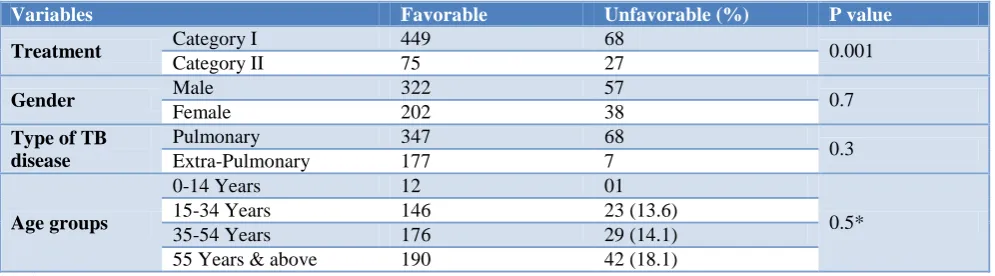
Table 7: Association of various variables with treatment outcome.
Variables Favorable Unfavorable (%) P value
Treatment Category I 449 68 0.001
Category II 75 27
Gender Male 322 57 0.7
Female 202 38
Type of TB disease
Pulmonary 347 68
0.3
Extra-Pulmonary 177 7
Age groups
0-14 Years 12 01
0.5*
15-34 Years 146 23 (13.6)
35-54 Years 176 29 (14.1)
55 Years & above 190 42 (18.1)
*Fisher’s exact test.
Table 8: Treatment outcome among HIV positive patient of tuberculosis (n=41).
Cured Treatment completed Died Default Failure Switch to Cat IV
10 28 2 1 0 0
Patient treatment outcome
The proportion of the patients with favorable outcome such as cured and treatment completed was seen 84.7% of the study population, and reported case fatality of 3.7% as seen in Table 6. Six percent of the patients were found to have missed doses during the treatment period.
In the study, HIV was found to be positive in 6.5% (41) of the patients, although HIV status was known only among 81.1% of the patients (Table 8). Among the TB-HIV co-infected patients, 46.3% of the cases were Extra-Pulmonary TB. Good treatment outcome was seen in patients who had HIV-TB co-infection. Among the positive patients, 51.2% (21) were started on ART.
DISCUSSION
In the present study, TB was consistently found to be higher in males as compared to females and this pattern concurs to what is seen in rest of India and the world.5,6 This trend observed in this study may not be related to gender inequality, because women have considerably better decision power about their own health in NE India, and also female patients were found to be more in age group below 15 years of age.7 The proportion of older age groups suffering from TB was found to be high, and showed an increasing trend with increasing age group. Although TB burden is considered highest to be in the age group of 15-54 years, which is the productive age group, and increasing trend of the disease is seen with increasing age in this study. This concurs with studies from different parts now, which can be a result of the demographic transition.6,8,9
In the study, the percentage of extra-pulmonary TB cases was 33.1%, which was higher than the country average of 18%.3 The case of higher extra-pulmonary cases could be because of higher prevalence of HIV in the state, and extra-pulmonary TB are more commonly seen in people living with HIV.10 The ratio of pulmonary to extra pulmonary was observed to have decreased with increasing age, and the pattern remain the same in both male and females. Similar results were seen in other studies.11 Most common extra pulmonary TB seen was pleural TB. Similar findings were seen in studies conducted in south India, but there were studies from Southern and Northern part of India which reported lymph node TB as the commonest extra-pulmonary TB.12-14
Sputum positive pulmonary TB– 36.5% (Smear positivity trend) was also found to be lower than the national average of 50%.4 The decrease seen could be a result of the implementation of the proper implementation of DOTS as similar findings are reported in other studies after implementation of DOTS.15-18
Pulmonary tuberculosis more in males and extra-pulmonary more in females which was found to be significant as seen in other studies too.19
Treatment outcome
Almost 85% favorable outcome with a case fatality of 3.7%. Favorable outcome was seen more in category I as compared to category II. This association was found to be significant and was expected. No significant favorable
outcome association were seen with gender, age or type of TB, sputum positivity although some studies have shown better outcomes in females and sputum positive patients, while adverse outcome were seen in elderly.20 The percentage of defaulters, failures, and deaths were 15% which is lower than the national average.3
CONCLUSION
Study conducted only in public sector with no representation from the private sector.
The study concur with many of the known facts about tuberculosis as seen in the rest of the country, a shift observed in the age of occurrence of tuberculosis will require further research which can have an impact on the prevention and control measures. The higher prevalence of extra-pulmonary tuberculosis seen in the region which is almost double of the national average also requires further research to help understand the epidemiology of the disease in the region.
Funding: No funding sources Conflict of interest: None declared
Ethical approval: The study was approved by the Institutional Ethics Committee
REFERENCES
1. United Nations General Assembly Resolution. Transforming our World: the 2030 Agenda for Sustainable Development. New York: United Nations Statistic Division; 2015. Available at http://www.un.org/ga/search/view_doc.asp?symbol =A/RES/70/1&Lang=E. Accessed on 3 March 2018. 2. World Health Organization. The End TB Strategy. Geneva: 2015. Available at http://www.who.int/ tb/End_TB_brochure.pdf?ua=1. Accessed on 22 February 2018.
3. Department of Health & Family Welfare. TB India 2018: Annual Status Report. New Delhi: Central TB Division; 2018. Available at https://tbcindia.gov.in/ showfile.php?lid=3314. Accessed on 27 May 2018. 4. Department of Health & Family Welfare. TB India
2017: Annual Status Report. New Delhi: Central TB Division; 2017. Available at https://tbcindia.gov.in/ WriteReadData/TB%20India%202017.pdf.
Accessed on 29 April 2017.
5. United Nations Development Program. Gender and Tuberculosis. New York: United Nations; 2015. Available at http://www.undp.org/content/dam/ undp/library/HIV-AIDS/Gender%20HIV%20and% 20Health/Gender%20and%20TB%20UNDP%20Dis cussion%20Paper%20(1).pdf. Accessed on 31 May 2018.
ce/meetings/tf_17march10_bg_9_estimating_tb_by_ age_sex.pdf. Accessed on 10 February 2018. 7. International Institute for Population Sciences (IIPS)
and ICF. 2017. National Family Health Survey (NFHS-4). Mumbai: IIPS; 2015-16.
8. Chaimowicz F. Age transition of tuberculosis incidence and mortality in Brazil. Rev Saude Publica. 2001;35(1):81-7.
9. Mori T, Leung CC. Tuberculosis in the Global ageing population. Infect Dis Clin N Am. 2010;24(3):751–68.
10. Prakasha SR, Suresh G, D’sa IP, Shetty SS, Kumar SG. Mapping the patterns and trends of extrapulmonary Tuberculosis. J Glob Infect Dis. 2013;5(2):54–9.
11. Kulchavenya E. Extrapulmonary Tuberculosis: are statistical reports accurate? Ther Adv Infect Dis 2014;2(2):61-70.
12. Ravikumar P, Priyadarshini BG. A study of extra-pulmonary tuberculosis and its outcomes. Int J Adv Med. 2017;4(1):209-13.
13. Chennaveerappa PK, Siddharam SM, Halesha BR, Vittal BG, Jayashree N. Treatment outcome of tuberculosis patients registered at dots centre in a teaching hospital, south India. Int J Biol Med Res. 2011;2(2):487-9.
14. Arora VK, Gupta R. Trends of extrapulmonary tuberculosis under revised national tuberculosis control programme. A study from South Delhi. Indian J Tuberc. 2006;53:77-83.
15. Kolapan C, Subramani R, Radhakrishna R, Santha T, Wares F, Baskaran D, et al. Trends in the prevalence of pulmonary tuberculosis over a period of seven and a half years in a rural community in South India with DOTS. Indian J Tuberc. 2013;60:168-176.
16. Zhao F, Zhao Y, Liu X. Tuberculosis control in China. Tuberculosis. 2014;83:15-20.
17. Frieden TR, Fujiwara PL, Washko RM, Hamburg MA. Tuberculosis in New York City – Turning the Tide. N Engl J Med. 1995;333:229-33.
18. Tupasi TE, Radhakrishna S, Chua JA. Significant decline in the tuberculosis burden in the Philippines ten years after initiating DOTS. Int J Tuberc Lung Dis. 2009;13:1224-30.
19. Mehraj J, Khan ZY, Saeed DK, Shakoor S, Hasan R. Extrapulmonary tuberculosis among females in South Asia-gap analysis. Int J Mycobacteriol. 2016;5(4):392-9.
20. Piparva KG. Treatment outcome of tuberculosis patient on DOTS therapy for category 1 and 2 at district tuberculosis center. Int J Pharm Sci Res. 2017;8(1):207-12.