
Corresponding author: [email protected]
2017 UTHM Publisher. All right reserved.
118
Device to Device Communication for Internet of Things
Ecosystem: An overview
Mohammed S.M. Gismalla*, Mohammed Faiz Liew Abdullah
Department of Communication Engineering, Faculty Electrical and Electronic Engineering, Universiti Tun Hussein Onn Malaysia (UTHM), Parit Raja, 86400 Batu Pahat, Johor, Malaysia
1.
Introduction
The Internet of Things (IoT) represents an amazing and powerful technology that allows the sharing of information between multiple devices connected together without intervention; it is designed to be obtainable on demand at any time and location [1], [2]. The mobile phone has to grow rapidly due to the daily human needs; this growth requires more spectrums supplementary to the radio frequency (RF) in next generation. The D2D was proposed to increase the spectrum efficiency, therefore (D2D) communication is probable to be an essential part of the IoT [3]. The future of wireless communication and the mobile system was investigated by leading communication companies in the world.
The companies studied the developing and designing of infrastructure for next generation. Besides that, they estimated that the traffic of communication will be increasing in the cellular network and may reach to 70% times till 2020 compared to 2010 such as shown in Figure 1 and thousand times by others predictions. Also, they proposed the D2D communication technique to offer a massive spectrum to the indoor wireless environment in the IoT ecosystem [4].
Figure 1: estimation of communication development in the range 2010 to 2020 [4].
The concept of the IoT is to connect multiple devices in an indoor environment to provide better services professionally. IoT contains a huge number of non-homogenous computing devices with different abilities connected together through an intelligent routing to accomplish a direct and effective D2D communication [5], [6]. D2D communication is considered as a direct connection between two vicinity mobile phones without passing the signal through the Base Station (BS) or core. In traditional cellular networks D2D elements (such as mobile phones) are unable to connect directly through each other but the signals travel from device to base station (BS) and from BS to other device causes damage on the system of energy efficiency due to the high transmitted power between transmitter and receiver [7], [8]. D2D will become a promising technology in future networks with the rapid growth of the indoor environment communication. The current studies showed that a substantial portion (>70 percent) of wireless traffic originated indoors [9], [10].
In this paper, we investigate D2D communication and IoT ecosystem and its contribution to supporting the next generation of cellular networks.
The rest of the paper is organized as follow: the D2D communication is presented in Section 2; it illustrated the past problems studied. In Section 3 the Internet of Things and practical applications. Section 4 is introduced the main challenges facing both technologies, the solution of this problem will support the realism of fifth generation. Finally section 5 shows the summary.
Abstract: Device to device (D2D) communication is deemed as an emerging technology to support
next-generation of cellular networks, it reduces time delay in communication, saves the energy consumption, and offer better spectrum efficiency. The exchange of information between groups of D2D communication connected simultaneously under the umbrella of cellular networks is presented and called internet of things (IoT). The purpose of this paper is to investigate the D2D communication and IoT technology. We present state of the art of these emerging technologies included related works and applications, in conclusion, we present the challenges and new trends of research for the both technologies.
2. Device to Device (D2D) Communication
The main characteristics of D2D communication was investigated contained usage scenarios, architecture design, technical features, and the area of current research [11]. The conclusion of authors estimated that the D2D communication produces a real-time response in IoT ecosystem and become an important part to realize the 5G cellular networks. The performance of the D2D was affected by sharing the same spectrum with cellular network in the IoT, due to the limitation of spectrum in the communication system a new architecture was investigated by using small base station as rely in order to enhance the data rate of D2D in the IoT system [12], further, a huge number of devices will be connected to each other in IoT to convey the data in more smart, suitable, and efficient method.
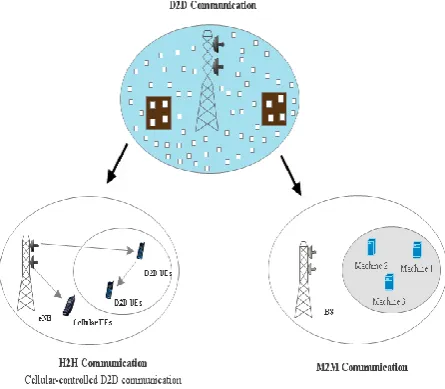
The IoT-D2D resource allocation technique was proposed to support the D2D to transfer information directly between IoT objects with maximum transmission rate in the indoor environments [13]. The resource sharing of D2D communication under cellular network was proposed by using game theory to increase the system capacity and reduce inter-cell interference (ICI) when the D2D coexist between the common area of neighboring cells [14], [15]. An overview of the VLC and D2D was discussed extensively as a promising technology to enhance the capacity in 5 G network, it is known as offloading techniques. The D2D was devoted to European 5G research project to be the backbone of massive services in 2020, the general idea of D2D is presented in Figure 2, and the channel modeling of D2D is required more attention to improve the indoor communication system specifically in case of multiple D2D works simultaneously [16], [17],[18].
Figure 2: general D2D communication system
The reuse of downlink resource system is investigated in the turnout of multiple D2D links and cellular users underlay cellular network, the sum-rate maximisation
trouble was formulated for D2D communication, whereas safeguard the cellular transmission [19].
Two algorithms are proposed for the common D2D-Cellular user matching, of the transmission duration to both online and offline energy harvesting processes at the D2D paths, and of the power distribution, the proposed algorithms are verified by simulation, and the result displayed that the online algorithm provided acceptable performance than the offline algorithm.a comprehensive review of several highly developed methods for the interference management was investigated to mitigate the interference between D2D and cellular networks, and two kinds of interference called co-tier and cross-tier are presented [20].
The MIMO transmitter was investigated to overcome the interference between D2D and produce the highest SINR [21], current trends may concern in D2D communication with visible lights for IoT application due to its high and unlicensed frequency band compared to the radio frequency, additionally, the co-tier interference between D2D communication is still lack and may require more studies. Moreover, to achieve a direct connection among D2D users, the minimum distance to guarantee the connection is required and the movement of devices represents one of the key challenges in the D2D communication to produce a successful transmission and reception between devices.
The synchronization content between D2D communications in the dynamic environment was proposed in [22][23], and two strategies of synchronization are studied in terms of the delay to enhance the energy efficiency. Also, it was analyzed theoretically and simulated via using a city section mobility model, and interference between devices is shown in Figure 3.
Figure 3: kind of interference in the indoor environment
Due to the exponential growth of the subscribers and requiring demands of high efficiency, sector antenna at the cells are proposed to offer the spectrum for both D2D and cellular network connections [21].
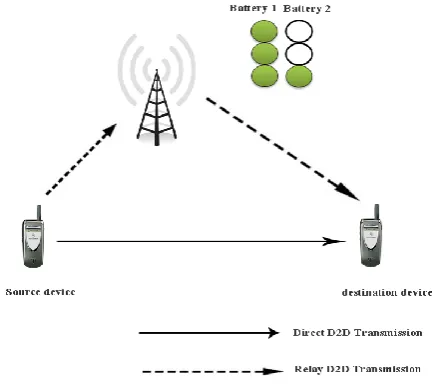
deployment of IoT services to obtain a very low latency, and the performance evaluation of the proposed mechanism is validated by the simulation [24]. The results show that the narrowband IoT is able to support an immense number of IoT elements with ultra-low latency, and the aggregate of narrowband IoT and D2D communications represents an appropriate practical solution. Also, the relaying of D2D communication together with twin batteries for IoT devices are investigated, the discussion shows an optimal resource allocation technique that facilitates the decreasing of total energy consumption when the signals are relaying through picocell [12]. Figure 4 depicted the mechanism of Relay and Direct D2D communications.
The transmission data rate of the nth
signals from the
source device to relay Base station is given by expression below:, ,
, , 2
0 ,
1
log
SR S
SR S n j n j
S
n j n j
n j
h
P
C
W
N W
(1)
Where
W
Sn j, refer to the bandwidth assigned to the all-source devices.P
Sn j,represent the transmission power of
all source devices, andh
SRn j,is the channel gain of links
between multiple source devices and the relay BS j.Figure 4: Relay and Direct D2D Communications
The transmission data rate of signals from the relay BS point to the nth
destination device expressed by:
, ,
, , 2
0 ,
1
log
RD R
RD R n j n j
R
n j n j
n j
h
P
C
W
N W
(2)
Where
W
Rn j,refer to the bandwidth allocated to the all
destination devices.P
Rn j,represent the transmission
power of the signals from jthrelay BS to the destination
devices, and
h
n jRD,is the channel gain of links between
the relay BS j to the nthdestination device.
The effective data rate of the transmitted signal from a source, relay BS, and the destination is expressed by:
, 1min
,, ,
2SD SR RD
c j n j n j
C
C C
(3)The result of the new architecture was improved the resource allocation of the network, optimized the data rates, and reduced the energy consumption of all signals through relay BSs, the VLC may require in order to enhance the obtained results in the IoT ecosystem. Various optimization methods applied to the spectrum allocation for the D2D model was proposed [25], and the rating of optimization problems and the appropriate key algorithms are investigated. The most studies were concern in the in-band communication due to its high ability to control the licensed spectrum that provides a better reduction for interference problem, on the other hand, it’s difficult to control the unlicensed spectrum and the QoS may decreases with the interference among the users, and this may open a new thinking about the interference mitigation techniques and methodologies for the next generation such as the mm-wave and visible light communication.
The power optimization problem of the coexistence of multiple D2D communication was studied underlying the cellular networks, and the problem was investigated by considered the fast and low fading in the channel state information. Additionally, the received power was supposed to be equal for all D2D elements to guard the cellular receiver against the interference, the result shows that multiple D2D element links can use the same band beside the cellular network with high performance, and this result may be optimized more in the future through using visible light communication [26].
D2D was proposed in the future of next generation to alleviate the congestion of cellular network by produces a direct device's communication that offers resources and enhancement the spectrum efficiency additional to reduces the time delay [30].
3. Internet of things IoT
simulated in the MATLAB R2014b [28]. The Figure 5, displayed the general application of IoT ecosystem. The IoT technology is used as the tracking and monitoring system for the real-time information to save and optimize the energy consumption. A large number of applications in IoT ecosystem are presented in the design, production, and services for several scenarios [29]. The dynamic modeling, standardization, security, and heterogeneity of devices in the IoT represents the main challenges in the future that faced by the manufacturing and companies and may require more studies to optimize the energy consumption of different application scenarios.
The convergence among 5G and IoT are presented based on some allowing technologies studied [30], and multidisciplinary resolutions are required to overtake the difficulties of the future in the IoT ecosystem [31]; a new model is presented and studied extensively to allow mutual assessment, and optimization of multidisciplinary characteristics containing hardware scheme, connection, and data processing.
Figure 5: general application of IoT ecosystem
Now the IoT is growing daily and become one of the effective tools toward an emerging of the smart life and the world respectively. An overview of IoT and their applications are investigated in [32], the result shows that about 50 billion items and devices will be connected to the internet in 2020 based on the Cisco record. Also, it has a marketing value capable to causes an impact on the economy in the future and will be the dominant size at 2025 such as shown in Figure 6 [33].
Figure 6: Estimated market share of predominant IoT applications by 2025 [33]
An extensive overview of the IoT is studied by demonstration the application of IoT in a widespread environment; also, middleware requirement was investigated to solve the non-homogeneity of physical objects and devices in the IoT [34]. Also, the progress and new directions of the IoT are investigated and still evolving by numerous organizations, universities, and industrials through the world to fill the integration and standardization between different applications and devices in the IoT system, additionally, to the security and others key challenges [35]. Furthermore, IoT has applied for forecasting natural disasters over the world and considered especially at a few years ago due to the large numbers of the catastrophic, and it’s known as an important application for the IoT recently [36].
The IoT network model becomes realism due to the huge increases in the devices that connected to the internet, and the incorporating to exchange the information between devices efficiently is required [37], also, IoT network contains a three essentially fragments called sensing, communication and management that used to produce the information, establish a connection, conveying and gathering the information, in addition to processing management respectively.
Day by day the technologies will be increasing by the unexpected way especially in the communication and network fields, and the amounts of connected devices were exceeding the number of the population in the world based on the Cisco report in 2008 – 2009, this report lead and support the emerging of the IoT system. Many difficulties for the IoT and web of things WoT are presented in [38], a great researcher and huge efforts of several groups and companies are required due to the advances in the smartphones, it may represent a key success of the IoT.
4. Challenges
A. Interference management
The cellular network of manifold D2D communication and cellular users connected simultaneously suffer from severe interference due to the spectrum sharing, and its causes two kinds of interference, the first is the interference between multiple D2D communication elements and the second is D2D elements with the cellular user, this interference causes a decreasing in the received power and SNR, and its degrade the performance of communication system, more solutions and investigations may in demand to mitigate the interference in the 5G networks.
B. Integration of IoT devices
Smartphones and electronic devices are growing rapidly to cover the daily human needs, a lot of companies and industries around the world produce devices with different software and hardware infrastructures and to facilitate the communication between these devices, more investigation and suggestion of new protocols may require providing a full compatibility between various devices.
5. Summary
This paper show state of the art of the D2D communication and IoT technology, it discusses the interference problem for D2D communication with proposed solution, in addition to energy saving and power optimization with different algorithms, also, its presented expected future of IoT by Cisco and others, the application of IoT ecosystem and transmission protocol to support the connection of IoT devices, finally we summarize the findings of this review in the part of the challenges, this review will open a gate to researchers to suggest and find the best solution to support both technologies in 5G cellular networks.
References
[1] A. Majeed, “Internet of Things (IoT): A verification framework,” in 2017 IEEE 7th
Annual Computing and Communication
Workshop and Conference (CCWC), 2017, pp. 1– 3.
[2] P. Barnaghi and A. Sheth, “On searching the internet of things: Requirements and challenges,” IEEE Intell. Syst., vol. 31, no. 6, pp. 71–75, 2016. [3] R. M. Mare, C. Luiz Marte, and C. E. Cugnasca, “Visible Light Communication Applied to Intelligent Transport Systems: An Overview,” IEEE Lat. Am. Trans., vol. 14, no. 7, pp. 2101– 2106, 2016.
[4] A. Osseiran et al., “The Foundation of the Mobile and Wireless Communications System for 2020 and Beyond: Challenges, Enablers and
Technology Solutions,” in 2013 IEEE 77th Vehicular Technology Conference (VTC Spring), 2013, vol. 25, no. 15, pp. 1–5.
[5] F. Deicke, W. Fisher, and M. Faulwasser, “Optical wireless communication to eco-system,” Futur. Netw. Mob. Submit, pp. 1–8, 2012.
[6] P. E. Hockberger, “A history of ultraviolet photobiology for humans, animals and microorganisms.,” Photochem. Photobiol., vol. 76, no. 6, pp. 561–579, 2002.
[7] M. V. Bhalerao and S. S. Sonavane, “Visible light communication: A smart way towards wireless communication,” in Proceedings of the 2014 International Conference on Advances in Computing, Communications and Informatics, ICACCI 2014, 2014.
[8] M. J. Malachowski and J. Zmija, “Organic field-effect transistors,” Opto-Electronics Rev., vol. 18, no. 2, pp. 121–136, 2010.
[9] O. Bello and S. Zeadally, “Intelligent Device-to-Device Communication in the Internet of Things,” Ieeexplore.Ieee.Org, vol. 10, no. 3, pp. 1–11, 2015.
[10] A. Asadi, Q. Wang, and V. Mancuso, “A survey on device-to-device communication in cellular networks,” IEEE Commun. Surv. Tutorials, vol. 16, no. 4, pp. 1801–1819, 2014.
[11] U. N. Kar and D. K. Sanyal, “An overview of device-to-device communication in cellular networks,” ICT Express, 2017.
[12] X. Liu and N. Ansari, “Green Relay Assisted D2D Communications with Dual Batteries in Heterogeneous Cellular Networks for IoT,” IEEE Internet Things J., 2017.
[13] E. Abd-Elrahman, H. Afifi, L. Atzori, M. Hadji, and V. Pilloni, “IoT-D2D task allocation: An award-driven game theory approach,” 2016 23rd Int. Conf. Telecommun. ICT 2016, no. May, 2016. [14] J. Huang, Y. Yin, Q. Duan, and H. Yan, “A Game-Theoretic Analysis on Context-Aware Resource Allocation for Device-to-Device Communications in Cloud-Centric Internet of Things,” Proc. - 2015 Int. Conf. Futur. Internet Things Cloud, FiCloud 2015 2015 Int. Conf. Open Big Data, OBD 2015, pp. 80–86, 2015. [15] J. Huang, Y. Yin, Y. Zhao, Q. Duan, W. Wang,
and S. Yu, “A Game-Theoretic Resource Allocation Approach for Intercell Device-to-Device Communications in Cellular Networks,” IEEE Trans. Emerg. Top. Comput., vol. 4, no. 4, pp. 475–486, 2016.
[16] S. Buzzi, I. Chih-Lin, T. E. Klein, H. V. Poor, C. Yang, and A. Zappone, “A survey of energy-efficient techniques for 5G networks and challenges ahead,” IEEE J. Sel. Areas Commun., vol. 34, no. 4, pp. 697–709, 2016.
[18] B. Ai, X. Yin, X. Cheng, Q. Wang, and Y. Li, “Device-to-device channel measurements and models: a survey,” IET Commun., vol. 9, pp. 312–325, 2015.
[19] S. Gupta, R. Zhang, and L. Hanzo, “Energy Harvesting Aided Device-to-Device Communication Underlaying the Cellular Downlink,” IEEE Access, vol. 5, pp. 7405–7413, 2017.
[20] M. Noura and R. Nordin, “A survey on interference management for Device-to-Device (D2D) communication and its challenges in 5G networks,” J. Netw. Comput. Appl., vol. 71, pp. 130–150, 2016.
[21] P. Gandotra and R. K. Jha, “Device-to-Device Communication in Cellular Networks: A Survey,” J. Netw. Comput. Appl., vol. 71, pp. 99– 117, 2016.
[22] W. Li, X. Chen, and S. Lu, “Content synchronization using device-to-device communication in smart cities,” Comput. Networks, vol. 120, pp. 170–185, 2017.
[23] M. Salih, M. Gismalla, and I. K. Eltahir, “Interference Reduction Between Device to Device (D2D) Communication Underlying Cellular Networks,” vol. 6, no. 11, pp. 410–414, 2015.
[24] A. Orsino et al., “Exploiting D2D Communications at the Network Edge for Mission-Critical IoT Applications,” pp. 68–73, 2017.
[25] M. Ahmad, M. Azam, M. Naeem, M. Iqbal, A. Anpalagan, and M. Haneef, “Resource management in D2D communication: An optimization perspective,” J. Netw. Comput. Appl., vol. 93, no. May, pp. 51–75, 2017.
[26] S. Shalmashi, G. Miao, and S. Ben Slimane, “Interference management for multiple device-to-device communications underlaying cellular networks,” Proc. IEEE PIMRC, pp. 223–227, 2013.
[27] Z.-Y. Yang and Y.-W. Kuo, “Efficient resource allocation algorithm for overlay D2D communication,” Comput. Networks, vol. 124, pp. 61–71, 2017.
[28] M. Jo, T. Maksymyuk, B. Strykhalyuk, and C.-H. Cho, “Device-to-device-based heterogeneous radio access network architecture for mobile cloud computing,” IEEE Wirel. Commun., vol. 22, no. 3, pp. 50–58, 2015.
[29] F. Tao, Y. Wang, Y. Zuo, H. Yang, and M. Zhang, “Internet of Things in product life-cycle energy management,” J. Ind. Inf. Integr., vol. 1, pp. 26–39, 2016.
[30] O. Galinina, S. Andreev, M. Komarov, and S. Maltseva, “Leveraging heterogeneous device connectivity in a converged 5G-IoT ecosystem,” Comput. Networks, vol. 0, pp. 1–10, 2016. [31] M. López-Benítez, T. D. Drysdale, S. Hadfield,
and M. I. Maricar, “Prototype for multidisciplinary research in the context of the Internet of Things,” J. Netw. Comput. Appl., vol. 78, no. November 2016, pp. 146–161, 2017. [32] E. Ahmed, I. Yaqoob, A. Gani, M. Imran, and M.
Guizani, “Internet-of-things-based smart environments: State of the art, taxonomy, and open research challenges,” IEEE Wirel. Commun., vol. 23, no. 5, pp. 10–16, 2016. [33] A. Al-fuqaha, S. Member, M. Guizani, M.
Mohammadi, and S. Member, “Internet of Things : A Survey on Enabling,” vol. 17, no. 4, pp. 2347–2376, 2015.
[34] Z. Garofalaki, D. Kallergis, G. Katsikogiannis, I. Ellinas, and C. Douligeris, “Transport services within the IoT ecosystem using localisation parameters,” in 2016 IEEE International Symposium on Signal Processing and Information Technology (ISSPIT), 2016, vol. 17, no. 3, pp. 87–92.
[35] R. Khan, S. U. Khan, R. Zaheer, and S. Khan, “Future internet: The internet of things architecture, possible applications and key challenges,” Proc. - 10th Int. Conf. Front. Inf. Technol. FIT 2012, no. April 2017, pp. 257–260, 2012.
[36] M. Kamruzzaman, N. I. Sarkar, J. Gutierrez, and S. K. Ray, “A study of IoT-based post-disaster management,” Int. Conf. Inf. Netw., no. January, pp. 406–410, 2017.
[37] I. E. Lee et al., “Design and development of a portable visible-light communication transceiver for indoor wireless multimedia broadcasting,” in 2014 2nd International Conference on Electronic Design (ICED), 2014, vol. 7, no. 3, pp. 20–24. [38] O. Bello, S. Zeadally, and M. Badra, “Network
![Figure 1: estimation of communication development in the range 2010 to 2020 [4].](https://thumb-us.123doks.com/thumbv2/123dok_us/8439593.1700854/1.595.65.284.623.703/figure-estimation-communication-development-range.webp)
![Figure 6: Estimated market share of predominant IoT applications by 2025 [33]](https://thumb-us.123doks.com/thumbv2/123dok_us/8439593.1700854/4.595.66.283.333.512/figure-estimated-market-share-predominant-iot-applications.webp)
