*Corresponding author: [email protected]. 2018 UTHM Publisher. All rights reserved.
e-ISSN: 2600-7924/penerbit.uthm.edu.my/ojs/index.php/jst
Electricity Load Demand Forecast using Fast Ensemble-Decomposed
Model
Nuramirah Akrom and Zuhaimy Ismail
**Department of Mathematical Sciences, Faculty of Sciences, Universiti Teknologi Malaysia, 81310 Skudai, Johor, Malaysia. Received 30 September 2017; accepted 10 June 2018; available online 1 August 2018
1. Introduction
Forecasting electricity load demand has always played a substantial role in generation scheduling, transmission planning, and pricing [1]. The importance of achieving the highest forecast accuracy of electricity load demand is really needed since deregulated companies in the power market depends on it [2].
Basically, forecasting electricity load demand has different forecast horizons. For example, long-term electricity load demand forecasts, ranging from one to ten years ahead of forecast, are necessary for capacity planning of an electricity company, and it also functions
as an economic parameter. Short-term
electricity load demand forecasts, meanwhile, are essential for the day-ahead markets [3].
Long-term patterns of electricity load demand sometimes have irregular components, depending on the consumption of load demand in that year. It is a challenging task to forecast the irregular patterns exhibited in long-term electricity load demand data series [4]. Hence, this creates an opportunity to develop new methods for forecasting long-term electricity load demand and indirectly, this new method can capture the irregular patterns that exist in the electricity load demand data series.
In previous literature, various models have been proposed by researchers in order to model, forecast, and counteract these irregular patterns for long-term electricity load demand
data series. For example, He et al., [5]
proposed four different steps, whereby for each step of the forecasting procedure, they employed four different methods to forecast urban electricity load demand in Tianjin, China. For the first step, they implemented linear regression and moving average method to capture the relationship between variables within the model. Secondly, they applied time
series forecasting methods, which are
Autoregressive Model (AR), Moving Average Model (MA), and Autoregressive Moving Average Model (ARMA), to determine the stationary pattern of the load data. Thirdly, they used grey forecasting model and combined forecasting models of ARIMA and Grey Model to predict the non-linear load
index. Lastly, they utilized Artificial
Intelligent (AI) methods, including Support Vector Machines (SVM), Artificial Neural Networks (ANN), Genetic Algorithm (GA), and Particle Swarm Optimization (PSO), to estimate the sensitivity of the initial value and to perform the long-term load demand
forecast. Trotter et al., [6] presented a
stochastic approach to forecast the climate
Abstract: Electricity load demand forecasting is a complex process since the pattern of electricity load demand data sets varies. To overcome this problem, a fast ensemble-decomposed model was proposed in this work. Firstly, two data sets of electricity load demand, which are electricity consumption and electricity production, were decomposed into two Intrinsic Mode Functions (IMFs). Secondly, the different values of ensemble trials are employed into fast ensemble-decomposed model. Then, the second IMF was used as the intrinsic prediction trend for the actual electricity load demand data sets. Lastly, the second IMF was compared with the actual electricity load demand time series data and the intrinsic prediction trend of the second IMF was forecasted. Simulation results revealed that the FED model better than the ARIMA and ANN methods and different values of ensembles trials do effect forecast accuracy.
Keyword: Fast Ensemble-Decomposed Model (FED); Electricity load demand; Electricity consumption; Electricity production; Forecasting.
185
change and long-term electricity demand in Brazil. They applied multiple linear regression model to calibrate electricity demand data series and forecasted the data series using the proposed method. Zhao and Guo [7] optimized Grey Modelling (1,1) with Ant Lion Optimizer and Rolling mechanism, namely Rolling-ALO-GM (1,1) model, to predict annual electricity consumption in Shanghai city and China states. The proposed model was compared with Grey Modelling (1, 1), Grey Modelling (1,1) optimized by Particle Swarm Optimization, Grey Modelling (1,1) optimized
by Ant Lion Optimizer, Generalized
Regression Neural Network, Grey Modelling (1,1) with Rolling mechanism, and Grey Modelling (1,1) optimized by Particle Swarm Optimization with Rolling mechanism [7].
Although the development of new
techniques proposed by previous researchers to forecast long-term electricity load demand has been helpful, most of them involve too many steps and procedures, which make them costly and time-consuming to implement.
This study, therefore, develops a new method to forecast long-term electricity load demand using Fast Ensemble-Decomposed (FED) model that involves four simple steps only to model and forecast long-term electricity load demand. In addition, there is no need to combine or hybrid the FED method with other methods. Firstly, the original data sets are decomposed into two Intrinsic Mode Functions (IMFs) using FED algorithm. Secondly, the different values of ensemble trials are employed into fast ensemble-decomposed model Thirdly, the second IMF is used as the intrinsic prediction trend for the actual data series. Lastly, the intrinsic prediction trend is forecast.
To demonstrate the effectiveness of the FED model, two data sets were deployed in this study, which are the annual electricity consumption and electricity production in Malaysia. The proposed FED model was compared with ARIMA and ANN models, where these two models also acted as the benchmark methods. This study also aiming to investigate whether the different values ensemble trials do affect the forecast accuracy or not.
The rest of the paper is organized as follows. Section 2 describes the data pattern of the annual electricity consumption and electricity production in Malaysia. Section 3
presents the methods and forecast accuracy measurement used in this study, which are ARIMA, ANN, FED, and Mean Absolute
Percentage Error (MAPE). Section 4
demonstrates the procedure in modelling and forecasting long-term electricity load demand using the three different methods. Section 5 discusses the experimental results and lastly, the conclusion is drawn at the end of this paper.
2. Data Sets.
The electricity load demand data sets cover
the annual electricity production and
electricity consumption in Malaysia, from the
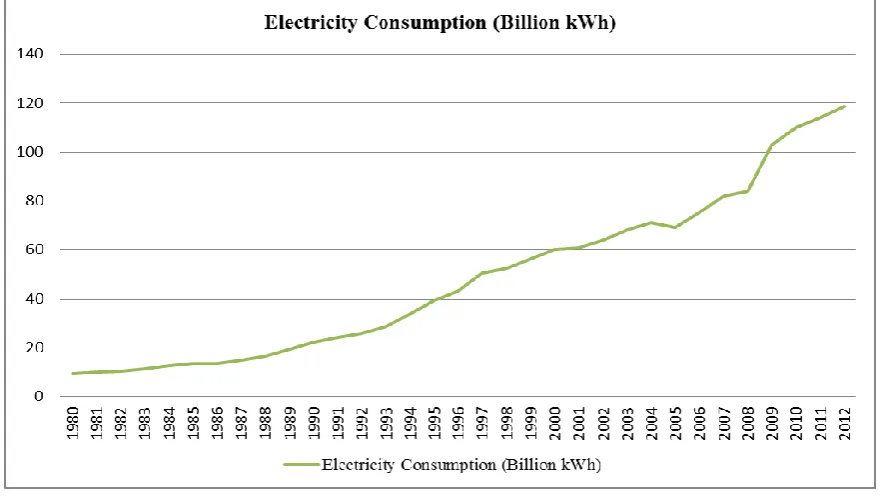
start of 1980 to the end of 2012. Both data gave 64 observations and were measured in kilo-watt per hour (kWh). The data are gathered from Statistical Department of Malaysia. The time series plots for both data are visualized in Fig. 1 and Fig. 2.
Both plots on the electricity load production and consumption showed an exponential pattern, whereby they gradually increased starting from the year 1993 for both data sets. Between 2005 and 2012, the pattern of electricity production and electricity consumption showed a superposition of several distinct frequencies. There were also several fluctuation patterns for the past 7
years, where some complexities and
uncertainties were exhibited in the data series.
3. Methodology 3.1 ARIMA Model.
Generally, the ARIMA ( , , )p d q model is
expressed as [8]:
( )(1
)
d( )
p
B
B
y
tc
qB
t
(1)where
1
1 P,
p B pB
1
( ) 1 q
q B B qB
and
c
is the constant value,y
t and
t are theactual time series data and error term in a
period of t,
B
is the backshift operator,d
isthe degree of differencing, and
pand
qarethe autoregressive and moving average
186 Fig. 1 Time series plot for electricity production (billion kWh) from 1980 to 2012
Fig. 2 Time series plot for electricity consumption (billion kWh) from 1980 to 2012
3.2 ANN Model.
Mathematically, a nonlinear ANN model is bounded and parameterized in the form of [9]:
1 2 1 2
( , , , n; , , , p) ( ; )
O f x x x
f x
(2)
where
o
is the output layer of the neuron,f
(.)
is anonlinear activation function,
1 2
( ,
,
,
n)
x
x x
x
is the entry vectorvariables into the neuron and
1 2
( ,
,
,
n)
187 3.3 FED Model.
FED was firstly popularized by Wang et
al., [10] is a renovated Ensemble Empirical
Mode Decomposition (EEMD) model,
developed by Wu and Huang in 2009 [11]. Basically, the FED algorithm can decompose any complex time series data into Intrinsic Mode Function (IMF); and the decomposition process as follows [10-12]:
Step 1: Obtain time series signal
Y t
( )
byadding white noise
n t
( )
to the targeted timeseries signal,
y t
( ),
( )
( )
( )
Y t
y t
n t
(3)where
1, 2, 3, ,n is the number ofensemble trials to add into the noise series
inside the original signal, y t( ).
Step 2: Connect all upper, eup1 and lower,
1
low
e
envelopes of Y t( )by utilizing cubicspline interpolations.
Step 3: Calculate the average envelope values between the upper and lower envelop:
1 1 1
( )
( )
( )
2
up low
e
t
e
t
m t
(4)Step 3: Obtain the difference between Y t( )
and
m t
1( )
:
D t
1( )
Y t
( )
m t
1( )
(5)Step 4: Judge whether or not
D t
1( )
satisfiesIMFs condition, If it does, it is accounted as IMF1, otherwise, it is examined as the original sequence, and the steps 1 to 3 are repeated into
k
rounds.The IMFs condition have the following properties:
a) In the whole data series, the number of
zero points and the number of extreme points are equal or differ at most by one.
b) The mean vales of the upper and lower
envelopes at any point must be zero.
In this study, the number of IMFs was simply set as 2, since we only needed 2 IMFs
and the ensemble trials are group into [0,100] intervals with 10 increments.
3.4 Forecast Accuracy Measurement.
To evaluate the forecast accuracy of these three methods, Mean Absolute Percentage Error (MAPE) was used as the forecasting accuracy measurement. The equation for calculating MAPE is as follows:
1
ˆ 1
| | 100
N
t t
t t
A F
MAPE X
N A
(6)where
A
t and Fˆt are the actual and forecasteddata, and
N
is the number of observations inthe data series.
4. ARIMA, ANN and FED Modelling and Discussions.
To model the annual electricity production and electricity consumption data series using ARIMA model, the procedure as proposed by Box et al., [8] is as follows.Firstly, both data
were differenced
(
d
1)
to transform thenon-stationary series into stationary series. Secondly, the Autocorrelation Function (ACF) and Partial Autocorrelation Function (PACF)
were used to determine the model orders of
p
and
q
. Then, for estimating the parameters ofautoregressive and moving average
parameters,
and
, the Minitab 16 softwarewas used. After several trials-and-errors, ARIMA (1,1,0) was chosen as the best ARIMA model for both data.
For ANN modelling, a three Multilayer Preceptor (MLP) feed-forward network was developed for predicting the electricity load demand. We also carried out trial-and-error process in calculating the best ANN architecture for both electricity load demand time series data. After several tries, [2-5-1] ANN architecture was chosen for electricity production time series data while [2-4-1] model was the chosen one for electricity consumption.
To model electricity load demand data using FED model, a Matlab 2017 code was built using the FED algorithm to decompose
the original electricity production and
188
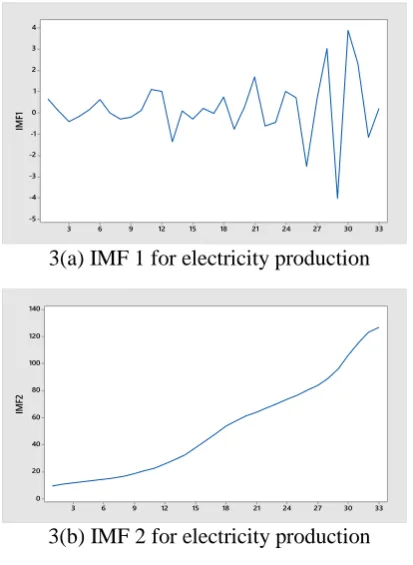
and Fig. 4 depict the IMFs of electricity production and electricity consumption data series.
3(a) IMF 1 for electricity production
3(b) IMF 2 for electricity production
Fig. 3 The IMFs for electricity production
4(a) IMF 1 for electricity consumption
4(b) IMF 2 for electricity consumption
Fig. 4 The IMFs for electricity consumption
From Fig. 3 and Fig. 4, the first IMF of both electricity load demand data series showed high frequencies and high spikes, and although at the beginning the frequency was not too high, starting from the 21st to 32nd frequencies, the spikes were clearly visible. These high spikes depict the start of high demands for electricity from the year 2005 to 2012. As for the second IMF, both data showed an exponential prediction trend of the
electricity production and electricity
consumption time series data. The second IMF was used to forecast the annual electricity load demand.
This study also is used to examine the effect of different number ensemble trials to the forecast accuracy. Table 1 depicts the results of MAPE with different values of ensemble trials.
Table 1 The effect of forecasting performance with different values of ensemble trials
Number of Ensemble Trials Data Electricity Production (MAPE %) Electricity consumption (MAPE %)
0-10 1.7402 1.9830
10-20 1.6687 2.7208
20-30 1.8456 2.0607
30-40 1.6389 1.8374
40-50 1.7900 1.7553
50-60 1.5718 1.9021
60-70 1.5797 1.7473
70-80 1.7458 2.0823
80-90 1.7285 1.8969
90-100 1.7731 1.8760
From Table 1, the best forecast
performances for electricity production is 1.5718% which only needs 50-60 ensemble trials while electricity consumption data need 60-70 ensemble trials for 1.7473 % of MAPE.
Huang et al., [13] proposed the maximum
number of ensemble trials for FED model is 100. Too many ensemble trials may lead to instable extrema distribution and indirectly effect the forecast accuracy.
5. Forecasting Results and Discussions.
To compare the forecasting performance of the three methods, both electricity load demand data had been divided into two groups, which are in-sample data and
189
sample data. For in-sample data, it consisted of 25 observations from 1980 to 2005 and for out-sample data, it consisted of 8 observations from 2006 to 2012. Table 2 shows the forecasting performance of the three models for electricity production and electricity consumption time series data. For FED model, the best number ensemble trials with the best MAPE are choose to demonstrates the effectiveness of this model
Table 2 Forecasting performance of ARIMA, ANN, and FED models
Electricity Production
Models MAPE (%)
In-sample Out-sample
ARIMA 4.2640 4.7750
ANN 4.0822 8.3248
FED 1.3097 2.3912
Electricity Consumption
Models MAPE (%)
In-sample Out-sample
ARIMA 4.6755 5.4638
ANN 4.0583 4.6337
FED 1.3751 2.9108
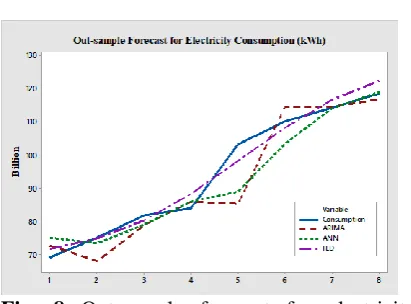
Table 2 shows that the FED model gave the highest forecast accuracy for both types of electricity load demand data as compared to ARIMA and ANN models. This was because the smooth exponential prediction trend of the second IMF in the FED algorithm gave a prediction trend that was closer to the actual electricity load demand data. The worst forecast was by the ANN model, as a result of using hyperbolic tangent sigmoid function in the input neuron and linear sigmoid function in the output neuron. After several trials-and-errors, these two sigmoid functions gave the lowest MAPE. At the end of the 8 observations of the electricity production and electricity consumption, the prediction values using ANN were far from that of the actual values. For ARIMA model, the beginning of the prediction curve followed the actual electricity load demand time series data closely, but towards the end of the prediction curve there were high spikes that gave prediction values that were far from the actual values. Fig. 5 to Fig. 8 illustrate the in-sample and out-sample forecasts using these three models.
Fig. 5 In-sample forecast for electricity production (kWh)
Fig. 6 Out-sample forecast for electricity production (kWh)
Fig. 7 In-sample forecast for electricity consumption (kWh)
190 6. Conclusion
A new technique for forecasting annual electricity load demand using FED model was proposed in this study. Two types of electricity load demand data were used to demonstrate the effectiveness of the FED model, which are annual electricity production and electricity consumption data series. The FED model was compared with ARIMA and ANN models. The empirical results showed the robustness of the FED model, which gave a range of MAPE between 1% and 2% only, as compared to ARIMA and ANN models which give a range of MAPE between 4% and 5%.
The different values of ensemble trials
do effect the forecast performances. The
number of ensemble trials in FED model
need to clearly investigates and clarify
since its
determine the correctness
distribution of extremum.
Acknowledgement
This study is supported by UTM Tier 1 Grant (11H89) and MyBrain 15.
References
[1] Yukseltan, E., Yucekaya, A., and Bilge, A.
H. (2017). “Forecasting Electricity
Demand for Turkey: Modelling Periodic Variations and Demand Segregation” in
Applied Energy, Vol. 193. pp. 287-296.
[2] Laouafi, A., Mordjaoui, M., Haddad, S.,
Boukelia, T. E. and Ganouche, A. (2017). “Online Electricity Demand Forecasting
Based on an Effective Forecast
Combination Methodology” in Electric
Power System Research, Vol. 148, pp. 35-47.
[3] Koprinska, I., Rana, M. and Agelidis, V.
G. (2015). “Correlation and Instance Based Feature Selection for Electricity
Load Forecasting” in Knowledge-based
Systems, Vol. 82, pp. 29-40.
[4] Shao, Z., Fu, C., Yang, S-L. and Zhou,
K-L. (2017). “A Review of the
Decomposition Methodology for
Extracting and Identifying the Fluctuation Characteristics in Electricity Demand
Forecasting” in Renewable and
Sustainable Energy Reviews, Vol. 75. pp. 123-136.
[5] He, Y., Jiao, J., Chen, Q., Ge, S., Chang,
Y. and Xu, Y. (2017). “Urban Long Term Electricity Demand Forecast Method Based on System Dynamics of the New Economic Normal: The Case of Tianjin” in Energy, Vol. 133. pp. 9-22.
[6] Trotter, I. M., Bolkesjo, T. F., Feres, J. G.
and Hollanda, L. (2016). “Climate Change and Electricity Demand in Brazil: A
Stochastic Approach” in Energy, Vol. 102.
pp. 596-604.
[7] Zhao, H. and Guo, S. (2016). “An
Optimized Grey Model for Annual Power
Load Forecasting” in Energy, Vol. 107.
pp. 272-286.
[8] Box, G. E. P., G. M. Jenkins, G. M., and
Reinsel, G. C. (2008). Time Series
Analysis: Forecasting and Control, 4th Edition. John Wiley and Sons, Inc, New Jersey.
[9] Haykin, S. (2009). Neural Networks and
Learning Machines. Third Edition. Pearson Education, New Jersey.
[10] Wang, Y-H., Yeh, C-H., Young, H-W.
V., Hu, K. and Lo, M-T. (2014). “On the
Computational Complexity of the
Empirical Mode Decomposition
Algorithm” in Physica A: Statistical
Mechanics and Its Applications. Vol. 400. pp. 159-167.
[11] Wu, Z. and Huang, N. E. (2009).
“Ensemble Empirical Mode
Decomposition: A Noise-Assisted Data
Analysis Method.” Advances in Adaptive
Data Analysis. Vol. 1(1). pp. 1-41
[12] Liu, H., Tian, H., Liang, X., and Y. Li,
(2015). “New Wind Speed Forecasting
Approaches using Fast Ensemble
Empirical Mode Decomposition, Genetic Algorithm, Mind Evolutionary Algorithm and Artificial Neural Networks” in
Renewable Energy, Vol. 83. pp. 1066-1075.
[13] Huang, N. E., Shen, Z., Long, S. R., Long,
S. R., Wu, M. C., Shih, H. H., Zheng, Q., Yen, N-C., Tung, C. C., and Liu, H. H.
(1998). “The empirical mode
decomposition and the Hilbert spectrum for nonlinear and non-stationary time
series analysis” in Proceedings of the