COMPARATIVE STUDIES OF THE CYTOGENETICAL EFFECTS O F NEUTRONS AND X-RAYS
NORMAN H. GILES, JR.
Yale University, New Haven, Conn.
Received May 3, 1943
INTRODUCTION
HE results of a number of studies of the biological effects of neutrons and
T
X-rays have shown that these two radiations usually differ in the effi- ciency with which they produce a given effect when the two are compared on the basis of equal total tissue doses of ionization. This is true for what may be referred to as general physiological responses as well as for specific cytoge- netical effects. For most physiological effects, such as inhibition of growth, neutrons have been found to be more efficient than X-rays (cf. AEBERSOLD and LAWRENCE 1942). As far as cytogenetical effects are concerned, two types of experiments have been madecytological and genetic studies of induced chromosomal rearrangements and genetic studies of lethal mutations. The genetic studies have indicated that neutrons are less efficient than X-rays in inducing lethal mutations in Drosophila (ZIMMER and TIMOP~EF-RESSOVSKY 1938; KAUFMANN 1941b; DEMPSTER 1941; FANO 1943). For chromosomal re- arrangements it is clear that neutrons are considerably more efficient than X-rays in the various plant species which have been studied (MARSHAK 1939;Differences other than the relative efficiencies of the two types of radiation have been found in the comparative experiments with induced chromosomal rearrangements in Tradescantia, the most notable being in the types of curves which show the relationship between the frequency of translocations and in- creasing dosage of X-rays or neutrons. It has been clearly shown (SAX 1940, 1941; RICK 1940; MARINELLI, NEBEL, GILES, and CHARLES 1942) that X-ray- induced translocations in Tradescantia increase approximately as the square of the dose when the time of irradiation is kept constant. However, for neutrons the relationship between dosage and frequency of translocations has been found to be approximately linear (GILES 1940; THODAY 1942). The present paper presents further data on this point and also evidence of other ways in which neutrons differ from X-rays in their cytogenetical effects.
GILES 1940; THODAY 1942).
MATERIALS AND METHODS
A clone of Tradescantia paludosa Anders. and Woodson having the haploid chromosome number of six and free from centric fragments was used as the experimental material for cytological study. Inflorescences were treated with either neutrons or X-rays, and the chromosomes were examined a t metaphase or anaphase of the first post-meiotic mitosis in the microspores by means of acetocarmine smears. Studies of chromatid effects were made at)rom, six to
EFFECTS OF NEUTRONS AND X-RAYS 399
of experimental data. Chromosome effects were studied a t five days fol- lowing irradiation. The types of rearrangements induced by neutrons are the same as those produced by X-rays (GILES 1940); these have been discussed and diagrammed by SAX (1940) and THODAY (1942). I n the present experi- ments the following terminology has been used in discussing induced aberra- tion types (synonyms are given in parentheses) : (I) Chromatid types induced a t prophase-(a) chromatid terminal deletions (chromatid breaks), (b) iso- chromatid rejoins (chromatid dicentrics or double deletions), and (c) chro- matid exchanges (rings and interchanges, both dicentric and eucentric) ; ( 2 )
Chromosome types induced during the resting stage-(a) chromosome ter- minal deletions (chromosome breaks), (b) chromosome exchanges (centric rings and dicentrics), and (c) chromosome interstitial deletions (isodiametric fragments). The class reported as chromosome rings includes only centric types, acentric rings being included in the totals for interstitial deletions. This makes possible a comparison with the results of SAX, who scores rings in this manner.
The neutrons used in these experiments were obtained from two different sources. The first source was the HARVARD cyclotron in which neutrons were produced by bombarding a beryllium target with deuterons accelerated to I I
MeV. The reaction used was:
Be49+ D I ~ + B ~ ~ O + no'
and the neutrons produced were inhomogeneous with energies up to approx- imately 15 MeV. The second neutron source was the YALE cyclotron. Here the beryllium reaction was also used, but the deuterons were accelerated to only 3.2
Mev., the neutrons being inhomogeneous with energies up to approximately 7.5 MeV. I n none of the experiments was any attempt made to exclude gamma radiation. The intensity of the irradiation was varied either by changing the distance of the inflorescences from the target or by varying the amperage of the deuteron beam. Due to the inherent difficulties in using the cyclotron, it was not always possible to control the time or the intensity of the irradiation with the desired degree of exactness, and consequently the exact dosages planned in advance in a given experiment were not always obtained.
A direct measurement of the neutron dosage was made for each exposure. Dosages were measured by means of a Victoreen r-meter with a IOO r bake- lite condenser-chamber and recorded in n units, an n being defined as that amount of fast neutrons which produces the same reading with the standard Victoreen IOO r-meter as does one r of X-rays. It has been shown that in terms of ionization in tissue, an n of neutrons corresponds to between 2 and 2.5 r
units of X-rays. Different IOO r chambers were used a t 'HARVARD and YALE.
A discussion of neutron dosimetry of the kind used in these experiments is given by AEBERSOLD and LAWRENCE (1942).
400 NORMAN H. GILES, JR.
The statistical problems encountered in experiments of this sort with Trades- cantia have been discussed by SAX (1940, 1941). I n the present data each of the experimental points was determined by analyzing from 50-200 cells on
from five to ten slides. The mean of the number of samples (slides) was used as the value for a given treatment. When standard errors were calculated, the number of slides was used as the value of n in the formula c/&. In general, the standard error is between five and ten per cent of the mean.
The methods used in the comparative study of induced lethals in Dropsoph- ila will be discussed later.
EXPERIMENTAL RESULTS Dosage curves with neutrons
The experiments of SAX have shown that there are two types of curves relating dosage of X-rays to aberration frequency in Tradescantia when the time of irradiation is kept constant. A linear relation holds for one-hit types (isochromatid rejoins, chromatid and chromosome terminal deletions; whereas, two-hit types (chromotid exchanges and chromsome exchanges) vary as the square of the dose. The experiments of RICK (1940) indicate that the curve for chromosome interstitial deletions is intermediate between a linear and a squared relationship.
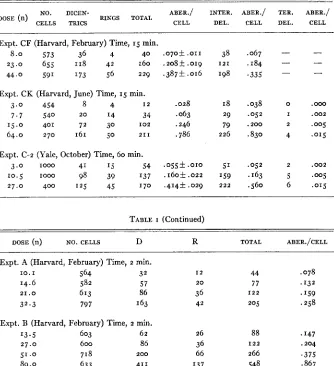
With neutrons, however, all types of rearrangements have shown an approx- imately linear relationship, including the two-break X-ray types. These results were first obtained using neutrons of high average energy (and a t high inten- sities) produced by the HARVARD cyclotron (GILES 1940). The initial results have been confirmed by subsequent experiments, particularly for chromosome aberration types. Data from four separate experiments studying chromsome effects (five days after irradiation) in which the time of irradiation was kept constant are presented in table I (expts.
A,
B,
CF, CK). It has also been pos-sible to test the dosage relationship for chromosome aberrations with neutrons of lower average energy produced by the YALE cyclotron.The results of such an experiment are also presented in table I (expt. C-2). For both classes of neu-
trons it is clear that there is an approximately linear relationship with dose for chromosome exchanges (rings and dicentrics). The results of the YALE experiment (C-2) and of one of the
HARVARD
experiments (CF) are plotted in figure I. The obvious difference in the slope of the two curves will be discussedlater.
Interstitial deletions (isodiametric fragments) constitute the other major class of aberrations induced by irradiation during the resting stage. The dosage relation with neutrons for this type has not been previously reported. Again, it has been found (table I, expts. CF, CK, C-2) that an approximately linear
relationship holds. Since very few true terminal chromosome deletions are found in five-day material, an adequate analysis of their relationship to dose is not possible. However, the few data which are available may be interpreted as indicating a linear relationship (table I).
EFFECTS OF NEUTRONS AND X-RAYS 401
shown that all of these exhibit approximately linear relationships with neutron dose. Similar results have been obtained where chromatid effects have been analyzed in the present study.
TABLE I
Dosage curves: time constant, intensity varied. Chromosome ejects at five days.
NO. DICEN- ABER./ INTER. ABER./ TER. ABER./
RINGS TOTAL
CELL DEL. CELL DEL. CELL
DOSE (n)
CELLS TRICS
Expt. CF (Harvard, February) Time, 15 min.
23.0 655 118 42 I 60
8.0 573 36 4 40
44.0 59‘ I73 56 229
Expt. CK (Harvard, June) Time, 15 min.
3 . 0 454 8 4 I 2
7 . 7 540 2 0 14 34
15.0 401 72 30 1 0 2 64.0 2 7 0 161 50 2 1 1
Expt. C-2 (Yale, October) Time, 60 min.
3.0 I O W 41 I5 54
10.5 1000 98 39 ‘37
27.0 400 125 45 1 7 0
.070+ ,011 .208f . o ~ g .387+ .016
.028 .063 .246 .786
.055f . O I O .160f . 0 2 2 .414f .029
38
198 1 2 1
I 8 29 79 226 51 ‘59
2 2 2
.067 .184 .335 .038 .os2 .830 . 2 0 0
.os2 .163
.560
0 .Ooo
I .002
2 ,005
4 . O I 5
2 . 0 0 2
5 .w5
6 . O I ~
TABLE I (Continued)
DOSE (n) NO. CELLS D R TOTAL ABER./CELL
Expt. A (Harvard, February) Time, 2 min.
10.1 564 32
14.6 582 57
32.3 797 ‘63
2 1 . 0 613 86
Expt. B (Harvard, February) Time, 2 min.
13.5 603 62
27.0 600 86
5 1 .o 718 2 0 0
89.0 633 411
12 2 0 36 42 26 36 66 137 44 77 205 1 2 2
88
266 I 2 2
548
,078
.
I32.
I59 . 2 5 8.
I47 .204 .37s .867402 NORMAN H. GILES, JR.
two clearly distinct breaks are produced by a single event (“hit”). It has been suggested that the proton path is to be considered this single event-both breaks in the majority of the exchange type rearrangements being produced by single proton paths (GILES 1940; THODAY 1942).
DOSE IN N W I T S
FIGURE 1.-The relation between dosage of neutrons in n units and frequencies of induced chromosome exchanges (rings and dicentrics) in Tradescantia microspores examined five days after irradiation. Results with HARVARD cyclotron (neutrons of ca 15 Mev maximum energy) in expt. CF shown by solid line; those with YALE cyclotron (neutrons of ca 7.5 Mev maximum energy) in expt. C-2 shown by broken line. Vertical lines indicate limits of standard errors.
Time-intensity factor
It is possible to test the hypothesis that neutron-induced exchange re- arrangements are due to single events by experiments on the effect of the time factor similar to those which have been made with X-rays.
EFFECTS OF NEUTRONS AND X-RAYS 403
varied, the relation between dosage and aberration frequency being studied. The different dosages may be obtained either by varying the duration of the irradiation, the intensity remaining constant, or by varying the intensity of irradiation, the duration remaining constant. If two curves using equal dosage points are obtained, one a t constant time, the other a t constant intensity, it is found that they are not identical. I n both types (except perhaps a t very low constant intensities (SAX 1941)) the aberration frequency is found to increase as some power greater than one of the dosage. However, with constant time this power is the square, whereas with constant intensity it is less than the square, the actual value depending on the degree of intensity.
The second category includes those experiments in which the dosage is kept constant, the effects of a single dosage administered in different ways being compared. The selected standard dosage may be given by continuous irradi- ation a t different intensities, or by discontinuous irradiation (intermittent exposures) with a number of “rest” periods between exposures. When a certain dose is given a t different intensities, the effect is found to be less at lower in- tensities (it shows a positive correlation with intensity) (SAX 1939; MARINELLI, et al. 1942). When a certain dose is administered in fractions, the effect is also less than when i t is given as continuous irrradiation.
The simplest interpretation of these results is that restitution (refusion of broken ends in the original positions) takes place for the majority of those breaks which do not take part in an exchange rearrangement within a certain time after breakage occurs (SAX 1939). I n this manner lower intensities or discontinuous irradiation would be expected to produce fewer rearrangements, since restitution of many of the initial breaks would occur before subsequent ones were available to permit new types of fusion. At high intensities or with continuous irradiation, all or most of the breaks remain open so that the max- imum number of new rearrangements is favored. These results would be ex- pected, however, only in the case of rearrangements produced by two inde- pendent events (whether these events are ionizations, or electron paths). The time factor should not be effective if the rearrangement is the result of a single event-a proton path which produces both the breaks essentially simul- taneously.
Tests for the presence of a time factor with neutron-induced rearrangements were of the two general kinds just described. I n the initial experiments de- signed to determine the relation between aberration frequency and dosage, the time of irradiation was kept constant. I n some of the subsequent exper- iments the intensity was kept constant and the dosage increased by increasing the time. The results of two such experiments are presented in table 2 . I n both the relation is approximately linear for chromosome exchanges (and also for interstitial deletions in C-2) and does not differ from that obtained in exper- iments in which the time of irradiation was kept constant.
404 NORMAN H. GILES, JR. TABLE 2
Dosage curves: time varied, intensity constant. Chromosome effects at five days.
ABER./ INTER. ABER./ TER. ABER./
CELL DEL. CELL DEL. CELL
D NO. 'n) CELLS
Expt. CB (Harvard, December) Intensity, 15 n/min.
18.5 709 87 30 117 .165
28.0 697 148 48 196 .281
69.0 725 374 I34 508 e 7 0 2
Expt. C-I (Yale, October) Intensity, 0.3 n/min.
3 700 '9 7 26 .a37 45 .064 2 .003
12.0 300 30 '3 43 -143 70 .233 I .003
6.3 500 26 I O 36 .072 46 .092 I .002
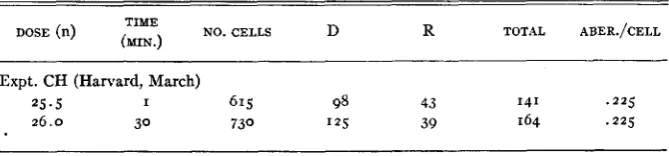
were tested with the same dose a t different intensities. The data for chromo- some rings and dicentrics are presented in table 3 . It is clear that there is no effect of the time factor with an intensity difference of I to 30 a t approximately
26 n. For chromatid effects a direct comparison was made between X-rays and neutrons with respect to the time-intensity factor. The data are presented in table 4. The difference between the means for exchanges in the X-ray exper- iment is three times its standard error and is the only difference which is a t all significant. For neutrons, then, there is no intensity effect for chromatid or for chromosome exchange type aberrations. The absence of any difference in the case of isochromatid rejoins with X-rays is in accord with previous ex- periments of SAX.
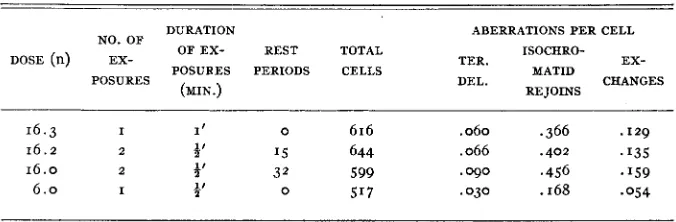
Chromatid effects were also studied in experiments using intermittent ver- sus continuous irradiation. The data are given in table 5.. I n this table are in- cluded both the so-called one-hit chromatid types-simple terminal deletions and isochromatid rejoins-as well as the exchange types. It may be seen that with split doses and rest periods of I 5 and 32 minutes there is no decrease in the
frequency of any of the aberration types. An attempt was made to obtain an approximate base line, but the dose was less than half that for the single one- minute exposure. However,, if a correction is made for this difference, it is found that the value obtained from the one-half minute exposure multiplied
TABLE 3
Intensity effect: constant dosage, intensity varied. Chromosome effects at five days.
DOSE (n) TIME NO. CELLS D R TOTAL ABER./CELL
(MIN.)
__-
Expt. CH (Harvard, March)
25.5 I 615 98 43 141 .225
EFFECTS OF NEUTRONS AND X-RAYS TABLE 4
Intensity effect: constant dosage, intensity varied. Chromatid effects at 28 hours.
405
TIME ISOCHROMATID
NO. CELLS ABER./CELL EXCHANGES ABER./CELL
(n) (MIN.) REJOINS
Expt. CE (Harvard, February)
Neutrons
1 1 n I t 483 I 28 . 2 8 2 66 . I 4
IO n 16' 375 148 .348 5 2 . I 3
X-rays
4 563 2 2 8 .400 I90 . 3 4 f .04
130 r
130 r 13$' 475 176 .380 94 . 1 9 f .03
31
by the proper factor is approximately the same as that for the single one min- ute exposure, giving further evidence that restitution has not occurred during fractional dosage.
Space factors in the reunion of broken ends
The X-ray experiments of
SAX
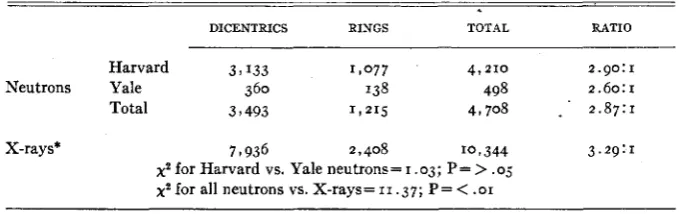
(1940, 1941) have shown that reunion of broken ends does not occur a t random in the nucleus, but that spatial as well as temporal limitations exist for X-ray induced two-hit breaks. Evidence of the limitations imposed by the factor of proximity in the reunion process has been obtained in two principal ways: (a) by a study of the relative frequencies of centric ring and dicentric rearrangements induced during the resting stage and (b) by a comparison of the proportions of types of chromatid aberrations in- duced a t different times during prophase development. Comparable data are now available for neutrons.A comparison of the dicentric:centric ring ratios for X-rays and neutrons is presented in table 6. For X-rays the ratio (based on the data of
SAX
1940) is 3.29: I ; for neutrons (using the total for all separate neutron experiments a t HARVARD and YALE) it is 2.87:1. The difference between the ratios for the two types of radiations is highly significant ( P < . o I ) as indicated by thex2
TABLE 5
Intensity effect: fractional dosage. Chromatid effects at 25 hours. (Howard, A p r i l )
DURATION ABERRATIONS PER CELL
NO. OF
O F E X - REST TOTAL ISOCHRO-
POSURES DEL. CHANGES
(MIN.) RE JOINS
DOSE (n) EX- TER. EX-
POSURES PERIODS CELLS MATID
16.3 I I t 0 616 .060 .366 .129
1 6 . 2 2 4' '5 644 .066 .402 .I35
1 6 . 0 2 $' 32 599 .090 .456 -159
I 2 1' 0 5'7 .030 .168 .054
406 NORMAN H. GILES, JR. TABLE 6
Comparative frequency of dicentrics and centric rings induced by X-rays and neutrons.
DICENTRICS RINGS TOTAL RATIO
-
Harvard 3 9 I33 1 , 0 7 7 49 2 1 0 2.90:1
Neutrons Yale 360 138 498 2.60:1
Total 3 7 493 1,215 4,708 _ . 2.87:1
X-rays* 7 t 936 2,408 1 0 2 344 3.29:I
xs for Harvard vs. Yale neutrons= I .03; P =
>
.os,ys for all neutrons vs. X-rays=II .37; P = < .OI * From SAX (1940).
test. Furthermore there is a difference between the ratios obtained with neu- trons a t HARVARD compared with those a t YALE, rings being even more favored in the latter experiments. This difference is not statistically significant, how- ever, on the basis of the number of aberrations studied so far.
The results of observations a t prophase of type (b) are presented in table 7. Here the X-ray data of SAX (1941) a t six hours and 24 hours after irradiation
are compared with neutron results a t these same times. I n general the results are similar, in that isochromatid rejoins are more frequent a t early prophase than are the other two types. However, a t later prophase, even though there is a decrease in the proportion of isochromatid rejoins, these still remain the most frequent type.
Relative eficiencies of neutrons of different energies
It has been pointed out in the discussion of the types of radiations usedin these experiments that the effects of neutrons produced by two different cyclotrons were studied. Furthermore, although the reaction used to produce the neutrons-bombarding beryllium with deuterons-was the same, deuterons of different energies were used in the two cases. Consequently, the resulting neutrons were of different energies, those a t HARVARD having a maximum energy of approximately 15 Mev and those a t YALE having a maximum of about half this value, or 7.5 MeV.
TABLE 7
Proportions of types of chromatzd aberrations induced during prophase development. Neutrons at Yale, October.
6 H R S . 24 ARS. X-RAYS* TYPES
NEUTRONS X-RAYS* NEUTRONS
Single terminal deletions 33% 34% 10% 23%
Isochromatid rejoins 43% 27% 60% 56%
Exchanges 24% 39% 30% 30%
No. of aberrations " I22 2 0 2 283 3 43
EFFECTS OF NEUTRONS AND X-RAYS 407
It is clear that for neutrons of both energy ranges the relation between dosage and frequency of aberrations is a linear one, as indicated by the dosage curves. However, it appears that there is a difference in the relative efficiency of the two in producing aberrations. The neutrons of lower energy used in the YALE experiments are more efficient.
The efficiency of the neutrons in producing aberrations in any given exper- iment may be measured by the constant (k) in the equation: aber./cell= (Dose/k)l, the constant being inversely related to the number of aberrations per cell. Although there is considerable variability in the several sets of exper- iments with dosage curves, possibly due to seasonal differences in sensitivity, slight effects of the time factor, or other causes, the value of the constant for induced chromosome rings and dicentrics is greater in all but one of the five HARVARD experiments than it is in either of the two YALE experiments (tables
I and 2 ) . The exceptional HARVARD experiment is number CK; it is not clear
why some of the points (particularly a t 1511) in this case are considerably out of line for both exchanges and deletions, although it appears that this may be due to a difference in seasonal sensitivity. I n order to make a general compar- ison, an average k has been obtained for neutrons of the two different energies by plotting all the points in the two series of experiments, a linear relation with dose being assumed for each series. The constants obtained (YALE, k = 73, HARVARD, k = 107) indicate that the lower energy neutrons are almost 50 percent more efficient in producing rings and dicentrics, the ratio being
1.46: I
A similar comparison has been made for interstitial deletions using data from those experiments which include records for this type of aberration. Here again, the lower energy neutrons are more efficient, the ratio being 1.75: I. T h e data for this comparison are not very extensive, and the magnitude of the ratio is not so well established as in the case of dicentrics and rings; further- more, this value may well be somewhat low as a general average, since one of the two HARVARD experiments included was number CK having exceptionally high values.
Adequate comparisons are not yet available for chromatid break types, but the data so far obtained indicate that here, too, lower energy neutrons are considerably more efficient. The results further suggest that the ratios vary with the type of aberration and possibly also with the stage in the nuclear cycle when irradiation takes place.
Sex-linked lethal mutations in Drosophila
408 NORMAN H. GILES, JR.
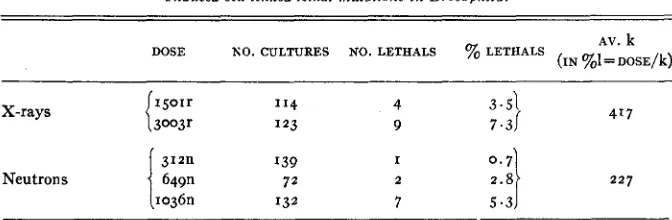
was tested by the ClB technique. A wild type stock which had been inbred for more than IOO generations was used. Males three to four days old were irradiated on the same day with either X-rays or neutrons a t constant inten- sity and mated with virgin sn/CZBQ 9 . F1 CZB9 Q were mated with their brother s n 3 3 in individual bottles. Both the inbred wild type males and the signed CZB females were from stocks kindly furnished for the experiment by DR. SHELDON REED. I n the Fz only bottles having a t least twenty-five
9 9 and no 3
8
were recorded as lethals. The results of the experiment are presented in table 8. Unfortunately the number of F2 cultures obtained wasTABLE 8
Induced sex-linked lethal mutations i n Drosophila.
AV. k (IN O/,l=DOSE/k) DOSE NO. CULTURES NO. LETHALS % LETHALS
X-rays
Neutrons
4 9
3.51
7.31 417
I
2 227
I39 72
1036n 132 7 5.3
considerably fewer than had been expected. However, it is apparent from the data available that the N/X ratio is much less for sex-linked lethals in Drosoph- ila than for chromosomal aberrations in Tradescantia. Furthermore, if the exposure in n units is corrected to give the actual tissue dose using the factor 2.5 as found by AEBERSOLD (cf. AEBERSOLD and LAWRENCE 1942)~ neutrons are found to be less efficient than X-rays, the k values being 417 for X-rays and 568 for neutrons. The N/X ratio then equals 0.73. I n both experiments the relation between dosage and percent mutations appears to be linear.
DISCUSSION
Nature of the interaction of neutrons and X-rays with protoplasm
EFFECTS OF NEUTRONS AND X-RAYS 409
with a striking dissimilarity in the distribution of ion pairs along their paths in protoplasm. Protons produce a very dense ionization over a relatively short and straight path, whereas secondary electrons result in scattered clusters of a few ion pairs along a much contorted path. Consequently, if equal amounts of ionization produced in a cell or tissue by the two radiations are compared, the distribution of the ionization in the two cases will be very different. With neutrons there will be relatively few proton paths, all having ion pairs densely spaced; with X-rays, there will be many scattered, irregular electron tracks, all with rather widely spaced small clusters of ions. If these differences are thought of in molecular terms, this means that an electron might pass scores of protein molecules without producing an ion pair, whereas a proton would produce one or more ion pairs in almost every protein molecule which it tra- versed. A more detailed discussion of the nature of the interaction between these two kinds of radiation and matter may be found in AEBERSOLD and L A W R ~ N C E (1942) and in LEA and CATCHESIDE (1943). Furthermore, the latter writers consider the problem of the difference between soft and hard X-rays and Gamma rays. From their discussion it is apparent that conclu- sions based on the absence of a wave length effect with X-rays, such as those of MULLER (1940) who concludes that chromosome breaks in Drosophila are caused by single ionizations, are not so valid as was first thought.
Having discussed briefly the manner in which X-rays and neutrons differ in their interactions with protoplasm, we may now proceed to consider whether the observed differences in the various cytogenetical effects produced by them can be explained on this basis. I n none of the experiments with neutron induced chromosomal aberrations in Tradescantia has any evidence of aberration types different from those produced by X-rays been obtained. With respect to the type of aberrations produced, then, the two radiations are similar. However, as regards their relative efficiencies in producing aberrations, the nature of the relation between frequency of break types and dosage, the presence or absence of a time-intensity factor, the ratios of various aberration types a t certain stages in the cell cycle and in other ways, the experimental data al- ready presented indicate that neutrons and X-rays differ markedly,
Dosage curves and the intensity factor with neutrons and X-rays; the mechanism of rearrangement
410 NORMAN H. GILES, JR
firmed by subsequent experiments a t both HARVARD and YALE presentedin this paper, and also by THODAY (1942) a t CAMBRIDGE UNIVERSITY. Further- more, the experimental results dealing with the intensity factor also presented here indicate that there is no intensity effect for neutron-induced exchange aberrations. The absence of such an effect has been shown by studies of com- parative dosage curves with either time or intensity constant, by giving single dosages a t different intensities, and by the use of intermittent dosages. For both chromatid and chromosome exchanges there is no evidence that a time factor exists with neutrons. The conclusion to be drawn, then, is that these exchange aberrations are produced by two related and essentially simulta- neous events: two ionizations or groups of ionizations formed by a single pro- ton path.
For X-rays it is clear from the experiments of SAX and others that the situ- ation with respect to exchange breaks is different. Here the relation between aberration-frequency and dosage is not linear, and there is an intensity effect. This may be taken to indicate that the two breaks which result in an exchange are the result of ionizations produced by two different electron paths.
EFFECTS OF NEUTRONS AND X-RAYS 41 1
a real one, however, for it is clear from the figures of aberration types produced a t CAMBRIDGE that interstitial deletions have not been distinguished from terminal deletions. Both metaphase plates (a) and (b) in figure 4 (THODAY 1942) contain single interstitial deletions as well as the expected acentric fragments accompanying exchanges.
For X-ray induced aberrations types other than exchanges the relationship with dosage is not always linear and depends on the type of aberration. For chromatid terminal deletions, isochromatid breaks, and chromosome terminal deletions the relation is linear, and there is no intensity effect (SAX 1940; RICK 1940). These three types, then, exhibit essentially the same dosage and intensity relationships with both X-rays and neutrons. T he isochromatid re- join is the only two-break aberration induced by X-rays whose mechanism of production is clearly similar to that of the one-hit neutron exchanges. It now seems apparent that the “hit” in the case of the chromatid dicentric is a single electron path and not a single ionization as was originally thought. This con- ception of the “hit” in the case of the isochromatid rejoin as a single electron path, and not a single ionization, eliminates the difficulty of explaining how a single ion pair can break two separated sister chromatids (DELBRUCK 1940). The nature of interstitial deletions and their relation to X-ray dose has been studied by RICK (1940). These aberrations vary as some power of dose which may be somewhat less than the square when the time is constant. Presumably they are a mixture of one- and two-hit types. With neutrons, however, these all seem to result from a single hit, which is not surprising in view of the great ionization density along a proton path.
Relative eficieizcies of X-rays and neutrons
41 2 NORMAN H. GILES, JR.
It has been pointed out in the previous section on dosage curves that the “hit” when used in terms of one-hit and two-hit aberrations is to be considered an electron or proton path. This conclusion does not indicate whether the actual break produced in one or more chromosomes results from one or several ionizations. The N/X ratios, however, do provide evidence on this point. Since protons produce many more ionizations in a given volume than do electrons, it follows that more ionizations will be produced within a chromosome by neutron than by X-radiation. Consequently if more than one ionization is necessary to break a chromosome, neutrons should be more efficient than X-rays, when equal doses (ionization) of the two are compared, and this is the case for all types of aberrations (within the dose range used).
This greater efficiency of neutrons over X-rays, then, indicates that more than one ionization is necessary to break a Tradescantia chromosome (GILES 1940; THODAY 1942). The results of MARSHAK (1939) with other plant genera, although not obtained in such a way as to be strictly comparable with the Tradescantia observations, also suggest that more than a single ionization is involved.
I n the present study, it has been found that protons of lower average en- ergies are more efficient in producing aberrations in Tradescantia than are those of higher average energies. The average values for all experiments with the two kinds of neutrons indicated a ratio of 1.46:1 for chromosome exchanges and of 1.75:1 for interstitial deletions. I n both cases the neutron (proton) measurements were made with a standard Ioor Victoreen bakelite thimble ionization chamber. As far as is known there should be no very great differences in the measurements obtained with such chambers due to the different energies of neutrons used.
It appears that this greater efficiency of lower energy protons is again due to differences in density of ionization. The density with which ion pairs are pro- duced by a proton along its path is a function of its energy, the two being inversely related. Consequently, protons of lower average energy produce more dense ionization and are more efficient in producing chromosome breaks, according to the present evidence. I n a recent paper, LEA and CATCHESIDE
(1943) calculated that the number of ionizations necessary to break a Trades- cantia chromosome is of the order of 17. Furthermore, they suggest t h a t protons break a chromosome whenever they pass through one. The present evidence would seem to indicate, however, that the efficiency of an ionizing par- ticle in breaking a chromosome is a function of ion density even with such densely ionizing particles as protons. Consequently, the probability of a break occurring when a proton traverses a chromosome would appear to be less than one, a t least for high energy protons.
Since these comparisons were made .using different neutron sources and were measured with different r-meters (although using standard Ioor chambers whose neutron responses differ by not more than 20 percent a t most, according
EFFECTS OF NEUTRONS AND X-RAYS 413
duced by one cyclotron and measured with a single Ioor chamber. Such exper- iments are being planned.
Comparative aberration ratios with X-rays and neutrons; the eject of the space jactor
SAX (1940, 1941) has discussed the nature of the evidence that with X-ray- induced breaks the reunion of broken ends does not occur a t random in the nucleus, but that spatial as well as temporal limitations exist. It has already been pointed out that this evidence is obtained in two principal ways: (a) by a study of the relative frequencies of centric ring and dicentric rearrangements induced during the resting stage and (b) by a comparsion of the proportions of types of chromatid aberrations induced a t different times during prophase development. On the basis of random reunion of broken ends in comparison (a), the ratio of dicentrics to centric rings should be IO:I. Actually the ob-
served ratio for X-rays is 3.29:1, and this is good evidence that reunion is not a t random. This high frequency of ring chromosomes is explained by SAX as a result of the polarized condition of the chromosomes of Tradescantia during the resting stage, exchanges between adjacent arms of the same chromosome evidently being favored.
The dicentric-ring ratio obtained for neutrons (2.86: I) is fundamentally similar to that for X-rays and indicates that the reunion of neutron-induced broken ends is also not a t random. However, the difference between the two ratios is significant, and it appears that rings are even more favored with neutrons than with X-rays. As in the case of other dissimilarities between the two radiations, this one seems to be reasonably explained on the basis of ioni- zation distribution. Apparently a densely ionizing proton will break both arms of a polarized chromosome, when these arms are within the limited distance over which refusion of broken ends can occur, in a greater proportion of cases than will two separate electron ionization paths. Furthermore, it is of interest to note that there is also a difference between the ratios when neutrons pro- duced a t HARVARD and YALE are compared. Rings are produced in still greater relative frequency with the lower energy neutrons a t YALE. Even though the difference is not statistically significant on the basis of the number of obser- vations to date, still it may well be real, and if so, it is apparently further evi- dence of an effect of ionization density, since protons of lower average energy a t YALE produce a more dense ionization than do those of higher average energy a t HARVARD as discussed previously.
The results of observations a t prophase of type (b) have been discussed for X-rays by SAX (1941). The occurrence of only chromatid types during the first 2 5 hours after irradiation has been taken to indicate that the chromosomes
414 NORMAN H. GILES, JR.
isochromatid rejoins occurs a t early prophase when sister chromatids are close together, whereas single deletions and exchanges are most frequent a t late pro- phase, when sister chromatids are more widely separated. Obviously space factors influence the reunion of X-ray-induced broken ends a t prophase as in the resting stage. Again, the results with neutrons a t prophase are fundamen- tally similar in indicating that reunion is affected by the factor of proximity. Furthermore, there are differences in the relative proportions of aberration types, and these appear to be correlated with ionization distribution. Isochrom- atid rejoins are more frequent a t early prophase than are the other two types -as with X-rays. However, a t later prophase, even though there is a decrease in the proporton of isochromatid rejoins, these still remain the most frequent type. Apparently proton ionization paths break both sister chromatids a t late prophase (when they are relatively far apart) in a greater proportion of the chromosomes than do electron ionization paths. I n view of the great differences in ionization density and straightness of path in the two cases, such results might well have been anticipated.
Comparative neutron and X-ray ejects i n Drosophila
The experiment (table 8) comparing the efficiency of neutrons and X-rays in inducing sex-linked lethal mutations in Drosophila indicates that neutrons are less efficient per ionization than are X-rays. These results agree in general with those of ZIMMER and TIMOF~EFF-RESSOVSKY (1938), KAUFMANN (1941b), DEMPSTER (1941), and FANO (1943). The lesser efficiency of neutrons in pro- ducing sex-linked lethals has been interpreted as indicating that densely ion- izing protons produce unnecessary extra ionizations within the sensitive vol- ume of the gene (cf. LEA 1940). Calculations of this sort usually do not take into account the fact that a considerable proportion of sex-linked lethals are deficiencies. There is some cytological evidence (vide infra) that neutrons are actually more efficient in inducing such rearrangements than are X-rays. Con- sequently the genetic results with lethals may show that neutrons are much less efficient than X-rays in producing the residual gene mutations (in the re- stricted sense) than the data a t first indicate.
EFFECTS OF NEUTRONS AND X-RAYS 415
For X-rays there is considerable evidence in Drosophila from both genetical (MULLER 1940) and cytological studies (BAUER, DEMEREC, and KAUFMANN 1938) that the relation between dosage and frequency of gross chromosomal rearrangements (eucentric translocations and inversions) is exponential and may approach closely a two-power curve (BAUER 1939). These results have been interpreted as indicating that gross structural changes are two-hit effects, two independent ionizations being involved. For neutrons, the evidence is not nearly so complete. However, the values obtained by KAUFMANN (1941b) in an experiment comparing X-rays and neutrons clearly indicate a more gradual rise with neutrons, and the relation with dosage may indeed be linear for gross rearrangements. Thus, on the basis of present data, it appears that the re- lation between dosage and frequency of gross rearrangements of comparable types for both X-rays and neutrons are in essential agreement in Drosophila and Tradescantia.
It will be recalled that in order to obtain a value for the N / X ratio inTrades- cantia, it is necessary to use one-hit aberration types (such as isochromatid rejoins or chromatid breaks), since only with these is the dosage-frequency relationship linear for both X-rays and neutrons. If gross rearrangements are made the basis for comparison, the value of the N/X ratio will depend on the dosage a t which the comparison is made, being high a t low dosages and be- coming progressively less a t increasing dosages. This of course results from the fact that the frequency of gross aberrations in Tradescantia increases linearly with the neutron dose,but as the square of the X-ray dose (with time constant). Since it appears that these same relations probably hold in Drosophila, the value of the N / X ratio cannot be obtained from data on gross rearrangements. Consequently it is not valid to conclude on the basis of such data (KAUFMANN 1941b) that neutrons are less efficient than X-rays in producing structural changes. I n the range of dosages used in those experiments (3000 and 4000 r) it appears that X-rays are more efficient than neutrons, but if different re- lations to dosage obtain, the data indicate that the N / X ratio a t 1000 r is
about three. Unfortunately, data for lower dosages are a t present not available to test this possibility.
416 NORMAN H. GEES, JR.
ratio for the one-hit types should be considerably higher. Consequently, it again appears that neutrons may be more efficient than’ X-rays in breaking chromosomes in Drosophila. The present indications, however, are that the magnitude of this efficiency is less in Drosophila than in Tradescantia. This difference may well be the result of the great difference in chromosome size between two species, the smaller chromosomes of Drosophila being broken by fewer ionizations. It seems probable that there may be a fairly direct relation between the size of a chromosome and the number of ionizations necessary to break it, and that the N/X ratio for various organisms may show a positive correlation with chromosome size.
I n one respect the mechanism of rearrangement in Drosophila appears to be clearly different from that in Tradescantia. The experiments of MULLER (1940) and of KAUFMANN (1941a) show that restitution of broken ends does not occur in irradiated sperms, whereas such restitution clearly occurs in Tradescantia microspores. This dissimilarity is probably not a fundamental one, however, for it presumably results from the very dissimilar arrangement and physiologi- cal condition of the chromosomes in the two kinds of cells.
From comparative cytogenetical studies of the effects of neutrons and X- rays in Tradescantia and Drosophila it may be concluded that the “hit” which is referred to as producing one-hit or two-hit aberration types, as judged by the dosage relationship, is to be interpreted in ferms of proton or electron ioni- zation paths, rather than in terms of single ionizations or excitations. Thus it is much easier to explain one-hit X-ray types such as isochromatid rejoins in Tradescantia and deficiencies in Drosophila. Furthermore, it seems probable that in both organisms single ionizations or excitations are incapable of pro- ducing chromosome breaks, though they apparently can produce gene mu- tations.
SUMMARY
Comparative effects of neutrons and X-rays have been investigated in Tradescantia by a cytological analysis of chromosomal rearrangements in- duced by irradiation of the developing microspores. Neutrons and X-rays were found to produce the same qualitative types of rearrangements-for chro- matid as well as for chromosome effects. The two radiations differ strikingly, however, in their quantitative effects. These quantitative differences are inter- preted as resulting from the very dissimilar ways in which a given amount of ionization produced by the two radiations is distributed inside the treated nuclei.
For equal total tissue doses of ionization, neutrons are more efficient than X-rays in breaking chromosomes. Furthermore, under the conditions of dosim- etry used in these experiments, neutrons of lower average energy (7.5 MeV) are more efficient in producing chromosomal rearrangements than‘are those of higher average energy (I 5 Mev). These results indicate that several ionizations are necessary to break a Tradescantia chromosome.
EFFECTS OF NEUTRONS AND X-RAYS 4= 7 imately linear for all types of rearrangements-terminal and interstitial de- letions and exchanges (translocations) within the dosage range used, indicat- ing that all these rearrangements are “one-hit” types, both breaks for most of the two-break aberrations being produced by single proton ionization paths. These results differ from those obtained with X-rays, where it is clear that exchanges are “two-hit” types, produced by two independent electron ioni- zation paths.
Results obtained by studies of dosage curves with either time or intensity constant, by giving single doses a t different intensities and by the use of inter- mittent doses, indicate that for both chromatid and chromosome exchanges induced by neutrons no time-intensity factor exists. This situation is contrary to that found in comparable X-ray experiments and provides further evidence that most neutron-induced exchanges are produced by single proton paths.
The ratios of certain aberration types induced during resting stage and pro- phase provide evidence that space factors limit the reunion of neutron-induced as well as X-ray-induced broken chromosome ends. However, the ratios with neutrons are different from those with X-rays, indicating that the denser ion- ization paths of neutron radiation modify the distribution of breaks and re- unions within nuclei.
I n Drosophila, neutrons are found to be less efficient than X-rays in in- ducing sex-linked lethal mutations. This effect is discussed and interpreted in comparison with the results in Tradescantia and with those obtained by pre- vious investigators in Drosophila.
ACKNOWLEDGMENTS
The experiments a t HARVARD were carried out while the writer was a Parker Fellow in Biology. DR. B. R. CURTIS kindly cooperated in arrang- ing the cyclotron irradiations a t HARVARD, and DR. RICHARD F. HUMPHREYS performed this same service a t YALE. The experiments a t YALE were supported in part by a grant from the AMERICAN PHILOSOPHICAL SOCIETY. The writer is also indebted to PROFESSOR KARL SAX for much helpful advice and criti- cism.
LITERATURE CITED
AEBERSOLD, P. C., and J. H. LAWRENCE, 1942 The physiological effects of neutron rays. Annu. Rev. Physiol. 4 : 25-48.
BAUER, H., 1939 Rontgenauslosung von Chromosomen Mutationen bei Drosophila melanogaster.
Chromosoma I : 343-390.
BAUER, H., M. DEMEREC, and B. P. KAUPMANN, 1938 X-ray induced chromosomal alterations in Drosophila melanogaster. Genetics 23 : 610-630.
DELBRUCK, M., 1940 Radiation and the hereditary mechanism. Amer. Nat. 74: 350-362.
DEMEREC, M., and U. FANO, 1941 Mechanism of the origin of X-ray induced notch deficiencies DEMPSTER, E. R., 1941 Dominant vs. recessive lethal mutation. Proc. Nat. Acad. Sci. Wash. FABERG%, A. C., 1940 An experiment on chromosome fragmentation in Tradescantia by X-rays.
in Drosophila melanogaster. Proc. Nat. Acad. Sci. Wash. 27: 24-31.
27: 249-250.
418 NORMAN H. GILES, JR.
FANO, U., 1943 Neutron-induced lethals in Drosophila. (Abstract.) Genetics 28: 74-75.
GILES, N. H., 1940 The effect of fast neutrons on the chromosomes of Tradescantia. Proc. Nat. Acad. Sci. Wash. 26: 567-575.
KAUPMANN, B. P., q41a The time interval between X-radiation of sperm of Drosophila and chromosome recombination. Proc. Nat. Acad. Sci. Wash. 27: 18-24.
1941b Induced chromosomal breaks in Drosophila. Cold Spring Harbor Symp. Quant. Biol. 9: 82-91.
LEA, D. E., 1940 A radiation method for determining the number of genes in the X-chromosome of Drosophila. J. Genet. 39: 181-188.
LEA, D. E., and D. G. CATCHESIDE, 1943 The mechanism of the induction by radiation of chromosome aberrations in Tradescantia. J. Genet. 4: 216-245.
MARINELLI, L. D., B. R. NEBEL, N. H. GILES, and D. R. CHARLES, 1942 Chromosomal effects of low X-ray doses on five-day Tradescantia microspores. Amer. J. Bot. 29: 866874.
MARSHAK, A., 1939 Effects of fast neutrons on chromosomes in mitosis. Proc. Soc. Exp. Biol.
41: 176-180.
MULLER, H. J., 1940 An analysis of the process of structural change in chromosomes of Dro- sophila. J. Genet.. 40: 1-66.
1941 Induced mutations in Drosophila. Cold Spring Harbor Symp. Quant. Biol. 9: 151-165.
PONTECORVO, G., 1942 The problem of dominant lethals. J. Genet. 43: 295-300.
RICK, C. M., 1940 On the nature of X-ray induced deletions in Tradescantia chromosomes. Genetics 25: 466-482.
SAX, K., 1939 The time factor in X-ray production of chromosome aberrations. Proc. Nat. Acad. Sci. Wash. 25: 225-233.
1940 An analysis of X-ray induced chromosomal aberrations in Tradescantia. Genetics 25: 41-68.
1941 Types and frequencies of chromosomal aberrations induced by X-rays. Cold Spring Harbor Symp. Quant. Biol. 9: 93-101.
THODAY, J. M., 1942 The effects of ionizing radiations on the chromosomes of Tradescantia bracteeta. A comparison between-neutrons and X-rays. J. Genet. 43: 189-210.