Simulation Study of Energetic Ion Driven Instabilities
near the Lower Hybrid Resonance Frequency
in a Plasma with Increasing Density
∗
)
Mieko TOIDA
1), Hiroe IGAMI
1), Kenji SAITO
1), Tsuyoshi AKIYAMA
1,2),
Shuji KAMIO
1)and Ryosuke SEKI
1,2)1)National Institute for Fusion Science, Toki, Gifu 509-5292, Japan
2)SOKENDAI (The Graduate University for Advanced Studies), Department of Fusion Science, Toki,
Gifu 509-5292, Japan
(Received 9 January 2019/Accepted 26 April 2019)
Using a one-dimensional electromagnetic particle code which simulates self-consistently the full ion and electron dynamics, we study instabilities driven by energetic ions injected continuously in a plasma where the density and the lower-hybrid resonance frequencyωLH increase with time. The simulation shows that the ion cyclotron harmonic wave withω lΩi, wherelis an integer andΩi is the ion cyclotron frequency, is excited whenωLHbecomes close tolΩi. WhenωLHis greater thanlΩi, this wave couples with the ion Bernstein mode that has the dispersion curve connecting toωLH. It is also found that as a result of the instabilities and the wave-wave coupling, the stair-like frequency chirping with the riserΩiappears in the magnetic fluctuations in the frequency range ofωLH. The frequency chirping has characteristics similar to the frequency chirping observed in the RF radiations at the plasma start-up phase of the LHD experiments.
c
2019 The Japan Society of Plasma Science and Nuclear Fusion Research
Keywords: instabilities driven by energetic ions, PIC simulation, lower hybrid resonance frequency, ion cy-clotron wave, ion Bernstein wave, Large Helical Device
DOI: 10.1585/pfr.14.3401112
1. Introduction
Waves with frequencies near the lower hybrid res-onance frequency ωLH propagating perpendicular to the magnetic field can be excited by energetic ion beams across the magnetic field when the beam speed is smaller than the Alfvén speed [1–3]. Here,ωLHis defined as
ω2
LH= ΩiΩe(1+ Ω2i/ωpi2)/(1+ Ω2e/ω2pe)
=(Ω2i +ω2pi)/(1+ω2pe/Ω2e), (1) where Ωj and ωpj are the cyclotron frequency and the
plasma frequency, respectively, and jrefers to ions (j=i) and electrons (j=e). The value ofωLH/Ωiincreases with the plasma density if the magnetic field strength is fixed. In the Large Helical Device (LHD), radio frequency (RF) waves from the plasma are detected [4, 5], and RF waves in the frequency range ofωLH were observed during the period of perpendicular neutral beam injection (NBI) [6]. Recently, stair-like frequency chirping is observed in the RF radiation in the frequency range of ωLH when the LHD plasma is initiated by almost simultaneous injections of the electron cyclotron wave and the tangential neutral beam [7]. The energetic ions produced by tangential NBI author’s e-mail: [email protected]
∗)This article is based on the presentation at the 27th International Toki Conference (ITC27) & the 13th Asia Pacific Plasma Theory Conference (APPTC2018).
can have the finite speed across the magnetic field although the angle between the magnetic field and the energetic ion beam is small. The experimental results also show that the riser of the stair isΩiand the RF wave withωlΩi, where
lis an integer, begins to grow whenωLHis close tolΩi. We are studying the excitation mechanism of waves in the frequency range ofωLHusing a one-dimensional (one spatial coordinate and three velocity components), electro-magnetic, particle-in-cell (PIC) code which simulates self-consistently the full ion and electron dynamics. In ref. [8], we investigated the linear and nonlinear evolution of insta-bilities due to energetic ions produced by the perpendicular NBI, assuming that the energetic ions have a ring-like dis-tribution in the velocity space perpendicular to the mag-netic field. It was shown that in addition to electromag-netic emissions near the ion cyclotron frequency and its harmonics, the high-frequency magnetosonic waves with frequencies slightly smaller than ωLH grow to large am-plitudes. We also performed the simulations for various plasma densities and demonstrated that the frequency of the large-amplitude magnetosonic wave increases with the electron density when the density is relatively small. The density dependence shown by the simulations qualitatively agrees with the density dependence of RF waves of the lower hybrid wave frequency range observed in the LHD experiments [6].
c
In this paper, we consider a plasma in which the den-sity andωLHare gradually increasing with time, such as at the plasma start-up phase. The density and the value of
ωLH/Ωiare much smaller than those considered in Ref. [8]. In order to study the mechanism of the stair-like frequency chirping observed at the plasma start-up phase of the LHD experiments [7], we perform a simulation of instabilities driven by energetic ions injected continuously in a plasma with the increasing density and the increasing ωLH. We investigate how the time variation ofωLH influences the wave evolution.
2. Linear Theory
Before explaining simulations, we look at the linear dispersion relations of energetic ion driven instabilities in the frequency range ofωLH.
We assume that the velocity distribution function of energetic ions is given by
f(v,v⊥)= 1
2πu⊥δ(v−u)δ(v⊥−u⊥), (2)
where the subscriptsand⊥indicate parallel and perpen-dicular to the external magnetic field, respectively, andu
is the initial speed of the energetic ions. We assume that
u⊥/u 1 andu/vA 1, wherevAis the Alfvén speed, because we consider the energetic ions produced by the tangential NBI in a low-density plasma where vA to be much greater thanu.
We consider waves propagating perpendicular to the external magnetic field. These waves may play essential roles in the stair-like frequency chirping in the RF radi-ations observed at the plasma start-up phase in the LHD experiments. The radiations are detected by the antenna lo-cated in the direction nearly perpendicular to the magnetic field from the point where the energetic ions are generated by the tangential NBI [7]. Although the excited waves will have both electromagnetic and electrostatic compo-nents, we use in this section the electrostatic approxi-mation for simplicity, which may be valid because these waves will have short wavelengths such thatkvA/Ωi 1 sinceu⊥/vA1.
The dispersion relations of the perpendicular electro-static waves in a plasma consisting of electrons, bulk ions, and the energetic ions can be written as [9]
=(1+ω
2 pe/Ω2e) (ω2−Ω2
i)
(ω2−ω2LHB)+h=0, (3) whereis the plasma dielectric function,ωis the complex frequency, ωLHB is the frequency of the Bernstein mode due to the bulk ions nearωLH, andh is the term due to the energetic ions. Assuming thatkvTi/Ωi 1, where
vTi is the bulk-ion thermal speed, andωpi Ωi, we can approximateωLHBas
ω2 LHB=ω
2 LH−
ω2 pi
(1+ω2 pe/Ω2e)
k2v2 Ti
Ω2 i
, (4)
where electron kinetic effects are neglected. In the limit of
k→0,ωLHBgoes toωLHdefined by eq. (1).
The energetic ion term h can be expressed as fol-lows, depending on the magnitude of the wave growth rate
γ. Whenγis much greater thanΩi, we can approximate the energetic ions that can interact with the perpendicular waves as the energetic ion beam across the magnetic field. Because this situation is similar to the modified two-stream instabilities [1, 2], the energetic ion termhcan be written as
h=−
ω2 ph
(ω−k⊥u⊥)2, (5)
whereωph is the plasma frequency of the energetic ions. The equation (3) with thish indicates that the interaction between the bulk-ion Bernstein mode connecting toωLH and the energetic-ion beam mode ω = k⊥u⊥ can cause strong instabilities [10].
Whenγ <Ωi,his written as [11, 12]
h=−
l ω2
phlg(λ)
Ωi(ω−lΩi)
, g(λ)= 1
λ
dJ2
l(λ)
dλ , (6)
wherel is an integer,λ = k⊥u⊥/Ωi, and Jl is the Bessel
function. We consider waves with frequencies nearlΩiand writeωasω=lΩi(1+ Δ). Then, the equation (3) leads to
2l2Ω2iΔ2+(l2Ω2i −ω2LHB)Δ− ω 2
ph(l2−1)g (1+ω2pe/Ω2e)
=0. (7) From this, we can obtain the unstable condition for the wave withωlΩias
(l2Ω2i −ω2LHB)2+8ω 2
phΩ2il2(l2−1)g (1+ω2
pe/Ω2e)
<0. (8)
This can be satisfied whenlΩi ωLH andg < 0. For
l≥2,gis negative in the range ofλ1 < λ < λ2, whereλ1 andλ2are the points at whichJl2becomes maximum and
minimum, respectively. Becauseλ1 is greater than 1, we can expect that the wave withω lΩiandk⊥u⊥/Ωi > 1 may be destabilized when lΩi is close to ωLH. We call this wave thelth harmonic ion cyclotron wave (ICW). The ICWs are supported by the energetic ions. They are not the Bernstein modes due to the bulk ions and can exist in the limit of a cold plasma approximation,vTi→0.
3. Simulation Model and Parameters
The plasma consists of three components: minor-ity energetic ions, electrons, and bulk ions. The ion-to-electron mass ratio ismi/me = 1000. The total charge of electrons is equal to that of ions. Initially, the electrons and bulk ions have Maxwell velocity distributions, whereas the energetic ions have a velocity distribution function given by eq. (2).
We set the speed of the energetic ions asu/vA0=0.1, wherevA0is the initial Alfvén speed. This is equal to the value ofu/vAfor the H ions with the energyK=178 keV in the H plasma withne = 0.3×10¹⁹m−3 andB=2.6 T. These values are close to the typical values in the plasma core region at the start-up phase of the LHD plasma [7], where the waves can be excited by energetic ions gener-ated by the tangential NBI. The ratios ofvA0to the electron thermal speedvTeisvA0/vTe =2.6, which is the same order as that for the electron temperatureTe=5 keV. Assuming that the ion temperatureTiis much smaller thanTe, we set
vA0/vTi=300.
We choose the angle between the energetic ion beam and the magnetic field asα = arctan(u⊥/u) = 10◦, ac-cording to Ref. [7]. Then, becauseu⊥/vA00.1, we can expect from the linear theory that the energetic ions would excite short-wavelength waves such thatkvA/Ωi 10. These wavelengths are much smaller than 1cm, and the variation of the LHD magnetic field and the density for these lengths in the plasma core region would be small. Therefore, we assume that the external magnetic field and the plasma density are uniform.
The simulation system is periodic in the xdirection with the lengthLx=2048Δg, whereΔgis the grid spacing, and the electron skin depth isc/ωpe = 10Δg. The waves propagate in thexdirection in the external magnetic field
B0 =(B0cosθ,0,B0sinθ), whereθis the propagation an-gle of the waves. Settingθ=89.7◦, we simulate the waves propagating nearly perpendicularly toB0.
The total number of the simulation particles is N =
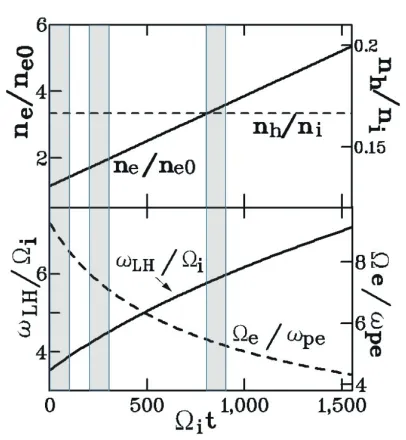
4×10⁶ att = 0. In order to simulate a situation where the energetic ions are injected continuously in a plasma with the increasing density andωLH, we increase the num-bers of electrons, bulk ions, and energetic ions as the time proceeds. The increase rates of the three species of parti-cles are equal. The positions and gyration phases of newly added particles are given randomly. The newly added elec-trons and bulk ions obey the Maxwell velocity distribu-tions, whereas the newly added energetic ions obey eq. (2). Figure 1 shows time variations of the simulation pa-rameters. The electron densitynenormalized by the initial densityne0, the energetic-ion densitynhnormalized by the bulk ion densityni, wherene=ni+nhis satisfied, and the values ofωLH/ΩiandΩe/ωpeare plotted. The increase of
ne/ne0 causes the decrease ofΩe/ωpe and the increase of
ωLH/Ωi sinceΩe andΩi are constant. We study how the increase ofωLH/Ωi influences wave evolution. The three periods shown by the shaded regions in Fig. 1 will be fo-cused on below.
Fig. 1 Time variations of simulation parameters.
4. Simulation Results
4.1
Wave evolution
We firstly present a result for a plasma without ener-getic ions. The left panel (a) of Fig. 2 shows the power spectrumP(k, ω) of magnetic fluctuations obtained for the period fromΩit =0 to 100. During this period, the den-sity andωLH increase fromne/ne0 = 1 to 1.4 and from
ωLH/Ωi = 3.6 to 3.9, respectively, as shown by the left shaded region in Fig. 1. The large-amplitude fluctuations near the lineω = kvA0 in the long-wavelength region are due to the magnetosonic mode. The fluctuations in the short-wavelength region such thatkvA0/Ωi>10 are due to the bulk-ion Bernstein mode that has the dispersion curve connecting toωLH, which was expressed asωLHBin Sec. 2. The right panel (b) of Fig. 2 displays the power spec-trum of the magnetic fluctuations in a plasma with the en-ergetic ions for the same period as the left panel (a). Com-parison between the two panels shows that the harmonics of ICW withω/Ωi =2, 3, and 4 are excited by the ener-getic ions. Also, the large-amplitude fluctuations are ex-cited near the point (kvA0/Ωi, ω/Ωi) =(280, 2.8). This point corresponds to the intersection between the curve for the bulk-ion Bernstein mode connecting to ωLH and the lineω = k⊥u⊥ = kxux for the energetic-ion beam mode
propagating in the positivexdirection, whereuxcan be
es-timated asux 0.01vA0. Here, we neglectedk, because
we performed the simulation for the exactly perpendicu-lar caseθ = 90◦ (k = 0), which is not shown here, and confirmed that the point near which large-amplitude fluc-tuations are excited whenθ=90◦is almost the same as the point shown in Fig. 2 (b). As predicted by eqs. (3) and (5), the strong instabilities occurred because of the interaction between the bulk-ion Bernstein mode connecting toωLH and the energetic-ion beam mode.
spec-Fig. 2 Power spectra of magnetic fluctuations for the period fromΩit=0 to 100 in a plasma without energetic ions (a) and in a plasma with energetic ions (b).
Fig. 3 Power spectra of magnetic fluctuations in a plasma with energetic ions for the periods 200< Ωit <300 (a) and 800<Ωit<900 (b).
trum varies. Figure 3 displays the power spectra of mag-netic fluctuations for the periods 200 < Ωit < 300 (a) and 800 < Ωit < 900 (b), which correspond the mid-dle and right shaded regions in Fig. 1, respectively. In the left panel (a), for whichne/ne0andωLH/Ωivary from 1.7 to 2.0 and from 4.2 to 4.5, respectively, the 5th harmonic ICW is newly excited slightly aboveω=ωLH. In the right panel (b), for whichne/ne0 andωLH/Ωi are in the range of 3.3 < ne/ne0 < 3.6 and 5.8 < ωLH/Ωi < 6.0, the 6th harmonic ICW appears. The strong instabilities due to the interaction between the bulk-ion Bernstein mode and the energetic ion beam mode are not shown in the two panels of Fig. 3, unlike in the right panel of Fig. 2. This is because the velocity distribution function of the energetic ions is drastically changed by the timeΩit <100, which will be shown below.
We now pay attention to how the dispersion curve near
ωLHvaries with time. In the left panel (a) of Fig. 3 where
ωLHis slightly smaller than 5Ωi, the frequency of the 5th harmonic ICW is almost constant,ω=5Ωi, along the hor-izontal axiskin the wavenumber regionkvA0/Ωi > 100.
Fig. 4 Time variations of amplitudes of the waves withω5Ωi and withω 6Ωi. These were obtained by integrating
P(k, ω) over the wavenumber regionkvA0/Ωi>100.
However, in the right panel (b) of Fig. 3 whereωLH is in the range of 5.8 < ωLH/Ωi < 6.0, we cannot see the wave with the constant frequencyω = 5Ωi. This is be-cause the 5th harmonic ICW excited by the energetic ions couples with the bulk-ion Bernstein mode that has the dis-persion curve connecting toωLH. Its frequency gradually decreases fromωLHto 5Ωi. The frequency of the 6th har-monic ICW slightly aboveωLH is almost constant in this panel. In the power spectrumP(k, ω) for the next time pe-riod, which is not shown here, this wave couples with the bulk-ion Bernstein mode connecting toωLH. The 4th har-monic ICW shown in Fig. 2 (b) couples with the bulk-ion Bernstein mode connecting toωLHin Fig. 3 (a).
In order to show the time variations of amplitudes of waves excited by the energetic ions in more detail, we aver-age the power spectraP(k, ω) over the wavenumber region
kvA0/Ωi > 100. We focus on the waves excited by the energetic ions nearω = ωLH and these waves are in this wavenumber region as shown in Fig. 3. Figure 4 shows the amplitudes of waves withω5Ωiand 6Ωi, where the for-mer is in the range of 4.9 < ω/Ωi <5.1, and the latter is in the range of 5.9 < ω/Ωi <6.1. Here,t5 andt6are the times whenωLH becomes equal to 5Ωi and 6Ωi, respec-tively. This figure clearly shows that the amplitude of the 5th harmonic ICW begins to grow neart=t5. The ampli-tude is saturated slightly aftert=t5and then gradually de-creases, which is caused by the variation of the dispersion curve shown in Fig. 3. The time variation of the wave with
ω 6Ωiis similar to that withω 5Ωi, except that the timet6 is important for the evolution of the 6th harmonic ICW.
We then plot the amplitudes of all the waves in the frequency range 0.5 < ω/Ωi < 8 in Fig. 5, where the color indicates the amplitudes of the magnetic fluctuations and the yellow line represents the frequencyωLH. We find that the stair-like frequency chirping appears in the region
ω/Ωi >4. The riser of the stairs isΩiand the wave with
ra-Fig. 5 Time variations of magnetic fluctuations in the frequency range of 0.5< ω/Ωi<8. The stair-like frequency chirp-ing appears near the lineω=ωLH.
diations at the plasma start-up phase of the LHD experi-ments [7].
4.2
Velocity distribution function and
en-ergy
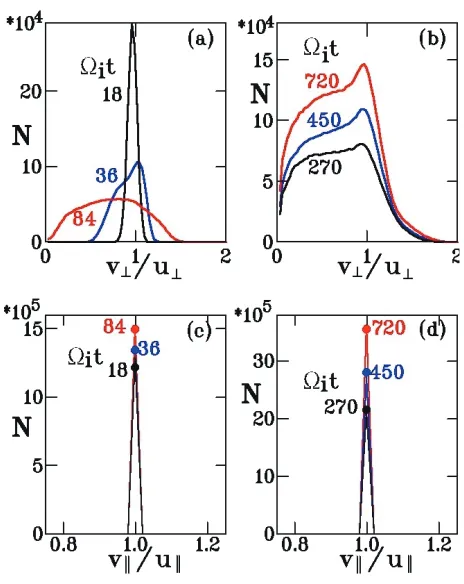
Figure 6 displays the time evolution of the velocity distribution functions of the energetic ions. The upper pan-els (a) and (b) show the perpendicular velocity distribu-tion, and the lower panels (c) and (d) show the parallel velocity distribution. In the panel (a), the perpendicular velocity distribution function f(v⊥) is drastically changed by the timeΩit=84. This is caused by the strong instabil-ities due to the interaction between the bulk-ion Bernstein mode connecting toωLHand the energetic ion beam mode
ω =ku⊥. Because of the change of f(v⊥), the strong in-stabilities do not occur afterΩit=100, as shown in Fig. 3. In the panel (b), the steep positive slope,∂f(v⊥)/∂v⊥ >0, is formed nearv⊥/u⊥ =1 because the energetic ions with
v⊥/u⊥ = 1 are added continuously in the simulation sys-tem. This can excite ICWs withω = lΩi nearωLH. In the lower panels (c) and (d), the parallel velocity distribu-tion funcdistribu-tion f(v) maintains its shape, although the peak value increases with time. This indicates that effects of the parallel velocity distribution on the wave evolution are negligibly small, compared to those of the perpendicular velocity distribution.
Figure 7 (a) shows the time variation of the kinetic en-ergy of the energetic ions. HereΔKhis defined as
ΔKh=Kh(t)−Kinj(t)
=Kh(t)−N(t)mi(u2 +u2⊥)/2, (9) whereKh(t) is the total energy of the energetic ions at the timet,Kinj(t) is the total injected energy by the timet, and
Fig. 6 Time evolution of velocity distribution function of ener-getic ions. The upper panels (a) and (b) show the pepen-dicular velocity distribution, and the lower panels (c) and (d) show the parallel velocity distribution.
N(t) is the total number of the energetic ions at t. The values ofΔKhin Fig. 7 (a) are normalized byKinj(0). The negativeΔKh indicates that a part of the injected energy is transferred to the waves. It is clearly shown thatΔKh decreases rapidly during the period 0 < Ωit < 100 and decreases gradually afterΩit 100. For comparison, we plot the time variations of the energies of magnetic fluc-tuations in the frequency ranges of 0 < ω/Ωi < 4.5 and 4.5 < ω/Ωi <7.5 in Figs. 7 (b) and (c), respectively. The waves in the range of 0< ω/Ωi<4.5 were excited before
Ωit100, as shown in Fig. 2 (b). From Figs. 7 (b) and (c), we confirm that the waves in the range of 0< ω/Ωi<4.5 grow rapidly beforeΩit 100, whereas the waves in the range of 4.5< ω/Ωi<7.5 grow gradually afterΩit200. In this paper, we assumed that the energetic ions con-tinue to exist in the simulation system after they are in-jected there. That is, we did not consider the change of
f due to the loss of the energetic ions from the system al-though this may significantly influence the wave evolution. The effect of the energetic ion loss is an important future problem.
4.3
Di
ff
erent bulk-ion temperature
In the previous subsections, we presented the results for the case of vA0/vTi = 300, where vA0 is the initial Alfvén speed andvT iis the bulk-ion thermal speed,
Fig. 7 Time variations of energies of energetic ions (a), mag-netic fluctuations in the frequency ranges 0< ω/Ωi<4.5 (b) and 4.5< ω/Ωi <7.5 (c). The fluctuation energies are averaged over the wavenumber regionkvA0>100, as in Figs. 4 and 5, and are normalized byB2
0L/(8π) with the system lengthL.
electron temperature. We also performed simulations for two cases of different bulk-ion temperatures.
Figure 8 shows the power spectra of magnetic fluctu-ations for the cases ofvA0/vTi=2.1×102(a) and 4.2×10² (b) obtained for the period fromΩit =200 to 300, which is the same period as for Fig. 3 (a). Here, the values of
vA0 and the other parameters are the same as those for Fig. 3 (a). We see almost the same spectra in Figs. 3 (a), 7 (a) and 7 (b), although the values ofvTiare different. The 5th harmonic ICW is excited nearωLH, and the 4th har-monic ICW, which was excited before this period, couples with the bulk-ion Bernstein mode connecting toωLH.
Figure 9 shows time variations of amplitudes of the waves withω 5Ωi (a) and with ω 6Ωi (b) for the cases of (vTi/vA0)/102 =4.2, 3.0, and 2.1, where t5 and
t6 are the same as those in Fig. 4. The waves with ω 5Ωiand 6Ωihave the greatest amplitudes neart =t5 and
t6, respectively, for all the three cases, although there are small differences.
As a result of the wave evolution shown in Figs. 8 and 9, almost the same chirping in the frequency range ofωLH appears in the cases ofvA0/vTi =4.2×10²and 2.1×10², which is not shown here. We have not understood the rea-son for the small differences caused by the effects of the bulk-ion temperature. We will study those effects by per-forming more simulations in the future.
Fig. 8 Power spectra of magnetic fluctuations for the period 200 <Ωit < 300 for the cases ofvA0/vTi =2.1×10² (a) and 4.2×10²(b).
Fig. 9 Time variations of amplitudes of the waves withω5Ωi (a) and withωi6Ωi(b) for the cases of (vA0/vTi)/102= 4.2, 3.0, and 2.1.
5. Summary
By means of a one-dimensional electromagnetic par-ticle code, we have studied instabilities near the lower-hybrid resonance frequencyωLH caused by the energetic ions continuously injected in a plasma with the increasing density andωLH. We have performed a simulation consid-ering typical parameters for the plasma start-up phase of the LHD experiments. We have analyzed how the increase ofωLHinfluences wave evolution.
has the dispersion curve connecting toωLHwhenωLH be-comes greater thanlΩi. We have also found that as a result of the instabilities driven by the energetic ions and the cou-pling between the ICWs and the bulk-ion Bernstein mode, the stair-like frequency chirping with the riserΩi appears in the frequency range ofωLH. The characteristics of the frequency chirping are similar to those of the frequency chirping observed in the RF radiations at the plasma start-up phase of the LHD experiments.
In this paper, we did not discuss whether the waves excited by the energetic ions can be detected by the antenna located outside the plasma. This should be studied in the future.
Acknowledgments
This work is performed with the support and under the auspices of the NIFS Collaboration Research program (NIFS18KNSS103).
[1] J.B. McBride, E. Ott, J.P. Boris and J.H. Orens, Phys. Flu-ids15, 2367 (1972).
[2] E. Ott, J.B. McBride, J.H. Orens and J.P. Boris, Phys. Rev. Lett.28, 88 (1972).
[3] K.A. Akimotoet al., J. Plasma Phys.34, 445 (1985). [4] K. Saitoet al., Fusion Eng. Des.84, 1676 (2009). [5] K. Saitoet al., Plasms Sci. Tech.15, 209 (2013). [6] K. Saitoet al., Plasma Fusion Res.13, 3402043 (2018). [7] H. Igamiet al., “Observation of stair-like frequency
transi-tions of ion cyclotron harmonic emissions in the lower hy-brid frequency range in LHD”, presented at International Toki Conference 2018, P1-80.
[8] M. Toidaet al., Plasma Fusion Res.13, 3403015 (2018). [9] T.H. Stix,Waves in Plasmas(Springer-Verlag, New York,
1992).
[10] D.G. Lominadze,Cyclotron Waves in Plasma(Pergamon Press, 1981).
[11] V.S. Belikov and Ya.I. Kolesnichenko, Sov. Phys. Tech. Phys.20, 1146 (1976).