Generation of Supersonic and Super-Alfv´enic Flow
Using ICRF Heating and a Magnetic Nozzle
Akira ANDO, Tatsuya HAGIWARA, Toshihiro KOMAGOME,
Kunihiko HATTORI
1)and Masaaki INUTAKE
2)Graduate School of Engineering, Tohoku University, Sendai 980-8579, Japan 1)Nippon Institute of Technology, Saitama 345-8501 Japan
2)Research Institute of Electrical Communication, Tohoku University, Sendai 980-8577, Japan
(Received 28 November 2007/Accepted 6 February 2008)
Fast-flowing plasmas in supersonic and super-Alfv´enic regime are generated in combined experiments of ion cyclotron resonance heating (ICRH) and acceleration in a magnetic nozzle. During radio-frequency (RF) wave excitation in a fast-flowing plasma produced by a magnet-plasma-dynamic arcjet (MPDA), strong ion cyclotron heating is clearly observed. Thermal energy in the heated plasma is converted into flow energy in a diverging magnetic nozzle, where the magnetic momentμis nearly kept constant. Plasma flow energy can be controlled by changing the input RF power and/or modifying the magnetic nozzle configuration. In a strongly diverging magnetic nozzle, an Alfv´en Mach number as well as ion acoustic Mach number are more than unity, that is, supersonic and super-Alfv´enic plasma flow is realized.
c
2008 The Japan Society of Plasma Science and Nuclear Fusion Research
Keywords: supersonic plasma flow, super-Alfv´enic plasma flow, ion cyclotron heating, magnetic nozzle, ad-vanced plasma thruster
DOI: 10.1585/pfr.3.S1018
1. Introduction
Recently, the production and control of fast-flowing plasma have became increasingly important for clarifying various MHD phenomena observed in space and fusion plasmas, for developing advanced electric propulsion sys-tems, and for applying in various industrial studies.
In cosmic plasmas, an astrophysical jet from a fast ro-tating star is one of the most interesting phenomena [1]. A helical structure is often observed in the jet, and the physical mechanism of the jet formation is still under in-vestigation. In fusion plasmas, such as those in a multiple mirror [2] and toroidal devices [3, 4], dynamics of a fast-flowing plasma in magnetic fields are important from the view point of stabilizing and improving the plasma con-finement.
As for the future space exploration projects, an elec-tric propulsion system is one of the inevitable technologies that need to be urgently developed. In an advanced space propulsion system for a manned interplanetary space flight, not only a high power density plasma thruster generating higher thrust, but also a thruster that has the capability of varying a specific impulse are required to improve propel-lant utilization and thrust performance.
A magneto-plasma-dynamic arcjet (MPDA) is one of the plasma sources that can generate high density plasma with high exhaust plasma velocity. It is utilized not only as one of the representative devices for electric propulsion systems but also as a supersonic plasma flow source.
author’s e-mail: [email protected]
Recently, intensive studies to develop an advanced space thruster named as Variable Specific Impulse Mag-netoplasma Rocket (VASIMR) have been conducted for the purpose of manned Mars exploration. The thruster can control the ratio of specific impulse to thrust at constant power. The exhausting plasma flow can be controlled by a combined system of ion cyclotron heating and a magnetic nozzle [5]. A flowing plasma is heated by ion cyclotron range of frequency (ICRF) heating and thermal energy of the heated plasma is converted to flow energy in the mag-netic nozzle.
We have demonstrated both ion cyclotron resonance heating and acceleration of ions in a magnetic nozzle for the first time [6]. Plasma flow was produced by an MPDA installed in the HIgh density Tohoku Plasma (HITOP) de-vice in Tohoku University. Strong ion heating was ob-served and the conversion of thermal energy to flow energy in a magnetic nozzle was confirmed. This technology can be applied for the production and control of fast-flowing plasma in various applications.
In this paper, we report the experimental studies of a fast-flowing plasma heated by ICRH and accelerated by a diverging magnetic nozzle in the HITOP device, To-hoku University. We also obtained a fast-flowing plasma in the supersonic and super-Alfv´enic regime at the end of a strongly diverging magnetic nozzle.
c
2008 The Japan Society of Plasma
2. Experimental Setup
Experiments were performed in the HITOP device at Tohoku University [7, 8]. A schematic of the device is shown in Fig. 1. The diameter of the cylindrical vacuum chamber is 0.8 m, and the length is 3.3 m. An external magnetic field up to 0.1 T can be produced with mag-netic coils surrounding the vacuum chamber. An MPDA is installed at one end port of the HITOP, which consists of a coaxial pair of electrodes. A rod cathode made of tungsten (10 mm in diameter) and an annular anode made of molybdenum (30 mm in diameter) are used. A quasi-steady plasma was formed in 1 ms by a high power MPDA with helium as a working gas. The plasma was heated by RF waves launched by a right-handed helically-wound an-tenna of 160 mm in diameter, which is set atZ =0.6 m downstream of the MPDA. The RF frequency fRF can be
varied from 0.2 to 0.5 MHz with an RF powerPRF up to
15 kW.
A diamagnetic coil is set at Z = 2.3 m to measure the plasma thermal energy. Electrostatic energy analyzers (EEAs) are set atZ =2.23 m andZ =3.03 m to measure ion energy distribution and ion temperature Ti⊥ andTi//.
Here, the suffix⊥and//indicate perpendicular and paral-lel components to the axial magnetic field, respectively.
In the region far downstream of the MPDA, we evalu-ated ion acoustic Mach number Mi using a Mach probe.
The Mach probe has two plane surfaces, one of which faced the flow upstream while the other faced the flow downstream. The ion Mach number could be derived as a function of the ratio of two ion saturation current densities,
Jup andJdown, The relationship betweenMiandJup/Jdown
was determined by the spectroscopic measurements [9,10].
3. Experimental Results
3.1
Combined experiments of ICRH and
magnetic nozzle
Experiments were performed with both a magnetic-beach and diverging nozzle magnetic field configuration. In Fig. 1, the magnetic field configuration is shown with a constantBU (=0.1 T) at the antenna position, a variable BD (corresponding to ion cyclotron resonance condition)
at the diamagnetic coil position, and a variableBN
(corre-sponding to the EEA position of downstream region). Us-ing the right-handed helically-wound antenna, RF waves were excited preferentially with an azimuthal mode num-ber ofm=−1 in the direction downstream of the antenna, which could couple with the cyclotron motion of plasma ions [6]. The excited RF wave inω/ωci <1 region
prop-agates downward and approaches in the region ofω/ωci=
1. Here,ωciis the ion cyclotron angular frequency and is
expressed asωci =eB/mi, whereeis electron charge and miis ion mass.
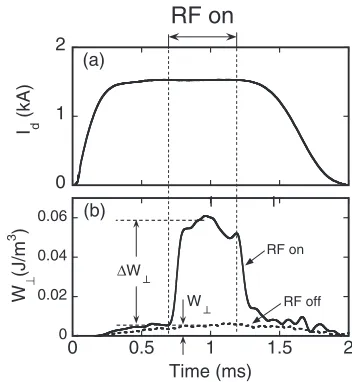
Figure 2 shows the typical waveforms of the discharge current Id of the MPDA and the diamagnetic coil signal W⊥. When radio-frequency (RF) waves were launched by
Fig. 1 Schematic of the HITOP device. Magnetic field with magnetic beach and diverging nozzle configuration is also shown.
Fig. 2 Time evolutions of (a)Idand (b)W⊥. He plasma. fRF = 0.24 MHz.
a helically-wound antenna in a plasma passing through a magnetic beach configuration, strong increase in plasma thermal energy was observed, as shown in Fig. 2 (b).
In order to clarify the ion cyclotron resonance heat-ing, we varied the magnetic fieldBDand measuredΔW⊥,
the increment ofW⊥. Figure 3 indicates the dependence ofΔW⊥on the magnetic fieldBD. The magnetic field
con-figuration was of a magnetic-beach type with a constant
BU of 0.1 T at the antenna position and a variable BD at
the diamagnetic coil position. Since the plasma conditions did not change at the antenna position, the excited wave intensity should be kept constant. The solid line indicates theBDcorresponding toω/ωci=1 for the excited RF
Fig. 3 Dependence ofΔW⊥ on the downstream magnetic field BD. He plasma. The solid and dashed lines correspond to ω/ωci =1 and 2, respectively, for the wave frequencies of fRF=237 kHz.
was also observed that the peak position is slightly shifted to a lowerBDfield than that corresponding toω/ωci =1,
i.e.,ω/ωciis higher than 1. This is due to the Doppler effect
caused by the fast plasma flow. A small peak of increment ΔW⊥ nearω/ωci =2 was also observed. This is caused
by the 2nd harmonic of cyclotron resonance or fundamen-tal resonance of He++ions. Further study is necessary to understand the small peak.
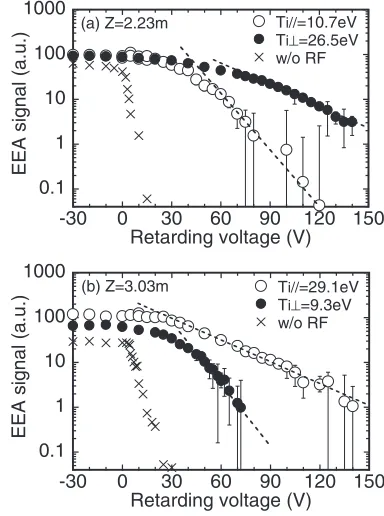
The plasma thermal energy was converted to flow en-ergy in a diverging magnetic nozzle. We measured ion temperatures using the EEAs in the diverging magnetic nozzle configuration. Figure 4 shows typical EEA signals obtained before and after the nozzle withBD(Z=2.23 m)
=57.5 mT andBN(Z =3.03 m)=17 mT. Increase in ion
temperature along the perpendicular direction occurred be-fore the magnetic nozzle. Ti⊥ increased from 3 to 27 eV
with an RF input power of 15 kW.
When passing through the diverging magnetic nozzle, increase inTi// and decrease inTi⊥were clearly observed
in the analyzer signals shown in Fig. 4 (b). This energy conversion occurred due to the conservation law of the magnetic moment,μ(=W⊥/B).
In order to clarify the conservation of the magnetic moment, we measured the axial profiles ofTi⊥ in the
di-verging magnetic field. Profiles ofTi⊥ calculated by
as-sumingμ=const. are also shown in Fig. 5. It is confirmed thatTi⊥ varied in order to keep the magnetic moment
con-stant.
We also measured the axial profile of plasma poten-tialVs using electrostatic Langmuir and emissive probes.
When an RF wave was excited and ion heating oc-curred, the potential decreased along the field line and an axial electric field was formed as shown in Fig. 6. The electric field that appeared in the magnetic noz-zle accelerated the ions in the downstream direction. The formation of the electric field is probably due to the ambipolar electric field, since electrons escape from the diverging magnetic nozzle faster than ions. The
Fig. 4 Electrostatic energy analyzer signals measured at (a)Z= 2.23 m and (b)Z =3.03 m. He plasma. PRF =13 kW, fRF =0.24 MHz, ne =1.0×10¹⁷m−3, BD = 57.5 mT, andBN =17 mT. Open circles: Ti//, closed circles:Ti⊥,
crosses:Ti⊥without RF.
ion velocity distribution in a parallel direction to the magnetic field should be determined by conversion from the increased thermal energy and the acceleration by the electric field.
The ion acoustic Mach numberMiis one of the
impor-tant parameters of an accelerated flow, which is expressed as follows:
Mi= Uz Cs
= Uz
kB(γeTe+γiTi)/mi
(1)
Here,Cs is ion acoustic wave velocity,Uzis ion flow
ve-locity, kB is Boltzmann constant, mi is ion mass, andγi
andγeare the specific heat ratios of the ions and electrons,
respectively. The square ofMi is related to the ratio of
flow energy to thermal energy of the flowing plasma. At the end of the magnetic nozzle region, this ratio is more than 3, which corresponds toMi>1, i.e., the formation of
supersonic plasma flow.
The parallel energy of exhausting plasma and the ion Mach number of the plasma flow can be controlled by changing the input RF power and/or modifying the mag-netic nozzle configuration.
ThrustF is yielded as a counteraction of the genera-tion of a fast-flowing plasma flow, which is estimated as
miniS Uz2. Here, S is plasma cross section. At the
ex-haust region (Z=3.03 m),nidecreases to 3×10¹⁶m−3and
Fig. 5 Axial profile ofTi⊥in the diverging magnetic nozzle
con-figuration. Lines are calculated ones assumingμ=const., andTi⊥ =30 eV (dotted line),Ti⊥ =25 eV (solid line),
andTi⊥=20 eV (dashed line). Closed circles are
experi-mental data.
Fig. 6 Axial profile ofVsin the diverging magnetic nozzle con-figuration with (closed) and without (open circles) RF power.
Fig. 7 Dependence ofTi⊥measured atZ =2.23 m on input RF power. RF waves were launched by the right helical an-tenna of 160 mm (closed triangles) and 130 mm (closed circles) in diameter.
One of the reasons for the low efficiency is the low value of antenna coupling with plasmas. In order to im-prove the antenna coupling, we performed the same experi-ments using an antenna with a smaller diameter of 130 mm. The heating efficiency increased more than twice as shown in Fig. 7. The exhaust energy of helium plasma was nearly 100 eV and the thrust efficiency improved. These results will be reported after further experimental studies.
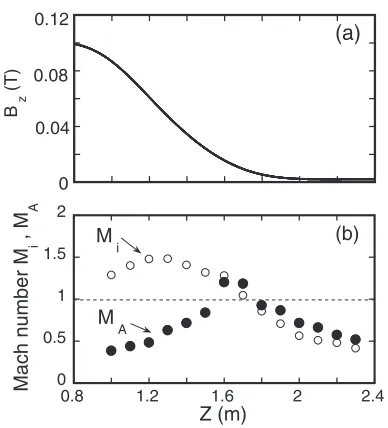
Fig. 8 Axial profile of (a) magnetic field and (b) ion Mach num-ber Mi and Alfv´en Mach number MA in the diverging magnetic nozzle configurations.
3.2
Supersonic and super-Alfv´enic plasma
flow in a strongly diverging magnetic
nozzle
In order to realize the super-Alfv´enic flow, the plasma flow should exceed the Alfv´en velocityVA. The Alfv´en
Mach numberMAis defined as follows: Mi=
Uz VA =
Uz Bz/√μ0nimi
(2) Here,VAis the Alfv´en velocity,μ0is permeability,ni
is the ion density.
We measured the ion Mach number using a Mach probe and ion density using a Langmuir probe, and ob-tained the axial profiles of Mi and MA in the diverging
magnetic field as shown in Fig. 8. Here, no ICRF heat-ing was applied. As shown in the figure, bothMiandMA
were more than unity, i.e., supersonic and super-Alfv´enic plasma flow was realized in a laboratory plasma. The super-Alfv´enic flow was controlled using the combination of ICRF heating and a magnetic nozzle.
Acknowledgments
This work was supported in part by a Grant-in-Aid for Scientific Researches from the Japan Society for the Promotion of Science, and under the auspices of the NIFS Collaborative Research Program (NIFS07KKMB001 and NIFS06KUGM018).
[1] D.L. Meier, S. Koide,Y. Uchida, Science291, 84 (2001) ; M. Nakamura, Y. Uchida, S. Hirose, New Astronomy6, 61 (2001).
[3] L.C. Steinhauer and A. Ishida, Phys. Rev. Lett.79, 3423 (1997).
[4] S.M. Mahajan and Z. Yoshida, Phys. Rev. Lett.81, 4863 (1998).
[5] F.R. ChangDiaz, et.al., Proc. of 36th Joint Propulsion Conf., (Huntsville, 2000),AIAA-2000-3756, pp.1-8.
[6] A. Andoet.al., Phys. Plasmas13, 057103 (2006). [7] M. Inutakeet al., Trans. Fusion Technol.43, 118 (2002). [8] M. Inutakeet al., Plasma Phys. Control. Fusion49, A121
(2007).