On the Numerical Solution of the
Nonlinear Stochastic
Kadar-Parisi-Zhang Equation with Reduced
Differential Transform Method
Olusola Tosin Kolebaje 1,*, Oluwole Emmanuel Oyewande 1
a
Department of Physics, University of Ibadan, Ibadan, Nigeria.
*Corresponding email: [email protected]
Abstract
The Reduced Differential Transform Method (RDTM) was used to obtain approximate solutions to the Kadar-Parisi-Zhang equation. The Kadar-Parisi-Zhang equation which is a stochastic nonlinear partial differential equation was used to investigate the growth (or erosion) of interfaces by particle deposition for bounded noise for an initially sinusoidal surface. The solutions obtained through RDTM with Mathematica package was compared to the finite difference solutions. The study shows the efficacy of the RDTM in solving the Kadar-Parisi-Zhang equation and is therefore a wonderful tool for solving nonlinear partial differential equations of stochastic or deterministic nature.
1. INTRODUCTION
A stochastic partial differential equation (SPDE) is a partial differential equation containing a random (noise) term. Stochastic partial differential equations appear in several different applications including the study of random evolution of systems (random interface growth, random evolution of surfaces, fluids subject to random forcing). They include the Edwards-Wilkinson (EW), the Kadar-Parisi Zhang (KPZ) and the Cuerno-Barabasi equations.
The goal of differential equations in surface growth is to find the variation with time of the interface height h(x,t) at any position x. The Edwards-Wilkinson equation which was the first continuum equation used to study the growth of interfaces by particle deposition is given by:
) , ( ) , ( )
,
( 2
t x t
x h v t
t x
h
(1)
Here v is sometimes called a ‘surface tension’ for the Laplacian term v2h tends to smooth the interface. The Laplacian term smoothens by redistributing the irregularities on the interface while maintaining the average height unchanged. Thus, the surface tension acts as a conservative relaxation mechanism [1]. The PDE is stochastic because of the presence of (x,t)a Gaussian and white noise with the following properties:
0 ) , (
x t (2)
) ( ) ( )
, ( ) ,
(x t x' t' 2 xx' tt'
(3)
This shows that the noise has zero configurational average and has no correlations in space and time. Often used in numerical simulations is ‘bounded noise’ in which 1
[2].
The predictions of this linear theory change however when non-linear terms are added to the growth equation. The first extension of the EW equation to include non-linear terms was proposed by Kadar, Parisi and Zhang [3]. Lateral growth which occurs locally normal to the interface suggests that a non-linear term of form (h)2 must be present in the growth equation to reflect the presence of lateral growth. Adding this term to the EW equation, we obtain the KPZ equation.
) , ( ) ( 2 )
,
( 2 2
t x h
h v t
t
x
(4)
The Reduced differential transform method (RDTM) has been applied to various nonlinear partial differential equations [5,6,7,8].
The motivation of this paper is to apply the reduced differential transform method to solve the stochastic KPZ equation for ‘bounded noise’ in which 1 and compare this solutions to the corresponding finite difference solutions. The initial and boundary conditions including other necessary parameters are given below:
Initial condition
l x t x
h( , 0) sin
Boundary condition 2 cos 2 ) , ( ) , 0 ( l x l t t t l h t
h
With x0.1,t0.1 for 0x5
The KPZ equation is solved for different values of v and .
2. FINITE DIFFERENCE APPROACH
From the KPZ equation (4), we transform each term of the equation into finite difference form to obtain a general finite difference scheme for the KPZ equation.
C h h B h h h A h h h h x t h h h x t v h h t h h x t h h h x t v h h j i j i j i j i j i j i j i j i j i j i j i j i j i j i j i j i j i j i j i j i j i 2 , , 1 , 1 , , 1 , 1 , 2 , , 1 2 , 1 , , 1 2 , 1 , 2 , 1 , 2 , 1 , , 1 2 , 1 , ) ( ) 2 ( ) ( ) ( 2 ) 2 ( ) ( ) ( ) ( 2 ) 2 ( ) ( (5)
where 2 2
) ( 2 , ) ( x t B x t v A and t C .
The finite difference formula in (5) is for the solving the one-dimensional Kadar-Parisi-Zhang equation and is implemented with FORTRAN
2.1 Reduced Differential Transform Method
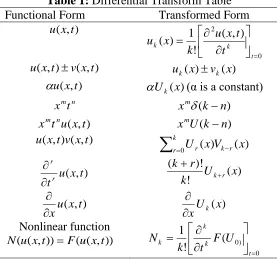
The basic definitions of the Reduced Differential Transform Method (RDTM) are introduced as follows (Y. Keskin and G. Oturanc , 2009);
If the function u(x,t) is analytic and differentiable continuously with respect to time and space in the domain of interest, then we introduce Uk(x)such that,
0 ) , ( ! 1 ) ( t k k k t t x u k x
U (6)
Where the -dimensional spectrum function Uk(x)is the transformed function of )
, (x t
Uk . The inverse differential transform of Uk(x)is defined as follows; k
k k
k x t U x t
u ( , ) ( )
0
(7)
Combining equation (6) and (7) we can write
The first term of the transformed solution U0(x)is just the initial condition at the time t 0. Also, for second order partial differential equations, the derivative of the initial condition with respect to time gives U1(x).The inverse transformation of the set of values
Uk(x)
nk0 gives approximate solution ask k n k
n x t U x t
u ( , ) ( )
0
(9)
Where n is the order of the approximation. Therefore, the exact solution of the equation is given by;
) , ( lim
) ,
(x t u x t
u n n (10)
Table 1: Differential Transform Table Functional Form Transformed Form
) , (x t u
0 2
) , ( ! 1 ) (
t k k
t t x u k x u
) , ( ) ,
(x t v x t
u uk(x)vk(x)
) , (x t u
Uk(x)(α is a constant) n
m t
x xm(kn)
) , (x t u t
xm n xmU(kn)
) , ( ) , (x t v x t
u
k
r 0Ur(x)Vk r(x) )
, (x t u tr
r
( )
! )! (
x U k
r k
r k
) , (x t u x
) (x U x k
Nonlinear function
)) , ( ( )) , (
(u x t F u x t
N
0 ) 0 ( !
1
t k
k
k F U
t k N
3. APPLICATION
Consider the Kadar-Parisi-Zhang equation (4):
) , ( ) ( 2 )
,
( 2 2
t x h
h v t
t x
h
Equation (4) can be written in standard operator form as equation (11), where 2 2 , x v R t L
and
2
2
x
N is the non-linear term.
( ( , )) ( ( , )) )) , (
(h x t R h x t N h x t
L (11)
With the initial condition
l x x f x
h( ,0) ( ) sin
From Table 1, we can transform each term of the KPZ equation as follows:
2 2 ) ( ) , ( x x h v x t x h v k (12) ) ( ! )! 1 ( ) , ( 1 x H k k t t x h k (13) ) ( ) ,
(x t k
where ( )
10 0
k
otherwise
k (14)
The following steps give first few non-linear terms Nk
2 2 3 1 4 0 4 2 1 3 0 2 0 4 4 4 2 2 12 12 ! 4 1 ! 4 1 x H x H x H x H x H N x H x H x H x H t x H t N x H x H x H x H x H x H N x H x H x H x H x H t x H t N 3 2 4 1 5 0 5 2 2 3 1 4 0 2 0 5 5 5 2 2 2 24 48 48 ! 5 1 ! 5 1
Substituting (12) – (14) into (11) we get the transformed form of the Kadar-Parisi-Zhang equation. ) ( 2 ) ( ) ( ! )! 1 ( 2
1 N k
x x H v x H k k k k
k
(15)
From the initial conditions we can write
l x x f x
H0( ) ( ) sin
Subsequent Hk(x) values are obtained by the following set of equations.
2 0
0 1 2 ) ( ) ( ! 0 ! 1 N x x H v x
H (0)
2 1
1 2 2 ) ( ) ( ! 1 ! 2 N x x H v x
H (1)
2 2
2 3 2 ) ( ) ( ! 2 ! 3 N x x H v x
H (2)
32 3
4 2 ) ( ) ( ! 3 ! 4 N x x H v x
H (3)
42 4
5 2 ) ( ) ( ! 4 ! 5 N x x H v x
H (4)
52 5
6 2 ) ( ) ( ! 5 ! 6 N x x H v x
The solution is given by the inverse differential transform of the Hk(x) values as follows:
.... ) ( )
( )
( ) ( )
( )
,
( 3 3
2 2 1 1
0 0
H x t H x H x t H x t H x tt x
h n
k
k k
n (16)
The implementation of the RDTM for the KPZ equation is done with the aid of MATHEMATICA to obtain the Uk values and plug them into (16) to get the approximate solution.
4. RESULTS AND DISCUSSION
The reduced differential transform method has been applied to the Kadar-Parisi-Zhang equation to investigate the growth (or erosion) of interfaces by particle deposition for bounded noise in which takes the values +1 and -1 with the non-linear term of the form ( )2
2 h
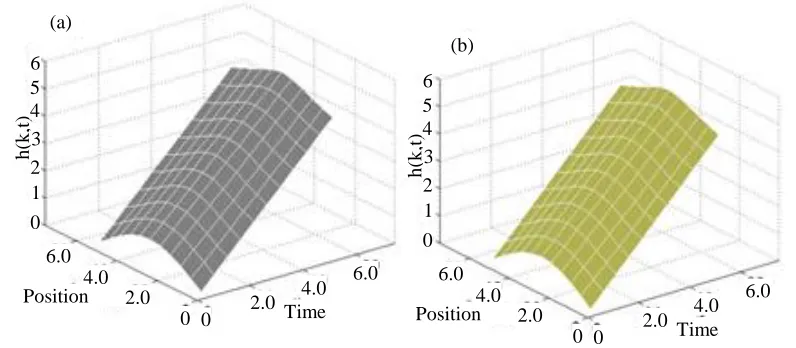
present in the equation to reflect the presence of lateral growth. The KPZ equation was solved with finite difference and RDTM, and the graphical plots for different values of v , and are presented in the Figure 1 and Figure 2.
Figure 1: Numerical solution of the KPZ equation after 5000 time steps (5.0 seconds) for v0.1, 0.5 and 1 with (a) Finite difference (b) RDTM.
h
(k
,t)
Position
0 0
1 4 5 6
2 3
6.0 4.0
2.0 0
6.0 4.0 2.0 Time (b)
(a)
h
(k
,t)
Position
0 0
1 4 5 6
2 3
6.0 4.0
2.0 0
Figure 2: Numerical solution of the KPZ equation after 5000 time steps (5.0 seconds) for v0.3, 0.5 and 1 with (a) Finite difference (b) RDTM.
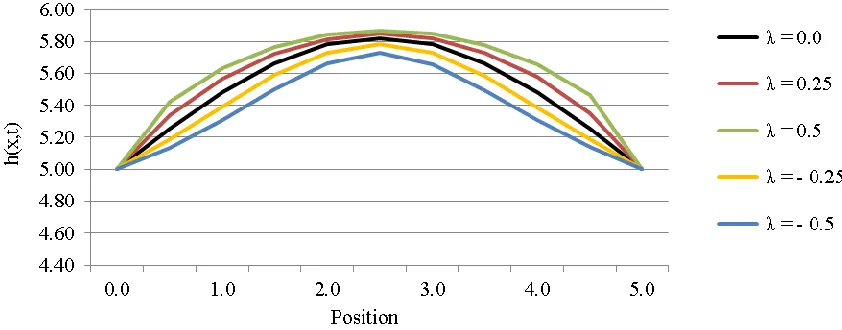
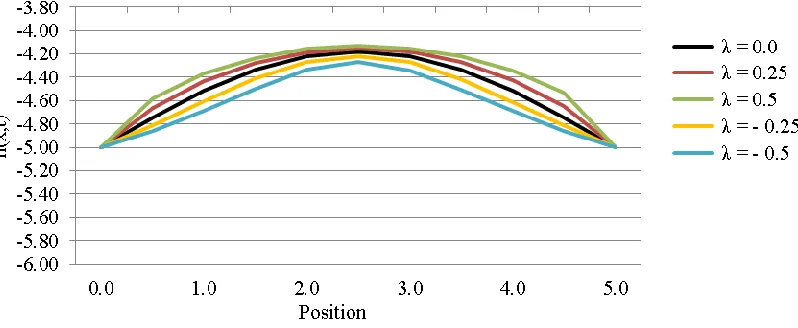
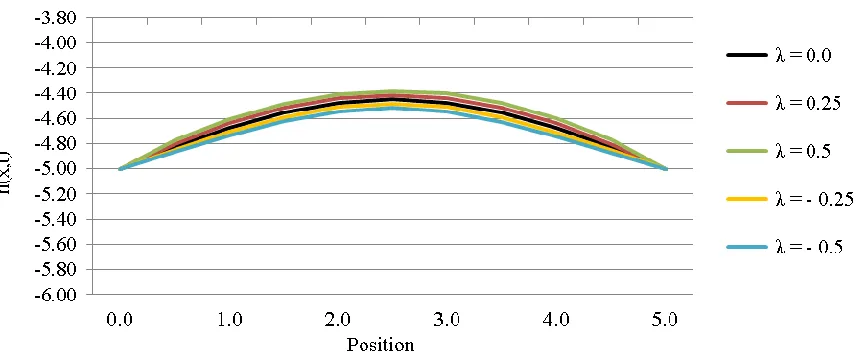
The term of the KPZ containing is the surface relaxation term which tends to smooth the surface while the non-linear term containing contributes lateral growth of surface. Figure 3-6 show the effect of increasing or decreasing the value of which is associated to lateral growth (erosion).
Figure 3: Effect of increasing on surface lateral growth for v0.1 and 1.
(b)
h
(k
,t)
-1
Position
0 -5
-4 0 1
3 2
6.0 4.0
2.0 0
6.0 4.0 2.0 Time
0 (a)
h
(k
,t)
-1
Position 0 -5
-4 0 1
3 2
6.0 4.0
2.0 0 6.0 4.0 2.0 Time
Figure 4: Effect of increasing on surface lateral growth for v0.3 and 1.
Figure 6: Effect of increasing on surface lateral growth for v0.3 and 1. The graphs in Figures 3–6 show the effect of the non-linear term of the KPZ equation. The surface was found to grow laterally for a positive increase in thereby leading to increase in average surface height whereas a negative increase in produces lateral erosion, leading to decrease in average surface height. The effect of increasing the surface tension term is also observed in comparing Figure 3 with Figure 4 and Figure 5 with Figure 6.
5. CONCLUSIONS
REFERENCES
[1] S.F. Edwards and D.R. Wilkinson. (1982). The surface statistics of granular aggregrate. Proc. R. Soc. London A , 381, 17-31.
[2] A.L. Barabasi and H.E. Stanley. (1995). Fractal Concepts in Surface Growth. Cambridge: Cambridge University Press.
[3] Kadar et al. (1986). Dynamic scaling of growing interfaces. Phys. Rev. Lett. , 56, 889-892.
[4] R. H. Landau and M. J. Paez. (1997). Computational Physics, Problem Solving with Computers. New York: John Wiley.
[5] Y. Keskin and G. Oturanc . (2009). Reduced Differential Transform Method for Partial Differential Equations. International Journal of Nonlinear Sciences and Numerical Simulation , 10 (6), 741-749.
[6] Y. Keskin and G. Oturanc. (2010). Reduced Differential Transform Method for Fractional Partial Differential Equations. Nonlinear Science Letters A , 1 (2), 61-72.
[7] Y. Keskin, S. Servi and G. Oturanc. (2011). Numerical Solution of sine-Gordon Equation by Reduced Differential Transform Method. Proceedings of the World Congress on Engineering, July6-8, 2011. 1. London: WCE 2011.