
Published online May 10, 2014 (http://www.sciencepublishinggroup.com/j/ajce) doi: 10.11648/j.ajce.20140203.12
Estimation of pre-compression parameters in the
acceleration of consolidation settlement
Yaw Adubofour Tuffour, Mark Adom-Asamoah
Department of Civil Engineering, Kwame Nkrumah University of Science and Technology, Kumasi, Ghana
Email address:
[email protected] (Y. A. Tuffour), [email protected] (M. Adom-Asamoah)
To cite this article:
Yaw Adubofour Tuffour, Mark Adom-Asamoah. Estimation of Pre-Compression Parameters in the Acceleration of Consolidation Settlement.American Journal of Civil Engineering. Vol. 2, No. 3, 2014, pp. 68-73. doi: 10.11648/j.ajce.20140203.12
Abstract:
Pre-compression by preloading is used to accelerate the consolidation settlement of a site ahead of construction so that post-construction settlement would be minimal. The principal aim of the technique is to remove the primary consolidation settlement anticipated under the proposed load with or without partial compensation for secondary compression so that post-construction settlement would consist of a small re-compression and secondary compression. In this paper, the scope of pre-compression is expanded to include partial removal of primary consolidation as a possible settlement management option. Modifications and simplifications are introduced into parameter estimation for design to deal with pre-compressions intended to remove any degree of the primary consolidation and those that go beyond the primary consolidation stage. This provides foundation engineers the flexibility to evaluate different pre-compression load and duration options under different settlement regimes and their implications. A numerical example is used to demonstrate and verify the modifications.Keywords:
Pre-Compression, Primary Consolidation, Settlement, Surcharge Load1. Introduction
Pre-compression offers the opportunity for large post-construction settlement of structures founded on highly compressible normally consolidated clay layers to be minimized in order to avoid failure due to excessive settlement. The process, also known as preloading, uses temporary loading to accelerate the consolidation of a site ahead of construction so that when the actual structure is built, very little consolidation settlement would take place. The principle is to remove primary consolidation so that post construction settlement would consist essentially of a small re-compression and secondary compression only. Because pre-compression renders the soil layer effectively over-consolidated on removal of the temporary load, the technique has the added benefit of slowing down the rate of secondary compression since the magnitude of secondary compression in a given time, is generally smaller in over-consolidated than in normally consolidated clays [1-3].
Interest in and the use of pre-compression have been motivated largely by the scarcity of advantageously-located land with good foundation conditions and also the high costs associated with reclamation of marginal lands compared to other alternatives [4]. Where there are time constraints, the
rate of pre-compression may be augmented by the installation of vertical sand drains to induce both vertical and radial drainage so that a site is brought to use much sooner. The use of the pre-compression technique to deal with soft sub-soils where excessive settlements posed a challenge to construction and engineering structures has been well reported in the literature [4-9].
when there are time, site, and resource constraints.
Based on the theory of consolidation, Johnson [4] derived expressions and presented a design procedure by which pre-compression load and time could be estimated from the consolidation parameters of the compressible layer. The underlying assumption was that the pre-compression load would be sustained until the total primary consolidation settlement anticipated under the proposed load has been removed. As a result of this assumption, the expressions derived thereof are inapplicable to the design of pre-compressions intended to remove only a portion of the primary consolidation settlement. In this paper, modifications and simplifications are introduced into pre-compression design expressions to make it possible to deal with pre-compressions that remove any degree of the primary consolidation settlement as well as those that go beyond the primary consolidation stage into secondary compression. The major thrust of the paper, therefore, is the estimation of the magnitude of the surcharge load to be employed in the pre-loading process.
2. Settlement Consideration
2.1. Fundamental Theory
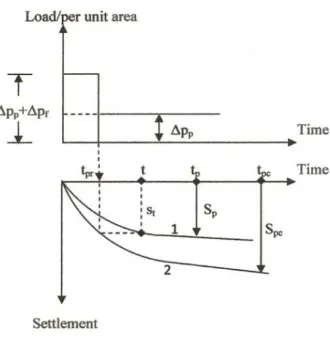
Figure 1 shows the loading and associated consolidation settlement curves for the proposed structural load (Curve 1) and pre-compression load (Curve 2) [4].
Figure 1. Load- and settlement-time curves for pre-compression and normal loads.
Associated with the curves are the following parameters; ∆pp= proposed load increase per unit area
∆pf= surcharge load per unit area
tp= end of primary consolidation under proposed structure
tpc= end of primary consolidation under
pre-compression load
tpr= time of pre-compression
st= settlement at any time t under proposed load
Sp= maximum primary consolidation settlement under
proposed structure
Spc = maximum primary consolidation settlement under
pre-compression load
For a normally consolidated clay layer, the maximum primary consolidation settlements associated with the loadings represented by Curves 1 and 2 are, respectively,
∆
(1)
and,
∆ ∆
(2)
where,
Cc=compression index of the clay layer
eo=initial void ratio of the layer
Hc=thickness of the layer
po =initial effective overburden pressure in the middle of
the clay layer.
2.2. Removal of any Degree of Primary Consolidation
At time t ≤ tp , let the settlement (st) under the proposed
load (Curve 1) correspond to the degree of consolidation Ut.
From consolidation theory, st may be evaluated as
(3)
This amount of settlement may be achieved by pre-compression (Curve 2) in a much shorter time t = tpr. Let
the pre-compression process at time t = tpr be at a degree of
consolidation Upr, then;
⁄ (4)
Substitution of Eqs. (1) and (2) into Eq. (4) results in the following expression for Upr ;
∆
!"# ∆ ∆∆ $ for 0< t ≤ tp (5)
Equation (5) indicates that up to the end of primary consolidation, the degree of consolidation under pre-compression is dependent on the pre-loading condition and the amount of primary consolidation settlement to be removed.
2.3. Partial Removal of Secondary Compression
Partial removal of secondary compression should become a design option only when removal of the entire primary consolidation would not suffice to bring settlements to within tolerable limits. For such a situation, consider Curve 1 in Fig. 1 and the settlement at any time t beyond tp (end of
primary consolidation). The settlement would consist of the entire primary consolidation settlement and a portion of secondary compression. Hence,
% ∆&' (6)
where,
cα= coefficient of secondary compression of the layer
Hp = thickness of compressible layer at the end of primary
consolidation (=Hc-Sp)
∆Hsec =portion of secondary compression being removed
The required degree of consolidation under pre-compression load that will achieve equivalent settlement may be given as,
- . * ⁄ ,
- (8)
where,
Upr =degree of consolidation under pre-compression load at
time t ≥ tp.
Substitution of Equations (1) and (2) in Eq. (8), results in the following expression for Uprwhen t ≥ tp (see [4] and
[10]);
/. ∆ 0.1 2
# ∆ ∆∆3 $ (9)
3. Estimation of Pre-Compression
Parameters
3.1. Overview of Method
The method for estimating either the surcharge load or time, elaborated by Johnson [4], covers the specific case of
Ut =1 in Eq. (5) when the pre-compression process is
intended to eliminate the entire primary consolidation settlement expected under the proposed load. The procedure involves the use of two charts; U-load ratio curves and U-Tv
curve reproduced in this paper as Figs. 2 and 3, respectively. The U-load ratio curves (Fig. 2) as re-plotted by Das [11] were originally presented by Johnson [4] based on a version of Eq. (5) without the parameter Ut for various combinations
of surcharge intensity ∆45⁄∆4 and permanent loading ratio ∆4 4⁄ . The U-Tv curve (Fig. 3), which expresses the
variation of the mid-plane degree of consolidation in the compressible layer with the time factor for consolidation, is taken conservatively to represent the average degree of consolidation during pre-compression as recommended by Johnson [4] due to the difficulty associated with the variation of the degree of consolidation across the depth of the compressible layer as a result of the position of the drainage surface. The two charts (Fig. 2 and Fig. 3) may be used together to obtain any of the pre-compression parameters (surcharge load or time). In practice, the magnitude of one of the parameters (more often the time) is pre-determined and the other estimated. The time factor (Tv)
for pre-compression is determined from standard expression (78 (8+ 9⁄ :) using the pre-compression time. The Tv
value so determined is then used to enter Fig. 3 to determine
U which is in turn used in Fig. 2 to determine the surcharge intensity from which the surcharge load is evaluated. The process is reversed if the duration of pre-compression is
required for a pre-determined surcharge load.
Fig 2.Plot of ∆45⁄∆4 against Ufor various values of ∆4 4⁄ [4].
Fig 3. Mid-plane degree of consolidation versus Tv in pre-compression [11].
3.2. Proposed Modification and Simplification
Figure 2 represents a specific case of the pre-compression process, i.e., removal of total primary consolidation settlement and is, therefore, inapplicable to designs intended to remove only a portion of the primary consolidation settlement. This limitation may be addressed by the use of Eq. (5) which contains the parameter Ut that takes care of the
degree of primary consolidation settlement desired to be removed by the pre-compression process. For further simplification, let the permanent loading ratio be denoted as
a, that is,
; ∆4 4⁄
(10)
Equation (5) can then be re-written as:
1 <2
= <* ∆ ⁄∆ ,> (11)
pre-compression process directly, Eq. (11) may be simplified and re-arranged to obtain,
∆45 ∆ 1 <2< =11 % ;2 ⁄ @/ A 1>
(12)
Even though Eq. (12) overcomes the limitation inherent in Fig. 2, its applicability ends at the primary consolidation stage. To deal with pre-compressions that go into secondary compression, Eq. (9) must be used but simplifications are needed to arrive at a direct expression for the surcharge load. To simplify the equation, let the following be introduced;
B ()11 % C 2 D⁄
(13)
E *1 A () =+ +⁄ >, (14)
Substitution of Equations (10), (13) and (14) into Eq. (9) results in the following expression for the degree of consolidation of pre-compression designed to remove a portion of secondary compression;
F 1 <2 G * ⁄ ,
= <* ∆ ⁄∆ ,> (15)
For t ≥ tp, Eq. (15) may be simplified further and
re-arranged to obtain the surcharge load directly as:
∆45 ∆ 1 <2< H11 % ;2F⁄ @/ *+ +⁄ ,G⁄ @A 1I (16)
It is to be noted that at the end of primary consolidation,
t=tp, Ut = 1, δ=1, and Eq. (16) reduces to Eq. (12).
By setting the value of t equal to the useful life of the construction in Eq. (16), the pre-compression could be designed to eliminate the entire secondary compression and, hence, practically all settlements to be expected during the life of the construction but this would, by no doubt, result in uneconomical preloads and possibly ground instability and other problems during the process. It may, therefore, suffice to design the pre-loading to remove only a portion of the secondary compression that would result in tolerable settlements should removal of the entire primary consolidation turn out to be inadequate. Computations could easily be carried out to determine the limit of t values that would achieve this, but values of t/tpequal to 10 or 15 are
suggested. A value of t/tp=10 covers one cycle of secondary
compression beyond the end of primary consolidation. To apply Eq. (12), the proportion of primary consolidation settlement to be removed expressed in terms of degree of primary consolidation (Ut) and the duration of
pre-compression (tpr) must first be decided upon; the time
factor (Tv) is then calculated and the value of the
corresponding degree of consolidation of pre-compression to achieve this is obtained with the help of Fig. 3. The value of the degree of consolidation is then input into Eq. (12) as
Upr to enable the computation of the surcharge load ∆pf
directly. On the other hand, if the duration of pre-compression is required for a given surcharge load and targeted level of primary consolidation settlement removal,
Upr is evaluated using Eq. (11) and then Fig. 3 used to
establish the corresponding value of Tv from which t=tpr is
calculated.
For pre-compressions that include partial removal of secondary compression, prior settlement computations by standard procedure would be necessary to determine the end of primary consolidation (tp), the total settlement (primary
and secondary) anticipated under the proposed load and the amount of secondary compression to remove. This would make it possible to arrive at a suitable value for the time ratio (t/tp) to be input into Eq. (16). From the pre-determined
surcharge duration, the time factor (Tv) is calculated in the
usual manner and the value used to enter Fig. 3 to obtain Upr
which in turn is used together with the t/tp value and other
relevant soil data to evaluate the surcharge load using Eq. (16). The procedure is reversed if the surcharge load is pre-determined and the duration of pre-compression is required.
The numerical example that follows demonstrates the use of the existing and modified expressions and simplifications for estimating pre-compression loads.
3.3. Numerical Example
A pre-compression project is intended to preload the site of a proposed warehouse, which is underlain by 6m thick normally consolidated clay, for a period of 10 months in order to minimize post construction settlement. The average effective overburden pressure of 200kN/m2 at the middle of the clay layer is expected to increase by 100kN/m2 when the warehouse is built. Given that the clay layer is drained both at the top and bottom and has
Cv=0.36m2/month, Cc=2.13, cα=0.022, eo=1.35, determine
the magnitude of surcharge load required for the preloading process, if:
i. the entire primary consolidation is to be removed. ii. removal of 75% of the primary consolidation would
lead to tolerable settlement.
iii. removal of one cycle of secondary compression beyond primary consolidation is necessary.
3.3.1. Removal of entire primary consolidation
a. Solution by existing procedure
This procedure combines the use of Figs. 2 and 3 to determine the surcharge load. From the data,
tpr=10months
Cv=0.36m2/month.
d=3m,
po=200kN/m2,
∆pp=100kN/m2.
; ∆4 4⁄ 0.50,
Hence, 78 0.40
From Fig. 3, for Tv=0.40, U=Upr= 54% (or Upr =0.54)
At U=54%, and ∆4 4⁄ 0.50, Fig. 2 gives
∆45⁄∆4 1.23
Hence,
Δ
p
f=123kN/m2.
b. Solution by modified procedure
Ut=1, Upr=0.54, a=0.5 , * ⁄ A 1, 0.852
Using Eq. (12),
∆45 1100211.520.5 11.5Q.RS:A 12 123.8TU/W:
3.3.2. Removal of 75% primary consolidation
Solution by modified procedure
From the data and previous calculations, Ut = 0.75,
Upr = 0.54, a = 0.5
* ⁄ A 1, 0.389,
Using, Eq. (12),
∆45 1100211.520.5 11.5Q.YRZA 12 51.24TU/W:
3.3.3. Partial removal of secondary compression
From the data and previous calculations,
+ +⁄ 10, a = 0.5, Upr= 0.54, δ = 0.978, β = 0.024
*E⁄ A 1, 0.811, *B⁄ A 1, 0.044
Using Eq. (16),
∆45 1100211.520.5 11.52Q.R 10Q.Q[[A 1
∆45 161.24TU/W:
4. Discussion
The first part of the numerical example showed almost excellent agreement between the existing and modified procedure with the latter presenting a much simpler evaluation; the small and negligible difference between the results of the two procedures being due entirely to the level of accuracy to which values from the relevant charts were read. In the case of partial removal of primary consolidation, the solution whereby Figs. 2 and 3 are combined was not possible, as Fig. 2 was developed solely for total removal of primary consolidation settlement; only the modified procedure could be used to arrive at the magnitude of the surcharge load. In addition, the modified procedure did not require the use of Fig. 2. In the case of pre-compressions that go into secondary compression, the simplification provided by Eq. (16) made it possible to evaluate the surcharge load directly using the relevant secondary compression data, pre-compression time, and degree of consolidation.
As demonstrated above, only Fig. 3 was actually required for any of the pre-compression load computations. The benefits of the modifications introduced are the possibility to design pre-compressions to cover partial removal of the primary consolidation and the simplicity of design computations. With the scope of pre-compression expanded by the current modifications to include partial removal of the primary consolidation as a possible option, foundation engineers now have a much wider choice of options to consider in terms of settlement removal and accompanying cost, time, and potential ground stability implications.
Of course it has to be understood that in situations where
the pre-compression has to go beyond removal of primary consolidation because a large amount of settlement is anticipated under the proposed structural load, the usefulness of the approach developed in this paper would be limited only to the simplifications introduced into the computational process for the relevant pre-compression parameters. Furthermore, the methodology and analysis procedure used did not consider the contribution of installation of sand drains to the pre-compression process. Because sand drains accelerate the settlement process by augmenting lateral drainage of the compressible layer, their use as part of pre-compressions is aimed at shortening the preloading time and possibly reduce the magnitude of the preload required. Further work is required to deal with parameter estimations in pre-compressions that are designed to remove only part of the primary consolidation settlement using sand drains to augment the process.
5. Conclusion
Pre-compression by preloading provides opportunity for excessive settlements anticipated under structures to be founded on sites underlain by highly compressible soils to be managed prior to the actual construction so that the safety and integrity of the structure would be assured. The magnitude of the pre-compression load is defined by the amount of the anticipated settlement to remove within a given time frame. Traditionally, the technique has tended always to focus on the removal of the entire primary consolidation settlement, with or without partial compensation for secondary compression. As a result, the expressions for determining pre-compression parameters are limited in application as they are based on the elimination of the total primary consolidation settlement and, therefore, cannot deal with partial removal of primary consolidation. This paper introduced some modifications and simplifications to the existing method of estimating pre-compression parameters to overcome this limitation. It is believed that partial removal of the primary consolidation could also be an option in settlement management by pre-compression, provided it would lead to tolerable settlements. Verification of the proposed modification and simplifications was demonstrated through a numerical example. The methodology and analysis procedure used in the paper, though, did not consider pre-compressions which use sand drains to accelerate the drainage process. Further work is, therefore, recommended in that direction to expand the scope of the subject.
References
[1] J. A. Knapett, and R. F. Craig, Craig’s Soil Mechanics, 8th ed., Spon Press, New York, 2012.
[3] A. K. Bhattacharya, and S. Basack, “A review of the use of preloading technique and vertical sand drains for soil consolidation,” Proc. Indian Geotechnical Conference, Kochi, December 2011, pp. 15-17.
[4] S. J. Johnson, “Precompression for improving foundation soils,” Journal of Soil Mechanics and Foundation Division, ASCE, vol. 96, No. SM1, 1970, pp. 114-144.
[5] J. D. Brown, and W. G. Paterson, “Failure of an oil storage tank founded on sensitive marine clay,” Canadian Geotechnical Journal, Vol. 1, No. 4, November 1964.
[6] R. D. Darragh, “Controlled water tests to preload tank foundations,” Journal of Soil Mechanics and Foundations Division, ASCE, Vol. 90, No. SM5. September, 1964.
[7] M. Kamiolkowski, R. Lancellotta, and W. Wolski, “Precompression and speeding up consolidation,” General
Report, Proc. 8th European Conf. Soil Mech. & Foundation Engrg., Vol. 3, 1983, pp. 1201-1226.
[8] E. C. Loeng, R. A. A. Soemitro, and H. Rhardjo, “Soil improvement by surcharge and vacuum preloading,” Geotechnique, Vol. 50, No. 5, 2000, pp. 601-605.
[9] G. Mesri, M. A. Ajlouni, T. W. Feng, and D. O. K. Lo, “Surcharging of soft ground to reduce secondary settlement,” Proc. 3rd Int. Conf. on Soft Soil Engineering, Hong Kong, December 2001, pp. 55-65.
[10] M. MacVay, and D. Nugyen, “Evaluation of embankment distress at Sander’s Creed-SR20,” Report submitted to the Florida Department of Transportation, UF Contract No. 4910-4504-734, May 2004.
![Fig 2. Plot of ∆45 ∆4⁄� against U for various values of ∆4� 4⁄�[4].](https://thumb-us.123doks.com/thumbv2/123dok_us/8464227.1709339/3.595.349.513.105.288/fig-plot-u-various-values.webp)
