485 |
P a g e
USING TECHNOLOGY IN AGRICULTURE TO SAVE
THE FALLING WATER TABLE IN INDIA
Ravinder Singh
1, Tripatjot Singh Panag
21
Department of Electronics and Communication Engineering, B.B.S.B.E.C (India)
2Assistant Professor, Department of Electronics and Communication Engineering, B.B.S.B.E.C (India)
ABSTRACT
Today India faces several problems and one of the major problems is the shortage of water for irrigation purposes. Ground water is an important source of irrigation mainly in Punjab. Due to irrational irrigation of paddy the utilization of ground water has increased manifold. So to save this underground water table we thought of designing a Wireless Sensor Network (WSN) based irrigation regulator system. The system uses the soil moisture level along with the weather forecast information to regulate the irrigation process. The weather forecast information is acquired from the mobile service provider (IDEA) using Weather Forecast Unit (WFU). This enquiry is made in response to a dry signal generated by Moisture Sensor Unit (MSU).After checking through the weather condition the Main Control Unit (MCU) of the system makes a decision whether to switch ON the motor or not. The system was deployed to regulate the irrigation process for the onion crop during the period Feb-2014 to May-2014. The results indicate that the system can reliably be used to regulate the irrigation process.
Keywords: Wireless Sensors, Soil Moisture, Weather Forecast, Irrigation Regulator, GSM
Modem.
I. INTRODUCTION
“Water is not a commercial product like any other, rather a heritage that must be protected, defended and treated
as such”. A recent study based on satellite data conducted by NASA has found that ground water levels in
486 |
P a g e
fields. In this paper, we have taken a step towards the deployment of WSN and Weather Forecast based irrigation regulator system practically in the fields to save the falling water table.
II. SYSTEM DESCRIPTION
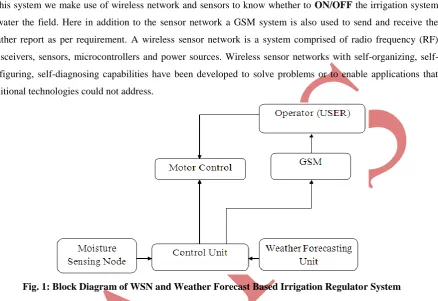
In this system we make use of wireless network and sensors to know whether to ON/OFF the irrigation system
to water the field. Here in addition to the sensor network a GSM system is also used to send and receive the
weather report as per requirement. A wireless sensor network is a system comprised of radio frequency (RF)
transceivers, sensors, microcontrollers and power sources. Wireless sensor networks with organizing, self-configuring, self-diagnosing capabilities have been developed to solve problems or to enable applications that traditional technologies could not address.
Fig. 1: Block Diagram of WSN and Weather Forecast Based Irrigation Regulator System
For The block diagram consists of the four basic parts i.e. MSN (Moisture Sensing Node), WFU (Weather forecasting Unit), Control unit and GSM, etc.
1. MSU (Moisture Sensing Unit)
This is the most important unit. In this two stainless steel rods are inserted into the soil acting as electrodes. Depending upon the moisture level in the soil, its conductivity will change. This variation shall be measured and used to make a decision.
2. WFU (Weather Forecast Unit)
This is a challenging block here it is intended to access the available weather forecast information. Using GSM, the weather information is obtained through an SMS from a telecommunication company or data can be received from some specific weather forecast station.
3. Control Unit
This unit will act as the brain of the complete hardware. The soil moisture sensed in the first unit plus the weather forecast information from the second unit is given to the control unit. Depending upon these two signals the control units makes a decision. The decision may be sent to the relay to switch the motor ON/OFF or it can be controlled manually by the user as it can cause chaos in the experimental setup.
4. GSM Module
487 |
P a g e
2.1 Working
The working of the whole system can be divided into three parts or steps. As soon as the system is turned ON, all the three parts starts working. These three parts work in the following manner:
2.1.1. Moisture Sensing Unit (MSU)
The continuous monitoring signals from all the sensors are received by the receiver at the Base Station. The signal received here indicates the soil condition i.e. wet or dry. If the wet signal is received from all the sensors then MSU further performs no action and it waits until the signal gets DRY. As soon as the DRY signal is received, the MSU sends a signal to the second unit i.e. control unit that the soil is DRY. The whole working is shown in Fig.2.
Yes
Dry
No
Fig.2: Working of Moisture Sensing Unit. Reset
Continuous monitoring signals from the all Sensors
Weather WET signal received from all the
Sensors?
Send signal to Control Unit that the Soil is DRY
2.1.2. Control Unit
This unit acts as the brain of the complete hardware. It will check the signal from MSU. If the signal indicates the soil to be DRY, then it sends the signal to Weather Forecasting Unit (WFU) to update weather conditions. Along with this it will also send an alert message to the user regarding the weather enquiry made. In the mean time WFU will send weather information to the control unit. The control unit will interpret this message and carry out the decision making process. If the weather remains conducive for irrigation it will send a message to the user to turn ON the motor otherwise it will send a message “No Need”. The working of the control unit is
shown in Fig.3.
2.1.3 Weather Forecasting Unit (WFU)
488 |
P a g e
NoYes Reset
Check the Signal from the Moisture sensor Unit
Soil Condition
Receive Weather information from W.F.U. and Interpret it Send Alert Message to the User “Weather Enquiry Made”
Send Signal to W.F.U. to update Weather Condition
If the Weather is Conducive for Irrigation
Send Message to User “No Need”
Send Message to the User “Motor Turned ON” Wet
Dry
Fig.3: Working of Control Unit
No
Dry
Yes
No
Yes Reset
Check the Command from Control Unit
Weather Command from CU received for Updating the Weather
Send SMS “Weather” to Idea Service Centre for Weather Information
Information Received?
Forward the Weather Information received by SMS to the Control Unit
489 |
P a g e
2.2. Hardware
2.2.1. Moisture Sensing Unit (MSU)
It consists of light weight circuit comprising of two stainless steel rods inserted into the soil acting as electrodes. A comparator circuit is used for checking the moisture level in the soil as shown in Fig. 3.9. The TWS-434 and TWS-330 are used for transmitting the moisture level to the base station.
2.2.2. Base station (Control Unit and Weather Forecast Unit (WFU)
It is the unit where whole processing takes place. The signal from the sensors is received by the receivers (RWS-434 & RWS-330) working at different frequencies. The receiver forwards the signal to the controller. The controller AVR Mega series is interfaced with GSM module (SIM300AT) and LCD LMB162A. The GSM modem
is used for sending and receiving the weather updates. Along with the weather information it also sends alert
messages to the user. The LCD indicates the status of all the sensor units and final decision made by the control unit.
III. RESULT AND DISCUSSION
The project was installed to monitor the irrigation of onions in the current season. The crop was sowed in the month of February in 2014. The system was installed to regulate irrigation process of onions in the month of March in 2014. The system checked the moisture level of the soil. Whenever the soil was found to be dry, it went on to check the weather forecast. If the weather was found to be sunny for the day and also for the next couple of days, it recommended switching ON of the motor. Otherwise it suggested not switching ON the motor as rains were expected. Thus it helped us in saving underground water as well as the crop. The data thus obtained is presented in the table below. The decision made by the system was also verified by manual enquiring about the weather (using IDEA message services) whenever there was a need to water the crop. The manual verification was needed because the project was in the evaluation phase. The data thus obtained is presented in the last column.
S.No. Date Soil Condition Alert Message
Received
Decision made by the User
Manual Verification
1. 25-Feb-2014 Nil Nil No Need Nil
2. 27-Feb-2014 Nil Nil Watering Nil
3. 08-Mar-2014 Nil Nil Watering Nil
4. 14-Mar-2014 Nil Nil Rain Nil
Installation of Irrigation Regulator System
S.No. Date Soil Condition Alert Message
Received
Decision made by the System
Manual Verification
1. 20-Mar-2014 Wet No Motor turned OFF
2. 25-Mar-2014 Dry Yes No Need Rain
3. 29-Mar-2014 Wet No Motor turned OFF
490 |
P a g e
5. 06-Apr-2014 Wet No Motor turned OFF
6. 10-Apr-2014 Wet No Motor turned OFF
7. 14-Apr-2014 Dry Yes Motor turned ON Sunny
8. 19-Apr-2014 Wet No Motor turned OFF
9. 24-Apr-2014 Dry Yes Motor turned ON Clear
10. 27-Apr-2014 Wet No Motor turned OFF
11. 02-May-2014 Dry Yes Motor turned ON Sunny
12. 04-May-2014 Wet No Motor turned OFF
13. 08-May-2014 Wet No Motor turned OFF
14. 12-May-2014 Wet No Motor turned OFF
15. 13-May-2014 Wet No Motor turned OFF
491 |
P a g e
out by the system as per the weather conditions on 14 Apr 2014, 15 Apr 2014 & 16 Apr 2014. So here the decision was made to water the crop because the weather was felt conducive for irrigation process. Weather was sunny for
these days.Then the soil was found to be dry on 24 Apr 2014. Decision making process was carried out by the
system as per the weather conditions on 24 Apr 2014, 25 Apr 2014 & 26 Apr 2014. It was decided to water the
crop because the weather was felt conducive for irrigation process.Last occasion when the soil was found to be
dry was on 02 May 2014. On the basis of the weather forecast for 2 May 2014, 3 May 2014 & 4 May 2014, the
system suggestedto water the crop
Graph 1 Indicates Moisture Level on different dates
Graph 1 Indicates Moisture Level on different dates. The soil was found to be wet on all occasions except on 25/03/2014, 2/04/2014, 14/04/2014, 24/04/2014, 02/05/2014.
Graph 2 Indicates Weather conditions on different dates
492 |
P a g e
24/04/2014 & 02/05/2014. The system makes the final decision from graph 1&2. It suggests to water the crop when the weather condition is sunny and soil is found to be dry.
IV. CONCLUSION
Calculated The WSN and Weather Forecast based irrigation regulator system was used over a period of about six months to regulate the irrigation process for two crops – wheat and onion. The results thus obtained help us to conclude that the system can reliably be used to regulate the irrigation process. This automation has many advantages as listed below:-
4.1 It reduces human burden
During conventional agricultural practices one needs to visit the fields regularly. But by using this system there is no need to visit the fields on regular basis to check whether there is need to irrigate the crop or not.
4.2 Avoids misinterpretation
Sometimes by usually interpreting the top layer of the soil we take it as dry, but if we penetrate deep (about an inch) into the soil, we find it to be wet. In fact, it is the moisture content at the root level that matters. But by using the sensor electrodes that goes deep into soil up-to the root level, we come to know the exact moisture content. So there is no chance of wrong interpretation in this case. But there is moisture in the soil near to the roots of the crop.
4.3 Helps in saving Energy and Groundwater
In normal conventional practices we water the crop by making interpretation from the soil upper layer. And we don’t have any knowledge about the weather forecast. If it rains within the next couple of days it may lead to loss
of energy and groundwater. But by using this system we will have weather forecast information for next three days and proper soil moisture. The system won’t water the crop unless the weather conditions are conducive. Therefore, it minimizes the energy and underground water loss.
4.4 Prevent Crop Damage
In conventional practices we water the crop without any weather information. If the weather gets turbulent within a couple of days from watering the crop, it may lead to the crop damage. As the system has weather forecast information therefore, the system saves the crop from being damaged.
4.5 Improves Crop Yield
Using this system the irrigation process is carried out only when it is required by the crop and along with that it also checks the weather forecast information for few couples of days. Therefore, it irrigates the crop with the exact amount of water required by the crop and also prevents irrigation when it may harm the crop. Hence the crop overall yield is improved.
493 |
P a g e
A WSN and internet based irrigation regulator system has been developed. Although a lot of efforts have been made for the development of the system; still it can be further improved with some small modification. Following points may be considered for the improvement of the system in future.
A. WSNs can be equipped with other specialized sensors and hence can also be used to regulate the use of Fertilizers, pesticides etc.
B. Sensor node can be made to work on solar energy.
C. Number of sensor nodes can increase to make the system more efficient.
D. High range RF module can be used to cover a larger area.
REFERENCES
[1] Chinchalkar, S., “Determination of Crack Location in Beams using Natural Frequencies”, Journal of Sound
and Vibration Volume 247 (3), 2001, 417-429.
[2] NASA Satellites Unlock Secret to Northern India's Vanishing Water at: http://www.nasa.gov.com.
[3] D.L. Corwin, Apparent soil electrical conductivity measurements in agriculture. Computers and Electronics
in Agriculture 46 (2005) 11-43.
[4] Ning Wang, Wireless sensors in agriculture and food industry. Computers and Electronics in Agriculture 50
(2006) 1-14.
[5] Izzat Din Abdul Aziz et al, Remote monitoring in Agriculture Greenhouse Using wireless sensor and SMS.
International Journal of Engineering & technology IJET-IJENS Vol: 09 No: 09.
[6] Nannan Wen, A wireless intelligent valve controller for agriculture Integrated Irrigation System. IFIP
International Federation for Information Processing 2011.
[7] Bei Wang et al, Application of wireless sensor network in farmland data acquisition system.
Springer-Verlag Berlin Heidelberg 2011.
[8] Xinjian Xiang, Design of fuzzy drip irrigation control system based on ZigBee WSN. IFIP International
Federation for Information Processing 2011.
[9] Max Billib betal, A Methodology to identify representative conFig.urations of sensors for monitoring soil
moisture. Springer Science B.V. 2011
[10]Robert Coates et al, Wireless sensors networks with irrigation valve control. Computers and Electronics in
Agriculture 96 (2013) 13-22.