International Journal of Advanced Technology in Engineering and Science www.ijates.com
Volume No.02, Issue No. 06, June 2014 ISSN (online): 2348 – 7550
152 |
P a g e
TEXT AND CHARACTER EXTRACTION OF
COLOUR IMAGE USING DWT IN MATLAB IMAGE
PROCESSING TOOL
Prem Narayan Singh
1, Arpit Jain
2 1,2College Of Engineering, TMU, Muradabad (India
)
ABSTRACT
Integrated images are captured, processed, and communicated power on a compact, sophisticated, portable and hand held
devices. It is attracting increased interest from computer vision researchers with a goal of applying a diverse collection of
vision tasks on the small handheld device. The paper explains the Discrete Wavelet Transform (DWT) method for colour
image analysis and its uses in text extraction of document images. The simulation is carried on MATLAB image
processing tool.
Keywords:
Digital Image Processing (DIP),
1.
INTRODUCTION
Digital image processing techniques [1] [3] are concerned primarily with extracting important information from images.
Ideally, it is possible to do with the help of computers, and with less or no human intervention. Generally, Image
processing algorithms [6] can be categorized at three levels [4]. At the lowest level are those techniques which deal
directly with noisy pixel values, raw data, denoising [7] and edge detection [9]. In the middle level algorithms are
categorized which can utilize low level results for further modifications, such as segmentation [5] , restoration,
enhancement and edge linking [6]. At the highest level those methods are considered which attempt to extract
information provided by the lower and upper levels, for example, handwriting recognition. Digital image processing can
be implemented into digital chips. For example digital cameras generally use dedicated digital image processing chips
which are used to convert the raw data taken from image sensor into a colour image in a standard image file format [9].
Further these images are used in digital cameras to improve their quality. A software program is used for the
modification in the image and can manipulate the images in different ways. Digital camera enable of viewing the
histograms of images by which a photographer can understand rendered brightness range of each image shot more
readily. Digital images play a very important role in our daily life applications such as magnetic resonance imaging [25],
satellite television, and computer tomography.
2.
WAVELET TRANSFORM
Wavelet analysis can be used divided the information of an image into approximation and detailed sub image signal. The
approximation sub signal shows the generally pixel value of image, and three detailed sub signal show horizontal,
vertical and diagonal details. Otherwise if these detail is very small than they can be set to zero without significantly
changing the picture. If the number of zeroes is greater than the compression ratio is also high. There is two types of
International Journal of Advanced Technology in Engineering and Science www.ijates.com
Volume No.02, Issue No. 06, June 2014 ISSN (online): 2348 – 7550
153 |
P a g e
transform. The Wavelet analysis is computed by filter bank. This is combination of high-pass and low-pass filters. Highpass filter kept high frequency information and lost low frequency information. Low pass filter kept law frequency
information and lost high frequency information. So signal is effectively decomposed into two parts, a detailed part (high
frequency) and approximation part. The Level 1 detail is horizontal detail, the level2 detail is vertical detail and level 3
details is diagonal detail of the image signal. According HAAR DWT algorithm, first applying reset signal is one then
run the simulator, so all the value of the previous input and output will be zero. After then applying a clock pulse on the
clock signal and the reset signal will be zero, all above condition will be done after then the original 2D image will be
convert the set of pixels Every pixels of the 2D image have own x-axis and y-axis, so we will represent the image pixels
in histogram representation. After then the image will be applying to a filter bank, the filter bank will consist of Low-pass
and High-pass filters, then the image signal will be separated high band signal and low band signal, according the HAAR
DWT algorithm the low band and high band image signal have four possible combination, such as LL,LH,HL,HH. The
LL band is more significant band it contains more information of the original image, so it is most important part of the
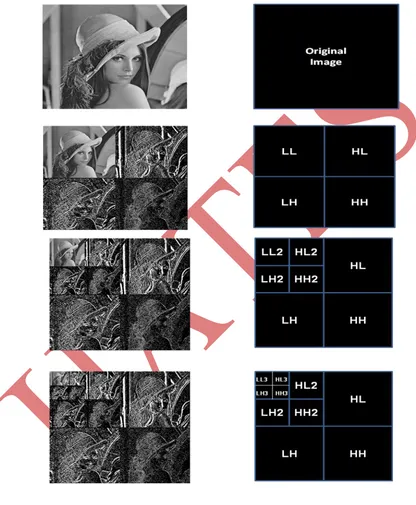
algorithm process. The LL sub-band can be further decomposed into four sub-bands. This process can continue to the
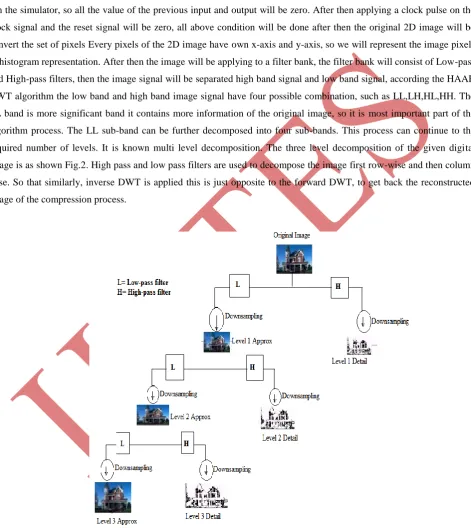
required number of levels. It is known multi level decomposition. The three level decomposition of the given digital
image is as shown Fig.2. High pass and low pass filters are used to decompose the image first row-wise and then column
wise. So that similarly, inverse DWT is applied this is just opposite to the forward DWT, to get back the reconstructed
image of the compression process.
Fig. 1 Decomposition of an input image using a wavelet transformation using three passes
The morphological operations like erosion and dilations are used for better approach of refining text region
International Journal of Advanced Technology in Engineering and Science www.ijates.com
Volume No.02, Issue No. 06, June 2014 ISSN (online): 2348 – 7550
154 |
P a g e
horizontal, vertical, diagonal etc are clubbed together when they are segregated separately in unwanted non-text regions.The identified region of text consists of all these boundary and region information can be the area where such types of
boundaries will be amalgamated. The boundaries are associated with one other in diversified directions and are normally
short. The Text and character extraction deploy both dilation and erosion for associating separated candidate text
boundaries in every detail constituent sub band of the binary image
Fig. 2Texture compressed image
International Journal of Advanced Technology in Engineering and Science www.ijates.com
Volume No.02, Issue No. 06, June 2014 ISSN (online): 2348 – 7550
155 |
P a g e
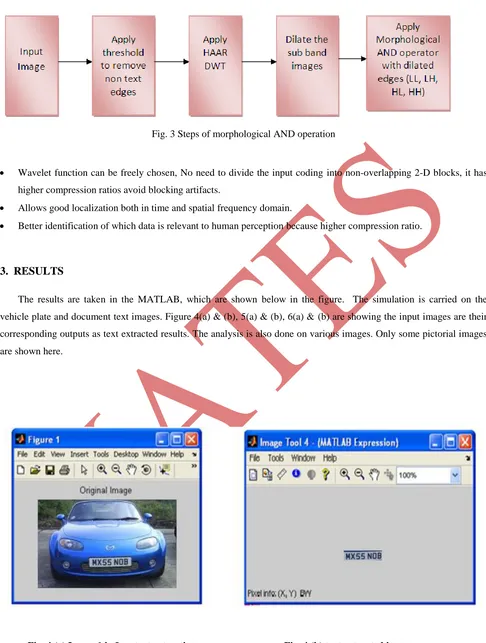
Fig. 3 Steps of morphological AND operation Wavelet function can be freely chosen, No need to divide the input coding into non-overlapping 2-D blocks, it has
higher compression ratios avoid blocking artifacts.
Allows good localization both in time and spatial frequency domain.
Better identification of which data is relevant to human perception because higher compression ratio.
3.
RESULTS
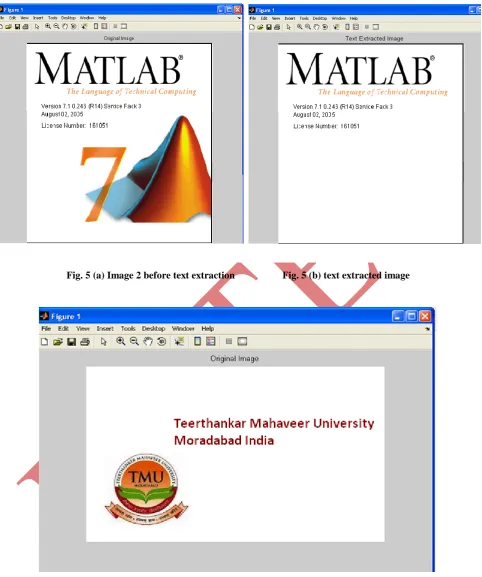
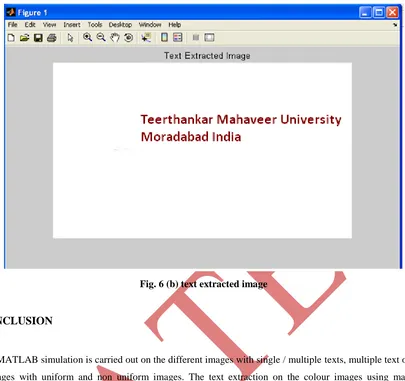
The results are taken in the MATLAB, which are shown below in the figure. The simulation is carried on the
vehicle plate and document text images. Figure 4(a) & (b), 5(a) & (b), 6(a) & (b) are showing the input images are their
corresponding outputs as text extracted results. The analysis is also done on various images. Only some pictorial images
are shown here.
International Journal of Advanced Technology in Engineering and Science www.ijates.com
Volume No.02, Issue No. 06, June 2014 ISSN (online): 2348 – 7550
156 |
P a g e
Fig. 5 (a) Image 2 before text extraction Fig. 5 (b) text extracted image
International Journal of Advanced Technology in Engineering and Science www.ijates.com
Volume No.02, Issue No. 06, June 2014 ISSN (online): 2348 – 7550
157 |
P a g e
Fig. 6 (b) text extracted image
4.
CONCLUSION
The MATLAB simulation is carried out on the different images with single / multiple texts, multiple text of different
sizes, images with uniform and non uniform images. The text extraction on the colour images using mathematical
morphology and Haar DWT is done successfully. Applications of text extraction are huge including the making of digital
copies of the ancient scripture to everyday life bills etc. It may be required to be of digital form. This setup can be used to
recover textual information from surveillance footage, satellite imaging, tollbooth as in a hybrid approach is used to
extract textual information form a video scene.
REFERENCES
[1] Bin Cheng, Jianchao Yang, Student Member, IEEE, Shuicheng Yan, Senior Member, IEEE, Yun Fu, Member, IEEE,
and Thomas S. Huang, Life Fellow, IEEE (2010) “Learning With Graph for Image Analysis” IEEE
TRANSACTIONS ON IMAGE PROCESSING, VOL. 19, NO.4, pp (3-4)
[2] Chen, Datong, Bourlard, H., and Thiran J. P., 2001 “Text identification in complex background using SVM”. IEEE
Computer Society Conference on Computer Vision and Pattern Recognition, Proceedings of the 2001, 2,
8-14:621-626.
[3] Chung-Wei Liang and Po-Yueh Chen (2004) “DWT Based Text Localization”, International Journal of Applied
Science and Engineering. Vol 2, issue 1: pp105-116
[4] Mansi Agarwal, Adesh Kumar, Vimal Gupta “Text Extraction of Colour Images using Mathematical Morphology &
HAAR Transform” IOSR Journal of Computer Engineering (IOSR-JCE) e-ISSN: 2278-0661, p- ISSN: 2278-8727
Volume 14, Issue 5 (Sep. - Oct. 2013), PP 78-87
International Journal of Advanced Technology in Engineering and Science www.ijates.com
Volume No.02, Issue No. 06, June 2014 ISSN (online): 2348 – 7550
158 |
P a g e
[6] Sunil Kumar, Rajat Gupta, NitinKhanna, Student Member, IEEE, SantanuChaudhury, and Shiv Dutt Joshi (2007)“Text Extraction and Document Image [23] Segmentation Using Matched Wavelets and MRF Model” IEEE