University of South Carolina
Scholar Commons
Theses and Dissertations
2017
Exploring Determinants and Consequences of
International Diversification: A Multi-Level
Perspective
Ettore Spadafora University of South Carolina
Follow this and additional works at:https://scholarcommons.sc.edu/etd
Part of theBusiness Administration, Management, and Operations Commons
This Open Access Dissertation is brought to you by Scholar Commons. It has been accepted for inclusion in Theses and Dissertations by an authorized administrator of Scholar Commons. For more information, please [email protected].
Recommended Citation
E
XPLORINGD
ETERMINANTS ANDC
ONSEQUENCES OFI
NTERNATIONALD
IVERSIFICATION:
A
M
ULTI-L
EVELP
ERSPECTIVEby
Ettore Spadafora
Bachelor of Science Università di Pisa, 2004
Master of Science Università di Pisa, 2006
Doctor of Philosophy Università di Pisa, 2010
Submitted in Partial Fulfillment of the Requirements
For the Degree of Doctor of Philosophy in
Business Administration
The Darla Moore School of Business
University of South Carolina
2017
Accepted by:
Tatiana Kostova, Major Professor
Marc van Essen, Committee Member
Kendall Roth, Committee Member
Sali Li, Committee Member
ACKNOWLEDGEMENTS
I want to sincerely thank my parents and my sister for their constant support over the
years.
I also want to thank Professors Tatiana Kostova and Marc van Essen for their guidance
during my time in the Ph.D. program, and Professors Kendall Roth and Sali Li for
serving on my dissertation committee.
Many thanks also to:
Professors Sjoerd Beugelsdijk, Claudio Giachetti, and Valentina Marano for the fruitful research collaborations;
The Sonoco International Business Department, the Center for International Business Education and Research at the Darla Moore School of Business, and the University of
South Carolina for the opportunity to be a part of a great academic environment;
The International Business Department and the Center for International Business Education and Research at George Washington University, and Professors Robert
Weiner and Noel Maurer for the opportunity to attend the GW-CIBER Summer
Doctoral Institute.
Finally, I want to thank my friends in Columbia, SC and in other parts of the U.S. for the
moments shared in the last five years and my friends in Italy for the long-distance
ABSTRACT
The dissertation explores determinants and consequences of international diversification
and consists of two essays. Essay I focuses on the relationship between international
diversification and firm performance (ID-P). Drawing on the global strategy literature
and the institution-based view of strategy, we propose that the mixed findings of extant
research on the ID-P relationship can be explained by the contextual conditions in which
this relationship exists, including home-country formal and informal institutions. The
model is tested in a meta-analysis (HOMA, MARA, and HiLLMA analyses) of firm-,
industry-, and home country-level factors driving the ID-P relationship. The sample
consists of 359 primary studies across 32 countries between 1972 and 2012—the largest
sample of primary studies of any meta-analysis on this topic to date. The main finding is
that international diversification positively impacts firm performance and the strength of
this effect is contingent on the specific formal and informal institutions of the home
country. Essay II focuses on the relationship between corporate governance and
international diversification (CG-ID). The study utilizes a multidimensional
conceptualization of the two constructs, exploring breadth and depth of ID and several
mechanisms of CG (e.g., ownership concentration, CEO compensation, and board
independence). Drawing on agency theory and the resource and information-processing
perspectives, we propose bidirectional causal effects between CG and ID. Our arguments
are then contextualized by exploring the moderating effect of home-country institutional
and the national uncertainty avoidance. We test the model using meta-analytic structural
equation modeling (MASEM) with data from 104 primary studies across 28 countries
covering the 1970-2012 period and find overall support for our theoretical predictions.
The dissertation contributes to the literatures of global strategy and corporate governance
TABLE OF CONTENTS
ACKNOWLEDGEMENTS ... iii
ABSTRACT ... iv
LIST OF TABLES ... viii
LIST OF FIGURES ... ix
INTRODUCTION ...1
ESSAY 1:HOME COUNTRY INSTITUTIONS AND THE INTERNATIONALIZATION- PERFORMANCE RELATIONSHIP:AMETA-ANALYTIC REVIEW ...6
INTRODUCTION ...6
THE PERFORMANCE IMPLICATIONS OF INTERNATIONALIZATION ...11
MODERATING ROLE OF HOME-COUNTRY INSTITUTIONS ...17
METHODOLOGY ...26
RESULTS ...34
DISCUSSION ...41
REFERENCES ...52
ESSAY 2:INTERDEPENDENCE BETWEEN CORPORATE GOVERNANCE AND INTERNATIONAL DIVERSIFICATION:AMETA-ANALYSIS ...79
INTRODUCTION ...79
THEORETICAL BACKGROUND AND MODEL DEVELOPMENT ...88
METHODOLOGY ...110
RESULTS ...120
REFERENCES ...138
LIST OF TABLES
Table 1.1 HOMA Meta-Analytic Results ...70
Table 1.2 MARA Meta-Analytic Results ...71
Table 1.3 HOMA Country-Specific Meta-Analytic Results ...73
Table 1.4 Meta-Analyses on the I-P Relationship ...75
Table 2.1 Meta-Analytic Correlation Matrix ...157
Table 2.2 MASEM Results for CGID ...159
Table 2.3 MASEM Results for IDCG ...161
Table 2.4 MASEM Results for CGID – Depth vs Breadth of International Diversification ...164
Table 2.5 MASEM Results for IDCG – Depth vs Breadth of International Diversification ...165
Table 2.6 MASEM Results for CGID – High vs Low Legal Shareholder Protection ...166
Table 2.7 MASEM Results for IDCG – High vs Low Legal Shareholder Protection ...167
LIST OF FIGURES
Figure 1.1 Distribution of Papers over Time ...77
Figure 1.2 Funnel Plot...78
Figure 2.1 Model Linking Corporate Governance to the Degree of International
Diversification...169
Figure 2.2 Model Linking the Degree of International Diversification to Corporate
Governance ...170
Figure 2.3 Effects of Corporate Governance on the Degree of International
Diversification...171
Figure 2.4 Effects of the Degree of International Diversification on Corporate
INTRODUCTION
Business landscapes are increasingly global. Over the last quarter of a century, world FDI
outward stock has dramatically increased (from 2,254 billion of dollars in 1990 to 25,875
in 2014) and country investment policy measures around the world have been geared to
promote cross-border investment to an ever-larger extent. In this scenario, constantly
advancing our understanding of the implications of international diversification is a
paramount objective for both scholars and practitioners. Equally important is the
investigation of the factors potentially affecting cross-border investment decisions, given
the complex competitive and economic cost-benefit trade-off characterizing international
diversification. Indeed, the determinants and consequences of international diversification
have drawn significant attention in the strategy and international business literatures.
Research has investigated antecedents at the individual, group, firm, industry, and
country level of analysis, as well as outcomes at the firm and country level of analysis.
This dissertation extends the extant literature on the determinants and consequences of
international diversification with two empirical essays.
Essay I focuses on the relationship between international diversification and firm
performance (ID-P). Understanding the performance consequences of international
diversification is widely recognized as a seminal issue in strategic management, given the
increasingly global nature of firms’ strategic focus and actions. Over the past four
decades, numerous empirical studies in management and international business have
positive, negative and non-significant linear effects as well as a variety of curvilinear
relations. This inconclusive empirical evidence suggests that far from having reached a
mature understanding of the ID-P relationship, the field is yet to fully understand this
complex phenomenon.
Drawing on the global strategy literature and the institution-based view of
strategy, we propose that the mixed findings of extant research on the ID-P relationship
can be explained by the contextual conditions in which this relationship exists, including
home-country formal and informal institutions. The model is tested in a meta-analysis
(HOMA, MARA, and HiLLMA analyses) of firm-, industry-, and home country-level
factors driving the ID-P relationship. The sample consists of 359 primary studies across
32 countries between 1972 and 2012—the largest sample of primary studies of any
meta-analysis on this topic to date. The main finding is that international diversification
positively impacts firm performance, although the overall effect is small and its
magnitude is contingent on the specific formal and informal institutions of the home
country.
We make three main contributions to the global strategy literatures. First, we
develop a novel integration of the theoretical perspectives from the ID-P research and the
institution-based view of strategy to explain how embeddedness in home-country
institutions affects the strength of the ID-P relationship. Second, we show the importance
of including both formal and informal institutions in analyses of firms’ institutional
embeddedness, thereby extending our knowledge of the effects of institutional
complexity. Our third contribution is methodological and reflects our use of advanced
effect sizes, which allow us to address unresolved debates about the sign and shape of the
ID-P relationship.
Essay II focuses on the relationship between corporate governance and
international diversification (CG-ID). From a theoretical point of view, corporate
governance scholars suggest that governance mechanisms may affect the extent of
international diversification. By contrast, the international management literature
suggests that expansion abroad, through multiple theoretical mechanisms, may trigger
changes in firms’ corporate governance framework. The literature, indeed, provides
evidence for both causality directions. For example, research corroborates the argument
that firms’ degree of international diversification both affects and is affected by the level
of contingent executive pay. Similarly, some scholars show that the extent of foreign
expansion has an effect on the proportion of outside directors, while others provide
evidence that board independence impacts export propensity. Likewise, the literature, on
the one hand, shows that board size influences the firm’s degree of international
diversification and, on the other hand, provides empirical support for the opposite
causality direction―from firms’ degree of foreign expansion to board size. Besides the
direction of causality, the sign of the relationship between corporate governance and
international diversification also receives mixed empirical evidence. Some scholars report
a positive correlation between the level of ownership concentration and the extent of
international diversification, while others provide evidence for a negative correlation.
Similarly, research shows both a positive and a negative correlation between CEO duality
Extant research therefore, from both a theoretical and an empirical perspective,
does not provide definitive answer as to the nature (i.e., direction, magnitude, and sign)
of the CG-ID relationship. Moreover, extant research is somewhat lacking in the
exploration of the theoretical mechanisms linking corporate governance and international
diversification. In order to have a more impactful research on the CG-ID relationship, it is
critical to develop a more fine-grained understanding of which mechanisms are at play
and how they operate.
Hence, there is an opportunity for further research, which may push forward the
existing theoretical knowledge about the relationship between corporate governance and
international diversification. This dissertation utilizes a multidimensional
conceptualization of the two constructs, exploring breadth and depth of ID and several
mechanisms of CG (e.g., ownership concentration, CEO compensation, and board
independence). Drawing on agency theory and the resource and information-processing
perspectives, we shed new light on such relationship in three major ways. First, we
investigate each direction of causality and the theoretical mechanisms at play. Second, we
examine the relative explanatory power of the two alternative cause-effect linkages
between corporate governance and international diversification. Third, we contextualize
our analysis by exploring the moderating effect of institutional and cultural conditions in
the home country including the legal protection of minority shareholders and the national
uncertainty avoidance.
We test the model using meta-analytic structural equation modeling (MASEM)
with data from 104 primary studies across 28 countries covering the 1970-2012 period
governance and international diversification is bidirectional and multifaceted in nature.
Second, corporate governance explains the degree of international diversification better
than international diversification explains the activation of corporate governance
mechanisms. Third, the nature of the causal linkages between corporate governance and
international diversification changes depending on whether the focus is on the depth or
breadth of foreign expansion. Fourth, both directions of causality in the CG-ID
relationship are moderated by country-level contingencies including legal shareholder
ESSAY 1
HOME COUNTRY INSTITUTIONS AND THE INTERNATIONALIZATION-PERFORMANCE RELATIONSHIP: A META-ANALYTIC REVIEW
INTRODUCTION
Understanding the performance consequences of internationalization is widely
recognized as a seminal issue in strategic management (e.g., Hitt, Tihanyi, Miller, &
Connelly, 2006b; Kirca et al., 2011; Rumelt, Schendel, & Teece, 1994), given the
increasingly global nature of firms’ strategic focus and actions (Hill & Hult, 2015; Hitt et
al., 2006b).1 Over the past four decades, numerous empirical studies in management and
international business (IB) have examined the performance effects of internationalization
and found positive, negative and non-significant linear effects as well as a variety of
curvilinear relations (see Hitt et al., 2006b). This inconclusive empirical evidence
suggests that far from having reached a mature understanding of the
internationalization-performance (I-P) relationship, the field is yet to “fully grasp this complex phenomenon”
(Wiersema & Bowen, 2011: 154; see also: Cardinal, Miller, & Palich, 2011; Hennart,
2011). We argue that the empirical inconsistencies in the existing research on the I-P
1 We rely on Hitt, Ireland, and Hoskisson’s (2007: 251) definition of internationalization as “a strategy through which a firm expands the sales of its goods or services across the borders of global regions and countries into different geographic locations or markets”. Terms such as “internationalization”,
relationship stem primarily from its failure to adequately consider the moderating effects
of firms’ home country formal and informal institutions.
The limited attention paid to the role of home country formal and informal
institutions on the I-P relationship is surprising, given that IB research has firmly
established the importance of home country institutions for firms’ global strategy (e.g.,
Peng, Wang, & Jiang, 2008) – also referred to as the “country of origin” effect (COE)
(e.g., Elango & Sethi, 2007; Harzing & Sorge, 2003; Noorderhaven & Harzing, 2003).
Still, there has been little effort to determine which home country institutions influence
the I-P relationship, or the mechanisms underlying these effects (Pajunen, 2008: 653).
Most empirical works on the I-P relationship, including existing meta-analyses (e.g.,
Kirca, Roth, Hult, & Cavusgil, 2012a), have either taken home country institutions as a
given, examined only institutional distances between home and host country, or relied on
a narrow conceptualization of the home country institutional context by using dummy
variables or focusing on a single institutional characteristic (e.g., Geringer et al., 1989; Li
& Yue, 2008). One important exception is Wan and Hoskisson’s (2003) study, which
develops a multifaceted conceptualization of the home country institutional context and
its moderating effect on the I-P relationship. Further, very few studies have examined
how multiple home country institutions shape the I-P relationship across a large number
of countries and years (Holmes, Miller, Hitt, & Salmador, 2013). Thus, existing findings
may not generalize to sets of “different institutions and to a broader spectrum of
countries” (Holmes et al., 2013: 533).
This study addresses these limitations both theoretically and empirically.
management to explain how home country formal and informal institutions shape the I-P
relationship (e.g., Carney, Gedajlovic, Heugens, Van Essen, & Van Oosterhout, 2011;
Elango & Sethi, 2007; Harzing & Sorge, 2003; Peng et al., 2008; Van Essen, Heugens,
Otten, & Van Oosterhout, 2012; Wan & Hoskisson 2003). Specifically, we view home
country contexts as complex, multifaceted institutional environments that provide the
foundational social structures, and thereby create templates for organizational action
(North, 1990). Home country institutions are the central components of national business,
governance and innovation systems (Henisz & Williamson, 1999; La Porta,
Lopez-de-Silanes, Shleifer, & Vishny, 1998; Nelson & Rosenberg, 1993; Whitley, 1992).
Therefore, they play a critical role in firms’ ability to develop and maintain their
competitive advantage at home and abroad by shaping managerial cognition and by
enabling or constraining the acquisition and deployment of strategic resources and
capabilities (Cuervo-Cazurra, 2011).
Empirically, we use advanced meta-analytic techniques (e.g., Carney et al., 2011;
Van Essen, Otten, & Carberry, 2015) to combine numerous single-country studies into a
single multi-country study, thereby maximizing the number and diversity of the home
country contexts under examination to test our hypotheses about the effects of home
country institutions on the I-P relationship. Specifically, our meta-analytic tests combine
359 studies from across the management, economics and finance disciplines – a
significant improvement from existing meta-analyses on the I-P relationship (i.e., Bausch
& Krist, 2007; Kirca et al., 2011; Kirca et al., 2012a; Ruigrok & Wagner, 2004; Yang &
Driffield, 2012), which respectively included 36, 111, 141, 62 and 54 studies.
firm-year observations (1,558,455 firm observations for the bivariate analyses and 2,576,772
firm-year observations for the partial analyses) and countries (i.e., 32) than any previous
meta-analysis on this topic.
Our results show that internationalization has an overall positive, but small, effect
on performance, albeit with substantial variation in the effect size distribution depending
on firms’ countries of origin. Firms in some countries experience significant negative
performance effects from their internationalization efforts (e.g., in Mexico), while in
others internationalization generates significant positive effects that range from very
small (e.g., in South Korea) to sizable (e.g., in Greece), or no effects (e.g., in the
Netherlands and Spain). Further, we find that specific home country institutions have
different effects on the I-P relationship. In particular, our results show that home country
quality of business regulations, political risk, generalized trust, long-term orientation and
uncertainty avoidance are all moderators of the I-P relationship.
This research makes three main contributions to the global strategy literature.
First, we show that, in the aggregate, the positive linear association between
internationalization and performance is modest, and should be considered only as a
“stylized fact” (Helfat, 2007). We also show that this relationship is contingent on home
country institutional conditions, which can significantly affect the magnitude and sign of
this relationship. Taken together, these results indicate that studies of the I-P relationship
should account for COE; if not, they are likely to be underspecified both theoretically and
empirically. Relatedly, our findings show the relevance of the institution-based view of
strategy for studying the I-P relationship. In particular, they suggest that home country
which, in turn, affect their ability to acquire and deploy strategic resources (Kirca,
Jayachandran, & Bearden, 2005), and, ultimately, their potential to succeed in markets at
home and abroad. To date, research has largely overlooked the importance of the
institution-based view for contextualizing the I-P relationship. Second, we show that
multiple formal and informal institutions across many countries, over a long period of
time, affect firms’ ability to benefit from internationalization, contributing to research on
institutional complexity (Greenwood, Raynard, Kodeih, Micelotta, & Lounsbury, 2011).
In doing so, our study provides a richer assessment of how firms’ institutional
embeddedness in their home country affects their effectiveness in international markets.
Our third contribution is methodological and pertains to our meta-analytical tests’ use of
both Pearson product-moment correlation and partial correlation as effect sizes, which
represents a significant improvement from existing meta-analyses that only used Pearson
product-moment correlations. Incorporating partial correlations allows us to generate
conclusive findings on several important matters that could not be properly addressed by
previous meta-analyses, including the sign and shape of the I-P relationship (Stanley &
Doucouliagos, 2012).
The paper is organized as follows. We begin with a review of the literature,
focusing on the mixed findings about the sign and shape of the I-P relationship and
previous attempts at reconciling them. We also identify firm-, industry- and host
country-level variables that have been deemed important in existing tests of the I-P relationship.
Then, we develop our central arguments based on the institution-based view to explain
how the home country institutional context shapes the I-P relationship. We focus on the
firms’ global competitive advantage. We also provide some specific examples of home
country formal and informal institutions that are relevant for the I-P relationship. Next,
we explain the meta-analytic methodology employed, data, and results. Finally, we
conclude with a discussion of our results and a number of avenues for future research on
the I-P relationship and the institution-based view in strategy. These suggestions point to
other scarcely researched factors that might also affect firms’ ability to generate profits
from their internationalization efforts, steps needed to further strengthen the
methodological rigor of the empirical research on the focal relationship, and ways in
which theoretical insights from the institution-based view can further advance research in
this area.
THE PERFORMANCE IMPLICATIONS OF INTERNATIONALIZATION
A considerable body of research has focused on the performance implications of
internationalization. Several review articles (Cardinal et al., 2011; Hennart, 2011; Hitt et
al., 2006b; Matysiak & Bausch, 2012; Oesterle & Richta, 2013) and meta-analyses
(Bausch & Krist, 2007; Kirca et al., 2011; Kirca, Hult, Deligonul, Perryy, & Cavusgil,
2012b; Yang & Driffield, 2012) have presented overviews of research on this topic, as
well as critical assessments of the main theoretical arguments used to explain the I-P
relationship (Hennart, 2007). Rather than providing another comprehensive review of the
vast literature on the I-P relationship, we focus instead on its central debates regarding
the sign and shape of the central relationship, the role of various methodological and
model specification artifacts that might explain the heterogeneous findings of this body of
Conflicting and Inconclusive Empirical Results
Scholars acknowledge that internationalization is accompanied by inherent benefits
(Geringer et al., 1989) as well as costs (Tallman & Li, 1996), which can produce different
views about the performance effects of internationalization (Hitt, Hoskisson, & Kim,
1997; Lu & Beamish, 2004). The positive effects are explained by economies of scale
and scope, location-based advantages, international arbitrage, broader learning and
market opportunities (Cardinal et al., 2011; Hennart, 2011; Hitt et al., 2006b). Costs
result from the complexity of internationalization dynamics due to external (e.g.,
managing across more diverse countries, liabilities of foreignness) and internal (e.g.,
coordinating more foreign direct investments) factors (Hennart, 2011). Empirical results
have been largely inconclusive on the existence and shape of the I-P relationship,
providing support for positive linear relationships (e.g., Grant, Jamine, & Thomas, 1988;
Kim, Hwang & Burgers, 1989), negative linear relationships (Siddharthan & Lall, 1982;
Wan & Hoskisson, 2003), no relationships (Hennart, 2007, 2011), U-shaped relationships
(Lu & Beamish, 2001), inverted U-shaped relationships (Geringer et al., 1989; Gomes &
Ramaswamy, 1999; Hitt et al., 1997), and sigmoid relationships (Contractor, Kundu, &
Hsu, 2003; Lu & Beamish, 2004).
Advocates of the positive linear relationship focus on the benefits of
internationalization. This approach has been criticized because it often ignores the
fundamental complexity of internationalization (Cardinal et al., 2011). More complex
non-linear relationships have been proposed to reflect both the costs and benefits of
internationalization. Proponents of a U-shaped I-P relationship (e.g., Lu & Beamish,
internationalization due to the costs stemming from the liabilities of foreignness and
newness (Hymer, 1976; Zaheer, 1995). However, over time as the firm continues to
internationalize, it acquires sufficient knowledge and capabilities to overcome these
difficulties and capture the benefits associated with internationalization. Thus, its
performance improves over time. Proponents of the inverted U-shaped relationship (e.g.,
Geringer et al., 1989; Gomes & Ramaswamy, 1999), instead, emphasize the positive
effects of internationalization up to an “internationalization threshold”, where the costs of
coordination among diverse subsidiaries exceed the benefits. Thus, according to this
view, firms are expected to enjoy better performance at moderate levels of
internationalization, but experience poorer performance at low and high levels of
internationalization. Finally, other researchers (e.g., Contractor et al., 2003; Lu &
Beamish, 2004; Thomas & Eden, 2004) propose a sigmoid I-P relationship in an effort to
synthesize the arguments made by the proponents of both the shaped and inverted
U-shaped relationships. Similarly to the advocates of the U-U-shaped relationship, they
suggest that firm performance is likely to deteriorate in the early phases of
internationalization, but then improve at later stages. However, negative performance
effects are also likely to develop when the firms internationalize beyond a certain
threshold, as suggested by the proponents of the inverted U-shaped relationship. Sigmoid
models are thus described as more sophisticated and integrative by their authors because
they account for the impact of internationalization on performance at different levels of
Reconciling Conflicting and Inconclusive Results
Conflicting findings about the sign and shape of the I-P relationship have triggered
several attempts to explain them. They can be broadly summarized in two groups. The
first group includes studies examining the impact of various methodological approaches
on the I-P relationship (see Bowen, 2007), such as differences in the time frames
examined, endogeneity controls, and operationalizations of the main variables of interest.
For example, Thomas and Eden (2004) show the different effects of internationalization
on short-term accounting measures of performance (e.g., return on assets, return on
equity, and return on sales) and long-term market-based measures (e.g., excess market
value, average market value). They find a stronger S-shaped effect in studies that rely on
market-based measures of performance. However, conflicting results can also be found in
studies relying purely on market-based measures (Hitt et al., 2006b). Another
methodological concern stems from the numerous approaches to measuring
internationalization as they capture different aspects of this phenomenon (Hennart, 2011;
Thomas & Eden, 2004). For example, while many studies measure firm’s
internationalization in terms of its “scale” (or “depth” – e.g., ratio of foreign sales to total
sales, foreign assets to total assets, or foreign employees to total employees), others rely
on measures that reflect “scope” (or “breadth” – e.g., number of countries, international
asset dispersion). These measures consider two different facets of firms’
internationalization. Scale reflects the strategic importance that a firm assigns to serving
foreign markets (Stopford & Wells, 1972); however, scope captures the heterogeneity of
internationalization across countries (Goerzen & Beamish, 2003; Tallman & Li, 1996).
relationships between internationalization and performance as it captures the potential
costs of internationalization. Firms with institutionally diverse portfolios of foreign
operations (i.e., with a larger scope of internationalization) are likely to experience
substantial complexity in their operations, given the need to manage operations across
countries with dissimilar institutional profiles (Kostova & Zaheer, 1999; Zahra, Ireland,
& Hitt, 2000). A larger scope of internationalization can also complicate the exploitation
of firm-specific assets (Rugman & Verbeke, 2005), thus negatively affecting
performance. To include both aspects of internationalization, some studies have
developed multidimensional measures of internationalization (e.g., Hitt, Bierman,
Uhlenbruck, & Shimizu, 2006a; Sullivan, 1994).
A second group of studies attempts to reconcile the conflicting findings of the I-P
literature by focusing on potential theory-driven moderators of the relationship (e.g.,
Bausch & Krist, 2007; Bowen, 2007; Hitt et al., 2006b). In addition to industry-level
moderating effects (e.g., Tallman & Li, 1996), a number of firm-level moderators have
been examined in the literature. Some of the most common ones include the degree of
product diversification (Hitt et al., 1997), size (Dragun, 2002), ownership type (Allen &
Pantzalis, 1996), leverage (Reuer & Miller, 1997), risk (Hejazi & Santor, 2010), growth
(Allen & Pantzalis, 1996), firm-specific intangible assets such as marketing and R&D
assets (Kirca et al., 2011), advertising intensity (Kim & Lyn, 1986), CEO pay or
international experience (Carpenter & Sanders, 2004), top management team’s (TMT’s)
international experience or diversity (Thomas, 2005), and human capital in the case of
service industries (Hitt et al., 2006a). However, the empirical results of some of these
Researchers have also examined how differences in firms’ internationalization
processes, in terms of pace (i.e., the speed with which it is carried out) and rhythm (i.e.,
the irregularity of the internationalization process) influence performance. For example,
using a sample of Dutch firms, Vermeulen and Barkema (2002) show that faster and
more irregular internationalization processes negatively moderate the I-P relationship.
However, Chang and Rhee (2011), using Korean data, find an insignificant relationship
between internationalization rhythm and performance. They also show that greater speed
enhances performance only in industries in which globalization pressures are high, and
when they are carried out by firms with superior international resources and capabilities.2
It is important to note that research on the performance implications of heterogeneous
processes of internationalization is still limited when compared to other areas of inquiry
reviewed herein.
Other studies rely on the construct of institutional distance and its impact on the
I-P relationship (e.g., Tihanyi, Griffith, & Russell, 2005). Institutional distance refers to the
“difference/similarity between the regulatory, cognitive, and normative institutional
environments of the home and host countries” of a multinational enterprise (MNE)
(Kostova & Zaheer, 1999: 68). Empirical studies have shown both positive and negative
moderating effects of institutional distance on the I-P relationship (e.g., Chao & Kumar,
2010; Tihanyi et al., 2005). For example, Tihanyi et al. (2005) find support for a positive
effect of cultural distance on performance, but only for MNEs entering developed
countries. Chao and Kumar (2010) also find that cultural distance is positively related to
MNE’s performance, however the effect for regulatory distance is negative. Some
all of the MNE’s portfolio of host countries, arguing that weaker institutional contexts are
more likely to increase the firm’s costs associated with “entry and liabilities of
foreignness and newness owing to unclear regulations and weak enforcement of the
rules” (Chao & Kumar, 2010: 95).
MODERATING ROLE OF HOME COUNTRY INSTITUTIONS
Attempts to reconcile mixed findings of the I-P relationship have examined a variety of
firm-, industry-, and host country-level factors, but scarce attention has been paid to the
role of firms’ home country institutional environments. This is surprising given the
existing view that home country institutions help shape firms’ strategies and their ability
to succeed at home and abroad by influencing their transaction costs and their managers’
cognitive processes. In particular, scholars have argued that home country institutions
engaging efficiency and uncertainty reduction mechanisms often determine the cost of
transacting internationally, and thereby affect firm performance. For example,
Cuervo-Cazurra (2011) argues that home country institutions affect firms’ domestic and global
performance because the “presence or absence of specific inputs outside the firm induces
it to develop distinct resources that either rely on the availability of particular external
inputs or compensate for the lack of certain external inputs […]” (Cuervo-Cazurra, 2011:
383). In addition, “the particular norms and institutions prevailing in the country induce
the company to develop specific resources to be able to interact with other players in the
marketplace […]” (Cuervo-Cazurra, 2011: 383). Others have explored country of origin
effects through the concept of national administrative heritage, which refers to shared
beliefs and cultural templates that determine "how things ought to be done" and
2007; Lubatkin, Calori, Very, & Veiga, 1998; Noorderhaven & Harzing, 2003). The
concept of national administrative heritage builds on the rich and theoretically eclectic
body of work on the institutional embeddedness of firms’ behaviors (e.g., DiMaggio &
Powell, 1983; Guillén, 1994; Lubatkin et al., 1998). McGahan and Victer (2010) rely on
the related concept of employees’ imprinting reflecting their absorption of home
country-based cognitive frames.
An important exception to the limited empirical attention given to the moderating
role of home country institutions on the I-P relationship is Wan and Hoskisson’s study
(2003), which examines the political, legal and societal institutions of a firm’s home
country. The authors find that stronger formal and informal institutions positively
moderate the I-P relationship. Our study builds on Wan and Hoskisson’s (2003) insights
by examining the role that home country formal and informal institutions play as
moderators of the I-P relationship. Our overarching contention is that, keeping other
factors constant, the strength of the I-P relationship will vary depending on firms’ home
country institutional environment (Andersson, Cuervo-Cazurra, & Nielsen, 2014), as it
generates conditions that push them to develop resources and capabilities that can sustain
or hinder their global competitive advantage (Cuervo-Cazurra, 2011; Wan & Hoskisson,
2003).
To further illustrate our general contention, we draw on the institution-based view
and COE tradition in strategy. We focus on institutional variables that the
institution-based view and COE traditions in strategy have identified as potentially influential for
firms’ global strategy. Even though the majority of the arguments presented below have
The rationale for this approach is two-pronged. First, we are interested in examining the
overarching contention that home country formal and informal institutions are important
moderators of the I-P relationship, rather than exploring in detail the role of specific
institutions. Second, our set of institutional variables should not be viewed as definitive,
nor do we explore the theoretical linkages among those variables. Rather, our goal is to
propose (based on theory) and test (benefiting from the advantages of advanced
meta-analytic methods) promising institutional arguments that are consistent with our general
hypothesis. We view our approach as exploratory and consistent with Cantwell, Dunning
and Lundan’s (2010) appreciative theory, which aims to create “an analytical bridge
between empirical investigation and formal models” (Cantwell et al., 2010: 573).
We draw on North’s institutional tradition and consider the impact of two
different but related types of home country institutions: formal and informal (Holmes et
al., 2013; Van Essen et al., 2012). Formal institutions consist of regulatory,
administrative, economic and political arrangements that detail the actions of people,
systems, and organizations through formal laws, regulations, policies, and other written
materials as well as their means of enforcement (North, 1990). Informal institutions are
norms and beliefs that are not codified or documented; rather, they are durable systems of
shared meanings and understandings that contribute to shape societal structures and
behaviors (Holmes et al., 2013).
Formal Institutions and the I-P Relationship
Because formal institutions reflect codified and explicit rules and standards, they provide
influential behavioral guidelines within society mainly through regulatory and political
influence of various aspects of home countries’ formal institutions on firms’ behavior and
performance (e.g., Chacar, Newburry, & Vissa, 2010; Kirca et al., 2012b; McGahan &
Victer, 2010; Van Essen et al., 2012; Wan & Hoskisson, 2003). In reviewing the
literature on formal institutions’ effect on a firm’s global strategy, we follow Holmes et
al. (2013) who argue that the most relevant formal institutions for managers are
regulatory/legal, economic, and political institutions. Much of the research on these
institutions has emphasized that their quality stimulates firms’ creation of specific
resources that rely on particular external inputs or compensate for the lack of other inputs
(Cuervo-Cazurra, 2011).
Research on legal institutions shows that the degree to which legal traditions
prioritize investor and private property rights helps explain cross-country variation in
financial development and corporate strategies (La Porta et al., 1998). Common law
systems provide stronger protection to both shareholders and creditors (La Porta et al.,
1998). Building on these ideas, Li and Yue (2008) test and find support for the notion that
firms from civil law countries achieve better performance in their international operations
than their common law counterparts. The authors attribute this outcome to civil law
countries’ less supportive legal environment, which forces local firms to develop coping
skills and capabilities that help them compete against their common law counterparts in
the global arena (Elango & Sethi, 2007; Li & Yue, 2008). In sum, these findings imply
that civil law home country traditions are likely to positively moderate the I-P
relationship.
Home country’s business regulations, including antitrust and product liability
to shape local firms’ access to resources and thus to influence their ability to compete in
the international arena (Chacar et al., 2010; Nachum, 2004; Wan & Hoskisson, 2003).
Two conflicting perspectives have emerged in this area with regard to how these
institutions can shape firms’ performance abroad. The first one suggests that higher
quality business regulations enable local firms’ economic activities because they reduce
firms’ transactions costs by limiting opportunistic behaviors and uncertainty in market
transactions. These regulations produce stronger national economies that provide more
resources, which in turn help firms to develop skills and routines that can strengthen their
ability to profit from their foreign operations (Chacar et al., 2010; Kirca et al., 2012b;
Wan & Hoskisson, 2003). Hence, these arguments suggest that home country quality of
government’s business regulations positively moderates the I-P relationship. The second
and conflicting perspective comes from the research on institutional voids (i.e., weak or
missing institutions) and firm performance (e.g., Khanna & Palepu, 1997). It contends
that weaker business regulations at home stimulate local firms’ development of coping
skills, which can be deployed in their foreign operations and translated into competitive
advantages over firms from countries with stronger regulations (Luo & Tung, 2007: 486).
Therefore, this perspective views home country quality of government’s business
regulations as likely to negatively moderate firms’ ability to benefit from
internationalization.
Research also suggests that the political system in an MNE’s home country can
affect the I-P relationship. Relative to autocratic regimes, democratic political systems
create more effective economies, more cooperative relationships between businesses and
informed stakeholders embedded within them (Hillman & Keim, 1995). Democratic
political systems also decrease the level of political risk in a country. By political risk, we
refer to the potential for arbitrary and capricious policymaking, which creates uncertainty
for firms (Henisz & Zelner, 2004). Lower levels of political risk can improve
performance by reducing uncertainty and enabling firms to identify and conform to
government priorities and facilitate relationships with government officials (Orr &
Kennedy, 2008). Two competing theoretical logics have emerged regarding the role of
political risk relative to firm’s performance that are similar to some of the arguments
discussed above for business regulations. For example, Wan and Hoskisson (2003) show
that firms headquartered in countries with stronger political institutions (which they
examined together with “legal” and “societal” institutions) tend to profit more from
internationalization than firms from countries with less strong institutions. They argue
that the latter group of firms may “lack globally redeployable capabilities for successfully
competing in foreign markets” (Wan & Hoskisson, 2003: 31). This is because their
competitive advantages usually depend on the lax home country institutional environment
and thus are “in many respects local and [...] likely to dissipate in foreign countries” (32).
However, others provide competing arguments. For example, Puffer, McCarthy and
Boisot (2010) argue that while countries characterized by unstable and unpredictable
political systems are prone to market inefficiencies, such conditions force firms to
develop coping strategies and capabilities to deal with difficult institutional settings. In
turn, these coping skills can help firms manage the challenges they experience in their
foreign operations (Elango & Sethi, 2007). This second perspective emphasizes the
when they internationalize: thus, it suggests that home country political risk should
positively moderate the I-P relationship.
Informal Institutions and the I-P Relationship
Culture is an important informal institution in a country (North, 1990; Peng et al., 2008).
Culture is composed of interrelated values and norms (Hofstede, 2001; Parsons & Shils,
1951), as well as repertoires, worldviews, stories, and symbols that people use to
determine strategies for action (Swidler, 1986). Culture is durable and provides a tacit
context for the development of formal institutions (Dunning & Bansal, 1997; Holmes et
al., 2013). A number of empirical studies have shown the impact of national culture on
firms’ administrative heritage (Lubatkin et al., 1998) and performance (Li, Lam, & Qian,
2001). National culture can affect managers’ ability to interpret and respond to strategic
issues (Schneider & De Meyer, 1991), leadership style, human resource management and
other organizational practices (Harzing & Sorge, 2003; House et al., 1999), which in turn
influence a firm’s ability to acquire and deploy strategic resources (Kirca et al., 2005). IB
research has examined how specific dimensions of national cultures affect firm
performance; hence, studying culture can help understand cross-country performance
variation. Based on an extensive review of the relevant literature, we identify three facets
of home country culture that are most likely to moderate the I-P relationship: generalized
trust, future orientation, and uncertainty avoidance.
Research shows that higher levels of home country societal trust, cooperative
norms, and relational activities enable firms to extract greater value from their
international operations (Wan & Hoskisson, 2003). This is because societies with higher
towards collective benefits (Knack & Keefer, 1997). International strategies have been
linked to a specific type of social trust referred as “generalized trust” (Kramer & Lewicki,
2010; Yamagishi & Yamagishi, 1994) and defined as the degree to which a country’s
population perceives people from foreign countries to be trustworthy (Ertug, Cuypers,
Noorderhaven, & Bensaou, 2013). Generalized trust reflects a social categorization effect
in that assumptions or stereotypes associated with membership in a social category (e.g.,
a foreign country) affect how much trust is afforded to members of that group (Kramer &
Lewicki, 2010). Generalized trust is part of a country’s national culture (Ertug et al.,
2013) and varies across countries (Ferrin & Gillespie, 2010; Huff & Kelley, 2003). In
addition to shaping local firms’ managerial practices (Calori, Lubatkin, Very, & Veiga,
1997; Ertug et al., 2013), it is especially relevant for internationalization strategies (e.g.,
Ertug et al., 2013). Indeed, higher generalized trust translates into firms’ greater openness
to foreign activities and practices (Huff & Kelley, 2003; Yamagishi, Cook, & Watabe,
1998), as well as a stronger learning orientation in foreign markets (Yilmaz, Alpkan, &
Ergun, 2005). By extension, this stronger openness to foreign activities and markets and
heightened learning orientations can lead to greater propensity to develop relevant
practices, skills and routines that foster firms’ ability to succeed abroad (Chen, Meindl, &
Hui, 1998; Yilmaz et al., 2005; Zahra et al., 2000). Hence, these arguments indicate that
home country generalized trust positively moderates the I-P relationship.
Other facets of home countries’ cultural systems may also be relevant for the I-P
relationship. For example, research suggests that the degree of the home country’s future
orientation (Hofstede, 2001) affects firms’ entrepreneurialism and performance (e.g., Li
outcomes; hence, planning and investing activities are geared towards long-term
outcomes (Ashkanasy, Gupta, Mayfield, & Trevor-Roberts, 2004). Prevalent social
norms, such as delayed gratification, prompt individuals and organizations to opt for
savings and forgo immediate spending. Ultimately, this enables capital accumulation
through investments in projects with long-term payoffs and the avoidance of expenditures
associated with short-term payoffs (Hofstede & Bond, 1988). Future orientation exists in
cultures that place a premium on loyalties and commitment, and the extension of familial
values to corporate settings (Ouchi, 1981). Future orientation may have an impact on the
supply and demand of capital by framing a country’s investment options as long-term
growth-opportunities. Thus, these ideas suggest that a country’s cultural emphasis on
future orientation could enhance its firms’ ability to extract value from foreign
investments/operations.
Finally, research points to one other facet of the home country’s cultural system
that is relevant for the I-P relationship, namely the degree of home country’s uncertainty
avoidance (Noorderhaven & Harzing, 2003). Uncertainty avoidance reflects the degree to
which individuals within a culture are tolerant of uncertain situations. Individuals and
organizations embedded in cultures with high degrees of uncertainty avoidance tend to be
more easily threatened by ambiguous situations, and prefer structures, regulations and
expert knowledge that mitigate risk (Hofstede, 2001). However, these preferences tend to
create cognitive constraints that limit a firm’s strategic flexibility (Brinckmann, Girchnik,
& Kapsa, 2010; Lubatkin et al., 1998). In turn, the lack of strategic flexibility can harm
firms’ ability to learn from their exposure to international markets and ultimately reduce
in countries with lower uncertainty avoidance may have better responsiveness, strategic
flexibility and tolerance for improvisational activities that help them to adapt to and
perform more effectively within the requirements and expectations of foreign local
conditions, thereby enhancing their chances for success in foreign markets (Brinckmann
et al., 2010). Thus, home country uncertainty avoidance should negatively moderate the
I-P relationship.
METHODOLOGY
In order to develop a systematic empirical evaluation of the firm-, industry-, home and
host country-level factors driving the I-P relationship that were discussed in the preceding
sections, we conducted a meta-analytic study following established methodological
guidelines (e.g., Buckley, Devinney, & Tang, 2013). In this section, after describing our
sample and coding approach, we discuss our three main meta-analytic approaches,
namely Hedges and Olkin-type meta-analytic techniques (HOMA; Hedges & Olkin, 1985);
meta-analytic regression analysis (MARA; Lipsey & Wilson, 2001); and hierarchical linear
modeling meta-analysis (HiLMMA; Hox, 2002; Raudenbush & Bryk, 2002). We
conclude this section by describing our measurement approach.
Sample and Coding
To identify the highest possible number of studies testing the I-P relationship, we used
five search strategies. First, we consulted several review articles (e.g., Hennart, 2011; Hitt
et al., 2006b; Li, 2007) and six prior meta-analytic articles (Bausch & Krist, 2007; Kirca
et al., 2011; Kirca et al., 2012b; Kirca et al., 2012b; Ruigrok & Wagner, 2004; Yang &
Driffield, 2012). Second, we explored five major electronic databases using the following
“internationalization”, “geographic diversification”, “international expansion”, and
“globalization” (Hitt et al., 2006b; Kirca et al., 2011; Kirca et al., 2012a, 2012b). Third,
we conducted a manual search in journals across the disciplines of economics,
entrepreneurship, management, and finance that have published articles on the I-P
relationship from the year of the first publication of each of the journals to 2014. Fourth,
after collecting an initial set of studies, we gathered all studies cited in the previously
retrieved articles, along with all articles citing them, using Google Scholar and ISI Web of
Knowledge. Fifth, we directly contacted researchers who had previously written one or
several papers relevant to this topic but did not report effect size information or whose
studies we could not retrieve by other means. We asked them for a correlation table,
sample size, regression output, and additional empirical studies. Combined, these
strategies yielded a final sample of 359 primary studies (288 published and 71 working
papers) with samples of firms from 32 countries across the 1972-2012 time period. In
Figure 1.1, we show the number of primary studies for each year included in our
meta-analysis and the growth trajectory of research on the I-P relationship.2
We proceeded by reading all articles and by developing a coding protocol (Lipsey
& Wilson, 2001) to extract data on all relevant variables and study characteristics. Two
authors coded all the data, and a third author re-checked all effect sizes to assess the
degree of agreement in the extracted information from primary studies (Stanley &
Doucouliagos, 2012). We resolved remaining discrepancies via discussion until we
reached a consensus.
Meta-analytic Procedures
We used three analytical procedures depending on our research objectives.
HOMA procedure. We use Hedges and Olkin-type meta-analytic techniques
(HOMA; Hedges & Olkin, 1985) to measure the meta-analytic mean correlation between
internationalization and performance and the corresponding confidence interval. In
addition, this procedure allows us to assess whether the heterogeneity of the effect size
distribution in the I-P relationship depends on the different operationalizations of the two
main constructs of interest (i.e., internationalization and performance) and variations in the
internationalization processes that firms pursue. It also enables us to examine the shape of
the I-P relationship. To carry out HOMA analyses, we use both Pearson product-moment
correlation r and the partial correlation rxy.z as effect sizes because these are easily
interpretable and scale-free measures of linear association. We use r, as this is the most
commonly reported effect size statistic in management (Geyskens, Krishnan, Steenkamp,
& Cunha, 2009). In addition, we use rxy.z, which represents the association between I(X)
and P(Y), given a set of n control variables (Z), and allows us to incorporate studies in
which bivariate effect size information was not reported. Exploring partial correlations is
useful for several additional reasons. First, rxy.z gives insights into the direction of
causality between two variables, provided that the authors of the primary study corrected
for endogeneity. Second, rxy.z controls for the effect of other variables and can be used to
determine the minimally required set of control variables for future studies (see our
discussion about the MARA technique below). Furthermore, it can also provide
information about nonlinearity when the authors of primary studies have incorporated
When primary studies reported effect size statistics other than r and rxy.z, we
transformed these to an r value. When we encountered multiple measurements of the
focal effect, for example due to the reporting of results for several different
operationalizations of internationalization, all effects were included in our overall analysis
and we unpacked them later with subgroup analyses (Bijmolt & Pieters, 2001).
MARA procedure. We use meta-analytic regression analysis (MARA; Lipsey &
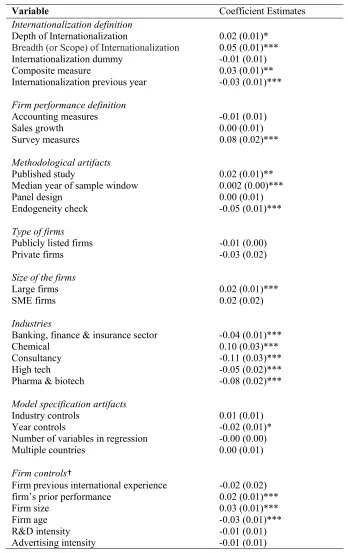
Wilson, 2001) to examine the impact of formal and informal institutions on the I-P
relationship. Similar to multiple regression approaches, MARA estimates a linear
regression model in which the dependent variable (in our case, the correlation between
I-P in a given primary sample) is regressed on a set of predictors (which are the potential
moderators of the focal relationship) (Carney et al., 2011). We weight the effect sizes
again by their inverse variance weight to account for differences in the precision of the
information contained in them. We follow Van Essen et al. (2015) and a long tradition of
meta-analytic research in economics (e.g., Stanley & Doucouliagos, 2012) and use r and
rxy.z as our effect size estimates for the MARA procedure, which, in our case, captures the
I-P relationship, with a given set of n control variables. One of the unique advantages of
using MARA is that it allows modeling the variance in the effect size distribution in light
of home country-level institutional variables that were not included in the primary studies
(Van Essen, Van Oosterhout, & Heugens, 2013). The institutional variables are measured
longitudinally, which allows us to match the individual effect sizes to the temporally
closest available institutional variables.
are consistent across countries, and if not, which percentage of the variability in the effect
size contribution depends on a firm’s country of origin. We also use HiLMMA as a
robustness check to rule out the possibility that stochastic dependencies between multiple
effect sizes harvested from a single primary study biased our HOMA and MARA
parameter estimates. Specifically, we interpret each effect size as a level 1 observation,
nesting it in the study from which it was derived, and coding this study as a level 2
predictor. If the intercept of the standardized HiLMMA test is comparable to the mean
effect size retrieved by the HOMA test, it signals the absence of estimation bias due to
stochastic dependencies. Inversely, a significant difference between the two values would
indicate the presence of such biases.
Measures of Performance and Internationalization
Firmperformance. Building on the findings by Hitt and colleagues (2006b), we
include four types of firm-level performance measures: (1) accounting-based measures
(e.g., Hitt et al., 1997; Thomas & Eden, 2004), such as ROE, ROA, ROS, ROI, profit
margin, and profit; (2) market-based measures (e.g., Thomas & Eden, 2004), such as
stock market performance, market to book value, Tobin’s Q, and excess market value; (3)
sales growth (e.g., Zahra et al., 2000); and (4) survey-based measures (e.g., Dhanaraj &
Beamish, 2003), which capture respondents’ perceptions of firm performance.
Internationalization. Based on Sullivan (1994) and Thomas and Eden (2004), we
include 11 internationalization variables grouped into five categories. (1) Depth of
internationalization. We include the following measures of depth: foreign sales to total
sales (Tallman & Li, 1996); foreign assets to total assets (Gomes & Ramaswamy, 1999);
activities are conducted outside the home country (Thomas & Eden, 2004). (2) Breadth
(scope) of internationalization. We include the following measures of breadth: number of
countries (Delios & Beamish, 1999); number of regions (Kim, Hoskisson, & Wan, 2004);
dispersion across countries (Goerzen & Beamish, 2003); and dispersion across regions
(Hitt et al., 1997). Together, these variables capture the span of a firm’s foreign
operations (Thomas & Eden, 2004). (3) Foreign subsidiaries (e.g., Vermeulen &
Barkema, 2002), measured as the number of the firm’s foreign affiliates in a given year,
and the ratio of foreign subsidiaries to total subsidiaries (Gomez-Mejia & Palich, 1997).
(4) Internationalization dummy (Chakrabarti, Vidal, & Mitchell, 2011), which takes value
of 1 if the firm has an international presence and 0 otherwise. (5) Composite measure
(Sanders & Carpenter, 1998), which measures the internationalization of a firm in a given
year by integrating different internationalization measures into a composite indicator.
Institutional Moderators
Formal institutions. As proposed in our preceding review, we examine three sets
of formal institutions. First, we assess the role of a country’s legal tradition on the I-P
relationship in terms of civil law vs. common law. Specifically, we use a time invariant
dummy variable that equals 1 if the country relies on the English common law system
and 0 otherwise (e.g., La Porta et al., 1997). These data are extracted from the database
compiled by the University of Ottawa’s JuriGlobe. Second, to capture economic
regulatory institutions, we consider the quality of government regulations targeting
starting, operating and closing a business. Specifically, we use the home country’s degree
of business freedom, which measures the quality of the regulations of business behavior
Economic Freedom, which is computed by the Heritage Foundation on a yearly basis
(Heritage Foundation, 2015) and has also been used widely in the international
management research (e.g., Meyer & Sinani, 2009; Gubbi, Aulakh, Ray, Sarkar, &
Chittoor, 2010). This variable is time variant. Third, we explore the role of political
institutions by examining the degree to which a country’s political structure creates
political risks for firms and investors. Specifically, we use Witold Henisz’s Political
Constraint Index dataset (POLCON V), which measures political risk in terms of the
degree of restrictions on policy changes and the distribution of power across political
branches (Henisz, 2000). The index ranges between 0 (most hazardous) and 1 (most
constrained, i.e., stable) and has been extensively used in IB research (e.g., Guler &
Guillén, 2010; Lu, 2002). This index is time variant. Also, we reverse code the index, so
that higher levels indicate more politically risky home countries.
Informal institutions. As discussed in our review, we examine the role of three
informal institutions. First, we examine the moderating role of generalized trust, which
reflects the degree to which a country’s citizens trust members of other nations. Data for
this time variant variable were obtained from the World Value Survey, which has been
used extensively in international research on generalized trust (e.g., Ertug et al., 2013;
Ferrin & Gillespie, 2010). Second, we examine the home country’s future orientation,
which is “the degree to which individuals in organizations or societies engage in such
behavior as planning, investing in the future, and delaying individual or collective
gratification” (House, Hanges, Javidan, Dorfman, & Gupta, 2004: 12). This measure
comes from the GLOBE project, which has been widely used by scholars exploring the
invariant. Third, we assess home country’s uncertainty avoidance, which is “the extent to
which members of an organization or society strive to avoid uncertainty by relying on
established social norms, rituals, and bureaucratic practices” (House et al., 2004: 11).
This time invariant measure is also drawn from the GLOBE project.
Control Variables
We also include numerous firm-, industry-, home and host country-level control variables
in the MARA model. To control for definitional effects, we include separate dummy
variables for the different definitions of internationalization and performance that we
discussed above, using foreign subsidiaries and market-based measures as the two
reference categories. We also include dummy variables measuring whether
internationalization was lagged (1) or not (0) in the studies.
To control for methodological artifacts, we test for the “file drawer problem”
(Rosenthal, 1979) by including a dummy variable denoting whether a study was
published or not (reference group). To allow for the possibility that the focal relationship
might change over time, we control for the median year of sample window. We also
include dummy variables indicating whether effect sizes were based on a panel or
cross-sectional (reference group) design, and whether they were derived from a study
controlling for endogeneity of internationalization on firm performance or not (reference
group). We control for type of firm, namely whether the sample includes only public
firms, private firms or both (reference group). We also control for firm size, namely
whether the sample includes only large firms, small medium size enterprises (SMEs) or
both (reference group). We control for the four industries in which sector-specific results
group). We assess whether primary studies controlled for industry effects or not
(reference group), year effects or not (reference group), and we include the number of
variables included in the regression models. We also include a control denoting whether
the sample included firms from multiple countries or not (reference group). Finally, we
include home country total GDP to control for the size of the home country’s economy as
it could influence the I-P relationship (Elango & Sethi, 2007).
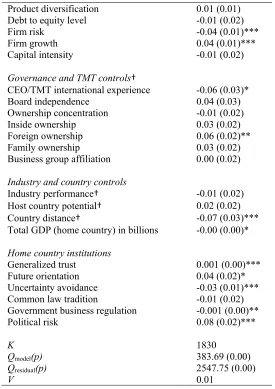
To account for the effects of specific omitted variables, we incorporate a set of
dummy variables indicating whether the following variables were included (yes = 1) in
the model from which a given effect size was derived: firm previous international
experience, prior firm performance measure, firm size, firm age, R&D intensity,
advertising intensity, product diversification, debt to equity level, firm risk, firm growth,
capital intensity, CEO/Top Management Team (TMT) international experience, board
independence, ownership concentration, inside ownership, foreign ownership, family
ownership, business group affiliation, industry performance, host country potential (i.e.,
the opportunities associated with operations in the host country), and country distance
(i.e., the institutional distance between the home and the host country).
RESULTS
I-P Relationship: Size, Shape and Related Methodological Issues
HOMA results. We present in Table 1.1 the results for our r-based (left-hand
panel) and rxy.z-based (right-hand panel) HOMA analyses. Like prior meta-analyses
(Bausch & Kirst, 2007: r-based mean = 0.06; Kirca et al., 2011: r-based mean = 0.10;
Ruigrok & Wagner, 2004: r-based mean = 0.04), we find that, overall,