385 | P a g e
CONGESTION AVOIDANCE AND CONTROL IN
WIRELESS SENSOR NETWORKS A SURVEY
Er. Vaibhav Eknath Narawade
1, Dr. Uttam D. Kolekar
2 1Research Scholar, Faculty of Engineering,
Pacific Academy of Higher Education and Research University, Udaipur
2
Professor & Principal, A. P. Shah Institute of Technology, Thane
ABSTRACT
A wireless sensor network (WSN) has its application in various fields such as temperature monitoring, pressure
monitoring, health monitoring, defence system etc. In wireless sensor networks, congestion occurs because of
the inadequate resources like low processing power of the sensor node. The performance of the WSN is
degraded by the congestion as it leads to the wastage of energy, reduction in throughput and huge information
loss. To avoid this condition, numerous congestion avoidance methods for lossless data packet transmission can
be employed. The objective of this survey is to investigate some of the existing congestion avoidance and control
methods to categorize them and to examine their advantages and disadvantages. Accordingly, various
congestion avoidance mechanisms are reviewed and the major issues are addressed in this paper.
Keywords: Congestion Avoidance, Congestion Control, Energy Efficiency, Optimization, Wireless
Sensor Networks
I.
INTRODUCTION
Wireless sensor networks have several sensor nodes based on its application. Since all the nodes are battery
powered, it is necessary to use the limited resources effectively. Congestion in wireless networks may occur
because of several aspects such as contention due to concurrent transmissions, overflow in buffers and time
varying wireless channel condition. Congestion detection is a technique in which the abnormalities in the usual
traffic is been made out. i.e., while transferring a data packet from one node to other node, quandary events may
occur. Some of the techniques for congestion control are, Detecting and Avoiding congestion, Event to Sink
Reliable Transport, Congestion control and Fairness etc.
In wireless sensor networks, source nodes send the packets to sink node (base station) in hop-by-hop or
multi-hop manner. It has two kinds of sink such as static sink and mobile sink. When an event happens, then a huge
amount of data traffic is sent from the corresponding sensor nodes to the sink node. Sometimes congestion
arises in the network, which may leads to the missing of data packets with important data in the network. So,
congestion problem in WSN must be solved efficiently to avoid wastage of energy and to increase the networks‟
386 | P a g e
congestion issue in the WSN, finding an effective way for congestion avoidance and control is still a
challenging task.
Two types of congestion are Link-level congestion and Node-level congestion. Node-level congestion happens
when the buffer at the sensor node is overflowed. All the incoming packets after overflow are simply dropped.
Also the queuing delay is also increased. In case of link-level congestion, all the nodes attempt to send traffic on
the link simultaneously. It results in packet collisions. Furthermore, due to link-level congestion, the link
utilization is reduced. To avoid all the above mentioned effects of congestion, congestion must be controlled or
avoided in an effective way. As a result of this, there exist two different research areas such as congestion
control and congestion avoidance. Congestion control learns resumption from congestion methodologies and
avoids collapsing in the network, whereas congestion avoidance investigates the techniques to prevent
congestion.
In this paper, some of the congestion control mechanisms from the literature are discussed and classified based
on several criteria with their advantages and disadvantages.. The goal of all the congestion management
schemes is to increase the QoS of the network. All schemes help to increase the parameters like network
throughout, packet delivery ratio. Also, it increases network lifetime. The organization of the paper is as
follows: The taxonomy of the congestion control and avoidance protocols is given in section 2. Section 3
reviews the several congestion control and avoidance protocols. Research gaps and issues are presented in
section 4 and section 5 concludes this paper.
II.
TAXONOMY
OF
CONGESTION
AVOIDANCE
AND
CONTROL
MECHANISMS
IN
WSNS
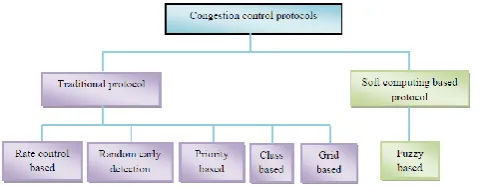
The taxonomy of the congestion control and avoidance protocols is given in figure 1. The congestion control
protocols are classified into traditional protocols and soft computing based protocols. Several traditional
protocols present in the literature are based on rate control, random early detection, priority, class and grid.
Soft computing techniques are intellectual techniques which enhances the effectiveness of the wireless
networks. Soft computing techniques optimize the power consumption and challenges in the network. Soft
computing techniques such as fuzzy logic are applied to different applications of wireless networks.
Figure 1. Taxonomy of Congestion Control and Avoidance Protocols
A. Traditional Protocols
In [1], congestion prediction approach using probabilistic method and congestion control using rate control
387 | P a g e
data traffic and buffer occupancy. The rate control methodology make use of a back-off selection approach and
also rate allocation approaches, such as rate regulation (RRG) and split protocol (SP), to enhance throughput
and decrease packet drop. A back-off interval selection approach is launched together with rate reduction (RR)
and RRG. The back-off interval selection approach considers channel state and packet transmission without
collision to avoid congestion. Experimental results were evaluated with decentralized predictive congestion
control (DPCC) and adaptive duty-cycle based congestion control (ADCC). The results illustrates that the
probabilistic method and the rate control method reduces congestion and improves performance. But, after a
successful transmission, state information indicating the actual contention level is not maintained.
In network systems with limited bandwidth and heavy traffic, the communication quality are ensured by
ATRED (adaptive thresholds random early detection) congestion control algorithm [2] to avoid congestion and
manage the resources is proposed. In ATRED, the control parameters are not statically organized, but it is
dynamically configured by the adaptive mechanism. In combination with the adaptive strategy, ATRED reduces
thedifficulty in tuning RED (random early detection) and provides a superior control on managing the queue,
and achieving a better performance than RED under changing network conditions. The stability of the network
system is assured with the proper design of the adaptive mechanism. Simulation results demonstrate that
ATRED algorithm achieves a good performance and provide more reliable service in changing network
conditions. RED based algorithm may cause intense oscillation of queue at the router and leads to serious
variation in delay. Congestion control based on backpressure routings and service differentiation is presented in
[3]. Back pressure routing algorithm does not calculate the routes in advance and the next step is selected
dynamically. Each node sees its own queue backlog and its neighbour's queue backlog and adjusts its own rate
and selects routes based on queue backlog of its neighbours. Dynamic prioritization is also used for service
differentiation when there are two or more data with same condition in backpressure routing. The network
should do most efforts to deliver data packets with instant or high priority.
In [4], Dynamic Alternative Path Selection Scheme (DAlPaS) for congestion avoidance and control is proposed.
DAlPaS is an easy and efficient approach for congestion control whereas keeping the overhead as minimum.
The function of this approach depends on the resource control rather than control on the sending rate at the
source. The performance of DAlPaS is experimented by comparing with other well-known schemes and the
results proved that the performance of DAlPaS is better than other schemes. But, the computational complexity
is high and requires complete idea about network-wide per-wavelength link-state. In [8], a data centric
congestion management protocol using AQM (Active Queue Managements) for healthcare applications is
presented. It deals with end to end delay, energy consumption, lifetime and fairness. The proposed HOCA
(Healthcare Aware Optimized Congestion Avoidance) protocol prevents congestion in the routing phase by
means of multipath and QoS (Quality of Service) aware routing. If it is not possible to avoid congestion, then it
will be alleviated via an optimized congestion control algorithm. Experimental results designated that HOCA
can attain its objectives. But, the computing power to analyze the packets and throttle the speeds is higher for
QoS techniques.
A congestion management data driven scheme for healthcare wireless sensor network applications with
388 | P a g e
control (congestion management) units. The service differentiation unit aids in three types of traffics such as
sensitive, non-sensitive, and control packet. The congestion management unit attempts to prevent congestion by
multipath routing with different stages such as request dissemination, event report, route establishment and data
forwarding. In data forwarding stage, the data traffic with high priority is transmitted via the shortest path route
to satisfy the low delay service requirements. The data traffic with less priority and the control traffics are
forwarded through the other routes. If congestion occurs, the proposed congestion control method allocates a
new rate for source traffics. The proposed methodology considers the parameters such as end to end delay,
energy consumption, networks‟ lifetime and its fairness in consuming energy. But the packets will suffer from
high delay when they pass through longer queues.
To alleviate congestion, a topology-aware resource adaptation (TARA) scheme was proposed in [9]. TARA
offers several advantages such as topology awareness, energy efficient, and distributed. By using a capacity
analysis model, TARA determines the required topology. This approach is developed by means of graph
colouring problem. The results established that the performance of TARA is closer to an ideal offline resource
control algorithm, by means of both fidelity satisfaction and conservation of energy. But, the level based
congestion avoidance is missing in this protocol. In [11], a Dynamic Resource Control Protocol (DRCP) for
controlling congestion in WSN is introduced. DRCP controls congestion by using multiple resources. It
minimizes the congestion by controlling the transmission power. Experimental results demonstrate that the
proposed method enhances the throughput of the system, and reduce packet dropping, while conserving more
energy. But, the priority consideration of the nodes is not considered.
In [12], Grid-based Multipath with Congestion Avoidance Routing protocol (GMCAR) is introduced. It utilizes
the concept of dividing the sensor network field into grids. Within each grid, one sensor node is choose as a
master node. The master node delivers the data generated by any node in the grid and forward the data received
from other master nodes in the neighbour grids. For every master node, multiple diagonal paths which connect
the master node with the sink node are stored as routing entries in the routing table of that node. The main idea
here is integrating the grids densities together with the hop count into the routing decisions. A congestion
control protocol is proposed in such a way to alleviate the congested areas if congestion occurs. The proposed
approach demonstrates its enhanced performance by attaining superior utilization to the available storage. But, it
suffers with heavy delay and the computational power is also high.
B. Soft computing based protocol
Fuzzy Based Adaptive Congestion Control (FBACC) is proposed in [6]. The proposed algorithm presents a
fuzzy logic based congestion estimation, which drops the data packet on occurrence of congestion up to a
tolerable level and it controls the traffic rate. FBACC performs well than the existing approaches in terms of
detecting congestion, packet loss, end-to-end delay and consumption of energy. FBACC accurately sense the
congestion in the network and also adjusts to present traffic rate relating to the product of previous participants
with previous traffic rate to decrease the packet loss. FBACC conserves energy of retransmission since the
packet loss is reduced because of traffic adaption. But, the product of traffic over participants is increased if the
389 | P a g e
The flocking behaviour of birds aids in the implementation of a robust, scalable and self-adaptive congestion
control protocol in WSNs [5]. This approach takes on a swarm intelligence paradigm enthused by the collective
behaviour of bird flocks. The major concept here is to „guide‟ packets (birds) to form flocks and travel on the
way to the sink (global attractor), while attempting to prevent congestion regions (obstacles). The direction of
motion of a packet flock is determined by the repelling and attracting forces between the packets, and the field
of view and the artificial magnetic field in the direction of the artificial magnetic pole (sink). The
implementation of the proposed approach is easier at the individual nodes, with reduced exchange of
information. Flock-based Congestion Control (Flock-CC) method balances the load by efficiently utilizing the
allotted network resources and transferring the data packets to the sink.Also, the proposed method attains the
potential in opposition to failing nodes, scalability in different network sizes and performs well than usual
techniques. The performance in terms of power and including the power in the desirability function is a difficult
task in this work.
III.
REVIEW
AND
ANALYSIS
Table 1 reviews the literature of congestion avoidance protocols and the major advantages of the method.
Table 1. Literature review
Authors Methods Advantages Disadvantages
R. Annie Uthraet
al.,[1]
Back-off interval, Rate
control
Per-node throughput is
increased and the energy in
the network is reduced by
preventing packet drops.
As the buffer occupancy is
minimal, the rupture of
data traffic is well
maintained.
The state information
after the transmission of
packets, representing the
real contention level is
not maintained.
Zhi Liu et al.,[2] ATRED congestion
control algorithm
Tuning difficulty of
random early detection
(RED) is decreased and
has superior control on
managing the queue, and
attains much better
performance.
RED algorithm leads to
serious queue oscillation
in the router and delay
390 | P a g e
Akbar Majidiet al.,[3] Backpressure routing and
dynamic prioritization for
congestion control
(BDCC)
This algorithm does not
pre-calculate routes and
next step is selected
dynamically.
Network should do most
efforts to deliver data
packets with instant or
high priority.
CharalambosSergiouet
al.,[4]
Dynamic Alternative Path
Selection Scheme
It is an easy and efficient
approach for congestion
control whereas the
overhead is maintained as
minimum.
The computational
complexity is high and
requires complete idea
about network-wide
per-wavelength link-state.
Pavlos Antoniou et
al.,[5]
Congestion control and
avoidance based on Bird
flocking behavior
Robust way to avoid the
congested area and dead
node zones.
Difficult to include power
in the desirability
function
SaurabhJaiswalet
al.,[6]
Fuzzy Based Adaptive
Congestion Control
Better technique to to drop
data packet up to a
tolerable level and can
control traffic rate.
The product of traffic
over participants is
increased if network is
less congested or stay
unaltered
Abbas Ali Rezaeeet
al.,[7]
Class Based Optimized
Congestion
Management
Protocol(COCM)
This algorithm is more
efficient in terms of packet
loss, energy efficiency,
end-to-end delay and
fairness.
Higher delays suffered by
packets when they go
through longer queues.
Abbas AliRezaeeet
al.,[8]
Optimized Congestion
Avoidance and control
protocol
Considers the parameters
such as end to end delay,
energy consumption,
lifetime of the network and
fairness in energy
consumption.
computing power to
analyze the packets and
throttle the speeds are
greater for QoS
391 | P a g e
J. Kang et al. [9]
Topology-Aware Resource
Adaptation to Alleviate
Congestion
Traffic control and
resource control
The congestion
level-based avoidance is
missing
P. Antoniou et al. [10] flocking behavior of birds Attains robustness against
failing nodes, scalability in
different network sizes and
performs better than
conventional approaches
QoS parameters are not
considered
Nazbanoo Farzaneh et
al. [11]
Dynamic Resource Control
Protocol (DRCP)
enhance throughput of the
system and reduces packet
drop, whereas energy
saving
The priority consideration
of nodes are not
considered
O. Banimelhem and S.
Khasawneh et al. [12]
Grid-based multipath with
congestion avoidance
routing protocol
suitable in attaining
superior utilization with
the available storage
It suffers with heavy
delay and computational
power
IV.
RESEARCH
GAPS
AND
ISSUES
One of the common problems in WSN is congestion which causes because of carrying more data to be
transferred through network. Consequently, it increases the queuing delays and causes information loss which is
absolutely degrading the quality of service (QoS) by decreasing the lifetime of the network and also the
disintegration of network topology in multiple components [5]. The congestion happening over the network
wastes the limited energy due to more number of retransmissions and packet drops, and also obstructs the event
detection reliability [3].
Due to the undesirable situation of congestion in network, various congestion control algorithms was applied in
order to mitigate congestion, such as ATRED congestion control algorithm, Backpressure routing and dynamic
prioritization for congestion control (BDCC), Dynamic Alternative Path Selection Scheme. But, these
392 | P a g e
causes resource depletion. The traditional algorithms results in serious oscillation of queue at the router and
leads to high delay variation. Also, those algorithms do not consider the data packets delivery with instant or
high priority. In [7 and 8], congestion control was carried out by finding the optimal rate which is found out
after solving the optimization problem. But, this optimization problem was not solved using the popular
heuristic methods. In [7], they utilized a simple Poisson process but the heuristic methods offers better rate
suggestion than the simple Poisson process.
V.
CONCLUSION
The literature review of congestion control and congestion avoidance algorithms in the wireless sensor networks
circumstance is presented in this paper. In this survey, the congestion control and avoidance mechanisms are
investigated in terms of their appropriateness in congestion detection and inform the related nodes with the
intention that a proper control can be taken. Based on the usage, several methods are applied to manage the
congestion. To satisfy the application requirements, either traffic control by throttling the node rates or resource
control by utilizing the unused resources are used. Different issues and challenges regarding the congestion
control protocols were studied which will be useful for further research in this field.
REFERENCES
[1] R. Annie Uthra, S. V. Kasmir Raja, A. Jeyasekar, Anthony J. Lattanze, "A probabilistic approach for
predictive congestion control in wireless sensor networks", Zhejiang University-science (Computers &
Electronics), vol. 15, no. 3, pp. 187-199, 2014.
[2] Zhi Liu , Yun Zhang, C.L. Philip Chen, "Adaptive mechanism-based congestion control for networked
systems", Systems Science, vol. 44, no.3,pp. 533-544, 2013.
[3] Akbar Majidi, Hamid Mirvaziri, "BDCC: Backpressure routing and dynamic prioritization for congestion
control in WMSNs", Computer Network and Information Security, vol. 5, pp. 29-34, 2014.
[4] [4] Charalambos Sergiou, Vasos Vassiliou, Aristodemos Paphitis, "Congestion Control in Wireless Sensor
Networks Through Dynamic Alternative Path Selection", Ad Hoc Networks archive, vol. 11, no.1,pp.
257-272, 2013.
[5] Pavlos Antoniou, Andreas Pitsillides, Tim Blackwell, Andries Engelbrecht, Loizos Michael, " Congestion
control in wireless sensor networks based on bird flocking behaviour", Computer Networks, vol. 57, pp.
1167–1191, 2013
[6] Saurabh Jaiswal, Anamika Yadav, “Fuzzy Based Adaptive Congestion Control in Wireless Sensor
Networks", In proceedings of Sixth International Conference on Contemporary Computing, pp. 433 - 438,
393 | P a g e
[7] Abbas Ali Rezaee, Mohammad HosseinYaghmaee, Amir Masoud Rahmani, "COCM: Optimized
Congestion Management Protocol for Healthcare Wireless Sensor Networks",Wireless Personal
Communications, vol. 75, no. 1, pp. 11–34, 2013.
[8] Abbas Ali Rezaee, Mohammad Hossein Yaghmaee, Amir Masoud Rahmani, Amir Hossein
Mohajerzadeh, "HOCA: Healthcare Aware Optimized Congestion Avoidance and control protocol for
wireless sensor networks", Network and Computer Applications, vol. 37, pp. 216–228, 2014.
[9] J. Kang, Y. Zhang, and B. Nath, “TARA: Topology-aware resource adaptation to alleviate congestion in
sensor networks,” IEEE Trans. Parallel Distrib. Syst., vol. 18, no. 7, pp. 919–931, Jul. 2007.
[10] P. Antoniou, A. Pitsillides, T. Blackwell, A. Engelbrecht, L. Michael d, “Congestion control in wireless
sensor networks based on bird flocking behaviour”. ELSEVIER, Science Direct Computer Networks,
Volume 57, Issue 5, 7 April 2013, Pages 1167–1191
[11] Nazbanoo Farzaneh , Mohammad Hossein Yaghmaee IEEE Senior member, Mehdi Dehghan
TakhtFooladi, “DRCP: A Dynamic Resource Control Protocol for Alleviating Congestion in Wireless Sensor Networks” 7th International Symposium on Telecommunication (IST 2014), 2014.
[12] O. Banimelhem and S. Khasawneh, “Grid-based Multipath with Congestion Avoidance Routing Potocol in